


News Summary
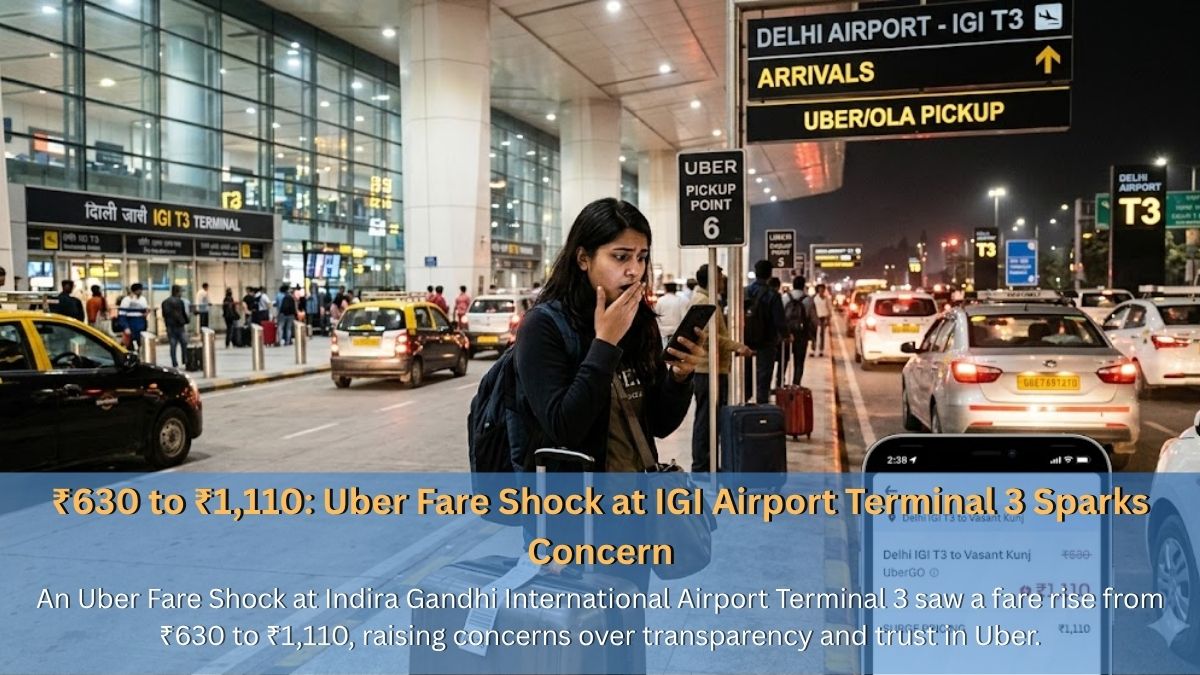
A recent Uber Fare Shock incident at Indira Gandhi International Airport Terminal 3 in Delhi has triggered widespread concern among commuters and the broader startup ecosystem. A passenger claimed that a ride initially priced at ₹630 unexpectedly surged to ₹1,110 during the trip. The incident has raised questions about pricing transparency, driver practices, and user trust in ride-hailing platforms.
According to multiple reports and social media discussions, the rider alleged that the driver manipulated the route mid-journey, which resulted in a significantly higher fare. The case quickly gained traction online, with users sharing similar experiences and warning others to stay cautious while using ride-hailing apps. Uber, one of the world’s leading ride-hailing platforms, operates on a dynamic pricing model. While this model adjusts fares based on demand, distance, and time, incidents like this raise concerns about misuse and lack of transparency.
Moreover, the issue highlights broader challenges in India’s fast-growing mobility startup sector. While companies aim to provide convenience and affordability, maintaining trust and ensuring fair practices remain critical. The incident also reflects the growing influence of user-generated content platforms like social media and forums, where such issues quickly go viral. As discussions continue, the spotlight is now on Uber’s response and the need for stricter safeguards to protect users. This Uber Fare Shock case serves as a reminder of the importance of accountability, transparency, and user awareness in the evolving ride-hailing ecosystem.
1. Uber Fare Shock: What Happened at IGI Airport
1.1 Incident Overview
The Uber Fare Shock incident began like any routine airport ride from Indira Gandhi International Airport Terminal 3 in Delhi. The passenger checked the Uber app and saw a fare of ₹630. That number felt fair and predictable. It set a clear expectation before the journey even started. The ride began smoothly, with no early signs of trouble or confusion. However, as the trip continued, something started to feel off. The route appeared longer than expected, and the time taken did not match usual travel patterns. By the end of the ride, the fare had jumped to ₹1,110. That sudden increase shocked the rider. It was not just about money. It was about trust breaking mid-journey, when the user had no control.
1.2 Social Media Reaction
Soon after, the story spread rapidly across platforms like Instagram and Reddit. Many users reacted strongly because they could relate. Several people shared similar experiences where fares increased without clear reasons. Some users said they had seen routes change during rides. Others felt the pricing system itself lacked clarity. At the same time, the incident sparked a wider debate about transparency in ride-hailing platforms. Some blamed drivers for taking longer routes. Others questioned whether the app’s algorithm always works correctly. What stood out clearly was user frustration. People were not just angry about higher fares. They were concerned about losing trust in a system they use daily.
2. Understanding Uber’s Business Model
2.1 How Uber Works
Uber operates as a technology platform that connects riders with drivers. It does not own cars or employ drivers directly. Instead, independent drivers use their own vehicles and accept ride requests through the app. The system matches riders with nearby drivers using algorithms. The app also uses GPS technology to suggest routes and calculate fares. However, drivers still make real-time decisions during the trip. This creates a mix of automation and human judgment. While the system is designed for efficiency, real-world conditions like traffic or driver choices can affect outcomes.
2.2 Revenue Model
Uber earns revenue by taking a commission from each ride. A percentage of the fare goes to the company, while the rest is paid to the driver. This model allows Uber to scale without owning physical assets. It also ensures that drivers earn based on the number of trips they complete. In addition, Uber uses surge pricing during high demand periods. This increases fares when more riders are booking rides than available drivers. While this helps balance supply and demand, it can also make pricing feel unpredictable. For users, the gap between estimated and final fare can create confusion and frustration.
3. Why the Uber Fare Shock Happened
3.1 Dynamic Pricing Explained
Dynamic pricing is a core part of Uber’s system. It adjusts fares based on real-time demand and supply. For example, during peak hours or bad weather, prices increase to encourage more drivers to come online. This ensures that riders can still find rides even during busy times. However, this system is not always easy for users to understand. Many riders expect the price shown at booking to remain constant. When fares change during or after the trip, it feels unexpected. This lack of clarity can lead to confusion, especially in cases like the Uber Fare Shock.
3.2 Route Manipulation Concerns
In this case, the rider alleged that the driver changed the route during the journey. This is important because Uber fares depend on distance and time. If a driver takes a longer route, the total cost automatically increases. Even small detours can lead to noticeable fare changes. Although GPS tracking exists, it does not fully prevent such situations. Drivers may take alternate routes due to traffic or personal judgment. However, when the route change feels unnecessary, users begin to question the system. This creates doubt and weakens trust in the platform.
4. Uber’s Journey: From Startup to Global Giant
4.1 Founding Story
Uber was founded in 2009 by Travis Kalanick and Garrett Camp. The idea came from a simple problem. Finding a taxi quickly was difficult and unreliable. They wanted to create a system where people could book rides easily using their phones. This idea changed urban transportation. It introduced convenience and control for users. With just a few taps, people could book a ride and track it in real time. This innovation quickly gained popularity and expanded globally.
4.2 Growth in India
Uber entered India in 2013 and rapidly expanded across major cities. The company adapted to local needs by offering affordable ride options and flexible payment methods. Over time, it became a key player in India’s mobility market. However, competition has been strong. Ola has remained a major rival. Despite this, Uber has maintained its position through continuous innovation. Still, incidents like the Uber Fare Shock show that maintaining user trust remains an ongoing challenge.
5. Services Offered by Uber
5.1 Core Services
At its heart, Uber is built on one promise. Get a ride when you need it, without stress. Over the years, that simple idea has grown into multiple ride options designed for different people and situations. From budget-friendly rides like Uber Go to more comfortable options like Premier, the platform tries to match both affordability and comfort. For many users, this flexibility is what makes Uber a daily habit. A college student may choose the cheapest ride to save money, while a business traveler may prefer a premium car after a long flight. In some cities, bike taxis offer even faster and cheaper alternatives. This range of services creates a sense of control. Users feel they are choosing what fits their moment, not just accepting whatever is available.
5.2 Additional Services
Beyond rides, Uber has experimented with expanding its ecosystem. Globally, services like Uber Eats turned the platform into more than just a transport solution. It became part of daily life, delivering food, groceries, and convenience at scale. This diversification helped Uber grow into a broader tech platform rather than a single-service company. However, in India, the focus remains largely on mobility. The company has chosen to strengthen its ride-hailing services instead of spreading too thin. This decision reflects the complexity of the Indian market. Traffic, pricing sensitivity, and competition demand constant attention. As a result, Uber continues to refine its core service, trying to make each ride smoother, faster, and more reliable.
6. Problem Uber Solves
6.1 Transportation Accessibility
Before ride-hailing apps, finding a reliable ride was often frustrating. People waited on roads, negotiated fares, and faced uncertainty. Uber changed that experience completely. With a few taps, a car arrives at your location. That shift may sound simple, but it transformed urban life. Today, Uber connects millions of riders with drivers in seconds. It reduces waiting time and removes the guesswork. For someone landing late at night or rushing to a meeting, this reliability matters deeply. It brings a sense of relief. You no longer wonder if you will find a ride. You know you will.
6.2 Convenience and Safety
Convenience is where Uber truly stands out. Features like live GPS tracking, estimated arrival times, and digital payments make the process smooth. Users can share trip details with family or friends, adding a layer of safety that traditional taxis never offered. However, convenience also creates expectations. When something goes wrong, like in an Uber Fare Shock situation, the disappointment feels stronger. Because users expect the system to protect them at every step. Safety is not just physical. It is also about financial clarity and trust. When both are intact, the experience feels seamless. When they break, the impact is immediate and emotional.
7. Industry Trends in Ride-Hailing
7.1 Growth of Mobility Startups
The ride-hailing industry has grown at an incredible pace. Cities are expanding, traffic is increasing, and people rely more on smartphones than ever. These factors have created the perfect environment for mobility startups to thrive. What started as a convenience has now become a necessity for many urban users. India, in particular, has seen rapid growth in this space. Millions of daily rides happen across cities. This growth has attracted heavy venture capital investment and pushed startups to innovate faster. Features like ride-sharing, electric vehicles, and subscription models are now becoming common. The industry is no longer just about getting from one place to another. It is about building a complete mobility experience.
7.2 Rising Competition
With growth comes competition, and the pressure is intense. Companies like Ola and Rapido are constantly pushing to capture market share. Each platform tries to offer better pricing, faster rides, or unique features to stand out. For users, this competition is a double-edged sword. On one hand, it brings better options and lower prices. On the other, it creates inconsistencies. Pricing models change frequently, incentives shift, and service quality can vary. This constant battle for dominance forces companies to evolve quickly. But it also increases the risk of issues like pricing confusion, which can lead to situations like an Uber Fare Shock.
8. Competitor Analysis
8.1 Direct Competitors
Uber operates in a highly competitive environment. In India, its biggest rival is Ola, which understands the local market deeply. Ola offers similar services and often competes aggressively on pricing and driver incentives. Rapido, on the other hand, has carved out a strong position in bike taxis, offering faster and cheaper rides for short distances. These competitors are not just copying Uber’s model. They are adapting it. They are building solutions specifically for Indian roads, traffic, and user behavior. This makes competition more intense. It is not just about technology anymore. It is about understanding the user better than anyone else.
8.2 Indirect Competitors
While app-based platforms dominate the conversation, traditional options still exist. Public transport, auto-rickshaws, and local taxis continue to serve millions of people every day. These are indirect competitors, but they remain relevant, especially for cost-sensitive users. However, they lack the predictability and convenience of app-based services. There is no upfront fare estimate, no digital tracking, and often no clear accountability. This is where Uber and its competitors win. They offer structure in a space that was once chaotic. Yet, when issues like an Uber Fare Shock occur, users are reminded that even digital systems are not perfect. And that realization can shift preferences back, even if temporarily.
9. Challenges in the Ride-Hailing Industry
9.1 Pricing Transparency
The Uber Fare Shock is not just a one-off incident. It exposes a deeper issue that many users quietly struggle with. Pricing in ride-hailing apps often feels like a black box. You see a number at the start. You trust it. But by the end, that number sometimes changes, and the explanation is not always clear.
For a regular user, this creates discomfort. People are not against paying more when there is a valid reason. They understand traffic, peak hours, and demand. However, what they expect is clarity. They want to know why the fare increased, step by step. When that explanation is missing, even a small price change feels unfair. Over time, this uncertainty builds hesitation. Users start checking every detail during a ride, something the technology was supposed to eliminate.
9.2 Driver Behavior
Technology can design systems, but humans still drive them. In platforms like Uber, driver behavior plays a huge role in shaping the experience. A polite driver, a smooth route, and a safe ride can leave a lasting positive impression. But one negative experience can undo that trust instantly.
Route choices are a major concern. While many drivers act honestly, even a few cases of unnecessary detours can damage the platform’s credibility. Users start questioning every turn. They begin to watch the map instead of relaxing during the ride. This shift changes the entire experience. What was once convenient now feels like something that needs constant monitoring. That emotional shift is one of the biggest hidden challenges in the industry.
10. Impact on Startup Ecosystem
10.1 Trust and Accountability
In the world of startups, especially platform-based businesses, trust is everything. Companies like Uber are built on the idea that users will rely on them without hesitation. The moment that trust cracks, the entire model feels vulnerable. Incidents like the Uber Fare Shock do not just affect one ride. They create doubt at scale. For the startup ecosystem, this is a powerful lesson. Growth and funding can build a company, but trust sustains it. When users feel uncertain, they start exploring alternatives. They may switch apps, compare prices more often, or even go back to traditional options. This shift may seem small at first, but over time, it can impact user retention and brand reputation in a big way.
10.2 Regulatory Pressure
Whenever user complaints become frequent, regulators start paying attention. Governments are already watching the ride-hailing space closely. Issues related to pricing, driver conduct, and user safety are sensitive topics. Incidents like the Uber Fare Shock can accelerate discussions around stricter rules.
This could mean more transparency requirements, stricter route monitoring, or even limits on dynamic pricing. While regulations aim to protect users, they also add pressure on startups. Companies must balance compliance with innovation. Too many restrictions can slow down growth, but too little control can harm users. Finding this balance is one of the toughest challenges for modern tech platforms.
11. Learning for Startups and Entrepreneurs
11.1 Importance of Transparency
Transparency is no longer optional. It is a basic expectation. Users today are informed, aware, and quick to question anything that feels unclear. Startups must design systems where users can easily understand how decisions are made, especially when money is involved. In the case of pricing, this means breaking down the fare clearly. Users should see what they are paying for and why. When people understand the logic, they are more willing to accept changes. But when the system feels hidden, even correct charges can feel wrong. Transparency builds comfort, and comfort builds loyalty.
11.2 User Trust is Key
Trust is not built through marketing. It is built through consistent experience. Every interaction matters. One smooth ride, one fair price, one respectful driver these small moments add up. At the same time, one negative incident can undo months of positive experiences. Startups must treat trust as their most valuable asset. It directly impacts retention, referrals, and long-term growth. In highly competitive markets, users always have alternatives. The only reason they stay is because they feel secure. When that feeling disappears, switching becomes easy.
11.3 Strong Monitoring Systems
No system can rely only on good intentions. Strong monitoring is essential. Platforms must actively track behavior, detect anomalies, and act quickly when something goes wrong. This includes monitoring routes, pricing changes, and driver patterns.
However, monitoring should not feel like control. It should feel like protection. Users should know that the system is watching out for them. Drivers should know that fairness is expected. When both sides understand this, the platform becomes more balanced. Over time, this creates a healthier ecosystem where trust, accountability, and efficiency can grow together.
About foundlanes.com
foundlanes.com is India’s leading startup idea discovery platform. It helps entrepreneurs find actionable startup opportunities, market insights, and industry-specific guidance to turn ideas into real businesses. With deep research and practical resources, foundlanes supports founders at every stage, from idea validation to launch and growth.