


Introduction:
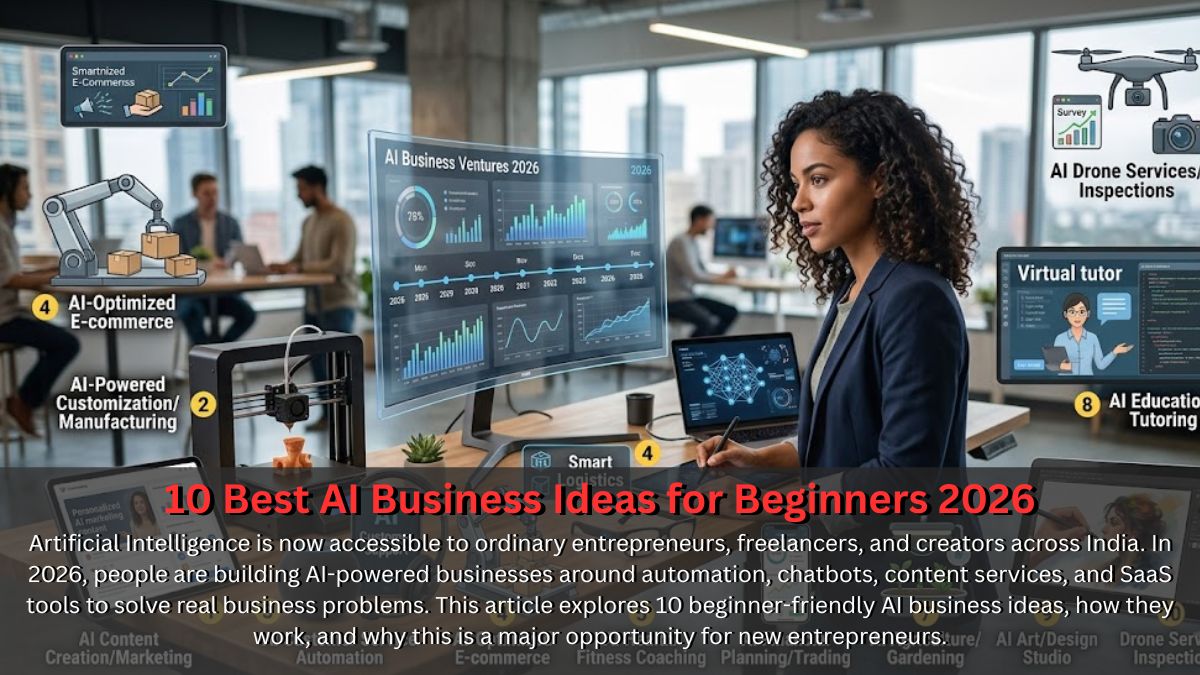
Artificial Intelligence does not feel scary or unreachable anymore. In 2026, it feels real. It feels close. It feels like an opportunity that ordinary people can actually touch and build with. A few years ago, whenever people heard the word “AI,” they imagined giant tech companies, highly paid engineers, complicated coding, and billion-dollar startups sitting somewhere in Silicon Valley. Most people thought it was a world meant only for experts. But things have changed faster than anyone expected, and today AI business ideas are opening doors for ordinary people to build startups, freelance services, and online businesses with minimal resources.
Today, someone sitting in a small town with a laptop and internet connection can build an AI-powered business from their room. A freelancer can turn AI tools into a full-time income. A student can launch a small SaaS product. A creator can automate content work that used to take entire teams. Even people with no deep technical background are finding ways to build something valuable using AI. That is why this moment feels different.
How India’s New Generation of Entrepreneurs Is Building AI-Driven Businesse
Across India, young founders, side hustlers, creators, and first-time entrepreneurs are experimenting, learning, failing, rebuilding, and slowly creating businesses around Artificial Intelligence. Not because they want to chase hype, but because businesses everywhere are genuinely looking for help. Companies want faster customer support. Small brands want affordable marketing automation. Recruiters want quicker hiring systems. Stores want better customer insights. Teams want to save time on repetitive work.
Everyone is searching for smarter ways to work. And for the first time, beginners actually have access to tools powerful enough to solve those problems without needing massive money or years of experience. That is the beautiful part about this AI wave. You do not have to be a genius programmer to participate in it. Sometimes all it takes is noticing a problem people struggle with every day and using AI tools creatively to make their lives easier.
Right now, thousands of people are quietly building businesses around automation, AI content services, analytics tools, chatbots, workflow systems, and niche software products. Some are starting as side projects. Some are becoming startups. Turning into life-changing opportunities. This article explores the 10 best AI business ideas for beginners in 2026, not just as trends, but as practical opportunities that real people can start building today. We will look at how these businesses work, how they make money, what kind of investment they may need, and why this could be one of the most important moments for new entrepreneurs willing to take the first step.
1. AI-Powered Content Automation Agency
Content has become the heartbeat of almost every business today. Brands are constantly trying to stay visible online, whether through blogs, Instagram posts, LinkedIn updates, email campaigns, YouTube scripts, ad copies, or product descriptions. The problem is that creating good content consistently is exhausting, expensive, and time-consuming. Most startups and small businesses simply cannot afford a full in-house content team. Even when they can, the pressure to publish content daily becomes overwhelming very quickly.
That is exactly why AI-powered content automation agencies are growing so fast in 2026. These businesses are not about replacing human creativity. They are about making content creation faster, smoother, and more scalable. Instead of spending days writing everything manually, agencies now use AI tools to speed up research, drafting, ideation, and workflow management while still keeping the human touch alive through editing, storytelling, emotion, and strategy. For beginners, this is one of the easiest AI businesses to start because the investment is low, the demand is huge, and businesses are actively searching for affordable content solutions.
1.1 Startup Idea Overview
An AI-powered content automation agency helps businesses create large volumes of content using AI-assisted workflows. This can include blog articles, website copy, social media posts, newsletters, ad creatives, scripts, product descriptions, SEO pages, and marketing campaigns.
The beauty of this business is its simplicity. You do not need a large office or a technical team to begin. Many founders start with just a laptop, a few AI subscriptions, and the willingness to learn how modern content systems work. Over time, the business can grow into a full-scale agency serving startups, creators, and brands across multiple industries.
1.2 Problem Statement & Solution
One of the biggest struggles businesses face today is consistency. Everyone wants to post regularly, rank on Google, stay active on social media, and build online visibility, but very few teams actually have the time or manpower to keep up.
Hiring experienced writers is expensive. Managing deadlines becomes stressful. Content production slows down, and marketing momentum disappears. An AI content automation agency solves this problem by making the process faster and more efficient. Tasks that once took days can now be completed within hours. AI helps speed up research, drafting, and formatting, while human editors make sure the final content still feels natural, emotional, and aligned with the brand voice. The result is faster delivery without losing quality.
1.3 Target Audience & Customer Persona
The biggest customers for this business are startups, D2C brands, digital agencies, coaches, SaaS companies, local businesses, and eCommerce sellers. Most of these businesses are growing fast but do not have dedicated content teams. They want affordable content solutions that help them stay active online without burning huge amounts of money every month.
Their priorities are usually very clear:
- Better online visibility
- Faster content production
- SEO-friendly articles
- Higher social media engagement
- Consistent branding
Many founders are not looking for perfection. They are looking for speed, reliability, and someone who understands their business goals.
1.4 Market Opportunity & Timing
The demand for digital content is exploding everywhere. Businesses are no longer competing only through products or pricing. They are competing for attention. Every company wants to rank on Google, grow on LinkedIn, attract traffic, build communities, and stay visible in crowded markets.
That demand is creating massive opportunities for AI-assisted content businesses. In India especially, startups, agencies, and small businesses are investing heavily in digital marketing because online visibility now directly impacts sales and growth. At the same time, many companies still cannot afford expensive traditional agencies. This creates the perfect opening for beginner-friendly AI content businesses that can offer faster and more affordable services.
1.5 USP & Value Proposition
The biggest strength of this business is the balance between AI efficiency and human creativity. Businesses do not want content that sounds robotic or emotionless. They still want storytelling, personality, relatability, and natural communication. What they truly want is faster delivery without sacrificing quality.
A strong AI content agency positions itself as:
- Fast but thoughtful
- Affordable but high quality
- Scalable but human-centered
- SEO-friendly but emotionally engaging
That combination becomes the real competitive advantage.
1.6 Business Model & Pricing Strategy
This business usually earns through recurring monthly retainers and subscription-based services.
Clients may pay for:
- Monthly blog packages
- Social media management
- SEO article plans
- Email marketing campaigns
- Ad copy creation
- Product descriptions
- Content strategy services
Some agencies charge based on word count, while others charge based on output volume or complete monthly marketing packages.
As trust grows, recurring income becomes very stable because businesses constantly need fresh content.
1.7 Execution Plan & Launch Strategy
For beginners, the smartest way to start is by focusing on one niche first. Trying to serve everyone often creates confusion.
A founder might begin with:
- Fintech startups
- Healthtech brands
- D2C companies
- Real estate businesses
- Coaches and creators
- SaaS startups
Once the niche is selected, the next step is building sample work, creating a simple website, and showcasing content examples.
Most early clients come through:
- LinkedIn networking
- Cold outreach
- Founder communities
- Freelance platforms
- Referrals
- Twitter or startup groups
In the beginning, consistency matters more than perfection.
1.8 Budget, Resources & Infrastructure
One of the reasons this business is beginner-friendly is because startup costs are relatively low.
The main expenses usually include:
- AI writing tool subscriptions
- Domain and website hosting
- Editing and grammar tools
- Design software
- Internet and marketing costs
Many people start this business with less than ₹50,000 and gradually scale as clients increase. There is no need for a large office initially. Many successful agencies begin remotely from home setups.
1.9 Brand Strategy
Branding plays a huge role because content businesses are built on trust and communication.
The brand should feel:
- Reliable
- Creative
- Modern
- Fast-moving
- Professional but human
Clean logos, simple typography, minimal design, and a strong online presence work very well for AI-focused service businesses. But beyond visuals, the real brand strength comes from how the agency communicates with clients and delivers results consistently.
1.10 Go-to-Market & Customer Acquisition Channels
LinkedIn has become one of the strongest platforms for acquiring clients in this space. Many startup founders actively search for content partners there every day.
Other effective channels include:
- SEO blogging
- Cold email outreach
- Twitter networking
- Startup communities
- Founder groups
- Freelance marketplaces
- Referral marketing
In the early stages, even one good client can create multiple future opportunities through word-of-mouth.
1.11 Growth & Retention Strategy
The real growth begins when the agency becomes part of the client’s long-term workflow instead of just a temporary service provider.
Retention improves when agencies:
- Deliver consistently
- Understand the client’s brand deeply
- Share analytics and performance reports
- Offer content strategy guidance
- Suggest new growth ideas proactively
Over time, clients start depending on the agency not just for writing content, but for helping them grow their online presence and business visibility. That is where this business becomes much bigger than simple content creation. It becomes a long-term growth partnership.
2. AI Recruiting Tools for Small Businesses
Hiring someone should feel exciting. A growing business bringing in a new person usually means progress, expansion, and new possibilities. But for most startups and small businesses, hiring often feels exhausting instead. Founders spend nights scrolling through endless resumes. Small HR teams struggle to reply to candidates on time. Interviews get delayed. Good applicants disappear because the process moves too slowly. And sometimes, after weeks of effort, businesses still end up hiring the wrong person.
It drains time, energy, money, and momentum. That is exactly why AI recruiting tools are becoming such a powerful business opportunity in 2026. Small businesses are desperately looking for ways to make hiring faster, smoother, and less chaotic without spending huge amounts on expensive HR software or large recruitment teams. And honestly, many founders are not searching for “fancy AI.” They simply want relief from repetitive work.
2.1 Startup Idea Overview
This business focuses on building AI-powered hiring software that helps companies automate the most time-consuming parts of recruitment.
Instead of manually reviewing every resume one by one, the platform can automatically:
- Screen applications
- Shortlist candidates
- Rank profiles based on job requirements
- Schedule interviews
- Conduct basic skill assessments
- Organize candidate pipelines
For a small business owner already handling ten different responsibilities every day, even saving a few hours during hiring feels incredibly valuable. The startup usually works as a SaaS platform where businesses pay monthly to use the software. And the beautiful part is this: beginners do not need to build a massive enterprise platform to start. Even a simple tool solving one painful hiring problem can create real demand.
2.2 Problem Statement & Solution
Hiring is broken for many small businesses. A startup founder might post a job opening and suddenly receive 500 resumes within two days. Somewhere inside those applications could be the perfect candidate, but manually reviewing every profile becomes mentally exhausting. People get skipped accidentally. Responses get delayed. Interviews become disorganized. Teams lose productivity because positions remain unfilled for weeks. Over time, the stress builds quietly.
AI recruiting tools help remove a large part of that pressure. Artificial Intelligence can scan resumes within seconds, identify relevant skills, filter out mismatched applications, and organize candidates based on role requirements. What normally takes days can happen in minutes. But the real value is not just speed. It is mental relief. It allows founders and HR teams to focus more on conversations, culture fit, and decision-making instead of drowning in repetitive admin work.
2.3 Target Audience & Customer Persona
The strongest customers for this business are usually:
- Startup founders
- Small business owners
- Recruitment agencies
- HR consultants
- Retail businesses
- Service-based companies
- Growing local businesses
Most of these customers are not looking for complicated enterprise software with hundreds of features they may never use.
They simply want something:
- Easy to understand
- Affordable
- Fast
- Reliable
- Practical for daily hiring needs
For small businesses, simplicity often matters more than complexity.
2.4 Market Opportunity & Timing
The way companies hire people is changing rapidly. Remote jobs, freelance work, startup growth, and online hiring platforms have completely transformed recruitment. Businesses now receive more applications than ever before, but many still manage hiring manually using spreadsheets, emails, and scattered processes.
That creates frustration everywhere. At the same time, AI adoption is growing across industries. Businesses are becoming more comfortable using automation tools because they are under pressure to save time, reduce costs, and move faster than competitors. India is entering a particularly interesting phase right now. Thousands of startups and SMEs are expanding, but many still cannot afford expensive HR teams or enterprise hiring systems. That gap is creating a huge opportunity for beginner-friendly AI recruiting platforms focused on affordability and simplicity.
2.5 USP & Value Propo+sition
One of the smartest things a beginner founder can do is avoid competing directly with giant HR tech companies. Large enterprise software often feels overwhelming for smaller businesses. Too many dashboards. Too many settings. Many features most companies never even use.
Small businesses usually want one thing:
“Help us hire faster without making life complicated.”
That becomes the real value proposition.
A simple AI recruiting platform can stand out by offering:
- Fast setup
- Clean user experience
- Affordable monthly pricing
- Easy candidate filtering
- Time-saving automation
Sometimes solving one small painful problem extremely well creates more value than building a giant complicated platform.
2.6 Business Model & Pricing Strategy
The business generally runs on a monthly subscription model.
Companies may pay based on:
- Number of job openings
- Hiring volume
- Team size
- Premium automation features
Additional income can come from:
- Candidate assessment tools
- Analytics dashboards
- Recruitment consulting
- Job board integrations
- White-label hiring solutions for agencies
One of the best parts about SaaS businesses is recurring revenue. Once businesses integrate the tool into their hiring workflow, they often continue paying every month because switching systems becomes inconvenient.
2.7 Execution Plan & Launch Strategy
Beginners often make the mistake of trying to build everything at once. The smarter approach is much simpler: Start small. Solve one problem properly. A founder can launch an MVP using no-code tools, AI APIs, and lightweight automation software without building a huge engineering team initially. Choosing a niche helps tremendously in the early stage.
For example:
- Startup hiring automation
- Retail staff recruitment
- Internship screening
- Blue-collar hiring
- Remote freelancer hiring
When the product solves a very specific hiring pain point, customer validation happens much faster. And honestly, the first few users matter more than having a perfect product.
Main expenses usually include:
- Software development
- Cloud hosting
- AI integrations
- UI/UX design
- Basic marketing
- Testing infrastructure
Many founders begin with small remote teams, freelance developers, or even no-code systems to reduce costs during the early phase. The goal at the beginning is not perfection. It is proving that businesses genuinely want the solution.
2.9 Risks, Challenges & Mitigation
One of the most sensitive parts of AI hiring is fairness. If AI systems are poorly designed, they can unintentionally favor certain profiles while rejecting others unfairly. That becomes dangerous very quickly because hiring decisions impact real human lives, careers, and opportunities. This is where trust becomes everything. Businesses may love automation, but they still want hiring systems that feel ethical, transparent, and responsible.
That means the platform should focus heavily on:
- Transparent screening logic
- Human review options
- Skill-based evaluations
- Ethical AI practices
- Bias reduction systems
At the end of the day, hiring is deeply human. Technology should support better decisions, not remove humanity from the process. The startups that understand this balance will likely build the strongest trust in the AI hiring industry over the next few years.
3. AI Retail Assistance Platform
Shopping has changed completely over the last few years. Customers no longer want to wait hours for replies, search endlessly for products, or struggle with confusing online stores. People expect quick answers, personalized recommendations, smooth experiences, and instant support almost everywhere they shop online. And honestly, most small businesses are struggling to keep up.
Large eCommerce companies have entire teams handling customer support, personalization, marketing, and retention. But smaller D2C brands and online stores usually operate with tiny teams trying to manage everything at once. That is why AI retail assistance platforms are becoming such a valuable business opportunity in 2026. These platforms help businesses create faster, smarter, and more personalized shopping experiences without needing massive support teams behind the scenes.
3.1 Startup Idea Overview
This startup focuses on building AI-powered assistants for eCommerce stores, D2C brands, and retail businesses.
The platform can help automate:
- Customer support
- Product recommendations
- Upselling suggestions
- Order tracking
- FAQ handling
- Shopping assistance
Instead of customers waiting endlessly for replies, AI assistants can instantly answer questions, guide users through products, and improve the overall shopping experience. For businesses, it feels like adding an extra support team without hiring dozens of employees.
3.2 Problem Statement & Solution
One of the biggest reasons online stores lose customers is frustration. A customer visits a website, has a question about sizing, delivery, payment options, or product details, and receives no response for hours. Many simply leave and never come back. Small businesses lose sales every single day because they cannot respond fast enough. AI-powered retail assistants solve this problem by providing instant engagement. Customers get faster replies, better recommendations, and smoother buying experiences while businesses reduce support workload significantly.
The result is simple:
- Better customer experience
- Higher conversions
- More repeat buyers
- Less operational stress
3.3 Market Opportunity & Timing
India’s eCommerce and D2C ecosystem is growing at an incredible pace. Every month, new online brands are launching across fashion, skincare, electronics, fitness, food, and lifestyle categories. But competition is becoming intense, and customer expectations are rising quickly.
Smaller brands now realize that good products alone are not enough anymore. Customer experience has become a major growth factor. At the same time, many businesses still cannot afford expensive enterprise automation systems. That creates a strong opportunity for beginner-friendly AI retail platforms offering affordable automation and personalization tools.
3.4 Business Model & Pricing Strategy
The platform usually works through monthly subscription pricing.
Businesses may pay based on:
- Number of customer interactions
- Website traffic
- Features used
- AI assistant volume
- Store size
Additional revenue opportunities can include:
- Premium integrations
- Advanced analytics
- Multi-platform support
- Custom automation setups
- Enterprise onboarding services
As stores grow, their dependency on automation increases, creating long-term recurring revenue potential.
3.5 Go-to-Market & Customer Acquisition Channels
One of the fastest ways to grow this business is through partnerships.
Collaborating with:
- Shopify agencies
- eCommerce consultants
- Startup incubators
- Marketing agencies
- D2C communities
can help bring early customers quickly. Content marketing also plays a huge role. Publishing SEO blogs, automation guides, customer experience case studies, and conversion improvement stories helps build trust and authority in the industry. In this market, businesses usually buy solutions from brands that educate them first.
4. AI Cybersecurity Monitoring Service
As businesses move online, fear quietly grows alongside opportunity. Every startup today stores customer data, payment information, business files, internal communications, and sensitive operational details digitally. But most small businesses are dangerously underprepared when it comes to cybersecurity.
Many founders assume cyberattacks only happen to giant corporations. The reality is very different. Small businesses are often easier targets because they lack dedicated security teams, advanced protection systems, and technical expertise. That is exactly why AI-powered cybersecurity monitoring services are becoming increasingly important in 2026.
4.1 Startup Idea Overview
This startup focuses on offering AI-driven cybersecurity monitoring for startups, SMEs, agencies, SaaS businesses, and online platforms.
The service can help detect:
- Suspicious login activity
- Phishing attempts
- Malware risks
- Unauthorized access patterns
- Security vulnerabilities
- Abnormal user behavior
Instead of waiting for major damage to happen, businesses receive early alerts and monitoring support before problems escalate.
For many companies, even one security incident can destroy customer trust completely.
4.2 Problem Statement & Solution
Most small businesses simply cannot afford full cybersecurity teams. Founders are usually focused on growth, sales, hiring, and operations. Security often becomes an afterthought until something goes wrong. The problem is that cyber threats are increasing rapidly. Phishing attacks, ransomware, account breaches, and data leaks are becoming more common every year.
AI-powered monitoring systems help businesses detect threats automatically without needing massive internal security infrastructure. The goal is not just protection. It is peace of mind. Business owners want to know someone or something is constantly watching for unusual activity before a small issue becomes a major disaster.
4.3 Target Audience & Customer Persona
The strongest customers for this business include:
- Startups
- SaaS companies
- Fintech platforms
- Online businesses
- Agencies
- eCommerce stores
- Growing SMEs
These businesses often handle customer information, financial transactions, or sensitive operational data but lack in-house cybersecurity expertise. Many know security matters, but they do not know where to begin. That is where affordable AI monitoring services become extremely valuable.
4.4 USP & Value Proposition
Most advanced cybersecurity solutions target large enterprises with massive budgets. Small businesses are often ignored or priced out completely. That creates a powerful opportunity for startups focused on accessibility and affordability.
The biggest value proposition becomes:
- Easy security monitoring
- Affordable protection
- Automated alerts
- Beginner-friendly systems
- Reduced risk without huge infrastructure costs
For small businesses, feeling protected without hiring an expensive security team is a huge advantage.
4.5 Business Model & Pricing Strategy
The business usually operates through monthly monitoring subscriptions.
Pricing can depend on:
- Number of devices monitored
- Company size
- Security coverage level
- Threat monitoring features
- Data usage
Additional revenue streams may include:
- Security audits
- Vulnerability assessments
- Compliance consulting
- Employee cybersecurity training
- Premium threat intelligence services
As businesses become more digital, cybersecurity often shifts from optional spending to necessary spending.
4.6 Risks, Challenges & Mitigation
Cybersecurity is one of the few industries where trust is everything. If the platform fails to protect users properly, the damage can be serious both financially and reputationally. The industry also changes constantly. New threats appear all the time, which means systems require continuous updates, monitoring, and technical improvement.
Because of this, the startup must prioritize:
- Data privacy
- Reliable monitoring systems
- Fast threat detection
- Strong encryption
- Compliance standards
- Technical transparency
Businesses are not just buying software here. They are buying safety, trust, and confidence. And in a world becoming more digital every day, that trust may become one of the most valuable services any startup can offer.
5. AI Healthcare Platforms for Clinics
Healthcare is one of the few industries where time, organization, and communication can directly affect people’s lives. Yet many small clinics and healthcare centers still struggle with outdated systems, handwritten records, missed appointments, scattered patient data, and endless administrative work. Doctors often spend more time managing paperwork than actually focusing on patients.
That frustration is creating a huge opportunity for AI-powered healthcare platforms in 2026. Small clinics and healthcare providers are now actively searching for affordable digital solutions that help them save time, reduce operational chaos, and improve patient experiences without needing expensive enterprise software.
5.1 Startup Idea Overview
This startup focuses on building AI-driven healthcare management software for clinics, diagnostic centers, and small healthcare providers.
The platform can help automate:
- Appointment scheduling
- Patient reminders
- Report generation
- Digital patient records
- Follow-up communication
- Basic predictive analytics
- Billing workflows
Instead of managing everything manually, clinics can run daily operations in a more organized and efficient way. For doctors and staff, that means less stress. For patients, it means smoother and faster experiences.
5.2 Problem Statement & Solution
Many clinics still rely heavily on traditional systems that consume huge amounts of time. Appointments get mixed up. Patient records become difficult to track. Staff members spend hours handling repetitive administrative work. Communication delays frustrate both doctors and patients.
AI-powered healthcare platforms help simplify these processes through automation and intelligent workflow management. The goal is not to replace doctors. It is to remove unnecessary operational pressure so healthcare professionals can focus more on patient care. Sometimes even small improvements in efficiency can make clinics feel far more organized and less overwhelming.
5.3 Target Audience & Customer Persona
The ideal customers include:
- Independent clinics
- Small hospitals
- Diagnostic centers
- Telemedicine providers
- Dental clinics
- Local healthcare chains
Many doctors today are becoming more comfortable with digital tools because they realize administrative overload affects both productivity and patient satisfaction.
What they usually want is:
- Simplicity
- Reliability
- Easy onboarding
- Better organization
- Reduced paperwork
Most smaller healthcare businesses are not looking for overly complex systems. They simply want tools that make daily work easier.
5.4 Market Opportunity & Timing
Healthcare digitization is growing rapidly across India. Telemedicine adoption, digital health awareness, government initiatives, and increasing patient expectations are pushing clinics toward modern healthcare systems faster than ever before.
At the same time, many smaller clinics still remain underserved when it comes to affordable healthcare software. That creates a strong opportunity for beginner-friendly AI healthcare startups focused on practical solutions rather than expensive enterprise platforms.
5.5 USP & Value Proposition
One of the smartest ways for a beginner startup to stand out is by focusing on affordability and accessibility. Many existing healthcare platforms feel complicated, expensive, or difficult for smaller clinics to adopt.
A startup can differentiate itself by offering:
- Simple onboarding
- Regional language support
- Affordable pricing
- Easy patient management
- Lightweight automation
In a country as diverse as India, language accessibility itself can become a major competitive advantage.
5.6 Legal, Compliance & Fundamentals
Healthcare is extremely sensitive because it involves private patient information and medical records. That means trust becomes absolutely critical.
The startup must prioritize:
- Data security
- Patient privacy
- Secure cloud storage
- Compliance standards
- Reliable infrastructure
In healthcare, businesses are not just buying software. They are trusting the platform with deeply personal information. That responsibility should never be taken lightly.
6. AI Supply Chain Management Analytics Platform
Behind every product people order online, there is an invisible system trying to keep everything moving smoothly. Inventory needs to arrive on time. Warehouses need accurate stock levels. Deliveries must be planned properly. Manufacturers need demand forecasts. Logistics teams need coordination.
When even one part of the supply chain fails, businesses lose money very quickly. That is why AI-powered supply chain analytics platforms are becoming increasingly valuable in 2026. As businesses scale, manual planning and guesswork are no longer enough. Companies now want smarter systems that help them predict demand, optimize inventory, and improve operational efficiency before problems happen.
6.1 Startup Idea Overview
This startup focuses on building AI analytics tools for manufacturers, logistics companies, warehouses, and eCommerce businesses.
The platform can help businesses:
- Forecast inventory demand
- Optimize logistics planning
- Improve warehouse operations
- Reduce delivery delays
- Analyze operational inefficiencies
- Predict stock shortages
Machine Learning models analyze business data and identify patterns that humans often miss manually. For companies dealing with large operations, even small improvements can save significant amounts of money.
6.2 Problem Statement & Solution
Traditional supply chain systems often depend heavily on manual forecasting and reactive decision-making.
Businesses frequently struggle with:
- Overstocking
- Inventory shortages
- Delivery delays
- Warehouse inefficiencies
- Poor demand prediction
These problems create operational stress and financial losses. AI-driven analytics help businesses make smarter predictions using historical data, demand trends, and operational insights. Instead of reacting after problems appear, businesses can plan more proactively. That shift from reactive operations to predictive decision-making is becoming incredibly valuable.
6.3 Market Opportunity & Timing
India’s manufacturing, logistics, and eCommerce sectors are growing rapidly. Warehousing networks are expanding. Online commerce continues rising. Supply chains are becoming more digital and data-driven every year.
At the same time, many businesses still struggle with fragmented systems and outdated operational planning methods. This creates strong demand for AI-powered analytics tools that improve visibility, forecasting, and operational efficiency. As industries modernize, smarter supply chain systems will likely become a necessity instead of a luxury.
6.4 Business Model & Pricing Strategy
The platform can generate revenue through:
- SaaS subscriptions
- Usage-based pricing
- Analytics dashboard access
- Enterprise implementation consulting
- Data integration services
Larger businesses may also pay for custom operational reports and advanced forecasting systems tailored to their industry needs. Recurring enterprise contracts can create long-term stable revenue.
6.5 Budget, Resources & Infrastructure
Compared to simpler AI businesses, this startup usually requires stronger technical infrastructure.
Main requirements include:
- Cloud servers
- Data engineering expertise
- Machine Learning systems
- Operational analytics tools
- API integrations
The good news is that open-source AI frameworks and cloud platforms have reduced development costs significantly compared to a few years ago. For beginners, starting with one niche industry first often makes execution far more manageable.
7. AI Video Editing Automation Studio
Video content has completely taken over the internet. Everywhere people scroll, there are reels, shorts, podcasts, tutorials, interviews, product videos, educational clips, and social media content competing for attention.
The problem is that creating video content consistently is exhausting. Editing takes time. Cutting clips takes effort. Adding subtitles, transitions, thumbnails, highlights, and social media formatting becomes repetitive very quickly. Many creators burn out simply trying to keep up with content demands. That is why AI video editing automation businesses are growing so rapidly in 2026.
7.1 Startup Idea Overview
This business focuses on automating video editing workflows using Artificial Intelligence.
The platform or service can automatically generate:
- Subtitles
- Smart cuts
- Highlight clips
- Thumbnails
- Social media snippets
- Transitions
- Audio cleanup
- Short-form content from long videos
Instead of spending hours editing manually, creators can produce content much faster while maintaining decent quality. For many creators and startups, speed matters almost as much as creativity now.
7.2 Problem Statement & Solution
Video editing is one of the biggest bottlenecks in content creation. Many creators have ideas, raw footage, and audiences, but they struggle with editing workload. Hiring editors can become expensive, while learning advanced editing software takes time.
AI automation helps simplify repetitive editing tasks dramatically. Instead of manually cutting every clip or adding subtitles line by line, AI systems can automate large parts of the workflow within minutes. That allows creators to focus more on storytelling, creativity, and audience building instead of getting stuck in endless editing cycles.
7.3 Target Audience & Customer Persona
The strongest customers include:
- YouTubers
- Instagram creators
- Podcasters
- Startups
- Educators
- Coaches
- Agencies
- Influencers
Most of these users prioritize:
- Faster turnaround
- Affordable editing
- Simplicity
- Content scalability
- Platform-ready formatting
For creators posting daily content, saving even a few hours every week feels extremely valuable.
7.4 USP & Value Proposition
The startup can position itself as a low-cost content scaling solution for modern creators and businesses.
The strongest value propositions usually include:
- Faster editing workflows
- Affordable content production
- Easy automation
- Creator-friendly systems
- High-volume content scaling
Many creators do not necessarily need cinematic perfection every time. They need consistency, speed, and sustainability.
7.5 Go-to-Market & Customer Acquisition Channels
Creator communities are one of the strongest growth channels for this business.
Good acquisition opportunities include:
- Instagram creator communities
- YouTube networking
- Podcasting groups
- Startup creator events
- Influencer collaborations
- Referral partnerships
Content creators trust recommendations heavily. One happy creator often brings several more users through word-of-mouth alone. And in a world where content never stops moving, businesses that help creators move faster will continue finding enormous demand.
8. AI Video Editing Automation Studio
Short-form video content has completely changed the internet. Every brand, creator, startup, coach, and influencer is trying to stay visible through reels, YouTube Shorts, podcasts, tutorials, and social media clips. The pressure to post consistently has become intense. People are no longer competing only on creativity. They are competing on speed. And honestly, that constant content demand can become exhausting.
Many creators spend more time editing videos than actually creating them. Hours disappear in cutting clips, adding subtitles, resizing content for different platforms, selecting highlights, creating thumbnails, and fixing small editing details. That is why AI-powered video editing automation businesses are growing so quickly in 2026.
8.1 Startup Idea Overview
This business focuses on automating video editing workflows using Artificial Intelligence.
The platform can automatically generate:
- Subtitles
- Smart video cuts
- Highlight moments
- Social media clips
- Thumbnails
- Transitions
- Captions
- Platform-ready short-form content
Instead of spending entire days editing manually, creators and businesses can produce content much faster with AI-assisted workflows. For many users, that speed feels life-changing because consistency becomes easier to maintain.
8.2 Problem Statement & Solution
Video editing is one of the biggest bottlenecks in modern content creation. Many creators have ideas, audiences, and raw footage, but editing everything manually becomes mentally draining and time-consuming. Hiring professional editors can also become expensive for smaller creators or startups.
AI automation helps reduce that workload dramatically. Tasks that normally take hours can often be completed within minutes. AI can identify highlights, generate subtitles automatically, trim unnecessary pauses, and create multiple content formats quickly. The goal is not to remove creativity. It is to remove repetitive effort so creators can focus more on storytelling and audience growth.
8.3 Target Audience & Customer Persona
The biggest customers for this business include:
- YouTubers
- Instagram creators
- Influencers
- Startups
- Podcasters
- Educators
- Coaches
- Agencies
Most of these users care deeply about:
- Faster content production
- Affordable editing
- Consistency
- Easy workflows
- Social media scalability
For creators posting content regularly, saving even a few hours every week makes a huge difference.
8.4 USP & Value Proposition
The startup can position itself as a low-cost content scaling solution for modern creators and brands.
Its biggest strengths usually become:
- Fast delivery
- Creator-friendly automation
- Affordable pricing
- Easy editing workflows
- Multi-platform content generation
Most creators are not searching for perfection every single time. They simply want to create more content without burning themselves out.
8.5 Go-to-Market & Customer Acquisition Channels
The creator economy itself becomes the biggest marketing channel for this business.
Strong customer acquisition opportunities include:
- Instagram creator communities
- YouTube networking groups
- Podcasting communities
- Creator-focused startup events
- Influencer partnerships
- Referral collaborations
In the creator world, recommendations spread very quickly. One happy creator often brings several others naturally through word-of-mouth. And as content demand keeps growing, businesses that help creators move faster will continue becoming more valuable.
9. AI-Powered Financial Planning Assistant
Money has become one of the biggest sources of stress for modern consumers. People earn, spend, save, invest, pay EMIs, manage subscriptions, use digital wallets, and try to plan their futures, but many still feel financially confused. Most people want guidance, but professional financial advisors often feel expensive or inaccessible, especially for students, freelancers, young professionals, and middle-class families.
That is why AI-powered financial planning assistants are becoming increasingly important in 2026. They make financial guidance feel simpler, more approachable, and available to ordinary people who simply want better control over their money.
9.1 Startup Idea Overview
This business focuses on building AI-driven financial planning tools for consumers, freelancers, and working professionals.
The platform can help users:
- Track expenses
- Monitor spending habits
- Create budgets
- Generate savings insights
- Set financial goals
- Receive automated recommendations
- Understand cash flow patterns
Instead of manually managing everything through spreadsheets or random apps, users get smarter and more organized financial guidance in one place.
9.2 Problem Statement & Solution
One of the biggest problems in personal finance is inconsistency. People often start budgeting with motivation but struggle to maintain discipline over time. Expenses become difficult to track, savings goals get ignored, and financial planning feels overwhelming.
AI systems help simplify these decisions by analyzing spending behavior and providing personalized insights automatically. Sometimes small reminders and smarter visibility alone can completely change how people manage money. The platform essentially acts like a digital financial companion that helps users stay more aware and organized.
9.3 Market Opportunity & Timing
India’s fintech ecosystem is growing rapidly. Digital payments, UPI adoption, online investing, and mobile banking have completely transformed how consumers interact with money. Younger generations are also becoming more interested in budgeting, investing, side incomes, and wealth creation than ever before. At the same time, financial literacy still remains limited for a large portion of the population. This creates strong demand for simple, affordable, AI-driven financial tools designed for everyday users rather than wealthy investors alone.
9.4 Risks, Challenges & Mitigation
Financial businesses operate heavily on trust. If users feel unsafe or receive poor recommendations, confidence disappears very quickly. Because financial decisions directly affect people’s lives, the startup must be extremely careful with both security and communication.
Key priorities include:
- Strong data protection
- Transparent recommendations
- Regulatory compliance
- Responsible financial guidance
- Secure user authentication
The platform should avoid making unrealistic promises or misleading investment advice. People are not just trusting the app with numbers. They are trusting it with their financial peace of mind.
10. AI Education & Skill Learning Platform
The way people learn is changing faster than traditional education systems can keep up with. Students no longer want boring one-size-fits-all courses where everyone watches the same videos regardless of skill level or learning speed. People now expect learning experiences that feel more personal, flexible, interactive, and adaptive. That shift is creating huge opportunities for AI-powered education and skill learning platforms. In 2026, learning is becoming less about memorizing information and more about personalized guidance, real-time feedback, and smarter skill development.
10.1 Startup Idea Overview
This startup focuses on building AI-powered education platforms for:
- Skill development
- Exam preparation
- Professional learning
- Career-focused training
- Personalized tutoring
The platform can adapt lessons based on student performance, strengths, weaknesses, and learning behavior. Instead of forcing every student into the same path, AI systems help create more customized learning journeys.
10.2 Problem Statement & Solution
Traditional online courses often feel passive and disconnected. Students lose motivation because content rarely adjusts to their pace or understanding level. Some learners feel left behind, while others feel bored because lessons move too slowly. AI-powered learning systems help solve this by personalizing education.
The platform can:
- Recommend lessons dynamically
- Adjust difficulty levels
- Track student progress
- Identify weak areas
- Provide smarter revision plans
- Improve engagement through adaptive learning
Learning becomes less frustrating when it feels designed around the student instead of forcing students to adapt to rigid systems.
10.3 Target Audience & Customer Persona
The primary users include:
- Students
- Job seekers
- Working professionals
- Competitive exam aspirants
- Career switchers
- Freelancers learning new skills
Parents, schools, coaching centers, and educational institutions can also become important customer segments. The demand is especially strong among people trying to improve employability and career opportunities.
10.4 Business Model & Pricing Strategy
The platform can generate revenue through:
- Monthly subscriptions
- Premium learning plans
- Certification programs
- Institutional partnerships
- Personalized mentorship features
Freemium models work particularly well in education because users often want to experience value before paying. Once trust builds, many learners are willing to upgrade for deeper learning support.
10.5 Growth & Retention Strategy
Education businesses grow strongest when students remain consistently engaged.
Retention improves through:
- Gamification systems
- Learning streaks
- Performance analytics
- Community interaction
- Personalized recommendations
- Continuous content updates
The more students feel progress emotionally and practically, the more likely they are to continue learning on the platform. And in a world where skills are becoming more valuable than degrees alone, personalized AI learning platforms may become one of the most powerful industries of the next decade.
11. AI Data Monetization Consulting Firm
Most businesses today are sitting on huge amounts of data without even realizing how valuable it actually is. Every sale, customer interaction, website visit, order history, marketing campaign, delivery update, and user behavior creates data. The problem is that for many startups and SMEs, all this information simply gets stored in spreadsheets, dashboards, or software systems without being properly understood or used.
And when businesses fail to understand their data, they often miss growth opportunities hiding right in front of them. That is why AI-powered data monetization consulting is becoming such an important business opportunity in 2026.
11.1 Startup Idea Overview
This startup focuses on helping businesses turn raw operational data into useful business insights and smarter decision-making systems.
The consulting firm can provide:
- Analytics dashboards
- AI-powered reporting systems
- Customer behavior analysis
- Sales performance insights
- Operational efficiency reports
- Forecasting models
- Revenue optimization recommendations
Instead of drowning in numbers, businesses get clear insights they can actually use to improve growth and profitability. For many companies, even small data-driven decisions can create major financial impact.
11.2 Problem Statement & Solution
One of the biggest problems businesses face today is not lack of data. It is lack of clarity.
Companies collect huge amounts of information every day but often struggle to answer simple questions like:
- Why are customers leaving?
- Which products perform best?
- Where is money being wasted?
- Which marketing campaigns actually work?
- What operational bottlenecks reduce efficiency?
AI-powered analytics tools help businesses organize and interpret data in ways that humans alone often cannot manage efficiently. The goal is to transform confusing data into practical decisions businesses can act on confidently.
11.3 Market Opportunity & Timing
Data-driven decision-making is quickly becoming standard across industries. Large corporations already invest heavily in analytics teams, but smaller businesses are now realizing they also need smarter insights to stay competitive.
At the same time, most SMEs still cannot afford expensive enterprise consulting firms. That creates a strong opportunity for beginner-friendly AI consulting businesses focused on affordability, simplicity, and practical results. In India especially, digital adoption among startups and SMEs is growing rapidly, which means businesses are generating more data than ever before.
11.4 USP & Value Proposition
A smart beginner-focused consultancy does not need to compete directly with massive enterprise analytics firms. Instead, it can stand out by helping smaller businesses understand data in simple and actionable ways.
The strongest value proposition becomes:
- Affordable analytics support
- Easy-to-understand dashboards
- Practical business insights
- Faster decision-making
- SME-focused consulting
Many businesses are not searching for complicated reports filled with technical jargon. They simply want answers that help them grow. Sometimes clarity itself becomes the product.
12. AI Voice Assistant Business for Regional Languages
India is not just growing digitally. It is growing in many different languages at the same time. Millions of internet users across the country feel more comfortable speaking Hindi, Bengali, Tamil, Marathi, Telugu, Kannada, Punjabi, or other regional languages rather than English. Yet many digital platforms still fail to communicate naturally with these users. That gap is creating one of the biggest AI opportunities in India right now. Regional-language AI voice assistants are becoming increasingly important because technology feels far more personal when people can interact in their own language.
12.1 Startup Idea Overview
This startup focuses on building AI-powered voice assistants designed for Indian regional languages.
These voice systems can be used for:
- Customer support
- Education platforms
- Local commerce
- Healthcare communication
- Government services
- Rural digital access
- Business automation
The platform may support multiple Indian languages depending on the target market and use case. Instead of forcing users to type or communicate in English, voice-based systems make digital experiences feel simpler and more natural.
12.2 Problem Statement & Solution
Language remains one of the biggest barriers to digital adoption in India. Many users struggle with apps, websites, or customer support systems because they are not comfortable using English-based interfaces. AI voice assistants help remove that barrier by allowing people to interact naturally in their preferred language.
This improves:
- Accessibility
- Customer engagement
- User comfort
- Digital inclusivity
- Service adoption
For many first-time internet users, voice interaction feels less intimidating than typing or navigating complex interfaces.
12.3 Target Audience & Customer Persona
The strongest customers for this business include:
- Rural businesses
- Local service providers
- Edtech platforms
- Healthcare services
- Government initiatives
- Regional startups
- Customer support companies
Businesses trying to expand beyond metro cities often realize that regional communication becomes essential for deeper customer reach. That is where localized AI systems become incredibly valuable.
12.4 Market Opportunity & Timing
India’s regional internet economy is growing extremely fast. Millions of new internet users are coming online from smaller cities and rural regions, and many prefer voice-first digital experiences over traditional text-heavy systems.
At the same time, smartphone adoption and affordable internet access continue increasing rapidly. This creates a massive opportunity for AI businesses focused on regional accessibility and voice-based communication. The companies that solve language accessibility well may become extremely powerful in the coming years.
12.5 Execution Plan & Launch Strategy
For beginners, the smartest strategy is usually to start small and focused.
Instead of trying to support every language immediately, founders can begin with:
- One regional language
- One specific use case
- One target customer segment
For example:
- Hindi customer support bots
- Tamil voice assistants for education
- Bengali voice commerce systems
Pilot partnerships with local businesses can help validate demand quickly before expanding further. In markets like India, localization often becomes one of the strongest competitive advantages.
13. Team Structure & Responsibilities
One of the most encouraging things about modern AI businesses is that many of them do not require huge teams in the beginning. A lot of first-time founders assume startups need large offices, dozens of employees, and massive infrastructure from day one. But in reality, many successful AI businesses start with very small teams handling multiple responsibilities together.
In the early stages, founders often manage:
- Sales
- Customer acquisition
- Operations
- Client communication
- Product coordination
- Basic marketing
At first, the business usually moves through hustle, experimentation, and constant learning rather than perfect structure. Technical work like software development can often be outsourced to freelancers, remote developers, or contract engineers. Marketing activities such as SEO writing, social media management, branding, and design can also be handled through freelance collaborators. This flexibility helps beginners reduce costs while validating the business model first.
As the company grows, hiring priorities generally shift toward:
- Customer success
- Technical support
- Product development
- Operations management
- Sales expansion
- Marketing systems
The most important thing in the beginning is not building a massive team. It is building a working solution people genuinely need. Many successful startups start small, messy, uncertain, and imperfect. What separates long-term winners is not having everything figured out on day one. It is staying consistent long enough to keep improving.
14. Vendor & Partner Strategy
Behind every successful AI startup, there is usually a strong ecosystem quietly supporting it in the background. Most beginner founders focus heavily on the product idea itself, but the truth is that choosing the right vendors and technology partners can shape how smoothly the business grows later on. A weak infrastructure decision early on can create expensive problems in the future. AI businesses rely heavily on tools, cloud systems, APIs, automation platforms, hosting providers, and third-party integrations. These systems become the backbone of daily operations. That is why founders should choose vendors carefully instead of simply selecting the cheapest option available.
The most important things to evaluate are usually:
- Reliability
- Scalability
- Integration flexibility
- Customer support quality
- Transparent pricing
- Security standards
When a startup begins growing, stable infrastructure matters far more than flashy features. Partnerships also play a huge role in early growth. Many beginner AI startups gain their first traction through collaborations rather than expensive advertising.
Working with:
- Startup incubators
- SaaS communities
- Digital agencies
- Creator networks
- Local business groups
- Industry consultants
can help founders reach customers faster and build credibility more naturally. In the early stages, the right partnership can sometimes create more growth than months of cold outreach.
15. Brand Strategy
In the AI startup world, branding is not just about logos, colors, or websites. It is about trust. Many people are still uncertain about Artificial Intelligence. Some are excited by it, while others quietly worry about automation replacing human judgment completely. Because of this, the way an AI startup presents itself matters enormously. The most successful AI brands usually position themselves as tools that assist humans rather than replace them entirely. People feel more comfortable when technology feels supportive instead of threatening.
That is why strong AI brands often communicate ideas like:
- Smarter workflows
- Human-assisted automation
- Faster productivity
- Better decision-making
- Simplified operations
instead of sounding cold, robotic, or overly technical.
The overall brand identity should feel:
- Modern
- Intelligent
- Clean
- Reliable
- Practical
- Human-centered
Minimalistic logos, clean typography, simple interfaces, and calm visual design often work extremely well for AI-focused businesses because they create a sense of clarity and trust. But branding goes far beyond visuals. Founders should also focus heavily on educational branding. In many cases, customers buy from the businesses they learn from first.
This can include:
- Writing blogs
- Sharing insights on LinkedIn
- Founder storytelling
- Community building
- Educational content marketing
- Industry case studies
People connect deeply with founders who explain problems clearly and communicate with honesty. Especially in AI, where many users still feel confused or overwhelmed, education itself becomes a powerful branding tool.
16. Legal, Compliance & Fundamentals
Many founders get excited about building products and acquiring customers, but legal foundations are often ignored until problems appear. That can become risky very quickly, especially in AI businesses handling sensitive user data and digital operations. Strong legal structure is not just paperwork. It creates stability, trust, and long-term protection for the business.
Every AI startup should establish core operational foundations from the beginning, including:
- Business registration
- GST compliance
- Service agreements
- Customer contracts
- Privacy policies
- Terms of use
- Intellectual property ownership
Without proper agreements and documentation, even small misunderstandings can create major business complications later. The responsibility becomes even more serious for businesses working with sensitive information.
For example:
- Healthcare platforms handle patient data
- Cybersecurity startups manage security-sensitive systems
- Financial tools process personal financial information
These industries require much stricter compliance standards because users are trusting businesses with deeply private information. Data protection and security should never become afterthoughts.
Founders also need to stay updated with changing AI regulations, digital laws, and compliance frameworks because governments across the world are increasingly focusing on how AI systems collect, process, and use user data. The startups that build trust early through transparency, privacy protection, and responsible systems will likely have a much stronger long-term advantage. In the end, people may try a product because of innovation, but they stay because they feel safe using it.
17. Growth & Retention Strategy
Getting customers feels exciting in the early stages of a startup. Every new signup, every payment notification, every positive message feels like proof that the idea might actually work. But after the initial excitement fades, founders usually discover a much deeper truth about building businesses: Getting customers is hard. Keeping them is even harder. In AI and SaaS businesses, long-term growth rarely comes from constant customer acquisition alone. Real stability begins when customers continue using the product month after month because it has genuinely become part of their daily workflow.
That is where retention becomes everything. The most successful AI startups are not the ones that simply launch fast. They are the ones that keep improving continuously after launch. They listen carefully to customers, study product usage patterns, fix friction points, and adapt based on real user behavior instead of assumptions. Small improvements often create massive long-term impact.
Things like:
- Personalized onboarding
- Helpful tutorials
- Faster customer support
- Educational resources
- Better automation features
- Product updates based on user feedback
can quietly increase customer loyalty over time. People stay with products that make their lives easier consistently. Subscription-based AI businesses especially need to focus on reducing churn because losing customers repeatedly creates constant pressure. The goal should be to make the product deeply integrated into the customer’s workflow so switching away feels inconvenient. The stronger the dependency, the stronger the retention.
Community building also plays a much bigger role than many founders initially realize. AI startups that create educational ecosystems around their products often build far deeper trust. When users learn, interact, share experiences, and grow alongside the product, they stop feeling like simple customers and start feeling like part of a larger community. That emotional connection becomes incredibly powerful over time.
18. Risks, Challenges & Mitigation
The AI industry is exciting, but it is also moving incredibly fast. That speed creates opportunities, but it also creates pressure. A product that feels innovative today can suddenly feel outdated within months because technology evolves so quickly. New tools appear constantly. Competitors launch rapidly. Features become easier to copy. Customer expectations keep changing. For beginners, this can sometimes feel overwhelming.
AI startups also face deeper challenges beyond competition:
- Data privacy concerns
- Regulatory uncertainty
- Algorithm bias
- Rising infrastructure costs
- Ethical concerns around automation
- Customer trust issues
People are becoming more aware of how AI systems collect and use their data. Businesses that ignore transparency or responsible AI practices may struggle to build long-term trust. That is why beginners should avoid trying to build giant all-in-one platforms immediately. The smarter approach is usually much simpler: Start focused. Solve one painful problem properly. Niche solutions often perform better because they create clearer value and allow startups to build stronger expertise in specific areas. At the same time, operational discipline matters enormously.
Founders who focus on:
- Strong customer support
- Honest communication
- Ethical AI usage
- Product reliability
- Consistent improvement
- Data security
usually build more resilient businesses over time. In AI, trust is often more important than hype.
19. Long-Term Vision & Goals
The next few years could become one of the biggest entrepreneurial shifts the world has seen in decades. Artificial Intelligence is no longer limited to giant corporations, elite engineers, or billion-dollar research labs. The tools are becoming accessible to ordinary people. And that changes everything. Today, freelancers, creators, marketers, consultants, students, operators, and first-time founders all have access to technologies that can help them build scalable businesses with surprisingly low starting capital. That is what makes this moment so powerful.
The biggest winners in the AI business wave of 2026 will probably not be the companies chasing trends blindly. They will be the ones solving real-world problems people genuinely struggle with every day.
Industries like:
- Cybersecurity
- Supply Chain Management
- Healthcare Platforms
- Data Monetization
- AI Retail Assistance
- Recruiting Tools
- SaaS automation
- Machine Learning-driven operational systems
are expected to see growing demand because businesses everywhere are trying to work faster, smarter, and more efficiently. For beginners, the opportunity is not about building the most complicated technology.
It is about:
- Starting early
- Understanding customer pain deeply
- Building practical solutions
- Learning continuously
- Adapting faster than the market changes
India’s startup ecosystem is also entering a very important phase
India’s startup ecosystem is also entering a very important phase. AI adoption is slowly moving beyond metro cities into Tier 2 and Tier 3 markets, creating opportunities that did not exist a few years ago. Regional innovation, vernacular AI systems, affordable automation tools, and localized digital solutions may become some of the strongest growth areas in the coming decade. This is especially exciting because it means innovation is no longer limited to a few big cities. More people from different backgrounds now have the chance to build meaningful businesses using AI.
The founders who succeed long-term will likely be the ones who focus less on hype and more on execution, trust, consistency, and customer experience. At FoundLanes.com, the mission is to help aspiring entrepreneurs discover practical startup opportunities, understand emerging business trends, and build sustainable ventures with real market potential. The platform focuses on actionable startup insights, founder-focused learning, and future-ready business opportunities designed for the next generation of entrepreneurs.
The rise of AI business ideas in 2026 is not just another technology trend people will forget after a few years. It is slowly reshaping industries, changing how businesses operate, transforming digital commerce, influencing education and healthcare, and redefining the way people work every day. And for beginners willing to learn patiently, experiment fearlessly, and keep showing up consistently, Artificial Intelligence may become one of the biggest entrepreneurial opportunities of this entire decade.
About foundlanes.com
foundlanes.com is India’s leading startup idea discovery platform. It helps entrepreneurs find actionable startup opportunities, market insights, and industry-specific guidance to turn ideas into real businesses. With deep research and practical resources, foundlanes supports founders at every stage, from idea validation to launch and growth.