


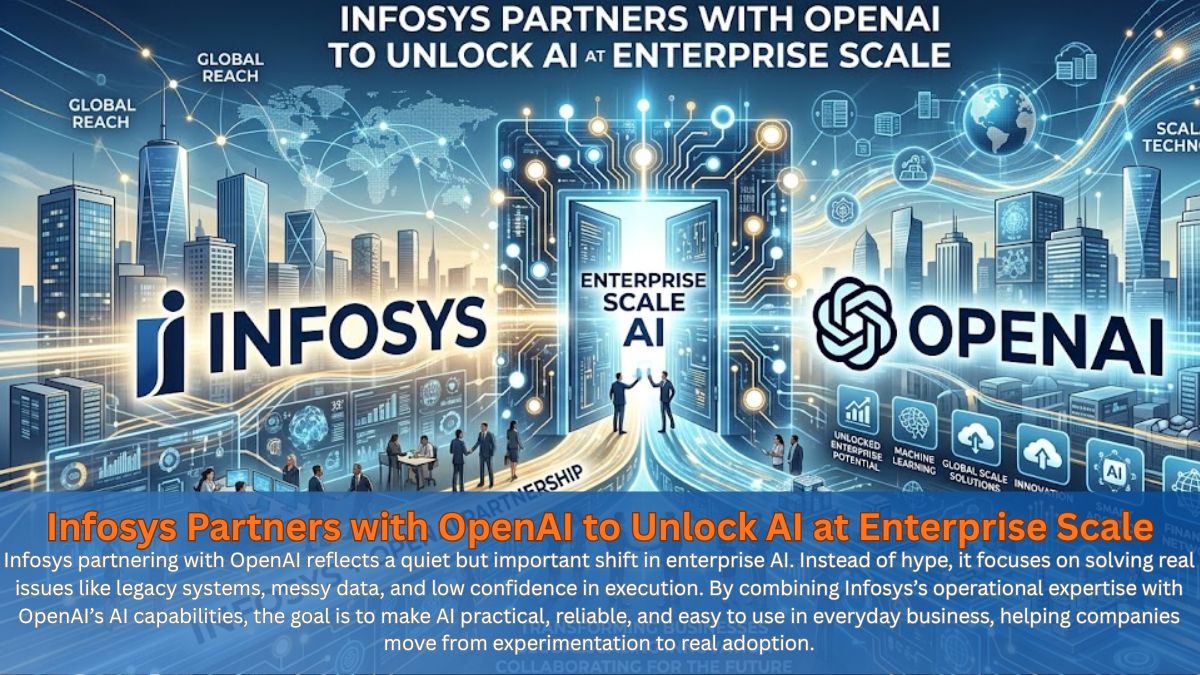
News Summary
Infosys Partners with OpenAI and this one feels different. Not loud. Not overhyped. But important in a quiet, almost unsettling way. Because it touches something many companies have been struggling with for years but rarely admit openly. Infosys joining hands with OpenAI is not just about bringing AI into businesses. It is about finally making AI work where it has often failed to deliver. For a long time, AI has lived in presentations, strategy decks, and pilot projects. Leaders have spoken about it with excitement, sometimes even pressure. “We need AI.” “We need to transform.” But behind those conversations, there has always been hesitation. Because when it comes to actually implementing AI, things get complicated.
Systems are old. Data is messy. Teams are unsure. And somewhere along the way, that initial excitement turns into confusion. Projects slow down. Expectations fade. People stop talking about AI as a solution and start seeing it as another unfinished experiment. This is the reality most enterprises don’t openly talk about. And that is exactly where this partnership steps in.
Infosys understands this reality deeply
Infosys understands this reality deeply. It has spent decades inside these systems, fixing problems that don’t show up in headlines. knows how fragile large-scale operations can be. knows that even a small disruption can break trust. OpenAI brings something equally important but very different. It brings possibility. Its models have shown what AI can do when it works well. Fast responses. Smarter decisions. Better understanding. But possibility alone is not enough.
What businesses need is confidence. The confidence that AI will not break their systems. The confidence that it will actually help, not complicate things further. This partnership is really about building that confidence. The goal is not to flood companies with new technology. It is to quietly fit AI into their existing workflows. To reduce friction instead of adding more. To make employees feel supported, not replaced. And that emotional shift matters. Because every transformation, no matter how technical it sounds, is deeply human. It affects how people work, how they feel, and how they see their future.
The timing also says a lot. Companies today are under pressure. They need to move faster, do more with less, and stay competitive. AI is no longer a “nice to have.” It is becoming necessary. But moving too fast without the right foundation can be risky. This collaboration feels like a response to that tension. A way to move forward without losing control. A way to adopt AI without fear. And maybe that is why this moment stands out. It is not just about Infosys. It is not just about OpenAI. about a larger shift we are starting to feel. A shift from talking about AI to actually living with it. From experimenting with it to depending on it. From uncertainty… to something that feels, finally, a little more real.
1. Infosys Partners with OpenAI: Breaking Down the Announcement
1.1 What the Collaboration Means
When Infosys partners with OpenAI, it is not just another corporate announcement. It reflects a deeper shift in how businesses are beginning to think about artificial intelligence. For years, AI has lived in presentations, pilot projects, and innovation labs. It has been talked about more than it has been used at scale. This collaboration changes that tone.
Infosys is not approaching AI as a theoretical capability. It is approaching it as something that must work inside real systems, with real constraints, and for real users. That means dealing with messy data, legacy infrastructure, regulatory pressure, and human resistance to change. These are the realities most enterprises face every day. OpenAI, on the other hand, brings the raw power. Its models are capable, fast, and increasingly reliable. But powerful tools alone do not solve business problems. They need context, structure, and integration. That is where Infosys steps in.
Think about a large bank trying to automate customer service. The idea sounds simple. Deploy AI, reduce response time, cut costs. But in reality, the bank deals with compliance rules, multilingual users, legacy systems, and millions of transactions. A generic AI model cannot handle this complexity alone. With this partnership, Infosys becomes the translator between possibility and execution. It takes OpenAI’s capabilities and shapes them into solutions that actually work in the real world. The real meaning of this collaboration lies here. It is not about building new AI tools. It is about making existing AI usable, reliable, and scalable inside enterprises that cannot afford failure.
1.2 Key Objectives of the Partnership
At first glance, the objectives seem straightforward. Faster adoption of AI. Better productivity. Smarter automation. However, when you look deeper, each of these goals carries layers of complexity. Improving productivity, for example, is not just about doing tasks faster. It is about changing how work happens. In many organizations, employees spend hours on repetitive tasks. Data entry, report generation, customer queries. These tasks are not just inefficient. They are draining.
The promise of this partnership is to reduce that burden. Imagine a support team that no longer has to manually respond to every query. Instead, AI handles the first layer of interaction. It understands context, retrieves relevant data, and responds instantly. The human agent steps in only when needed. This is not about replacing people. It is about giving them better work to do. Automation is another key objective. But automation in enterprises is rarely simple. Systems are interconnected. A change in one process affects another. Infosys understands these dependencies because it has spent decades working inside these environments.
This is where the partnership becomes powerful. OpenAI provides intelligence. Infosys provides structure. Customer experience is the third pillar. Today’s users expect speed, accuracy, and personalization. They do not want to repeat information. They do not want delays. AI can meet these expectations, but only if it is implemented correctly. At the same time, there are real concerns. Data privacy. Security risks. Compliance requirements. These are not optional considerations. They are critical. Infosys brings governance frameworks that ensure AI is deployed responsibly. So while the objectives sound simple, the execution is anything but. And that is exactly why this collaboration matters.
1.3 Why This Matters for the Industry
There is a moment in every technology cycle when things stop being experimental and start becoming essential. This partnership signals that moment for AI. For years, companies have explored AI through pilots. Small projects. Limited scope. Controlled environments. These experiments were useful, but they did not transform businesses. Now, the conversation is different. Enterprises are no longer asking, “Should we use AI?” They are asking, “How fast can we deploy it, and where will it deliver the most value?”
This shift is significant. It means budgets are being allocated. Teams are being trained. Leadership is being held accountable for results. AI is moving from the innovation team to the core business. Partnerships like this accelerate that shift. They reduce uncertainty. They provide a clear path to implementation. At the same time, they raise the bar.
Competitors cannot afford to wait. If one company successfully integrates AI into its operations, others must follow. This creates a ripple effect across industries. There is also a broader emotional layer to this change. For many professionals, AI represents both opportunity and anxiety. It promises efficiency, but it also challenges traditional roles. Companies must navigate this carefully. They need to show that AI is a tool for empowerment, not replacement. Infosys has experience managing large-scale transformations. It understands that technology adoption is as much about people as it is about systems. This is why the partnership matters beyond technology. It represents a shift in mindset. A move from curiosity to commitment.
2. Background: Infosys Journey in the Global Startup Ecosystem
2.1 Founders and Early Growth
To understand why Infosys is central to this story, you have to go back to its beginnings. In 1981, Narayana Murthy and a small group of engineers started Infosys with limited resources but a clear belief. They believed India could deliver world-class technology services. At that time, this idea was not widely accepted. The global tech industry was concentrated in the West. India was not seen as a technology powerhouse.
The early years were difficult. Infrastructure was limited. Access to global markets was challenging. Building trust with international clients took time. But Infosys persisted. What set the company apart was its discipline. It focused on quality, transparency, and long-term relationships. did not chase quick wins. It built credibility slowly. There is something deeply human about this journey. It is not a story of overnight success. It is a story of patience, resilience, and belief.
Over the decades, Infosys grew into a global organization. It expanded its services, entered new markets, and built a reputation for reliability. By the time the digital era began, Infosys was already a trusted partner for many enterprises. This trust became its biggest advantage.
2.2 Business Model and Revenue Streams
Infosys operates on a model that may seem simple on the surface but is incredibly complex in execution. At its core, it provides services. Consulting, outsourcing, and digital transformation. But these are not standalone offerings. They are deeply integrated into the operations of client organizations. When a company works with Infosys, it is not just buying a service. It is entering a long-term relationship.
Revenue comes from large contracts. Multi-year engagements. Continuous support and improvement. This creates stability. However, it also creates responsibility. Clients expect consistency. They expect reliability. They expect solutions that work in real-world conditions. Over time, Infosys adapted its model to include digital services. Cloud computing, data analytics, and now AI. Each shift required new skills, new investments, and new ways of thinking. This ability to evolve is what makes Infosys relevant even after decades.
2.3 Evolution into Digital and AI Services
The transition from traditional IT services to digital transformation was not easy. It required a shift in mindset. Instead of just maintaining systems, Infosys had to help clients reimagine them. Instead of focusing on efficiency alone, it had to focus on innovation. This is where AI entered the picture.
Initially, AI was seen as an add-on. A feature that could enhance existing systems. But over time, it became clear that AI could redefine entire processes. Infosys invested heavily in this space. It built platforms, trained teams, and developed frameworks for AI deployment. However, even with these investments, one challenge remained. How do you bring cutting-edge AI into complex enterprise environments without disrupting operations? This is the gap that the partnership with OpenAI aims to fill.
3. OpenAI: The AI Powerhouse Driving Innovation
3.1 Founders and Vision
OpenAI was created with a bold vision. To ensure that artificial intelligence benefits humanity. This is not just a technical goal. It is a philosophical one. AI has immense power. It can transform industries, improve efficiency, and create new opportunities. But it also carries risks. Misuse, bias, and unintended consequences. OpenAI’s approach has been to build powerful models while focusing on safety and alignment. This balance is not easy. It requires constant iteration, feedback, and responsibility.
3.2 Products and Services
OpenAI’s models, including GPT, have changed how people interact with technology. They can understand language, generate content, and assist with complex tasks. However, their true value lies in adaptability. These models can be applied across industries. Customer support, education, healthcare, finance. The possibilities are vast.
But again, there is a gap between capability and application. A model may be powerful, but it needs to be tailored to specific use cases. It needs to understand context. It needs to integrate with systems. This is where partnerships become essential.
3.3 Role in the Global AI Ecosystem
OpenAI is not just another AI company. It is one of the defining players in the current AI wave. Its work has influenced startups, enterprises, and governments. It has accelerated innovation. It has raised expectations. has also sparked important conversations about ethics and responsibility. In many ways, OpenAI represents the cutting edge of AI. But cutting edge technology needs grounding.
It needs partners who understand real-world complexity. Who can take innovation and turn it into impact. This is why the collaboration with Infosys feels natural. It brings together two different strengths. One focused on possibility. The other focused on execution. And somewhere in between, real transformation begins.
4. The Core Problem This Partnership Solves
4.1 Challenges in Enterprise AI Adoption
On paper, artificial intelligence looks like a breakthrough waiting to happen. In boardrooms, it is often presented as the next big lever for growth. However, once companies move beyond presentations and into execution, reality hits hard. Most enterprises are not built for AI.
They run on legacy systems that were designed years, sometimes decades, ago. These systems were never meant to handle real-time data processing or adaptive learning models. So when leaders say, “Let’s implement AI,” what they are really asking is to rewire a system while it is still running. That is not easy.
There is also a deep skills gap. AI is not just about coding. It requires data scientists, machine learning engineers, domain experts, and business leaders who understand how to translate problems into models. Many organizations simply do not have this mix. Even when they hire talent, integration becomes a challenge. Teams work in silos. Data sits in different systems. Nothing talks to each other smoothly. Then comes the question nobody likes to answer honestly. What exactly should AI solve?
This is where many projects fail. Companies invest in AI because it sounds important, not because they have a clear use case. They build pilots that look impressive but deliver little real value. Over time, frustration builds. Projects stall. Budgets tighten. Confidence drops. Employees begin to see AI as another corporate experiment that will fade away. This is the emotional layer of the problem. It is not just about technology failing. It is about belief eroding. And once belief is lost, even the best tools struggle to find a place.
4.2 Gap Between Innovation and Execution
There is a striking contrast in today’s tech landscape. On one side, you have startups and AI labs moving at incredible speed. They release new models, new tools, new capabilities almost every month. The pace is exciting, almost overwhelming. On the other side, you have enterprises that move carefully, sometimes painfully slowly. This gap is not because enterprises lack ambition. It is because they carry responsibility.
A startup can experiment freely. If something breaks, the impact is limited. But when a large bank or healthcare provider deploys technology, the stakes are high. A small error can affect thousands, sometimes millions, of people. So they move cautiously. However, this caution creates distance. By the time an enterprise is ready to adopt a technology, the technology has already evolved. The target keeps moving. Teams feel like they are always catching up. There is also a cultural divide.
Startups are built for speed. They embrace change. They are comfortable with uncertainty. Enterprises, in contrast, value stability. They prioritize predictability. Change is carefully managed. Bringing these two worlds together is not just a technical challenge. It is a human one. People resist change when they do not understand it. They hesitate when they fear losing control. This is why many AI initiatives remain stuck in the “pilot phase.” They never cross the bridge into full-scale deployment. The gap between innovation and execution is not just about tools. It is about trust, alignment, and readiness.
4.3 How Infosys and OpenAI Address the Problem
This is where the partnership begins to make real sense. OpenAI brings the intelligence. Its models can process language, analyze data, and generate insights at a level that was unimaginable a few years ago. But intelligence alone is not enough. Infosys brings something equally important. It brings context. It understands how enterprises operate. knows the constraints, the workflows, the dependencies. seen where things break and why.
When these two strengths come together, the equation changes. Instead of asking enterprises to adapt to AI, the partnership adapts AI to the enterprise. That shift is powerful. Infosys acts as the bridge. It takes OpenAI’s models and integrates them into existing systems. ensures that the AI understands the business context. It aligns outputs with real-world requirements. At the same time, it manages the human side of transformation. It trains teams. builds confidence. It shows employees how AI can support them rather than replace them. This reduces resistance. It also builds trust. And trust is what ultimately determines whether a technology succeeds or fails. Together, they are not just offering a product. They are offering a pathway. A way for enterprises to move from curiosity to capability.
5. Working Model of the Collaboration
5.1 Integration of AI into Enterprise Systems
Integration is where most AI stories either succeed or collapse. It is easy to build a standalone AI tool. It is much harder to embed that tool into a live system where thousands of processes are already running. Infosys approaches integration with a deep understanding of enterprise architecture. Instead of forcing a complete overhaul, it works layer by layer. It identifies where AI can add immediate value. It starts small but builds with scalability in mind. For example, in a customer service environment, AI might first handle basic queries. Over time, as confidence grows, it takes on more complex tasks. This gradual approach reduces risk. It also allows teams to adapt.
OpenAI’s models power these interactions. They bring speed, understanding, and adaptability. But they are guided by Infosys’ frameworks, which ensure consistency and reliability. The result is not just automation. It is augmentation. Employees still play a role. But their role evolves. They move from repetitive tasks to decision-making and problem-solving. That shift changes how work feels. It becomes less about routine and more about impact.
5.2 Industry-Specific Use Cases
One of the biggest mistakes companies make with AI is treating it as a one-size-fits-all solution. In reality, every industry has its own challenges. A bank deals with compliance, fraud detection, and customer trust. A retailer focuses on personalization, inventory management, and customer experience. A healthcare provider must handle sensitive data and critical decisions. This partnership recognizes these differences.
Instead of offering generic solutions, it builds industry-specific applications. In banking, AI can analyze transactions in real time to detect fraud. It can also assist customers with personalized financial advice. In retail, it can predict demand, optimize pricing, and enhance customer engagement. In healthcare, it can support diagnosis, manage patient data, and improve operational efficiency. Each use case is designed with care.
It considers not just what AI can do, but what it should do. This distinction matters. Because in industries like healthcare and finance, the cost of error is high. By focusing on specific problems, the partnership ensures that AI delivers real value, not just theoretical potential.
5.3 Scalable Deployment Strategy
Scalability is often underestimated. A solution that works for a small team may fail when applied across an entire organization. Systems get overloaded. Performance drops. Costs increase. Infosys understands this challenge deeply. It designs solutions with scale in mind from the beginning.
This means building robust infrastructure. It means ensuring that systems can handle large volumes of data and transactions. It also means planning for growth. OpenAI’s models are inherently scalable. They can handle complex tasks and large datasets. But scaling them within enterprise environments requires careful orchestration.
Infosys provides that orchestration. It ensures that performance remains consistent even as usage increases. It monitors systems continuously. Adapts as needs evolve. This creates confidence. Enterprises know that the solutions will not just work today. They will continue to work as the business grows. And that assurance is critical. Because no company wants to invest in a system that cannot grow with it.
6. Industry Trends Driving This Partnership
6.1 Rise of AI Startups and Global Funding
Over the past few years, artificial intelligence has moved from niche research to mainstream investment. Venture capital has poured into AI startups. New companies are emerging almost every day, each promising to solve a specific problem. This surge in funding reflects belief. Investors see AI as a foundational technology. Something that will shape the future of industries. But with this surge comes noise. Not every startup will succeed. Not every solution will scale.
This is where established players like Infosys play a role. They bring stability to an otherwise fast-moving space. At the same time, companies like OpenAI continue to push the boundaries of what is possible. The combination of innovation and stability creates a powerful dynamic. It accelerates adoption while reducing risk.
6.2 Enterprise Demand for AI Solutions
Enterprises are under pressure. They need to improve efficiency. They need to reduce costs. Need to deliver better customer experiences. AI offers a path to achieve these goals. But demand alone is not enough. Companies need solutions that work in their specific context. They need support. They need guidance. This is why partnerships like this are gaining importance. They provide a complete package. Technology, expertise, and execution. For many enterprises, this reduces the barrier to entry. It makes AI feel less like a leap of faith and more like a calculated step.
6.3 Competitive Landscape
The competition in enterprise AI is intense. Companies like Microsoft, Google, and Amazon are investing heavily in AI. They are building platforms, tools, and ecosystems. This competition drives innovation. But it also creates pressure. Enterprises must choose the right partners. They must navigate a complex landscape of options. In this environment, differentiation matters.
The Infosys and OpenAI collaboration stands out because it combines deep enterprise expertise with cutting-edge AI. It is not just about technology. It is about making that technology work where it matters most. Inside real businesses, with real challenges, and real expectations.
7. Competitors and Market Dynamics
7.1 Direct Competitors
The moment Infosys partners with OpenAI, it steps into one of the most intense battlegrounds in global tech. This is not a quiet space. Companies like Microsoft, Google, and Amazon have been building their AI ecosystems for years. They are not just competitors. They are entire platforms. Own infrastructure, developer tools, cloud systems, and in many cases, the customer relationship itself.
Microsoft, for instance, has deeply integrated AI into its enterprise products. From productivity tools to cloud platforms, AI is no longer an add-on. It is embedded into the workflow. Google, on the other hand, leverages its strength in data and search. Its AI capabilities are shaped by years of understanding user behavior at scale. Amazon brings a different edge. It dominates cloud infrastructure, and its AI services are tightly woven into AWS offerings.
So where does Infosys stand in this landscape? It does not compete head-on in infrastructure. It does not build foundational models like OpenAI. Instead, it plays a different game. Infosys competes on trust, execution, and relationships. For decades, enterprises have relied on Infosys to run critical systems. Payroll, banking operations, supply chains. These are not experiments. These are the backbone of businesses. That level of trust is not built overnight.
This is where Infosys becomes powerful. While big tech companies offer tools, Infosys offers transformation. It sits inside the organization. It understands the nuances. Knows what works and what fails, not in theory, but in practice. Now, when it brings OpenAI into that equation, it adds intelligence to an already trusted execution layer. This combination creates a different kind of competition. It is not just about who has the best AI. It is about who can make AI work where it matters most. And that is where the real battle is being fought.
7.2 Indirect Competitors
While large tech firms dominate headlines, a quieter, more unpredictable force is shaping the market. AI startups. These are smaller teams, often with sharper focus. They are not trying to solve everything. Instead, they go deep into one problem. One startup might focus only on legal document analysis. Another might specialize in medical imaging. A third might build AI tools for marketing automation. Their strength lies in specialization. They move fast. They experiment freely. Are not weighed down by legacy systems or long approval cycles. This allows them to innovate at a speed that larger organizations often cannot match. But there is also a limitation. Scaling is hard.
A startup may build an excellent solution for a specific use case. But integrating that solution into a large enterprise environment is a different challenge altogether. It requires resources, relationships, and operational depth. This is where companies like Infosys come back into the picture. In many cases, Infosys does not compete with these startups. It collaborates with them. It integrates their solutions into larger systems. Acts as a bridge between innovation and scale. However, there is also competition.
Some startups are evolving. They are expanding beyond niche solutions. Building platforms. They are trying to own larger parts of the value chain. This creates a dynamic environment. Enterprises now have more choices than ever. They can work with large service providers, adopt solutions from big tech companies, or experiment with agile startups. Each option has its strengths and risks. The challenge for enterprises is not just choosing the best technology. It is choosing the right combination of partners.
7.3 Global Market Position
The partnership between Infosys and OpenAI is not just a collaboration. It is a statement. It signals that Infosys is ready to move beyond traditional IT services and take a stronger position in the global AI conversation. For years, Infosys has been known for execution. Reliable, consistent, disciplined execution. Now, it is adding innovation to that identity. This changes how the market perceives the company.
It is no longer just a service provider. It becomes a transformation partner in the AI era. For OpenAI, the partnership opens a different door. Its technology is powerful, but reaching enterprise customers at scale requires more than just APIs. It requires integration, customization, and ongoing support. Infosys provides that reach. It brings OpenAI into boardrooms, into operations, into everyday business processes. Together, they expand each other’s influence. And in a market where positioning matters as much as capability, this collaboration strengthens both sides in a meaningful way.
8. Impact on Indian Startups and Tech Ecosystem
8.1 Opportunities for Indian Startups
There is a quiet ripple effect that follows announcements like this. When a company like Infosys partners with OpenAI, it does not just impact enterprises. It reshapes the environment in which startups operate. For Indian startups, this creates opportunity. Access to advanced AI tools is no longer limited to large corporations. As these technologies become more integrated into platforms and services, startups can build on top of them. This lowers the barrier to entry.
A small team can now build solutions that would have required massive resources a few years ago. They can create products in healthcare, fintech, education, and logistics using AI as a foundation. But opportunity comes with responsibility. Startups must move beyond hype. They must focus on real problems. AI should not be used just because it is trending. It should be used because it adds value. There is also a shift in expectations.
Investors are becoming more selective. They are looking for startups that can demonstrate clear use cases, strong execution, and scalable models. In this environment, partnerships like this set the benchmark. They show what serious AI implementation looks like.
8.2 Influence on Startup Trends
Trends in the startup ecosystem often follow signals from large players. When enterprises begin adopting AI at scale, startups take notice. AI is no longer a niche. It becomes a default layer. We are already seeing this shift. New startups are being built with AI at their core. Not as an add-on, but as a foundation. Whether it is customer service, analytics, or product development, AI is becoming central to how startups operate.
This also changes hiring patterns. Startups are looking for talent that understands both technology and business. They need people who can bridge the gap between models and markets. At the same time, there is a growing emphasis on ethics. As AI becomes more powerful, questions around bias, privacy, and accountability become more important. Startups that address these concerns early will have an advantage. This is where the influence of partnerships like Infosys and OpenAI becomes visible. They set standards. They shape expectations. And they push the ecosystem toward more mature, responsible innovation.
8.3 Role in Digital Transformation
India’s digital transformation has been one of the most significant stories of the past decade. From digital payments to online services, the country has embraced technology at scale. AI is the next phase of this journey. However, transformation at this level requires more than tools. It requires infrastructure, expertise, and collaboration.
This is where partnerships like this play a role. They accelerate adoption. They bring global capabilities into the local ecosystem. Create a ripple effect that reaches startups, enterprises, and even government initiatives. For India, this is an opportunity. An opportunity to not just adopt AI, but to shape how it is used. To build solutions that are relevant, inclusive, and scalable. And to position itself as a leader in the global tech landscape.
9. Business Strategy Behind the Collaboration
9.1 Infosys Growth Strategy
For Infosys, this partnership is not a sudden move. It is part of a larger, carefully thought-out strategy. The company understands that the future of IT services is changing. Clients no longer want just support. They want transformation. They want partners who can help them navigate complexity and unlock new value. AI is central to this shift. By partnering with OpenAI, Infosys strengthens its ability to deliver on this promise. It moves up the value chain.
Instead of just implementing systems, it becomes a co-creator of intelligent solutions. This also helps Infosys stay competitive. As the industry evolves, companies that fail to adapt risk becoming irrelevant. Infosys is clearly choosing to adapt. And it is doing so in a way that builds on its strengths rather than abandoning them.
9.2 OpenAI Expansion Strategy
For OpenAI, the challenge is different. It already has powerful technology. It already has global recognition. But scaling that technology across enterprises is not straightforward. Each organization has unique needs. Different systems. Different constraints. OpenAI cannot address all of this alone. This is where partnerships become essential.
By working with Infosys, OpenAI gains access to a vast network of enterprise clients. It gains a partner that understands how to implement technology at scale. This accelerates its growth. It also helps it move beyond being just a technology provider. It becomes part of the enterprise ecosystem. And that shift is critical for long-term success.
9.3 Long-Term Vision
At a deeper level, this collaboration reflects a shared vision. Both companies understand that AI is not just a tool. It is a transformation layer. It will change how businesses operate. How decisions are made. How value is created. But for this transformation to succeed, it must be sustainable. It must be scalable. And it must be responsible.
Infosys brings discipline to this vision. It ensures that solutions are practical and reliable. OpenAI brings ambition. It pushes the boundaries of what is possible. Together, they create a balance. A balance between innovation and execution. Between speed and stability. Between possibility and reality. And in that balance lies the future of enterprise AI.
10. Challenges and Risks
10.1 Implementation Challenges
On the surface, deploying AI sounds like a logical next step for any modern enterprise. However, once organizations begin the process, they quickly realize how layered and demanding it actually is. The biggest challenge is not building AI. It is making AI work inside systems that were never designed for it. Most large enterprises still rely on legacy infrastructure. These systems are stable, but they are rigid. They were built for consistency, not adaptability. When AI enters this environment, it often feels like trying to fit a high-performance engine into an old machine. The potential is there, but the alignment is missing.
This is where integration becomes painful. Data is scattered across departments. Systems do not communicate easily. Even simple tasks like connecting databases or standardizing formats can take months. And while all this happens, the business cannot pause. Operations must continue. There is also the human side of implementation.
Employees are not always ready for change. Some feel uncertain. Others feel threatened. AI introduces new workflows, new expectations, and sometimes new roles. Without proper communication, this creates resistance. Even leadership teams face pressure. They are expected to deliver results quickly. But AI does not always produce immediate outcomes. It requires experimentation, iteration, and patience. This gap between expectation and reality can lead to frustration.
When Infosys works with OpenAI, they are not just solving technical problems. They are navigating these emotional and operational challenges. They must ensure that AI does not disrupt the system in a way that damages trust. Because in enterprise environments, trust is everything. One failure, one major outage, or one incorrect output can undo months of progress. That is why implementation is not just about speed. It is about precision. It is about moving forward carefully while keeping the organization stable.
10.2 Regulatory and Ethical Concerns
As AI becomes more powerful, the questions around it become more serious. Who is responsible when an AI system makes a mistake? How is sensitive data being used? Can decisions made by AI be explained and justified? These are not theoretical concerns. They are real, and they are growing. Enterprises operate in regulated environments. Banking, healthcare, insurance, and even retail now face strict data protection rules. Every piece of information must be handled carefully. Every decision must be auditable.
AI complicates this. Unlike traditional software, AI systems learn and adapt. Their outputs are not always predictable. This creates a level of uncertainty that regulators are still trying to understand. Companies cannot afford to ignore this. They must ensure that their AI systems are transparent. They must build safeguards. Constantly monitor outputs to prevent bias, errors, or misuse. There is also an ethical dimension that goes beyond compliance.
AI has the power to influence decisions. Hiring, lending, healthcare recommendations. These are areas where fairness matters deeply. If an AI system carries bias, even unintentionally, the consequences can be serious. This is where partnerships like the one between Infosys and OpenAI carry a heavy responsibility. It is not enough to build powerful systems. They must be responsible systems. Infosys brings experience in governance and compliance. It understands how to operate within regulatory frameworks. OpenAI brings a focus on safe and aligned AI development. Together, they must ensure that innovation does not come at the cost of trust. Because once trust is lost, it is very difficult to rebuild.
10.3 Market Competition
The race in AI is intense, and it is only getting faster. Every major technology company is investing heavily. New models are being released. New platforms are being launched. The pace of innovation is relentless. For companies like Infosys and OpenAI, this creates constant pressure. They cannot afford to slow down.
Competitors are not just improving their technology. They are expanding their ecosystems. They are building partnerships, acquiring startups, and capturing market share. In such an environment, standing still is not an option. But competition is not just external. It is also internal. Organizations must continuously improve their own capabilities. They must train their teams, upgrade their systems, and refine their strategies.
There is also the challenge of differentiation. As more companies adopt AI, the advantage of simply having AI decreases. What matters is how effectively it is used. This is where execution becomes critical. A company that can deploy AI faster, more efficiently, and more reliably will have an edge. At the same time, there is a risk of overextension. In the rush to innovate, companies may take on too much. They may invest in projects that do not deliver value. They may stretch their resources thin.
This is why strategic focus is essential. Infosys has built its reputation on discipline. It does not chase every trend. It evaluates, prioritizes, and executes carefully. OpenAI, on the other hand, pushes the boundaries of what is possible. The balance between these approaches is what will determine success. Because in a competitive market, it is not just about being first. It is about being right.
11. Learning for Startups and Entrepreneurs
When you look at the collaboration between Infosys and OpenAI, it is easy to focus on the scale. The size of the companies. The reach of their solutions. The impact they can create. But beneath all that, there are lessons that apply to every startup, no matter how small. The first lesson is about collaboration.
Startups often try to do everything on their own. They want to build, scale, and dominate independently. While this ambition is admirable, it can also be limiting. Partnerships accelerate growth. When you collaborate with the right partner, you gain access to resources, expertise, and networks that would take years to build alone. Infosys did not try to build its own AI models from scratch. It partnered with OpenAI. That decision saves time and amplifies impact.
11.1 The second lesson is about solving real problems
The second lesson is about solving real problems. AI is exciting. It is powerful. But it is also easy to misuse. Many startups build products around AI without a clear problem in mind. They focus on the technology instead of the user. This rarely works. Successful startups start with the problem. They understand the pain points. They design solutions that fit naturally into users’ lives.
AI should be an enabler, not the centerpiece. The third lesson is about execution. Ideas are everywhere. Every founder has them. What separates successful startups from the rest is execution. Execution is not glamorous. It involves long hours, constant iteration, and dealing with unexpected challenges. It requires discipline and resilience. Infosys has built its entire identity around execution. That is why it is trusted by enterprises worldwide. For startups, this is a reminder.
11.2 Do not just focus on what you want to build
Do not just focus on what you want to build. Focus on how you will build it, deliver it, and sustain it. The fourth lesson is about timing. Timing is often underestimated. Entering the market too early can be as risky as entering too late. If the ecosystem is not ready, adoption will be slow. If the market is crowded, differentiation becomes difficult.
The collaboration between Infosys and OpenAI comes at a time when enterprises are ready for AI. The demand exists. The infrastructure is improving. The mindset is shifting. For startups, this highlights the importance of understanding the market. Watch trends. Observe behavior. Identify the right moment to act. Finally, there is a deeper lesson. Technology alone does not build successful companies. People do. The way you treat your team, your customers, and your partners matters. The trust you build, the values you uphold, and the consistency you maintain define your journey.
The story of this partnership is not just about AI. It is about alignment. Alignment between vision and execution. Between innovation and responsibility. Between ambition and discipline. For startups and entrepreneurs, that alignment is the real goal. Because in the end, success is not just about building something new. It is about building something that lasts.
About foundlanes.com
foundlanes.com is India’s leading startup idea discovery platform. It helps entrepreneurs find actionable startup opportunities, market insights, and industry-specific guidance to turn ideas into real businesses. With deep research and practical resources, foundlanes supports founders at every stage, from idea validation to launch and growth.