


1. News Summary
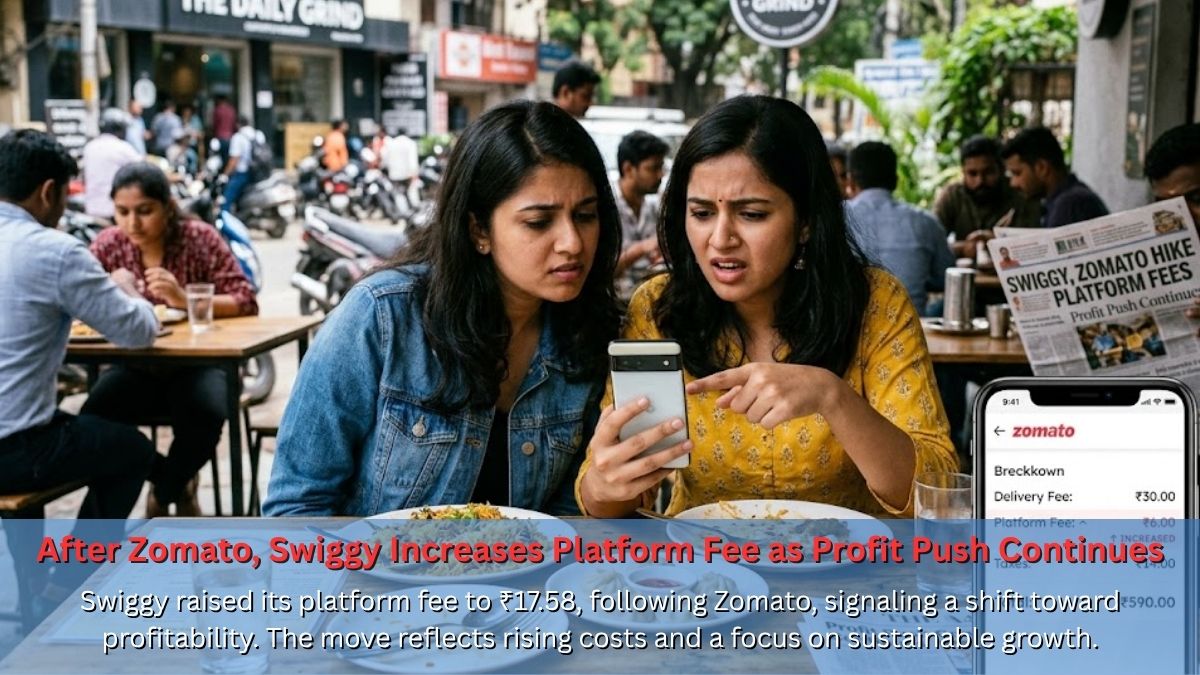
Swiggy Increases Platform Fee across its food delivery platform, raising the charge to ₹17.58 per order, shortly after a similar move by Zomato. This development signals a clear shift in India’s foodtech industry, where leading platforms are prioritizing profitability over aggressive discounting. The increase, which comes days after Zomato’s platform fee hike of over 19%, reflects rising operational costs and the need for sustainable business models. The decision by Swiggy is part of a broader trend among Indian startups and unicorn companies. After years of rapid expansion fueled by venture capital and global funding, companies are now focusing on unit economics, margins, and long-term growth strategies. Platform fees, once minimal or promotional, are becoming a key revenue stream.
For consumers, the change may appear small per order. However, frequent users could see a noticeable increase in monthly spending. For the companies, even a few rupees per order can significantly impact revenue at scale. The move also highlights intense competition in the startup ecosystem. As food delivery platforms face pressure from investors and public markets, profitability is becoming a central theme. Swiggy’s latest pricing adjustment reflects this transition from growth-first to profit-focused operations. This news article explores the implications of this pricing shift, the business model behind food delivery platforms, and what it means for the future of India’s digital commerce landscape.
2. Swiggy Increases Platform Fee: A Strategic Shift in Food Delivery Economics
There’s something quietly significant happening every time you place an order now. Swiggy has raised its platform fee to ₹17.58 per order, up from ₹14.99. On paper, it looks like a small bump. In reality, it signals a deeper shift in how food delivery businesses in India are thinking about survival and growth. What makes this move more telling is the timing. Just days earlier, Zomato made a similar adjustment. When two market leaders take near-identical steps within such a short span, it’s rarely coincidence. It’s strategy.
For years, food delivery platforms operated with a clear goal: grow fast, capture market share, and worry about profits later. Discounts were generous, delivery fees were subsidized, and convenience came cheap for customers. But that phase is ending. Now the focus has shifted. Investors are no longer impressed by just growth numbers. They want profitability, or at least a visible path to it. And companies like Swiggy are responding in the only way they realistically can, by tightening their revenue streams. From a user’s perspective, ₹2–₹3 extra per order may feel negligible. But multiply that across millions of daily transactions, and you’re looking at a serious revenue engine. This is not just a fee hike. It’s a recalibration of the entire business model.
3. Understanding the Food Delivery Business Model
To really understand why Swiggy increases platform fee, you have to step into the shoes of the company for a moment. Food delivery platforms don’t cook food. They don’t own most of the restaurants. What they do is orchestrate a complex ecosystem. They connect three moving parts: restaurants, delivery partners, and customers. And keeping this ecosystem running smoothly is far from cheap.
Every order triggers a chain reaction. There’s the cost of maintaining the app, running algorithms that assign delivery partners, ensuring real-time tracking, handling cancellations, refunds, and customer complaints. Then comes the logistics layer, arguably the most expensive part, which involves managing thousands of delivery partners across cities, dealing with fuel costs, and optimizing routes. On top of that, there’s marketing. Remember those heavy discounts and cashback offers that made ordering feel like a steal? Those were not sustainable. They were investments in customer acquisition. For a long time, companies accepted these losses as the cost of building a habit. Now that the habit is built, the math has to work. This is where the shift becomes real. Instead of chasing growth at any cost, platforms are now asking a tougher question: how do we make each order profitable?
4. Revenue Streams and the Role of Platform Fees
Platform fees, once barely noticeable, have quietly become one of the most reliable revenue streams. Earlier, these fees were often waived or kept minimal to avoid scaring away users. The idea was simple: make ordering so cheap and convenient that customers wouldn’t think twice. But scale changes everything. When a platform processes millions of orders daily, even a small fixed fee starts to matter. It becomes predictable, consistent, and less dependent on variables like restaurant commissions or delivery distances.
The new ₹17.58 fee may not change individual behavior immediately. Most users will still order when they’re tired after work, craving something specific, or simply unwilling to cook. Convenience still wins. But from the company’s side, this adds stability. It improves unit economics, meaning each order contributes a little more toward covering costs and eventually generating profit. This is the subtle but important transition from a “growth-first” mindset to a “sustainable business” approach.
5. Background: The Rise of Swiggy and Zomato
To fully appreciate this moment, it helps to look back at how far these companies have come. Swiggy, founded in 2014, didn’t just enter the market. It reshaped it. At a time when ordering food online was still a novelty in many Indian cities, Swiggy focused heavily on logistics, ensuring faster and more reliable deliveries than competitors. That focus became its biggest strength.
Zomato started earlier, as a restaurant discovery platform. Over time, it pivoted into food delivery, competing head-to-head with Swiggy. What followed was one of the most intense startup rivalries in India. Both companies raised massive funding, expanded aggressively into tier-2 and tier-3 cities, and built infrastructure at a scale that didn’t exist before. For customers, this meant one thing: food from almost anywhere, delivered to your doorstep.
But behind that convenience was years of heavy spending and thin margins. Now, the story is evolving. The same companies that once fought for users with discounts are now asking those users to share a slightly bigger part of the cost. Not abruptly, but gradually. Not loudly, but consistently. And that’s what makes this moment important. It’s not just about a ₹17.58 fee. It’s about an entire industry growing up, moving from ambition to accountability, from expansion to efficiency.
6. Why Swiggy Increases Platform Fee Now
If you look closely, this isn’t just about adding a few rupees to your bill. The timing tells a much bigger story. Swiggy didn’t wake up one morning and decide to charge more. This is the result of pressure building from multiple directions at once. Start with the most obvious one, costs. Delivering food isn’t as simple as picking up a packet and dropping it off. Fuel prices have been unpredictable, delivery partners expect better payouts, and customers expect faster delivery than ever. Behind the scenes, there’s also heavy spending on tech. Route optimization, real-time tracking, AI-driven recommendations, none of this comes cheap.
Then there’s the investor angle. For years, startups were allowed to burn cash in the name of growth. That phase is fading. Investors now want discipline. They want to see businesses that can stand on their own feet. Swiggy isn’t just answering customers anymore, it’s answering stakeholders who expect clear progress toward profitability. And competition is tighter than it looks on the surface. It’s not just about Zomato anymore. Every new player, every alternative model, adds pressure. In that environment, relying only on commissions and discounts is risky. A stable, predictable revenue stream like a platform fee becomes essential. So when you see this fee hike, it’s not random. It’s Swiggy quietly saying: “We can’t keep subsidizing convenience forever.”
7. Impact on Consumers and Market Behavior
From a customer’s point of view, the change feels small at first. A couple of extra rupees doesn’t seem like a big deal when you’re already spending ₹300–₹500 on an order. But habits reveal the real impact. If you’re someone who orders occasionally, you’ll barely notice it. But if you’re ordering three or four times a week, maybe late nights, busy workdays, weekends, that extra cost starts adding up. Over a month, it’s no longer “just ₹2 more.” It becomes part of a pattern. And yet, here’s the interesting part. Most people won’t stop ordering.
Because food delivery isn’t just about food anymore. It’s about convenience when you’re tired, comfort when you don’t feel like cooking, and sometimes just treating yourself after a long day. That emotional layer is powerful. It often outweighs price sensitivity. Still, not everyone reacts the same way. In price-sensitive segments, especially students or budget-conscious households, even small increases matter. You might see people comparing apps more often, waiting for offers, or reducing order frequency. What we’re witnessing is a subtle shift in behavior. People are becoming more aware of what they’re paying, but they’re also accepting that convenience has a price.
8. Industry Trends in Foodtech and Startup Ecosystem
What’s happening with Swiggy isn’t an isolated case. It’s part of a larger reset happening across the startup world. In the early days, the goal was simple: grow fast, capture users, dominate the market. Profitability was almost an afterthought. Discounts were everywhere, and customers got used to paying less than the real cost of service. Now, the equation is changing.
Across the globe, startups are pulling back on aggressive discounting. They’re raising fees, optimizing operations, and focusing on sustainable growth. The question has shifted from “How fast can we grow?” to “Can this business actually make money?” In India, this shift feels even more intense. The ecosystem has matured. Investors are more cautious, funding is more selective, and companies are under pressure to prove they’re not just scalable, but also viable. Swiggy increasing its platform fee is a clear signal of this transition. It shows that even market leaders are no longer chasing growth at any cost. They’re choosing stability, even if it means risking short-term customer friction.
9. Competitive Landscape and Market Dynamics
The food delivery space might look like a two-player game, but under the surface, it’s far more complex. Yes, Swiggy and Zomato dominate the market. Their scale, brand recall, and logistics networks give them a strong advantage. But they’re not operating in a vacuum. Quick commerce platforms are starting to blur the lines. What began as grocery delivery is slowly expanding into ready-to-eat meals. Then there are cloud kitchens, built purely for delivery, cutting out the traditional restaurant layer. Some restaurants are even pushing customers toward their own apps to avoid paying commissions altogether. All of this creates pressure. Not always visible, but constant.
Despite that, Swiggy and Zomato still set the tone for the industry. When they change pricing, the ripple effect is immediate. Smaller players watch closely. Competitors adjust strategies. The entire market reacts. That’s why this fee hike matters beyond just one company. It shapes expectations. It normalizes the idea that food delivery won’t always be cheap. And maybe that’s the real shift here. For years, customers got used to subsidized convenience. Now, slowly but surely, the industry is asking them to pay closer to its true cost.
10. Operational Costs and Profitability Challenges
On the surface, ordering food feels effortless. A few taps, a short wait, and your meal arrives. But behind that simplicity is a system that is constantly under financial pressure. For a company like Swiggy, every single order triggers multiple costs at once. There’s the delivery partner who needs to be fairly compensated. There’s fuel, which rarely stays stable in price. There’s the cost of maintaining a tech platform that millions rely on at the same time without glitches. Then comes customer acquisition, one of the most expensive battles in this space. Think about all the discounts, cashback offers, and push notifications you’ve seen over the years. None of that was free. It was a calculated investment to build a habit in users. Marketing adds another layer. Ads, partnerships, influencer campaigns, all designed to keep the brand top of mind in a crowded market.
When you put all of this together, you start to understand why profitability has always been difficult. It’s not that these companies didn’t want to make money earlier. It’s that the model required heavy upfront spending to even get to scale. Now that scale exists, the focus has shifted to making the numbers work. Increasing platform fees is one of the few levers that directly improves margins without completely disrupting the user experience. But it’s a delicate balance. Push too hard, and customers feel exploited. Go too slow, and profitability remains out of reach. This is the tightrope these companies are walking every day.
11. Role of Technology and Innovation
If there’s one thing holding this entire ecosystem together, it’s technology. Without it, food delivery at this scale simply wouldn’t exist. Swiggy isn’t just a delivery company. It’s a technology company at its core. Every order you place is processed through layers of algorithms that decide which delivery partner gets assigned, what route they should take, and how quickly your food can reach you. Artificial intelligence and data analytics play a huge role here. They help predict demand, reduce idle time for delivery partners, and optimize routes to save both time and fuel. Even small improvements in these areas can translate into massive cost savings when you’re operating at scale.
Then there’s the user experience. The app needs to feel smooth, intuitive, almost invisible. You shouldn’t have to think twice while ordering. That level of simplicity takes constant iteration, testing, and investment. Logistics innovation is another piece of the puzzle. From batching multiple orders in one route to setting up cloud kitchens closer to demand hotspots, companies are constantly experimenting to improve efficiency. All of this innovation isn’t just about growth anymore. It’s about survival. The better your technology, the lower your costs, and the stronger your path to profitability.
12. Broader Implications for Startup Ecosystem
What we’re seeing here goes far beyond food delivery. When Swiggy increases its platform fee, it reflects a mindset shift happening across the entire startup ecosystem. There was a time when startups were celebrated purely for scaling fast. High user numbers, rapid expansion, and big funding rounds were enough to build credibility. Profitability could wait. That narrative is changing.
Investors today are asking tougher questions. How sustainable is the business? Can it generate consistent revenue? Does the model work without heavy subsidies? This shift is visible everywhere. Fintech startups are tightening lending practices. AI companies are focusing on monetization instead of just innovation. Clean energy startups are being pushed to prove long-term viability, not just vision. What ties all of this together is discipline. Startups are no longer being rewarded just for ambition. They’re being evaluated on execution, efficiency, and their ability to build something that lasts. Swiggy’s decision fits perfectly into this new reality.
13. Learning for Startups and Entrepreneurs
There’s a lot to learn from this, especially if you’re building something yourself. The first lesson is simple but often ignored. Growth without a path to profit is a temporary win. It feels good in the moment, but eventually, the numbers catch up. Second, relying on a single revenue stream is risky. Swiggy earns from commissions, delivery charges, and now increasingly from platform fees. That diversification gives it flexibility when one stream comes under pressure.
Third, pricing is not static. What works in the early stage won’t work forever. Markets evolve, customer expectations shift, and businesses need to adapt. Holding on to old pricing models for too long can hurt more than changing them. And finally, never lose sight of the customer. Even as companies push toward profitability, the experience still matters. If users feel the value is worth the cost, they stay. If they feel taken for granted, they leave. It’s that simple. What makes this moment interesting is that it captures a transition. Not just for one company, but for an entire generation of startups learning to move from excitement to responsibility, from chasing growth to building something that can truly sustain itself.
About foundlanes.com
foundlanes.com is India’s emerging startup idea platform dedicated to helping aspiring entrepreneurs discover practical business opportunities. The platform publishes detailed startup guides, founder stories, market insights, and execution strategies designed for students, professionals, and early-stage founders. By simplifying complex business concepts and presenting them in accessible formats, foundlanes aims to empower individuals to explore entrepreneurship and launch successful ventures in India’s rapidly evolving startup ecosystem.