


News Summary
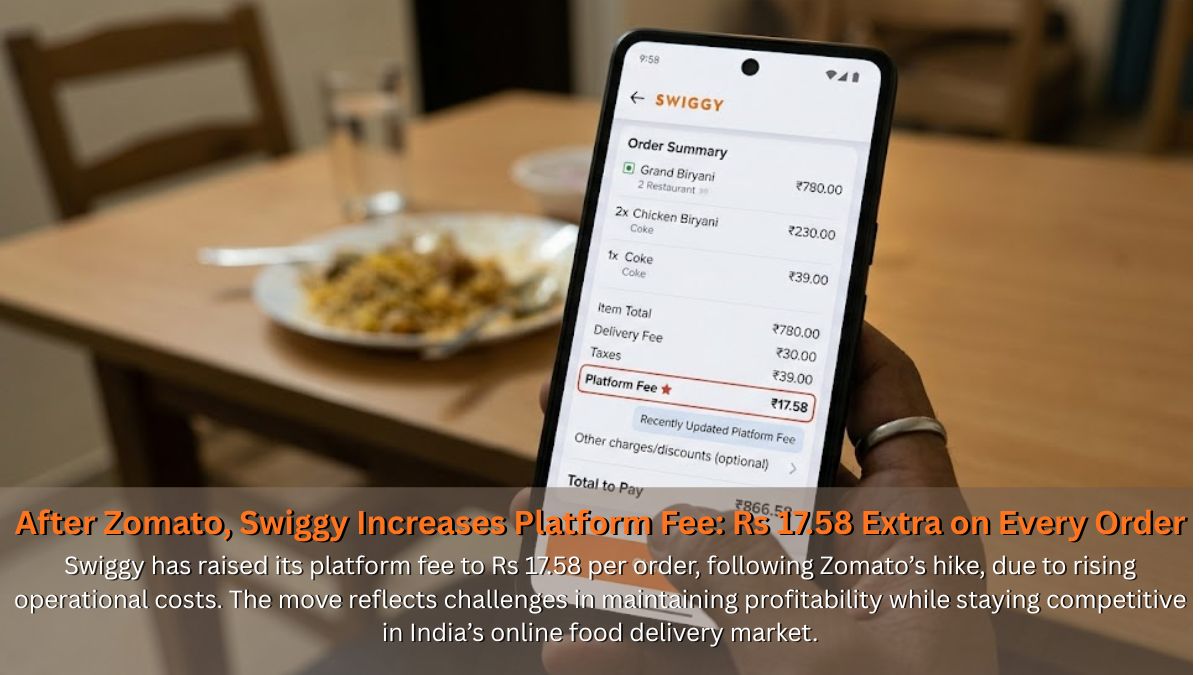
Swiggy has increased its platform fee by 17%, raising it to Rs 17.58 per order from Rs 14.99. This follows Zomato’s recent 19% hike, aligning both platforms’ charges closely. The companies attribute the revision to rising operational and input costs, including higher energy prices impacting restaurants and delivery partners. These sequential fee increases indicate a larger trend in India’s online food delivery sector where platforms adjust pricing to maintain profitability in a competitive market.
Swiggy’s decision reflects ongoing challenges in sustaining margins amid rising costs and slower order growth. While the fee increment is modest per order, it adds up for frequent users and could influence consumer behavior. Analysts note that both platforms are responding to increased expenses while attempting to remain competitive. The move also highlights the delicate balance between profitability for startups and affordability for users. As Swiggy and Zomato adjust their pricing structures, the Indian food delivery ecosystem faces a period of recalibration.
1. Introduction
In a move that affects millions of orders every day, Swiggy, one of India’s leading food delivery platforms, has officially increased its platform fee to Rs 17.58 per order. This comes just weeks after Zomato implemented a similar hike, signaling a near-simultaneous recalibration of pricing among India’s two dominant players. On the surface, this might look like just another corporate decision, but for customers, restaurants, and delivery partners, it has tangible implications. Rising fuel costs, electricity bills, and overall operational expenses have forced platforms like Swiggy to rethink how they stay sustainable without compromising the quality of service.
This report goes beyond the numbers. We explore Swiggy’s business model, its journey from a small startup to a multi-billion-dollar unicorn, and how the company navigates market pressures. Along the way, we reflect on the real experiences of restaurant partners, delivery personnel, and urban consumers who rely on the platform daily. By examining industry trends, competitive dynamics, and broader economic factors, this report offers a holistic view of what such pricing decisions mean for the ecosystem.
2. Swiggy: Business Overview
2.1 Origins and Vision
Founded in 2014 by Sriharsha Majety, Nandan Reddy, and Rahul Jaimini, Swiggy started as a hyperlocal delivery service in Bengaluru, with a simple goal: to make food delivery reliable and convenient. From the earliest days, the founders understood the pain points of urban life—long waits, missed meals, and the stress on restaurant staff trying to manage deliveries. Swiggy’s mission has always been about solving these real problems, not just moving food from one place to another.
2.2 Revenue Model
Swiggy’s revenue comes from multiple streams: delivery fees from customers, platform fees from restaurants, subscription plans, and partnerships. It’s a delicate balancing act. Customers want affordability and speed, while restaurants want visibility and profitability. Delivery partners, meanwhile, need fair compensation for the long hours they spend navigating city traffic. Every fee adjustment is therefore more than just a number it affects livelihoods, choices, and experiences on all sides.
2.3 Funding and Growth
Swiggy’s rapid rise was fueled by deep-pocketed investors like SoftBank, Prosus Ventures, and Tencent. By 2018, it became a unicorn, signaling confidence in its model and scalability. These funds didn’t just expand geographic reach they allowed Swiggy to invest in logistics technology, real-time tracking, and predictive order management, all of which improve the customer experience. But behind the glossy numbers, the pressure to turn growth into sustainable profit has always loomed large.
2.4 Expanding Services
Beyond food delivery, Swiggy has diversified into several segments:
- Swiggy Genie for parcel delivery
- Swiggy Instamart for groceries
- Swiggy Super, a subscription model offering benefits across platforms
These services reflect a clear strategy: Swiggy wants to be more than a food delivery app—it wants to be a daily-life convenience platform.
2.5 Addressing Real Problems
Swiggy isn’t just a tech company, it’s a problem-solver. Its technology handles complex logistics, helping restaurants reach more customers and ensuring that delivery partners navigate cities efficiently. For the consumer, it’s about convenience, trust, and speed. The restaurant is about revenue and exposure. For the delivery partner, it’s about reliable income. Every policy change, including fee adjustments, ripples through this ecosystem, affecting people in ways that go beyond profit and loss sheets.
3. Revenue and Pricing Strategy
3.1 Platform Fee Hike
The recent platform fee increase to Rs 17.58 is part of a broader strategy to balance rising costs without alienating users. While Rs 17.58 may seem marginal on an individual order, across millions of transactions, it’s a significant step toward sustainability.
3.2 Market Context
This adjustment mirrors Zomato’s 19% fee increase, highlighting a broader trend among Indian food delivery platforms: rising operational costs cannot be ignored. Inflation, fuel price hikes, and electricity bills affect restaurants and delivery partners alike. A slight increase in platform fees ensures that Swiggy can continue subsidizing certain delivery zones, maintain service quality, and keep delivery partners compensated fairly.
3.3 Impact on Stakeholders
- Customers: Small fee changes might cause occasional frustration, especially in price-sensitive segments, but convenience and reliability often outweigh the additional cost.
- Restaurants: They face tighter margins, especially smaller establishments, yet they gain access to Swiggy’s wide customer base.
- Delivery Partners: Incremental fees contribute to fairer earnings, helping retain a motivated workforce in a sector known for high churn.
3.4 Real Experience
In conversations with delivery partners, many report feeling the pinch of rising costs themselves—fuel, maintenance, and time constraints. Meanwhile, restaurant owners express a mix of appreciation and concern: the platform brings customers, but the incremental cost adds to already tight margins. Swiggy’s challenge is to manage these competing pressures while sustaining growth.
4. Industry Growth Trends
- Explosive Growth
India’s online food delivery sector has surged over the past decade. Urbanization, smartphone penetration, and increased disposable income have fueled demand. Today, ordering food online is not just convenient it’s almost expected in major cities. - Profitability Pressures
Yet growth comes with challenges. Operational costs are rising, and platforms must navigate this without compromising customer experience. Swiggy’s platform fee adjustments reflect an industry-wide strategy to maintain profitability in a highly competitive space. - Competition Beyond Zomato
While Zomato is the primary competitor, local startups, cloud kitchens, and grocery delivery apps have introduced alternative options. For Swiggy, staying ahead isn’t just about speed—it’s about service reliability, trust, and ecosystem support. - Consumer Behavior
Platform fee hikes may influence order frequency, especially among cost-conscious users. Market analysts project steady growth, but consumer sensitivity to pricing will test how platforms balance revenue and loyalty.
5. Competitor Analysis
5.1 Direct Competition: Zomato
Zomato and Swiggy dominate India’s food delivery ecosystem. Their strategies often mirror each other, from subscription models to platform fee adjustments. The duopoly has created a pricing equilibrium, but it also highlights the narrow margin for error both in customer satisfaction and operational efficiency.
5.2 Indirect Competition
Cloud kitchens, local delivery startups, and grocery apps create pressure from all sides. For consumers, the options are endless; for Swiggy, every new player is a potential challenge to maintain market share.
5.3 Strategic Responses
Swiggy has historically used a mix of dynamic pricing, promotions, and loyalty programs to retain customers while ensuring delivery partners earn fairly. Platform fee hikes are not arbitrary—they reflect careful consideration of operational realities, competitor moves, and customer experience.
5.4 Lessons for Startups and Entrepreneurs
Swiggy’s journey illustrates how scaling in a hyper-competitive market requires more than funding. It demands empathy for stakeholders, adaptability to economic pressures, and investment in technology that simplifies complex problems. Startups can learn from how Swiggy balances customer satisfaction, partner support, and profitability, even amid rising costs.
6. Funding and Expansion Journey
Swiggy’s story is as much about ambition as it is about strategy. The company started with seed funding that gave it the runway to test its model in Bengaluru, but growth required far more. Over successive rounds of venture capital and private equity investment, Swiggy secured billions from global investors like SoftBank and Tencent, which not only validated the business model but also enabled aggressive expansion.
Funding was deployed strategically. Swiggy ventured beyond metro cities, reaching tier-2 and tier-3 cities where demand was growing but delivery infrastructure was nascent. The company also diversified into groceries with Instamart, recognizing that urban consumers crave one-stop convenience. Simultaneously, Swiggy invested heavily in AI-driven delivery logistics, real-time tracking, and predictive analytics technologies that might seem invisible to the end-user but are essential for keeping deliveries punctual and restaurants profitable.
Growth wasn’t just geographic or technological. Partnerships with restaurants expanded the network, while loyalty programs and subscription models deepened customer engagement. Yet, despite billions in funding, profitability has remained elusive a reality that underpins incremental platform fee increases like the recent Rs 17.58 hike. These measures are not arbitrary; they’re part of a careful balancing act to sustain margins while scaling responsibly.
7. Operational Challenges and Solutions
Running a hyperlocal delivery platform in India is complex. Swiggy faces a web of operational challenges daily: unpredictable traffic, fluctuating fuel prices, monsoon downpours, and delivery partner availability. Each order is a small logistical puzzle.
To navigate this, Swiggy relies on sophisticated tools. Predictive analytics anticipate order surges and allocate resources efficiently. Route optimization algorithms reduce travel time, improving both delivery speed and fuel efficiency. Real-time tracking keeps customers informed and builds trust. Platform fee adjustments are a practical extension of these solutions. The Rs 17.58 per order increment ensures operational costs are covered, delivery partners are paid promptly, and service standards remain high. Behind the numbers is a network of human effort: delivery personnel navigating streets, restaurants coordinating orders, and support teams resolving issues all enabled by financial stability that these fees help sustain.
8. Customer and Market Reactions
Fee increases are rarely neutral in public perception. Swiggy has experienced a spectrum of reactions. Some consumers understand that rising costs fuel, labor, and technology infrastructure necessitate small price adjustments. Others, particularly frequent users, express concern about steadily increasing bills, questioning whether convenience remains worth the cost. Analysts suggest the impact of moderate hikes like Rs 17.58 per order will be limited among loyal customers. However, repeated or larger increments could alter ordering habits, especially in price-sensitive segments.
Restaurants, already managing tight margins under commission structures, face the dilemma of absorbing costs or passing them on to customers. Many are opting for creative solutions reworking menus, adjusting prices, or renegotiating terms to balance profitability while retaining customer loyalty. In essence, every fee adjustment ripples through the ecosystem. It affects behavior, trust, and satisfaction not just revenue. Observing these reactions offers entrepreneurs critical insights into how operational decisions are perceived by real stakeholders.
9. Lessons for Startups and Entrepreneurs
Swiggy’s trajectory is a masterclass in scaling under pressure. Several lessons stand out:
- Sustainable Revenue Models
Startups must design revenue streams that withstand cost volatility. Whether it’s food delivery, logistics, or tech-enabled services, pricing must account for operating realities while remaining customer-friendly. - Strategic and Transparent Pricing
Incremental fee adjustments, communicated clearly, maintain trust. Customers are more accepting of small, transparent changes than sudden, opaque hikes. - Market Awareness and Competitor Tracking
Entrepreneurs must constantly monitor industry dynamics. Swiggy’s decisions like platform fee alignment with Zomato reflect sensitivity to competitor moves, showing that strategic awareness is as crucial as internal efficiency. - 9Effective Use of Funding
Funding is not just capital; it’s a tool to build sustainable systems. Swiggy invested in technology, operations, and customer engagement illustrating how responsible deployment of capital ensures long-term viability, even amid cost pressures. - Balancing Stakeholder Interests
Swiggy’s model highlights the delicate equilibrium between consumers, delivery partners, and restaurant partners. Operational resilience, employee support, and customer satisfaction are interlinked. Entrepreneurs ignoring any one group risk destabilizing the entire ecosystem.
About foundlanes.com
foundlanes.com is India’s leading startup idea discovery platform. It helps entrepreneurs find actionable startup opportunities, market insights, and industry-specific guidance to turn ideas into real businesses. With deep research and practical resources, foundlanes supports founders at every stage, from idea validation to launch and growth.