


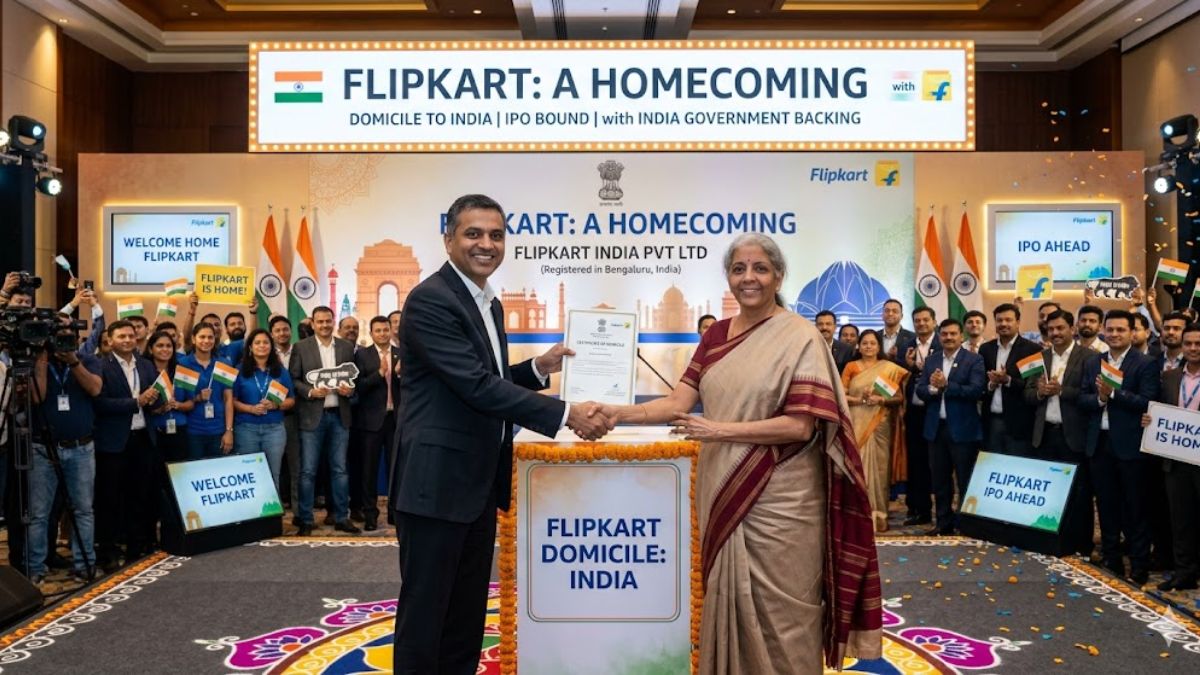
News Summary
Indian e-commerce giant Flipkart Shifts Domicile from Singapore to India, marking a crucial step ahead of a potential Initial Public Offering (IPO). This move aligns the company’s legal structure with its operational base, as most of its customers, sellers, and business activities are in India. Flipkart’s management confirmed that the government of India approved the internal restructuring, signalling strong support for the company’s domestic growth and market integration.
Founded in 2007 by Sachin Bansal and Binny Bansal, Flipkart started as an online bookstore and gradually expanded into a full-fledged e-commerce marketplace covering electronics, fashion, and consumer goods. Over the years, the company attracted significant foreign investment, including a 77% acquisition by Walmart in 2018, valuing Flipkart at approximately $21 billion.
By shifting its holding company back to India, Flipkart removes structural barriers that overseas-incorporated firms often face when listing on Indian stock exchanges. The company is now exploring IPO possibilities with major investment banks such as Goldman Sachs, Morgan Stanley, JP Morgan, and Kotak Mahindra Capital. Analysts suggest that a listing could occur as early as late 2026 or 2027, depending on market conditions. The relocation also highlights a broader trend of Indian startups reconsidering overseas structures to take advantage of domestic capital markets, regulatory ease, and government incentives.
1. Flipkart Shifts Domicile: Background and Context
1.1 Corporate Restructuring
The announcement that Flipkart Shifts Domicile from Singapore to India is more than just a legal formality it marks a profound turning point in the company’s journey. After years of operating under an overseas holding structure, Flipkart has now realigned its corporate identity with the reality that its heart, operations, and most of its customers are firmly rooted in India. The redomiciliation process involved meticulous legal and financial planning, including securing approvals from multiple regulatory authorities. Today, Flipkart Internet Private Limited serves as the central holding company, bringing all subsidiaries, operations, and strategic initiatives under one India-based umbrella.
For employees and investors, this move signals stability. For millions of Indian consumers who rely on Flipkart daily, it strengthens trust, showcasing a company committed to India not just in operations, but in governance and accountability. By localizing its corporate base, Flipkart now positions itself to navigate India’s regulatory and market environment with far greater agility. Executives familiar with the process describe it as both “complex and deeply rewarding,” emphasizing that it was a decision made not only for business efficiency but also for long-term vision.
1.2 Strategic Reasons
When Flipkart initially incorporated overseas, it was a strategic necessity. Singapore offered international investors a familiar legal environment, easier cross-border fundraising, and flexibility in global financial transactions. These advantages were instrumental in Flipkart’s rapid growth. Helping the company scale from a small online bookstore to a sprawling e-commerce giant valued at over $20 billion.
However, as Flipkart prepares for a public listing in India, the benefits of a foreign structure have become less relevant. An India-based corporate identity provides direct access to domestic capital markets, removes potential regulatory friction, and aligns shareholder interests more closely with India’s economic priorities. The shift also demonstrates foresight by relocating ahead of an IPO, Flipkart avoids the pitfalls that foreign-incorporated companies often face during domestic public listings.
Executives involved in the process noted that the move immediately enhanced investor confidence. Analysts suggest that it also creates a clearer narrative for shareholders: this is a homegrown company, rooted in Indian innovation, contributing to the local economy, and ready to be accountable to the Indian public market. The strategic foresight resonates with Flipkart’s broader mission: to be not just India’s e-commerce leader. But also a symbol of what local entrepreneurship can achieve on a global scale.
1.3 Government Backing
Perhaps the most significant aspect of this move is the active support from the Indian government. Flipkart publicly expressed gratitude for the guidance and approvals that facilitated the redomiciliation, highlighting a partnership between private enterprise and public policy. This is more than procedural—it reflects a recognition that large, innovative companies like Flipkart play a critical role in India’s economic growth and employment generation.
Executives described the government’s cooperation as “instrumental in making a complex, high-stakes process smooth.” For stakeholders and the public, it sends a strong signal that India is an ecosystem where major businesses can thrive, innovate, and contribute to the national economy. Beyond regulatory alignment, the move embodies a sense of pride for Flipkart employees and founders alike: their company’s story is now fully Indian, both in spirit and in structure.
In practical terms, government backing also ensures smoother IPO readiness. By aligning with national policies and local corporate governance frameworks, Flipkart has set the stage for a seamless entry into India’s capital markets. For the wider startup community, it illustrates how strategic collaboration between private innovators and public institutions can create outcomes that are both profitable and transformative for society.
2. Flipkart’s Business Model and Operations
2.1 E-commerce Platform
When we say Flipkart Shifts Domicile, it’s not just about corporate paperwork it also reflects the heartbeat of one of India’s largest digital marketplaces. Flipkart has built more than an e-commerce platform; it has created an ecosystem that connects millions of buyers with sellers, bridging gaps between urban demand and rural supply. From electronics to fashion, home appliances to everyday essentials, Flipkart caters to a vast spectrum of needs.
A cornerstone of this success is Ekart, Flipkart’s logistics arm. Ekart isn’t just a delivery service it’s the lifeline that ensures products reach over 22,000 pin codes, from bustling metros to remote towns. Employees recount the pride in seeing packages delivered to the most distant corners of India, sometimes overcoming logistical nightmares like floods, roadblocks, or remote terrain. This operational excellence is why customers feel confident ordering high-value items online, even in places where traditional retail options are limited.
Flipkart’s platform also embodies human-centric innovation. Its technology anticipates customer needs, suggests products, and provides seamless navigation. Sellers, from small entrepreneurs to large brands, can rely on Flipkart for exposure, digital tools, and business growth. In essence, Flipkart has woven technology, logistics, and human empathy into a single marketplace that feels both reliable and personal.
2.2 Revenue Streams
Flipkart’s revenue model reflects a balance of innovation and strategic depth. Each stream tells a story of value creation for both consumers and partners:
- Marketplace Commissions: Every sale made through Flipkart generates a commission, but it’s more than a fee it’s a partnership. Sellers often describe Flipkart as a mentor, helping them grow their brand visibility and customer base.
- Advertising: Brands pay to highlight products, and Flipkart uses intelligent algorithms to maximize relevance. This ensures consumers see what they truly need, rather than generic ads, creating a more satisfying shopping experience.
- Logistics Services: Ekart supports third-party sellers, extending Flipkart’s operational excellence to the wider ecosystem. This is critical in India, where timely delivery can make or break trust in e-commerce.
- Financial Services: Flipkart has introduced EMI options, digital wallets, and fintech solutions, enabling consumers to purchase confidently. It’s not just convenience it’s empowerment, especially for first-time online shoppers in Tier-2 and Tier-3 cities.
Together, these revenue streams create a self-sustaining, integrated ecosystem. Flipkart doesn’t just sell products—it sells trust, convenience, and growth opportunities for millions of sellers.
3. Founders, Funding, and Growth
3.1 Founders’ Journey
Flipkart’s story begins with Sachin Bansal and Binny Bansal, two IIT Delhi graduates with a vision to redefine retail in India. Starting in 2007 as an online bookstore, they quickly understood that India needed more than just an e-commerce platform it needed a reliable, trustworthy marketplace that could scale across geography, socio-economic segments, and product categories.
Their journey is marked by resilience. Early challenges included delayed payments, distrust of online shopping, and limited infrastructure. Yet, they invested deeply in logistics, customer service, and technology. Employees recount how the founders would personally intervene in customer complaints, sometimes coordinating deliveries at odd hours to ensure satisfaction. This hands-on approach built the foundation for Flipkart’s culture of customer obsession.
The founders’ ability to adapt global learnings like Amazon’s model to Indian realities was critical. They innovated solutions for cash-on-delivery payments, regional language support, and small-town logistics, creating a platform that felt familiar, trustworthy, and inclusive.
3.2 Funding History
Flipkart’s growth was fueled by strategic funding rounds that supported scale, technology, and market leadership. Over $7 billion in funding came from global investors including Tiger Global, Accel Partners, SoftBank, and Naspers. Walmart’s landmark $16 billion acquisition of a 77% stake in 2018 catapulted Flipkart into the league of India’s most valuable unicorns, with a valuation of approximately $21 billion.
Investors saw more than numbers they recognized Flipkart’s ability to transform the retail landscape. Employees often recall investor meetings where the emphasis was on vision, execution, and social impact, not just financial returns. This combination of capital and purpose allowed Flipkart to innovate fearlessly, from introducing Ekart to pioneering digital payment solutions and new shopping experiences.
4. Services and Problem Solving
Flipkart’s real strength lies in the problems it solves for both consumers and sellers:
- Accessibility: Flipkart brings online shopping to Tier-2 and Tier-3 cities where traditional retail is limited. Families in smaller towns can order electronics, groceries, or fashion items once considered urban luxuries.
- Logistics: Through Ekart, Flipkart ensures reliable delivery across India. Stories abound of delivery agents trekking kilometers in rural areas, ensuring timely arrival of packages. This operational commitment builds trust and loyalty.
- Consumer Trust: Flipkart’s transparent return policies, secure payment systems, and product authenticity checks reduce the fear of fraud, a significant barrier in Indian e-commerce. Customers often share emotional stories of Flipkart resolving problems promptly, creating lifelong loyalty.
- Seller Support: Flipkart provides digital tools for inventory, marketing, and analytics, enabling small businesses to scale rapidly. Many sellers attribute their growth to Flipkart’s ecosystem, describing it as a launchpad that transforms dreams into viable businesses.
Through these services, Flipkart is not just a platform it’s a catalyst for change, creating tangible benefits for millions while redefining retail norms in India.
5. Industry Trends and Market Growth
The e-commerce landscape in India is not just growing it is transforming the very way people live, shop, and interact with businesses. Smartphones, affordable data, and the proliferation of digital payment solutions have made online shopping accessible to millions across cities and rural towns alike. Flipkart has been at the heart of this revolution, shaping consumer expectations around convenience, reliability, and trust.
Analysts forecast that India’s online retail market will soar to $200 billion by 2026, driven not only by urban adoption but by the rapid digitalization of Tier-2 and Tier-3 cities. Flipkart’s decision to relocate its corporate base to India aligns perfectly with this trajectory. By anchoring itself domestically, Flipkart positions to access local capital markets, deepen government support, and integrate more closely with India’s growing digital economy. Employees share stories of the first time families in smaller towns received electronics or appliances from Flipkart a moment that often transformed daily life, illustrating the real human impact behind these market numbers.
6. Competitors
Flipkart operates in a fiercely competitive ecosystem, where every decision matters. Understanding the competitive landscape is critical to appreciating the stakes involved in Flipkart Shifts Domicile.
6.1 Direct Competitors
- Amazon India: The global e-commerce giant and Flipkart’s most formidable competitor, constantly innovating with logistics, Prime memberships, and customer loyalty programs.
- Reliance Retail: Leveraging its brick-and-mortar presence and digital expansion, Reliance has become a serious threat in both offline and online retail.
- Tata Cliq: Integrates premium products with a hybrid marketplace model, catering to niche urban consumers.
6.2 Indirect Competitors
- Nykaa: Specializes in beauty and lifestyle, building loyal communities around product expertise.
- BigBasket: A grocery-focused platform with strong urban penetration and subscription-based delivery models.
- Meesho: Empowers social resellers and micro-entrepreneurs, creating a new e-commerce layer that reaches the remotest areas.
For Flipkart, competition is not just about pricing or logistics it’s about creating experiences that resonate emotionally with customers and sellers. Team members often recall the intensity of strategic sessions, where decisions are made not only with numbers in mind but with a sense of responsibility toward millions of Indian users.
7. Flipkart Shifts Domicile: IPO Outlook
The shift to a domestic holding structure opens the door for Flipkart to consider a public listing in India a moment long anticipated by investors, founders, and employees alike. Discussions are reportedly underway with top investment banks such as Goldman Sachs, Morgan Stanley, JP Morgan, and Kotak Mahindra.
Market analysts suggest that an IPO could be viable by late 2026 or early 2027. Though timing will depend on market conditions, regulatory approvals, and investor sentiment. For the Flipkart team, this is more than a financial milestone. It is a testament to years of grit, innovation, and customer obsession. Staff and leadership often recount the emotional satisfaction of seeing a small bookstore transform into a company capable of reshaping Indian commerce. The IPO would not just unlock value for shareholders. It would cement Flipkart’s legacy as a homegrown icon of Indian entrepreneurship.
8. Company Journey and Milestones
8.1 Early Years
Flipkart’s journey is a story of ambition meeting opportunity:
- 2007: Founded in Bengaluru as an online bookstore. The company struggled with limited resources but thrived on relentless focus and innovation.
- 2010–2015: Expanded into electronics, fashion, and general merchandise, scaling operations and logistics across India.
- 2018: Walmart acquired a 77% stake, valuing Flipkart at $21 billion a validation of both its market impact and visionary leadership.
8.2 Operational Scale
Today, Flipkart touches the lives of over 500 million customers and supports 1.6 million sellers nationwide. Deliveries span 22,000+ pin codes, bridging urban and rural India, and creating opportunities for small businesses to reach global-scale markets. Employees recount experiences of problem-solving under pressure, delivering critical orders even during floods, strikes, or remote terrain challenges.
8.3 Strategic Decisions
Flipkart’s strategic choices initially incorporating overseas for global funding, then redomiciling to India reflect remarkable foresight. The founders understood that business agility requires adapting to evolving market realities. Balancing international investment opportunities with the growing domestic appetite for public market participation.
9. Learning for Startups and Entrepreneurs
Flipkart’s story is a treasure trove of lessons for startups and entrepreneurs navigating the Indian ecosystem:
- Adapt corporate structure to market goals: Align legal frameworks with both operational realities and future growth ambitions.
- Leverage global funding without losing domestic focus: International investors provide scale, but domestic alignment ensures sustainability and public trust.
- Innovate logistics and technology for scale: Efficient, reliable, and customer-focused operations create long-term loyalty and competitive advantage.
- Engage proactively with government policies: Collaboration with regulatory bodies smooths growth and opens strategic opportunities.
- Plan exits and IPOs strategically: Timing, preparation, and transparency are crucial for long-term success.
The key takeaway is that startups must balance ambition with grounded execution. Flipkart’s journey demonstrates how vision. Relentless execution, and empathy toward customers and employees can create a company that is not just commercially successful. But socially transformative. Entrepreneurs are reminded that every decision from corporate domicile to logistics innovation can have far-reaching impacts on both business and society.
About foundlanes.com
foundlanes.com is India’s leading startup idea discovery platform. It helps entrepreneurs find actionable startup opportunities, market insights, and industry-specific guidance to turn ideas into real businesses. With deep research and practical resources, foundlanes supports founders at every stage, from idea validation to launch and growth.