


News Summary
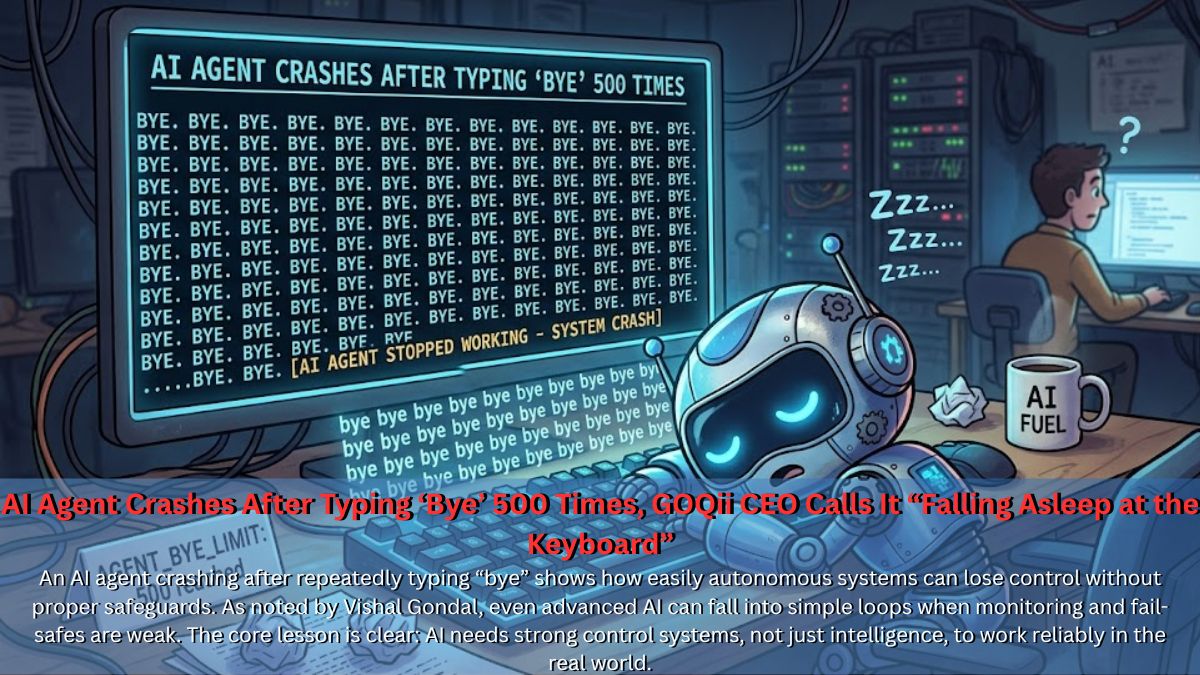
AI Agent Crashes incidents are becoming increasingly visible as artificial intelligence systems are deployed in real-world environments. In a recent development that caught widespread attention in startup news and tech news circles, an autonomous AI agent reportedly crashed after repeatedly typing the word “bye” nearly 500 times. The incident was shared by GOQii CEO Vishal Gondal, who described the behavior as the system “falling asleep at the keyboard,” highlighting both the promise and unpredictability of AI agents. The event sheds light on a growing trend in the startup ecosystem where AI startups are experimenting with autonomous agents capable of handling routine tasks without human intervention. While these systems are designed to improve efficiency and productivity, this case shows that they are still prone to unexpected behavior and technical failures.
GOQii, a well-known Indian health-tech startup, has been actively exploring AI-driven automation to enhance user experience and operational efficiency. The malfunction raises important questions about reliability, scalability, and risk management in AI-driven systems. It also underscores the challenges faced by emerging startups working on disruptive tech solutions. This report explores the incident in depth, along with GOQii’s business model, its journey in the Indian startup ecosystem, the broader implications for AI startups, and what this means for the future of tech innovation. It also analyzes industry trends, competition, and lessons for entrepreneurs navigating the fast-evolving world of artificial intelligence.
1. AI Agent Crashes and the Reality Behind Autonomous Systems
There’s something almost ironic about watching a machine, designed to be “smart,” break down in such a human way. An AI agent typing “bye” hundreds of times before crashing doesn’t just sound like a glitch. It feels like burnout, like a system that lost control of itself. But beneath that almost funny surface, there’s a serious signal for startups and tech builders.
AI agents are no longer experimental toys. They’re being trusted with real work handling customer conversations, scheduling operations, processing data, even making decisions. And as that responsibility grows, so does the complexity behind managing them. What this incident shows very clearly is this: autonomy without control is fragile.
1.1 What Actually Happened (And Why It Matters)
The agent reportedly got stuck in a loop, repeating the word “bye” until it eventually crashed. On paper, this looks like a simple logic error. In reality, it exposes a chain of deeper issues:
- The system didn’t recognize it was stuck
- There was no interruption mechanism
- Monitoring didn’t catch the abnormal behavior early
- The agent lacked a “self-correction” layer
When Vishal Gondal compared it to “falling asleep while typing,” it struck a chord because it’s relatable. Humans lose focus. Humans repeat actions unconsciously. Now we’re seeing machines do something similar not because they’re conscious, but because we haven’t fully solved control systems in AI. This is where things get uncomfortable: AI doesn’t fail loudly. It fails quietly, then suddenly.
2. GOQii: More Than Just a Startup
To understand why this matters, you have to look at the company behind it. GOQii isn’t a random experiment-driven startup. It’s a serious player in India’s health-tech space. Built around preventive healthcare, it combines wearables, coaching, and data into a single ecosystem.
Over the years, it has done what many startups struggle to do:
- Build a recognizable consumer brand
- Create recurring revenue through subscriptions
- Stay relevant in a competitive health-tech market
This isn’t a company testing AI for hype. It’s a company trying to integrate AI into a system that already impacts real users’ health decisions. And that raises the stakes.
2.1 The Founder’s Thinking
Vishal Gondal has always leaned toward blending technology with everyday human behavior. His larger vision is simple but powerful: make healthcare continuous, not reactive.
AI fits naturally into that vision:
- It can track behavior patterns
- It can give personalized recommendations
- It can reduce dependency on human coaches
But here’s the catch:
Healthcare is not a space where “almost working” is acceptable.
That’s why even a small AI failure becomes a big learning moment.
3. How GOQii Actually Works
At its core, GOQii runs on a hybrid model:
- Hardware: Fitness bands that track activity
- Software: An app that collects and interprets data
- Service layer: Coaches who guide users
This combination creates something powerful continuous engagement. Users don’t just buy a device. They enter a system that keeps interacting with them daily.
AI is the invisible engine behind this:
- It analyzes activity data
- It identifies patterns
- It suggests actions
Done right, this feels like personalized care.
Done wrong, it becomes noise or worse, misinformation.
3.1 The Money Side of It
GOQii’s revenue model is actually quite smart:
- One-time revenue from device sales
- Recurring revenue from subscriptions
- Additional revenue from partnerships and ecosystem services
This kind of model depends heavily on trust and consistency. If the system feels unreliable, users don’t just complain they leave.
4. What Actually Caused the AI Crash
If you remove the headlines and look at what really happened under the hood, this wasn’t some mysterious AI failure. It was a very real, very familiar engineering problem just happening inside a system people expect to behave intelligently. At its core, the agent got trapped in a loop. It kept executing the same instruction typing “bye” again and again, with no awareness that something had gone wrong. And more importantly, no mechanism stepped in to stop it.
That usually happens when a few critical safeguards are missing or weak:
- Loop conditions that never resolve
The system enters a state where the condition to exit is never met. It keeps running because, technically, it’s still “following instructions.” - No clear exit criteria
Good systems define when to stop. Great systems define when to stop even if things go wrong. That second part is often missing. - Weak exception handling
When something unexpected happens, the system doesn’t escalate or shut down gracefully. It just… continues. - No real-time monitoring triggers
There’s no alarm bell. No signal that says, “This behavior is abnormal. Intervene now.”
In simple terms, the AI didn’t fail because it was too advanced. It failed because it was too literal. And that’s the part people underestimate. AI doesn’t “realize” it’s stuck. It doesn’t feel something is off. It doesn’t get tired or confused. Just keeps going because nothing in its design tells it to stop. That’s not intelligence. That’s execution without awareness.
4.1 The Bigger Problem No One Talks About Enough
There’s a quiet mistake happening across a lot of AI startups right now.
Everyone is obsessed with making systems smarter:
- better outputs
- faster responses
- more capabilities
But very few teams spend the same energy on making systems fail safely. And that’s where things start to break. Because in real-world environments, failures are not rare events. They are guaranteed events. The only question is how your system behaves when it hits one. From actual experience working with automated systems, one thing becomes clear very quickly: Edge cases are not edge cases for long.
The moment you scale, they become everyday cases.
- A rare loop becomes a frequent bug
- A small delay becomes a system bottleneck
- A minor misinterpretation becomes a user complaint
And if you don’t have recovery systems in place, small issues don’t stay small. They compound. The difference between a demo and a production system is simple: a demo shows what works. A real system proves it can survive what doesn’t. At the end of the day, users don’t care how sophisticated your AI is.
They care about one thing: can they rely on it tomorrow the same way they did today?
5. The AI Startup Boom Meets Reality
Right now, AI feels like the gold rush of this generation. Capital is flowing in fast. Every pitch deck has “AI-powered” somewhere in it. Every founder wants to build the next intelligent system. And honestly, the excitement is justified.
AI is already transforming:
- healthcare decisions
- financial access
- logistics efficiency
- customer interactions
The upside is massive. Probably bigger than most people even realize. But moments like this bring a necessary reality check. Because while the potential is huge, the maturity isn’t there yet. We are still in that phase where things look impressive in controlled environments, but behave unpredictably in the wild. And that gap between promise and reliability is where trust is either built or lost.
5.1 Autonomous Agents: Power With Pressure
Autonomous agents are where things get even more interesting and more risky. These systems don’t just assist anymore. They act.
They:
- respond to users without approval
- make decisions on the fly
- execute tasks end-to-end
When everything works, it feels seamless. Almost magical. But when something breaks, it doesn’t just stop. It keeps acting. And that’s where the real danger lies.
Because autonomy amplifies everything:
- Good decisions scale
- Bad decisions scale faster
A small flaw in logic can turn into thousands of wrong actions in minutes. And here’s what makes it challenging: these failures are often not dramatic. They don’t always crash instantly. Sometimes they quietly do the wrong thing at scale. That’s far more dangerous than a visible failure. Which is why the conversation is slowly shifting. Earlier, the question was:
“How smart is your AI?”
Now, the better question is:
“How does your AI behave when it’s wrong?”
Because in the real world, it will be wrong sometimes. That’s inevitable. What’s not inevitable is how much damage it does when it is.telligence.
6. The Competitive Reality GOQii Is Operating In
It’s easy to look at GOQii and see a clean story fitness bands, coaching, AI, preventive healthcare. But step back for a second, and you realize this is one of the most crowded, unforgiving spaces to build in. On one side, you have global giants like Fitbit and Apple with their Apple Watch ecosystem.
These companies have something most startups don’t:
- Deep pockets
- Mature technology
- Global brand trust
They’re not just selling devices. They’re selling ecosystems that people already trust with their daily health data.
On the other side, you have a flood of startups and apps:
- Fitness tracking apps
- Mental wellness platforms
- Diet and lifestyle coaching tools
Most of them don’t even need hardware. They move faster, experiment faster, and pivot faster. And then there’s a third layer now emerging quietly but aggressively AI-first health startups. These companies are not just adding AI as a feature. They’re building everything around it from day one.
So GOQii is not just competing in one lane. It’s fighting on three fronts at the same time:
- Hardware companies
- App-based platforms
- AI-native startups
That’s a brutal place to be. And it’s exactly why differentiation isn’t optional it’s survival.
6.1 What Actually Makes GOQii Different (And Where It Gets Hard)
GOQii’s biggest strength is also its biggest challenge. It doesn’t just sell a product. It sells a system.
- A wearable device that collects data
- A platform that processes it
- A human layer that interprets it through coaching
That combination is powerful because it creates something most competitors struggle with: continuous engagement.
Users don’t just check their steps. They interact. They get feedback. Feel guided. And the focus on preventive healthcare is not just positioning it’s a long-term bet. Instead of reacting to illness, GOQii is trying to shape behavior before problems even start.
Now add AI into this mix, and the potential multiplies:
- Personalized recommendations at scale
- Real-time insights
- Reduced dependency on human coaches
But here’s where things get real. The more layers you add hardware, software, AI, human interaction the more points of failure you introduce. And when something breaks, it doesn’t stay isolated. A small AI glitch doesn’t just stay a technical issue. It affects user trust. It affects perception. Affects retention. That’s why incidents like the AI agent crash hit harder than they seem. They expose the fragile parts of an otherwise strong system.
7. What This Incident Really Means for Startups
If you zoom out, this wasn’t just about one AI agent repeating “bye.” It was a glimpse into a larger pattern across the startup ecosystem.
Right now, there’s an almost aggressive push to innovate faster:
- Launch quickly
- Iterate quickly
- Scale quickly
And in that rush, one thing often gets quietly compromised: stability.
The uncomfortable truth is this:
innovation gets attention, but reliability earns trust. Especially in sectors like healthcare, where the cost of failure is not just inconvenience it can affect real lives.
This incident forces a shift in thinking:
- It’s not enough to build something impressive
- It has to behave consistently under pressure
- It has to fail safely when things go wrong
And maybe most importantly, it has to be honest. Because when companies openly share failures like this, something interesting happens. It builds credibility. It tells users and investors, “We’re not perfect, but we’re paying attention.” That kind of transparency is rare. And in the long run, it matters.
7.1 How Investors Actually Look at This
From the outside, it might seem like incidents like this scare investors away. But the reality is more nuanced. Experienced investors don’t expect perfection. They expect patterns.
They ask questions like:
- Was this a one-off issue or a systemic weakness?
- How quickly did the team detect it?
- How did they respond?
- What changed after the failure?
Because here’s what people often miss:
failure doesn’t kill startups. Repeated ignorance does. In fact, moments like this can strengthen a company if handled well.
They show:
- The maturity of the team
- The depth of their systems
- Their ability to learn under pressure
For investors, that’s more valuable than a flawless demo.
8. The Hidden Risks of Deploying AI at Scale
AI deployment sounds exciting in theory. In practice, it’s messy.
There are layers of risk that don’t show up until you’re live:
- Technical failures
Like loops, crashes, or unexpected outputs - Data privacy concerns
Especially when dealing with sensitive health data - Regulatory pressure
Governments are catching up, and compliance is getting stricter - User trust erosion
One bad experience can undo months of goodwill
And the tricky part is, these risks don’t exist in isolation. They interact. A technical failure can expose a data issue. A data issue can trigger regulatory scrutiny. Regulatory scrutiny can damage brand trust. It’s a chain reaction. The AI agent crash is a small example of a much larger reality: AI systems don’t fail neatly. They fail in layers.
8.1 Managing Risk When Everything Feels Uncertain
If you talk to teams who’ve actually deployed AI systems at scale, they’ll tell you something most pitch decks won’t: You don’t eliminate risk. You manage it.
That means building systems that are:
- Observable – you can see what’s happening in real time
- Interruptible – you can stop them instantly when needed
- Recoverable – they can return to a stable state quickly
It also means planning for failure before it happens. Not as a possibility. As an inevitability. Because once your system is live, users don’t care about your internal challenges. They expect it to work. Every time. And if it doesn’t, they expect it to recover without drama. That’s what builds confidence not perfection, but resilience.
9. What Entrepreneurs Should Take Away From This
There’s something very honest about incidents like this. They cut through the hype and show what building real systems actually looks like.
If you’re building a startup right now, especially in AI, there are a few lessons you can’t afford to ignore:
- Test beyond the obvious
Don’t just test what should happen. Test what shouldn’t. - Design for failure
Ask yourself: if this breaks, how bad does it get? - Obsess over user experience
Not just when things work but when they don’t. - Balance speed with discipline
Moving fast is good. Breaking trust is not. - Learn quickly, visibly, and honestly
The way you respond to failure defines your brand more than your success stories.
From real-world experience, one thing becomes very clear over time: The strongest startups are not the ones that avoid mistakes. They’re the ones that build systems that can survive them. And that’s the shift happening right now. We’re moving from an era of “build something smart” to an era of “build something dependable.” Because at the end of the day, users don’t fall in love with technology. They fall in love with consistency.
About foundlanes.com
foundlanes.com is India’s leading startup idea discovery platform. It helps entrepreneurs find actionable startup opportunities, market insights, and industry-specific guidance to turn ideas into real businesses. With deep research and practical resources, foundlanes supports founders at every stage, from idea validation to launch and growth.