


News Summary
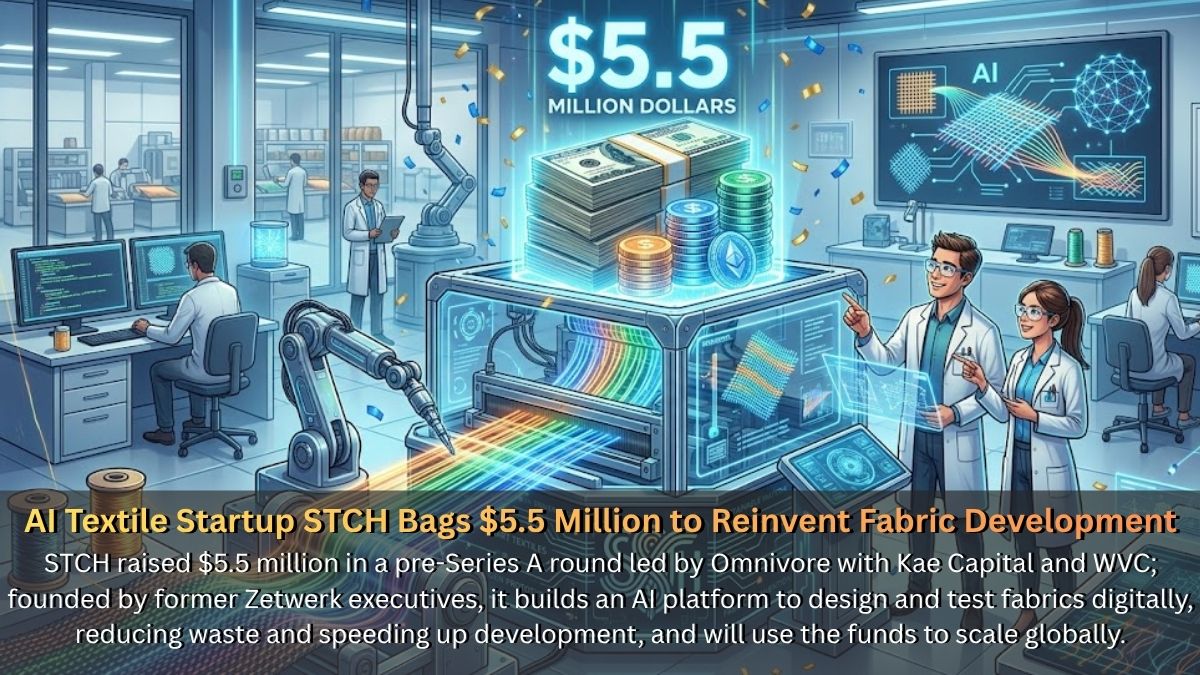
The AI Textile Startup STCH has raised $5.5 million in a pre-Series A funding round to transform how fabrics are developed for global fashion brands. The round was led by Omnivore, with participation from Kae Capital and WVC, according to multiple industry reports published in April 2026. The startup aims to solve one of the most persistent inefficiencies in the textile industry: the reliance on trial-and-error processes in fabric research and development.
Founded by former Zetwerk executives, STCH operates at the intersection of artificial intelligence and textile innovation. The company is building an AI-driven platform that helps brands design, test, and develop fabrics digitally before physical production. This reduces waste, shortens development cycles, and improves precision in material selection.
The startup is based in India but serves global fashion and textile brands. It launched with the vision of digitizing fabric innovation, a process that has traditionally been manual, slow, and resource-intensive. The platform uses machine learning models trained on textile data to predict fabric performance and optimize development.
With this funding, STCH plans to scale its technology, expand its team, and strengthen its presence in global markets. The textile industry, valued at hundreds of billions globally, is increasingly adopting technology to improve efficiency and sustainability. This funding round highlights a broader trend where AI startups are entering traditional industries to drive transformation. STCH’s approach reflects how deep-tech solutions are reshaping manufacturing and supply chains. For startups and investors alike, this signals growing interest in innovation within legacy sectors.
1. The Rise of AI Textile Startup STCH in India’s Tech Ecosystem
If you’ve spent even a little time around India’s manufacturing clusters, you already know this: the textile industry runs on experience, instinct, and a lot of patience. For decades, that’s been enough. But in a world where speed, precision, and sustainability define competitiveness, “good enough” is no longer good enough. That’s where STCH enters the picture, not as just another startup, but as a signal that something deeper is changing.
The AI Textile Startup STCH is emerging as a serious contender in India’s evolving tech ecosystem. What makes it interesting isn’t just the funding or the buzz around AI. It’s the fact that it is stepping into one of the oldest, most deeply rooted industries in the country and attempting to rebuild how it works from the ground up.
India has always been a global textile powerhouse. From Surat’s synthetic fabrics to Tiruppur’s knitwear exports, the country has scale, skill, and legacy. But innovation in fabric development has lagged behind. While sectors like fintech, SaaS, and e-commerce embraced technology early, textile R&D largely remained manual, slow, and dependent on human judgment.
1.1 STCH is trying to change that narrative. Instead of replacing the industry
STCH is trying to change that narrative. Instead of replacing the industry, it’s augmenting it. Instead of forcing disruption, it’s solving a problem everyone in the ecosystem quietly acknowledges but rarely addresses: the inefficiency of fabric development. What makes STCH particularly relevant right now is timing. Across India’s startup landscape, there’s a visible shift happening. Founders are moving beyond consumer apps and into deep-tech solutions that tackle complex, real-world industrial problems. Manufacturing, supply chains, materials science, these are no longer “boring sectors.” They are becoming the new frontier.
STCH sits right at that intersection. It is not just a textile startup. It’s part of a larger movement where technology is finally catching up with industries that were left behind in the first wave of digitization. That’s why investors are paying attention. That’s why global brands are curious. And that’s why its growth story matters beyond just startup headlines.
1.2 Background of the Textile Industry’s Challenges
To understand why STCH matters, you have to understand the pain it’s addressing. Fabric development, even today, is surprisingly primitive in its process. A designer or brand starts with an idea. That idea is translated into samples. Those samples go through multiple iterations, tweaking yarns, changing blends, adjusting finishes. Each iteration takes time. Each iteration costs money. And most importantly, each failed attempt adds to waste.
In real terms, what does this look like? It looks like weeks, sometimes months, of back-and-forth between brands and manufacturers. It looks like piles of rejected samples. Looks like missed deadlines because the “perfect fabric” took longer than expected. And here’s the uncomfortable truth: a lot of this process is guesswork. Experienced professionals rely on intuition built over years. And while that experience is valuable, it doesn’t scale. It doesn’t guarantee accuracy. And it certainly doesn’t align with the speed global fashion brands now demand.
Today, brands expect faster turnaround cycles. Trends change overnight. Seasonal collections are shrinking into micro-drops. The pressure on manufacturers is intense. At the same time, sustainability is no longer optional. The textile industry is one of the largest contributors to global waste and pollution. Every failed sample, every discarded batch, adds to that burden. Yet, despite all this, the tools used in textile R&D have barely evolved. There’s a clear gap between what the industry needs and what it currently has. And that gap is exactly where STCH positions itself.
2. Founders and the Origin Story of STCH
Every meaningful startup begins with a moment of discomfort, that point where someone sees a problem so clearly that they can’t ignore it anymore. For STCH, that moment came inside the world of large-scale manufacturing.
2.1 From Zetwerk to Textile Innovation
The founders of STCH come from a background that gave them a front-row seat to industrial inefficiencies. As former executives at Zetwerk, they weren’t outsiders looking in. They were deeply embedded in the system. At Zetwerk, they worked on scaling manufacturing operations, dealing with supply chains, coordinating with vendors, and solving execution challenges at scale. This exposure did something important, it sharpened their understanding of where time and money were being lost. And one inefficiency stood out more than most: fabric development.
Despite advances in automation, logistics, and digital procurement, textile R&D remained stubbornly manual. It didn’t benefit from the same level of technological intervention. That contradiction was hard to ignore. On one side, you had a modern, tech-enabled manufacturing ecosystem. On the other, a critical component of that ecosystem still running on trial-and-error. That gap became the starting point for STCH.
2.2 Motivation Behind the Startup
The founders weren’t trying to build something flashy. They were trying to solve something frustrating. They had seen firsthand how brands struggled to get fabrics right. How manufacturers burned time and resources chasing specifications. How delays in fabric development cascaded into larger production issues. What they wanted was simple in theory but complex in execution: remove uncertainty from fabric development.
They believed AI could do what human intuition alone couldn’t, bring predictability. Imagine being able to test a fabric digitally before producing it. Imagine knowing how it would behave under different conditions without physically creating it. Reducing weeks of experimentation into hours of simulation. That was the vision. And it wasn’t just about efficiency. It was about giving both brands and manufacturers confidence in their decisions.
This mindset aligns with a broader global trend. Across industries, AI is being used to reduce ambiguity and improve precision. From drug discovery to financial modeling, the idea is the same: let data guide decisions. STCH is applying that philosophy to textiles.
3. What Problem Does the AI Textile Startup Solve?
When you strip away the buzzwords, STCH is solving three very real, very expensive problems.
3.1 Trial-and-Error in Fabric R&D
If you talk to anyone in textile manufacturing, they’ll tell you this: getting a fabric right is rarely a one-shot process. It’s iterative. Brands test multiple samples. They tweak compositions. They adjust finishes. Each step brings them closer, but rarely straight to the goal. The downside? Time and cost spiral quickly. A single fabric development cycle can involve multiple rounds of sampling, each taking days or weeks. Multiply that across product lines, and the inefficiency becomes massive.
STCH tackles this by shifting experimentation from physical to digital. Using AI models, the platform simulates how fabrics will behave. It predicts outcomes before anything is produced. This doesn’t just reduce iterations, it fundamentally changes how decisions are made. Instead of asking, “Let’s try and see,” teams can now ask, “What does the data suggest?” That shift alone can cut development cycles dramatically.
3.2 Waste and Sustainability Issues
There’s a human side to waste that often gets overlooked. Walk into a textile unit after multiple sampling rounds, and you’ll see stacks of unused fabric. Each piece represents effort, material, energy, and ultimately, loss. The environmental cost is even larger. Textile production consumes significant water, energy, and chemicals. When samples are discarded, those resources are wasted too. By enabling digital testing, STCH reduces the need for physical samples. Fewer samples mean less waste. Less waste means lower environmental impact. For brands under pressure to meet sustainability targets, this isn’t just a benefit, it’s becoming a necessity.
3.3 Lack of Data-Driven Decision Making
For an industry of this scale, textile manufacturing surprisingly lacks structured data usage in R&D. Decisions are often based on past experience. While valuable, this approach has limitations. It doesn’t capture patterns at scale. It doesn’t adapt quickly to new requirements.
STCH introduces a data-first approach. By analyzing historical textile data, material properties, and performance metrics, the platform creates a knowledge base that improves over time.The more it’s used, the smarter it becomes. This changes decision-making from reactive to proactive. And in a competitive market, that difference matters.
4. How STCH Works: The Technology Behind the Platform
What makes STCH compelling isn’t just the problem it solves, but how it solves it.
4.1 AI-Driven Fabric Simulation
At the core of STCH is its simulation capability. The platform uses machine learning models trained on textile data to predict how fabrics will behave. This includes factors like strength, texture, durability, and performance under different conditions. Think of it as a virtual testing lab. Instead of producing a sample and then testing it, users can simulate outcomes in advance. This reduces uncertainty and speeds up decision-making. For teams used to waiting weeks for results, this shift feels almost transformative.
4.2 Digital Fabric Innovation Platform
STCH isn’t just a backend engine. It’s a working environment. Brands and manufacturers can log into the platform, input their requirements, and experiment with different fabric configurations. They can tweak variables, compare outcomes, and refine designs, all without touching physical materials.
This creates a space where creativity and data coexist. Designers don’t lose control. They gain better tools. And that’s an important distinction. Technology here isn’t replacing human creativity, it’s amplifying it.
4.3 Integration with Manufacturing Systems
A lot of tech solutions fail because they don’t fit into existing workflows. STCH avoids that trap. The platform is designed to integrate with current manufacturing systems. This means companies don’t have to overhaul their operations to adopt it. Instead, STCH becomes a layer that enhances what already exists. This approach makes adoption smoother. It also makes scaling easier. Because at the end of the day, the success of a platform like this isn’t just about innovation. It’s about usability. And STCH seems to understand that well.
5. Revenue Model and Business Strategy
If you look closely at how STCH is positioning itself, the business model isn’t trying to be clever, it’s trying to be durable. STCH operates on a B2B model, and that choice alone says a lot about the seriousness of its ambition. This isn’t a product built for quick adoption or viral growth. It’s designed for industries where decisions are slow, stakes are high, and trust is earned over time. The platform is offered to global fashion brands, textile manufacturers, and production partners who are already dealing with large volumes and complex supply chains. These are not customers who switch tools overnight. They adopt solutions only when they see clear, measurable impact. And that’s exactly where STCH leans in.
Instead of selling a one-time product, the company is likely building its revenue through subscriptions and enterprise contracts. On paper, that sounds standard. In reality, it reflects something deeper, long-term relationships. When a manufacturer integrates STCH into its workflow, it doesn’t just “use” the platform. It begins to depend on it. Fabric development becomes tied to the system. Teams align around its outputs. Decisions start flowing through it. That kind of integration naturally leads to recurring revenue. But more importantly, it creates stickiness.
5.1 From a practical standpoint
From a practical standpoint, imagine a textile exporter working with multiple international brands. If STCH helps them reduce sampling cycles from six rounds to two, and cuts development time by even 30–40%, the cost savings alone justify the subscription. Add to that faster delivery timelines and better client satisfaction, and the value becomes hard to ignore. This is where the SaaS model works beautifully. It aligns incentives.
STCH grows when its clients grow. The more fabrics tested, the more collections launched, the more value the platform delivers. And because the system improves with data over time, clients aren’t just paying for access, they’re investing in a tool that keeps getting better. There’s also a subtle but important strategic layer here. By working with both brands and manufacturers, STCH positions itself in the middle of the ecosystem. It’s not dependent on just one side. It becomes a bridge between design intent and production reality. And once a platform sits in that position, it becomes incredibly powerful.
6. Funding Details and Investor Confidence
When a startup raises money, the number itself gets the headlines. But what really matters is who is writing the cheque and why. STCH raised $5.5 million in a pre-Series A round, led by Omnivore, with participation from Kae Capital and WVC. On the surface, it’s a solid early-stage raise. But if you read between the lines, it signals something more meaningful. Take Omnivore, for example. The firm has built a reputation around backing startups that operate at the intersection of technology and real-world industries, agriculture, supply chains, climate-focused innovation. They tend to invest where problems are messy, not where solutions are easy. For them to back STCH suggests one thing clearly: this is not a superficial idea.
It’s a problem worth solving at scale. The same applies to Kae Capital and WVC. These investors aren’t chasing hype cycles. They’re looking for businesses that can sustain growth, build defensibility, and eventually become category leaders. So what are they really betting on? They’re betting that textile R&D is overdue for transformation. They’re betting that AI can move from experimentation to actual industrial application. And most importantly, they’re betting that STCH can execute.
From a founder’s perspective, this kind of backing does more than just provide capital. It brings credibility. When you’re trying to sell into traditional industries, trust is everything. Manufacturers want to know that the platform they adopt will still be around in five years. Brands want assurance that the technology is stable and evolving. Funding like this answers those concerns. It tells the market: serious people believe in this. And in early-stage ecosystems, that belief can be as valuable as the money itself.
7. Industry Trends: AI in Textile and Manufacturing
If STCH feels like it’s riding a wave, that’s because it is. But this wave didn’t start in textiles. It started in a broader shift where AI began moving beyond consumer-facing applications and into the core of industrial systems.
7.1 Growth of AI Startups in Traditional Industries
For a long time, sectors like manufacturing and textiles were considered too complex, too fragmented, or simply too “old-school” for meaningful tech disruption. That perception is changing fast. Today, AI startups are actively targeting these industries, not because they’re easy, but because they’re inefficient. And inefficiency, at scale, is opportunity. In manufacturing alone, small improvements in process efficiency can translate into massive cost savings. In textiles, where margins are often tight and timelines are critical, even a slight reduction in development time can create a competitive edge.
What’s interesting is how founders are approaching these sectors now. They’re not coming in with a “replace everything” mindset. They’re coming in with a “fix what’s broken” approach. That’s why platforms like STCH make sense. They don’t ask manufacturers to abandon their expertise. Enhance it. They don’t remove human judgment. Support it with data. And that balance is what makes adoption possible.
From a ground-level perspective, this shift feels very real. Conversations that once revolved around cost-cutting now include discussions about optimization, simulation, and predictive modeling. Terms like “AI-driven workflows” are no longer abstract, they’re becoming operational realities.
7.2 Sustainability and Innovation
If there’s one force accelerating change in textiles, it’s sustainability. And not the kind that lives in marketing campaigns, but the kind that affects procurement decisions, supplier relationships, and long-term contracts. Global brands are under pressure, from regulators, from consumers, and from their own internal goals, to reduce waste and improve environmental impact. But here’s the challenge: sustainability often comes at a cost.
At least, that’s how it has traditionally been perceived. What platforms like STCH are doing is reframing that narrative. By reducing sampling, optimizing material usage, and improving accuracy in development, they make sustainability economically viable. You’re not just saving the environment, you’re saving money. That’s a powerful combination. In real-world terms, fewer failed samples mean less raw material consumption. Faster development cycles mean less energy spent on repeated processes. Better predictions mean fewer production errors. All of this adds up. And for brands trying to balance profitability with responsibility, this kind of solution isn’t just helpful, it’s necessary.
8. Competitive Landscape
No startup operates in isolation. And while STCH is early in its journey, it’s already part of a competitive and evolving space.
8.1 Direct Competitors
There are other startups exploring the intersection of textiles and technology. Some are working on AI-driven fabric simulations. Others are focusing on supply chain optimization or material innovation. But here’s the reality: this space is still in its infancy. There isn’t a clear dominant player yet.
That gives STCH something valuable, breathing room. As an early mover, it has the chance to define how this category evolves. It can shape customer expectations, set benchmarks, and build relationships before the market becomes crowded. But early-mover advantage is a double-edged sword. It gives you visibility, but it also puts pressure on execution. You don’t just compete with others, you compete with the expectations you create. If STCH can consistently deliver measurable results, faster development cycles, reduced costs, improved accuracy, it can build a strong moat early on.
8.2 Indirect Competitors
In many ways, STCH’s biggest competition isn’t another startup. It’s the existing system. Traditional fabric development companies, R&D labs, and in-house design teams have been operating in a certain way for decades. They rely on experience, relationships, and tried-and-tested processes. And to be fair, those processes do work.
The challenge is that they don’t scale well in today’s environment. They’re slower. They’re less predictable. And they’re harder to optimize. STCH doesn’t eliminate these players, it challenges them. It offers an alternative that is faster, more data-driven, and more aligned with modern demands. But adoption here isn’t just about proving efficiency.
It’s about changing mindset. Convincing someone to trust a simulation over a physical sample isn’t easy. It takes time. It takes evidence. Takes repeated success stories. That’s why the real competition isn’t just technological, it’s psychological. And if STCH manages to win that battle, even gradually, it won’t just be competing in the market. It will be reshaping it.
9. Growth Potential and Market Opportunity
When you step back and look at the textile industry as a whole, the scale is almost overwhelming. We’re talking about a global market that runs into hundreds of billions of dollars, touching everything from fast fashion to luxury apparel, from industrial textiles to everyday essentials. It’s one of those industries that quietly powers the world. And yet, despite its size, a large part of it still operates in ways that haven’t fundamentally changed in decades. That contrast is where the real opportunity lies.
Digital transformation in textiles is still in its early innings. Unlike fintech or e-commerce, where technology has already reshaped consumer behavior, textiles are only beginning to explore what digitization can truly unlock. Most factories are still transitioning. Most workflows are still hybrid at best. And most decision-making processes still rely heavily on manual input. For a startup like STCH, this isn’t a limitation, it’s an opening. Because when an industry of this size starts to shift, even slightly, the ripple effects are enormous.
9.1 Think about it in practical terms
Think about it in practical terms. If STCH’s platform can reduce fabric development time by even 25–30% for a single manufacturer, that improvement doesn’t just stay within one company. It flows through the entire supply chain. Faster development means quicker production. Quicker production means shorter time-to-market. And in fashion, timing often defines success. Now scale that across multiple clients, multiple geographies, and multiple product lines.
The impact compounds quickly. There’s also a strong global tailwind working in STCH’s favor. AI adoption is no longer experimental. It’s becoming operational. Businesses are moving from “Should we use AI?” to “Where can AI give us an edge?” In textiles, that edge is still largely untapped. This is why STCH isn’t just another startup riding the AI wave. It’s entering a space where the combination of scale, inefficiency, and timing creates a rare window of opportunity. And that’s exactly the kind of window venture-backed companies are built to capture.
From an investor’s lens, the thesis is simple but powerful: if you can become a core layer in an industry this large, even a small market share translates into a massive business. But from an operator’s perspective, it feels more grounded. It feels like solving problems that people have lived with for years. It feels like walking into a factory floor, understanding the frustrations, the delays, the compromises, and then slowly replacing them with something better. That’s the kind of growth that doesn’t just look good on paper. It feels real.
10. Broader Impact on Startup Ecosystem
What STCH represents goes beyond textiles. It reflects a shift in how the startup ecosystem itself is evolving. For a long time, especially in India, startup success stories were dominated by consumer internet companies. Apps that scaled quickly, platforms that captured attention, marketplaces that optimized convenience. And while those businesses created immense value, they also shaped a certain mindset, that innovation had to be visible, fast, and user-facing. That mindset is changing.
Today, there’s a growing respect for deep-tech startups, companies that work quietly on complex problems, often away from the spotlight, but with the potential to create long-term impact. STCH fits into that new wave. It’s part of a broader movement where founders are choosing to solve harder problems. Problems that don’t have immediate feedback loops. Problems that require domain expertise, patience, and resilience. You see this across sectors now, AI in manufacturing, blockchain in supply chains, advanced materials in energy and climate tech.
10.1 They demand more from founders
These aren’t easy spaces. They demand more from founders. More research, more iteration, more credibility. But they also offer something consumer startups often struggle with: defensibility. When you build deep-tech solutions, you’re not just competing on user experience or pricing. You’re building intellectual property. You’re embedding yourself into workflows. Becoming part of how industries function. That’s a different kind of moat.
STCH’s journey also highlights the evolving role of venture capital. Firms like Omnivore and Kae Capital are not just funding ideas. They’re backing transformations. They’re willing to invest in startups that may take longer to scale but have the potential to redefine entire sectors. This shift in capital allocation is important. Because without patient capital, deep-tech innovation struggles to survive. And with it, startups like STCH get the runway they need to experiment, refine, and eventually scale. In many ways, this is a more mature phase of the ecosystem. Less noise, more substance. Less chasing trends, more solving problems that actually matter.
11. Learning for Startups and Entrepreneurs
There’s something quietly powerful about the way STCH has approached its journey. It’s not loud. It’s not trying to be everything at once. But if you look closely, there are lessons here that apply far beyond textiles. The first lesson is almost simple, but often ignored: solve a real problem. Not a hypothetical one. Not a trend-driven one. A real, lived problem.
The founders of STCH didn’t stumble upon their idea in isolation. They experienced the inefficiencies firsthand. They saw the delays, the wasted effort, the frustration that came with trial-and-error processes. That kind of proximity changes how you build. You’re not guessing what users want. You already understand their pain. And that shows in the product. The second lesson is about leverage, specifically, leveraging technology in a way that creates clear differentiation.
11.1 AI, today, is everywhere
AI, today, is everywhere. But simply using AI doesn’t make a startup valuable. What matters is how it’s applied. STCH didn’t use AI as a buzzword. It used it as a tool to solve a specific, high-impact problem. That focus is what gives it an edge. It’s the difference between building something impressive and building something useful. The third lesson is timing. There’s a reason STCH is gaining traction now and not five years ago.
The industry is ready. Manufacturers are more open to digital tools. Brands are under pressure to move faster and become more sustainable. Investors are actively looking for deep-tech opportunities. All these factors create alignment. And when timing aligns with execution, momentum follows. Finally, there’s the importance of execution and backing. Ideas don’t scale. Execution does.
STCH’s ability to attract investors like Omnivore isn’t just about the idea. It’s about confidence in the team’s ability to deliver. Because at the end of the day, building in a space like this isn’t easy. You’re dealing with legacy systems. You’re changing established behaviors. Introducing new ways of thinking. It takes persistence. It takes credibility. And it takes the ability to show results, not just promise them.
For any founder or entrepreneur reading this, the takeaway isn’t to copy the idea. It’s to understand the approach. Find problems that matter. Build solutions that are grounded in reality. Use technology with purpose. And be patient enough to let it all come together. Because sometimes, the most impactful startups aren’t the ones that move the fastest. They’re the ones that move the deepest.
About foundlanes.com
foundlanes.com is India’s leading startup idea discovery platform. It helps entrepreneurs find actionable startup opportunities, market insights, and industry-specific guidance to turn ideas into real businesses. With deep research and practical resources, foundlanes supports founders at every stage, from idea validation to launch and growth.