


News Summary
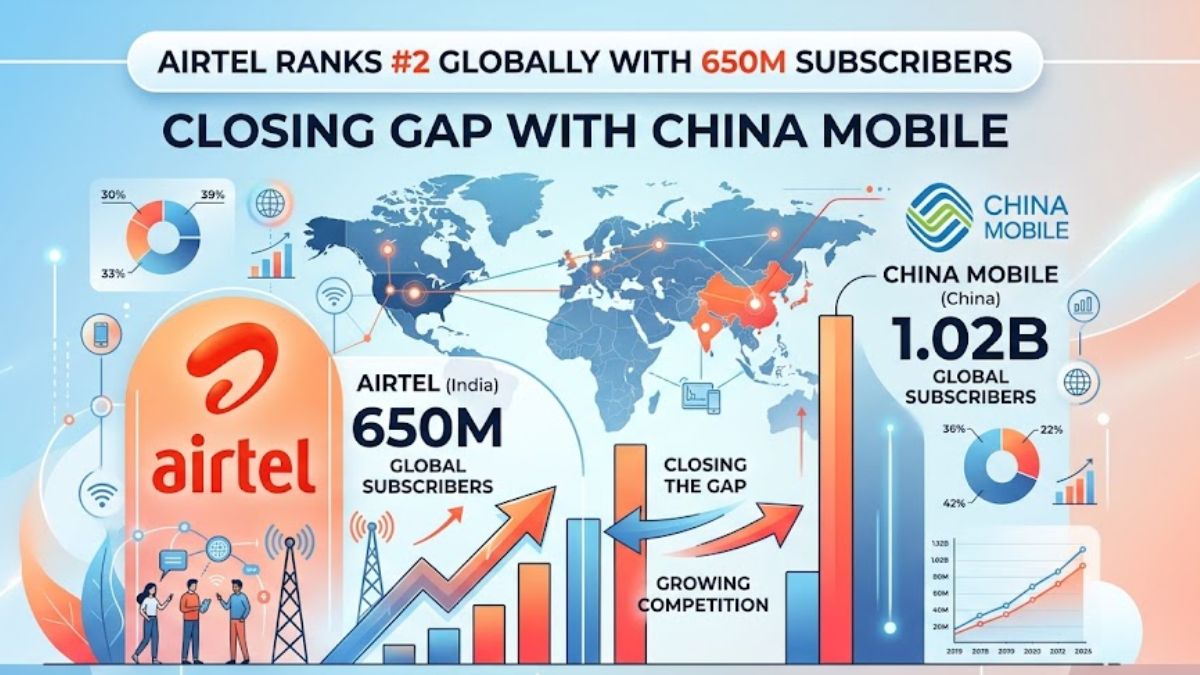
A major shift has taken place in the global telecom industry as Bharti Airtel reaches a historic milestone. The company has become the world’s second-largest mobile service provider, crossing 650 million subscribers worldwide. This development places it just behind China Mobile and highlights a significant moment in global telecom competition. The phrase Airtel Ranks #2 is now being widely used to describe this achievement across industry reports and financial news coverage.
This milestone reflects years of strategic expansion, network investments, and strong execution across both Indian and international markets. Airtel’s growth has been driven by rising mobile data consumption, increasing smartphone adoption, and strong demand for digital connectivity services. Moreover, the company’s presence across multiple regions has helped it scale beyond traditional market limitations.
At the same time, this achievement is not only a telecom story. It also reflects broader trends in the global startup ecosystem, venture-backed infrastructure growth, and digital transformation across emerging markets. While Airtel is not a startup, its scale and strategy mirror several principles seen in high-growth startups, including aggressive expansion, technology-driven service delivery, and customer-centric innovation.
Furthermore, this development signals India’s rising influence in global business transformation. As Airtel strengthens its position, it also highlights how Indian companies are competing at global scale alongside dominant international players. Consequently, Airtel Ranks #2 becomes more than a ranking. It becomes a symbol of structural change in global telecom leadership. This news also raises important discussions about competition with China Mobile, the role of digital infrastructure, and the future of global connectivity markets. As telecom demand continues to grow, Airtel’s position will likely play a key role in shaping industry direction.
1. Airtel Ranks #2 Globally in Telecom Industry Landscape
The rise of Bharti Airtel to the second position in the global telecom industry is a major structural shift, not just a headline. The company has crossed 650 million subscribers worldwide, placing it just behind China Mobile. This milestone, widely referred to as Airtel Ranks #2, reflects decades of steady execution, infrastructure building, and expansion across complex and diverse markets.
What makes this moment important is the scale behind it. Telecom is one of the hardest industries to grow in because it depends on physical infrastructure, spectrum access, and continuous upgrades. Despite these challenges, Airtel has managed to build a presence that now connects hundreds of millions of people daily. This growth is also deeply connected to real-world usage. For many users, Airtel is not just a service provider. It is the backbone of daily life, supporting education, business communication, financial transactions, and digital access in both urban and rural regions.
1.1 Airtel Ranks #2 and the Global Subscriber Milestone
The Airtel Ranks #2 achievement is the result of long-term decisions that compounded over time. Bharti Airtel expanded aggressively in India while also building strong international operations, especially in Africa. This dual-market strategy helped balance growth and reduce dependence on a single geography. Reaching 650 million subscribers required continuous investment in network expansion, fiber connectivity, and spectrum acquisition. These are not short-term investments. They take years to reflect in subscriber growth and revenue stability.
At the same time, rising smartphone penetration and cheap data consumption patterns in emerging markets created a strong demand base. Airtel was able to capture this demand effectively through improved coverage and service quality. As a result, the subscriber base did not grow in spikes, but through steady accumulation over time. That consistency is what pushed Airtel into the global Airtel Ranks #2 position.
1.2 Market Reaction to Airtel Ranks #2 Achievement
The market reaction to Airtel Ranks #2 has been largely positive, as investors see this as a signal of stability and scale. With 650 million subscribers, Bharti Airtel has reached a level where revenue becomes highly predictable due to its large user base. This predictability is important in telecom, where costs are high and competition is constant. A large subscriber base helps absorb shocks from pricing changes, regulatory shifts, and market fluctuations. Analysts also view this milestone as a sign of operational maturity. Airtel is no longer just competing on growth. It is competing on efficiency, service quality, and ecosystem strength. This strengthens its position in global telecom rankings and reinforces long-term investor confidence.
2. Company Background and Global Expansion Journey
The journey of Bharti Airtel began in India, where telecom access was limited and infrastructure was still developing. Over time, the company transformed from a domestic operator into a global telecom player. A key turning point in this journey was its expansion into Africa. This move was not just geographical expansion. It was a strategic shift into emerging markets with high mobile adoption potential.
This expansion helped Airtel build resilience by diversifying its revenue base. Instead of relying only on India, the company created a multi-region growth engine that supported long-term scalability and stability. The result of this strategy is visible today in the Airtel Ranks #2 milestone, where global scale is built on multiple strong markets rather than a single dominant region.
2.1 Evolution of Bharti Airtel
In its early phase, Bharti Airtel focused on solving one core problem: connectivity. At that time, mobile penetration was low, and building network access was the primary challenge. As the market matured, Airtel evolved from a basic telecom provider into a full-scale digital connectivity company. This shift required constant upgrades in infrastructure, technology, and service delivery.
The move into Africa further tested its ability to operate in different regulatory and economic environments. This experience helped Airtel build operational flexibility, which later became a key strength in global scaling. Over time, this evolution shaped Airtel into a company capable of operating at massive scale, eventually supporting the Airtel Ranks #2 global position.
2.2 Expansion Strategy and Market Penetration
The expansion strategy of Bharti Airtel has consistently focused on high-growth markets where mobile demand is rising rapidly. Instead of spreading resources thin across low-opportunity regions, Airtel prioritized markets with strong long-term potential.
This approach allowed the company to maximize return on infrastructure investments. Telecom infrastructure requires heavy upfront capital, but once established, it supports long-term subscriber growth. Airtel also focused heavily on improving network quality and customer experience. In competitive markets, service reliability becomes a major differentiator. This helped Airtel retain users and reduce churn rates. Combined with aggressive infrastructure expansion, this strategy played a major role in achieving the Airtel Ranks #2 milestone.
3. Working Model of Airtel and Service Ecosystem
The business model of Bharti Airtel is built on large-scale infrastructure and recurring revenue. It provides mobile connectivity, broadband services, and enterprise communication solutions. The core strength of this model lies in subscription-based revenue. Users pay regularly for continued access, which creates steady cash flow and financial predictability.
At scale, this model becomes extremely powerful. Once infrastructure is deployed, each new user adds revenue with relatively lower incremental cost. This improves profitability over time and strengthens operational efficiency. This structure is one of the key reasons Airtel has been able to reach the Airtel Ranks #2 position globally.
3.1 Telecom Infrastructure and Service Delivery Model
Bharti Airtel operates through a deeply integrated network infrastructure system. This includes mobile towers, fiber optic networks, spectrum holdings, and data centers. These assets form the backbone of its entire service delivery system. Every call, message, or data session depends on this infrastructure working reliably at scale.
As usage increases, the system is upgraded continuously to handle higher traffic loads. This ongoing investment cycle ensures service quality remains stable even as subscriber numbers grow. This ability to maintain performance at scale is one of the core reasons behind the Airtel Ranks #2 achievement.
3.2 Digital Services and Value-Added Platforms
Beyond traditional telecom, Bharti Airtel has expanded into digital ecosystems. These include payments, cloud services, and entertainment platforms. This shift is important because telecom alone is becoming a low-margin, highly competitive business. Digital services help Airtel increase revenue per user while also improving customer engagement.
For users, this means Airtel is no longer just a connectivity provider. It becomes a daily digital platform integrated into payments, entertainment, and business tools. This diversification strengthens Airtel’s long-term positioning and supports its global scale, reinforcing the significance of the Airtel Ranks #2 milestone.
4. Revenue Model and Financial Strength
The financial backbone of Bharti Airtel is built on a simple but powerful idea: scale recurring usage. Unlike one-time businesses, telecom survives on monthly engagement. Every active user becomes a predictable revenue source, and when the user base reaches hundreds of millions, that predictability turns into real financial strength.
Over the years, Airtel has moved from being a pure connectivity provider to a layered revenue platform. The core still comes from mobile services, broadband, and enterprise connectivity, but newer digital layers have started contributing meaningfully. This shift is important because it reduces dependence on traditional voice and data pricing, which is often under pressure in competitive markets. What stands out in Airtel’s case is not just revenue growth, but revenue stability. Even when markets slow down, people rarely disconnect from mobile services. That creates a natural cushion that keeps cash flow steady.
4.1 Core Revenue Streams
The primary revenue engine of Bharti Airtel comes from mobile services. This includes prepaid and postpaid plans, where users pay regularly for data, calls, and messaging. At scale, even small monthly payments turn into massive revenue when multiplied across hundreds of millions of users. Broadband is another strong pillar. As home internet usage rises, especially for remote work and streaming, broadband subscriptions have become more important than ever. In many urban households, Airtel is now a default choice for stable connectivity.
Enterprise solutions add another dimension. Businesses rely on Airtel for cloud connectivity, secure communication, and data infrastructure. These contracts are often long-term and high-value, adding depth to revenue quality. On top of this, digital platforms and partnerships are gradually growing. While still evolving, they represent the next phase of monetization where Airtel moves beyond traditional telecom into broader digital services.
4.2 Monetization Strategy and Growth Efficiency
The monetization approach of Bharti Airtel is less about chasing volume blindly and more about improving value per user. This is where Average Revenue Per User (ARPU) becomes critical. Instead of only adding new subscribers, Airtel has been steadily working on upgrading existing users to higher-value plans. This includes premium data packs, bundled services, and long-term subscriptions. The result is not just growth, but healthier growth.
There is also a clear emotional layer to this strategy. Airtel is trying to shift from being “just another SIM card” to becoming a trusted digital service provider. That shift is subtle, but it changes how users perceive value. This focus on ARPU improvement has helped strengthen financial performance, even in highly competitive markets where pricing pressure is constant.
5. Industry Growth Trends and Telecom Evolution
The telecom industry is not what it was a decade ago. It has moved from basic voice communication to being the foundation of the entire digital economy. Everything from payments to education now depends on connectivity.
For Bharti Airtel, this shift is not just a trend. It is the environment in which it operates. Growth today is tied directly to how fast societies become digital. What makes this industry unique is that demand rarely disappears. It changes shape, but it keeps expanding. More video, more apps, more remote work, more cloud usage. All of it flows through telecom networks. This is why the Airtel Ranks #2 position matters. It is not just about size. It is about being positioned at the center of global digital consumption.
5.1 Global Telecom Market Expansion
The global telecom market continues to expand, especially in developing economies where internet penetration is still rising. In many regions, the first experience of the internet still happens through a mobile network. Bharti Airtel has benefited from this shift. As smartphone adoption increases, so does demand for data. This creates a long runway for growth, especially in Asia and Africa.
What is interesting is the emotional dependency that telecom creates. It is no longer just utility. It is identity, communication, and access to opportunity. People feel disconnected without it. This growing dependency supports long-term subscriber retention, which directly strengthens Airtel’s global position and reinforces the Airtel Ranks #2 milestone.
5.2 Digital Transformation and Connectivity Demand
Digital transformation has completely changed how telecom companies operate. It is no longer enough to just provide network coverage. Users now expect seamless streaming, instant communication, and always-on connectivity. Businesses also rely heavily on telecom infrastructure. From cloud systems to remote operations, everything depends on stable networks.
For Bharti Airtel, this shift has been both a challenge and an opportunity. The challenge is constant pressure to upgrade infrastructure. The opportunity is deeper integration into digital ecosystems. This transformation is what makes the Airtel Ranks #2 achievement more meaningful. It shows adaptability in a fast-changing digital world.
6. Competitive Landscape in Global Telecom Industry
The global telecom industry is intensely competitive, with large operators fighting for scale, efficiency, and technological leadership. In this environment, staying relevant requires continuous investment and strategic clarity. Bharti Airtel operates in a space where even small differences in pricing or network quality can shift millions of users. Competition is not static. It evolves with every new technology cycle. What makes Airtel’s position notable is that it is competing not only in India but across multiple regions with different economic and regulatory environments.
6.1 China Mobile and Global Competition
At the top of the global telecom ladder sits China Mobile, which remains the largest operator by subscribers. However, the gap between leaders is no longer just about scale. It is about efficiency, digital capability, and long-term sustainability. Bharti Airtel has steadily moved closer to this top position through disciplined expansion and better monetization strategies.
The competition between global telecom giants reflects a broader industry trend: consolidation and efficiency over pure expansion. Companies are now focusing on profitability per user rather than just adding numbers. This shift makes Airtel’s Airtel Ranks #2 achievement not just impressive, but strategically significant.
6.2 Regional and Global Competitors
Apart from global leaders, Bharti Airtel also competes with strong regional players across Asia and Africa. These competitors often focus heavily on pricing, aggressive data offers, and localized strategies. In such markets, competition becomes personal for users. A small price difference or better network quality can influence switching decisions.
Airtel’s response has been to focus on reliability and service quality rather than just price wars. This approach helps build long-term loyalty, even in highly competitive regions. Over time, this has contributed to subscriber stability and supported its rise in global rankings, reinforcing the Airtel Ranks #2 position.
7. Strategic Positioning Behind Airtel Ranks #2 Growth
The journey to Airtel Ranks #2 is not accidental. It is the result of deliberate strategic positioning built over years of investment, risk-taking, and operational discipline by Bharti Airtel. At its core, Airtel’s strategy revolves around three pillars: network strength, customer experience, and long-term digital transformation. These are not separate efforts. They work together as one system. What makes this positioning powerful is its consistency. Even during market slowdowns or competitive pressure, Airtel has continued investing in infrastructure and technology.
7.1 Network Expansion and Infrastructure Investment
A major reason behind the rise of Bharti Airtel is its consistent focus on infrastructure. Telecom is a capital-heavy industry. Without continuous investment in towers, fiber networks, and spectrum, growth collapses quickly. Airtel’s expansion into 4G and 5G networks has been critical in supporting modern data demand. As users consume more video, gaming, and cloud services, network capacity becomes essential. These investments do not show immediate returns. They take years to reflect in subscriber growth and revenue. But when they do, the impact is massive and long-lasting. This foundation is what supports the Airtel Ranks #2 milestone today.
7.2 Customer-Centric Digital Strategy
At the heart of Bharti Airtel strategy is customer experience. In telecom, customers rarely talk about the brand when everything works well. But they always notice when it fails. Airtel has focused heavily on improving network reliability, reducing downtime, and simplifying digital services. This may sound operational, but it directly impacts emotional trust. Over time, this trust translates into retention. People stay not just because of pricing, but because switching feels risky and unnecessary. This quiet loyalty is one of the strongest drivers behind the Airtel Ranks #2 achievement, and it continues to shape Airtel’s global position in the telecom industry.
8. Startup Ecosystem Parallels and Business Transformation
Even though Bharti Airtel is a large, established telecom operator, its growth story surprisingly feels similar to a startup that never stopped scaling. The difference is only in size. The mindset of continuous expansion, experimentation, and adaptation is very much the same.
What stands out is how Airtel has repeatedly reinvented itself with each technology shift. From basic voice services to mobile internet, and now toward digital ecosystems, each phase required a reset in thinking. This is not a one-time transformation. It is ongoing, almost like a startup that keeps rebuilding itself at every stage of growth. The Airtel Ranks #2 milestone is not just about subscriber count. It reflects this long journey of reinvention under pressure, where every decision had real financial and operational consequences.
8.1 Telecom Growth and Startup-Like Scalability
If you look closely, the growth pattern of Bharti Airtel resembles startup scalability principles more than traditional corporate expansion. Startups scale through technology leverage. Airtel does the same, but at a massive infrastructure level. Once a tower network or fiber system is deployed, it starts serving millions of users without needing a proportional increase in cost. This is similar to how digital startups scale software products.
There is also a strong element of experimentation. Airtel has tested pricing models, bundled services, and digital offerings in different markets, learning from each outcome. Some experiments worked immediately, others took time, but the learning cycle remained constant. In real terms, this means Airtel did not grow in a straight line. It grew in waves, adjusting strategy every time user behavior or technology shifted. That adaptability is a key reason behind the Airtel Ranks #2 position today.
8.2 Digital Ecosystem Influence
The telecom industry has slowly stopped being just a connectivity business. It has become the foundation layer for multiple digital industries like fintech, AI, cloud computing, and entertainment. For Bharti Airtel, this convergence has created a new kind of opportunity. Instead of being only a network provider, Airtel now sits at the center of digital activity. Every payment, video stream, or cloud service indirectly depends on its infrastructure.
This overlap is important because it increases switching cost for users. Once customers are inside this ecosystem, moving away becomes inconvenient. That quiet lock-in effect strengthens retention without aggressive marketing. At a broader level, this convergence is also pushing industries to collaborate. Telecom is no longer isolated. It is deeply connected with fintech platforms, AI-driven services, and digital-first startups, creating a shared ecosystem of growth and dependency.
9. Airtel Ranks #2 and India’s Global Business Position
The Airtel Ranks #2 milestone is not just a corporate achievement. It also reflects the changing position of India in the global business landscape. A company from India competing at the very top of the telecom world signals a deeper shift in capability and ambition.
Bharti Airtel reaching this scale shows that Indian enterprises are no longer limited to domestic dominance. They are now building global footprints and competing directly with some of the largest corporations in the world. This matters because telecom is not a soft industry. It requires heavy capital investment, regulatory navigation, and long-term strategic discipline. Success here signals maturity, not just growth.
9.1 India’s Rising Global Influence
The rise of Bharti Airtel into the Airtel Ranks #2 position highlights how India’s corporate ecosystem is evolving. Earlier, Indian companies were often seen as strong in services or domestic markets. Now, they are actively competing in infrastructure-heavy global industries. This shift reflects better capital access, stronger leadership, and improved execution capability.
There is also an emotional layer to this progress. For many observers, Airtel’s global position feels like proof that Indian companies can build and sustain world-class systems, not just local businesses. This changes perception internationally. India is no longer just a consumption market. It is becoming a production and innovation hub for large-scale global infrastructure companies.
9.2 Economic and Strategic Impact
From an economic perspective, the Airtel Ranks #2 achievement strengthens investor confidence in Indian enterprises. It signals that companies from India can scale beyond regional boundaries and compete with global giants.
For Bharti Airtel, this also improves its strategic positioning. A strong global rank brings better negotiation power, stronger partnerships, and improved access to capital markets. On a broader level, it also encourages other Indian companies to think bigger. It sets a benchmark that scale is possible, but only with long-term discipline and consistent investment. This is not just symbolic. It directly influences how global investors evaluate Indian markets and future opportunities.
10. Challenges and Future Outlook
Even with strong global positioning, Bharti Airtel operates in one of the most demanding industries in the world. Telecom is capital-intensive, highly regulated, and constantly evolving. Growth comes with pressure at every level. The Airtel Ranks #2 milestone does not remove these challenges. In fact, it increases expectations. Larger scale means higher responsibility, more competition, and continuous technological upgrades.
10.1 Market Competition and Infrastructure Pressure
Competition in the telecom industry is relentless. Bharti Airtel constantly faces pressure from global and regional operators who compete on pricing, coverage, and digital services. Infrastructure is another heavy burden. Building and maintaining networks requires continuous investment. 5G expansion, fiber upgrades, and spectrum costs are not one-time expenses. They are ongoing commitments.
There is also a hidden pressure that users rarely see. Network quality must remain stable even as traffic increases exponentially. A small drop in service quality can lead to customer churn at massive scale. So, behind the Airtel Ranks #2 achievement lies a constant balancing act between growth and operational strain.
10.2 Future Growth Opportunities
Despite challenges, the future for Bharti Airtel still looks strong, mainly because the world is becoming more digital every year. The biggest opportunity lies in digital services. Telecom is no longer the final product. It is the entry point into a larger ecosystem that includes payments, cloud platforms, entertainment, and enterprise solutions. As data consumption grows, Airtel’s role becomes even more central. Every new digital habit, whether streaming, online learning, or remote work, strengthens demand for connectivity.
There is also potential in expanding into new geographies and deeper digital integration. If executed well, these opportunities can help Airtel not only maintain its Airtel Ranks #2 position but potentially challenge the top global spot in the long run. In many ways, the journey is still unfolding, and the next phase may be even more transformative than what has already been achieved.
About foundlanes.com
foundlanes.com is India’s leading startup idea discovery platform. It helps entrepreneurs find actionable startup opportunities, market insights, and industry-specific guidance to turn ideas into real businesses. With deep research and practical resources, foundlanes supports founders at every stage, from idea validation to launch and growth.