


Introduction
The story of the Cashfree founder is not just another fintech success narrative from India. It is a layered journey of persistence, technical depth, and a sharp understanding of real-world payment problems that businesses face daily. Akash Sinha Nigam, along with his co-founder, built Cashfree Payments into one of India’s most respected fintech platforms by focusing on solving fundamental inefficiencies in digital payments.
Cashfree Payments was founded in 2015 in Bengaluru, at a time when India’s digital payments ecosystem was still evolving. While the likes of payment gateways existed, they were often slow, rigid, and not built for scale. Akash Sinha Nigam, an engineer by training, identified a massive gap in the market for faster, developer-friendly, and reliable payment infrastructure. The “why” behind Cashfree’s creation lies in the inefficiencies faced by businesses when handling payouts, refunds, and vendor payments. The “how” was deeply technical. Instead of building a surface-level product, the founders focused on creating a strong backend infrastructure that could process transactions at scale with speed and reliability.
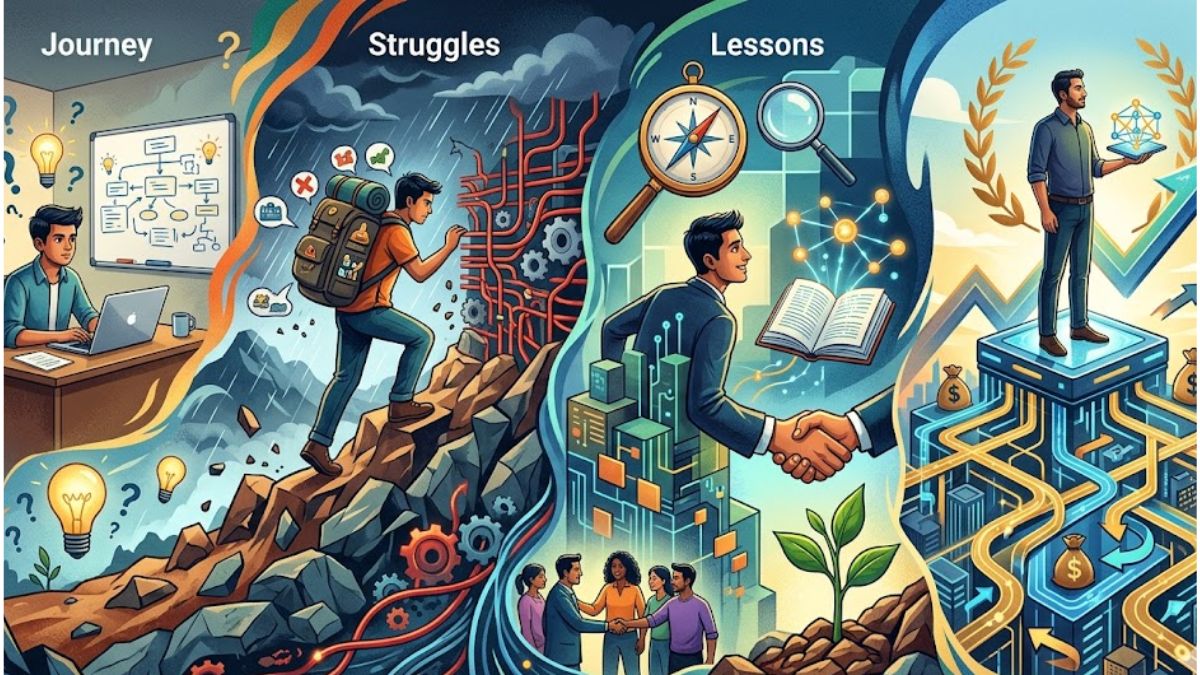
Over time, Cashfree expanded its offerings from a payment gateway to a full-stack payments platform, including payouts, subscriptions, and banking APIs. Today, it serves thousands of businesses across India and beyond, powering digital transactions for startups, enterprises, and marketplaces. But the journey was far from smooth. From early struggles with product-market fit to funding challenges and intense competition, the Cashfree founder story reflects the reality of building a fintech startup in India. It is a story of conviction, adaptability, and learning through failures. This article explores that journey in depth, unpacking the struggles, lessons, and evolution of one of India’s leading fintech founders.
1. Background and Early Life
1.1 Early life, education, and influences
Every founder story has a quiet beginning, long before the startup exists, long before the funding headlines. In the case of Akash Sinha Nigam, that beginning was shaped by something simple but powerful: a deep respect for learning and clarity of thought. He grew up in an environment where education wasn’t just about scoring marks, it was about understanding how things work. There’s a difference between the two, and it shows up later in life. From an early age, Akash wasn’t just solving problems, he was trying to understand why they existed in the first place.
Mathematics came naturally to him. Not in a mechanical way, but in a way that reflected curiosity. Patterns, logic, structure, these things made sense to him. And more importantly, he enjoyed them. That quiet comfort with complexity would later become one of his biggest strengths as a founder. Like many driven students in India, his academic journey led him to Indian Institute of Technology Kharagpur. For anyone who has spent time in an IIT campus, you know it’s not just an institution, it’s an ecosystem. It challenges you, stretches you, and constantly puts you in rooms where everyone is equally sharp.
1.2 At IIT, something subtle but important happens
At IIT, something subtle but important happens. You stop being “the smartest person in the room,” and you start learning how to think differently. You’re surrounded by people building things, questioning systems, experimenting with ideas that may or may not work. Akash absorbed that environment. But unlike many who immediately jump into startups, chasing the excitement of building something new, he chose a more grounded path after graduation. He joined Amazon as a software development engineer.
And this decision, though it may seem conventional, turned out to be one of the most defining phases of his journey. At Amazon, he wasn’t just writing code. He was exposed to how systems operate at scale. He saw what efficiency looks like when it’s built into the DNA of a company. Understood how even the smallest process improvements could create massive impact when multiplied across millions of users. More importantly, he experienced what customer obsession really means.
At Amazon, decisions are not made in isolation. They’re made with a clear understanding of how they affect the end user. That discipline, of always thinking from the customer’s perspective, stayed with him. And then came the contrast. While working in a global system that ran with precision, Akash couldn’t ignore the gaps back home. India’s infrastructure, especially in financial systems, felt fragmented. Processes that should have been seamless were often manual. Tasks that should have taken minutes stretched into hours or even days. That gap between what is possible and what exists, it stayed with him. And over time, it became impossible to unsee.
1. Founder and Company Overview: Cashfree founder story
1.1 Introduction to the founder and company
The story of Cashfree Payments didn’t begin with a grand vision of building a fintech giant. It began with a very specific frustration. Akash Sinha Nigam, along with his co-founder Reeju Datta, set out to solve a problem that most people outside business operations don’t even think about: how money moves out of a company. While most payment companies were focused on helping businesses accept payments, collecting money from customers, very few were solving the equally important challenge of payouts. And that’s where Cashfree started.
In its early days, it wasn’t trying to be everything at once. It focused on building a reliable, scalable payout system. Something businesses could trust when sending money to vendors, freelancers, delivery partners, or customers. But as the product matured, so did the vision. Cashfree evolved into a full-stack payments platform. Today, it enables businesses to accept payments, automate payouts, manage subscriptions, and handle complex financial workflows, all through a single infrastructure. What sets it apart is its developer-first approach. Instead of building rigid systems, Cashfree focused on creating flexible APIs that businesses could easily integrate. This made it especially attractive to startups, who needed speed, reliability, and scalability without unnecessary complexity. And that focus paid off.
1.2 Target audience and market served
Cashfree didn’t try to serve everyone at once. It started with a clear understanding of who needed the product the most. Startups. Young companies moving fast, dealing with high transaction volumes, and often struggling with inefficient payment systems. For them, speed isn’t a luxury, it’s survival. Cashfree offered something that felt almost relieving, quick integration, fast onboarding, and systems that actually worked the way they were supposed to. But the use cases didn’t stop there.
E-commerce platforms needed smooth payment collection and instant refunds. Fintech companies needed reliable payout systems. Gaming platforms required real-time transactions. Edtech companies handled recurring payments and subscriptions. Logistics companies dealt with constant vendor payouts. Each of these sectors had slightly different needs, but one common requirement: a payment infrastructure that wouldn’t break under pressure. Over time, as Cashfree proved its reliability, larger enterprises began to take notice.
What started as a startup-friendly platform gradually expanded into an enterprise-grade solution. And that transition is never easy. Serving startups requires speed. Serving enterprises requires stability, compliance, and scale. Balancing both requires discipline. Cashfree managed to do that.
1.3 Year of founding and growth stage
Cashfree was founded in 2015, a time when India’s digital payments ecosystem was just beginning to take shape. UPI hadn’t yet become the dominant force it is today. Digital adoption was growing, but slowly. Many businesses still relied heavily on manual processes. From the outside, it may not have looked like the perfect time to start a payments company. But in hindsight, it was. Because being early gave Cashfree something invaluable, time to build.
While the ecosystem evolved, the company refined its product, strengthened its infrastructure, and built relationships with businesses that would later scale alongside it. Then came the inflection points. Demonetization accelerated digital adoption. UPI transformed how money moved in India.
Startups began scaling faster than ever. And suddenly, the need for robust payment infrastructure exploded. Cashfree was ready. Today, it stands as one of the leading fintech players in India, competing with established names while continuing to innovate quietly in the background.
2. The Problem, Insight, and Trigger
2.1 Core problem identified
Before Cashfree existed, managing payouts in India was far more painful than most people realize. If you’ve ever run a business, even a small one, you understand this. Paying vendors, freelancers, or partners sounds simple. In reality, it’s anything but. It involves multiple bank interfaces, manual entries, constant follow-ups, and frequent errors. Payments get delayed. Reconciliation becomes messy. Teams spend hours just ensuring money reaches the right place. And for businesses operating at scale, marketplaces, logistics companies, fintech platforms, this problem multiplies quickly. Ironically, while collecting money from customers was becoming easier, sending money out remained complicated. That imbalance created a clear gap in the system. And that gap was costing businesses time, money, and focus.
2.2 Personal insight behind the idea
The insight behind Cashfree didn’t come from a brainstorming session. It came from observation. Akash Sinha Nigam noticed how much time businesses were spending on managing transactions instead of growing their core operations. It wasn’t just inefficient, it was distracting. Teams that should have been focused on scaling products or improving customer experience were stuck dealing with payment issues.
That realization was powerful. Because sometimes, the biggest opportunities aren’t in creating something new, they’re in fixing something broken. Akash understood that if payouts could be simplified, if they could be made fast, reliable, and scalable, it would unlock real value for businesses. Not theoretical value. Practical, everyday impact. And that became the foundation of Cashfree’s early strategy.
3. Trigger moment to start
There’s always a moment when an idea stops being a thought and starts becoming a decision. For Akash, that moment was shaped by contrast. At Amazon, he had seen what well-designed systems could achieve. He had experienced efficiency at a level that felt almost invisible, because everything just worked. And then he looked at India’s payment ecosystem.
The gap was too large to ignore. That gap created both frustration and clarity. Frustration, because the inefficiencies were obvious. Clarity, because the opportunity was equally obvious. Leaving a stable job is never easy. There’s comfort in predictability. There’s security in structure. But there’s also a certain restlessness that comes when you know something can be better. And for Akash, that restlessness turned into action. He chose to step away from certainty and move toward a problem that didn’t yet have a clear solution. That decision wasn’t just about starting a company. It was about committing to a belief, that India’s payment infrastructure could be faster, simpler, and more reliable. And that belief became Cashfree.
4. Early Days and Initial Struggles
4.1 Early assumptions and naivety
In the beginning, like most first-time founders, Akash Sinha Nigam and Reeju Datta believed something that sounds logical on paper but rarely holds true in the real world: if you build a great product, people will come. It’s an assumption almost every technical founder makes at some point. They focused deeply on building a strong, reliable system. Clean APIs, stable infrastructure, and a product that solved a real problem. From an engineering standpoint, it was solid. It worked. It did what it was supposed to do. But the market didn’t respond the way they expected. Because fintech isn’t just about functionality. It’s about trust.
You’re asking businesses to route their money through your system. You’re asking them to rely on you for something that directly impacts their operations, their cash flow, and their credibility with customers and partners. In that context, “good product” is not enough. Businesses don’t switch payment providers easily. They don’t take risks unless they are absolutely convinced. And in the early days, Cashfree didn’t yet have the proof points to create that confidence. That realization hit hard. It forced the founders to confront a truth that every startup eventually learns: distribution is as important as the product, sometimes more.
4.2 Entrepreneurial struggles
The early days of Cashfree Payments weren’t glamorous. There were no big announcements, no instant traction, no overnight success. Instead, there were long conversations, repeated rejections, and a constant need to explain why their solution mattered. Convincing a business to switch its payment system is not like selling a new tool or feature. It’s asking them to change something deeply embedded in their workflow. Something they depend on every single day. And most companies resist that kind of change.
Even when they saw the value, they hesitated.
- “What if something goes wrong?”
- “What if transactions fail?”
- “What if this affects our customers?”
These weren’t unreasonable questions. They were real concerns. For the founders, this meant starting from scratch every single time. Building trust one conversation at a time. Demonstrating reliability not through promises, but through small, consistent wins. There’s a certain kind of grind in those early stages that doesn’t get talked about enough. It’s not just about building. It’s about convincing. About showing up, again and again, even when the answer is “not now.”
4.3 What turned out harder than expected
If there’s one thing that surprised the founders the most, it was the complexity of operating in fintech. From the outside, building a payments platform might look like a technical challenge. And it is. But the deeper challenge lies in everything around it. Regulation. Fintech is one of the most tightly regulated sectors. Compliance isn’t optional. It’s foundational. Every process, every integration, every feature has to align with regulatory frameworks.
For a young startup, navigating this landscape can feel overwhelming. It requires patience, legal understanding, and constant adaptation. Then there’s the banking ecosystem. Integrating with banks isn’t always straightforward. Systems differ. Processes vary. Reliability becomes a constant concern. A single failure in a transaction isn’t just a bug, it’s a trust issue.
Ensuring that every transaction goes through smoothly, consistently, at scale, is far more complex than it sounds. These challenges didn’t just test the product. They tested the founders’ resilience. Because at some point, it stops being about solving a problem and starts being about surviving long enough to solve it properly.
5. Failures, Setbacks, and Self Doubt
5.1 Toughest phase of the journey
There’s a phase in every startup journey that feels like you’re moving, but not really going anywhere. For Cashfree, that phase came when the product was ready, but growth wasn’t. They had built something meaningful. They believed in the problem they were solving. But traction was slow. Too slow. And that’s when the hardest questions start creeping in. Are we solving the right problem?
Is the market ready for this? Are we missing something obvious? These aren’t easy questions to sit with. Because unlike technical problems, there’s no clear answer. No immediate fix. Just uncertainty.
5.2 Early failures and setbacks
Not everything Cashfree built in the early days worked. Some features didn’t gain traction. Some assumptions didn’t hold. Efforts simply didn’t translate into adoption. And that’s a difficult reality to accept, especially when you’ve invested time, energy, and belief into what you’re building. But this is also where real learning happens.
Instead of holding on to what wasn’t working, the team chose to listen. They paid attention to customer feedback. They observed how businesses actually used the product, not how they expected them to use it. This led to pivots. Small adjustments. Refinements. Nothing dramatic. But enough to slowly align the product with real needs. And over time, those small changes added up.
5.3 Emotional lows and self doubt
Entrepreneurship has a way of amplifying emotions. There are days when everything feels possible. And there are days when nothing seems to move. For Akash Sinha Nigam, there were moments of doubt. Moments where progress felt slow, especially when compared to others in the ecosystem who seemed to be growing faster. It’s easy to look around and feel like you’re falling behind. But what’s not visible is the context behind each journey.
Different problems. Different markets. Timelines. Still, those comparisons can affect you. The key difference is how you respond to them. In Cashfree’s case, the response wasn’t panic. It was focus. Instead of chasing trends or trying to match others, the founders stayed committed to their path. They kept refining, improving, and pushing forward. And sometimes, that quiet persistence is what makes the biggest difference.
6. Validation and Early Traction
6.1 First real validation
The turning point for Cashfree Payments didn’t come from a single moment. It came from a shift. Businesses started using the platform not just experimentally, but operationally. They began relying on Cashfree for payouts at scale. And that changed everything. Because once a company trusts you with real transaction volume, it’s no longer a test. It’s validation. It meant the problem was real. It meant the solution worked. The market was ready. For the founders, this wasn’t just growth. It was relief.
6.2 Early revenue growth and feedback
As adoption increased, something else started happening. Revenue. Not explosive, not overnight, but steady. And steady growth is often more valuable in the long run. It signals product-market fit. It reflects consistency. Shows that customers are not just trying the product, they’re staying. At the same time, feedback became a powerful tool.
Customers weren’t just users, they were collaborators. They pointed out gaps, suggested improvements, and highlighted what mattered most to them. This continuous loop of feedback and iteration helped Cashfree evolve faster and more effectively.
6.3 Why this moment mattered
Validation doesn’t just change metrics. It changes mindset. Before validation, everything feels uncertain. After validation, there’s belief. Not blind confidence, but grounded belief. For the founders, this shift was critical. It allowed them to move from questioning the idea to scaling it. From proving the concept to expanding its reach. It also caught the attention of investors and partners. Because in startups, nothing speaks louder than real usage.
7. Funding, Money, and Growth Constraints
7.1 Bootstrapped beginnings
In its early days, Cashfree wasn’t backed by large funding rounds. It was built carefully, almost cautiously. The founders chose to bootstrap, focusing on building a sustainable business rather than chasing rapid expansion. This decision shaped the company’s culture.
Every expense mattered. Every feature had to justify itself. Decision was made with long-term impact in mind. Bootstrapping forces clarity. You don’t have the luxury of experimenting endlessly. You have to prioritize. Have to focus. And in many ways, that discipline became one of Cashfree’s strengths.
7.2 Capital challenges
As the company grew, so did its needs. Fintech isn’t a lightweight business. It requires infrastructure, compliance, security, and constant upgrades. All of this requires capital. But raising funds wasn’t immediate. Investors needed proof. Not just of the idea, but of traction. Of scalability. Of the team’s ability to execute in a complex space.
This meant the founders had to keep building while simultaneously proving their case. It wasn’t easy. But it ensured that when funding eventually came, it came with conviction.
7.3 Growth limitations
Limited resources come with limitations. The team couldn’t build everything they wanted at once. They had to choose.
- Which features matter most?
- Which problems are urgent?
- Where will the biggest impact come from?
These decisions shaped the product. Instead of becoming bloated, it stayed focused. Instead of trying to serve everyone, it served its core users exceptionally well. And ironically, these constraints became an advantage. Because in trying to do less, they ended up doing the right things better.
8. Team Building and Leadership Evolution
8.1 Early hiring challenges
In the early days of Cashfree Payments, hiring wasn’t just about finding talent, it was about finding belief. When you’re an unknown startup, you don’t have the luxury of offering top-tier salaries or brand recognition. You’re competing with established companies that offer stability, higher pay, and clearer career paths. So the question becomes: why would someone choose you? For Akash Sinha Nigam and Reeju Datta, the answer wasn’t compensation. It was conviction. They had to find people who were willing to take a bet, not just on the company, but on the problem itself. People who could look at a broken payment system and feel the same urgency to fix it. But finding such people isn’t easy.
Early hires shape everything. They define culture, set standards, and influence how the company evolves. One wrong hire at that stage doesn’t just slow things down, it can shift the entire direction. So the founders were careful. Sometimes painfully slow. They looked for people who were not only technically strong but also emotionally invested. People who could handle uncertainty. People who didn’t need constant validation to keep going. And when those people came in, something changed. It stopped feeling like a small team working on a product. It started feeling like a group building something that mattered.
8.2 Delegation and leadership
In the beginning, like most founders, Akash did everything. Product decisions, engineering discussions, customer conversations, operational issues, everything flowed through him. That level of involvement is natural in the early stages. It gives founders control, clarity, and speed. But it doesn’t scale. At some point, doing everything yourself becomes the very thing that slows you down. This realization doesn’t come easily. Delegation isn’t just about handing over tasks. It’s about letting go of control. It’s about trusting others to make decisions, sometimes differently than you would. And that can be uncomfortable. For Akash Sinha Nigam, this transition marked a turning point.
Instead of being involved in every detail, he began focusing on building systems, processes, and teams that could operate independently. Instead of solving every problem himself, he started enabling others to solve them. This shift wasn’t immediate. It came with trial and error. There were moments where delegation didn’t work as expected. Decisions had to be revisited. Processes had to be refined. But over time, something important happened. The company stopped depending on the founders for every decision. And that’s when real scaling begins.
8.3 Leadership learnings
Leadership at a startup doesn’t stay the same. It evolves. In the early days, leadership looks like execution. You’re in the trenches, building, fixing, responding. Your value comes from how much you can do. But as the company grows, that definition changes. For the Cashfree CEO, leadership gradually shifted from doing to thinking.
- From writing code to shaping direction.
- From solving problems to anticipating them.
- From managing tasks to building an organization.
And this transition is one of the hardest parts of being a founder. Because it requires you to step back from what you’re comfortable with.
It forces you to ask bigger questions:
- Where is the company going?
- What should we focus on next?
- How do we build something that lasts?
In many ways, the journey of Akash Sinha Nigam is not just about building a product. It’s about becoming the kind of leader the company needs at each stage.
9. Growth, Scaling, and Operational Challenges
9.1 Brand positioning and go-to-market
One of the smartest decisions Cashfree Payments made early on was how it positioned itself. Instead of trying to be everything for everyone, it chose to be something very specific: a developer-first payment platform. This wasn’t just a marketing line. It was a product philosophy. Everything from API design to documentation to onboarding was built with developers in mind. Integration was simple. Systems were flexible. The platform felt intuitive for those building tech products. And that created a natural pull.
Startups, especially tech-driven ones, started adopting Cashfree not because they were aggressively sold to, but because the product made their lives easier. It reduced friction. And in a world where speed matters, that’s a powerful advantage.
9.2 Scaling challenges
Growth brings its own kind of pressure. As transaction volumes increased, the stakes became higher. A small glitch that might have gone unnoticed earlier could now impact thousands of transactions. In fintech, reliability isn’t optional. Every payment has to go through. Transaction has to be accurate. Every failure has consequences. Scaling infrastructure to handle this level of demand is not easy.
It requires constant monitoring, continuous upgrades, and a deep understanding of how systems behave under stress. There were moments where the team had to push their systems to the limit. Moments where they had to respond quickly to ensure stability. Moments where the focus wasn’t on growth, but on maintaining trust. Because at scale, trust becomes your biggest asset.
9.3 Operational fixes
To handle these challenges, Cashfree didn’t just rely on technology. It built processes. The team invested heavily in improving systems, refining workflows, and creating checks that ensured consistency. Every issue became a learning opportunity. Every failure became a chance to improve. Over time, this created a culture of continuous improvement. Not reactive, but proactive.
Instead of waiting for problems, the team started anticipating them. And that shift made all the difference. Because in a high-stakes environment like payments, it’s not about avoiding problems entirely. It’s about being prepared for them.
10. Personal Sacrifices and Burnout
10.1 Personal costs
Behind every startup story, there’s a personal story that rarely gets told. Building Cashfree Payments wasn’t just a professional journey for Akash Sinha Nigam. It was a life-consuming commitment. Long hours became normal. Weekends blurred into weekdays. Conversations revolved around product, growth, and challenges.
Personal life didn’t disappear, but it took a backseat. And that’s the reality for many founders. You don’t notice it immediately. It happens gradually. One late night turns into many. One missed plan becomes a pattern. And before you realize it, your world revolves around the company.
10.2 Burnout phases
There were phases where exhaustion set in. Not just physical tiredness, but mental fatigue. The constant pressure to perform, to solve, to move forward, it builds up over time. There are days when you wake up energized, ready to take on challenges. And then there are days when everything feels heavier than it should. For founders, these cycles are part of the journey.
What matters is how you navigate them. For Akash, managing stress became as important as managing the business. Finding ways to stay focused, to recover, to maintain clarity, these weren’t optional anymore. They were necessary for survival.
10.3 Impact on life
Entrepreneurship doesn’t just change your career. It changes your life. It reshapes how you think, how you spend your time, how you define priorities. For Akash Sinha Nigam, the journey meant constantly balancing ambition with well-being. It meant learning when to push harder and when to step back. It meant understanding that success isn’t just about growth metrics, it’s also about sustainability, both for the company and for yourself.
11. Lessons, Beliefs, and Values
11.1 Core lessons
If there’s one lesson that stands out from the Cashfree Payments journey, it’s this: solving real problems matters more than chasing ideas. Ideas are everywhere. Execution is rare. The founders didn’t build something because it sounded exciting. They built it because it needed to exist. And that clarity guided every decision.
11.2 Evolving beliefs
Over time, one belief became stronger: flexibility is survival. What works today may not work tomorrow. Markets change. Customer needs evolve. Technology shifts. Holding on too tightly to initial assumptions can become a weakness. Cashfree’s journey shows the importance of adapting, listening, and evolving without losing sight of the core mission.
11.3 Non-negotiable values
As the company grew, certain values became non-negotiable. Integrity, because in fintech, trust is everything. Customer focus, because every feature impacts real businesses.
Technical excellence, because reliability defines success. These weren’t just words. They shaped decisions. They influenced hiring, product development, and long-term strategy. And they became the foundation on which the company continues to build.
12. Present Challenges and Future Vision: Cashfree founder outlook
12.1 Ongoing challenges
Even today, the journey isn’t easy. The digital payments space in India is highly competitive. New players are constantly emerging. Regulations continue to evolve. Customer expectations keep rising. For Cashfree Payments, staying relevant means constantly adapting. It means staying ahead without losing stability.
12.2 Current leadership philosophy
Today, Akash Sinha Nigam operates with a different perspective. The focus is no longer just on building features. It’s on building long-term value. That means investing in innovation, strengthening infrastructure, and maintaining the trust that customers have placed in the platform. It’s a more measured approach. Less about speed for the sake of speed, and more about sustainable growth.
12.3 Future vision
The vision ahead is ambitious but grounded. Cashfree aims to become a global payments platform, expanding beyond India while continuing to strengthen its presence at home. But at its core, the mission remains unchanged. To make digital payments seamless. To make them reliable. Make them accessible for businesses of all sizes. It’s a simple idea. But as the journey so far has shown, simple ideas, when executed well, can create extraordinary impact.
About foundlanes.com
foundlanes.com is India’s leading startup idea discovery platform. It helps entrepreneurs find actionable startup opportunities, market insights, and industry-specific guidance to turn ideas into real businesses. With deep research and practical resources, foundlanes supports founders at every stage, from idea validation to launch and growth.