


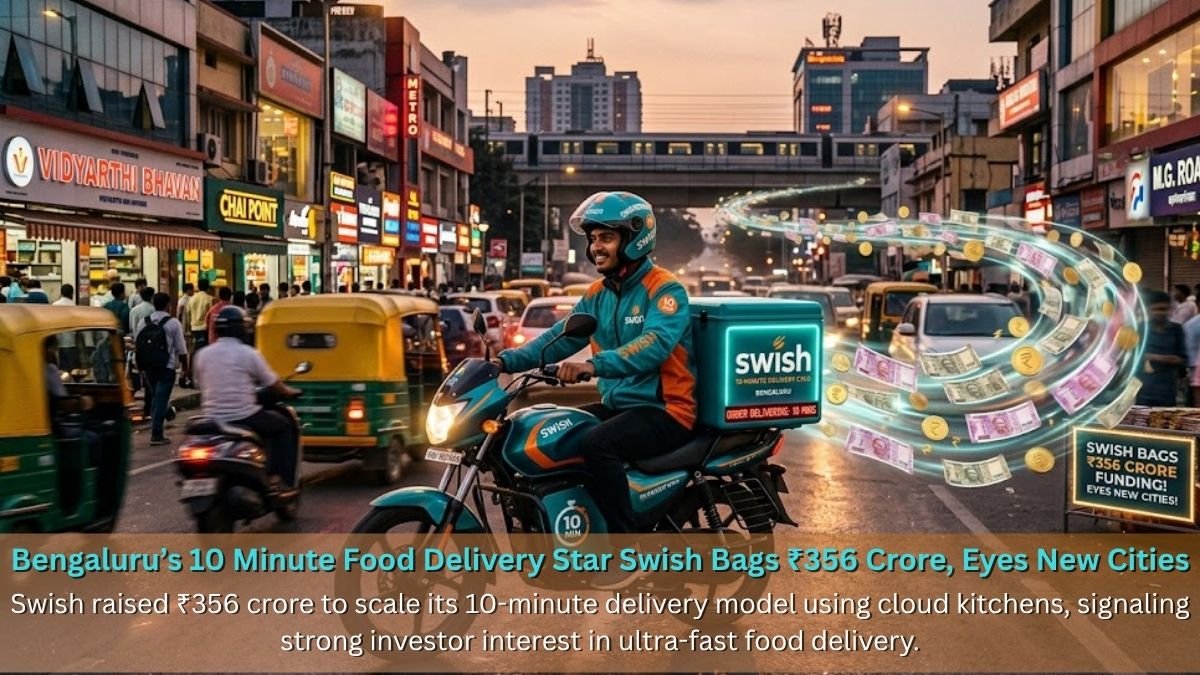
1. News Summary
Bengaluru-based foodtech startup Swish has raised ₹356 crore (around $38 million) in fresh funding as it pushes forward its ambitious 10 Minute Food Delivery model across India. The funding, which marks its third round in just 18 months, highlights growing investor confidence in ultra-fast food delivery as a new frontier within the startup ecosystem. With this round, Swish aims to expand beyond Bengaluru into multiple Indian cities while strengthening its operations, technology, and supply chain.
Founded with the idea of delivering freshly prepared meals within minutes, Swish operates differently from traditional food delivery platforms. Instead of aggregating restaurants, it runs its own network of cloud kitchens strategically located to enable rapid delivery. This model allows Swish to control quality, speed, and pricing more effectively. The company is tapping into a rising trend in the foodtech space where convenience and speed are becoming key differentiators. As consumer expectations evolve, startups are experimenting with hyperlocal logistics, optimized menus, and predictive demand systems to deliver meals faster than ever before.
Swish’s rapid funding journey also reflects broader trends in venture capital, where investors are increasingly backing high-growth, disruptive tech models. However, the ultra-fast delivery space comes with operational and profitability challenges, making execution critical. With fresh capital in hand, Swish is now focusing on scaling its quick food delivery service, entering new urban markets, and refining its hyperfast meal delivery infrastructure. As competition intensifies, the startup’s ability to maintain speed, quality, and unit economics will determine its long-term success.
2. The Rise of 10 Minute Food Delivery in India
The concept of 10 Minute Food Delivery is rapidly reshaping India’s foodtech and startup ecosystem. Traditionally, food delivery platforms promised delivery within 30 to 45 minutes. However, changing consumer behavior has pushed companies to reduce delivery times drastically. Today, customers expect instant service. This shift is driven by urban lifestyles, increased disposable income, and growing reliance on digital platforms. As a result, ultra-fast food delivery, instant meal delivery, and rapid food logistics have become key industry trends.
Swish is among the emerging startups capitalizing on this shift. Its model focuses on delivering freshly prepared meals within minutes rather than relying on traditional restaurant partnerships. This approach aligns with broader tech innovations in logistics, predictive analytics, and supply chain optimization. It also reflects how Indian startups are experimenting with disruptive tech to create new market categories.
3. Swish Funding Details and Investor Confidence
Swish recently raised $38 million, equivalent to ₹356 crore, in its latest funding round. This marks its third funding round within 18 months, indicating strong traction and investor interest. The funding highlights how venture capital firms are increasingly investing in high-speed delivery models. Investors see potential in startups that combine technology, logistics, and consumer demand effectively.
This round adds Swish to the list of fastest-growing startups in India’s foodtech sector. It also reflects a broader trend where venture-backed startups are focusing on hyperlocal delivery ecosystems. Moreover, this funding aligns with global startup trends, where instant delivery services are gaining popularity in multiple markets.
4. Founders and Background Story
Swish was founded by a team of entrepreneurs who understood the challenges of traditional food delivery systems. While detailed founder profiles are limited in public sources, the leadership team has focused on building a tech-driven logistics platform. The startup began with a simple idea. Reduce delivery time drastically while maintaining food quality.
Initially, the team experimented with limited locations in Bengaluru. Over time, they refined their model by optimizing kitchen placement, menu design, and delivery routes. This journey reflects how many successful startups evolve through experimentation and iteration rather than immediate scale.
5. Business Model: How Swish Works
Swish operates on a cloud kitchen-based model. Unlike aggregator platforms, it controls the entire process from cooking to delivery. The company sets up small kitchens in high-demand areas. These kitchens prepare a limited menu designed for quick cooking. Orders are processed through a mobile app or website. Once an order is placed, the nearest kitchen prepares and dispatches it within minutes.
This system enables ultra-fast food delivery, often within 10 minutes. It also reduces dependency on third-party restaurants. The model is similar to quick commerce platforms but applied to freshly cooked meals. This makes it unique in the foodtech industry.
6. Revenue Model and Monetization Strategy
Swish’s revenue model looks simple on the surface, but the real story is in how carefully everything needs to be balanced behind the scenes. At its core, the company earns through direct food sales. Every order placed through the app contributes to its top line. But unlike traditional platforms, Swish isn’t just a marketplace, it owns the kitchen experience, which changes the economics entirely. There’s also room for additional revenue through delivery fees and peak-time pricing. During high-demand hours, slight price adjustments can help offset operational pressure. Still, this is a delicate game. Push prices too high, and customers leave. Keep them too low, and margins disappear.
The real engine of growth here is repeat behavior. Swish is not trying to win on one-time orders, it’s trying to become a habit. High-frequency users, daily meals, and potential subscription plans are where long-term value sits. If they can lock in users with meal plans or memberships, revenue becomes far more predictable. But the biggest challenge is brutally real: speed is expensive. Delivering food in under 10 minutes sounds great to customers, but it demands tight logistics, dense kitchen networks, and near-perfect execution. One small inefficiency can wipe out margins. That’s why unit economics isn’t just important for Swish, it’s survival.
7. What Problem Does Swish Solve?
Swish is built around a very real frustration that almost everyone has felt at some point: waiting too long for food. Traditional food delivery often takes 30 to 45 minutes, sometimes more. When you’re hungry, tired, or stuck between meetings, that wait feels even longer. Swish cuts that down to under 10 minutes, which completely changes the experience. It’s not just faster, it feels instant.
But speed alone isn’t enough. Another major issue in food delivery is inconsistency. You might order the same dish twice and get completely different results. Swish tackles this by controlling its own kitchens. That means standardized recipes, controlled processes, and more predictable quality. Then there’s the lifestyle shift. Urban consumers today are not just looking for food, they’re looking for convenience. Cooking feels like a task, and even stepping out feels like effort after a long day. Swish fits right into that mindset. It’s designed for people who want something quick, reliable, and effortless. In many ways, Swish isn’t just solving hunger, it’s solving time, effort, and decision fatigue.
8. Industry Growth Trends in Foodtech
The foodtech space in India is evolving faster than most people realize. What used to be a luxury is now becoming a daily habit for millions. Smartphone usage has exploded, digital payments are frictionless, and consumers are more comfortable ordering online than ever before. This has created the perfect environment for food delivery platforms to grow.
But the real shift is happening in expectations. Quick commerce platforms have trained users to expect everything instantly, groceries in 10 minutes, essentials in minutes. Naturally, food delivery is moving in the same direction. Waiting 40 minutes now feels outdated. Behind the scenes, technology is driving this transformation. AI is helping predict demand, optimize delivery routes, and reduce idle time. Hyperlocal logistics ensures food travels shorter distances, which directly improves speed and freshness. Investors are also paying close attention. There’s a clear pattern: money is flowing into startups that are not just improving existing systems, but completely rethinking them. Swish fits right into this wave. Its growth isn’t random, it’s a reflection of where the industry is heading.
9. Competitive Landscape
Swish is entering a space that is already crowded, and not just with small players. On one side, there are new startups experimenting with ultra-fast delivery, all trying to crack the same problem. On the other, there are giants like Swiggy and Zomato, companies that already dominate customer mindshare and have massive operational scale. But Swish is playing a slightly different game. Instead of relying on external restaurants, it controls its own kitchens. This gives it tighter control over quality, preparation time, and overall experience. In theory, this makes speed easier to achieve and maintain.
However, this advantage doesn’t come without pressure. Large players are not standing still. They are already exploring quick delivery formats and investing heavily in logistics. The moment they fully commit to this model, competition will intensify significantly. For Swish, the challenge is clear: move fast, build strong customer habits, and create a system that’s hard to replicate before bigger players catch up.
10. Expansion Plans and Future Strategy
With fresh funding in hand, Swish is stepping into its next phase, expansion. But growth in this space is not just about entering new cities, it’s about getting every detail right. The immediate focus will likely be metro and tier-1 cities, where demand for speed and convenience is already high. These markets are more receptive, but also more competitive. Scaling this model isn’t easy. Each city requires a carefully planned network of cloud kitchens, positioned strategically to meet the 10-minute promise. Logistics needs to be tight, demand needs to be predictable, and operations need to run almost flawlessly.
At the same time, Swish will need to invest heavily in technology, better routing systems, smarter demand forecasting, and more efficient kitchen operations. These aren’t optional upgrades, they are essential for survival at scale. The ambition is clear: become a leader in the 10-minute food delivery segment. But getting there will require more than just speed. It will demand consistency, smart execution, and the ability to manage costs without compromising the experience. If they get this balance right, Swish won’t just compete, it could redefine how people think about food delivery altogether.
11. Challenges in Scaling Ultra-Fast Delivery
On paper, delivering food in under 10 minutes sounds like a breakthrough. In reality, it’s one of the hardest business models to sustain. The biggest pressure point is cost. Running multiple cloud kitchens across a city isn’t cheap. Add to that a dedicated delivery fleet, real-time coordination, and the need to stay “always ready” even during low demand hours, and the expenses stack up fast. This isn’t a model where you can afford inefficiency. Even small mistakes show up immediately in the numbers.
Then comes demand predictability, which is far more complex than it sounds. You’re not just guessing how many people will order, you’re predicting what they’ll order, when they’ll order, and from which location. Get it wrong, and you either waste food or delay orders. Both hurt the business, one financially, the other in customer trust. And while Swish is building something exciting, it’s not operating in isolation. Larger players already have scale, capital, and customer loyalty. The moment they decide to aggressively enter this space, they can move fast and absorb losses longer. That kind of competition isn’t just tough, it can reshape the entire market overnight.
This is why execution becomes everything. Not strategy decks, not big ideas, but day-to-day discipline. The ability to run tight operations, make fast decisions, and constantly improve. That’s what will decide who survives.
12. Role of Technology and Innovation
If you look closely, Swish is as much a tech company as it is a food business. Without technology, this model simply doesn’t work. Every order triggers a chain of decisions in seconds. What kitchen should prepare it? Is inventory available? Which delivery partner is closest? What route will get the food there fastest? These aren’t manual calls, they’re driven by data and algorithms working quietly in the background. Demand prediction is where things get even more interesting. By analyzing past behavior, peak hours, weather patterns, and even local events, Swish can prepare in advance. This reduces waiting time and cuts down waste. It’s not perfect, but when it works well, it feels almost invisible to the customer.
Route optimization is another critical layer. Saving even a minute on delivery time can make the difference between meeting the 10-minute promise or missing it. Over thousands of orders, those minutes translate into real operational gains. Looking ahead, advancements in AI and logistics tech will push this even further. Smarter forecasting, automated kitchen workflows, and hyper-efficient delivery systems will slowly turn what feels impossible today into a standard expectation tomorrow.
13. Impact on Startup Ecosystem
Swish’s rise is not just about food delivery, it reflects a deeper shift in how startups are being built and funded today. Investors are no longer impressed by incremental improvements. They’re looking for bold ideas that challenge existing behavior. A 10-minute food delivery model does exactly that. It changes how people think about time, convenience, and even daily routines.
There’s also a clear trend toward backing businesses that sit at the intersection of technology and real-world problems. Whether it’s foodtech, fintech, or AI-driven services, the focus is on scalable models that can impact everyday life. When startups like Swish gain traction, it sends a strong signal to the ecosystem. It tells founders that there’s room to rethink traditional industries. It encourages experimentation. It pushes people to go beyond “better” and aim for “different.” At the same time, it reminds everyone of a hard truth: funding may open doors, but execution decides outcomes.
14. Learning for Startups and Entrepreneurs
There’s a lot to take away from what Swish is trying to build, especially for anyone thinking about starting something of their own. The first lesson is simple but often overlooked: solve something real. Swish didn’t invent hunger, but it understood frustration. Long wait times, inconsistent quality, lack of convenience. It focused on a clear pain point and built around it. The second lesson is about perspective. Innovation doesn’t always mean new technology. Sometimes it’s about rethinking the model itself. Swish didn’t just improve delivery, it redesigned how food is prepared, stored, and delivered. That shift is what creates new opportunities. Then comes execution, which is where most ideas fall apart. It’s easy to design a great concept. It’s incredibly hard to make it work every single day, across cities, customers, and unpredictable conditions. Consistency is what builds trust, and trust is what builds businesses.
Finally, adaptability. Markets change fast. Consumer expectations evolve even faster. What feels like a competitive edge today can become a basic expectation tomorrow. The startups that survive are the ones that stay alert, learn quickly, and aren’t afraid to change direction when needed. In the end, Swish’s journey is not just about speed or food. It’s about understanding people, building with intent, and staying relentless in execution even when things get difficult.
About foundlanes.com
foundlanes.com is India’s emerging startup idea platform dedicated to helping aspiring entrepreneurs discover practical business opportunities. The platform publishes detailed startup guides, founder stories, market insights, and execution strategies designed for students, professionals, and early-stage founders. By simplifying complex business concepts and presenting them in accessible formats, foundlanes aims to empower individuals to explore entrepreneurship and launch successful ventures in India’s rapidly evolving startup ecosystem.