


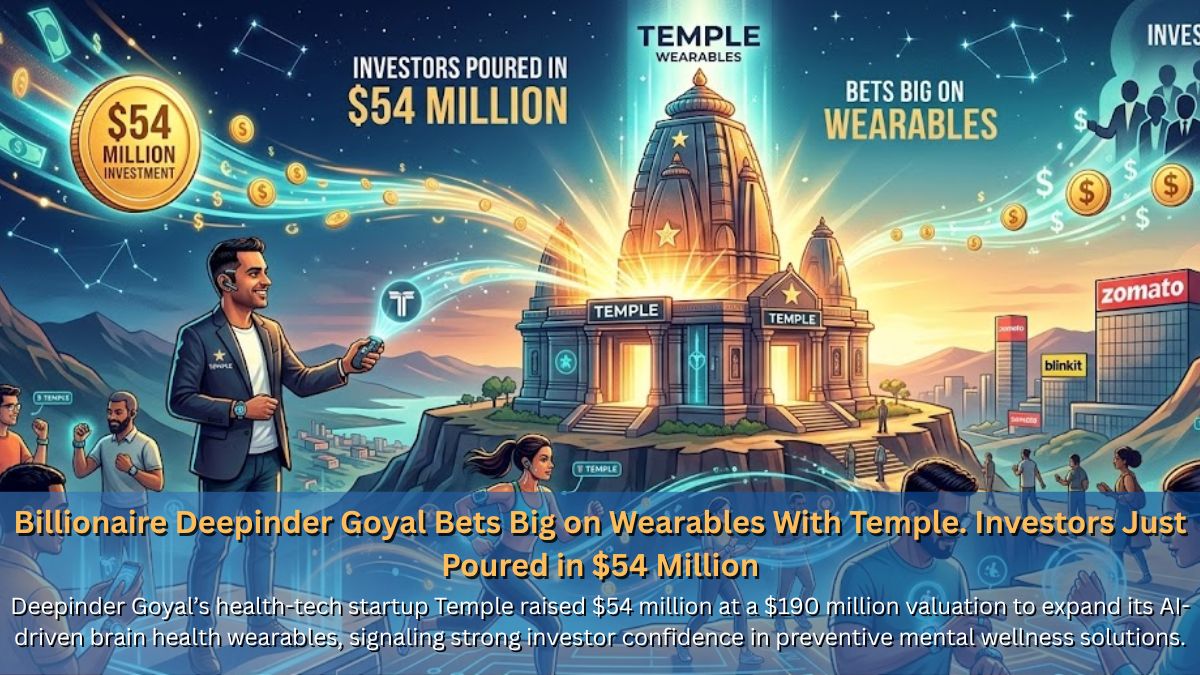
News Summary
The Indian startup ecosystem has witnessed a remarkable development as Deepinder Goyal Bets Big on wearables with his health-tech startup, Temple. The company has raised $54 million in a fresh funding round, pushing its valuation to $190 million. Investors, including Steadview Capital, Peak XV Partners, and several angel investors, participated in this round, signaling strong confidence in Temple’s potential. This development marks the return of Deepinder Goyal to the entrepreneurial arena after his successful journey with Zomato, India’s food-tech unicorn.
Temple, a wearable technology startup, is designed to monitor brain health and provide users with actionable insights. The startup leverages innovative hardware, machine learning algorithms, and user-friendly mobile applications to track cognitive patterns and mental well-being. The funding infusion is expected to accelerate product development, expand market reach, and strengthen research capabilities. Analysts highlight that Temple’s model addresses a growing need for preventive healthcare and personalized mental wellness solutions in India and globally.
The move is also a reflection of the rising investor interest in the health-tech and wearable segments, which are projected to grow exponentially in the coming years. As more consumers adopt smart devices and wearable health monitors, companies like Temple are poised to capitalize on this trend. For startup founders and investors, this funding round demonstrates that strategic innovation, combined with strong leadership, can attract significant capital even in competitive tech markets.
1. Introduction: Why “Deepinder Goyal Bets Big” Is Resonating Across India
When you read the headline Deepinder Goyal Bets Big, it hits differently than most startup news. It isn’t just another funding announcement. It’s the moment a founder who helped build Zomato into a household name is placing a meaningful wager on the future of health technology. The recent $54 million funding round for Temple has stirred conversations not just because of the number, but because of what it represents: confidence that wearable health tech can meaningfully improve lives, and belief in a visionary founder’s ability to shape a new category.
This story isn’t just about capital. It’s about conviction. For many onlookers and investors, it signals that India’s tech narrative is maturing that founders who’ve succeeded once are now stretching into domains with societal impact, not just scale. There’s a sense of optimism mixed with curiosity: can someone who reshaped how millions eat now change how millions think, feel, and manage their cognitive wellbeing?
2. Background of Temple and Deepinder Goyal
2.1 Temple’s Early Days and Purpose
Temple didn’t arise from a trend. It grew out of a very real gap that its founders saw in health tech the absence of tools that meaningfully measure and support mental and cognitive wellness. Unlike fitness trackers that count steps or monitor heart rate, Temple sets its focus on the brain. It measures cognitive activity, stress triggers, and subtle indicators of mental fatigue that most of us don’t know how to track, let alone manage.
Early iterations of the device were painstaking. Engineers and health specialists worked side by side to understand not only what the sensors could read, but what those readings meant to a person’s daily life. Temple’s wearable isn’t just a gadget it’s the result of countless conversations with early users who said things like, “I feel exhausted, but I don’t know why,” or, “My sleep looks fine, but my focus doesn’t.” The startup set out to give people answers, not just data points.
2.2 Deepinder Goyal’s Journey from Zomato to Temple
Deepinder Goyal’s story with Zomato is familiar to many: starting with a simple idea of helping users discover restaurants, and scaling it into one of India’s most recognizable tech brands. That journey taught him something crucial technology matters most when it touches daily life in meaningful ways.
With Temple, Goyal is not chasing another category just because it’s exciting. His move into wearables and health tech is deeply personal. It reflects long conversations with friends, family, and colleagues about stress, burnout, and unaddressed mental strain. He’s seen first‑hand how performance pressures in startup life and beyond take a toll without clear tools for measurement or support. That experience gave him both empathy and impetus to build something genuinely useful.
2.3 Why Temple Matters Now
Mental health awareness is no longer fringe thinking. People want tools that help them understand why they feel the way they do and how to improve it. Temple sits at the intersection of rising health consciousness and accessible technology. It arrives at a moment when individuals are ready to invest not just in physical fitness, but in cognitive clarity, emotional balance, and long‑term wellbeing.
3. How Temple Works: Beyond a Gadget
3.1 A Product Built Around Real Human Experience
Temple’s core product is a wearable device built to go deeper than standard trackers. Instead of merely observing steps taken or hours slept, it reads patterns in brain activity, stress response, and focus levels. The hardware is thoughtfully designed non‑invasive sensors that are comfortable to wear, intuitive connectivity to users’ devices, and accuracy that’s been refined through rigorous testing. But what really matters isn’t the hardware. It’s how the device translates that data into understanding. Temple doesn’t just show graphs; it tells a story about how your brain is responding to your life, your routines, and your stressors. It turns complex neurodata into something a person can act on.
3.2 Intelligence That Learns With You
At the heart of Temple is a machine learning engine that grows smarter with each interaction. It doesn’t treat everyone the same. Over time, the system begins to notice patterns unique to you how your stress levels shift after certain activities, how your focus fluctuates throughout the day, or how well you recover after sleep. The app leverages these insights to offer personalized suggestions. It might prompt you to take a moment to breathe before a meeting, suggest cognitive exercises, or highlight patterns that correlate with your best days. This level of personalization isn’t gimmicky; it’s the difference between data that sits unused and insights that change behavior.
3.3 A Revenue Model Rooted in Sustainability
Temple’s business model is designed to be sustainable and value‑driven. It combines device sales representing meaningful hardware innovation with a subscription service that unlocks deeper analytics, personalized coaching, and ongoing insight. This dual approach gives Temple predictable revenue while keeping users engaged over time. For the company, this isn’t about selling another gadget. It’s about building a relationship with users one that evolves as they use the platform, trust its recommendations, and find real improvement in their daily lives.
4. Revenue Model and Business Strategy
4.1 Direct-to-Consumer Sales: Building a Relationship, Not Just a Transaction
Temple’s wearable devices are primarily sold directly to consumers through online channels. This approach is more than a sales tactic it’s a deliberate way to engage with users from the very first interaction. By controlling distribution, Temple can ensure pricing consistency, maintain brand integrity, and, most importantly, understand customer behavior firsthand.
For founders, this direct link with users is invaluable. Every piece of feedback whether about comfort, data accuracy, or app usability feeds directly into product improvements. Early testers have shared stories of noticing small stress patterns they never recognized before, which has created loyal advocates for the product. In essence, every sale is the beginning of a conversation, and each conversation informs the next stage of product development.
4.2 Subscription-Based Services: Turning Data Into Meaning
Temple’s premium subscriptions go beyond basic analytics. They offer mental health coaching, guided exercises, and exclusive insights that transform raw neurodata into actionable guidance. This recurring revenue model is not just financially strategic it builds a lasting relationship with the user.
Subscribers often report tangible changes: better focus, improved sleep routines, and clearer awareness of stress triggers. From a business perspective, this enhances lifetime value, strengthens engagement, and creates a community of users who actively participate in their own cognitive wellness journey. Founders describe the subscription as a way to make the wearable not a one-time gadget but a daily companion that evolves with the user.
4.3 Strategic Partnerships: Scaling Impact Beyond Individuals
Temple is also pursuing B2B collaborations with hospitals, wellness centers, and corporate wellness programs. These partnerships are about scale and impact. Hospitals can integrate Temple devices into preventive health programs, wellness centers can use data insights to customize treatments, and corporations can monitor employee wellness proactively.
These collaborations open institutional revenue streams that are often larger and more stable than individual sales. More importantly, they position Temple as a trusted partner in health and wellness, not just a tech startup. This strategic dual approach serving both consumers and institutions allows the company to expand its footprint while staying true to its mission of promoting cognitive health.
5. Funding and Financial Trajectory
5.1 Recent $54 Million Funding Round: A Vote of Confidence
Temple’s recent $54 million funding round, at a $190 million valuation, is more than a headline it is a clear endorsement of the startup’s vision and execution. Investors, including Steadview Capital, Peak XV Partners, and a network of angel backers, are placing their faith in both the technology and the founder’s ability to scale it responsibly.
For Temple, this capital will fund deeper product development, advanced R&D, and marketing campaigns aimed at both direct consumers and institutional partners. Beyond dollars, the round sends a signal to the ecosystem: experienced founders venturing into health-tech are being taken seriously, and preventive cognitive wellness is emerging as a meaningful category.
5.2 Capital Efficiency and Growth Strategy: Scaling with Discipline
Unlike many venture-backed hardware startups, Temple emphasizes capital-efficient growth. The combination of device sales, subscription revenue, and strategic partnerships creates a balanced revenue mix that allows the company to scale without over-reliance on continuous fundraising.
This approach reflects Goyal’s experience at Zomato knowing when to invest aggressively and when to optimize for efficiency. By avoiding unnecessary dilution and keeping a disciplined approach to capital allocation, Temple can focus on delivering tangible impact to users while sustaining long-term financial health. Early metrics show healthy unit economics, with subscription retention and engagement rates reinforcing that the business model works in practice, not just on paper.
5.3 Future Fundraising Prospects: Positioned for Global Expansion
The combination of market interest in health-tech and Temple’s unique value proposition makes the startup well-positioned for future rounds. Expansion into international markets, particularly regions with growing awareness of mental wellness and preventive healthcare, could attract global investors seeking early-stage exposure to cognitive wellness technology.
This isn’t just about growth it’s about building a platform that can genuinely make a difference in how people understand and manage their mental health. For Goyal and his team, fundraising is a means to an end: enabling innovation, delivering measurable outcomes, and creating a product that users trust enough to integrate into their daily lives.
6. Products, Services, and Features
6.1 Brain Monitoring Wearables: A Window Into How You Really Feel
Temple’s core product isn’t just another fitness tracker. It’s a wearable designed to monitor what most people never think to measure: cognitive patterns, stress responses, the ebb and flow of focus throughout the day, and how your sleep truly affects your mental state. Behind the sleek device are years of research and real conversations with users who kept saying the same thing: “I feel tired, but I don’t know why.”
The device gathers neurodata through non‑invasive sensors and sends it to Temple’s mobile app, where raw signals turn into human language. Users don’t get charts they can’t interpret; they get insights that feel like advice from someone who truly understands what they’re going through. People report moments of clarity “I didn’t realize my stress surged every afternoon until I saw it here” and that’s when the product stops being a gadget and starts being a companion on their wellbeing journey.
6.2 Personalized Coaching: Guidance That Feels Tailored
Temple doesn’t stop at data collection. The platform offers personalized coaching powered by machine learning that adapts to each user’s unique cognitive profile. This isn’t generic wellness content. It’s tailored recommendations from mindfulness exercises when stress spikes to productivity cues when focus wanes. This AI‑driven coaching feels intuitive because it evolves with the user. Early adopters often describe it like having a thoughtful, patient coach: “It suggested small breathing exercises right before my presentation, and it genuinely helped calm my mind.” This feature turns metrics into meaning and makes the wearable feel alive in its support for everyday emotional wellbeing.
6.3 Data‑Driven Analytics: Seeing the Unseen
What really sets Temple apart is predictive analytics. The platform looks not just at what’s happening now, but at patterns that signal what might come next. It flags early signs of cognitive fatigue or mental wellness risks before the user consciously notices them. This isn’t about alarm bells. It’s about empowerment giving users the chance to act before stress becomes burnout, before foggy thinking becomes chronic distraction. In real use, people have shared how these insights changed their routines: adjusting sleep schedules, rediscovering focus blocks, or simply recognizing when they need a break. That’s the kind of impact you don’t see in glossy marketing you feel it.
7. Problems Temple Solves
7.1 Closing a Deeply Personal Cognitive Health Gap
Most of us navigate our days without tools that truly track how our brains are performing. We might monitor steps, calories, or heart rate but mental clarity, emotional resilience, cognitive strain? That’s largely uncharted territory for most people. Temple zeroes in on this unmet need. Users routinely express relief in knowing they’re not “just imagining” feeling scattered or overwhelmed. Temple gives language and understanding to internal experiences that were previously invisible. That’s not just innovation that’s validation.
7.2 Making Preventive Mental Health Tangible
In a world where stress and lifestyle pressures are increasing, Temple gives people a way to see their cognitive health before issues escalate. Rather than waiting until exhaustion becomes burnout or anxiety turns chronic, users can monitor signals and course‑correct. This is preventive health care in the truest sense. It’s like seeing a small crack in your windshield and fixing it before it spreads. For families, professionals, and anyone juggling many demands, this early awareness isn’t luxury it’s essential.
7.3 Empowering Daily Life Optimization
Temple does more than measure it equips. Users gain insights that help them optimize sleep patterns, sharpen focus, manage stress, and make choices that feel aligned with how they want to live. The platform integrates into daily routines not as another chore, but as a resource you return to because it helps. Early adopters often describe a shift: “I started taking my afternoon breaks seriously because Temple showed me stress peaks then.” That shift from vague discomfort to actionable change is where real impact lives.
8. Industry Growth Trends
8.1 Wearables Market Expansion: A Culture Ready for Mental Health Tech
The global wearables market is booming not just because people want cool tech they want understanding, accountability, and insight into their health. From fitness bands to smart watches, adoption is rising. But the real story unfolding now is demand beyond steps and heart rate. In India, this trend is amplified by two forces: skyrocketing smartphone penetration and a growing cultural focus on holistic health. Temple arrives at a moment when people are ready to think about mind as health, not just body as health. That’s why conversations about mental wellness aren’t niche anymore. They’re mainstream.
8.2 Health‑Tech and AI Integration: Personalized Care at Scale
AI‑driven health tech is transforming traditional models of care. No longer is technology limited to hospitals or research labs. Machine learning allows personalized wellness insights to be delivered directly to a user’s wrist and phone. Temple sits at this intersection. By combining sophisticated analytics with real human behavior, the platform demonstrates how deeply personalized care can be both scalable and empathetic. It’s not cold tech it’s tech that learns you, adapts to you, and supports you where you are.
8.3 Investor Appetite for Health‑Tech: Confidence Meets Purpose
The $54 million funding round isn’t a fluke it’s proof of growing conviction that health‑tech and wellness wearables are not just commercially viable but societally necessary. Investors are increasingly looking at startups that solve real human challenges, especially those enabled by AI and data science.
Mental wellness and preventative care are no longer fringe investment themes. They’re front and center in a world where people seek tools that help them feel better, perform better, and live with more clarity and confidence. Temple’s traction, user feedback, and thoughtful product strategy have made investors take notice — not just for profit potential, but for potential impact.
9. Competitors in the Market
9.1 Direct Competitors: A Tight but Diverse Space
Temple operates in a growing but selective market of mental wellness wearables, going head-to-head with companies like Muse and BrainTap. These platforms focus on cognitive tracking and meditation support, yet their technology and analytics often lack the depth Temple brings. While competitors may provide snapshots of brain activity or guided meditation, Temple’s AI-driven predictive analytics and continuous cognitive monitoring allow users to anticipate stress and fatigue rather than just react to it.
This nuanced difference matters to consumers. Early users have shared how Temple’s insights uncover subtle patterns in daily focus and stress that they would otherwise overlook. It’s not just tracking it’s translating brain signals into actionable life improvements, a distinction that positions Temple as a premium cognitive wellness solution.
9.2 Indirect Competitors: Fitness Wearables Aren’t Enough
Indirectly, mainstream wearables like Fitbit and the Apple Watch vie for attention and spending. These devices excel at monitoring heart rate, sleep, or steps but fall short on cognitive health. Many users who started with fitness wearables report a sense of incompleteness they can see how long they slept but not why they felt mentally drained or unfocused. Temple fills that gap, turning previously invisible mental patterns into tangible, understandable insights.
9.3 Differentiation Strategies: AI Meets Human Experience
Temple’s differentiation isn’t just technical it’s deeply human. Personalized coaching, predictive analytics, and a focus on cognitive wellness create a product that doesn’t merely observe behavior but guides it. Users often describe Temple as a partner rather than a gadget: it notices, it alerts, and it suggests, bridging the gap between raw data and meaningful action. This emotional resonance, combined with measurable results, gives Temple an edge in a crowded but fragmented market.
10. The Startup’s Journey
10.1 Founding Vision: Beyond Technology
Temple began with a clear purpose: to integrate wearable technology into preventive mental healthcare. The founding team brought together neuroscientists, hardware engineers, and AI specialists to tackle a problem that has long been overlooked. For them, it wasn’t about creating another device; it was about giving people tools to understand and care for their minds proactively.
10.2 Product Development Milestones: Learning from Users
From early prototypes to commercial-grade devices, Temple invested in iterative development. Sensor accuracy, app usability, and seamless hardware-software integration were constantly refined based on real feedback. Users shared frustrations, small irritations, or unexpected insights, and the team used these stories to improve the experience. One early adopter recounted noticing a midday cognitive slump, adjusting her routine, and feeling tangible improvements within a week a moment that validated the product’s potential.
10.3 Market Entry: Starting with the Mindful Urban Consumer
Temple initially targeted urban professionals and students, demographics most attuned to mental wellness trends. Early adoption confirmed the product-market fit: users responded not only to functionality but to the platform’s ability to integrate seamlessly into daily life. These early successes informed scaling strategies, marketing approaches, and the design of premium subscription offerings, creating a foundation for sustainable growth.
11. The Broader Impact
11.1 Empowering Consumer Wellness
Temple transforms how individuals approach cognitive health. By offering continuous insights and actionable guidance, the platform empowers users to prevent stress accumulation, optimize focus, and maintain mental balance. Stories from early users highlight real-life changes: improved productivity, better sleep hygiene, and more mindful daily routines. In effect, Temple turns abstract concepts like “cognitive wellness” into tangible, actionable behaviors.
11.2 Influence on the Startup Ecosystem
The successful $54 million funding round demonstrates that visionary founders in emerging health-tech sectors can attract serious capital. Temple’s story signals to other entrepreneurs that India’s ecosystem is ready to support startups that blend technology, health, and deep human insight. It reinforces the notion that meaningful innovation, when executed well, draws both investor confidence and market traction.
11.3 Transforming the Industry
Temple’s AI-driven predictive analytics could reshape how mental wellness is approached globally. By turning cognitive health into measurable, actionable insights, the startup provides a model for integrating data-driven preventive care into mainstream wellness practices. This could influence corporate wellness programs, clinical recommendations, and consumer expectations, creating ripples beyond the immediate user base.
12. Strategic Vision and Growth Plans
12.1 Scaling Within India
Temple plans to expand across major Indian cities, increasing device availability and subscription adoption. By focusing on urban centers first, the startup can continue collecting valuable user data, refine coaching algorithms, and strengthen brand awareness before moving to broader markets. Scaling is paired with education ensuring users understand how to act on the insights provided which deepens engagement and retention.
12.2 Global Expansion Prospects
The startup is exploring international markets with high awareness of mental wellness, including the US and Europe. These markets represent both opportunity and challenge: regulatory frameworks, user behavior, and competitive landscapes differ, but Temple’s data-driven, personalized approach positions it well. Early conversations with international partners suggest that the platform’s combination of hardware, AI, and coaching resonates with users who are increasingly looking for mental wellness tools that go beyond apps and meditation guides.
12.3 Continuous Research and Innovation
Temple continues to invest in R&D to enhance sensor precision, predictive algorithms, and personalization. The aim is to create a device that doesn’t just monitor but learns and adapts to each user over time. Founders emphasize that innovation isn’t about features for the sake of novelty it’s about impact. Every update, every algorithm tweak, is measured against the tangible difference it makes in users’ cognitive health.
13. Why “Deepinder Goyal Bets Big” Matters
13.1 Experienced Leadership: Credibility That Moves Markets
Deepinder Goyal’s involvement in Temple goes beyond a founder’s title. It carries the weight of experience, credibility, and a proven ability to execute at scale. Investors, team members, and early adopters alike recognize that this is not a first-time venture by an untested entrepreneur it is a leader who has navigated the challenges of building Zomato into a global brand. This experience matters in tangible ways. Goyal understands how to prioritize product-market fit, manage regulatory hurdles, and motivate teams under pressure. For investors, his presence signals that Temple isn’t just chasing a trend it is anchored by operational discipline, strategic foresight, and a founder who knows how to turn vision into measurable outcomes. Early feedback from beta users reflects this: product iterations are rapid, support is proactive, and the roadmap is aligned with real human needs, not just technological ambition.
13.2 Market Timing: Entering at the Convergence of Need and Technology
Temple arrives at a unique moment in India and globally: a convergence of AI, wearable technology, and a growing recognition of preventive healthcare’s importance. Consumers are more aware of cognitive health, and the tools to measure and act on it are finally mature. This creates a rare opportunity for first movers to define standards and establish deep brand recognition. Timing also plays out in user adoption. Urban professionals, students, and wellness-conscious consumers are actively seeking ways to monitor stress, improve focus, and enhance mental resilience. Temple doesn’t ask people to change behavior drastically; it meets them where they are, offering insights that are immediately understandable and actionable. This alignment of technology and human need is why early traction is strong and why the funding round resonated so positively in the market.
13.3 Investment Signal: Confidence in Vision and Execution
The $54 million funding round is more than capital it is a collective vote of confidence. Investors are signaling belief in both the product and Goyal’s capacity to deliver on the promise of predictive cognitive wellness. This infusion allows Temple to accelerate R&D, scale device distribution, refine AI algorithms, and expand subscription services without compromising quality or user experience. More than numbers, the funding validates a philosophy: that technology can serve humanity by addressing mental wellness proactively. For the startup ecosystem, it demonstrates that investors are increasingly looking for ventures that combine technical rigor, social impact, and market scalability.
14. Lessons for Startups and Entrepreneurs
14.1 Leverage Experience to Enter New Domains
Founders who have built successful companies once can use that credibility to tackle entirely new challenges. Deepinder Goyal’s pivot from food delivery to health-tech shows how prior success opens doors, attracts talent, and earns investor trust, but it also comes with the responsibility of thoughtful execution.
14.2 Address Unmet Needs with Tangible Impact
Startups that solve real human problems like cognitive health monitoring gain attention and engagement quickly. Temple didn’t follow trends blindly; it listened to users, identified gaps, and built solutions that addressed pain points that traditional fitness trackers overlook. The result: early adoption, meaningful engagement, and a strong value proposition for investors.
14.3 Combine Hardware, Software, and AI Thoughtfully
Creating differentiated value requires integrating multiple technologies in a way that is seamless and user-centric. Temple’s combination of wearable sensors, AI analytics, and personalized coaching transforms raw data into actionable guidance, turning a device into a trusted companion for daily life.
14.4 Prioritize Capital-Efficient Growth
Sustainable scaling matters more than rapid expansion for its own sake. By balancing device sales, subscription revenue, and strategic partnerships, Temple can grow without excessive dilution, ensuring financial stability while pursuing long-term innovation.
14.5 Strategic Partnerships Amplify Reach
Collaborations with hospitals, wellness centers, and corporate wellness programs enable startups to reach wider audiences and create recurring revenue streams. These partnerships are not just transactional they also provide credibility and institutional validation that complements consumer adoption.
14.6 Human-Centered Design Drives Adoption
Beyond technology, understanding real human behaviors, routines, and emotions is critical. Temple’s success lies in translating complex neurodata into insights people can easily act on, creating tangible improvements in focus, stress management, and overall cognitive health.
About foundlanes.com
foundlanes.com is India’s leading startup idea discovery platform. It helps entrepreneurs find actionable startup opportunities, market insights, and industry-specific guidance to turn ideas into real businesses. With deep research and practical resources, foundlanes supports founders at every stage, from idea validation to launch and growth.