


News Summary
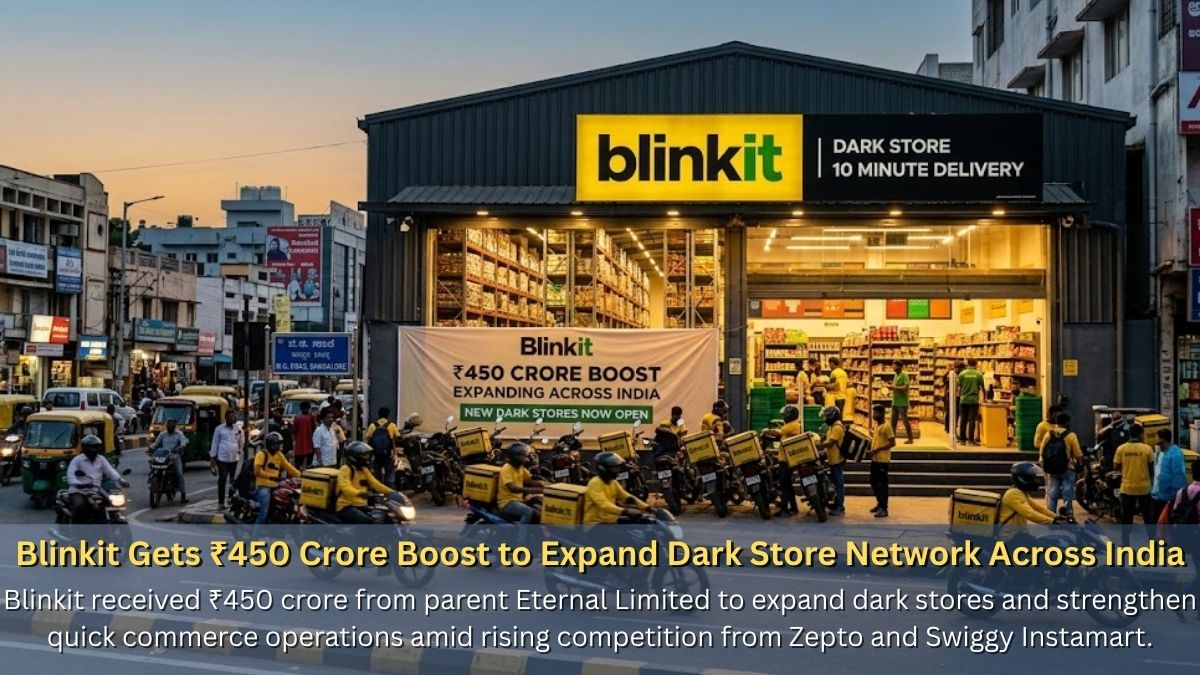
Blinkit Gets ₹450 Crore Boost as the quick commerce battle in India enters a new phase of aggressive expansion and investment. The parent company Eternal Limited, previously known as Zomato, has infused ₹450 crore into its rapid grocery delivery platform Blinkit to accelerate growth and expand its dark store network across major Indian cities. The move signals a strong push to dominate the fast-growing quick commerce sector where companies promise deliveries within minutes.
The investment comes at a time when the quick commerce industry in India is witnessing intense competition and heavy venture capital spending. Platforms such as Swiggy Instamart, Zepto, and BigBasket are rapidly expanding their dark store infrastructure to capture urban consumers who prefer ultra-fast grocery deliveries. As a result, companies are raising capital, strengthening logistics networks, and deploying advanced tech innovations to scale operations.
Blinkit plans to use the fresh capital to open more dark stores, improve supply chain efficiency, and enhance delivery operations. Dark stores are small warehouses located close to residential clusters that enable rapid order fulfillment. The expansion strategy reflects the company’s goal of strengthening its position in India’s evolving quick commerce market.
Meanwhile, the funding also reflects the broader momentum in the Indian startup ecosystem, where venture-backed startups continue to attract business funding to scale disruptive business models. Investors are betting that ultra-fast delivery will become a key part of urban retail infrastructure.
Industry analysts note that quick commerce is one of the fastest-growing segments in India’s tech startup landscape. However, profitability remains a challenge due to high operational costs and intense competition. Despite that, companies are doubling down on growth strategies to capture market share early. Therefore, the latest funding round highlights how Blinkit and its parent company are positioning themselves for long-term dominance in India’s quick commerce revolution.
1. Introduction: Blinkit Gets ₹450 Crore Boost in India’s Quick Commerce War
India’s quick commerce race just got even more intense. Grocery delivery platform Blinkit has received a fresh capital infusion of ₹450 crore from its parent company Eternal Limited. The goal is clear: expand faster, build more dark stores, and strengthen the logistics backbone that powers 10-minute deliveries.
In India’s largest cities, consumer behavior has changed dramatically over the past few years. A growing number of people now expect groceries, snacks, and daily essentials to reach their doorstep almost instantly. For working professionals, students, and families juggling busy schedules, waiting hours for delivery feels outdated. Convenience has become the new standard.
This shift is what fuels the quick commerce boom. Companies are no longer competing just on price or product variety. They are competing on speed, reliability, and last-mile efficiency. The new funding for Blinkit reflects this reality. Building a nationwide rapid-delivery network requires massive investment in technology, supply chains, and local infrastructure. The ₹450 crore boost is not just about expansion. It signals confidence in the quick commerce model and highlights how urban retail in India is quietly being rewritten.
2. The Story Behind Blinkit
2.1 From Grofers to Blinkit
Before it became a quick commerce leader, Blinkit was known as Grofers, a grocery delivery startup launched in 2013 by founders Albinder Dhindsa and Saurabh Kumar. In its early years, Grofers followed a traditional model. Customers would place grocery orders online and schedule deliveries for later in the day or the next morning. At that time, the idea of groceries arriving within minutes seemed unrealistic. The logistics simply didn’t exist. But something interesting began happening.
Urban consumers started demanding instant gratification. Food delivery apps were conditioning people to expect faster service. The same expectation slowly spread to groceries and household essentials. The founders noticed this change early. Instead of sticking with the old model, they made a bold decision: pivot completely to instant delivery. That transformation led to the birth of Blinkit, a brand designed around one promise, delivering essentials almost instantly. Rebranding was more than a marketing move. It represented a deeper strategic shift toward speed, technology, and hyperlocal logistics.
2.2 Acquisition by Zomato
The next turning point arrived in 2022. Food delivery giant Zomato acquired Blinkit in a high-profile deal that sent ripples across India’s startup ecosystem. The acquisition placed Blinkit under the corporate structure of Eternal Limited. At the time, many observers questioned the move. Food delivery and grocery logistics operate differently. Yet the leadership at Zomato saw a larger opportunity. They believed quick commerce could become as significant as food delivery.
The integration brought clear advantages. Blinkit gained access to capital, technology infrastructure, and operational expertise. At the same time, Zomato expanded its presence in a rapidly growing segment of online retail. The partnership allowed Blinkit to accelerate expansion, particularly in metropolitan markets where demand for rapid delivery is strongest.
3. Understanding the Quick Commerce Model
3.1 What Exactly Is Quick Commerce?
Quick commerce, often called q-commerce, is a delivery model designed around extreme speed. Instead of promising deliveries in hours or days, companies aim to deliver everyday products in 10 to 20 minutes. At first glance, this sounds simple. But the system behind it is complex.
The model relies on three key pillars:
- Hyperlocal warehouses
- Smart logistics routing
- Real-time inventory technology
The warehouses, commonly called dark stores, are located within residential neighborhoods. Because they sit close to customers, delivery partners can reach homes quickly. Orders are processed instantly through automated systems. The moment a customer clicks “buy,” the nearest warehouse receives the request. Within minutes, the order is picked, packed, and handed to a delivery rider. When everything works smoothly, the entire cycle can take less than 15 minutes.
3.2 How Blinkit Executes This Model
Blinkit has built its quick commerce system around dense clusters of dark stores across major Indian cities.
The process looks simple from the customer’s perspective:
- Open the Blinkit app.
- Select groceries or essentials.
- Confirm the order.
- Wait a few minutes for delivery.
But behind the scenes, the system is highly optimized. Every dark store manages inventory based on local demand patterns. For example, stores in residential neighborhoods stock more household staples, while stores near offices may focus on snacks and beverages. Technology also plays a huge role. Algorithms predict demand spikes, track delivery routes, and optimize rider assignments. This combination of data, logistics, and proximity is what makes quick commerce possible.
4. Dark Stores: The Engine Behind Fast Delivery
4.1 What Are Dark Stores?
Dark stores are essentially mini-warehouses built exclusively for online orders. They look like small supermarkets inside but remain closed to the public. Only employees and delivery staff operate within them.
These facilities typically stock around 2,000 to 3,000 high-demand products, including:
- Fruits and vegetables
- Packaged groceries
- Dairy products
- Snacks and beverages
- Personal care items
- Medicines and household supplies
Because the assortment focuses on everyday essentials, orders can be picked quickly. A typical dark store worker can collect items for an order in less than two minutes. This operational efficiency is what enables rapid dispatch.
4.2 Blinkit’s Expansion Strategy
With the new ₹450 crore investment, Blinkit plans to significantly expand its dark store network.
More stores mean:
- shorter delivery distances
- faster service times
- better product availability
In dense urban areas, quick commerce companies aim to place dark stores within 2 to 3 kilometers of customers. This proximity is critical. Even a small increase in distance can add several minutes to delivery time. In a business built around speed, those minutes matter.
The funding will also support improvements in:
- warehouse automation
- supply chain efficiency
- rider logistics systems
All these upgrades aim to ensure that Blinkit can handle rising order volumes without slowing down delivery times.
5. Funding Strategy and What It Means for the Market
5.1 Why Eternal Injected ₹450 Crore
The capital infusion from Eternal Limited signals strong confidence in Blinkit’s long-term potential. Quick commerce requires heavy upfront investment. Companies must build warehouses, hire delivery partners, and maintain large inventory levels. In the early stages, profitability is often secondary to market expansion and customer acquisition.
The ₹450 crore will help Blinkit:
- open more dark stores
- strengthen logistics infrastructure
- improve delivery speed
- expand operations in high-demand cities
These investments help secure market share before competitors catch up.
5.2 The Bigger Picture: Startup Funding Trends
The funding also reflects broader trends in India’s startup ecosystem. Investors continue to place large bets on businesses that combine technology with real-world infrastructure. Quick commerce sits right at that intersection. In recent years, companies in this space have collectively raised billions of dollars in venture capital. The belief is simple: if consumers become accustomed to instant delivery, the market could grow into a massive retail category.
Urban lifestyles already support this shift. Busy professionals often prefer convenience over price savings. Ordering groceries in minutes can save an hour trip to the supermarket. For families, it removes the need to plan weekly grocery runs. That convenience is what investors are betting on.
6. Products and Services Offered by Blinkit
The success of Blinkit lies in a simple but powerful idea: people no longer want to wait hours or days for everyday items. In fast-moving urban life, convenience has become incredibly valuable. Over time, Blinkit has expanded its platform to offer a wide range of products designed to meet everyday needs quickly. What began primarily as a grocery delivery service has gradually evolved into a broader quick commerce ecosystem, where customers can order multiple categories of products and receive them within minutes. This expansion has played a critical role in increasing both customer engagement and order frequency.
6.1 Grocery Delivery
At its core, Blinkit remains a grocery delivery platform.
The app allows users to order essential grocery items such as:
- Fresh fruits and vegetables
- Packaged food products
- Dairy items
- Snacks and beverages
These products form the foundation of the company’s revenue model because groceries are high-frequency purchases. Unlike electronics or fashion items that people buy occasionally, groceries are needed almost every day. For urban households, the ability to receive these essentials within minutes can be incredibly valuable. A family that suddenly runs out of milk, bread, or cooking ingredients no longer needs to rush to the nearest store. Instead, they simply open the app, place an order, and wait a short while for the delivery. This small convenience often creates a strong emotional connection with the service. Once consumers experience the comfort of instant access to groceries, it quickly becomes part of their daily routine.
6.2 Daily Essentials
Beyond groceries, Blinkit has expanded into the delivery of daily household essentials.
Customers can order items such as:
- Personal care products
- Cleaning supplies
- Household utilities
- Baby care products
These categories are extremely important for quick commerce platforms because they address urgent, last-minute needs. Imagine discovering late at night that you’ve run out of toothpaste, detergent, or cleaning liquid. Traditionally, this would mean waiting until the next day to visit a store. Quick commerce changes that experience completely. With services like Blinkit, consumers can receive these items quickly without interrupting their daily schedules. Over time, this convenience has turned many quick commerce platforms into digital neighborhood stores, accessible through a smartphone.
6.3 Expansion into New Product Categories
One of the most interesting developments in the quick commerce industry is the rapid expansion into new product categories. Platforms like Blinkit have realized that once they build a reliable logistics network and a dense network of dark stores across cities, they can deliver far more than groceries.
As a result, the company has gradually introduced additional product categories such as:
- Consumer electronics and accessories
- Mobile chargers and headphones
- Stationery products
- Basic medicines and health products
This diversification plays an important strategic role. First, it increases the average order value. Customers who initially open the app to order groceries might add a phone charger or stationery item to the same cart. Second, it improves customer retention. The more categories a platform offers, the more reasons customers have to return regularly. Over time, quick commerce platforms aim to become the default destination for everyday purchases, not just groceries.
7. Revenue Model of Blinkit
Behind the convenience of ten-minute deliveries lies a carefully structured business model. Quick commerce requires significant investment in logistics infrastructure, inventory management, and last-mile delivery. To sustain operations and scale effectively, Blinkit generates revenue through multiple streams.
7.1 Commission from Brands
One of Blinkit’s primary revenue sources is commission from brands and sellers listed on its platform. When a product is sold through the Blinkit app, the company earns a percentage of the transaction value. This commission model is widely used across digital marketplaces. For brands, the platform provides direct access to millions of urban consumers who prefer online ordering. In return, Blinkit earns revenue while handling product discovery, logistics, and last-mile delivery. As the platform continues to grow its user base, the commission model becomes increasingly powerful. More users attract more brands. More brands increase product variety. And that variety further attracts new customers.
7.2 Delivery Fees
Another important revenue stream is delivery charges paid by customers. Although the fees are typically small, they contribute significantly when multiplied across thousands or millions of orders.
These delivery charges help offset the cost of logistics, including:
- Warehouse operations
- Delivery partner payments
- Fuel and transportation costs
In many cases, quick commerce companies balance delivery fees carefully to maintain affordability while sustaining operational costs.
7.3 Advertising and Brand Promotions
A less visible but highly profitable revenue stream comes from advertising within the platform.
Brands often pay for:
- Sponsored product placements
- Featured listings
- In-app promotional banners
These promotional placements increase product visibility and influence purchasing decisions. For example, when a user searches for snacks or beverages, certain brands may appear at the top of the results because they have paid for premium placement. For Blinkit, this advertising model creates an additional revenue channel without increasing operational costs.
8. The Problem Blinkit Is Solving
To understand the popularity of quick commerce platforms, it helps to look at the everyday challenges faced by urban consumers. City life is busy and often unpredictable. Long working hours, traffic congestion, and tight schedules leave many people with very little time for routine errands. Something as simple as grocery shopping can become inconvenient when it requires commuting to a store and waiting in checkout lines. Blinkit addresses this problem by bringing the store to the customer.
Instead of spending time traveling to a supermarket, users can simply order items through their phones and receive them within minutes. This shift saves time, reduces effort, and allows people to focus on more important aspects of their lives. Beyond convenience for consumers, the platform also creates opportunities for businesses. Small brands and local suppliers can reach customers through Blinkit’s digital infrastructure without building their own logistics networks. In this way, the platform contributes to the digital transformation of India’s retail ecosystem.
9. Industry Growth and Market Trends
The rapid rise of Blinkit reflects a broader transformation happening in India’s digital commerce landscape. Quick commerce has emerged as one of the fastest-growing segments within the startup ecosystem.
9.1 Growth of Quick Commerce
Over the past few years, the demand for ultra-fast delivery has grown dramatically. Consumers have become accustomed to instant services across industries, from food delivery to ride-hailing. Quick commerce extends that expectation to everyday products. Industry analysts estimate that the quick commerce market could reach billions of dollars in value over the coming years.
Several factors are driving this growth:
- Rising smartphone penetration
- Expanding digital payment infrastructure
- Changing consumer expectations around convenience
Urban customers increasingly prioritize speed and accessibility. For many people, waiting even a few hours for groceries feels inconvenient when faster alternatives exist. This behavioral shift is what fuels the rapid expansion of companies like Blinkit.
9.2 Rising Investment Activity
The growth potential of quick commerce has attracted significant investor interest. Venture capital firms, institutional investors, and global technology companies have poured large amounts of capital into the sector. Investors view quick commerce as an extension of both logistics innovation and digital retail transformation. While the industry still faces challenges around profitability and operational efficiency, its long-term potential continues to attract funding. The ability to combine technology, logistics, and consumer behavior insights makes quick commerce one of the most fascinating sectors within the startup economy.
10. Competitors in the Quick Commerce Market
Despite its strong growth, Blinkit operates in an intensely competitive environment. Multiple companies are racing to dominate the ultra-fast delivery market in India’s major cities.
10.1 Direct Competitors
Blinkit’s closest competitors are other quick commerce platforms offering similar delivery models.
Major rivals include:
- Swiggy Instamart
- Zepto
These companies operate networks of dark stores across urban areas and promise rapid delivery times.
Competition among these platforms often revolves around factors such as:
- Delivery speed
- Product availability
- Pricing and discounts
- User experience
The intense rivalry has led to aggressive expansion strategies as companies race to capture market share.
10.2 Indirect Competitors
Blinkit also faces indirect competition from other digital and traditional retail models. For instance, BigBasket offers grocery deliveries through scheduled time slots rather than instant delivery. While the model is slower, it often allows for larger orders and bulk purchases. At the same time, traditional neighborhood stores and supermarkets remain important alternatives for many consumers. In fact, the quick commerce ecosystem often coexists with local retail rather than replacing it entirely.
Many customers still prefer visiting nearby stores for certain purchases, while relying on platforms like Blinkit for urgent needs. This hybrid shopping behavior reflects how technology is reshaping retail. Instead of eliminating traditional models, digital platforms are adding new layers of convenience to everyday life.
11. The Real Challenges Behind Quick Commerce
From the outside, quick commerce can look almost magical. A few taps on a phone and groceries appear at your doorstep in minutes. But behind that convenience lies one of the most complicated operational systems in modern retail. Companies like Blinkit are running an incredibly demanding logistics machine. Every minute counts, every order must be precise, and every delivery partner must move quickly through crowded city streets. When thousands of orders arrive simultaneously during peak hours, the system is pushed to its limits. The first and most obvious challenge is cost.
Running a quick commerce network is expensive. Each order involves warehouse staff, delivery riders, packaging materials, and transportation costs. Unlike traditional e-commerce, where deliveries can be grouped over longer routes, quick commerce demands speed above all else. That means more riders, shorter routes, and tighter operations. All of this increases operational expenses. Another major challenge is inventory management. Dark stores must always keep the right products in stock. If a customer orders milk or bread and the item is unavailable, the promise of convenience breaks instantly. Multiply this challenge across hundreds of micro-warehouses in multiple cities and the complexity becomes enormous.
Inventory teams constantly analyze demand patterns. A neighborhood with many families might require more dairy and breakfast products. A student-heavy area might see higher demand for instant noodles and snacks late at night. Getting these patterns wrong leads to either stock shortages or wasted inventory. Then there is the delicate issue of profitability. Quick commerce companies are expanding rapidly, opening new warehouses and hiring thousands of delivery partners. Growth is exciting, but growth alone does not guarantee sustainable profits. Companies must eventually ensure that each order generates enough revenue to cover the logistics costs behind it.
This is why funding rounds, like the recent ₹450 crore investment in Blinkit, are so important. They give companies breathing space to scale infrastructure while working toward long-term efficiency. The quick commerce race is not just about speed. It is about building a system that can deliver fast and survive financially over time.
12. What Blinkit’s Growth Means for the Indian Startup Ecosystem
The funding boost for Blinkit reflects something much larger than one company’s expansion. It highlights how India’s startup ecosystem has matured into a powerful engine for innovation. A decade ago, grocery delivery startups were still experimental ideas. Today, quick commerce companies operate across dozens of cities and handle millions of orders every week. That transformation shows how technology, venture capital, and entrepreneurial ambition can reshape everyday industries. The ripple effects are enormous.
First, there is job creation. Quick commerce platforms employ thousands of people across different roles: software engineers building the apps, warehouse staff managing inventory, operations teams optimizing delivery routes, and riders bringing orders to customers. For many young professionals and gig workers, these platforms have created entirely new employment opportunities. Second, the sector is pushing forward logistics innovation.
To deliver within minutes, companies must develop sophisticated supply chains and real-time data systems. These innovations often spill into other industries, improving how goods move across cities and warehouses. Third, quick commerce has transformed the relationship between technology and retail. Traditional grocery stores are now competing with digital platforms that use data, algorithms, and mobile apps to serve customers faster than ever before. This shift has pushed the entire retail industry to modernize. In many ways, the quick commerce boom reflects the confidence investors have in India’s digital economy. The country’s large urban population, rising smartphone usage, and growing middle class make it one of the most exciting markets for startup innovation.
13. The Road Ahead for Blinkit and Quick Commerce
With the latest funding injection, Blinkit is preparing for the next phase of growth. The company is expected to expand its network of dark stores, deepen its presence in major cities, and continue refining its logistics systems. Faster delivery times, better inventory accuracy, and improved customer experience will remain key priorities. But the future of quick commerce is not just about adding more warehouses.
Technology will play an even bigger role. Artificial intelligence and predictive analytics are already helping companies forecast demand more accurately. These tools can analyze purchasing patterns, seasonal trends, and local consumption habits to ensure that the right products are stocked in the right locations. At the same time, logistics optimization will continue evolving. Delivery routes are becoming smarter, warehouse operations more automated, and supply chains more data-driven.
All these improvements move the industry closer to its ultimate goal: sustainable profitability. For companies like Blinkit, the challenge is clear. They must maintain the speed customers love while gradually reducing operational costs. If they succeed, quick commerce could become one of the most influential sectors in India’s digital economy. The impact could extend far beyond groceries. Medicines, electronics, home essentials, and even fashion items may eventually become part of the rapid-delivery ecosystem. In that scenario, quick commerce would reshape not just how people shop, but how cities function.
14. Lessons for Startup Founders and Entrepreneurs
The journey of Blinkit offers valuable lessons for anyone building a startup. The first lesson is adaptability. When the company began as Grofers, scheduled grocery deliveries were the core business model. But the founders recognized that customer expectations were changing. Instead of resisting the shift, they embraced it and pivoted toward quick commerce. Many startups fail because they cling too tightly to their original ideas. Blinkit’s story shows that survival often depends on the willingness to evolve.
The second lesson is the importance of capital and strategic backing. Scaling a logistics-heavy business requires significant investment. The support from companies like Zomato and Eternal Limited gave Blinkit the financial strength to expand its infrastructure and compete in an aggressive market. For founders, choosing the right investors or partners can make a huge difference. The third lesson is about technology as a competitive advantage. Quick commerce is not just about delivering groceries. It is about building systems that manage inventory in real time, optimize delivery routes, and predict customer demand. Startups that integrate technology deeply into their operations often gain a powerful edge.
Finally, Blinkit’s journey highlights the value of strategic mergers and acquisitions. The acquisition by Zomato accelerated Blinkit’s growth by providing resources, operational support, and market credibility. In fast-moving industries, partnerships can sometimes unlock opportunities that would take years to achieve independently. For entrepreneurs watching from the sidelines, Blinkit’s rise is both inspiring and instructive. It shows that bold ideas, smart pivots, and strong execution can transform an everyday service into a technology-driven industry. And perhaps most importantly, it reminds us that the startups shaping the future are often those willing to rethink how ordinary problems are solved.
About foundlanes.com
foundlanes.com is India’s leading startup idea discovery platform. It helps entrepreneurs find actionable startup opportunities, market insights, and industry-specific guidance to turn ideas into real businesses. With deep research and practical resources, foundlanes supports founders at every stage, from idea validation to launch and growth.