


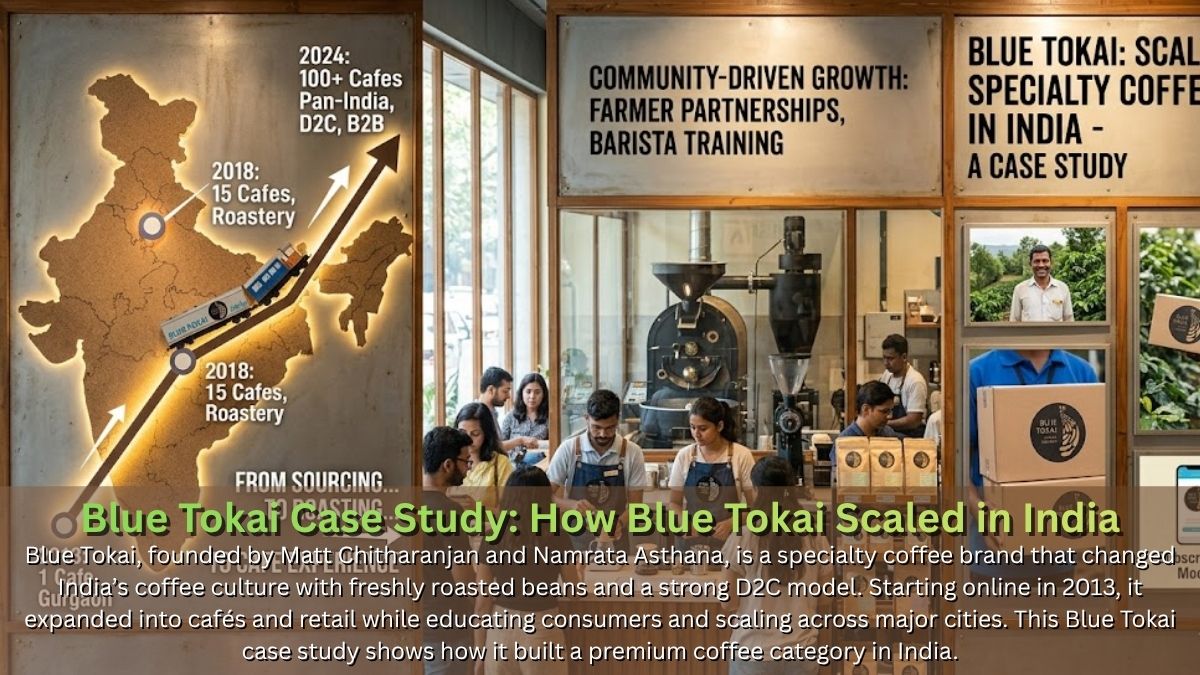
The Blue Tokai case study is one of the most compelling examples of how a niche product can evolve into a category-defining brand in India. Blue Tokai Coffee Roasters is a specialty coffee company that sources, roasts, and sells high-quality Indian coffee beans while also operating cafés and a direct-to-consumer business. The company was founded by Matt Chitharanjan and Namrata Asthana, who set out to change how Indians perceive and consume coffee. Based in New Delhi, Blue Tokai was launched in 2013 at a time when India’s coffee market was dominated by instant coffee and a few large chains.
The idea behind Blue Tokai was simple but ambitious. The founders wanted to introduce Indian consumers to freshly roasted, high-quality coffee and educate them about origin, roasting, and brewing methods. The company started as an online-first brand, selling roasted beans directly to customers. Over time, it expanded into cafés, retail partnerships, and subscription models.
Blue Tokai operates through a vertically integrated model. It sources beans directly from Indian estates, roasts them in-house, and distributes them through both online and offline channels. This control over the supply chain ensures quality and consistency. The company has raised multiple rounds of funding from investors and has expanded rapidly across major Indian cities. While exact revenue figures vary across reports, Blue Tokai revenue India has grown significantly year-on-year, reflecting increasing demand for specialty coffee. This Blue Tokai Coffee Roasters case study explores how the brand built a market, educated consumers, and scaled sustainably in a traditionally price-sensitive market.
1. The Origin Story and Early Background
The story of Blue Tokai didn’t begin with a grand plan. It started with a quiet realization that something was missing. For years, coffee in India meant two things. Either a quick cup of instant coffee at home or a standardized café experience that felt more about the space than the coffee itself. The drink was routine, not something people explored or understood. When Matt Chitharanjan returned to India after working abroad, that gap stood out immediately. He had seen how coffee could be treated as a craft, how origin, roasting, and brewing could completely change the experience. Coming back, it felt like that entire layer was missing here.
Along with Namrata Asthana, he didn’t just see a business opportunity. He saw a disconnect that didn’t make sense. India was already producing some of the finest coffee beans in the world. Estates in regions like Chikmagalur and Coorg had been growing high-quality coffee for decades. But most of it was shipped abroad. Indian consumers rarely experienced their own coffee at its best. That contradiction became the starting point. Instead of importing beans and building a premium image around foreign products, they chose a harder, more meaningful path. They decided to work with Indian beans and build a brand around them. It wasn’t just a sourcing decision. It was a belief. A belief that Indian coffee, when treated with care and presented honestly, could stand on its own. That idea became the foundation of what Blue Tokai would eventually represent.
2. Founder Journey, Motivation, and Early Struggles
2.1 The Vision Behind the Brand
From the beginning, Matt Chitharanjan and Namrata Asthana were clear about one thing. They weren’t just building a coffee brand. They were trying to change how people experienced coffee.
Their vision rested on three simple but demanding pillars:
- Quality that customers could consistently trust
- Transparency about where the coffee came from
- Education that helped people actually understand what they were drinking
Because the truth was, you can’t build a specialty product in a market that doesn’t yet understand it. They knew that if people could taste the difference, they would care. But first, they had to create that moment of realization. And that required patience.
2.2 Early Challenges in Building the Market
The early days were not glamorous. In fact, they were filled with small, repeated efforts that didn’t always show immediate results. The biggest challenge was awareness. Most customers didn’t know what “freshly roasted” meant. Terms like single-origin, roast profiles, or brewing methods sounded complicated, even unnecessary. For many, coffee was just coffee. So the founders had to slow everything down.
They spent time explaining things most brands would ignore:
- Why freshness matters
- How grind size affects taste
- What makes one bean different from another
They hosted tastings, wrote detailed descriptions, and engaged directly with customers. Not to sell, but to educate.
Then came pricing. Specialty coffee costs more. There’s no way around it. Better beans, careful roasting, smaller batches, all of it adds up. Convincing someone to pay significantly more for something they didn’t yet understand is not easy. It requires trust. And trust isn’t built through ads. It’s built through consistency. Every good cup mattered. Every repeat order mattered. Slowly, things started to shift. Customers who initially hesitated began to notice the difference. And once they did, many didn’t go back.
3. The Problem Blue Tokai Identified in the Market
At its core, Blue Tokai was built around a very real and very overlooked problem. India was a major coffee producer, yet its own consumers had limited access to quality coffee. What was available locally was often mass-produced, stale, or stripped of its identity.
The specialty coffee market in India was almost invisible at the time:
- Freshly roasted beans were hard to find
- Information about origin and processing was missing
- Brewing was treated as an afterthought
And perhaps the most important gap was the disconnect between farmers and consumers. Farmers were growing exceptional coffee, but their work rarely reached Indian customers in its best form. There was no story, no connection, no appreciation. Blue Tokai stepped into that gap with a clear role. They became the bridge. They sourced directly from estates, roasted in small batches, and told the story of each coffee. Not as marketing, but as context. As a way to bring people closer to what they were drinking.
Over time, that approach did more than build a brand. It started shaping a category. What was once unfamiliar slowly became part of everyday conversation. People began asking about origins, trying different brews, and paying attention to taste in a way they hadn’t before. And that’s when you know a company isn’t just selling a product anymore. It’s changing behavior.
4. Product Development and Evolution
4.1 Building a Specialty Coffee Portfolio
In the early days, Blue Tokai kept things simple, but very intentional. The focus wasn’t on launching a wide range of products. It was on getting one thing absolutely right, freshly roasted coffee. But even that came with a difference people hadn’t seen before.
Every bag told a story. Not in a vague, marketing-heavy way, but in clear, specific detail:
- Where the coffee was grown
- The altitude of the farm
- The tasting notes you could expect
For many Indian consumers, this was their first introduction to coffee as something nuanced. Something that could vary based on origin and process, just like wine or tea. At first, it felt unfamiliar. Even slightly intimidating.But over time, something interesting happened. Customers started paying attention. They began noticing differences between beans, experimenting with brewing methods, and forming preferences. That shift didn’t happen because of a product launch. It happened because the brand chose to educate instead of oversimplify.
As the market slowly matured, Blue Tokai expanded:
- Cold brews for convenience
- Ready-to-drink options for accessibility
- Brewing equipment for those who wanted control
Each addition wasn’t random. It followed the customer’s journey. From curiosity to experimentation to habit. That’s what made the portfolio feel cohesive, not scattered.
4.2 Continuous Innovation and Customer Feedback
What really kept Blue Tokai evolving was how closely it listened. In the beginning, feedback didn’t come through large data dashboards. It came through emails, reviews, café conversations, and repeat orders or the lack of them.
Customers were honest:
- Some found certain roasts too strong
- Others struggled with brewing at home
- Many wanted more convenience without losing quality
Instead of defending their choices, the team paid attention.
They tweaked roast profiles. They improved grind consistency. simplified guides. introduced formats that made good coffee easier to access. This constant loop of listening and improving created something deeper than product-market fit. It built trust. Customers felt heard. And when customers feel heard, they stay.
5. Early Traction and Validation
The first real signs of traction for Blue Tokai didn’t come from big campaigns. They came quietly, through the internet.
Online orders started picking up among a very specific group:
- Coffee enthusiasts
- Urban professionals
- People who had experienced specialty coffee abroad
These early customers were curious and open. More importantly, they were vocal. When they found something they genuinely liked, they talked about it. They recommended it to friends, shared it online, and kept coming back. That word-of-mouth became the brand’s strongest growth engine. But the real turning point came with cafés.
Opening physical spaces changed everything. Suddenly, people could:
- Taste before they committed
- Ask questions
- Learn directly from baristas
It removed hesitation.
You could see the shift in real time. Someone walks in unsure, tries a cup, asks a few questions, and walks out with a pack of beans. That’s not just a sale. That’s conversion through experience. This phase proved something critical. There was demand for premium coffee in India. It just needed the right introduction.
6. Business Model and Revenue Approach
The strength of Blue Tokai lies in how it built its business across multiple channels without losing its core identity.
At a high level, the model blends three key streams:
- Direct-to-consumer (online orders)
- Café operations
- Retail and partnerships
Each channel serves a different purpose.
Online sales bring better margins and reach customers beyond metro cities. Cafés, on the other hand, are about experience. They are where the brand comes alive. Where first impressions are formed. Retail partnerships help with visibility. They place the product in everyday environments, making it easier for new customers to discover it. Then there’s subscriptions. For a product like coffee, which people consume regularly, subscriptions create stability. They turn one-time buyers into long-term customers.
But here’s where it gets real. Not all channels are equally profitable.
- Direct sales offer higher margins
- Cafés involve higher costs but build brand loyalty
- Retail sits somewhere in between
So the business isn’t about maximizing one channel. It’s about balancing all three in a way that sustains growth without diluting the brand.
7. Funding History and Investor Involvement
Over time, Blue Tokai attracted investors who believed in both the category and the way the company was building it. But unlike many startups that chase rapid expansion, Blue Tokai’s funding journey has felt measured.
The capital raised has largely gone into:
- Opening new cafés
- Strengthening supply chains
- Investing in roasting and technology
- Expanding distribution
This kind of growth may not always make headlines, but it builds something more durable.
Investor confidence didn’t come from hype. It came from consistency:
- A clear product-market fit
- Strong repeat customer behavior
- A brand that people genuinely trust
And that’s important. Because in a category like specialty coffee, growth isn’t just about scale. It’s about depth. How deeply you connect with your customer. How consistently you deliver quality. Blue Tokai’s journey reflects that understanding. It’s not rushed. It’s built layer by layer, with each step reinforcing the last.essive fundraising.
8. Go-to-Market Strategy and Distribution Channels
From the beginning, Blue Tokai understood something most brands overlook. You can’t sell what people don’t understand. So their go-to-market strategy didn’t start with pushing products. It started with breaking down confusion.
They used digital platforms not just to reach customers, but to teach them:
- What makes coffee “specialty”
- Why freshness changes taste
- How simple brewing methods can improve everyday coffee
Blogs, videos, and social media weren’t just marketing tools. They were classrooms. Quiet, consistent efforts to make coffee feel less intimidating and more approachable. And it worked. People who had never thought twice about coffee started asking questions. They became curious. And curiosity is often the first step to conversion. As demand grew, distribution evolved.
What started as an online-first brand slowly moved into physical spaces:
- Cafés where people could experience the product
- Retail shelves where discovery became easier
- Partnerships that brought the brand into everyday moments
Each channel played a role. Online built depth. Cafés built connection. Retail built reach. The strategy wasn’t about being everywhere at once. It was about being present where it actually mattered.
9. Brand Positioning and Messaging Evolution
Positioning a brand like Blue Tokai comes with a delicate balance. On one hand, it needed to stand for quality. On the other, it couldn’t feel intimidating. Many premium brands fall into the trap of exclusivity. They make the product feel out of reach, almost reserved for a niche audience. Blue Tokai chose a different path. It positioned itself as premium, but not pretentious.
The tone was simple, clear, and honest:
- No unnecessary jargon
- No overcomplication
- No talking down to the customer
Instead of saying “this is elite,” the brand said, “this is better, and here’s why.” That difference matters. Over time, the messaging evolved. As the market matured, Blue Tokai didn’t just talk about coffee as a product. It started becoming part of a lifestyle:
- Work-from-home rituals
- Weekend brewing routines
- Café culture as a social experience
But even with this evolution, the core stayed intact. Quality, transparency, and education remained at the center. That consistency is what built trust. And in a crowded market, trust is what keeps a brand from becoming forgettable.
10. Competitive Landscape and Differentiation
The Indian coffee market is no longer what it used to be.
Today, it’s layered and competitive:
- Large café chains with strong brand recall
- Instant coffee giants dominating mass consumption
- New-age startups entering the specialty space
In the middle of all this, Blue Tokai had to carve out its identity and protect it. Its differentiation wasn’t loud. It was precise.
It focused on things that are hard to fake:
- Consistent quality across batches
- Clear sourcing from Indian estates
- Transparency in how coffee is grown, roasted, and sold
While others competed on pricing or scale, Blue Tokai competed on experience and authenticity. Its commitment to Indian beans also gave it a unique edge. Instead of relying on imported narratives, it built pride around local produce. At the same time, the rise of third wave coffee in India brought more players into the space.
On the surface, that means more competition. But in reality, it also means a bigger market. More awareness. More people willing to try something new. And when a category grows, the brands that built it early often have an advantage.
11. Key Challenges, Failures, and Turning Points
Scaling Blue Tokai was never just about opening more cafés or selling more coffee. It came with layers of operational complexity.
Behind every cup is a chain that has to work perfectly:
- Sourcing from farms
- Roasting at the right time
- Managing inventory without losing freshness
- Delivering consistently across locations
One small break in that chain can affect the final experience. Maintaining quality at scale is one of the hardest things in a business like this. And it requires constant attention. Then came one of the biggest tests, the pandemic. Cafés, which were a major part of the brand experience, suddenly went silent. Footfall dropped to zero. For many businesses, that would have been devastating. But this is where earlier decisions mattered.
Because Blue Tokai had already invested in its online presence, it had a lifeline:
- Customers could still order from home
- Subscriptions continued
- Digital engagement kept the brand alive
What could have been a collapse became a moment of adaptation. The company leaned harder into e-commerce, strengthened its direct-to-consumer channel, and stayed connected with its audience. This phase changed how the business operated. It reinforced a critical lesson: diversification isn’t optional. It’s survival. And more than anything, it proved the strength of what they had built. Not just a product, but a relationship with their customers. Because when everything else stopped, that relationship didn’t.
12. Operational Execution and Scaling Decisions
As Blue Tokai began to grow, the real challenge wasn’t demand. It was delivering the same quality, every single time, no matter where the customer was. That’s where operational decisions started to matter more than branding. The company invested heavily in its own roasting facilities. This wasn’t just about control. It was about responsibility. When you promise freshness and consistency, you can’t outsource the most critical part of your product.
They built systems around:
- Precise roasting schedules
- Quality checks across batches
- Inventory that moved fast enough to stay fresh
At the same time, supply chains were strengthened. Working directly with farms meant better control over sourcing, but it also required deeper coordination. Harvest cycles, logistics, storage, everything had to align. Then came cafés. Opening a café isn’t just about finding a location and setting up machines. It’s about creating an experience that feels the same across cities. That meant investing in people. Baristas weren’t just trained to make coffee. They were trained to understand it, to explain it, and to guide customers through it. These decisions may not be visible to customers, but they’re the reason the brand feels consistent. And consistency is what allows a business to scale without losing its identity.
13. Growth Metrics and Milestones
The growth of Blue Tokai didn’t happen in sudden spikes. It happened steadily, almost quietly, but with strong intent. Cafés began appearing across major cities. Not all at once, but one by one, each adding to the brand’s physical presence. Online sales continued to grow alongside. And that’s important. Because it showed that the brand wasn’t dependent on just one channel. People were not only discovering Blue Tokai in cafés, they were choosing to bring it into their homes.
That’s a deeper level of adoption. Repeat orders increased. Subscriptions gained traction. Customers who once tried out of curiosity started building habits around the product. While exact valuation numbers may vary, what’s more telling is how the brand is perceived. Today, Blue Tokai isn’t just another coffee company. It’s often seen as the name that defined specialty coffee for a large part of urban India. And that kind of positioning doesn’t come from numbers alone. It comes from consistency over time.
14. Team Building and Leadership Approach
Behind the growth of Blue Tokai is a team that understands something simple but powerful: you can’t fake passion in a product like coffee. From the start, the founders focused on building a team that didn’t just work with coffee, but cared about it. Hiring wasn’t only about experience. It was about curiosity. About people who wanted to learn, experiment, and engage with customers.
Training became a core part of the culture:
- Baristas learned not just how to brew, but why it matters
- Teams were encouraged to understand sourcing and roasting
- Customer interaction was treated as part of the product experience
Because in a café, the person serving you is part of the brand. Leadership, in this context, wasn’t about aggressive expansion or short-term wins. It was about maintaining standards while growing.
That meant:
- Saying no to shortcuts
- Prioritizing quality even when scaling pressure increased
- Building systems that could sustain long-term growth
It’s a slower way to build. But it creates something far more stable.
15. Technology, Operations, and Supply Chain Insights
As the business expanded, technology quietly became a backbone for Blue Tokai.
Not in a flashy way, but in ways that directly impacted operations:
- Tracking inventory to maintain freshness
- Managing online orders and delivery timelines
- Understanding customer preferences through data
This allowed the company to make smarter decisions. For example, knowing which coffees sell more in certain cities helps optimize roasting and distribution. It reduces waste and improves availability. The supply chain, meanwhile, remained rooted in direct sourcing.
Working closely with farms ensured:
- Better quality control
- Transparency in sourcing
- Stronger relationships with producers
It also meant supporting the people at the start of the chain, not just the end. All of this combined creates reliability. And reliability is what turns first-time buyers into long-term customers.
16. Regulatory and Industry-Specific Hurdles
Running a food and beverage business in India comes with its own set of challenges. For Blue Tokai, compliance wasn’t optional. It was foundational.
Food safety regulations, quality standards, and operational guidelines had to be followed at every level:
- Roasting and packaging
- Storage and transportation
- Café operations
These processes can slow things down. They add layers of complexity. But they also build trust. Instead of treating compliance as a burden, the company integrated it into its systems. Transparency wasn’t just a brand message. It became part of how the business operated. And in a category where customers are becoming more conscious about what they consume, that matters more than ever.
17. Current Status of the Startup
Today, Blue Tokai stands as one of the most recognizable names in India’s specialty coffee space. What started as a niche idea has now become part of mainstream urban culture.
The company continues to:
- Expand its café network
- Introduce new products
- Strengthen its online presence
But more importantly, it has helped shape how people think about coffee. For many customers, Blue Tokai wasn’t just a brand they discovered. It was their introduction to better coffee. And that kind of role in a market is hard to replicate.
18. Future Outlook
The road ahead for Blue Tokai looks promising, but not without its challenges. The specialty coffee market in India is still growing. Awareness is increasing. More people are willing to explore, experiment, and spend on quality. That creates opportunity. But it also brings pressure. Scaling further will require:
- Maintaining consistency across more locations
- Protecting brand identity as competition increases
- Continuing to educate a wider audience without losing authenticity
There’s also the possibility of going beyond India. Indian coffee has global potential. And a brand like Blue Tokai is well-positioned to represent it. But global expansion brings its own complexities. At its core, the journey ahead remains the same as it was in the beginning. Stay close to the product. Stay honest with the customer. Keep improving quietly. Because in the end, this isn’t just a story about coffee. It’s a story about building something with care, staying patient when growth is slow, and believing that if you do things right, people will notice. An understanding of the market can create a lasting impact.
About foundlanes.com
foundlanes.com is India’s leading startup idea discovery platform. It helps entrepreneurs find actionable startup opportunities, market insights, and industry-specific guidance to turn ideas into real businesses. With deep research and practical resources, foundlanes supports founders at every stage, from idea validation to launch and growth.