


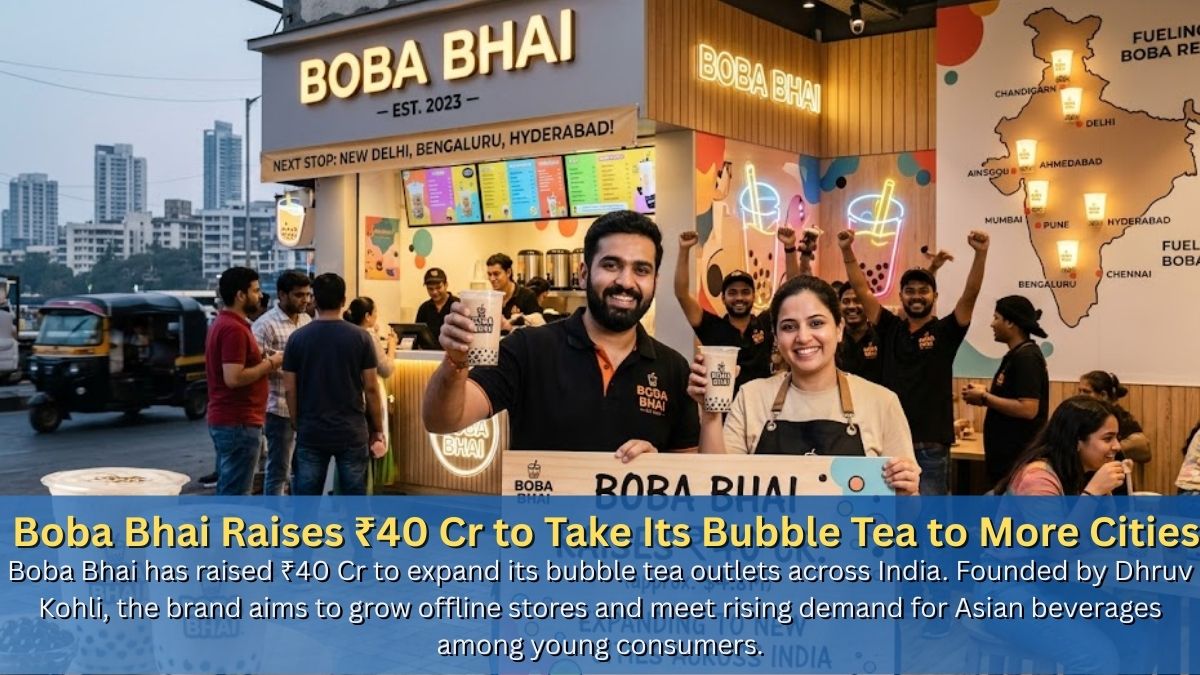
News Summary
Boba Bhai Raises ₹40 Cr in fresh funding as the fast-growing bubble tea startup accelerates its expansion across India. The brand, founded by Dhruv Kohli, has quickly emerged as one of the most recognizable names in India’s emerging bubble tea and Asian beverage segment. The latest investment round will help the company strengthen its offline retail presence, open new stores, and expand operations into additional cities. The funding reflects growing investor interest in India’s quick-service restaurant (QSR) and foodtech segments. Investors believe that India’s young consumers are rapidly embracing global beverage trends, especially bubble tea. Therefore, brands like Boba Bhai are positioning themselves to capture a significant share of this evolving market.
Founded with the goal of introducing authentic Asian beverages and desserts to Indian consumers, Boba Bhai started as a digital-first brand but quickly expanded into offline outlets. Its menu includes bubble tea, Korean-inspired beverages, and Asian desserts that appeal strongly to Gen Z and millennial audiences. Over time, the startup has focused heavily on brand storytelling, experiential retail spaces, and community-driven marketing.
The fresh capital will allow Boba Bhai to expand its physical store network, invest in supply chain infrastructure, and strengthen brand visibility across India’s major urban centers. As competition increases in India’s QSR and beverage startup ecosystem, the company aims to scale rapidly while maintaining product quality and customer experience. The funding also highlights a broader trend in the Indian startup ecosystem. Consumer brands, particularly in the foodtech and beverage sectors, are increasingly attracting venture capital investment as investors search for the next wave of scalable retail startups.
1. Boba Bhai Raises ₹40 Cr: A New Chapter in India’s Beverage Startup Story
The announcement that Boba Bhai Raises ₹40 Cr marks an important milestone in the growth of India’s emerging bubble tea market. Over the last few years, consumer preferences have evolved significantly. Young consumers now explore international food and beverage trends more actively than ever before. Bubble tea, originally popularized in Taiwan, has slowly entered the Indian urban lifestyle. However, until recently, the category lacked strong local brands capable of scaling nationwide.
This is where Boba Bhai stepped in. The startup positioned itself not just as a beverage company but as a lifestyle brand designed for India’s social media generation. Therefore, the news that Boba Bhai Raises ₹40 Cr reflects growing confidence among investors in the brand’s ability to scale.
1.1 Founders Behind the Vision
1.1.1 The Entrepreneurial Journey of Dhruv Kohli
The startup was founded by Dhruv Kohli, an entrepreneur known for building youth-focused brands. Kohli recognized a clear gap in India’s beverage startup market. While global chains dominated coffee culture, bubble tea remained largely unexplored at scale. Kohli saw an opportunity to bring authentic Asian beverage culture to Indian consumers while adapting flavors to local preferences. His idea was simple but powerful. Build a premium yet approachable brand that offers unique drinks, visually appealing products, and strong digital engagement. This approach allowed the startup to grow rapidly within a short period.
2. The Working Model of Boba Bhai
To understand why Boba Bhai Raises ₹40 Cr is such a significant moment, one must first look closely at how the company actually works. On the surface, it may appear to be just another beverage brand selling trendy drinks. However, the real strategy runs much deeper. Traditional beverage companies in India mostly focus on packaged products. Their drinks sit on supermarket shelves and rely on large distribution networks. Boba Bhai took a completely different path. Instead of selling only products, the brand decided to sell an experience.
When customers walk into a Boba Bhai outlet, they immediately notice the difference. The lighting feels vibrant. The colors are playful. The design looks like something people want to photograph and share online. That is not accidental. It is carefully planned. The company understands how today’s consumers behave. Young customers do not just buy drinks. They also share moments on Instagram, create reels, and talk about brands with friends.
Boba Bhai designed its outlets to fit directly into that culture. As a result, every store quietly becomes a marketing engine. Customers click photos, post stories, and tag the brand without being asked. In marketing terms, this creates organic visibility. In real life, it creates excitement. That is why the moment Boba Bhai Raises ₹40 Cr, the company focuses heavily on building more physical spaces where these experiences can happen.
2.1 Product Strategy
While the store experience attracts attention, the real test lies in the product itself. If the drink disappoints, the excitement disappears instantly. Boba Bhai clearly understands this. The brand’s menu focuses on a range of bubble tea variations including milk teas, fruit teas, and experimental Asian-style beverages. These drinks are not just about flavor. They are designed to be interactive.
Many beverages include chewy tapioca pearls that sink to the bottom of the cup. Others contain popping boba that burst with flavor when bitten. Some drinks feature flavored jellies or fruit textures that add surprise to every sip. For someone trying bubble tea for the first time, the experience feels playful and new. Beyond beverages, the company also experiments with Asian-inspired desserts. Influences from Korean and Japanese dessert culture appear across the menu. These include light sweet treats that pair naturally with tea-based drinks.
This strategy is important because India’s beverage market is extremely crowded. Consumers already have endless options including coffee chains, milkshake brands, juice bars, and tea cafés. Therefore, Boba Bhai cannot win by being ordinary. It must stay interesting. By blending global trends with flavors that suit Indian tastes, the company manages to stand out in a market where attention is extremely hard to capture.
2.2 Store Experience and Branding
If someone observes a busy Boba Bhai outlet for a few minutes, they will notice something interesting. People are not just buying drinks and leaving. Many stay for a while. Some chat with friends. Others take photos near colorful walls. A few record short videos before taking the first sip of their drink. This is exactly what the brand wants. Boba Bhai stores are designed to feel less like beverage counters and more like social hangouts. The interiors use bright color palettes, playful typography, and modern lighting that appeals strongly to young audiences. These elements may seem cosmetic at first. However, they create a deeper emotional connection.
For many customers, visiting Boba Bhai becomes part of a weekend outing or casual evening plan. The brand gradually moves from being a product into becoming a social ritual. That is powerful brand positioning. Therefore, when Boba Bhai Raises ₹40 Cr, the company plans to invest heavily in opening more outlets in locations where young consumers naturally gather. These include shopping malls, high-street retail hubs, and entertainment districts. Every new store becomes both a revenue center and a brand billboard.
3. Revenue Model and Business Strategy
A successful startup must eventually convert popularity into revenue. Boba Bhai’s model attempts to do this through multiple streams. The most obvious revenue source comes from beverage sales at retail outlets. Each drink sold contributes directly to store-level revenue. Because the ingredients are relatively simple compared to full meals, beverage businesses often maintain healthier margins. However, Boba Bhai does not rely only on walk-in customers. The brand also sells through food delivery platforms. This allows customers to order drinks from home or office. Delivery platforms expand the brand’s reach beyond the physical boundaries of each store. In addition, there is future potential in brand extensions.
As the brand grows stronger, it may explore packaged beverages, merchandise, or ready-to-drink products for retail shelves. Many global beverage brands eventually move into packaged goods once their identity becomes recognizable. The key advantage here is brand loyalty. Customers who already trust the brand in stores are far more likely to purchase related products outside the store as well. Therefore, the moment Boba Bhai Raises ₹40 Cr, investors are not simply funding more stores. They are backing a brand that could potentially evolve into a much larger consumer company.
4. Funding Journey of Boba Bhai
Startup success rarely happens overnight. Every visible milestone usually rests on years of experimentation, trial, and persistence. The story where Boba Bhai Raises ₹40 Cr is actually part of a longer funding journey. Earlier, the company secured investment from 8i Ventures through a Series A funding round. That capital allowed the startup to test its expansion strategy and refine its retail model. With that investment, the company opened more outlets, improved supply chain operations, and strengthened brand identity.
Investors carefully watched how the brand performed.
- Did customers return?
- Did stores remain profitable?
- Did the concept scale across different cities?
The answers appeared promising. This confidence eventually led to the new round where Boba Bhai Raises ₹40 Cr to accelerate expansion further. For venture capital firms, consumer brands carry both risk and reward. If a brand resonates strongly with customers, it can grow extremely fast. However, if the concept fails to build loyalty, the growth can stall quickly. In Boba Bhai’s case, investors seem convinced that the brand has real potential to scale across urban India.
5. Expansion Plans After Boba Bhai Raises ₹40 Cr
With new funding secured, the company now faces the next big challenge: execution. Expanding a retail brand sounds exciting, but it requires careful planning. Every new outlet brings responsibilities including staffing, supply chain coordination, and quality control. According to its growth strategy, Boba Bhai plans to enter more Indian cities while strengthening its presence in existing markets.
The focus will likely remain on large urban centers where young consumers actively explore new food and beverage trends. High-footfall locations will play a critical role. These include shopping malls, entertainment hubs, university areas, and business districts where young professionals work. Another major focus will be supply chain development. Bubble tea ingredients such as tapioca pearls and specialized syrups require consistent sourcing. If supply chains break, customer experience suffers. Therefore, part of the funding will go toward building stronger procurement systems and centralized preparation processes.
Marketing will also play a major role. As the brand enters new cities, awareness campaigns will introduce bubble tea culture to customers who may not have tried it before. This is where storytelling becomes powerful. When Boba Bhai Raises ₹40 Cr, it is not simply expanding stores. It is introducing an entirely new beverage culture to many Indian consumers.
6. Bubble Tea Industry Growth in India
The rise of Boba Bhai also reflects a larger global trend. Bubble tea originated in Taiwan during the 1980s. Over time, it spread across East Asia and later expanded into the United States and Europe. Today, the bubble tea industry is worth billions of dollars globally. In cities like New York, London, Singapore, and Seoul, bubble tea stores often attract long queues of customers. India is now beginning to experience a similar shift. Young consumers today are far more globally connected than previous generations. They discover food trends through travel, social media, and international pop culture. When they see something exciting online, they want to try it themselves. Bubble tea fits perfectly into this environment. It looks colorful. It feels interactive. And it offers flavors that differ from traditional beverages.
However, building a national brand in this category requires both patience and creativity. That is why the moment Boba Bhai Raises ₹40 Cr carries meaning beyond one company. It signals that investors believe bubble tea could become a meaningful category within India’s broader food and beverage market. If that belief proves correct, Boba Bhai may be among the brands that helped introduce the trend to millions of Indian consumers.
7. Competitors in the Bubble Tea and Beverage Market
No startup grows in isolation. The moment a brand begins attracting attention, competition naturally follows. That is exactly the environment Boba Bhai now operates in. While the excitement around the news that Boba Bhai Raises ₹40 Cr signals strong momentum, it also means the company must compete harder than ever. India’s beverage market is one of the most crowded consumer spaces. Walk into any busy urban street and you will see coffee chains, tea cafés, juice counters, dessert shops, and quick-service restaurants competing for the same customers.
Bubble tea brands are slowly joining that mix. Direct competition comes from Asian beverage chains and smaller bubble tea startups trying to capture the curiosity of Indian consumers. Many of these brands also experiment with tapioca-based drinks, fruit teas, and trendy dessert beverages. Some operate as small boutique stores in malls or college neighborhoods. Others run cloud kitchen models that rely on delivery apps. However, the more interesting competition comes from outside the bubble tea category.
Global coffee chains like Starbucks already dominate premium beverage culture in many Indian cities. Their cafés have become comfortable meeting spaces for young professionals and students. Meanwhile, Indian brands such as Chaayos have built a strong identity around customized tea experiences. These brands compete for the same moments in a consumer’s day. A college student deciding where to hang out with friends could choose coffee, tea, or bubble tea. A young professional taking a break after work might make a similar choice.
This is where differentiation becomes crucial. Boba Bhai’s biggest advantage lies in its strong Asian beverage identity. The brand does not try to imitate coffee culture or traditional tea cafés. Instead, it celebrates something new and playful. The drinks look different. The textures feel unusual. Even the store vibe feels closer to Asian pop culture than conventional cafés. That uniqueness gives the brand emotional appeal. People do not just visit Boba Bhai to drink something. They visit because it feels like a fresh experience. Still, the competition will only grow stronger. If bubble tea demand continues rising in India, more brands will inevitably enter the market. The companies that survive will be those that build the strongest connection with customers.
8. Growth Trends in the Indian Startup Ecosystem
The milestone where Boba Bhai Raises ₹40 Cr is not happening in isolation. It reflects a larger shift within the Indian startup ecosystem. Over the past decade, India’s startup landscape has expanded dramatically. Technology companies once dominated venture capital conversations. Investors focused heavily on fintech, software platforms, and artificial intelligence. However, a new wave of consumer startups is beginning to attract serious attention.
Investors are realizing something important. India’s young population is not just digitally active. It is also eager to explore new lifestyles, new brands, and new experiences. Walk through any modern Indian mall or busy urban street and you will notice a clear change. Consumers no longer look only for basic products. They look for brands that feel exciting, relatable, and shareable. This is where lifestyle-driven startups thrive.
Food and beverage brands, direct-to-consumer companies, and experiential retail startups are now receiving strong venture capital support. Investors see these businesses as scalable opportunities if they build strong brand loyalty. The logic is simple. Once a brand captures consumer attention, expansion can happen across multiple cities. With the right marketing strategy, a startup can grow from a local brand into a national presence.
The funding milestone where Boba Bhai Raises ₹40 Cr fits perfectly into this trend. Venture capital firms are betting that the brand could become a leading player in India’s emerging bubble tea market. At the same time, India’s demographic advantage plays a huge role. A large portion of the population is under thirty years old. These consumers spend time on social media, follow global trends, and actively try new food experiences. They are curious, experimental, and often loyal to brands that reflect their identity. For startups, this is an incredible opportunity. For investors, it is a signal that consumer brands built for young audiences may deliver strong long-term returns.
9. Challenges Ahead for Boba Bhai
Success stories often sound glamorous from the outside. Funding announcements generate headlines. New stores create excitement. Customers line up for trendy drinks. However, behind every fast-growing startup lies a long list of challenges. The same will be true for Boba Bhai, even after the positive moment where Boba Bhai Raises ₹40 Cr. One of the biggest challenges will be maintaining product consistency. When a brand operates only a handful of stores, quality control feels manageable. But as the network expands across cities, the risk of inconsistency increases.
A drink prepared in Bengaluru must taste the same as one served in Delhi or Mumbai. If the experience varies too much, customer trust weakens quickly. Supply chains also become more complicated with growth. Ingredients like tapioca pearls, flavored syrups, and specialty toppings require reliable sourcing. Delays or shortages can disrupt operations. Therefore, building strong supplier relationships and efficient logistics systems will be critical. Another challenge comes from rising operational costs.
Retail spaces in premium locations often demand high rents. At the same time, staff salaries, utilities, and marketing expenses increase as the brand grows. Balancing these costs while maintaining profitability requires careful planning. Competition will add further pressure. If the bubble tea category proves successful in India, many new players will enter the market. Larger food chains may even launch their own bubble tea products. This could quickly intensify the fight for consumer attention. In moments like these, the strength of the brand becomes the deciding factor. If customers feel emotionally connected to Boba Bhai, they will return even when alternatives appear.
10. Learning for Startups and Entrepreneurs
The story behind Boba Bhai Raises ₹40 Cr offers something deeper than a funding milestone. It reveals several lessons for entrepreneurs who dream of building impactful startups. The first lesson is about the power of branding. At its core, Boba Bhai sells tea-based drinks. On paper, that sounds simple. Yet the company transformed this everyday product into something memorable. Through design, storytelling, and culture-driven marketing, the brand turned a beverage into an experience.
This shows how powerful branding can be when executed thoughtfully. The second lesson revolves around understanding people. Many successful startups begin with a deep understanding of their audience. Boba Bhai recognized that young consumers crave novelty. They enjoy trying something visually appealing, sharing it online, and talking about it with friends. By aligning the product with this behavior, the brand created natural word-of-mouth marketing.
Another lesson lies in combining online and offline experiences. Digital marketing alone rarely builds long-term loyalty. Physical spaces allow customers to feel connected with a brand in a more personal way. Boba Bhai’s outlets function as social spaces where memories form. Those memories keep customers coming back. Finally, the story highlights the importance of scalability. Every startup dream includes expansion.
However, scaling too quickly without operational strength can damage a brand. Entrepreneurs must balance ambition with discipline. Growth should feel exciting, but it must also remain sustainable. For aspiring founders, this journey offers a powerful reminder. Great startups are not built only with money or technology. They are built with understanding, creativity, patience, and a genuine connection with the people they serve.
About foundlanes.com
foundlanes.com is India’s leading startup idea discovery platform. It helps entrepreneurs find actionable startup opportunities, market insights, and industry-specific guidance to turn ideas into real businesses. With deep research and practical resources, foundlanes supports founders at every stage, from idea validation to launch and growth.