


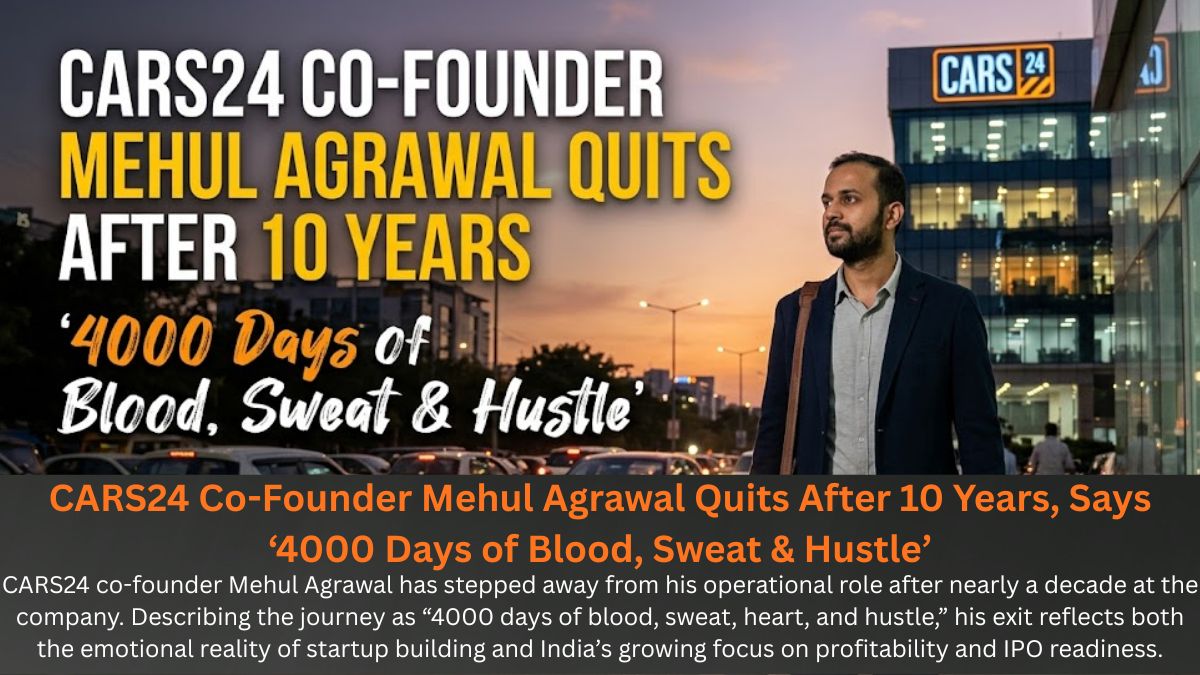
News Summary
There are startup journeys that look glamorous from the outside. Then there are the real ones built quietly through sleepless nights, pressure-filled meetings, constant uncertainty, and years of relentless work. For Mehul Agrawal, the story of CARS24 seems to have been exactly that. After nearly a decade of building the used-car platform into one of India’s most recognised startup brands, the CARS24 Co-Founder has decided to step away from his operating role at the company. The timing of the move has naturally grabbed attention across the startup ecosystem. CARS24 is currently at a stage where conversations around profitability, scale, and a possible IPO are growing stronger. For a founder to step back during such a crucial phase makes the moment feel emotional as much as strategic.
In a heartfelt reflection shared publicly, Agrawal described his journey at the company as “4000 relentless days of blood, sweat, heart, and hustle.” It did not sound like a corporate statement. It sounded personal. Almost like someone looking back at a chapter that consumed a major part of his life. And honestly, that sentence probably explains startup life better than any motivational LinkedIn post ever could. When CARS24 started in 2015, India’s used-car market was chaotic. Selling a car often meant dealing with brokers, paperwork headaches, pricing confusion, and endless negotiation. Trust was missing from the system.
That is where founders like Vikram Chopra, Mehul Agrawal, Gajendra Jangid, and Ruchit Agarwal saw an opportunity. Instead of treating used cars like an unorganised side market, they approached it like a technology problem waiting to be solved. Slowly, the startup began changing how Indians bought and sold second-hand vehicles. Instant car pricing, AI-powered valuation systems, doorstep inspections, faster ownership transfer, financing options, insurance support, everything was designed to remove friction from the experience.
Over time, the company grew far beyond just another startup. It became one of the biggest names in India’s used-car ecosystem and attracted backing from major investors including SoftBank, Alpha Wave Global, and DST Global. But growth stories often come with invisible costs. Behind every funding headline are founders spending years under pressure. Constant hiring challenges. Market slowdowns. Investor expectations. Expansion risks. Competition. The emotional weight of leading thousands of employees while trying to keep the business growing every single quarter. That is why Mehul Agrawal’s decision feels less like a sudden exit and more like the closing of an exhausting marathon.
Importantly, he is not completely leaving CARS24. The company confirmed that he will continue as a shareholder and board member, meaning he will still remain connected to the business he helped build. Still, stepping away from day-to-day operations after giving nearly ten years to a startup is never just a professional decision. It is deeply personal too. His exit also reflects a larger shift happening across India’s startup world right now. Many late-stage founders are moving from hustle mode into institution-building mode. The focus today is no longer only about rapid growth and billion-dollar valuations. Investors now want stability, profitability, governance, and long-term sustainability.
As startups mature, leadership structures naturally evolve too. For aspiring entrepreneurs, Mehul Agrawal’s journey is a reminder that startup success is rarely overnight. It is usually built through years of uncertainty, sacrifices, missed weekends, emotional burnout, difficult decisions, and an obsession with solving problems people ignored for years. The headlines may talk about unicorns and IPO plans. But behind those headlines are founders spending thousands of days simply trying to make things work.
1. CARS24 Co-Founder Mehul Agrawal Exits After Nearly a Decade of Building the Startup
1.1 A Major Leadership Shift at CARS24
For most people reading startup headlines today, leadership exits may look like ordinary corporate developments. But inside the startup world, especially inside companies built from scratch, moments like these carry years of emotion behind them. That is exactly why the news of Mehul Agrawal stepping away from his operational role at CARS24 feels far bigger than a standard executive transition. This was not simply a founder leaving a designation behind. This was someone stepping away after dedicating nearly ten years of his life to building one of India’s most recognized automotive startups brick by brick, problem by problem, crisis by crisis. In the startup ecosystem, people often celebrate funding rounds and billion-dollar valuations, but very few truly understand the emotional exhaustion that comes with carrying a company for thousands of days without certainty about what tomorrow may bring.
The timing of the exit has naturally intensified conversations across India’s startup ecosystem because CARS24 is currently moving through a critical growth stage where discussions around profitability, operational efficiency, and future IPO plans have become increasingly important. Mehul Agrawal’s emotional statement about “4000 days of blood, sweat, heart, and hustle” resonated deeply because it did not sound polished or manufactured.
It sounded real. Founders, startup employees, venture capital investors, and even young entrepreneurs immediately connected with that line because it captured the invisible reality behind startup success stories. Building a unicorn startup is rarely glamorous from the inside. It means sacrificing personal time, surviving constant pressure, solving operational fires every day, managing investor expectations, handling market slowdowns, and continuously making difficult decisions while pretending to stay calm. That emotional weight becomes part of a founder’s identity over time. Which is why this transition feels deeply personal, not only for Agrawal but also for many people who watched the company grow over the years.
1.2 Mehul Agrawal’s Role in Building the Startup
Inside every successful startup, there are usually a few people obsessively solving problems that outsiders never notice. In the case of CARS24, Mehul Agrawal was widely seen as one of those operators who helped transform ambitious ideas into scalable systems. During the company’s early years, India’s used-car market was highly fragmented, disorganized, and built heavily around mistrust. Selling a used vehicle was frustrating for customers because pricing lacked transparency, paperwork moved slowly, and buyers often struggled with unreliable dealers. Solving these issues required far more than just launching an app or building a website. It required operational discipline at scale. Agrawal played a major role in helping the startup build those systems from the ground level, including vehicle inspections, logistics networks, customer operations, financing structures, and marketplace efficiency.
As the startup expanded across India, operational complexity increased dramatically. Running a used-car platform at scale is extremely difficult because every vehicle is different. Every city behaves differently. Customer expectations change constantly. Inventory cycles fluctuate rapidly. Unlike digital-only startups, businesses like CARS24 must manage both technology and heavy operational execution simultaneously. That balancing act became one of the company’s defining strengths. Industry observers often point out that operational consistency helped the startup scale faster than many competitors in the automobile resale segment. Behind every inspection center, every logistics movement, every instant pricing system, and every ownership transfer process were teams trying to solve messy real-world problems every single day. Founders like Mehul Agrawal spent years inside that chaos building systems strong enough to support millions of transactions and customers. Those contributions rarely become visible in headlines, but they often define whether a startup survives or disappears.
1.3 Why the Exit Matters
Leadership exits at late-stage startups usually signal something much larger happening beneath the surface. In India’s startup ecosystem today, companies are no longer operating with the same “growth at any cost” mindset that dominated previous years. Investors have become more cautious. Public markets expect profitability. Governance standards are becoming stricter. Businesses are now under pressure to prove sustainability, not just expansion speed. Against that backdrop, Mehul Agrawal stepping away from daily operations feels symbolic of a broader transformation happening across Indian startups. Companies that were once driven entirely by founder-led hustle are now evolving into structured institutions preparing for long-term stability and potential public listings.
What makes this transition particularly important is the stage at which CARS24 currently stands. The company has already established strong brand recognition, raised large amounts of capital, expanded internationally, and diversified into multiple business verticals. The next phase requires a different level of discipline focused on governance, sustainable profitability, operational optimization, and investor confidence. Across sectors including fintech startups, AI startups, SaaS companies, and consumer tech unicorns, India is witnessing similar leadership restructurings. Many founders are gradually shifting away from day-to-day execution roles and moving toward strategic positions on boards or long-term advisory structures. That transition is emotionally difficult because startups are deeply personal creations for founders. Walking away from daily operations after dedicating years of energy often feels like letting go of a part of one’s identity. That emotional reality is what makes Mehul Agrawal’s exit resonate so strongly across the startup ecosystem today.
2. The Background Story of CARS24
2.1 How the Idea Started
Every successful startup usually begins with frustration. Not with glamour. Not with billion-dollar ambitions. Just frustration with a broken system that people had silently accepted for years. That was the reality behind the birth of CARS24. Back in 2015, selling a used car in India was an exhausting experience for ordinary people. Car owners often had to negotiate with local dealers who offered unclear pricing, delayed payments, endless bargaining, and complicated paperwork. There was little transparency in the process, and most customers walked away feeling uncertain about whether they had received a fair deal. The second-hand vehicle market was massive, but trust was missing from almost every stage of the transaction.
That gap became the foundation for what founders Vikram Chopra, Mehul Agrawal, Gajendra Jangid, and Ruchit Agarwal decided to build. Instead of seeing used cars as a traditional dealer-driven business, they approached the problem from a technology and efficiency perspective. Their thinking was simple but powerful. If technology could organize food delivery, payments, and transportation, why could it not organize used-car transactions too? That belief became the starting point of the startup’s journey. Initially, the company focused on simplifying vehicle resale through digital inspections, pricing algorithms, and streamlined documentation. But behind those ideas was a much larger mission: rebuilding trust in an industry where customers had stopped expecting transparency.
2.2 Early Startup Challenges
The early years were far from easy. Like many startups trying to disrupt traditional industries, CARS24 faced resistance from multiple directions. Building trust in India’s used-car market was incredibly difficult because customers had already experienced years of manipulation, hidden pricing, and poor service from unorganized dealers. Convincing people to trust a technology-driven platform with something as emotionally and financially significant as their car required patience and operational consistency. Every small mistake could damage customer confidence. Every delayed payment or inspection issue carried reputational risk.
At the same time, the startup was solving operational problems that were extremely complex behind the scenes. Vehicle inspection systems had to become accurate. Pricing engines needed reliable market data. Ownership transfer processes had to move faster than traditional dealership systems. Customer acquisition costs remained high, and scaling city by city required large operational investments. There were likely moments when growth looked uncertain. Like most startups during their early years, the founders probably dealt with hiring struggles, investor pressure, cash flow stress, and constant unpredictability. But what helped the company survive was its focus on solving real customer pain points instead of chasing superficial hype. Customers slowly began appreciating the convenience, transparency, and speed the platform offered. That trust became the foundation upon which the company eventually scaled nationwide.
2.3 Scaling Across India
As customer demand increased, CARS24 entered a completely different phase of growth. Scaling a startup across India is never easy because every market behaves differently. Consumer behavior changes from city to city. Operational costs fluctuate. Competition intensifies. Logistics become harder. Yet the company aggressively expanded into multiple Indian cities while continuing to improve its technology infrastructure and operational systems. Inspection hubs were established, logistics chains strengthened, and digital systems optimized to handle rising demand. Slowly, the startup stopped looking like a niche platform and started becoming a nationwide automotive brand.
One of the biggest reasons behind this scale was the company’s ability to blend technology with execution. AI-driven pricing models improved valuation accuracy. Digital marketing helped customer acquisition. Instant payment systems reduced friction for sellers. Faster ownership transfer mechanisms improved trust. These improvements may sound technical on paper, but for customers, they solved deeply frustrating real-world problems. Instead of waiting weeks to sell a vehicle through traditional channels, people could now complete transactions quickly and with greater transparency. That convenience fundamentally changed consumer behavior. Over time, CARS24 evolved into one of India’s fastest-growing automotive startups and became a symbol of how technology could modernize even highly unorganized industries.
3. How CARS24 Works
3.1 The Startup’s Working Model
At its core, CARS24 operates by removing the complexity traditionally associated with selling used cars in India. Before platforms like this emerged, the process was often emotionally draining for ordinary car owners. People spent days speaking to multiple dealers, negotiating prices, handling paperwork, and worrying about fraud risks. There was little transparency, and sellers frequently felt powerless during negotiations. The startup recognized that most customers did not simply want a higher price. They wanted convenience, speed, trust, and peace of mind. That insight shaped the company’s business model.
Today, the platform functions as a technology-enabled auto commerce ecosystem connecting sellers, buyers, dealers, financing partners, and service providers. Customers can book inspections online, receive AI-generated pricing estimates, complete documentation digitally, and receive payments faster than traditional market systems. While the process appears simple from the outside, the operational engine behind it is extremely sophisticated. Pricing algorithms analyze vehicle conditions, demand patterns, market trends, and regional resale data. Logistics teams coordinate inspections and transfers. Documentation systems handle legal compliance. All these layers work together to create a smoother customer experience. That operational efficiency became one of the company’s biggest competitive advantages over traditional used-car dealerships.
3.2 Technology and AI Integration
Technology is not just a support function inside CARS24. It sits at the center of the business itself. One of the startup’s strongest innovations was its use of AI-powered pricing systems to reduce uncertainty in vehicle valuation. In traditional used-car markets, pricing often depended on negotiation skills rather than accurate data. Sellers rarely knew whether they were receiving fair value. The startup attempted to change that dynamic through machine learning models and data-driven pricing engines capable of analyzing vehicle conditions, historical trends, location-based demand, and resale probabilities.
This technological layer helped the company improve efficiency while also reducing fraud and pricing inconsistencies. Machine learning systems continuously processed market behavior to improve valuation accuracy over time. These innovations not only strengthened customer trust but also attracted major investor interest from global venture capital firms. Investors recognized that CARS24 was not merely another dealership platform. It was building technology infrastructure capable of transforming how India’s used-car economy functioned. In many ways, the company’s success reflected a larger trend within Indian startups where traditional industries were being rebuilt through software, automation, and data intelligence.
3.3 Services Offered by CARS24
Over time, CARS24 expanded far beyond simple vehicle resale. The company understood that automotive ownership includes multiple financial and operational needs extending beyond the purchase itself. This realization pushed the startup toward becoming a broader auto commerce ecosystem rather than remaining only a marketplace platform. That diversification opened new revenue opportunities while strengthening customer retention.
The company gradually entered areas such as vehicle financing, insurance support, subscription models, and servicing infrastructure. Financing options made vehicle purchases more accessible for customers who lacked upfront capital. Insurance integration simplified renewals and documentation. Subscription-based experiments targeted younger urban consumers who preferred flexible ownership models over long-term commitments. Vehicle servicing and maintenance support further deepened customer engagement. These expansions reflected a broader startup philosophy increasingly visible across India’s unicorn ecosystem today: build ecosystems, not standalone products. Instead of focusing only on transactions, companies now aim to own larger portions of the customer journey. That strategic shift helped CARS24 strengthen its position inside India’s rapidly evolving mobility and automotive technology sector.
4. How CARS24 Makes Money: Inside the Revenue Engine Powering India’s Used-Car Unicorn
4.1 Transaction Commissions Became the Backbone of CARS24’s Business Model
Behind the rapid rise of CARS24 lies a carefully built revenue engine that transformed India’s chaotic second-hand car market into a technology-driven commerce ecosystem. While most consumers see the platform as a quick way to sell cars online, the actual business model operating underneath is far more sophisticated. The startup primarily earns money through transaction margins by purchasing pre-owned vehicles from sellers and later reselling them through dealer auctions, retail buyers, and marketplace channels. The difference between acquisition cost and resale value becomes a major revenue source for the company.
However, unlike traditional automobile dealerships, this model is not purely dependent on negotiation. It is heavily powered by data intelligence, demand forecasting, and operational efficiency. Every car entering the platform carries unique pricing variables including mileage, city demand, fuel type, condition, resale popularity, and ownership history. That means profitability depends on how accurately the company predicts future resale value before purchasing the vehicle. This is where CARS24 built a massive competitive edge. Instead of relying on instinct-driven pricing like offline dealers, the startup developed AI-powered valuation systems capable of analyzing market behavior in real time.
What truly accelerated the company’s growth was the emotional problem it solved for customers. For years, selling a used car in India felt stressful, time-consuming, and deeply frustrating. Most people had to negotiate endlessly with local brokers who often manipulated prices or delayed payments. CARS24 entered that broken system and offered something incredibly valuable: certainty. Instant offers, quicker transactions, faster payments, and reduced negotiation fatigue changed customer behavior completely. People were no longer just selling vehicles. They were buying convenience, transparency, and peace of mind.
As transaction volumes increased, the startup gained another advantage that traditional dealerships struggled to replicate: scale-driven intelligence. Every completed transaction generated more pricing insights, regional demand patterns, and inventory behavior data. Over time, this created a powerful feedback loop where higher scale improved pricing accuracy, and better pricing accuracy attracted even more customers. That cycle helped CARS24 become one of India’s fastest-growing automotive technology startups.
4.2 Financing and Insurance Opened New Revenue Streams for CARS24
As the company matured, the founders realized an important truth about consumer behavior in India’s automobile market. Customers were not only looking for a place to buy or sell vehicles. They wanted an end-to-end automotive experience where financing, insurance, paperwork, and servicing could happen seamlessly under one ecosystem. That insight pushed CARS24 beyond simple car transactions and into high-margin financial services categories.
Vehicle financing became one of the startup’s biggest monetization opportunities. Many customers interested in buying used vehicles lacked immediate purchasing power or preferred structured monthly payment options. Traditional loan approval systems often involved lengthy paperwork and complicated processes. By integrating financing partnerships directly into the customer journey, the company simplified affordability for buyers while simultaneously generating additional commission-based income. This move was strategically powerful because financing directly influences conversion rates inside the automobile industry. A customer hesitant about affordability often becomes confident once accessible EMI options are introduced.
Insurance services created another important layer inside the company’s revenue ecosystem. Car ownership in India comes with recurring insurance renewals, compliance requirements, and documentation management. Historically, customers depended on offline agents and fragmented systems for these services. CARS24 streamlined that process by integrating insurance support into its platform experience. Customers could renew policies, manage documentation, and access assistance more conveniently, while the startup earned commissions from insurance partnerships.
What makes this expansion strategically important is that it strengthened customer lifetime value instead of relying only on one-time transactions. The startup no longer interacted with users only during vehicle purchases or resale. It stayed connected through financing repayments, insurance renewals, servicing requirements, and future trade-ins. That ecosystem approach significantly improved monetization potential while increasing customer retention.
From an investor perspective, these diversified income streams also improved profitability visibility. Global investors today increasingly favor startups capable of generating layered revenue instead of depending entirely on aggressive expansion. By entering adjacent financial categories, CARS24 positioned itself as more than a used-car platform. It evolved into a full-stack auto commerce and mobility business.
4.3 Data, AI, and Smart Pricing Became CARS24’s Biggest Competitive Weapon
One of the strongest reasons behind CARS24’s dominance is not just brand awareness or funding power. It is the company’s growing technology and data intelligence advantage. Every inspection, vehicle inquiry, transaction, financing request, resale trend, and customer interaction generates valuable data points that continuously strengthen the startup’s pricing ecosystem.
In the traditional used-car market, pricing often depended on negotiation skills rather than real market intelligence. Customers rarely knew whether they were receiving fair value for their vehicles. This information gap created distrust across the industry. CARS24 changed that dynamic by building AI-driven valuation systems capable of analyzing vehicle conditions, regional resale trends, seasonal demand shifts, ownership history, and market fluctuations. As transaction volumes increased, the algorithms became more accurate and operationally smarter.
This technology advantage created enormous operational efficiency. The company could estimate resale probabilities faster, reduce inventory risks, identify high-demand vehicle categories, and optimize regional pricing strategies. Traditional dealerships struggled to match this level of precision because they lacked access to large-scale transaction data and machine learning systems.
But beyond operational metrics, there is a deeply human side to this technological transformation. Selling a vehicle is often emotionally significant for customers. Cars are connected to family memories, financial milestones, and personal achievements. When customers receive fair pricing quickly and transparently, it removes anxiety from the process. That emotional comfort becomes part of the brand experience itself.
The startup’s technology infrastructure also created long-term barriers for competitors. Every additional transaction strengthened its pricing intelligence, and stronger pricing intelligence improved customer trust. This scale-driven data advantage became one of the key reasons global venture capital firms aggressively backed the company during multiple funding rounds.
5. CARS24 Funding Story: How Investors Backed India’s Used-Car Revolution
5.1 Global Investors Placed Big Bets on CARS24’s Growth Story
Every unicorn startup reaches a stage where vision alone is not enough. Scaling operations, entering new markets, hiring talent, building technology infrastructure, and sustaining aggressive expansion require massive financial backing. For CARS24, attracting global investment became one of the defining moments in its journey from startup to automotive powerhouse.
In the early years, convincing investors was not easy. India’s used-car industry was widely considered fragmented, operationally messy, and difficult to standardize. Many investors questioned whether technology could truly organize such a chaotic market. But as the startup demonstrated consistent growth, improving operational systems, and rising customer trust, investor confidence started accelerating rapidly.
Major global investment firms including SoftBank, DST Global, and Alpha Wave Global eventually backed the company through multiple funding rounds. These investments allowed the startup to strengthen AI systems, expand into more Indian cities, improve logistics networks, hire aggressively, and diversify into adjacent automotive categories.
For startup founders, funding rounds are not merely financial transactions. They are emotional validation after years of uncertainty, rejection, operational stress, and relentless execution. Behind every investment headline are countless investor meetings, failed pitches, sleepless nights, and moments where founders wonder whether the business will survive. That is why global investor backing became such a major milestone for CARS24.
5.2 Becoming a Unicorn Changed Everything for CARS24
Crossing the billion-dollar valuation mark transformed CARS24 from a fast-growing startup into one of India’s most closely watched unicorn companies. The milestone placed the startup among India’s elite technology ventures and strengthened confidence around automotive commerce as a scalable digital category.
But unicorn status is often misunderstood from the outside. The headlines celebrate valuations, but internally, pressure increases dramatically. Investors expect profitability pathways. Employees expect stability. Competitors begin attacking aggressively. Markets start questioning sustainability. Suddenly, every business decision carries greater scrutiny.
For the founders and employees who spent years building the company, the unicorn milestone likely felt emotional because it represented validation of years spent inside uncertainty. Most startup teams operate under constant pressure while sacrificing weekends, personal time, emotional energy, and financial stability hoping their efforts eventually matter. Reaching unicorn status tells those teams that the struggle produced something meaningful.
At the same time, billion-dollar valuations also change company culture. Startups slowly shift from survival mode into institution-building mode. Governance becomes stricter. Financial discipline becomes critical. Public market conversations begin. This is the stage where companies stop behaving like scrappy startups and start operating like future public corporations. That transition is exactly where CARS24 appears to be today.
5.3 IPO Buzz Around CARS24 Is Growing Stronger
Over the past year, discussions surrounding a potential IPO for CARS24 have intensified across India’s startup ecosystem. Although the company has not officially confirmed a listing timeline, industry analysts increasingly believe the startup is entering a strategic restructuring phase focused on long-term public market readiness.
Preparing for an IPO is far more than a financial milestone. It is a complete organizational transformation. Private startups operate with speed and flexibility, while public companies face continuous scrutiny from regulators, institutional investors, analysts, and shareholders. That shift demands stronger governance systems, cleaner balance sheets, sustainable profitability, and operational maturity. This context makes Mehul Agrawal’s operational exit even more significant. Leadership transitions often happen when startups evolve from founder-led execution cultures into institution-driven organizations preparing for public accountability. Similar restructuring trends are now visible across India’s fintech startups, AI startups, SaaS companies, and consumer technology unicorns.
Emotionally, IPO preparation can be deeply exhausting for founders because startups become personal identities over time. Many founders spend entire decades building companies through chaos, uncertainty, financial pressure, and nonstop decision-making. Reaching a stage where the company prepares for public markets often forces difficult personal transitions as leadership structures evolve. For the broader startup ecosystem, CARS24’s IPO speculation reflects something much larger happening in India today. Startups are no longer judged only by growth speed or valuation headlines. Investors now care deeply about sustainability, governance, profitability, and long-term business resilience.nvenience.
7. India’s Used-Car Revolution: Why Millions of Indians Are Choosing Pre-Owned Cars Today
7.1 India’s Used-Car Market Is No Longer “Second Choice” Anymore
There was a time in India when buying a second-hand car carried a certain stigma. Families often looked at used vehicles as a compromise rather than a smart decision. People worried about hidden engine problems, fake paperwork, accident history, manipulated odometers, and dishonest dealers. The process felt risky, uncomfortable, and emotionally draining. Most buyers entered the market already expecting stress. But over the last decade, something changed quietly and very powerfully. India’s used-car market exploded.
Today, pre-owned vehicles are no longer treated like a backup option. For millions of Indians, they have become the smarter financial decision. Young professionals buying their first car, middle-class families upgrading from two-wheelers, startup employees relocating to metro cities, and even experienced car owners looking for value are increasingly entering the used-car ecosystem.
One major reason behind this shift is rising vehicle ownership across India. More people can now afford cars than ever before. But what is even more interesting is how consumer behavior has evolved. Earlier, families used to keep one car for ten or fifteen years. Now, people upgrade faster. Lifestyle aspirations have changed. Someone who bought a hatchback five years ago may now want an SUV. Urban consumers are constantly chasing better features, comfort, and status upgrades. That creates a continuous flow of used vehicles entering the market.
At the same time, digital platforms completely transformed customer confidence. Before startups like CARS24 entered the market, selling a car often meant spending weekends meeting random buyers, negotiating endlessly, and hoping paperwork got completed properly. It was exhausting. Sometimes emotionally exhausting too. People feared scams, delayed payments, or legal complications after the sale. Then platforms arrived and simplified everything. Suddenly, customers could get instant pricing online. Inspections became organized. Documentation became easier. Payments became faster. Technology removed layers of confusion that had existed for decades. That convenience changed consumer psychology completely. And then came financing.
Earlier, loans for second-hand cars were difficult to obtain. Banks preferred financing new vehicles. But fintech integration and digital lending models changed the game. Easy EMI options suddenly made used cars accessible to younger buyers who previously thought car ownership was financially impossible. This combination of rising aspirations, digital convenience, financing accessibility, and growing trust transformed India’s used-car industry into one of the country’s fastest-growing startup sectors. What once looked like an unorganized market slowly became a technology-driven opportunity worth billions.
7.2 Why Investors Are Betting Big on Automotive Startups and Mobility Platforms
A few years ago, most venture capital money in India flowed toward food delivery, e-commerce, and fintech startups. Automotive businesses were rarely seen as exciting technology stories. Investors considered the sector operationally messy, difficult to scale, and heavily dependent on offline infrastructure. But startups like CARS24 changed that perception entirely. They proved that even deeply traditional industries could be rebuilt using technology, AI systems, data intelligence, and customer-focused execution. That realization triggered massive investor interest.
Today, automotive technology startups are attracting serious attention from venture capital firms, angel investors, and global funds because the opportunity is far bigger than simply buying and selling cars. Investors now see entire digital ecosystems hidden inside the mobility sector. Think about it. A customer buying a vehicle may also need financing. Insurance. Servicing. Warranty support. Documentation help. Future resale options. Subscription services. Roadside assistance. Each layer creates additional business opportunities.
This is why investors became so excited about companies operating in automobile commerce. The sector stopped looking like a dealership business and started looking like a long-term technology ecosystem. Artificial intelligence added another layer of excitement. AI-powered pricing systems now estimate vehicle value within minutes. Machine learning tools analyze market demand, resale probabilities, regional pricing trends, and customer behavior patterns. Fintech startups integrate instant loan approvals directly inside automotive platforms. Insurance partnerships simplify ownership experiences.
All these systems work together behind the scenes while customers simply experience smoother transactions. That invisible technology infrastructure is what investors are truly betting on. But beyond the business numbers, there is also an emotional reason why this industry feels powerful. Cars represent aspiration in India. For many families, buying a car is not just a transaction. It is an emotional milestone connected to years of hard work, financial growth, and personal achievement. Startups that simplify that journey become deeply relevant in people’s lives. And investors understand the emotional strength of markets tied to aspiration.
7.3 Why Indian Consumers Are Losing Trust in Traditional Dealers
For decades, local car dealers controlled India’s used-car market. Some were honest and reliable. But many customers walked away from transactions feeling manipulated, confused, or emotionally drained. Hidden damages, fake promises, delayed paperwork, unclear pricing, and aggressive negotiations became common experiences for buyers and sellers alike. Over time, consumers simply got tired. People no longer wanted to spend weeks bargaining with multiple dealers hoping to receive a fair deal. They did not want uncertainty around ownership transfer or fear legal issues after selling vehicles. Most importantly, they wanted transparency. That frustration created the perfect opportunity for organized startup platforms.
Companies like CARS24 stepped into a market where trust had almost disappeared. Instead of functioning like traditional dealers, they positioned themselves as technology-driven platforms focused on inspections, verified pricing, digital paperwork, and structured customer experiences. That shift mattered emotionally. Customers felt safer dealing with systems rather than unpredictable negotiations. Today, especially among younger consumers, convenience matters almost as much as pricing itself. People prefer platforms where processes feel organized, professional, and transparent. They want faster payments, smoother documentation, and reduced stress.
This behavioral shift is one of the biggest reasons organized automotive startups continue growing aggressively across India. And honestly, it reflects a larger cultural change happening in the country. Whether it is banking, food delivery, healthcare, education, or automobile commerce, Indian consumers increasingly trust structured digital platforms more than fragmented offline systems. Trust became the new currency. And startups that solved emotional frustration, not just operational inefficiency, became category leaders.
8. The Competition Around CARS24 Is Becoming Fiercer Every Year
8.1 The Used-Car Startup War Is Getting More Intense
India’s used-car industry is no longer a quiet business category. It has become one of the country’s biggest startup battlefields. As digital adoption accelerated and investors poured billions into mobility startups, several companies entered the market hoping to dominate India’s rapidly growing automotive commerce ecosystem. While CARS24 built strong brand recognition early, the competition around it keeps becoming stronger every year. One major rival is CarDekho, which already had massive visibility through automotive reviews, vehicle comparisons, and online listings before expanding deeper into used-car transactions. Its strong content ecosystem helped it attract millions of automobile-focused users organically.
Then came Spinny, which positioned itself differently. Instead of competing only on scale, Spinny heavily focused on customer trust, premium experience, certified vehicles, warranties, and cleaner buying journeys. It understood something very important about Indian consumers: people may compromise slightly on pricing, but they rarely compromise on peace of mind.
That emotional positioning helped the brand grow rapidly among urban buyers. International players like Carsome added another layer of competition. As Asian automotive markets become increasingly connected, mobility startups are now competing beyond local city markets. They are competing regionally. What makes this startup war fascinating is that every company is trying to solve the same problem differently.
- Some prioritize scale.
- Some focus on trust.
- Some push AI-driven pricing.
Others focus on financing ecosystems. But underneath all strategies lies one central goal: winning consumer confidence in a market that historically lacked trust.
8.2 Traditional Dealers Are Still Fighting Back
Even though digital startups dominate headlines today, traditional offline dealers are far from disappearing. In fact, many local dealerships still hold tremendous influence across smaller cities and semi-urban India. These dealers often have decades-old customer relationships, deep local understanding, and community trust built over generations.
For many consumers, especially older buyers, personal interaction still matters more than technology. Some customers still prefer sitting across the table, physically inspecting vehicles, negotiating face-to-face, and relying on human relationships instead of algorithms. That reality creates a unique challenge for startups like CARS24. They are not only competing against technology companies. They are competing against deeply rooted local ecosystems built through years of offline trust.
At the same time, entirely new categories of mobility startups continue entering the industry. Electric vehicle platforms, subscription-based mobility services, AI-driven automotive startups, fleet management businesses, and fintech-powered transportation ecosystems are all reshaping consumer behavior simultaneously. The industry is evolving extremely fast. And honestly, nobody can predict exactly what India’s automobile ecosystem will look like ten years from now. But one thing is clear. The companies that survive long term will not simply be the ones with the biggest funding rounds. They will be the ones capable of building trust consistently while adapting to changing customer expectations.
9. The Emotional Reality Behind Startup Success Stories
9.1 Building a Unicorn Startup Quietly Destroys Your Personal Life Too
People love startup success stories. They see billion-dollar valuations, funding announcements, media interviews, and glamorous founder photographs. From the outside, entrepreneurship often looks exciting and inspirational. But the reality inside most startups is far more brutal.
Mehul Agrawal’s line about “4000 days of blood, sweat, heart, and hustle” hit people emotionally because it sounded painfully real. That sentence carried exhaustion inside it. Building a company like CARS24 does not just consume time. It consumes mental energy, emotional stability, relationships, sleep, and sometimes entire years of personal life. Founders spend years operating under nonstop pressure. Hiring pressure. Funding pressure. Growth pressure. Investor pressure. Market pressure.
Competition pressure. And the hardest part is that founders usually cannot afford to emotionally collapse publicly because entire organizations depend on them appearing strong. There are nights when growth slows unexpectedly. Days when funding conversations fail. Moments when expansion plans collapse. Weeks where burnout quietly builds while leaders continue pretending everything is under control. Most people never see those moments. They only see the success headlines later. That is why Mehul Agrawal’s emotional reflection connected so strongly across India’s startup ecosystem. It reminded people that behind every unicorn company are human beings carrying invisible emotional weight for years.
9.2 Why Founders Eventually Step Back From Daily Operations
In the early stages of startups, founders do everything. They hire employees, raise funding, solve customer complaints, build products, manage operations, negotiate partnerships, and fight fires every single day. But as companies become larger, that structure becomes impossible to sustain. Once startups evolve into massive organizations with thousands of employees, multiple business verticals, global investors, and IPO ambitions, leadership structures naturally begin changing. Professional executives enter. Governance systems become stricter. Processes become institutionalized. Founders slowly shift from execution-heavy roles into strategic leadership positions.
This transition is happening across global startups, AI companies, fintech unicorns, and venture-backed businesses worldwide. And emotionally, it is extremely complicated. Because startups are not just companies for founders. They become identities. Years of sacrifice, ambition, stress, relationships, failures, and victories get attached to those businesses emotionally. So when someone like Mehul Agrawal steps away from daily operations after nearly ten years, it is not simply a professional decision. It feels like closing an entire chapter of life.
9.3 Behind Every Startup Headline Is a Human Story Nobody Sees
Every successful startup hides invisible sacrifices behind the headlines. People celebrate unicorn valuations and IPO rumors, but very few talk about the emotional cost of building those companies. Missed family moments. Constant uncertainty. Mental exhaustion. Burnout. Fear of failure. Pressure to keep going even during emotionally difficult phases. Startup culture often glorifies hustle without discussing what nonstop hustle actually does to people psychologically over long periods of time.
Founders are expected to inspire teams, satisfy investors, manage crises, and remain optimistic continuously, even when they themselves feel emotionally drained. That emotional performance becomes exhausting. This is why so many entrepreneurs connected deeply with Mehul Agrawal’s words. Because underneath the business story was something deeply human. A person looking back at ten years of relentless pressure, sacrifice, ambition, and survival. And honestly, that is the real side of startup culture most people never get to see.
10. Impact on India’s Startup Ecosystem
10.1 India’s Startup Ecosystem Is No Longer in Its “Growth at Any Cost” Era
There was a time when India’s startup ecosystem felt like a nonstop race. Every founder wanted faster growth, larger funding rounds, bigger valuations, more aggressive expansion, and headlines that could dominate startup news for weeks. Investors celebrated companies burning capital rapidly if user numbers kept rising. Profitability often became an afterthought because the ecosystem believed scale alone would eventually solve everything. Those were the years when startups were competing to become unicorns as quickly as possible, even if operational foundations were still fragile underneath. But over the last few years, reality changed the mood completely. The ecosystem matured. And honestly, it had to.
Several startups across India and globally realized that hypergrowth without discipline creates long-term instability. Companies that looked unstoppable during funding booms suddenly started facing cash burn pressure, layoffs, valuation corrections, governance concerns, and investor scrutiny. Public markets became less forgiving. Venture capital firms stopped rewarding reckless expansion blindly. Suddenly, words like “profitability,” “unit economics,” “governance,” and “sustainable growth” became more important than vanity metrics. This shift is exactly why stories around CARS24 and leaders like Mehul Agrawal matter so much right now.
The company’s evolution reflects the larger coming-of-age story of India’s startup ecosystem itself. Earlier, startups were trying to prove they could scale. Now, they are trying to prove they can survive responsibly. That difference is massive. And emotionally, it changes everything for founders too. In the early startup phase, energy comes from ambition and adrenaline. Teams move quickly. Decisions happen instantly. Everyone operates with urgency because survival depends on speed. But once companies become larger organizations with thousands of employees, investors, compliance obligations, and IPO discussions, the emotional environment shifts completely. Suddenly, founders are no longer just building products. They are carrying institutions.
Employees depend on them for stability. Investors expect accountability. Customers demand consistency. Regulators require transparency. Public scrutiny becomes relentless. Every operational mistake becomes magnified. That pressure transforms startup leadership itself. And this is why leadership transitions inside mature startups are becoming increasingly common across India today. Founders who once built companies through pure hustle eventually reach a stage where institutional systems, governance structures, and operational maturity become equally important. In many ways, India’s startup ecosystem is slowly moving from “startup culture” into “business culture.” And that transition marks one of the most important moments in the country’s entrepreneurial history.
10.2 Investor Expectations Have Become Sharper, Tougher, and Far More Realistic
The relationship between startups and investors has changed dramatically over the last decade. Earlier, venture capital firms often rewarded aggressive expansion almost unconditionally. If a startup showed explosive growth potential, investors were willing to overlook operational inefficiencies, heavy cash burn, or unclear profitability timelines. Capital flowed aggressively because everyone believed India’s digital economy would continue expanding endlessly. But then global markets slowed. Funding winters arrived. Several high-profile startups around the world struggled after going public.
And suddenly investors started asking tougher questions.
- Can this company actually make money sustainably?
- Can the business survive difficult economic cycles?
- Are governance systems strong enough?
- Can operations remain stable under public market scrutiny?
These questions completely reshaped investor psychology. Today, startup founders cannot rely purely on storytelling or growth projections anymore. Investors expect operational clarity, disciplined spending, sustainable monetization, and long-term strategic maturity. This shift is especially visible among late-stage startups preparing for IPO discussions because public markets operate very differently compared to private funding environments. Inside private markets, investors may tolerate uncertainty for years. Public markets rarely do. And this is exactly why leadership restructuring inside companies like CARS24 becomes so important.
When startups move closer toward IPO readiness, every part of the organization starts evolving simultaneously. Financial reporting systems become stricter. Compliance structures become stronger. Operational leakages receive greater scrutiny. Transparency expectations increase dramatically. Founders who spent years operating through instinct and rapid execution suddenly need to think like long-term institutional leaders. That transition is emotionally exhausting because it changes how companies function internally. In the early startup years, chaos often feels normal. Quick decisions feel powerful. Experimentation feels exciting. But mature businesses require discipline. And discipline often feels slower, heavier, and emotionally more demanding.
This is why many founders eventually transition away from day-to-day operational intensity and move toward strategic leadership roles instead. It is not necessarily about stepping back emotionally from the company. In many cases, it is about allowing the organization to evolve into something larger than its original startup identity. For India’s startup ecosystem, this shift represents something deeply important. The country is no longer producing startups only capable of attracting venture capital. It is now building companies capable of surviving public-market expectations. That is a completely different level of business maturity.
10.3 CARS24 Represents a Bigger Revolution Happening Across Traditional Indian Industries
The story of CARS24 is not really just about used cars. It is about how technology is fundamentally reshaping old Indian industries that people once assumed could never change. For decades, India’s used-car market operated through confusion, informal dealer networks, inconsistent pricing, and paperwork nightmares. Most consumers simply accepted frustration as part of the process because there were very few organized alternatives available. Selling a vehicle often felt emotionally draining. Buyers worried about fraud. Sellers worried about delayed payments. Ownership transfer processes moved painfully slowly. People tolerated the chaos because they believed that was simply how the industry worked.
Then startups arrived and challenged that assumption completely. CARS24 proved something powerful to the entire startup ecosystem: even deeply traditional industries can be transformed if someone removes friction intelligently. And honestly, that insight changed Indian entrepreneurship forever. Because once founders realized technology could organize used-car transactions, they started applying the same thinking everywhere else. Fintech startups modernized banking access. Edtech companies digitized learning. Health-tech startups improved healthcare accessibility.
E-commerce transformed retail behavior. And automotive startups rebuilt vehicle commerce. This larger wave of business transformation happening across India is not really about apps or websites. It is about reducing emotional frustration hidden inside outdated systems. That is the real reason startups succeed. Not because technology looks impressive. But because customers are emotionally exhausted by inefficiency.
Inside CARS24, technology became a tool for rebuilding trust itself. AI-powered valuation systems reduced pricing confusion. Digital documentation simplified ownership transfers. Automation improved speed. Data analytics increased transparency. Customers no longer felt completely dependent on unpredictable local dealer negotiations. And that emotional shift matters more than people realize.
When consumers stop fearing a process, adoption accelerates naturally. This is exactly why investors became so excited about India’s startup ecosystem over the last decade. They realized Indian founders were not merely building digital products. They were rebuilding entire economic systems. And companies like CARS24 became proof that even industries considered messy, fragmented, and difficult could become scalable technology-driven businesses.
11. Lessons Entrepreneurs Can Learn From the CARS24 Journey
11.1 Startups That Solve Deep Human Problems Usually Last Longer
One of the biggest reasons CARS24 became successful is surprisingly simple. It solved a problem people genuinely hated dealing with. And honestly, that matters far more than most startup founders realize. Many entrepreneurs become obsessed with trends. They chase whatever sounds futuristic, viral, or investor-friendly at the moment. But the companies that survive long term are usually the ones solving painful everyday problems customers already desperately want fixed. Before CARS24 entered the market, selling a used car in India was emotionally exhausting for many people. Sellers often spent weeks speaking with dealers who constantly negotiated prices downward. Buyers worried about hidden defects or legal paperwork complications. The entire process felt stressful, uncertain, and mentally draining.
The startup did not invent demand. The frustration already existed. That is what made the business powerful. It stepped into an emotionally broken system and simplified it. And customers responded because emotional relief itself became valuable. This is one of the most important lessons for entrepreneurs today. You do not always need a revolutionary invention to build a meaningful company. Sometimes the biggest opportunities come from fixing ordinary experiences people silently struggle with every day.
Trust became one of CARS24’s strongest assets because customers desperately wanted someone to remove uncertainty from the process. And honestly, trust is one of the hardest things any startup can build. Especially inside industries where consumers have spent years expecting disappointment. The company succeeded not only because it used technology effectively but because it understood human frustration deeply. That emotional understanding became its real competitive advantage.
11.2 Technology Alone Never Builds Great Companies
From the outside, startup success stories often look heavily technology-driven. People see AI systems, algorithms, machine learning models, apps, dashboards, automation tools, and digital infrastructure. It becomes easy to assume technology itself creates successful businesses. But the reality inside startups is far more complicated. Technology may attract attention initially. Execution determines survival.
CARS24 did not become successful simply because it built pricing software or online inspection systems. The company grew because teams spent years obsessively refining operations behind the scenes. They improved inspection quality, optimized logistics, reduced paperwork friction, managed customer complaints, strengthened financing workflows, and continuously fixed operational bottlenecks.
Those invisible systems mattered enormously. Because customers do not remember algorithms. They remember experiences. If inspections feel unreliable, customers lose trust. If payments get delayed, confidence collapses. Documentation creates stress, users stop recommending the platform. This is where many startups fail.
They become obsessed with innovation headlines while underestimating operational consistency. But sustainable businesses are usually built through repetition, discipline, and reliability, not just flashy technology. Inside companies like CARS24, teams likely spent years solving tiny operational problems nobody outside the organization ever noticed. And honestly, that is what real startup building looks like most of the time. Not glamorous product launches. Just thousands of difficult operational decisions repeated every day for years.
11.3 Fast Growth Means Nothing Without Sustainable Financial Discipline
For years, startup culture celebrated aggressive growth almost blindly.
- More funding.
- More hiring.
- More cities.
- More expansion.
- More customer acquisition.
The ecosystem treated speed like the ultimate achievement. But eventually, reality catches up with every business. And that reality usually arrives through financial pressure. Over the last few years, many startups globally discovered that rapid expansion without operational discipline creates fragile businesses. Companies that once looked unstoppable suddenly faced layoffs, cash burn crises, valuation corrections, and investor pressure.
That shift changed how founders think about scaling today. Growth still matters. But sustainability matters more. This is one of the biggest lessons emerging from mature startup ecosystems now. Companies like CARS24 are entering a phase where operational efficiency, profitability pathways, and financial discipline carry enormous importance. Investors no longer reward expansion alone. They want businesses capable of surviving long-term market cycles.
And honestly, this change may be healthier for the startup ecosystem overall. Because building sustainable companies requires different thinking compared to chasing temporary momentum. It requires patience. Discipline. Operational control. And the willingness to grow responsibly rather than emotionally reacting to competition constantly. For entrepreneurs, this lesson is critical. Temporary hype may create headlines. But disciplined businesses create longevity.
11.4 Leadership Changes Are a Natural Part of Startup Evolution
One of the biggest misconceptions young entrepreneurs have is believing startup leadership always remains fixed. In reality, leadership inside startups evolves continuously as companies grow. The person capable of surviving chaotic early-stage startup life may not always be the same person best suited for scaling a mature organization preparing for public markets. And that is completely normal.
In the beginning, startups depend heavily on founder energy. Small teams move quickly, decisions happen instinctively, and survival depends on adaptability. Founders personally manage operations, fundraising, hiring, customer complaints, partnerships, and product execution simultaneously. But as companies become larger institutions, operational complexity increases dramatically. Thousands of employees join. Governance requirements strengthen. Investor accountability increases. Processes become institutionalized. And leadership structures naturally evolve. Professional operators often enter the system while founders transition toward strategic, visionary, or board-level responsibilities.
This pattern exists across global startups, AI companies, fintech unicorns, SaaS businesses, and venture-backed enterprises worldwide. So when Mehul Agrawal stepped away from daily operational responsibilities, it reflected something much larger than a simple exit. It reflected startup evolution itself. Emotionally, however, these transitions are never easy. Because startups are not just businesses for founders. They become identities built through years of sacrifice, stress, ambition, and emotional investment. Stepping back after nearly a decade can feel both relieving and heartbreaking simultaneously.
11.5 Emotional Resilience Is the Most Underrated Skill in Entrepreneurship
If there is one lesson that stands above everything else in the journey of Mehul Agrawal, it is this: Entrepreneurship is emotionally brutal. People outside the startup world often romanticize founder life because they see media coverage, funding announcements, billion-dollar valuations, and success stories. But what they rarely see are the invisible emotional battles founders fight every single day.
Fear of failure. Pressure from investors. Responsibility toward employees. Uncertainty about the future. Burnout hidden behind confidence. Mental exhaustion carried silently for years. Founders spend enormous amounts of emotional energy trying to keep organizations stable even during difficult moments. Entire teams depend on their decisions. Investors expect optimism. Markets remain unpredictable. Competitors move aggressively. And through all of this, entrepreneurs still wake up every morning trying to solve problems and push forward.
That emotional resilience becomes the real foundation behind startup survival. Which is exactly why Mehul Agrawal’s “4000 days of blood, sweat, heart, and hustle” statement resonated so deeply with entrepreneurs across India. Because it felt honest. Not polished. Not manufactured. Just painfully human. And maybe that honesty is what made people connect with his journey emotionally. Because behind every successful startup story is usually someone who spent years carrying invisible pressure while the world only saw the final success headlines.
About foundlanes.com
foundlanes.com is India’s leading startup idea discovery platform. It helps entrepreneurs find actionable startup opportunities, market insights, and industry-specific guidance to turn ideas into real businesses. With deep research and practical resources, foundlanes supports founders at every stage, from idea validation to launch and growth.