


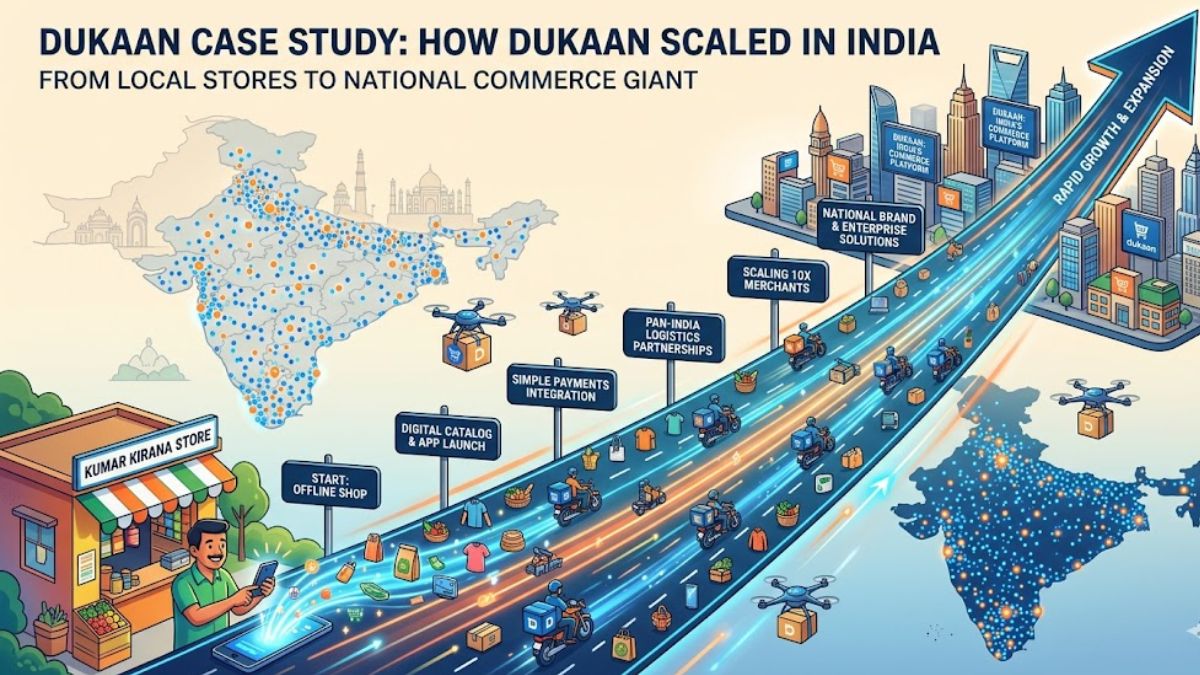
Dukaan Case Study and the Rise of a No-Code Commerce Platform in India
The Dukaan Case Study is one of the most widely discussed startup journeys in India’s SaaS and e-commerce ecosystem. Dukaan is a Bengaluru-based startup that helps small businesses create online stores instantly without coding knowledge. The platform was designed to simplify digital commerce for India’s massive base of offline retailers who wanted to move online but lacked technical expertise. The idea behind Dukaan came from a simple observation: millions of small shop owners in India were losing customers because they did not have an online presence, especially during the COVID-19 lockdown period. The founders saw an urgent gap in the market and built a product that allowed any merchant to create an online store in under a minute using a mobile-first interface.
Dukaan was founded by Sumit Shah, Suumit Shah, and Subhash Choudhary, and officially launched in 2020 during the early phase of the pandemic. The timing played a critical role in its rapid adoption, as physical retail came to a halt and digital ordering became a necessity. The platform works as a no-code store builder where merchants can upload products, manage orders, and accept payments through simple integrations. It positions itself as a Shopify alternative in India, but optimized for simplicity, speed, and WhatsApp-driven commerce.
While Dukaan initially saw explosive traction, its journey also reflects the realities of scaling a startup in a highly competitive e-commerce platform India ecosystem. The company reportedly raised funding from investors such as Lightspeed Venture Partners, although detailed revenue figures remain undisclosed publicly. The Dukaan Case Study is not just about rapid growth. It is also about product-market fit during a crisis, challenges of scaling SaaS in India, and the evolving nature of small business digitalization.
1. Dukaan Case Study: Origin Story and Founding Vision
The Dukaan Case Study begins with a familiar problem in India’s retail landscape. Millions of small businesses were operating offline, relying entirely on foot traffic and local visibility. Despite the rise of e-commerce giants, penetration into small towns and local shops remained limited. The founders observed that even though platforms like Amazon and Flipkart were growing, they were not solving the problem for the smallest merchants. Setting up an online store still required technical knowledge, developer support, and time.
Dukaan was born as a response to this gap. The vision was to eliminate friction in online store creation apps and make digital commerce accessible to anyone with a smartphone. The founding team initially experimented with multiple digital products before narrowing their focus on a no-code platform. The idea was not just to build another SaaS product but to create a tool that could democratize small business digitalization in India. The pandemic in 2020 accelerated this need dramatically. With lockdowns in place, thousands of small retailers needed a way to continue selling. Dukaan positioned itself as a quick solution for survival rather than a long-term software tool.
2. Problem Identification: What Was Broken in the Market
Before Dukaan, the Indian SME ecosystem faced multiple barriers to digital adoption. Most small retailers did not have websites, and those who tried often struggled with complexity and cost. Existing solutions required technical setup, payment gateway integration, hosting management, and marketing knowledge. This created a significant entry barrier for non-technical users. Another key issue was fragmentation. Even if a merchant created a website, they still needed separate tools for payments, inventory, and customer communication.
The Dukaan Case Study highlights that the core problem was not lack of demand, but lack of simplicity. Small business owners wanted something that worked instantly without training or onboarding. This is where Dukaan introduced a radical approach. Instead of building a complex e-commerce system, it focused on speed, simplicity, and mobile-first usability.
3. Product Development and Evolution
The initial version of Dukaan was built rapidly during the early lockdown period. The focus was on speed of deployment rather than feature richness. The product allowed merchants to create a store in minutes, upload product images, set prices, and start accepting orders via WhatsApp and other messaging channels. Over time, Dukaan evolved into a more structured SaaS platform. Features such as payment gateway integration, analytics dashboards, and delivery tracking were added.
The company positioned itself as a no-code store builder, targeting users who had never used traditional e-commerce tools. One of the defining aspects of the Dukaan Case Study is how the product prioritized simplicity over customization. This helped reduce onboarding friction but also created limitations for advanced users.
4. Early Traction and Market Validation
Dukaan’s early traction was heavily influenced by the COVID-19 pandemic. Thousands of small businesses signed up as offline retail shut down across India. Word-of-mouth played a major role in growth. Many merchants shared their success stories on social media, which created organic visibility for the platform.
The company also benefited from India’s rapidly growing adoption of e-commerce platforms in India, especially among small retailers who had never sold online before. Early validation came from the fact that users were able to generate real sales within days of onboarding. This phase of the Dukaan Case Study shows how urgency-driven adoption can accelerate startup growth significantly.
5. Business Model and Revenue Strategy
What makes Dukaan interesting is not just what it built, but how it chose to make money. At its core, Dukaan follows a SaaS subscription model. On paper, that sounds standard. But in the Indian SME context, it’s a very deliberate choice. Small business owners here are cautious with spending. They don’t commit easily unless they see immediate value. That’s where the freemium approach played a critical role. Dukaan didn’t ask users to pay upfront. It gave them a way to get started for free, to experiment, to see if this “online store” idea even worked for their business. And that matters more than it sounds. Because for many small merchants, this wasn’t just a new tool, it was a completely new way of doing business.
Once users experienced the value, better store management, smoother order handling, visibility into their business, they became more open to paying for advanced features. Things like analytics, custom domains, and marketing tools stopped feeling like expenses and started feeling like upgrades. From a real-world perspective, this shift is everything. You’re not forcing monetization. You’re earning it.
The revenue model is built around recurring subscriptions, monthly or annual. This creates predictability, not just for the company, but also for how it plans growth. Unlike transaction-based models, where income fluctuates with user activity, subscriptions provide stability. What’s also notable is what Dukaan didn’t focus on. It didn’t heavily rely on commissions or transaction fees. That decision made the platform feel less extractive and more supportive, especially for small sellers trying to maximize margins. In many ways, the Dukaan model is a localized version of global SaaS frameworks, but adapted thoughtfully for India. Lower pricing, simpler onboarding, and clear value delivery. That’s what made it work.
6. Funding History and Investor Backing
As Dukaan started gaining traction, it naturally caught the attention of investors. Among them was Lightspeed Venture Partners, a name that tends to back companies with strong product-market fit and scalable potential. This wasn’t just about capital. It was validation. At a time when the “Shopify alternative for India” narrative was gaining momentum, Dukaan positioned itself right in that conversation. Investors saw the opportunity. A massive SME base, increasing digital adoption, and a product that simplified entry into e-commerce.
While exact revenue numbers haven’t been widely disclosed, Dukaan’s presence in India’s SaaS growth story speaks for itself. It became part of a larger shift where software products were no longer just for enterprises, but for everyday businesses. Funding also brought a shift internally. The focus moved from rapid user acquisition, getting as many people on the platform as possible, to building a more structured, reliable product. Engineering teams expanded. Customer support improved. Systems became more robust. This is a phase many startups go through. The excitement of early growth gives way to the discipline of building something that lasts.
7. Go-to-Market Strategy and Distribution Channels
Dukaan’s early growth didn’t come from massive ad budgets. It came from understanding how its users already behaved. One of the smartest moves was leaning into WhatsApp. In India, WhatsApp isn’t just a messaging app. It’s where business happens. Orders are discussed, products are shared, and trust is built. By aligning with this behavior, Dukaan didn’t have to force users into a new system. It fit into their existing workflow. That reduced friction significantly.
Social media also played a huge role. Not in a polished, corporate way, but in a raw, relatable manner. Founders spoke directly to users. Stories were shared. The product felt accessible, not intimidating. There’s a real lesson here. In early-stage SaaS, distribution often matters more than product depth. You can have the most feature-rich platform, but if people don’t discover it or understand it, it won’t scale. Dukaan focused on being easy to find, easy to try, and easy to talk about. And that made all the difference.
8. Brand Positioning and Messaging Evolution
In its early days, Dukaan positioned itself as something urgent, almost like a lifeline. During COVID-19, when physical stores were shutting down, it gave small businesses a way to survive. That messaging was powerful because it was real. It spoke to a problem people were actively facing. But as the world moved forward, the brand had to evolve. Survival messaging has a shelf life. Growth messaging lasts longer. So Dukaan shifted its narrative. It moved from being a temporary solution to becoming a long-term partner in digital commerce.
The core themes remained consistent: simplicity, speed, and accessibility. But the tone matured. It wasn’t just “get online quickly” anymore. It became “build and grow your business online.” Importantly, Dukaan didn’t try to compete head-on with global giants on complexity. It didn’t overwhelm users with too many features. Instead, it leaned into ease of use. From a user’s perspective, that decision matters. Especially for small business owners who don’t have the time or technical knowledge to navigate complicated platforms. In a crowded e-commerce ecosystem, where many platforms promise everything, Dukaan stood out by promising something simpler, clarity. And then actually delivering on it.ystem.
9. Key Challenges and Turning Points
As Dukaan began to scale, the early excitement of rapid adoption slowly gave way to more complex, less visible challenges. Getting merchants onboard was never the problem. The product was simple, fast, and intuitive. People could set up a store in minutes. But what came after that was far more difficult. Retention. Many merchants signed up, explored the platform, even made a few sales, but long-term engagement required something deeper. As businesses grew, their needs evolved. They started looking for better analytics, more control, deeper integrations, and advanced tools. This is where the real tension emerged. Dukaan’s strength was simplicity. But scaling a product often demands complexity. Balancing the two is not just a product decision, it’s a philosophical one.
Add to that the pressure of competition. Global platforms like Shopify offered depth and maturity. Local players were also entering the space with aggressive strategies. For Dukaan, this phase became a turning point. It forced the team to ask hard questions. Should they stay simple and risk losing advanced users, or evolve and risk losing their core identity? There was no perfect answer. Only trade-offs.
10. Operations and Scaling Decisions
Scaling a SaaS product like Dukaan is not just about adding users. It’s about building systems that can support those users without breaking under pressure. In the early days, speed was everything. But as the user base grew, cracks started to appear. Support requests increased. Onboarding needed structure. Merchants needed guidance, not just tools. So the company began investing in infrastructure. Not just technical infrastructure, but operational systems. Customer support teams were strengthened. Onboarding flows were refined. Merchant success became a real function, not just an afterthought.
Automation played a big role here. Repetitive tasks were streamlined. Processes that once required manual intervention became self-serve. This wasn’t just about efficiency, it was about survival at scale. One of the most important shifts during this phase was mindset. The focus moved from “grow as fast as possible” to “grow in a way that lasts.” That meant making decisions that didn’t always maximize short-term numbers but built long-term stability. From experience, this is where many startups either mature or struggle. Growth is exciting. Sustainable growth is disciplined.
11. Competitive Landscape and Differentiation
The space Dukaan operates in is crowded and constantly evolving. On one side, you have global giants like Shopify with deep ecosystems and years of product refinement. On the other, regional SaaS players trying to capture the same SME market. In such an environment, survival depends on clarity. You have to know exactly who you are building for and why. Dukaan’s differentiation lies in its deep understanding of Indian small businesses. It didn’t try to replicate global platforms feature by feature. Instead, it focused on localization. The product feels familiar to Indian users. The workflows match how small merchants actually operate. The learning curve is minimal.
The mobile-first approach also played a huge role. Many small business owners in India run their operations entirely from their phones. Dukaan embraced that reality instead of trying to change it. And then there’s the integration with WhatsApp. This is where the product feels almost native to how commerce already happens in India. Orders, conversations, follow-ups, everything flows through a channel people already trust. This isn’t just a feature. It’s a strategic advantage.
12. Growth Metrics and Milestones
Dukaan’s growth story is closely tied to a moment the world won’t forget, the pandemic. When physical stores shut down, thousands of small businesses were left with a simple but urgent question: how do we survive? Dukaan became an answer. The platform saw a surge in adoption. Merchants who had never considered going online suddenly needed a digital presence. And because Dukaan was easy to set up, it became a natural choice. What’s important here is the nature of this growth. It wasn’t heavily driven by marketing budgets. It was driven by necessity.
From a real-world perspective, this kind of growth is powerful but also unpredictable. External events can accelerate adoption dramatically, but sustaining that momentum requires a strong product and consistent value delivery. While detailed financial metrics aren’t widely public, the early traction itself became a milestone. It proved that the demand existed. That small businesses were ready to digitize, if the barrier to entry was low enough.
13. Team Building and Leadership Approach
Behind every fast-moving product is a team that’s constantly building, fixing, and improving. In Dukaan’s case, the early team operated with a strong bias for speed. Decisions were made quickly. Features were shipped fast. The focus was always on execution over perfection. Hiring reflected this mindset. The company invested heavily in engineering and product teams, people who could build and iterate rapidly. At the same time, merchant support became equally important, because a product is only as good as the experience it delivers.
Leadership followed a builder-first approach. There was a strong emphasis on creating rather than over-planning. On testing ideas in the real world instead of debating them endlessly. But as the company grew, leadership also had to evolve. Speed alone isn’t enough at scale. It has to be balanced with structure, clarity, and long-term thinking. Processes need to be defined. Teams need alignment. Decisions need more context. This evolution is subtle but critical. Because in the early days, a startup survives on hustle. But to grow beyond that, it needs discipline.elivery over extensive corporate structure.
14. Technology and Operational Insights
What sits behind Dukaan may look simple from the outside, but that simplicity is carefully engineered. The platform is built with one clear priority: make it effortless for a small business owner to get online without feeling overwhelmed. That means the technology has to do the heavy lifting quietly in the background. Its architecture is designed for scalability, not just in terms of handling more users, but in supporting thousands of small, independent businesses with very different needs. A kirana store, a home-based clothing seller, and a local electronics shop might all use Dukaan, but their workflows are completely different. The system has to adapt without becoming complicated.
Integrations play a huge role here. Payment gateways are embedded seamlessly, so merchants don’t have to think about technical setup. Inventory tools help track products without requiring spreadsheets or external software. Analytics give basic insights in a way that feels understandable, not intimidating. From real user experience, this is where Dukaan stands out. It doesn’t try to impress with complexity. It tries to remove friction. And then there’s the mobile-first approach. In India, for many small business owners, the smartphone is the business hub. Orders, communication, payments, everything happens through that one device. Dukaan respects that reality. It doesn’t push users toward desktops or complex dashboards. It meets them where they already are. That decision, simple as it sounds, is deeply strategic. Because adoption increases dramatically when a product fits naturally into existing behavior.
15. Regulatory and Market Challenges
Operating in the digital commerce space in India comes with its own set of responsibilities. For a platform like Dukaan, compliance is not optional. It’s built into everyday operations. Payment processing has to align with regulatory frameworks. Data handling must meet evolving privacy standards. Even small lapses in these areas can have serious consequences. Then there’s GST. For many small merchants, taxation itself is confusing. Dukaan doesn’t just provide a storefront, it becomes part of how these businesses manage compliance. That adds another layer of complexity. The platform has to simplify processes that are, by nature, not simple.
And the regulatory landscape is constantly shifting. New rules, updated guidelines, changing expectations, it’s a moving target. From a company’s perspective, this requires constant vigilance. Systems need to be updated. Processes need to adapt. And decisions need to be made with both growth and compliance in mind. From a founder or operator’s lens, this is one of the less glamorous parts of building a SaaS business. But it’s also one of the most important. Because in the long run, trust is built not just on product experience, but on how responsibly a platform operates.
16. Current Status of Dukaan
Today, Dukaan is no longer just a fast-growing startup chasing adoption. It’s a platform that has seen both rapid growth and the challenges that come with it. The focus has clearly evolved. Early on, it was about getting as many merchants online as possible. Now, it’s about keeping them there. Retention has become a priority. That means improving product depth, adding features that genuinely help businesses grow, and ensuring that users don’t outgrow the platform too quickly.
Monetization has also matured. Instead of relying purely on expansion, the company is looking at long-term value. How can each merchant generate consistent revenue for the platform while also finding sustained value in using it? In the broader ecosystem, Dukaan continues to be seen as a strong alternative to platforms like Shopify, especially for Indian SMEs. But more importantly, it represents something larger. A shift toward making digital commerce accessible to people who were previously excluded from it. And that’s where its real impact lies. Not just in the technology it built, but in the doors it opened for thousands of small businesses trying to find their place in a digital world.
Future Outlook: Dukaan Case Study and the Road Ahead
The future of the Dukaan Case Study reflects the broader evolution of India’s digital commerce ecosystem. As more small businesses come online, platforms like Dukaan will need to move beyond basic store creation and offer deeper business tools. The next phase of growth will likely focus on automation, AI-driven insights, and better integration with logistics and marketing systems. The opportunity in small business digitalization remains large, especially in tier-2 and tier-3 cities.
However, competition is also intensifying. Global SaaS platforms and local startups are all targeting the same merchant base. The winners will be those who can balance simplicity with long-term value creation. For Dukaan, the challenge is no longer just onboarding users but helping them grow sustainably. The Dukaan Case Study ultimately shows that timing, simplicity, and product-market fit can create explosive early growth, but long-term success depends on depth, retention, and ecosystem building.
About foundlanes.com
foundlanes.com is a startup knowledge platform that documents and analyzes India’s startup ecosystem through detailed case studies, founder journeys, and business model breakdowns. It focuses on delivering factual, research-driven, and editorial-style insights that help readers understand how startups are built, scaled, and sustained in real market conditions.