


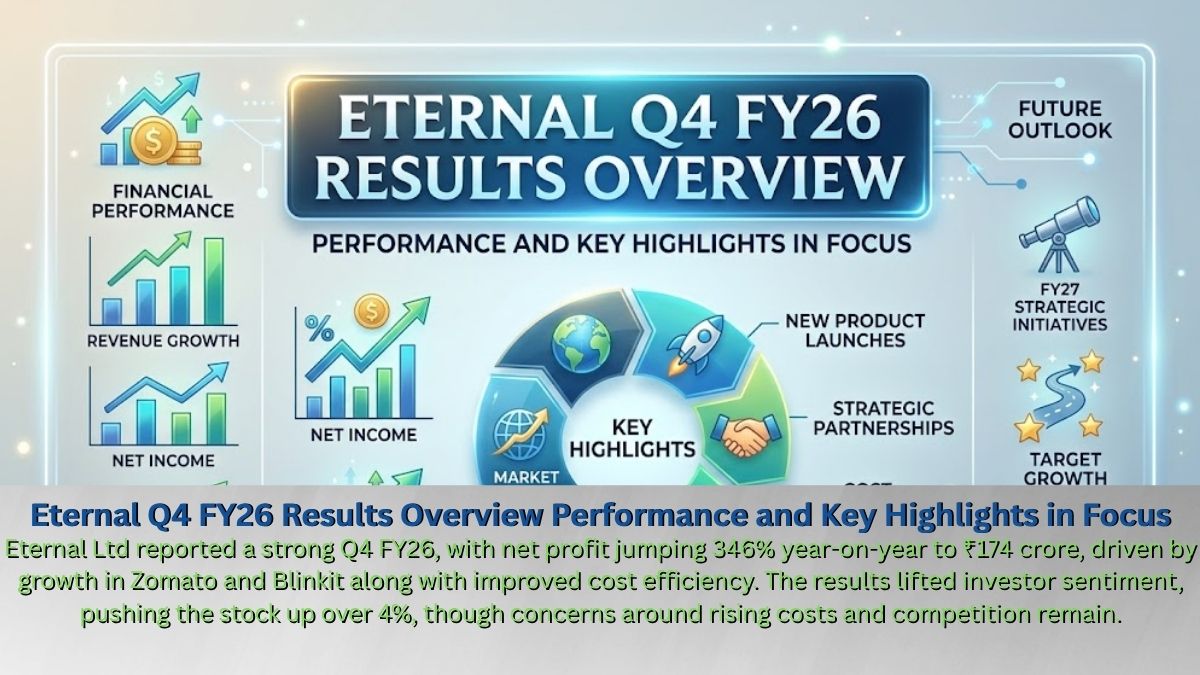
Financial Performance and Key Highlights Driving Growth
Eternal Ltd delivered a strong financial performance in Q4 FY26, marking one of its most significant quarterly profit jumps in recent years. The company reported a net profit of ₹174 crore, compared to much lower profits in the previous year, representing a 346% surge in profitability. This performance and key highlights reflect improved monetization across both Zomato and Blinkit.
Revenue growth was supported by higher order volumes in food delivery and rapid expansion in quick commerce. Additionally, cost optimization strategies helped improve margins. These performance and key highlights have placed Eternal among the fastest-growing tech companies in India’s startup ecosystem.
Market Reaction and Investor Sentiment
Following the announcement, Eternal shares rose more than 4% in stock market trading sessions. Investors responded positively to the improved earnings and strong execution in Blinkit’s expansion strategy. However, analysts also pointed out that rising operational costs and competition could impact long-term margins. Despite concerns, the overall sentiment remains optimistic, especially in venture capital and startup markets, where profitability-driven growth is becoming more important than rapid expansion.
1. Background of Eternal Ltd and Evolution from Zomato
1.1 Journey from Food Delivery Startup to Diversified Tech Company
Zomato didn’t start as something big or intimidating. It began with a very ordinary human problem. People were hungry, confused, and just wanted to know where to eat without wasting time or getting disappointed. In those early days, it felt like a simple idea sitting quietly in the background of the internet. Nothing dramatic. Just useful.
But that “simple usefulness” is often where everything starts changing. As more people started relying on it, Zomato slowly became part of daily life in cities. Ordering food stopped feeling like a luxury or a backup plan. It became routine. And with that shift, the company also started changing without even fully announcing it. It wasn’t just about restaurants anymore. It became about time, convenience, and expectation.
Then food delivery took over everything. That’s when things really got intense. Because now it wasn’t just a website or app anymore. It was a promise. A promise that food would arrive hot, on time, every single day, no matter how chaotic the city outside looked. And keeping that promise at scale is not easy. It creates pressure that never really stops.
When Blinkit came into the picture, it didn’t feel like just an acquisition. It felt like a widening of ambition. Like the company was no longer comfortable being placed inside one category. It wanted to sit closer to daily life itself. Groceries, essentials, food, everything moving through one system. And the name “Eternal” reflects that shift in mindset. It doesn’t feel like branding. It feels like an attempt to say, “we are not done evolving yet.”
1.2 Founders and Early Growth Story
The early story of Zomato is not polished the way people often imagine startup success stories. It was uncertain, slow at times, and full of moments where things could have easily gone wrong. Deepinder Goyal and Pankaj Chaddah weren’t building with certainty. They were building while figuring things out, adjusting constantly, and trying to understand what users actually wanted versus what they thought they wanted. In the beginning, it was just restaurant listings. No big ambitions, no grand ecosystem thinking. But something interesting happened. People started depending on it more than expected. Not because it was perfect, but because it reduced confusion in everyday decisions. That’s a powerful place for any product to reach.
Growth didn’t feel like a straight line. It felt more like bursts. Sudden traction, followed by confusion, followed by rebuilding. Funding helped keep things alive, but it didn’t remove the chaos. In fact, scaling often made things more complicated. Every new city added pressure. Every new user raised expectations. Over time, though, something steady formed. Systems improved. Delivery became real. Operations became complex. And Zomato slowly turned from a discovery platform into something deeply embedded in urban life. Today, Eternal feels like the result of all those messy years layered on top of each other. Not a clean transformation, but a long evolution shaped by trial, error, and persistence.
2. Business Model of Eternal – Performance and Key Highlights Explained
2.1 Food Delivery Revenue Model
Food delivery looks simple from the outside. You open an app, you order food, it arrives. But behind that simplicity is a system that is constantly under pressure. Restaurants depend on it for orders. Customers depend on it for convenience. Delivery partners depend on it for income. And the platform sits in the middle, trying to keep all of it balanced without letting anything fall apart. Money flows in from multiple directions. Restaurants pay commissions. Customers pay delivery fees. Brands pay for visibility. But none of that really captures what the system feels like when it is running at full speed. It feels alive, constantly reacting, adjusting, and correcting itself.
There’s also something very human underneath it all. Food is emotional. People don’t just order because they are hungry. They order when they are tired, stressed, celebrating, or just not in the mood to cook. So every order carries a small emotional context that the system has to serve without ever seeing it. When performance improves, like better efficiency or stronger margins, it doesn’t just mean financial growth. It means fewer delays, fewer frustrated moments, and a smoother experience for millions of small everyday situations that people rarely talk about but deeply feel.
2.2 Blinkit Quick Commerce Model
Blinkit changed something subtle but powerful in how people think. It made waiting feel unnecessary. Before this model, groceries were planned. You made lists, you scheduled visits, you adjusted your day around shopping. Now, that entire rhythm has changed. Something runs out, and it can be replaced almost immediately. That shift sounds small, but it changes behavior in a big way. Behind that experience is a very intense operational system. Dark stores stocked carefully. Riders positioned strategically. Inventory constantly adjusted based on unpredictable demand patterns. Everything has to stay close to perfect because there is almost no tolerance for delay.
But this speed comes at a cost. It is not an easy business to run. It demands constant investment, constant monitoring, and constant adaptation. Some areas work beautifully. Others take time to stabilize. There is no comfort zone in this model. Still, once users get used to it, it becomes part of daily expectation. And expectations, once formed, are very hard to reverse.
2.3 Advertising and Platform Services
Advertising inside Eternal’s ecosystem feels less like traditional marketing and more like attention flowing through a system. Restaurants don’t just want to exist on the platform. They want to be noticed. Brands don’t just want visibility. They want relevance at the exact moment a user is deciding. That creates a very different kind of advertising model, one that is tied directly to intent.
It blends into the experience in a way that most users don’t even consciously notice. A suggestion here, a promoted listing there. It feels natural because it is happening inside a decision-making flow, not outside it. But this also requires balance. If the system pushes too hard, trust breaks. If it stays too quiet, value is lost. So it sits in this careful middle space, constantly adjusting itself based on user behavior and response.
3. Funding History and Startup Ecosystem Position
3.1 Venture Capital and Global Funding Support
Funding in Eternal’s journey was never just about expansion. In the early years, it was about survival. Keeping the system alive long enough to figure out what it could actually become. Investors didn’t just back a product. They backed uncertainty. Because at that time, it wasn’t clear whether this would become a content platform, a logistics company, or something entirely different. That uncertainty shaped everything. As the company matured, funding shifted from survival to scale. New markets, new verticals, new experiments. But eventually, another shift had to happen. Growth alone wasn’t enough anymore. Efficiency, discipline, and profitability started to matter just as much.
That transition is not comfortable for any company. It forces decisions that slow momentum but strengthen survival. It forces clarity after years of speed. Eternal today stands in that in-between space where growth and discipline both matter equally, and neither can be ignored.
3.2 Role in Indian Startup Ecosystem
Eternal’s impact on the Indian startup ecosystem is not just about size or valuation. It is about visibility. It shows what it looks like when a startup becomes part of everyday life. Not in theory, but in real behavior. People ordering food late at night. Riders moving through traffic for hours. Grocery orders arriving within minutes. These are not abstract metrics. They are lived experiences.
For founders, it is a reference point. For investors, it is a case study. Workers, it is a source of income. For users, it is just normal life now. And that is probably the most interesting part. It stopped feeling like a startup story a long time ago. It started feeling like infrastructure. Something you don’t always notice, but you would definitely feel if it disappeared.
4. Services, Products, and Business Expansion
4.1 Zomato Food Delivery Services
At its core, Zomato is still built around something very simple: helping people decide what to eat and getting that food to them without friction. But when you look closely, it’s not really just “food delivery” anymore. It’s a system that quietly sits between hunger, convenience, and time. Think about what actually happens when someone opens the app. It’s rarely a mechanical action. Most of the time, it’s a tired evening, a busy workday, or a moment where cooking just doesn’t feel possible. In that small emotional gap, Zomato steps in. It shows options, removes confusion, and turns a scattered set of restaurants into something structured and usable.
Behind that simplicity, there is a massive invisible machine. Restaurants trying to stay visible. Delivery partners moving through traffic. Algorithms trying to predict demand. And users who expect everything to just work, without thinking about the chaos behind it. Over time, this has turned into more than a service. It feels like a quiet layer sitting under urban life.
4.2 Blinkit Grocery and Quick Delivery
Blinkit changed the emotional relationship people have with shopping. Earlier, groceries were something planned. A task you prepared for. Now, it feels more like a reflex. Something runs out at home, and instead of adjusting your day around it, you just order it. That shift might sound small, but it actually changes how people experience time in their daily lives. Waiting becomes optional. Planning becomes lighter. Convenience becomes the default expectation.
But what makes Blinkit interesting is what sits behind that speed. Dark stores filled with carefully arranged inventory. Systems predicting what people might need before they even ask. Riders already positioned close enough so that “10 minutes” isn’t just marketing, but something that actually happens in real streets with real traffic and real pressure. It’s not an easy model. It runs on tight margins, constant coordination, and a level of operational intensity that most users never see. But when it works, it feels almost invisible. And that invisibility is exactly what makes it powerful.
4.3 Additional Tech Innovations
Underneath all the visible services, there’s a quieter layer of work happening inside Eternal. It’s not always obvious to users, but it shapes everything they experience. AI-driven logistics, for example, is not just about technology. It’s about trying to make sense of chaos. Traffic, weather, order spikes, restaurant delays, rider availability, all of it happening at once. The system constantly tries to predict what will go wrong before it actually does.
Personalization also plays a subtle role. The app learns preferences over time, not in a flashy way, but in small suggestions that feel increasingly familiar. It’s less about “AI features” and more about reducing friction in decision-making. And then there’s supply chain optimization, especially for Blinkit, where timing is everything. A delay of a few minutes can change the entire experience. So the focus is always on tightening gaps, reducing uncertainty, and making the system feel smoother than the complexity behind it actually is.
5. Problems Solved by Eternal in the Market
5.1 Solving Food Accessibility and Convenience
Food delivery solved something very human long before it became a tech category. It solved fatigue. It solved indecision. Solved the “what should I eat” moment that used to take more mental energy than it should.
Eternal doesn’t just connect users to restaurants. It removes layers of effort between intention and action. You don’t have to search, call, negotiate, or plan. You just decide, and the system handles the rest. And that changes behavior. Eating out becomes less of an event and more of an option that is always available. Convenience stops feeling like a luxury and starts feeling like normal life.
5.2 Solving Grocery Delivery Inefficiencies
Blinkit addresses something that used to feel unavoidable: the time cost of basic household needs. Earlier, buying groceries meant planning a trip, dealing with traffic, walking through stores, and spending time on something repetitive. It wasn’t difficult, but it was always there as a task. Blinkit compresses that entire experience into a few minutes.
What it really removes is interruption. You don’t have to stop your day anymore. You don’t have to reorganize your time around small necessities. That shift may seem operational, but it quietly changes how people structure their routines. It also solves a deeper urban problem: unpredictability. In cities where time feels fragmented, instant delivery brings a strange sense of control back into daily life.
5.3 Solving Digital Commerce Fragmentation
One of the less visible contributions of Eternal is how it brings scattered digital behavior into one place. Food, groceries, quick delivery, payments, discovery, everything sits inside overlapping systems. Instead of switching between apps and services, users stay inside one ecosystem that slowly becomes familiar.
That reduces friction, but it also creates comfort. People start trusting the platform not just for one thing, but for multiple needs. And once that trust forms, it becomes part of routine behavior, almost like a habit that runs in the background of daily life.
6. Competitors and Industry Landscape
6.1 Direct Competitors in Food Delivery
The food delivery space in India has always been intense, and that intensity hasn’t really reduced over time. Swiggy remains the closest competitor, and the competition between the two has shaped almost everything in this market. It’s not just about who delivers faster or cheaper. It’s about reliability under pressure. Festivals, weekends, weather disruptions, sudden demand spikes, all of these moments test systems in real time. And both companies are constantly trying to stay one step ahead in efficiency, pricing, and restaurant partnerships.
What makes this competition interesting is that it doesn’t feel distant. Users experience it directly. Discounts, delivery times, offers, all of it is visible. It creates a market where competition is not hidden behind corporate strategy, but visible in everyday choices.
6.2 Quick Commerce Competition
In quick commerce, the competition feels even sharper because the expectations are tighter. Blinkit, Instamart, Zepto, all operate in a space where speed is the product itself. There is very little room for delay or inconsistency. And that creates a constant race not just for customers, but for operational efficiency.
But this segment is also expensive to run. Every promise of speed requires infrastructure, inventory planning, and logistics density. So while the growth is exciting, the pressure underneath is always present. It’s a space where scaling too fast can hurt, but scaling too slowly can also mean losing ground.
6.3 Indirect Competition
Not all competition comes from other apps. A large part of it still comes from the offline world. Local grocery stores, neighborhood restaurants, and traditional shopping habits still hold strong influence. There are moments when people prefer walking out, talking to a shopkeeper, or simply choosing food in person rather than through a screen.
And that’s important to remember. Digital platforms don’t fully replace offline behavior. They exist alongside it, constantly negotiating convenience versus experience, speed versus familiarity. Even emerging platforms and niche services add to this ecosystem, creating a landscape that is less about domination and more about constant coexistence and adjustment.
7. Industry Trends and Startup Ecosystem Insights
When you look at Eternal’s journey in isolation, it feels like a company story. But when you zoom out a little, it starts to look like a reflection of where India’s startup ecosystem itself is heading. There was a time when startups were almost obsessed with growth. Everything was about speed, expansion, user acquisition, and market dominance. Profitability felt like something you could worry about “later.” But that mindset has clearly shifted. Now, there is a much sharper focus on survival in the real sense. Not just growing fast, but building something that can actually sustain itself without constant external fuel.
7.1 Investors today think differently too
Investors today think differently too. Unit economics is no longer a background metric. It sits at the center of every conversation. How much it costs to serve one order, how long it takes to recover customer acquisition costs, how efficiently a company can operate at scale, these are not side questions anymore. They are the main questions.
At the same time, the broader ecosystem is expanding in multiple directions. Fintech continues to evolve, especially in areas like credit access, payments infrastructure, and digital banking behavior. E-commerce and quick commerce are still growing, but they are also getting more disciplined under pressure. And then there is the rise of AI-driven startups, where everything from logistics to customer interaction is being reshaped in real time. Even blockchain, which went through cycles of hype and silence, is still quietly evolving in the background in different forms.
What makes this moment interesting is that India is no longer just catching up to global trends. In many cases, it is participating in shaping them. Global companies are also stepping into similar spaces, especially in delivery, commerce, and platform services. That increases pressure, but it also pushes local companies to innovate faster and think more deeply about execution, not just ideas. And in all of this, the common thread is simple. The companies that survive are not the ones with the loudest narratives. They are the ones that quietly improve systems every single day.
8. Learning for Startups and Entrepreneurs
Eternal’s journey, when you strip away the scale and numbers, feels like a long lesson in building under pressure. The first and most uncomfortable truth is that growth alone is never enough. A company can expand quickly, enter new cities, attract funding, and still struggle if the basic unit economics don’t make sense. At some point, every startup has to face that reality. And it is not a theoretical exercise. It shows up in cash flow, margins, and operational strain. Another important lesson is about not depending on a single idea too heavily. Eternal didn’t stay in one lane. It moved from discovery to delivery, from food to groceries, from single-purpose usage to multiple layers of daily life. That kind of diversification is not just strategy. It is a way of reducing vulnerability. Because markets change faster than most companies can predict.
8.1 Not as a buzzword, but as a survival tool
Then there is technology. Not as a buzzword, but as a survival tool. In fast-moving sectors, technology is what holds complexity together. Without it, scaling breaks systems. With it, scaling becomes at least manageable, even if never easy. Whether it is logistics optimization, customer behavior tracking, or supply chain planning, the companies that invest deeply in tech are the ones that stay steady when demand becomes unpredictable. But maybe the most important learning is something less technical. It is about balance. Between growth and profitability. Between speed and control. Ambition and discipline.
Eternal’s recent performance cycles, including Q4 FY26 results, quietly show this balance taking shape. Not perfectly, not without tension, but in a way that suggests maturity. Efficiency starts to matter as much as expansion. Execution starts to matter as much as vision. And for entrepreneurs, that is often the hardest stage. Because building fast is exciting. But building something that lasts requires patience, restraint, and a very honest understanding of reality.
About foundlanes.com
foundlanes.com is India’s leading startup idea discovery platform. It helps entrepreneurs find actionable startup opportunities, market insights, and industry-specific guidance to turn ideas into real businesses. With deep research and practical resources, foundlanes supports founders at every stage, from idea validation to launch and growth.