


News Summary
India’s startup world keeps changing in quiet but interesting ways, and this story fits right into that shift. A group of Ex-Blinkit Employees has managed to raise ₹7.55 crore in a pre-seed funding round to build and scale doorstep smartphone repair services across India. The funding was co-led by Titan Capital and 8i Ventures, along with support from other early-stage investors who are increasingly betting on practical, everyday problem-solving startups. The focus here is not something flashy or futuristic. It is something very basic that almost every smartphone user in India has faced at some point, a broken phone and the hassle of getting it fixed.
The startup, Instafix, is trying to make that entire experience simpler. Instead of customers stepping out, waiting in queues, or dealing with uncertain repair timelines, they can just book a service and get a technician at home. It sounds small, but for anyone who has lost a day just to fix a phone, it feels like a real relief. What makes this even more interesting is the journey of the founders. These Ex-Blinkit Employees come from a background where speed is everything and delays are not acceptable. They have worked in systems where even a few minutes matter, and that mindset is now being carried into a very different industry, smartphone repair.
Right now, the repair market in India is still uneven. Some places are reliable, many are not. Prices can change from shop to shop, and customers often don’t really know what they are paying for. Instafix is trying to reduce that confusion by making the process more structured and predictable.
The new funding will help the startup grow its technician network, improve its tech platform, and expand into more cities. The bigger idea is simple: make repairs feel less like a struggle and more like a service that comes to you when you need it. In many ways, this is a classic example of Ex-Blinkit Employees taking what they learned in fast-paced delivery systems and quietly applying it to something people deal with every day but rarely think about changing.
1. Introduction: Rise of Ex-Blinkit Employees in India’s Startup Ecosystem
India’s startup ecosystem has reached a stage where experience from inside big startups is turning into new companies. A growing number of Ex-Blinkit Employees are now stepping out and building ventures of their own, especially in services that touch daily life.
This particular startup focuses on doorstep smartphone repair, which is something most urban users instantly relate to. Almost everyone has had that moment where their phone stops working and the entire day gets disrupted.
The timing is important too. People in India are far more open now to at-home services, whether it is food, groceries, or repairs. Convenience has quietly become a major deciding factor in how services are designed and delivered.
2. Founders and Startup Background of Ex-Blinkit Employees
2.1 Founding Journey
The startup didn’t come from a big strategy meeting or a long corporate plan. It came from experience. The Ex-Blinkit Employees behind this idea spent years working in systems where speed, accuracy, and delivery efficiency were part of everyday life. While working in that environment, they started noticing a gap. Food and groceries could reach people in minutes, but repairing something as common as a smartphone still felt slow, unclear, and outdated. That gap stayed with them and eventually turned into the idea behind Instafix.
2.2 Transition from Quick Commerce to Service Tech
At first glance, moving from grocery delivery to phone repair might feel like a big jump. But when you look closer, the logic is actually quite similar. Both depend on coordination. Both depend on timing. And both fall apart if execution is weak.
These Ex-Blinkit Employees understood how important last-mile delivery really is. So instead of building something completely new from scratch, they took those same principles and applied them to a very different problem. It is less about changing industries and more about changing how services reach people.
2.3 Vision of the Founders
The long-term goal is not just to fix phones. It is to fix how unpredictable the entire repair experience feels today. The founders want a system where people don’t have to wonder what the price will be, or how long it will take, or whether the technician will show up on time. They want it to feel simple and consistent. That is the direction these Ex-Blinkit Employees are working toward, building something that feels reliable rather than uncertain.
3. Funding Details and Investor Participation
3.1 Pre-Seed Funding Round
The startup has raised ₹7.55 crore in a pre-seed round, which is an early but important stage for any new company. At this point, investors are not just betting on numbers. They are betting on people and execution. Titan Capital and 8i Ventures co-led the round, bringing in experience from backing several early-stage startups in India.
3.2 Strategic Investor Confidence
What stands out here is the type of confidence investors are showing. It is not just about smartphone repairs as a category. It is about whether this team can actually execute in the real world. And that is where the background of these Ex-Blinkit Employees matters. They have already worked inside systems where speed, logistics, and scale are tested daily. In a way, investors are backing that experience as much as the idea itself.
3.3 Use of Funds
The money raised will mainly go into building things that customers will actually feel in their day-to-day experience. A big part will go into expanding the technician network so that services can reach more homes without delays. Another important area is improving the technology that runs everything behind the scenes, from booking a repair to tracking it in real time.
The startup also plans to expand into more cities, especially where people have smartphones but limited access to reliable service options. On top of that, some funds will go into building awareness, because trust takes time in a market like this. For these Ex-Blinkit Employees, this funding is less about celebration and more about responsibility. Now the real work begins.
4. Working Model of the Startup
4.1 Doorstep Service Structure
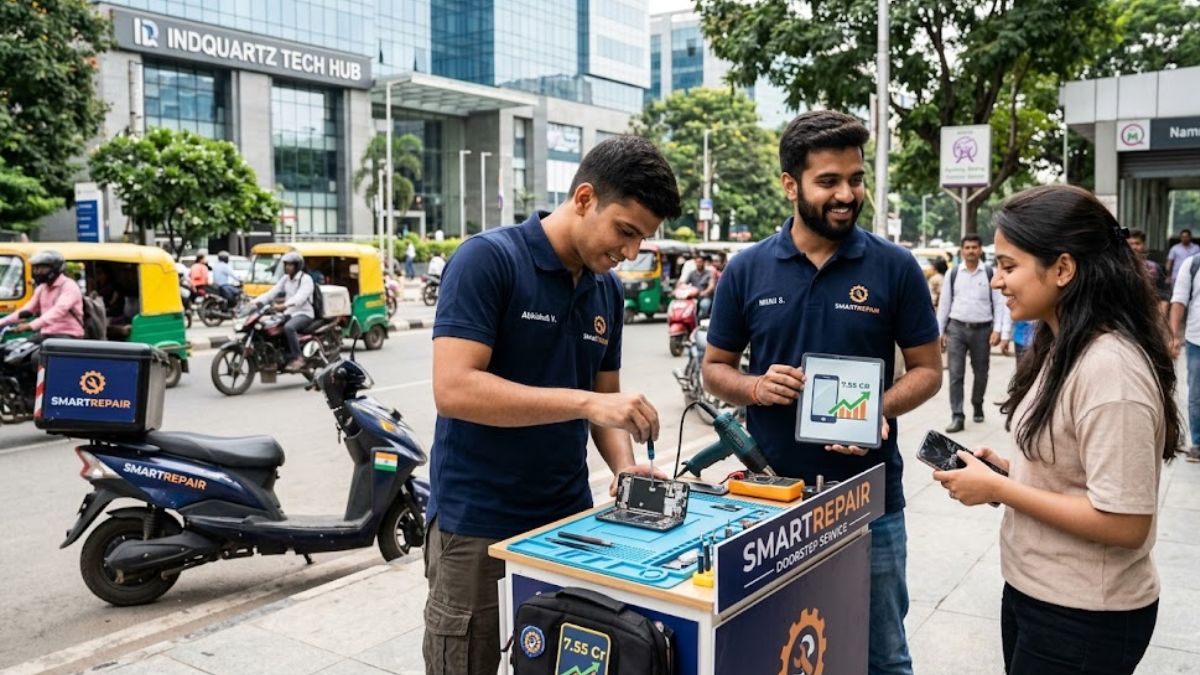
At the heart of this startup is a very straightforward idea. You don’t need to step out when your phone breaks. A customer simply opens the app or website, selects the issue, and books a repair. From there, the system takes over. A trained technician is assigned and sent directly to the customer’s location. It is designed to feel easy and familiar, almost like ordering any other on-demand service today. The goal is to remove friction, not add more steps.
4.2 Service Workflow
Once a booking comes in, the system quickly matches the request with a nearby technician. This is where speed really matters. The technician arrives, checks the device, and tries to fix the issue on the spot whenever possible. For simpler problems, the repair is completed right there in front of the customer. If the issue is more complex, the device is safely taken to a service hub, repaired, and returned.
What makes this model work is coordination. And that is exactly where the experience of Ex-Blinkit Employees quietly shows up, because they are used to systems where timing and movement have to stay tightly connected.
4.3 Technology Integration
Behind the scenes, there is a system that keeps everything moving smoothly. The platform uses scheduling tools to assign technicians, real-time tracking so customers know what is happening, and service logs that keep a record of every repair. This is not just about convenience. It is also about trust. When people can see what is happening, uncertainty goes down.
For the Ex-Blinkit Employees building this, the thinking is simple. If you can track a delivery, you should also be able to track a repair.
5. Revenue Model and Monetization Strategy
5.1 Service-Based Revenue
The most direct source of income is the repair itself. Customers pay for the service based on what needs to be fixed. A screen replacement is not priced the same as a software issue, and that variation depends on the complexity of the job. This keeps the model simple and aligned with actual work done.
5.2 Commission-Based Technician Network
The startup does not rely only on in-house technicians. Instead, it builds a structured network of service partners. Technicians get assigned jobs through the platform, and the company earns a margin from each completed service. This structure helps the business scale without owning every part of the service delivery. It also allows flexibility in expanding to new locations.
5.3 Future Monetization Channels
Over time, the startup is expected to expand beyond just repair services. Some of the possible directions include warranty coverage, device protection plans, refurbished phone sales, and even maintenance contracts for businesses. These additions can turn a simple repair service into a broader device care ecosystem. For now, though, the focus remains on getting the core service right.
6. Problem Statement and Market Gap
6.1 Fragmented Repair Market
India’s smartphone repair space is still scattered. There are thousands of small shops, independent technicians, and local service points. While this creates availability, it also creates inconsistency. Prices can vary from one shop to another. Service quality is not always predictable. And customers often have no clear reference point.
6.2 Trust Deficit
One of the biggest issues in this market is trust. People often don’t know whether they are being charged fairly or whether a repair is actually necessary. Diagnostics are not always transparent, and that leads to doubt. This uncertainty becomes frustrating, especially when your device is something you depend on every day. The startup is trying to reduce that gap by making processes more visible and structured.
6.3 Convenience Gap
The final problem is something most users simply accept as normal. When a phone breaks, you still have to go to a shop, wait, and often follow up multiple times just to get updates. It costs time, and sometimes an entire day. This is exactly the gap Ex-Blinkit Employees are targeting with doorstep repair services, bringing the service to the customer instead of the other way around.
7. Industry Trends and Growth Outlook
7.1 Rising Smartphone Penetration
India’s smartphone usage continues to grow at a steady pace, and that alone keeps the repair market active and expanding. With millions of users depending on their phones for work, payments, communication, and daily tasks, even a small issue creates immediate demand for repair services.
This rising dependency means repair needs are not occasional anymore. They are frequent, which creates a stable and long-term opportunity for startups working in this space, including ventures led by Ex-Blinkit Employees.
7.2 Growth of On-Demand Services
Over the past few years, India has become very comfortable with services that come directly to the doorstep. Food, groceries, laundry, and even beauty services are now part of this shift. That behavioural change is important. It shows that people no longer want to spend time traveling for basic services if they can avoid it.
This is exactly where the model built by Ex-Blinkit Employees fits in. It is not introducing a new habit. It is extending an existing one into another category, smartphone repair.
7.3 Venture Capital Interest
Investors are also paying closer attention to this shift. There is growing interest in startups that combine logistics thinking with everyday consumer services. Sectors like service tech, hyperlocal delivery, and convenience-driven platforms are attracting steady venture capital funding. The reason is simple. These businesses solve real problems that people face repeatedly. For ventures led by Ex-Blinkit Employees, this creates a supportive environment where execution-focused ideas are more likely to find funding and scale.
8. Competitive Landscape
8.1 Direct Competitors
In the smartphone repair space, competition is already quite fragmented. The startup competes with local repair shops, authorised OEM service centres, and small organised repair networks. Each of these players serves a part of the market, but often without standardisation. Local shops offer convenience in terms of proximity, but quality and pricing can vary widely. OEM centres offer reliability but usually involve longer waiting times. This creates a gap in the middle, which new-age startups are trying to fill.
8.2 Indirect Competitors
Indirect competition comes from services that solve similar problems in different ways. This includes urban home service platforms that handle appliance repair, independent technicians working through offline networks, and retail warranty service providers bundled with device purchases. While these are not direct smartphone repair startups, they still influence customer behaviour and expectations around service quality and convenience.
8.3 Market Positioning
The startup built by Ex-Blinkit Employees is trying to position itself in a space where both trust and convenience matter. It is not trying to be the cheapest option in the market, and not just another premium service either. Instead, it is aiming for consistency. The idea is simple. A customer should know what to expect every time, whether it is pricing, timing, or service quality. That balance between affordability and reliability is where the positioning sits.
9. Growth Strategy and Expansion Plans
9.1 Geographic Expansion
The immediate focus is on expanding into major Tier 1 and Tier 2 cities across India. These markets are important because they combine high smartphone usage with uneven service infrastructure. People here often have devices but limited access to reliable repair options. By entering these cities early, the startup led by Ex-Blinkit Employees can build presence where demand already exists but supply is inconsistent.
9.2 Technician Network Scaling
A service business like this depends heavily on people on the ground. That is why building a strong technician network is one of the most important parts of the growth plan. The goal is not just to increase numbers, but to ensure consistency in service quality. Training, onboarding, and verification become critical here. Without that, scaling quickly can actually create problems instead of solving them.
9.3 Technology Enhancement
Alongside physical expansion, there is also a strong focus on improving the technology backbone. This includes better scheduling systems, faster allocation of technicians, real-time updates for customers, and smoother service tracking. The mindset behind this reflects the experience of Ex-Blinkit Employees, where technology and operations always work together, not separately.
10. Future Outlook of the Startup
The opportunity here is fairly large if the execution stays consistent. Smartphone usage is only going to increase, and with it, repair needs will also grow. At the same time, customers are becoming more comfortable with doorstep services across categories. If the startup manages to maintain service quality while scaling, it could become a strong player in India’s service-tech ecosystem.
There is also room for expansion into related services like device protection, warranty support, and even refurbishment in the future. For now, the focus remains on building trust and reliability at scale, one repair at a time.
11. Learning for Startups and Entrepreneurs
There are a few clear takeaways from this journey. First, experience from high-growth companies can give founders a real execution advantage. Understanding systems, speed, and scale early on makes a big difference later. Second, real startup success often comes from solving everyday problems that people have already accepted as “normal inconvenience.”
And finally, execution matters as much as the idea itself. Many startups fail not because the idea is wrong, but because operations cannot keep up with ambition. For Ex-Blinkit Employees, this is exactly the space they are now testing themselves in.nology. Finally, trust, transparency, and convenience remain key drivers in service-based businesses.
About foundlanes.com
foundlanes.com is India’s leading startup idea discovery platform. It helps entrepreneurs find actionable startup opportunities, market insights, and industry-specific guidance to turn ideas into real businesses. With deep research and practical resources, foundlanes supports founders at every stage, from idea validation to launch and growth.