


News Summary
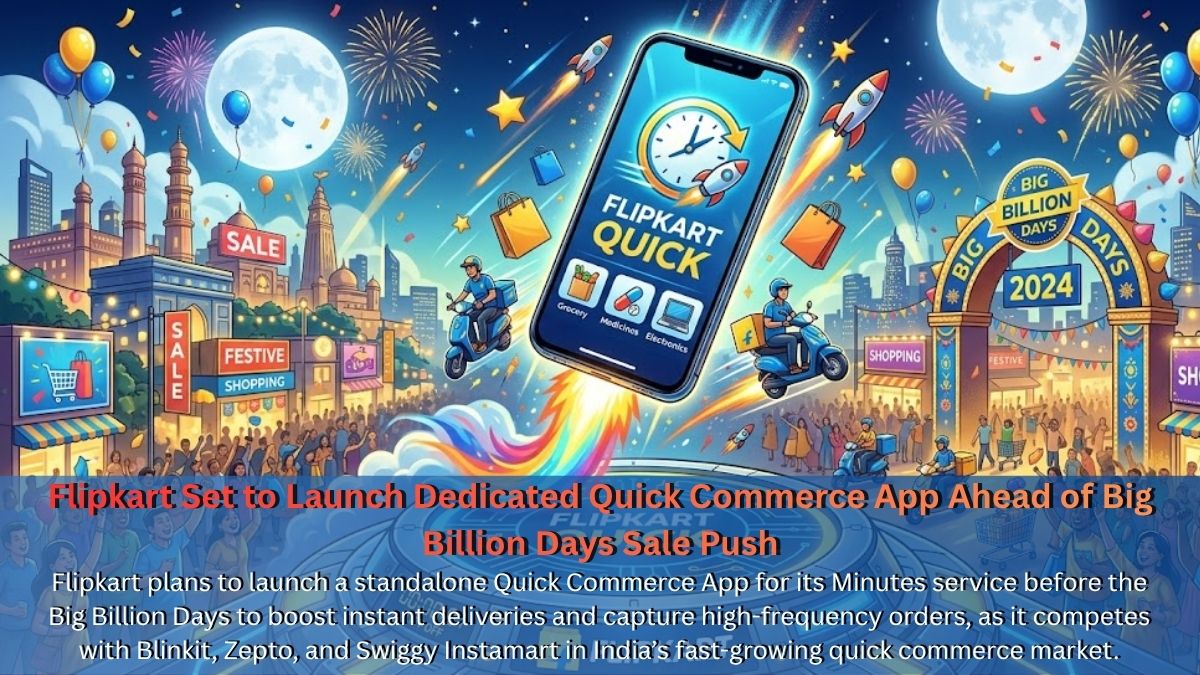
Quick Commerce App expansion is becoming central to India’s fast-growing e-commerce landscape, and Flipkart is now preparing to take a bold step in this direction. The Walmart-owned e-commerce giant is planning to launch a standalone Quick Commerce App for its rapid delivery arm, Minutes, ahead of its flagship Big Billion Days sale. This move signals Flipkart’s intent to compete aggressively in the quick delivery segment, which is currently dominated by players like Blinkit, Zepto, and Swiggy Instamart.
According to multiple reports, Flipkart aims to separate its quick commerce services into a dedicated mobile application. This strategy is expected to improve user experience, streamline operations, and create a sharper brand identity for its 10–15 minute delivery services. The company has already been expanding its quick commerce infrastructure across key cities, focusing on dark stores and localized supply chains to ensure faster delivery timelines.
The timing of this launch is crucial. The Big Billion Days sale is one of India’s largest online shopping events, and a dedicated Quick Commerce App could help Flipkart capture impulse purchases and high-frequency orders. This shift also reflects a broader trend in the startup ecosystem where companies are building specialized platforms to cater to evolving consumer needs.
Flipkart’s move comes at a time when quick commerce is witnessing rapid growth in India. Consumers increasingly demand instant delivery for groceries, essentials, and even electronics. By launching a separate app, Flipkart is positioning itself to tap into this demand more effectively.
This development highlights how major Indian startups and global startups are reshaping business models through innovation and tech disruption. As the competition intensifies, Flipkart’s Quick Commerce App could play a key role in defining the future of hyperlocal delivery in India.
1. Introduction: Quick Commerce App Strategy Gains Momentum
The Quick Commerce App strategy is no longer just an experiment for Flipkart. It has quietly become the heart of its next growth chapter. For years, Flipkart built its reputation on reliability, pricing, and scale. However, the world has changed faster than most expected. Today, people do not just shop online, they expect things almost instantly. That subtle shift in expectation has forced even giants like Flipkart to rethink everything they once believed about delivery timelines. Launching a dedicated platform for its Minutes service is not just a product decision. It feels more like a response to a deeper consumer emotion, the desire for immediacy.
At the same time, there is something very human behind this shift. People are busier, more impatient, and more used to convenience than ever before. Waiting even one day now feels long. That is why this move, right before the Big Billion Days sale, carries so much weight. Flipkart understands that during peak shopping moments, every second matters. A separate Quick Commerce App could capture impulse decisions in real time. It could turn a passing thought into an instant purchase. And honestly, that is where modern commerce is heading, not just fulfilling demand, but anticipating it before it fades.
1.1 The quick commerce segment is not growing quietly
Moreover, the quick commerce segment is not growing quietly. It is exploding. Across India, startups and large companies are racing to build faster, smarter, and more localized delivery systems. This is not just about speed anymore. It is about survival. As consumers lean toward instant gratification, companies that fail to adapt risk becoming irrelevant. Flipkart’s move shows that even established players feel that pressure deeply. It reflects awareness, urgency, and a willingness to evolve, all at once.
There is also a broader industry truth hidden here. Growth today is not just about scale, it is about relevance. And relevance comes from understanding what people feel, not just what they buy. Flipkart seems to recognize that the emotional gap between wanting something and getting it is shrinking rapidly. The Quick Commerce App is their attempt to close that gap completely.
2. Flipkart’s Quick Commerce Expansion Plan
2.1 Standalone App Development
Building a separate Quick Commerce App might look like a technical upgrade on the surface. But in reality, it is a strategic reset. Right now, the Minutes service exists within the main Flipkart app, almost like a feature tucked inside a larger experience. However, that setup limits its potential. A dedicated app gives it identity, focus, and space to grow on its own terms. It allows Flipkart to design an experience purely around speed, urgency, and everyday needs, without being overshadowed by its broader marketplace.
There is also a psychological layer here. When users open a specialized app, their intent is sharper. They are not browsing endlessly. They are there for something specific, something immediate. That clarity can drive higher conversions and stronger engagement. Flipkart likely understands this behavioral shift very well. By separating quick commerce into its own platform, it is not just simplifying navigation. It is aligning itself with how people actually think and act in high-speed decision moments.
At a deeper level, this move signals confidence. Flipkart believes that quick commerce is not just an add-on. It is a standalone business vertical that deserves its own ecosystem. That kind of clarity usually comes after observing strong internal data, consistent demand patterns, and long-term potential. It shows that Flipkart is not reacting blindly. It is acting with conviction built over time.
2.2 Launch Timeline and Strategic Timing
Timing, in business, often matters more than the idea itself. Flipkart seems to be placing its bet at a very calculated moment. Launching the Quick Commerce App ahead of the Big Billion Days sale is not random. It is deeply strategic. This sale period brings massive traffic, emotional buying behavior, and heightened urgency. It is when people are most open to trying new features, especially if those features promise speed and convenience.
During such high-pressure shopping windows, even small improvements in delivery speed can create a huge difference in customer satisfaction. Imagine a user debating between buying something now or waiting. A promise of delivery within minutes can tip that decision instantly. Flipkart knows that. It is not just about attracting users. It is about influencing decisions at the exact moment they are made.
There is also a competitive layer to this timing. Other quick commerce players are already strong in daily essentials. However, Flipkart has an advantage during large-scale sales. By introducing a Quick Commerce App at this moment, it blends urgency with scale. It brings together two powerful forces, massive demand and instant fulfillment. That combination could redefine how people experience big sale events in India.
From a broader perspective, this move reflects maturity. Flipkart is not just launching a product. It is orchestrating an experience around a cultural shopping event. That level of planning shows how deeply it understands both its users and the market rhythm.
2.3 Infrastructure and Dark Store Network
Behind every fast delivery promise lies a complex system that most users never see. Flipkart’s expansion of dark stores is a clear sign that it is investing heavily in the backbone of quick commerce. These are not traditional warehouses. They are small, hyperlocal hubs designed for speed. Each one is strategically placed to reduce delivery time and improve efficiency. However, building this network is not easy. It requires deep understanding of local demand, precise inventory planning, and flawless execution. A single mistake in stocking or logistics can break the promise of instant delivery. Flipkart seems to be approaching this challenge with patience and long-term thinking. Instead of rushing, it is gradually strengthening its supply chain, city by city.
There is also a human side to this infrastructure story. Every dark store represents jobs, coordination, and real people working behind the scenes. Delivery partners, warehouse staff, logistics managers, all playing their part to make “instant delivery” feel effortless. Flipkart’s investment here is not just financial. It is operational and deeply human. At the same time, strengthening the supply chain brings emotional reassurance to customers. When people trust that something will arrive quickly and reliably, they stop overthinking purchases. That trust is powerful. It turns occasional buyers into habitual users. Flipkart is not just building infrastructure. It is building confidence, quietly but consistently.
3. Understanding Flipkart’s Business Model
3.1 Marketplace Model
At its core, Flipkart is not just a platform. It is a bridge that connects millions of small dreams with millions of everyday needs. When people talk about marketplaces, they often reduce them to transactions. But in reality, Flipkart’s marketplace is a living ecosystem. It allows a small seller in a remote town to reach a customer sitting hundreds of kilometers away. That connection is powerful. It removes barriers that once felt impossible to cross. For many sellers, this platform is not just a business tool. It is their livelihood, their growth story, and sometimes their only chance to compete with larger brands.
However, what truly makes this model stand out is not its scale. It is the trust it has built, slowly and patiently. In the early days of Indian e-commerce, people were unsure. There was hesitation, doubt, and even fear around online payments and product quality. Flipkart did not fight that hesitation with marketing alone. It addressed it with empathy. Features like cash on delivery and easy returns were not just clever strategies. They were emotional reassurances. They told customers, “It is okay to try. You will not lose.” Over time, that reassurance turned into confidence, and that confidence turned into habit.
3.2 Even today, that trust continues to act as Flipkart’s strongest foundation
Even today, that trust continues to act as Flipkart’s strongest foundation. It gives the company stability in a market that is constantly shifting. While new trends like quick commerce come and go, this base ensures that Flipkart never loses its grounding. It allows the company to experiment without risking its identity. Customers still return because they know what to expect. Sellers continue to rely on it because it delivers reach and consistency. That balance between innovation and stability is not easy to achieve, but Flipkart has managed to hold onto it with surprising strength.
There is also a deeper human layer to this model. Every order placed is not just a transaction. It is a moment of trust. Someone is choosing to believe that what they see on a screen will match what arrives at their doorstep. That belief is fragile. It takes years to build and seconds to break. Flipkart’s marketplace model works because it respects that fragility. It protects it through policies, systems, and constant improvement. And in doing so, it turns everyday commerce into something that feels reliable, almost personal.
3.3 Integration of Quick Commerce
The arrival of a Quick Commerce App inside Flipkart’s ecosystem feels like a natural evolution, yet it also marks a deep shift in how the platform understands human behavior. Traditionally, online shopping was a planned activity. People would browse, compare, think, and then decide. It was a slow, almost thoughtful process. But quick commerce changes that rhythm completely. It introduces urgency. It captures moments when people do not want to wait, when they need something immediately, without overthinking.
This shift is not just functional. It is emotional. Flipkart is moving from serving planned needs to responding to spontaneous desires. That is a big leap. It requires understanding not just what people buy, but when and why they feel the need to buy it instantly. Maybe it is a forgotten grocery item before dinner. Maybe it is a last-minute gift. It is just a sudden craving. These are small moments, but they carry strong emotional weight. Quick commerce taps into those moments and responds almost instantly.
3.4 Flipkart to stay relevant in a rapidly changing market
At the same time, integrating this model allows Flipkart to stay relevant in a rapidly changing market. Specialized quick delivery platforms have already built strong positions by focusing only on speed. If Flipkart ignored this shift, it risked losing a part of its audience. Instead, it chose to adapt. By building its own Quick Commerce App, it keeps users within its ecosystem. It ensures that whether someone is planning a big purchase or acting on an instant need, Flipkart remains their first choice.
There is also a strategic depth here. This integration creates new opportunities for growth. It opens doors to categories that were previously difficult to capture in traditional e-commerce. Daily essentials, fresh products, and high-frequency purchases now become part of Flipkart’s universe. Over time, this can increase engagement and strengthen customer relationships. People may start visiting the platform not just occasionally, but daily.
On a human level, this transformation reflects something deeper about modern life. People are busier, more connected, and less patient than before. They value time more than ever. By embracing quick commerce, Flipkart is acknowledging this reality. It is not just selling products faster. It is respecting the pace at which people now live.
3.5 Technology-Driven Operations
Behind every smooth experience on Flipkart lies a complex network of technology that most users never notice. And perhaps that is the beauty of it. When technology works perfectly, it becomes invisible. It quietly supports every action, every click, every delivery. Flipkart has spent years building these systems, refining them, and scaling them to handle millions of transactions every day.
These systems are not just about speed. They are about precision. They predict what people might buy, where demand will rise, and how inventory should move. Optimize delivery routes so that orders reach customers faster. Track every step of the journey, from warehouse to doorstep. In quick commerce, this level of accuracy is not optional. It is essential. Even a small delay or mistake can break the promise of instant delivery, and once that promise breaks, trust follows.
But beyond efficiency, there is an emotional side to this technology. When a user places an order and it arrives exactly as expected, without delays or issues, they feel a sense of ease. They do not think about the algorithms or the logistics behind it. They simply feel that the platform understands them. That feeling is powerful. It builds loyalty in ways that marketing alone cannot.
Flipkart’s investment in technology shows that it understands this deeply. It knows that every system failure is not just a technical problem. It is a broken expectation. That is why it continues to invest in improving its infrastructure, making it stronger and more reliable with each passing year.
In the end, technology for Flipkart is not just a tool. It is the silent backbone that holds everything together. It enables speed, ensures consistency, and protects the customer experience. And as expectations continue to rise, this invisible strength will become even more important.
4. Revenue Model and Monetization Strategy
4.1 Core Revenue Streams
Flipkart’s revenue model may look simple from the outside, but it is layered with careful planning and constant evolution. At its core, the company earns through commissions on product sales. Every time a seller makes a sale, Flipkart takes a percentage. This model allows it to scale without holding all the inventory itself. It creates a win-win situation where sellers gain access to a massive audience, and Flipkart earns from enabling those connections.
However, over time, the company has built additional revenue streams that strengthen its financial base. Advertising has become a major contributor. Sellers are willing to pay for visibility because they know that attention directly translates into sales. Flipkart also earns from logistics services, offering fulfillment solutions that help sellers deliver products efficiently. These layers make the business more resilient and less dependent on a single source of income.
There is also a deeper insight here. Flipkart’s revenue model is not just about earning money. It is about creating value at every step. When sellers succeed, Flipkart succeeds. When customers find what they need easily, they return. This interconnected system ensures that growth feels organic rather than forced. It builds a cycle where every participant benefits, and that cycle becomes stronger over time.
4.2 Quick Commerce Revenue Potential
The introduction of a Quick Commerce App adds a completely new dimension to Flipkart’s revenue strategy. Unlike traditional e-commerce, which often involves occasional purchases, quick commerce thrives on frequency. People may not buy expensive items every day, but they do buy groceries, essentials, and small items regularly. This shift from low-frequency to high-frequency transactions can significantly increase overall revenue.
More importantly, these frequent interactions create stronger relationships with customers. When users rely on a platform for their daily needs, it becomes a part of their routine. That kind of engagement is hard to achieve through traditional models. It builds familiarity, trust, and long-term loyalty. Over time, this can lead to higher lifetime value for each customer.
There is also an emotional aspect to this model. Quick commerce meets immediate needs. It solves small problems in real time. And when a platform consistently solves those problems, it becomes more than just a service. It becomes dependable. That dependability can drive repeat usage without heavy marketing efforts.
From a strategic perspective, this model also opens up cross-selling opportunities. A user who comes for groceries might end up exploring other categories. This creates a ripple effect that benefits the entire ecosystem. Flipkart is not just adding a new revenue stream. It is expanding the depth of its customer relationships.
4.3 Profitability Challenges
Despite its potential, quick commerce is not an easy business. It demands heavy investment in infrastructure, logistics, and technology. Building dark stores, maintaining inventory, and ensuring rapid delivery all come at a cost. In the early stages, these costs can outweigh the revenue, making profitability a challenge. However, this is where efficiency becomes critical. Over time, as operations scale and systems improve, costs can be optimized. Better demand prediction reduces waste. Improved logistics lower delivery expenses. Higher order volumes spread fixed costs more effectively. Gradually, the model can move toward profitability.
There is also a deeper reality here. Quick commerce is a long game. It requires patience, resilience, and a willingness to invest before seeing returns. Flipkart understands this. It is not chasing short-term gains. It is building a foundation for future growth. On a human level, this journey reflects the nature of any meaningful endeavor. Growth often comes with struggle. There are challenges, uncertainties, and moments of doubt. But with the right strategy and persistence, those challenges can turn into strengths. Flipkart’s approach to quick commerce shows that it is ready to embrace this journey, not just for immediate success, but for long-term impact.
5. Founders, Ownership, and Funding Journey
Flipkart’s story begins with two individuals, Sachin Bansal and Binny Bansal, who believed that India was ready for something new. They started with a simple idea, selling books online. At that time, it did not seem revolutionary. But behind that simplicity was a bold vision. They saw a future where people across India would trust the internet for their everyday needs.
The early days were not easy. There were logistical challenges, limited internet penetration, and widespread skepticism. Yet, they persisted. They listened to customers, adapted quickly, and kept improving. Over time, their small venture grew into one of the most recognized names in Indian e-commerce. Their journey reflects the spirit of Indian startups, where determination often matters more than resources. A major turning point came in 2018, when Walmart acquired a majority stake in Flipkart. This was not just a business deal. It was a moment that validated the entire Indian startup ecosystem. It showed that global players recognized the value and potential of Indian companies.
Since then, Flipkart has gained access to global expertise, resources, and capital. This backing has allowed it to invest in innovation, expand its operations, and explore new business models like quick commerce. Yet, even with this global support, the company has retained its local understanding. It continues to operate with a deep awareness of Indian consumers, their habits, and their needs. At its heart, Flipkart’s journey is a story of evolution. From a small bookstore to a tech-driven giant, it has constantly adapted to changing times. And now, with the introduction of quick commerce, it is once again stepping into a new phase, driven by the same curiosity and ambition that started it all.
6. Products and Services Offered
6.1 Core E-commerce Offerings
At its heart, Flipkart is still what millions of Indians first trusted it for, a place where almost anything can be found. From smartphones and laptops to clothing, furniture, and home essentials, the platform has grown into a digital marketplace that mirrors the diversity of Indian households. It is not just about selling products. It is about understanding what people need at different stages of their lives. A student buying their first phone, a family upgrading their home appliances, or someone simply looking for affordable fashion, all find a place here.
Over time, this wide product range has created a deep emotional connection with users. People do not just visit Flipkart to shop. They return because they feel familiar with it. There is a sense of comfort in knowing that the platform will have options, fair prices, and reliable delivery. That consistency matters more than most people realize. It reduces decision fatigue. It builds habit. And in a country as diverse as India, offering this level of accessibility across categories is not easy. Flipkart has managed to do it by constantly listening, adapting, and expanding its offerings in a way that feels natural rather than forced.
6.2 Quick Commerce Services
The introduction of a Quick Commerce App marks a very different emotional space in Flipkart’s journey. While traditional e-commerce solves planned needs, quick commerce steps into moments of urgency. It is designed for situations where waiting is not an option. Groceries running out during dinner preparation, a forgotten household item, or even a sudden craving, these are small moments, but they carry real stress. The Quick Commerce App aims to remove that stress almost instantly.
What makes this service powerful is not just speed, but the feeling of relief it brings. When something arrives within minutes, it feels almost like the platform is anticipating your needs. That creates a different kind of bond with the user. It shifts Flipkart from being a shopping destination to becoming a daily support system. Over time, this can change how people interact with the brand entirely. Instead of occasional visits, it becomes part of everyday life. That shift from occasional use to daily dependence is where the real transformation lies.
6.3 Value-Added Services
Beyond products and speed, Flipkart has quietly built a layer of services that make the entire experience feel safe and effortless. Features like easy returns, secure payments, and responsive customer support may seem basic today, but they were once game-changers. They addressed real fears that people had about online shopping. And even today, they continue to play a crucial role in maintaining trust.
There is also a human side to these services that often goes unnoticed. When a customer knows they can return a product without hassle, they feel more confident while buying. When payments are smooth and secure, they do not hesitate. These small reassurances remove friction from the buying process. They make the experience feel less transactional and more supportive. Flipkart’s focus on these details shows a deep understanding of human behavior. It knows that trust is not built through big promises, but through consistent, reliable experiences over time.
7. Problem Flipkart Solves with Quick Commerce
7.1 Need for Instant Delivery
The world has changed in subtle but powerful ways. People are no longer willing to wait as they once did. Life has become faster, more demanding, and more unpredictable. In such a world, waiting even a day for a product can feel inconvenient. This is where the Quick Commerce App steps in. It addresses a very real and growing need, the need for immediacy.
But this is not just about speed. It is about reducing anxiety. Imagine realizing you are out of a basic item when you need it the most. That moment carries frustration. Quick commerce removes that frustration by offering a solution almost instantly. It turns a problem into a non-issue. And when a platform consistently does that, it becomes deeply valuable. Flipkart is not just delivering products faster. It is delivering peace of mind in moments that matter.
7.2 Convenience and Accessibility
Convenience is one of those things people rarely think about until it is missing. Flipkart understands this deeply. The Quick Commerce App is designed to make access to daily essentials effortless. It removes the need to step out, wait in lines, or plan purchases in advance. Everything becomes available at the tap of a button.
This level of accessibility is especially important in urban environments where time is limited. However, it also has broader implications. It makes quality products available to more people, regardless of their schedule or location. That inclusivity adds another layer of value. It ensures that convenience is not a luxury, but a standard experience. Flipkart’s approach here shows that it is not just solving logistical problems. It is simplifying everyday life in a way that feels natural and intuitive.
7.3 Competitive Pressure
The quick commerce space is intense. Players like Blinkit, Zepto, and Swiggy Instamart have already built strong positions by focusing entirely on speed. They have trained users to expect deliveries within minutes. This creates pressure on established platforms like Flipkart to evolve quickly. However, pressure often brings clarity. It forces companies to rethink their strategies and push beyond their comfort zones. Flipkart’s response is not reactive. It is thoughtful. By building its own Quick Commerce App, it is not just trying to catch up. It is trying to integrate speed into a much larger ecosystem. This approach gives it a unique advantage. It combines the depth of traditional e-commerce with the immediacy of quick delivery.
There is also a deeper lesson here. Competition is not just about winning. It is about growing. It pushes companies to innovate, improve, and stay relevant. Flipkart’s journey in quick commerce reflects this mindset. It shows that even market leaders must continue to evolve, because in today’s world, standing still is not an option.
8. Industry Trends Driving Quick Commerce Growth
8.1 Rising Demand for Speed
Speed has become one of the most defining expectations of modern consumers. People are used to instant communication, instant entertainment, and now they expect instant delivery as well. This shift has not happened overnight. It is the result of years of technological progress and changing lifestyles. Quick commerce is simply the next step in this evolution.
What makes this trend powerful is its emotional impact. Waiting creates friction. Speed removes it. When a service delivers quickly, it feels efficient and respectful of the user’s time. That feeling drives loyalty. It turns occasional users into regular ones. Flipkart’s investment in a Quick Commerce App reflects its understanding of this shift. It recognizes that speed is no longer a bonus. It is becoming a basic expectation.
8.2 Expansion of Digital Payments
The growth of digital payments has played a crucial role in enabling quick commerce. Transactions that once took time and effort are now completed in seconds. This ease of payment removes another layer of friction from the buying process. It allows users to act on impulse without hesitation.
There is also a sense of trust that comes with this shift. People are more comfortable using digital payments today than ever before. That comfort supports faster decision-making. It aligns perfectly with the quick commerce model, where speed is everything. Flipkart benefits from this ecosystem. It operates in a market where users are ready, willing, and equipped to embrace instant transactions.
8.3 Investment in Logistics
Behind every quick delivery lies a massive investment in logistics. Companies are building dark stores, optimizing supply chains, and refining delivery networks to meet rising expectations. This infrastructure is not visible to users, but it is critical to the experience.
Flipkart’s focus on strengthening its logistics shows that it understands this deeply. It knows that promises mean nothing without execution. Every delivery must be fast, accurate, and reliable. Achieving this requires continuous investment and improvement. It is not a one-time effort. It is an ongoing commitment.
There is also a human dimension to this investment. Logistics is powered by people, delivery partners, warehouse staff, and operations teams. Their efficiency and dedication bring the entire system to life. Flipkart’s ability to scale quick commerce will depend not just on technology, but on how well it supports and empowers these people.
9. Competitive Landscape
9.1 Direct Competitors
The quick commerce market is crowded with strong players who have already shaped user expectations. Platforms like Blinkit, Zepto, and Swiggy Instamart operate with a singular focus on speed. They have built systems designed purely for rapid delivery, and they have done it well.
Competing with them requires more than matching delivery times. It requires understanding what they do well and then going a step further. Flipkart’s approach is different. It brings scale, variety, and trust into the equation. While others focus on speed alone, Flipkart combines speed with a broader ecosystem. This difference could become a key advantage over time.
9.2 Indirect Competitors
Beyond quick commerce players, traditional e-commerce platforms also form part of the competitive landscape. They may not offer instant delivery, but they compete for the same customer attention. Every time a user chooses where to shop, these platforms are part of the decision. This indirect competition creates an interesting dynamic. Flipkart is not just competing with others. It is also competing with itself. It must balance its traditional model with its quick commerce ambitions. Ensure that one does not weaken the other. This balancing act requires careful planning and execution.
9.3 Competitive Advantage
What gives Flipkart an edge in this crowded market is its deep-rooted presence and strong brand recall. Millions of users already trust the platform. That trust is not easy to replicate. It gives Flipkart a head start as it enters the quick commerce space.
However, advantage alone is not enough. It must be supported by execution. Flipkart’s ability to integrate its Quick Commerce App into its existing ecosystem could be its biggest strength. It allows users to move seamlessly between different shopping needs without leaving the platform. There is also an emotional advantage here. People tend to stick with what they know and trust. If Flipkart can deliver on its promise of speed without compromising reliability, it can turn that trust into long-term loyalty. And in a market driven by constant change, loyalty is one of the most valuable assets a company can have.
10. Flipkart’s Journey and Evolution
What we see today as Flipkart did not begin with scale, confidence, or certainty. It began with a simple idea and a lot of unanswered questions. When Sachin Bansal and Binny Bansal started selling books online, India was not ready for e-commerce. Internet access was limited, trust was low, and logistics were unpredictable. Every order felt like a small gamble, both for the company and for the customer. Yet, they kept going. Not because the path was clear, but because they believed it would eventually make sense.
Those early years were not just about building a business. They were about building belief. When Flipkart introduced cash on delivery, it was not just solving a payment problem. It was addressing fear. It was telling customers that they did not have to trust blindly. They could pay only when they felt comfortable. That single decision changed everything. It opened the door for millions of first-time online shoppers. It turned hesitation into curiosity, and curiosity into habit. Over time, these small, thoughtful innovations built a foundation that no marketing campaign could have achieved.
10.1 As Flipkart grew, it did not stay confined to books.
As Flipkart grew, it did not stay confined to books. It expanded into electronics, fashion, home goods, and almost every category imaginable. But this expansion was not random. It was driven by a deep understanding of what Indian consumers wanted. At the same time, the company invested heavily in logistics and technology. It built warehouses, optimized delivery routes, and created systems that could handle massive scale. These investments were not visible to customers, but they shaped every experience.
The journey also saw defining moments like the acquisition by Walmart in 2018. That moment was bigger than Flipkart itself. It signaled that Indian startups could reach global significance. It validated years of effort and risk-taking. Today, Flipkart stands as a major force not just in India, but in the global startup ecosystem. Yet, despite its size, its story still feels grounded. It is a reminder that even the biggest companies start small, uncertain, and vulnerable.
11. Impact on Startup Ecosystem
The decision to launch a Quick Commerce App is not just a company-level move. It sends ripples across the entire startup ecosystem. When a player of Flipkart’s scale enters a segment more aggressively, it changes the rules of the game. Smaller startups feel the pressure. Competitors rethink their strategies. Investors start paying closer attention. Suddenly, the quick commerce space is not just growing, it is accelerating.
This kind of shift often leads to a wave of innovation. Companies begin experimenting more. They look for ways to differentiate, to improve, and to stand out. Some may focus on better delivery times, while others may explore niche categories or hyperlocal strategies. In this sense, Flipkart’s move acts as a catalyst. It pushes the ecosystem forward, forcing everyone to raise their standards. And while competition becomes tougher, it also becomes more meaningful.
At the same time, this development is likely to attract more venture capital into the sector. Investors are always watching where the momentum is building. When they see strong players doubling down on a segment, it signals long-term potential. As a result, funding flows increase, new startups emerge, and existing ones scale faster. This creates a cycle of growth that benefits the entire ecosystem.
There is also a deeper message here about business transformation. Flipkart’s move highlights how important it is to keep evolving. No matter how successful a company becomes, it cannot afford to stay still. Technology keeps changing, customer expectations keep rising, and new opportunities keep emerging. The startups that survive are the ones that adapt. Flipkart’s journey into quick commerce reflects this truth in a very real and powerful way.
12. Learning for Startups and Entrepreneurs
One of the strongest lessons from Flipkart’s journey is the importance of listening to customers. Markets do not change overnight, but customer expectations do. People today value speed, convenience, and reliability more than ever before. Flipkart recognized this shift and acted on it. The move toward a Quick Commerce App is not just about growth. It is about staying aligned with what customers truly want. For startups, this is a critical takeaway. Success does not come from forcing ideas onto the market. It comes from understanding the market deeply and responding with clarity.
There is also a lesson in patience and long-term thinking. Flipkart did not become what it is today in a short time. It went through challenges, setbacks, and constant learning. It invested in technology, logistics, and infrastructure long before the returns were visible. This kind of commitment is not easy. It requires belief, resilience, and a willingness to take risks. But over time, these investments create a strong foundation that supports sustainable growth.
12.1 Another important insight is the role of innovation
Another important insight is the role of innovation. Flipkart’s success is built on a series of thoughtful innovations, from cash on delivery to quick commerce. These innovations were not always complex. Often, they were simple solutions to real problems. That is what made them powerful. For entrepreneurs, this is a reminder that innovation does not always mean building something entirely new. Sometimes, it means improving what already exists in a way that truly matters to people.
Finally, timing plays a crucial role in success. Launching a new initiative at the right moment can amplify its impact. Flipkart’s decision to push its Quick Commerce App ahead of the Big Billion Days sale shows a deep understanding of timing. It aligns the product with peak demand, maximizing its reach and effectiveness. For startups, this highlights the importance of not just what you build, but when you bring it to market. At a deeper level, Flipkart’s story is about belief. It is about starting with uncertainty and moving forward anyway. It is about adapting, learning, and growing with every step. And most importantly, it is about understanding that behind every business decision, there are real people, real emotions, and real needs. Startups that remember this will not just grow. They will endure.
About foundlanes.com
foundlanes.com is India’s leading startup idea discovery platform. It helps entrepreneurs find actionable startup opportunities, market insights, and industry-specific guidance to turn ideas into real businesses. With deep research and practical resources, foundlanes supports founders at every stage, from idea validation to launch and growth.