


News Summary
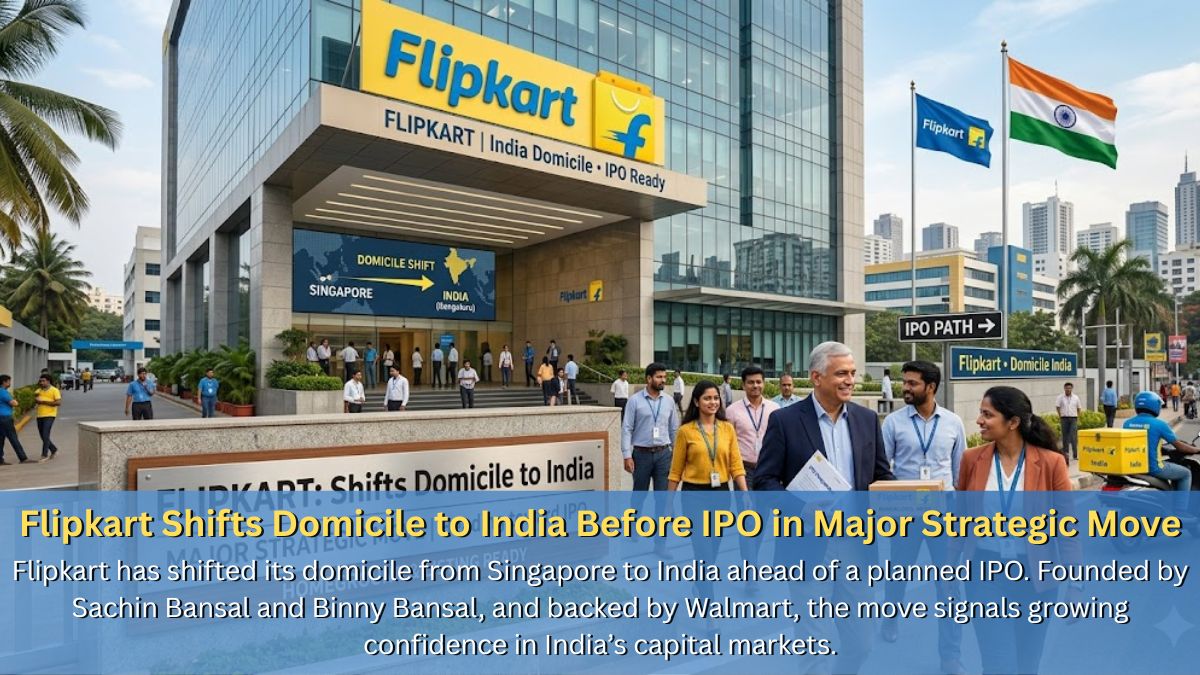
The Indian startup ecosystem received a major update as Flipkart shifts domicile from Singapore back to India ahead of its planned public listing. The move signals a strategic realignment by one of India’s largest unicorn startups as it prepares for a future IPO in the Indian market. The decision is widely seen as part of a broader trend where venture-backed startups that were previously incorporated overseas are returning to India to benefit from regulatory clarity, domestic capital markets, and improved investor confidence.
Founded in 2007 by Sachin Bansal and Binny Bansal, Flipkart started as an online bookstore and later expanded into one of India’s biggest e-commerce platforms. Today, the company competes with global giants like Amazon and domestic players in India’s fast-growing digital commerce market. Flipkart is currently owned by Walmart, which acquired a majority stake in 2018 in one of the largest acquisitions in the Indian startup ecosystem.
The reverse-flip or relocation of its holding structure to India comes at a time when the Indian government is encouraging startups to list domestically. Over the past few years, several unicorn companies and venture-backed startups have explored similar moves. Analysts believe that Flipkart’s decision will strengthen its positioning for a potential IPO and may inspire other global startups with Indian operations to follow the same route.
Moreover, the move also reflects the growing maturity of the Indian startup ecosystem, which now attracts strong venture capital, angel investment, and public market participation. As a result, Indian capital markets are increasingly becoming viable destinations for large unicorn startups looking to raise capital through IPOs.
In addition to the structural shift, Flipkart continues to invest heavily in technology, logistics, and artificial intelligence to strengthen its leadership in India’s fast-growing e-commerce sector. The relocation, therefore, represents not only a regulatory step but also a strategic move that aligns with Flipkart’s long-term growth strategy and India’s expanding digital economy.
1. Introduction: Flipkart Shifts Domicile Ahead of IPO
The headline news that Flipkart Shifts Domicile back to India marks a major milestone for the country’s startup ecosystem. The move reverses a long-standing corporate structure where the company’s holding entity was registered in Singapore. For years, many Indian startups chose overseas incorporation due to regulatory advantages and access to global venture capital. However, the landscape has changed. India now has stronger capital markets, improved startup regulations, and growing investor participation.
Therefore, the decision by Flipkart to relocate its legal domicile reflects confidence in the Indian market. It also signals readiness for a potential IPO update that could become one of the largest listings in India’s tech sector. Furthermore, the shift highlights how global startups are aligning their corporate structures with their primary markets.
2. Flipkart’s Journey: From Startup Idea to Unicorn Company
2.1 The Beginning of Flipkart
Flipkart began in 2007 in Bengaluru as a small online bookstore. The founders, Sachin Bansal and Binny Bansal, were former employees of Amazon. They noticed a clear gap in India’s online retail market. At that time, buying books online was difficult. Payment systems were unreliable, and logistics networks were weak. However, the founders believed India would soon embrace digital commerce. They launched Flipkart with a simple model: sell books online with reliable delivery. Gradually, the startup expanded into electronics, fashion, home goods, and groceries.
2.2 Growth of a Venture-Backed Startup
Within a few years, Flipkart became one of India’s fastest-growing startups. Venture capital firms quickly noticed its potential. Major funding rounds came from global investors including venture capital firms and institutional investors. These funding rounds helped Flipkart scale technology, logistics, and hiring. As the platform expanded, Flipkart became one of the first unicorn startups in India.
3. The Reverse Flip: Why Flipkart Shifts Domicile
The decision that Flipkart Shifts Domicile back to India is not just a corporate restructuring. It reflects a deeper shift in how global startups view India’s economic future. For nearly two decades, Flipkart operated with its holding company registered in Singapore. That structure was common among Indian startups seeking global venture capital and regulatory flexibility.
However, the move back to India signals confidence in the country’s evolving startup ecosystem. It also highlights how India’s capital markets have matured enough to support large technology IPOs. For Flipkart, the shift is both symbolic and strategic. The company that helped build India’s digital commerce revolution is now aligning its corporate identity with the country where its business truly lives and grows.
Behind the headlines, the decision required complex legal restructuring, regulatory approvals, and coordination with global investors. It is not a quick switch. Instead, it represents years of planning and negotiations.
More importantly, the move reflects a larger transformation happening across the Indian startup landscape. Increasingly, founders are realizing that India is no longer just a market. It is becoming the financial and regulatory home for global-scale startups.
3.1 What Reverse Flipping Means
When people hear that Flipkart Shifts Domicile, the term can sound technical. In reality, it refers to a fairly straightforward idea. A “reverse flip” happens when a startup that was originally incorporated outside India moves its holding company back into India. For Flipkart, this meant relocating the top-level legal entity from Singapore to India.
Years ago, many Indian founders set up companies abroad. Singapore and the United States were popular choices. Investors preferred these jurisdictions because they offered familiar legal systems, smoother cross-border investment rules, and fewer regulatory complications. Back in the late 2000s and early 2010s, India’s startup policies were still evolving. Venture capital funds often insisted on overseas incorporation before investing. As a result, several well-known Indian startups built their corporate structures outside the country even though most of their business operations were based in India.
Flipkart followed the same path. Its operational teams, warehouses, engineers, and customers were all in India. Yet the legal parent company remained overseas. Now the situation has changed dramatically. India’s startup ecosystem has matured. Regulations have improved. Public markets have opened their doors to technology companies. Domestic investors now play a larger role in funding startups. Therefore, reverse flipping is becoming more common. Startups that once moved abroad are slowly returning home. For Flipkart, the reverse flip is not simply paperwork. It reflects the company’s confidence that India’s regulatory system and financial markets can support its next chapter of growth.
3.2 Reasons Behind the Strategic Move
The decision that Flipkart Shifts Domicile did not happen overnight. Several important forces pushed the company toward this step. First, India’s capital markets have become much stronger over the past decade. Technology companies are now finding real opportunities to raise capital through domestic IPOs. Investors are more familiar with digital businesses, platform economics, and startup growth models. Second, the Indian government has been encouraging startups to list locally. Policymakers want successful technology companies to raise funds from Indian investors rather than overseas markets. This approach strengthens the domestic financial ecosystem and allows Indian citizens to benefit from the growth of local startups.
Third, corporate governance becomes simpler when the company is headquartered in the same country where most of its business happens. Managing cross-border structures often adds layers of complexity. Tax compliance, shareholder agreements, and regulatory approvals can become difficult when operations and legal entities are separated across countries. By shifting its domicile to India, Flipkart reduces that complexity. This can streamline compliance, improve transparency, and simplify the IPO process.
Another important factor is emotional and symbolic. Flipkart is one of India’s most iconic startup success stories. Millions of customers associate the brand with India’s digital commerce boom. Bringing the company’s legal base back to India strengthens that identity. It reinforces the idea that Flipkart is not just operating in India. It belongs here. Finally, the move opens the door for Indian retail investors to directly participate in the company’s future growth. When a startup lists in local markets, ordinary investors gain access to the same opportunity that early venture capital funds once had. That shift matters. It connects India’s startup success stories with the broader public.
4. Flipkart’s Business Model
Understanding Flipkart’s rise requires looking beyond headlines and funding rounds. At its core, the company built a business model that solved real problems faced by Indian consumers. When Flipkart started in 2007, online shopping in India was frustrating. Payments often failed. Delivery timelines were uncertain. Many customers did not trust digital transactions. The founders recognized these barriers early. Instead of simply copying global e-commerce models, they adapted their strategy for Indian realities. Over time, Flipkart built an ecosystem that combines technology, logistics, data science, and marketplace partnerships.
4.1 Marketplace Model
Flipkart operates primarily as a marketplace platform. This means the company connects buyers and sellers rather than owning most of the products itself. Thousands of merchants list products on Flipkart’s platform. These sellers range from large brands to small entrepreneurs. Customers across India can browse these products, compare prices, and place orders online.
This model gives Flipkart significant advantages. First, it allows the company to scale quickly. Instead of purchasing massive amounts of inventory, Flipkart enables sellers to manage their own stock. Second, the platform can offer a much wider product catalog. Because thousands of sellers participate, customers can choose from millions of items across electronics, fashion, appliances, books, and household products. Third, the marketplace model encourages competition among sellers. As a result, customers often receive better prices and more variety.
Over time, Flipkart has refined the platform using data analytics. Algorithms analyze customer behavior, purchasing patterns, and browsing history. This helps personalize recommendations and improve the overall shopping experience. The marketplace approach turned Flipkart from a small online bookstore into one of India’s largest digital commerce platforms.
4.2 Logistics and Supply Chain
While technology powered the platform, logistics became Flipkart’s real competitive edge. In the early days of Indian e-commerce, delivery networks were unreliable. Orders often arrived late or got lost in transit. Rural regions had almost no access to organized delivery services. Flipkart recognized this challenge early. Instead of relying entirely on third-party logistics providers, the company began building its own supply chain infrastructure. Warehouses, sorting centers, and delivery hubs gradually expanded across India. The company also invested heavily in last-mile delivery networks.
One of Flipkart’s biggest innovations was cash-on-delivery. Many Indian customers were hesitant to pay online. By allowing payment at the time of delivery, Flipkart removed a major psychological barrier. That single decision played a huge role in building trust among first-time online shoppers. Over the years, the company improved delivery speed, inventory management, and tracking systems. Today, advanced logistics technology allows Flipkart to handle millions of orders during major shopping events. Efficient supply chain management is now one of the company’s strongest operational advantages.
4.3 Technology and AI Investments
As the platform grew, technology became the backbone of Flipkart’s strategy. Artificial intelligence and machine learning now play a central role in how the company operates. These systems analyze vast amounts of data generated by millions of customers. AI helps Flipkart recommend products based on individual preferences. It predicts demand trends and helps sellers manage inventory more efficiently. Customer service has also improved through technology. Chatbots and automated support systems resolve many queries instantly, reducing wait times for customers.
Fraud detection systems use machine learning models to identify suspicious transactions. This improves security and protects both buyers and sellers. Furthermore, data analytics helps Flipkart understand regional shopping patterns across India. Demand for products can vary widely between cities, towns, and rural areas. Technology allows the company to adapt quickly to these variations. In many ways, Flipkart today operates as much like a technology company as it does a retailer.
5. Revenue Model of Flipkart
Behind the customer experience lies a sophisticated revenue structure. Flipkart earns income from multiple streams rather than relying on a single source. The largest portion of revenue comes from seller commissions. Every time a product is sold on the platform, Flipkart charges a percentage fee. This commission varies depending on product category and seller agreements. Another important revenue stream comes from advertising and product promotion. Sellers often pay for visibility on the platform. Sponsored listings, banner ads, and promotional campaigns help products appear higher in search results.
These marketing tools have become increasingly valuable as competition among sellers grows. Logistics services also generate revenue. Sellers who use Flipkart’s warehousing and delivery infrastructure pay service fees. Because the company has built a large logistics network, many merchants prefer using its integrated fulfillment services. In addition, Flipkart has expanded into financial services and fintech partnerships. Payment solutions, credit options, and buy-now-pay-later services create new opportunities for revenue.
All these streams combine to create a diversified business model. This diversification helps the company remain resilient even as market conditions change. It also supports long-term growth as the Indian e-commerce sector continues expanding. For Flipkart, the ability to generate revenue across technology, logistics, advertising, and financial services has been key to sustaining its leadership in a fiercely competitive market.
6. Walmart Acquisition and Strategic Expansion
6.1 The Landmark Deal That Changed Flipkart’s Future
In 2018, the global retail giant Walmart made one of the boldest moves in the history of the Indian startup ecosystem. The company acquired a majority stake in Flipkart in a deal valued at around $16 billion. At the time, the acquisition stunned the global business world. It was not just the size of the deal that grabbed attention. It was also the message behind it. A traditional retail powerhouse was betting heavily on the future of Indian digital commerce. For Walmart, the decision came after years of watching India’s retail transformation. Millions of young consumers were moving online. Smartphone usage was rising fast. Digital payments were becoming normal for everyday purchases.
Walmart understood that entering India through traditional brick-and-mortar retail would be difficult due to strict regulations. However, partnering with Flipkart offered a different path. By investing in Flipkart, Walmart instantly gained access to one of India’s largest e-commerce platforms, a massive logistics network, and a rapidly growing customer base. For Flipkart, the acquisition marked a turning point. The company suddenly had the backing of one of the most powerful retail corporations in the world.
6.2 Strategic Advantages After the Acquisition
The Walmart partnership brought far more than just capital. It brought global retail expertise, supply chain knowledge, and access to international sourcing networks. Flipkart was already strong in technology and marketplace innovation. However, scaling logistics across a country as large and complex as India requires enormous operational experience. Walmart had spent decades mastering global supply chains. That knowledge helped Flipkart strengthen warehousing systems, optimize procurement, and improve inventory management. Another major advantage was financial stability. Competing against Amazon requires deep pockets. Price wars, logistics investments, and customer acquisition costs can quickly drain startup resources.
With Walmart’s backing, Flipkart gained the ability to continue investing aggressively in growth without worrying about short-term financial pressure. The investment also enabled expansion into new sectors. Flipkart accelerated its push into online grocery, fashion retail, and digital payments. Each of these markets represents massive opportunities in India’s rapidly evolving consumer economy. In many ways, the Walmart deal transformed Flipkart from a successful startup into a global-scale retail technology company.
7. Industry Trends: Growth of Indian E-commerce
7.1 Rapid Expansion of Digital Commerce
Over the past decade, India has witnessed one of the fastest digital transformations in the world. The growth of e-commerce has been nothing short of remarkable. In the early days of Flipkart, online shopping was still a novelty. Many people were hesitant to trust digital transactions. Deliveries could take weeks. Internet speeds were slow. Today, the picture looks completely different.
India now has hundreds of millions of internet users. Affordable smartphones and cheaper data plans have brought millions of new consumers online. Even small towns and rural regions are now participating in the digital economy. Digital payment systems have also played a major role. Platforms like PhonePe and Paytm helped normalize online transactions. Customers became comfortable paying through mobile wallets and instant bank transfers. As a result, e-commerce companies suddenly had access to a much larger audience.
The shift is visible during large online sales events. Millions of orders are placed within hours. Products that once took weeks to deliver now reach customers in a day or two. This rapid adoption has turned India into one of the most promising e-commerce markets in the world. For companies like Flipkart, the opportunity is enormous. India’s retail market is valued in trillions of dollars, and only a small portion has moved online so far. That means the growth story is still unfolding.
7.2 Rise of Startup Platforms and Tech Investment
The growth of e-commerce did not happen in isolation. It developed alongside the rapid rise of the Indian startup ecosystem. Over the past decade, venture capital firms and angel investors have poured billions of dollars into Indian startups. These investments span multiple sectors including fintech, artificial intelligence, logistics, and clean energy. This wave of funding has fueled innovation at a remarkable pace.
Young founders are launching startups that solve everyday problems through technology. Some are building digital payment platforms. Others are developing logistics solutions, AI tools, or financial services products. The result is a vibrant ecosystem where startups constantly push each other to innovate faster. India is now home to dozens of unicorn companies and thousands of emerging startups. Technology hubs like Bengaluru, Hyderabad, and Gurgaon have become global centers of innovation. Flipkart played a major role in shaping this ecosystem. Many early employees and leaders from the company later went on to launch their own startups. This ripple effect helped create a new generation of entrepreneurs. In that sense, Flipkart’s story is deeply connected to the broader story of India’s startup revolution.
8. Competitors in the E-commerce Market
8.1 Direct Competitors
Competition in India’s e-commerce industry is intense. The most prominent rival for Flipkart remains Amazon. Both companies have spent years building logistics networks, expanding seller ecosystems, and improving customer experiences. Each platform tries to offer faster delivery, better pricing, and wider product selection. The rivalry often becomes visible during major shopping events. Discount wars, aggressive marketing campaigns, and exclusive product launches are common strategies used to attract customers. Amazon brings global technology expertise and deep financial resources. Flipkart, on the other hand, has strong local knowledge and a deep understanding of Indian consumer behavior.
This competition has pushed both companies to innovate faster. Customers benefit from better services, improved delivery speeds, and more competitive prices. However, sustaining this level of competition requires constant investment. Logistics infrastructure, warehouse automation, and AI-driven recommendation systems all demand significant capital. That is why strategic partnerships and long-term investors play such an important role in this industry.
8.2 Indirect Competitors
While Amazon is the most visible rival, Flipkart also faces competition from several indirect players. Traditional offline retailers still dominate large parts of India’s retail market. Millions of neighborhood stores continue to serve customers who prefer in-person shopping. At the same time, a new wave of startups is reshaping how people buy everyday items. Quick-commerce companies promise ultra-fast delivery within minutes. These startups focus on groceries and daily essentials. Their convenience is attracting urban consumers who value speed above all else.
In addition, emerging tech startups are experimenting with new retail models powered by artificial intelligence and data analytics. Personalized shopping, voice-based ordering, and predictive delivery systems are slowly becoming part of the industry. All these developments create a highly dynamic market environment. For Flipkart, staying ahead means continuously investing in technology, logistics, and customer trust.
9. Impact on the Indian Startup Ecosystem
When news broke that Flipkart Shifts Domicile back to India, the impact went far beyond one company. For many founders and investors, the decision felt symbolic. Flipkart is not just another startup. It is one of the earliest success stories of India’s digital economy. Its journey from a small online bookstore to a global e-commerce powerhouse inspired countless entrepreneurs across the country. Therefore, the decision to relocate its holding company to India sends a powerful signal. It shows that India’s regulatory and financial systems have evolved enough to support global-scale technology companies.
Many venture-backed startups previously incorporated overseas because investors demanded it. Singapore and the United States offered simpler legal frameworks and easier access to international capital. But today, the situation is changing. India’s capital markets have matured. Domestic investors are more comfortable funding technology companies. Regulatory reforms are making it easier for startups to operate locally.
If a company as large as Flipkart is willing to move its legal base back to India, other startups may follow the same path. This shift could reshape how Indian startups structure their businesses in the future. Instead of looking abroad for legal stability and funding access, founders may increasingly build and scale their companies entirely within India. That would strengthen the country’s position as one of the world’s most important technology and innovation hubs.
10. IPO Expectations and Market Impact
The possibility of a future public listing has added another layer of excitement to the story. If Flipkart proceeds with its IPO, it could become one of the largest technology listings in India’s history. Investors across the financial world are watching closely. For early venture capital investors, a public listing provides something extremely valuable: liquidity. After years of supporting the company’s growth, an IPO allows them to finally realize returns on their investments. But the importance goes beyond investor profits.
A successful listing would demonstrate that India’s stock markets are ready to host large-scale technology companies. It would also encourage other unicorn startups to consider domestic IPOs instead of listing overseas. For everyday investors, the IPO could open a rare opportunity to participate in the growth of one of India’s most influential digital companies.
Millions of customers have used Flipkart for years. An IPO would allow many of them to become shareholders in the business they helped build through their loyalty and purchases. That emotional connection matters. In many ways, the potential IPO represents the final chapter in Flipkart’s long journey from startup idea to industry giant. And if it succeeds, it will mark another milestone in the ongoing evolution of India’s startup ecosystem.
11. Learning for Startups and Entrepreneurs
The story behind Flipkart Shifts Domicile offers valuable lessons. First, founders must adapt their business strategies as markets evolve. Second, regulatory alignment is critical when preparing for large funding rounds or IPOs. Third, strong technology and logistics infrastructure can create sustainable competitive advantages. Finally, startups should focus on solving real customer problems while building scalable business models. These lessons remain relevant for entrepreneurs building the next generation of successful startups.
About foundlanes.com
foundlanes.com is India’s leading startup idea discovery platform. It helps entrepreneurs find actionable startup opportunities, market insights, and industry-specific guidance to turn ideas into real businesses. With deep research and practical resources, foundlanes supports founders at every stage, from idea validation to launch and growth.