


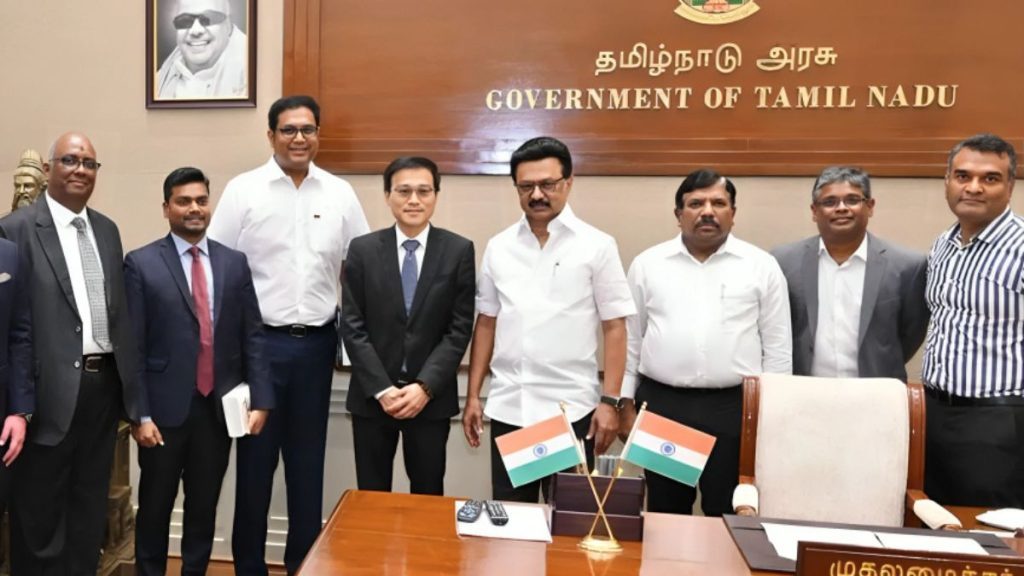
Tamil Nadu recently became the center of a major industrial discussion with the announcement of the Foxconn Investment in Tamil Nadu: Rs 15,000 Crore. On October 13, 2025, Industries Minister T.R.B. Rajaa revealed that Taiwanese electronics giant Foxconn would invest this massive amount into the state’s electronics and advanced manufacturing sectors. The government stated that the move could create 14,000 high-value engineering jobs while significantly boosting AI-driven operations and R&D.
However, Foxconn quickly responded, clarifying that during a meeting between its newly appointed India representative Robert Wu and Chief Minister M.K. Stalin, no new financial commitments were discussed. The company emphasized that while it remains committed to Tamil Nadu, the ₹15,000 crore figure reflects ongoing plans rather than a fresh pledge.
This contradiction created confusion. The Tamil Nadu government insists the number represents a tangible commitment, backed by a year-long engagement strategy. Minister Rajaa also announced a dedicated Foxconn Desk at Guidance Tamil Nadu to facilitate approvals and ensure smooth project execution. Political opponents, however, have questioned the credibility of the announcement, leaving investors and the public to discern the reality behind the headline.
1. Introduction
The debate surrounding the Foxconn Investment in Tamil Nadu: Rs 15,000 Crore highlights a recurring challenge in India’s industrial growth narrative: the gap between announcement, perception, and execution. Whether this represents a new commitment or an extension of earlier plans, the episode underscores the delicate balance between multinational corporations and state governments.
For Tamil Nadu, it’s more than just numbers; it’s about positioning the state as a hub for advanced manufacturing, AI-driven operations, and R&D innovation while managing public and political perception.
2. Background of the Disagreement
2.1 Government’s Announcement
On October 13, 2025, Industries Minister T.R.B. Rajaa publicly claimed that Foxconn would invest ₹15,000 crore, creating 14,000 high-value engineering jobs. The announcement was presented as a transformative step for Tamil Nadu’s industrial ambitions, particularly in AI-driven manufacturing. Rajaa emphasized that this figure reflected over a year of negotiations aimed at securing Foxconn’s next phase in the state.
2.2 Foxconn’s Denial
The next day, Foxconn issued a statement clarifying that no new financial commitments had been made. The meeting with Robert Wu was part of ongoing engagement, not a fresh investment. This direct denial contradicted the government’s announcement and raised questions about whether the ₹15,000 crore should be considered a “new” investment.
2.3 Government’s Response
Minister Rajaa maintained that discussions had occurred. Even if Foxconn sees the number as part of ongoing projects, the public acknowledgment marks a milestone for Tamil Nadu. The establishment of a Foxconn Desk at Guidance Tamil Nadu demonstrates the government’s determination to expedite approvals and facilitate smooth project implementation.
3. Analysis of the Investment Claim
3.1 Nature of the Investment
The dispute is largely semantic. Is the ₹15,000 crore a new investment or an extension of prior plans? In May 2025, Foxconn, through its Indian arm Yuzhan Technologies, announced a $1.5 billion (~₹13,000 crore) project to establish a smartphone display module facility near Chennai, which already had cabinet approval.
The current ₹15,000 crore figure appears to include that project while adding plans for advanced manufacturing, R&D integration, and AI-driven operations. From the government’s perspective, it is a public milestone; from Foxconn’s perspective, it is a continuation of ongoing strategic investments.
3.2 Implications for Employment
Regardless of semantics, the announcement is tied to 14,000 potential high-value engineering jobs. If realized, this could strengthen Tamil Nadu’s reputation as a South Asian hub for advanced manufacturing. The Foxconn Desk initiative aims to reduce bureaucratic friction and accelerate project approvals.
3.3 Political Dimensions
The controversy quickly took on political significance. Opposition parties used Foxconn’s denial to challenge the government’s credibility, while Minister Rajaa countered by asserting that critics were undermining job opportunities for Tamil Nadu’s youth. With assembly elections approaching in 2026, industrial announcements often intersect with political narratives.
4. Broader Implications for India’s FDI Landscape
4.1 Attracting Foreign Investment
Foxconn’s continued presence underscores India’s appeal for multinational corporations seeking opportunities in advanced manufacturing and technology. Even if the ₹15,000 crore commitment is debated, it signals Tamil Nadu’s strategic role in attracting FDI in electronics, AI-led innovation, and R&D.
4.2 Importance of Transparent Communication
The conflicting narratives highlight a key lesson: communication must be clear and consistent. Misaligned messaging can confuse investors, spark media controversies, and impact market confidence.
4.3 Impact on State-Level Investment Strategies
Other states can learn from this episode. Aligning public announcements with corporate commitments, documenting negotiations, and managing political optics are essential strategies to attract and retain multinational investments.
5. Learning for Startups and Entrepreneurs
- Clarity in Communication: Ensure all stakeholders fully understand commitments.
- Documentation: Maintain detailed records to prevent disputes.
- Transparency: Public statements should reflect reality to preserve credibility.
- Political Awareness: Understand local political dynamics, especially when government policy impacts operations.
- Persistence: Like the Tamil Nadu government’s year-long engagement with Foxconn, sustained effort often precedes transformative partnerships.
About Foundlanes
Foundlanes tracks Indian and global startup developments, offering insights into emerging industrial and technological trends. The Foxconn debate illustrates how corporate announcements and government narratives intersect, impacting startups, investors, and entrepreneurs. Through detailed coverage, the platform helps readers navigate regulatory challenges, investment opportunities, and strategic growth decisions.