


News Summary
India’s digital payments revolution created several powerful fintech platforms. Among them, PhonePe has emerged as one of the most influential players in the country’s financial technology sector. The company built its reputation through Unified Payments Interface transactions. However, it is now moving far beyond digital payments. The strategy centers on transforming the platform from Payments to Financial Products, turning PhonePe into a full financial services ecosystem.
Originally launched in 2015, PhonePe became one of the largest UPI apps in India within a few years. Millions of Indians began using the platform for everyday payments. Over time, the company leveraged this large user base to expand into financial services such as insurance, lending, wealth management, and merchant services. This transition reflects a broader industry trend where fintech platforms evolve into digital financial marketplaces.
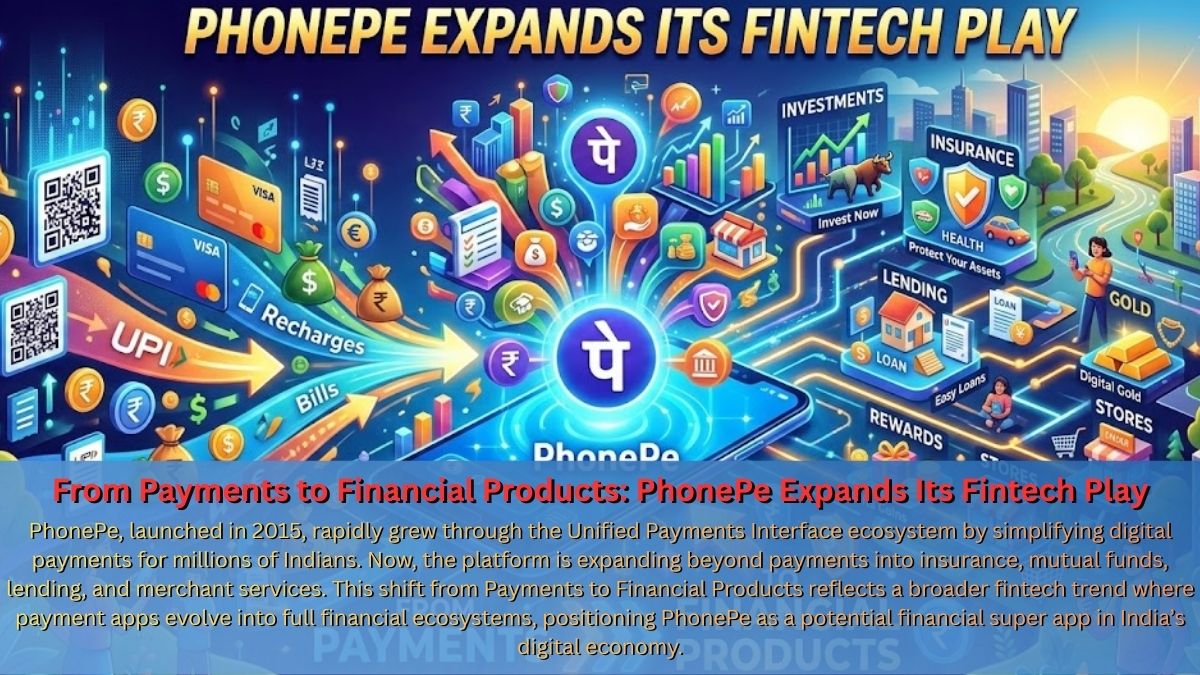
Today, PhonePe is building a wide fintech stack that includes mutual funds, insurance distribution, credit products, and merchant financial solutions. The company aims to serve both consumers and businesses. By doing so, it is positioning itself as a financial super app within India’s growing digital economy. The move from Payments to Financial Products also comes at a time when the company is preparing for future public market opportunities. Analysts believe the diversification strategy could strengthen its revenue streams and reduce dependence on payment-based income.
Furthermore, India’s fintech sector continues to attract global attention. Venture capital investors and global funds see enormous potential in platforms that combine payments, lending, and financial services in one ecosystem. Therefore, PhonePe’s strategy highlights how fintech platforms are evolving from simple payment apps into comprehensive financial platforms. The company’s expansion also signals a new phase in the competition among Indian fintech giants. As platforms fight for market leadership, the race is no longer about payments alone. Instead, the next battle will revolve around who controls the broader financial services ecosystem.
1. The Evolution From Payments to Financial Products
1.1 Why PhonePe Is Moving Beyond Payments
When PhonePe first entered the Indian fintech landscape, its mission was simple: make digital payments easy for millions of Indians. The app quickly became a daily utility. People used it to split restaurant bills, pay electricity charges, recharge mobile numbers, and send money to friends and family within seconds. But the reality of the payments business is that scale does not automatically translate into profit.
Payments are essential for building user trust and habit, yet they generate extremely thin margins. In India, where competition in UPI transactions is intense and transaction fees are minimal, payment apps often struggle to convert massive user activity into sustainable revenue. This is where strategy begins to evolve. PhonePe’s leadership understood early that payments were not the destination. They were the entry point. Think of payments as the front door to a much larger financial ecosystem. Once a user trusts an app to handle their money, that same platform becomes a natural place to offer other financial services. Over time, this trust turns into opportunity.
Today, PhonePe serves hundreds of millions of users across India. Every transaction tells the company something about user behavior: spending habits, bill payment cycles, recharge patterns, and financial needs. This data creates a powerful foundation for offering products that go far beyond sending money. Instead of remaining a simple payments tool, PhonePe is gradually transforming into a financial marketplace where users can access insurance, mutual funds, credit products, and other financial services in one place.
The shift is not just about increasing revenue. It is about deepening the relationship with users. When someone uses an app only for payments, they may open it a few times a week. But if the same app becomes the place where they invest, buy insurance, and manage financial goals, it becomes part of their daily financial life. This is the long-term vision behind PhonePe’s expansion. Payments build trust. Financial products build a business. And in a country like India, where millions of people are still discovering digital finance, the potential is enormous.
1.2 The Fintech Expansion Playbook
PhonePe’s transition is not happening in isolation. It reflects a pattern seen across the global fintech industry. Most successful fintech companies begin by solving one simple problem. Often, that problem is payments. Payments are easy to understand, widely needed, and capable of attracting a large user base quickly. Once users begin relying on the platform, companies start expanding their services. The reason is straightforward. Financial ecosystems become stronger when multiple services exist within a single platform.
A user who sends money through an app might eventually want to:
- invest small amounts of savings
- buy insurance for family protection
- access short-term credit
- track financial goals
Instead of forcing users to move across different apps, fintech platforms aim to keep these services under one digital roof.
This approach increases what the industry calls “revenue per user.” More importantly, it improves convenience. For users, it means fewer apps, simpler financial decisions, and faster access to services that once required paperwork and long bank visits. For fintech companies, it means building long-term customer relationships rather than one-time transactions. PhonePe’s strategy fits perfectly within this global blueprint. The company is leveraging the trust it built through payments to gradually introduce more complex financial products. This evolution is not a sudden shift. It is a carefully planned journey built on years of user engagement, technological infrastructure, and deep understanding of India’s digital economy.
2. The Journey of PhonePe
2.1 Founding and Early Vision
The story of PhonePe begins in 2015, when three entrepreneurs saw an opportunity in India’s rapidly changing digital landscape. The founders, Sameer Nigam, Rahul Chari, and Burzin Engineer, had already spent years building internet products and technology platforms. They understood how digital services could transform everyday experiences. But India’s payments ecosystem at the time was still fragmented. Sending money often required complicated bank processes, slow transfers, or cash-based exchanges. Digital payments existed, but they were not seamless or widely adopted.
Then came a powerful technological shift. India introduced the Unified Payments Interface, commonly known as UPI. This infrastructure allowed instant bank-to-bank transfers using simple identifiers like phone numbers or virtual payment addresses. For the first time, digital payments could be as easy as sending a text message. The PhonePe founders immediately recognized the potential. Their vision was not just to build another wallet. They wanted to create a platform where money could move instantly, securely, and effortlessly between people, merchants, and businesses. Launching early on the UPI infrastructure gave PhonePe a crucial advantage. The company was among the first apps to fully embrace the system, allowing users to experience instant transfers without complicated onboarding.
The timing could not have been better. Smartphone usage was rising rapidly across India. Affordable mobile data plans were bringing millions of new users online. Digital payments were about to enter mainstream adoption. PhonePe was ready for that moment. Within a short period, the app began gaining traction. Users appreciated the simplicity of scanning QR codes, paying bills instantly, and sending money without delays. Word spread quickly. What began as a small startup with a bold idea started turning into one of India’s most widely used financial apps.
2.2 The Flipkart Moment That Changed Everything
Early growth is important for any startup, but scaling in a country as vast as India requires more than a good product. It requires capital, distribution, and a strong ecosystem. That turning point came when Flipkart acquired PhonePe soon after its launch. The acquisition gave the young fintech company something invaluable: immediate access to millions of users within India’s largest e-commerce platform. Suddenly, PhonePe was not just a payments app. It became deeply integrated into the digital commerce experience.
Customers shopping on Flipkart could pay instantly through PhonePe, making transactions faster and smoother. This integration helped the app expand its reach far beyond early adopters. But the story did not stop there. In 2018, Walmart acquired Flipkart in one of the largest e-commerce deals in history. Through this acquisition, PhonePe became part of a global technology and retail ecosystem. For a young fintech company, this backing was transformative. It meant access to global resources, deeper investments in technology, and the ability to scale operations across India at an unprecedented pace.
With strong financial backing and a rapidly growing user base, PhonePe continued expanding its services. The platform introduced bill payments, merchant integrations, and digital financial services. Each new feature brought users closer to a fully integrated financial platform. What started as a simple payments tool was slowly evolving into something much bigger. And that transformation is still unfolding today.
3. The Fintech Platform Working Model
3.1 How PhonePe’s Ecosystem Actually Works
To understand the rise of PhonePe, it helps to look beyond the interface of the app and see the deeper system working behind it. For most users, the experience feels almost effortless. You download the app, connect your bank account, and suddenly sending money becomes as simple as scanning a QR code or entering a phone number. A transaction that once required standing in a bank queue now takes just a few seconds. But behind that simplicity lies a carefully designed financial ecosystem.
The backbone of PhonePe’s payments infrastructure is the Unified Payments Interface. This system allows direct bank-to-bank transfers without requiring a wallet balance. When a user sends money through PhonePe, the platform acts as the digital bridge connecting two bank accounts in real time. This technology changed how Indians interact with money. Earlier, digital payments often meant loading money into wallets, remembering passwords, and dealing with delayed settlements. UPI removed many of those frictions. PhonePe built its entire user experience around making this process feel natural and seamless.
But payments are only one part of the ecosystem. Over time, PhonePe quietly expanded the range of services available within the app. Today, when users open the platform, they are not just looking at a payments tool. They are entering a digital financial hub.
Within the same interface, people can:
- pay electricity and gas bills
- recharge mobile phones and DTH connections
- transfer money instantly to friends or family
- make payments at physical stores using QR codes
- purchase financial products such as insurance or investments
This “single app” experience is intentional. The founders wanted to build a platform where financial tasks that once required multiple apps or physical visits could happen in one place. It reduces friction in everyday life. Paying rent, splitting dinner bills, investing small savings, or buying insurance no longer feel like complicated financial decisions. They become routine digital actions. For millions of Indians, especially first-time users of digital finance, this simplicity matters deeply. It turns intimidating financial processes into familiar everyday habits. And that habit is the foundation of PhonePe’s ecosystem.
3.2 The Power of the Merchant Network
Another reason PhonePe’s ecosystem has grown so rapidly is its massive merchant network. Across India today, it is almost impossible to walk through a market without spotting a QR code stand that accepts PhonePe payments. From roadside tea stalls to large retail stores, merchants have embraced digital payments at an unprecedented pace. This network includes millions of small businesses. Local grocery shops, vegetable vendors, restaurants, salons, pharmacies, and service providers now accept payments through the platform. For many of these merchants, digital payments solved a real problem: managing cash.
Cash transactions are slow, difficult to track, and sometimes risky. Digital payments provide instant confirmation and automatic records of transactions. For small business owners, that recordkeeping becomes extremely valuable. It helps them track daily income, understand customer behavior, and even build a digital financial history. This merchant ecosystem is far more powerful than it may appear at first glance.
Every time a customer pays through PhonePe, the platform captures valuable information about transaction patterns. Over time, this data reveals insights into spending habits, business performance, and financial activity. These insights create new opportunities. For example, if a merchant regularly receives digital payments and maintains stable revenue patterns, fintech platforms can use that data to offer credit services. Small businesses that once struggled to obtain loans from traditional banks may now gain access to working capital through digital platforms. In other words, the merchant network does not just expand payments. It opens the door to financial inclusion. PhonePe’s ecosystem grows stronger as both consumers and merchants participate in the same digital network. Each transaction strengthens the platform’s role in India’s evolving financial infrastructure.
4. The Transition From Payments to Financial Products
4.1 Expanding the Financial Services Portfolio
As PhonePe’s user base grew into the hundreds of millions, the company reached an important strategic crossroads. Payments had helped it scale rapidly. But the next phase required something deeper. The company began expanding into financial services. Instead of remaining a tool for sending money, PhonePe started introducing products that help users manage their financial lives more effectively. These include insurance policies, investment options, and wealth-building tools. The transformation has been gradual but meaningful.
Through partnerships with leading insurance providers, the platform now allows users to purchase policies directly from their smartphones. Health insurance, life insurance, and accident coverage can be explored and bought within minutes. For many Indians, this accessibility removes a major barrier. Traditionally, buying insurance often involved agents, paperwork, and complex explanations. Digital distribution simplifies the process. Users can compare policies, understand coverage, and complete purchases without leaving their homes.
PhonePe has also entered the investment space. Through the platform, users can explore mutual funds and begin investing even with small amounts of money. For a generation that grew up with limited access to financial advice, these digital tools make investing less intimidating. Instead of needing a broker or financial advisor, users can start their investment journey directly through their mobile app. This evolution turns PhonePe into something much larger than a payments platform. It becomes a financial marketplace. In this marketplace, multiple financial service providers connect with millions of users through a single digital gateway.
4.2 The Opportunity in Lending
Among all financial services, lending represents one of the biggest opportunities for fintech platforms. Credit is essential for both individuals and businesses. People need loans for education, emergencies, and personal goals. Small businesses often require working capital to manage operations or expand. Yet millions of Indians still struggle to access formal credit.
Traditional banks rely heavily on credit history, documentation, and strict eligibility criteria. Many individuals and small merchants simply do not meet these requirements, even if their businesses are stable. This is where fintech companies see an opportunity. Platforms like PhonePe hold valuable transaction data generated through everyday digital payments. Over time, these transactions create a picture of financial behavior. How frequently someone receives payments. much they spend. How consistently they manage transactions.
This information can help lenders evaluate creditworthiness more accurately. Instead of relying only on traditional credit scores, fintech platforms can use digital activity as an alternative indicator of financial stability. PhonePe has been gradually exploring partnerships that allow it to facilitate such lending services. Rather than becoming a bank itself, the company works with financial institutions that provide the actual credit products. PhonePe acts as the digital marketplace connecting users with these lenders. For consumers, this could mean faster loan approvals and simpler application processes. For small businesses, it could mean easier access to capital that helps them grow.
5. Revenue Model and Monetization Strategy
5.1 The Reality of Payments Revenue
One of the most misunderstood aspects of the fintech industry is how little money payment platforms earn from transactions. In India, most Unified Payments Interface transfers are free for consumers. The system was designed to promote digital adoption rather than maximize transaction fees. As a result, payment apps process billions of transactions but earn very little directly from each one.
This creates a unique business challenge.Companies like PhonePe handle enormous transaction volumes, maintain secure infrastructure, and support millions of users, yet they cannot rely solely on payment fees for revenue. Instead, they generate income through related services. For example, when merchants accept digital payments through the platform, they may subscribe to additional business tools. These tools can include payment analytics, advertising visibility, or business management features. PhonePe also earns commissions from bill payment services and mobile recharges facilitated through the app. While these revenue streams contribute to the business, they are not large enough to fully sustain the scale of operations. This is why the expansion into financial products is so important.
5.2 Why Financial Products Unlock Real Revenue
The shift toward financial services dramatically changes the economics of a fintech platform. When users purchase insurance policies, invest in financial products, or access credit through the platform, PhonePe earns commissions or distribution fees from partner institutions. Insurance companies pay the platform for helping them reach new customers. Investment platforms share revenue when users begin investing through the app. Lending partners compensate fintech platforms for facilitating loan distribution. These partnerships create sustainable monetization opportunities.
Unlike payments, financial products often involve long-term relationships. An insurance policy may last for years. Investment accounts can grow over time. Lending services may involve repeat borrowing. Each of these interactions strengthens the platform’s revenue potential while deepening user engagement. In simple terms, payments build the highway. Financial products generate the traffic that turns that highway into a thriving economy. PhonePe’s strategy reflects this understanding. By gradually expanding its financial services portfolio, the company is positioning itself not just as a payments provider but as a central player in India’s rapidly evolving digital finance ecosystem.
6. Funding and Financial Backing
6.1 The Financial Power Behind PhonePe’s Growth
Building a fintech platform that serves hundreds of millions of users is not a small task. Behind every smooth transaction and every tap on the screen lies an enormous technological infrastructure. Servers must run continuously, security systems must protect sensitive financial data, and engineering teams must constantly improve the platform. Scaling such an ecosystem requires significant financial backing.
From its early days, PhonePe benefited from strong investor confidence. The most significant support came from its parent company, Walmart, which has invested billions of dollars into the fintech platform over the years. These investments have played a critical role in shaping PhonePe’s journey. Capital allows the company to do several things simultaneously. It enables the development of sophisticated payment technology, supports the expansion of merchant networks across India, and funds the hiring of engineers, data scientists, and product teams who build the platform’s evolving services.
More importantly, funding gives fintech companies the patience to focus on long-term growth rather than short-term profits. In the payments business, user acquisition and infrastructure investment often come long before revenue begins to scale. Investors who believe in the long-term potential of digital finance understand this reality. PhonePe’s continued financial support reflects a strong belief in India’s digital transformation.
Over the past decade, India has moved rapidly toward a cash-light economy. Smartphones, affordable internet access, and digital identity systems have accelerated this shift. Investors see fintech platforms as the infrastructure of this new financial era. For PhonePe, financial backing is not simply about survival. It is about preparing for the next phase of growth. The expansion into financial products, merchant services, and digital commerce requires resources, partnerships, and technological innovation. Strong funding ensures the company can pursue these opportunities without slowing its momentum.
6.2 Preparing the Ground for a Future IPO
As fintech companies mature, a natural question begins to emerge: what comes next? For many large technology platforms, the next milestone is entering the public markets. Industry observers widely believe that PhonePe could eventually pursue an Initial Public Offering (IPO) once its business reaches the right scale and stability. An IPO is not just a financial event. It represents a transition from a fast-growing startup to a publicly accountable company with long-term shareholder expectations. Before reaching that stage, companies often strengthen their business models.
Payments alone rarely provide the revenue diversity that public market investors prefer. That is why PhonePe’s shift from payments to a broader financial services ecosystem is strategically important. Diversification matters. When a company generates income from multiple sources, such as insurance distribution, investment services, lending partnerships, and merchant tools, it becomes more resilient. Revenue streams become less dependent on a single business line.
For investors evaluating a potential IPO, this diversity signals stability. Analysts often view PhonePe’s expansion into financial products as part of a long-term preparation for public listing. By building stronger monetization channels and deeper user engagement, the company is positioning itself for the expectations of global capital markets. Whether that IPO happens soon or several years from now remains uncertain. But the strategic groundwork is clearly being laid.
7. The Problems PhonePe Is Solving
7.1 Making Digital Payments Simple for Everyday Life
To truly understand the impact of PhonePe, it is important to remember what financial transactions in India looked like not too long ago. For decades, cash dominated daily commerce. People carried physical currency for nearly every activity. Paying a shopkeeper, transferring money to family members, or settling bills meant exchanging notes and coins. While this system worked for generations, it also created limitations.
Cash transactions leave no digital record. They require physical presence and sometimes create delays when people need to transfer money quickly across distances. Digital payments began changing that behavior. By building on the Unified Payments Interface, PhonePe helped make instant bank transfers accessible to ordinary users. What once required visiting a bank branch or using complicated online banking portals suddenly became effortless.
A user could open the app, scan a QR code, and complete a payment within seconds. For millions of Indians, this was the first truly seamless digital financial experience. Small everyday moments began to change. Paying for groceries, sending rent money, or splitting a dinner bill with friends no longer required counting cash. Transactions became instant and transparent.
Over time, this convenience began reshaping consumer behavior. People who were initially hesitant about digital finance slowly started trusting it. The ease of use played a huge role in this transformation. PhonePe’s design focused on simplicity, making financial interactions feel natural even for users who were new to smartphone apps. In many ways, the platform helped turn digital payments from a novelty into a daily habit.
7.2 Expanding Access to Financial Services
Beyond payments, PhonePe is also addressing a deeper challenge in India’s financial system: financial inclusion. Despite significant progress, millions of people across the country still lack access to essential financial services. Insurance coverage remains limited, investment participation is relatively low, and access to formal credit is uneven. Traditional financial institutions often require documentation, physical visits, and lengthy approval processes. For individuals in smaller towns or rural areas, these barriers can feel overwhelming. Digital platforms offer an alternative path.
By expanding from payments into insurance, investment products, and credit partnerships, PhonePe can bring financial tools directly to users through their smartphones. This accessibility has the potential to transform how people interact with money. Someone who starts by using the app to send small payments might eventually explore insurance coverage for their family. Another user may begin investing small savings through digital mutual funds. A small merchant might gain access to working capital that helps their business grow. Each of these interactions represents more than a transaction. It represents an expansion of financial opportunity.
8. Trends Shaping the Fintech Industry
8.1 The Explosion of Digital Payments in India
India’s fintech revolution did not happen overnight. It is the result of technological infrastructure, government initiatives, and a growing digital population. The launch of the Unified Payments Interface created a foundation that allowed fintech companies to build user-friendly payment platforms. The impact has been remarkable. Every month, billions of UPI transactions take place across the country. From urban supermarkets to rural marketplaces, digital payments are now an everyday reality. This explosive growth has created enormous opportunities for fintech startups. Platforms like PhonePe have grown alongside this wave of adoption. As users became comfortable with digital payments, they naturally began exploring other financial services offered within the same apps. What began as a payment revolution is now evolving into a broader financial transformation.
8.2 The Emergence of Financial Super Apps
Another powerful trend shaping the fintech landscape is the rise of the “super app.” A super app combines multiple services within a single digital platform. Instead of using separate applications for payments, investments, insurance, shopping, and services, users can access everything from one interface. This model has already proven successful in several global markets. In India, fintech platforms are increasingly moving in the same direction.
PhonePe’s expansion from payments into financial products reflects this shift. The company is gradually building a comprehensive ecosystem where users can manage multiple aspects of their financial lives without leaving the app. The goal is not just convenience. It is about creating a digital environment where financial services feel interconnected and accessible. Payments lead to savings. Savings lead to investments. Investments connect to long-term financial planning.
When all these services exist within a single platform, the user experience becomes smoother and more intuitive. For fintech companies, this ecosystem approach also strengthens customer loyalty. Once users rely on a platform for multiple financial needs, switching to another app becomes less attractive. This is the vision driving the next phase of fintech evolution. And PhonePe is positioning itself right at the center of that transformation.
9. Competitors in the Fintech Market
9.1 Direct Competitors in the UPI Ecosystem
The rise of PhonePe did not happen in isolation. India’s digital payments revolution has attracted multiple powerful players, each trying to capture a share of the rapidly expanding fintech market. Among the most visible competitors are Paytm and Google Pay. These platforms, much like PhonePe, became household names as millions of Indians began adopting digital payments.
All three operate on the backbone of the Unified Payments Interface, which enables instant bank-to-bank transfers. The simplicity of scanning QR codes or sending money using a phone number turned these apps into everyday tools for consumers. But competition in this space goes far beyond transaction volume. Each of these platforms is trying to evolve into something much bigger than a payment service.
Paytm, which started as a digital wallet, has gradually built an ecosystem that includes banking services, insurance products, wealth management tools, and merchant solutions. Google Pay, backed by the global strength of Google, continues expanding its financial features and partnerships within India’s fintech ecosystem. The battle is no longer just about who processes the most payments. It is about who can build the most trusted financial platform. User trust, product innovation, merchant partnerships, and financial service offerings now determine which platform remains relevant in the long term. In this environment, PhonePe’s strategy of expanding beyond payments into broader financial products reflects an industry-wide shift toward deeper financial engagement.
9.2 Competition Beyond Fintech Apps
While payment apps compete directly with each other, the broader financial services market introduces a much wider range of competitors. Traditional banks still hold enormous influence over India’s financial system. Institutions that have operated for decades maintain large customer bases, extensive regulatory frameworks, and deep experience in credit and financial management. However, the way customers interact with financial services is changing rapidly. Digital-first platforms are redefining expectations. Consumers increasingly expect financial services to be available instantly through their smartphones rather than through lengthy paperwork or physical branch visits.
This shift has created space for new players. Digital banks and neobanks are emerging as technology-driven alternatives to traditional banking institutions. These platforms focus on seamless digital experiences, simplified account management, and user-friendly financial tools. At the same time, specialized fintech startups are targeting specific financial segments. Some focus on personal investments, helping young professionals begin their wealth-building journeys. Others focus on lending, using digital data to provide faster loan approvals. In this increasingly crowded ecosystem, PhonePe’s greatest strength lies in its scale.
Because millions of people already use the app for daily payments, the platform begins its financial services expansion with an enormous user base. Instead of convincing people to download a new financial app, PhonePe can introduce additional services directly to users who already trust the platform. That trust becomes a powerful competitive advantage.
10. Industry Impact and Future Strategy
10.1 Building a Complete Financial Ecosystem
The transformation of PhonePe reflects a broader strategic ambition. The company is no longer positioning itself merely as a payment processor. Instead, it is gradually building what many industry experts call a “full financial stack.” In practical terms, this means creating a platform where multiple financial services exist together within a single digital ecosystem. Payments form the foundation. They attract users and create daily engagement with the platform. Once users are comfortable making transactions through the app, additional services can be introduced naturally.
These services may include:
- insurance protection for families
- investment options for long-term savings
- credit services for personal or business needs
- merchant tools that help small businesses manage finances
Each of these services strengthens the relationship between the user and the platform. From a business perspective, this approach significantly increases customer lifetime value. A user who only makes payments generates limited revenue. But a user who purchases insurance, invests through the platform, and accesses credit becomes a long-term customer. This transformation changes the economics of the platform. Instead of relying solely on high transaction volumes, PhonePe can build deeper financial relationships that generate sustainable revenue over time.
10.2 Positioning for India’s Fintech Future
India is currently one of the most dynamic fintech markets in the world. Several forces are driving this growth simultaneously. Smartphone penetration continues to rise. Mobile internet access has become significantly more affordable. Government-backed digital infrastructure has simplified identity verification and financial connectivity. Together, these changes are reshaping how millions of people interact with money. Consumers who once relied entirely on cash are now comfortable using digital platforms for everyday financial tasks. Younger generations, in particular, expect financial services to be fast, transparent, and mobile-first.
In this environment, companies that can offer integrated financial ecosystems are likely to dominate the market. The future may belong to platforms that combine multiple services seamlessly. Payments, investments, credit, insurance, and commerce may increasingly exist within the same digital environment. PhonePe’s expansion strategy reflects this reality. By gradually moving from payments toward a broader suite of financial products, the company is positioning itself for the next phase of India’s digital finance revolution. The competition will remain intense, but the opportunity remains enormous.
11. Lessons for Startups and Entrepreneurs
The story of PhonePe offers valuable insights for founders and entrepreneurs who are building businesses in today’s fast-changing digital economy. One of the most powerful lessons is the importance of starting with a clear and focused problem. PhonePe did not begin by trying to solve every financial challenge at once. The founders focused on one thing: making digital payments simple and reliable. That clarity helped the company build trust with users quickly.
Another lesson is the power of scale. Once the platform attracted millions of users, entirely new opportunities emerged. A large user base created the foundation for introducing additional services such as insurance, investments, and credit. Partnerships also played a crucial role in the company’s growth. Early support from Flipkart, followed by strong backing from Walmart, provided the resources needed to scale technology, marketing, and operations.
These partnerships did more than provide capital. They accelerated PhonePe’s ability to reach millions of consumers across India. Another key lesson is the importance of diversification. Businesses built around a single revenue stream often struggle to sustain long-term growth. By expanding from payments into broader financial services, PhonePe created multiple monetization channels that strengthen its business model. Finally, the company’s journey highlights a fundamental truth about entrepreneurship: innovation never stops. Markets evolve. Consumer expectations change. Technologies improve. The companies that survive are the ones willing to adapt continuously.
About foundlanes.com
foundlanes.com is India’s leading startup idea discovery platform. It helps entrepreneurs find actionable startup opportunities, market insights, and industry-specific guidance to turn ideas into real businesses. With deep research and practical resources, foundlanes supports founders at every stage, from idea validation to launch and growth.