


Summary
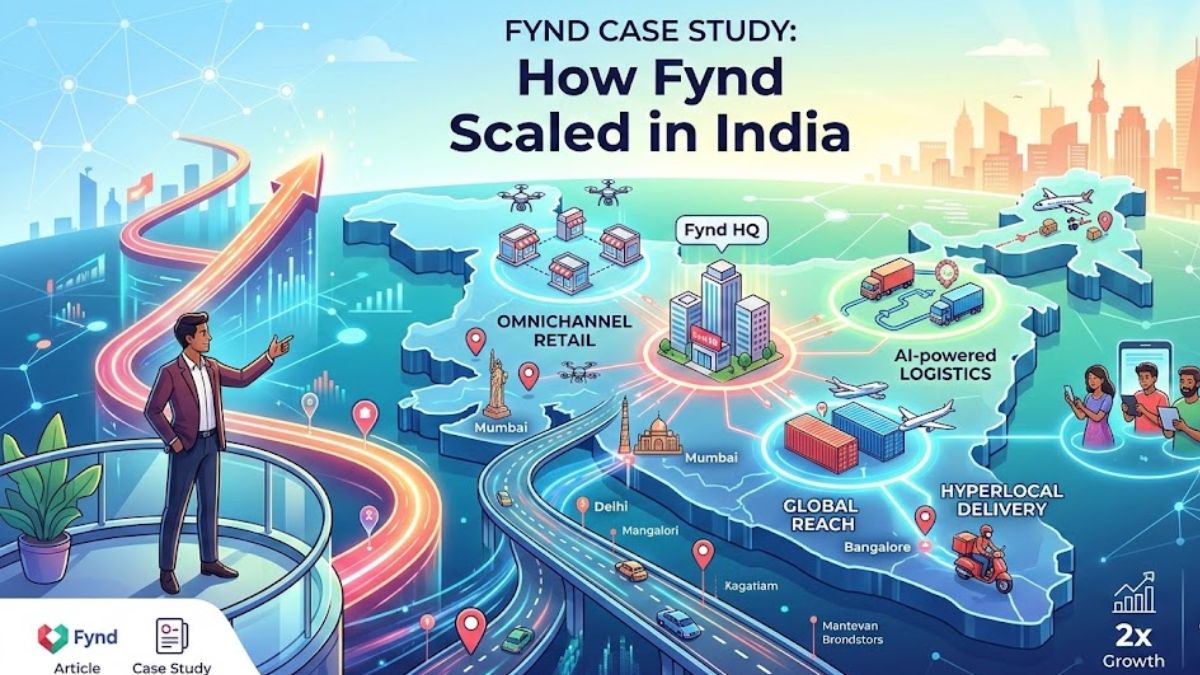
Fynd Case Study pieces usually start by introducing the company, its purpose, and why it matters within India’s retail technology landscape. Fynd is an Indian omnichannel retail platform that enables brands to unify inventory, streamline catalog management, automate marketplace listings, and run integrated online-offline commerce through a single backend. It is positioned as a core technology layer that connects stores, warehouses, online channels, and delivery workflows. The company was first launched as Shopsense in 2012 before evolving into Fynd in 2015.
Fynd was created to solve a problem that was common across India’s retail chains. Brands struggled with fragmented systems. Inventory sat in silos, sales channels were disconnected, and poor visibility led to lost sales. A store could have excess stock while another location faced stockouts. Websites often displayed inaccurate availability because legacy ERPs were not built for real-time syncing across channels. Fynd emerged as a platform focused on giving brands a unified view of their operations.
The company was founded by Farooq Adam, Harsh Shah
The company was founded by Farooq Adam, Harsh Shah, and Sreeraman MG, three entrepreneurs with a shared background from IIT Bombay and early careers observing the structural gaps in Indian retail. Fynd is headquartered in Mumbai. The founders wanted to bridge the widening distance between rising consumer expectations and the outdated systems used by retailers.
The Fynd platform works by integrating a brand’s entire inventory footprint into a unified engine that connects physical stores, warehouses, online marketplaces, and brand-owned e-commerce sites. Once integrated, Fynd manages catalog uploads, real-time inventory syncing, order routing, and fulfillment through the best available location. This approach reduces cancellations, improves delivery speed, and helps brands reduce operational inefficiencies.
In 2019, Reliance Retail acquired an 87.6 percent stake in Fynd, moving it from a high-growth startup into a strategic technology arm inside one of India’s largest retail groups. The company continues to operate independently while expanding across categories and building new digital products. This Fynd Case Study explores how the company was built, how it scaled, the challenges it overcame, and its larger impact on India’s unified commerce landscape.
1. The Origin of the Fynd Journey
Fynd’s story begins several years before the brand took on its current identity. When the founders met at IIT Bombay, they bonded over their shared interest in technology-driven problem solving and the emerging digital shifts in India. Retail caught their attention early. They noticed that despite rapid expansion in both e-commerce and physical retail, the backend infrastructure powering stores had barely changed.
After college, each founder spent time working in industries where they gained firsthand exposure to how Indian consumers behaved and how difficult it was for offline retailers to keep up. They saw a gap that few were addressing. Brick-and-mortar stores were still operating on legacy systems. Store managers relied on outdated stock ledgers, slow replenishment cycles, and disconnected POS setups. Even large-format chains struggled to connect store-level data with corporate systems. The founders recognized that modernization was inevitable. As consumers started discovering products online and walking into stores expecting faster service, retailers needed better tools. There was a clear mismatch between what customers wanted and what stores were capable of. This insight became the foundation on which their first venture, Shopsense, was built.
1.1 The Shopsense Phase
Launched in 2012, Shopsense was designed as a digital product discovery tool inside retail stores. It introduced interactive digital screens that helped customers browse beyond the store’s physical inventory. If an item was unavailable in that particular outlet, the screen displayed sizes, colors, and styles from the brand’s wider catalog. The concept was promising on paper. It offered customers more choice and gave brands a modern touchpoint inside stores. But the founders soon discovered a deeper issue. Even if a customer found the right product on the digital screen, the store often couldn’t fulfill the request instantly because inventory was scattered across other locations.
This led the founders to a critical realization. The problem wasn’t discovery. It was the lack of unified inventory. Customers didn’t care where the product was stored. They simply expected the brand to fulfill the order quickly. With Shopsense, the founders had solved a surface-level problem. The real challenge lay underneath the retail infrastructure.
1.2 Why Shopsense Evolved Into Fynd
By 2015, it became clear that the in-store discovery product was only a small part of a much larger opportunity. Retail inventory was fragmented across hundreds of stores, regional warehouses, distribution centers, and online listings. No system unified these channels in real time. Retailers lost thousands of sales because stores couldn’t access products outside their premises.
This insight prompted a strategic shift. The company rebranded to Fynd and positioned itself as a full-stack omnichannel platform. The founders built the technology required to map inventory across an entire brand’s footprint and expose it through a single backend.
The rebrand was more than cosmetic. It aligned the company with a broader mission: to help consumers “find” the right product anywhere in a brand’s network and help brands “find” operational clarity across channels. Fynd positioned itself at a time when the omnichannel retail strategy India conversation was emerging. Global retail was moving toward unified commerce, but Indian brands still lacked the tools. Fynd aimed to bring global-grade retail infrastructure to the Indian market.
3. The Problem Fynd Set Out to Solve
Indian retail in the early 2010s suffered from scattered systems, limited data visibility, and slow decision-making. Retailers operated with inventory split across locations, often with no digital link between them. Each channel offline stores, branded websites, and online marketplaces—functioned independently.
3.1 Fragmented Systems Across the Retail Value Chain
Most retailers used old ERP systems built for a time when offline stores were the only sales channel. These systems were not designed for real-time data exchange. As e-commerce grew, retailers struggled to create a single source of truth for inventory. One channel constantly contradicted another.
A brand’s website might show “in stock,” but the actual product could be stuck in a remote warehouse or reserved for another offline outlet. This led to order cancellations, unhappy customers, and lost sales. Retailers also struggled to balance inventory across regions. Some stores had surplus stock while others had shortages. The founders understood that unless a brand could unify all inventory pools into a central system, true omnichannel retailing would remain impossible.
3.2 Rise of Digital Storefront Integrations
Another challenge emerged as retailers began listing their products across multiple marketplaces. Managing these digital storefront integrations manually was overwhelming. Teams had to upload catalogs repeatedly, update stock values daily, track orders on different dashboards, and manage returns on separate panels.
Mistakes were common. Products were oversold. Incorrect listings led to penalties from marketplaces. Pricing discrepancies confused customers. Retailers needed automation. Fynd built integrations that automated catalog updates, inventory syncing, and order flows across channels. This helped brands avoid errors and maintain consistency.
3.3 Why Fashion Retail Became Fynd’s First Big Use Case
Fashion brands were hit hardest by inconsistent systems. They had thousands of SKUs, each available in multiple sizes and colors. Seasonal changes added new variants every few months. Inventory moved fast, and demand was unpredictable. Customers had little patience for stockouts. Fashion retail growth India trends also made the category appealing. It was expanding quickly with rising disposable incomes, and consumer expectations were shifting toward personalized and fast experiences.
Because fashion brands needed accuracy and speed, they became the perfect entry point for Fynd. Once the platform proved itself in fashion, it eventually expanded to footwear, accessories, cosmetics, electronics, and lifestyle products.
4. Early Product Development and Evolution
Fynd’s product did not emerge fully formed. It grew through continuous iteration and insights gained from working closely with retailers. Many features were born from real conversations with store managers, supply chain heads, and brand teams.
4.1 Building the Unified Inventory Engine
The first major engineering breakthrough came from building a system capable of ingesting stock data from hundreds of stores simultaneously. Stores updated inventory at different times, used different POS vendors, and had varied operational discipline. The platform had to account for these inconsistencies while still presenting a real-time view to brands and marketplaces. Unified inventory became Fynd’s signature value proposition. It allowed the platform to route orders automatically based on stock proximity and availability.
4.2 Marketplace Integrations and Automation
Fynd built API integrations with leading marketplaces in India. Brands could upload their catalog once and push it across channels automatically. Inventory levels updated instantly whenever a sale happened in any channel. This significantly reduced cancellations and errors. Before Fynd, many retailers faced penalties for inaccurate listings. After adopting the platform, operations became smoother.
4.3 Sell-From-Store and Distributed Fulfillment
A major unlock came when Fynd helped brands fulfill marketplace or website orders from physical stores rather than only from warehouses. This “store as fulfillment center” model became increasingly important as brands realized stores held valuable, fast-moving stock. Fulfilling orders from stores meant faster delivery and better inventory turnover.
4.4 Brand-Owned E-commerce Integration
Fynd also built website solutions for brands that wanted direct-to-consumer control. The same backend that powered marketplace listings also powered branded websites. This created consistency and reduced the need for separate teams. Retailers now had a unified system managing everything from catalog creation to order delivery.
5. Early Traction and First Customers
Fynd’s early traction phase was shaped by long cycles of experimentation, direct interactions with retail teams, and several rounds of rethinking the product. After evolving from Shopsense into Fynd, the founders approached small and mid-sized fashion brands that were open to trying new technology. These early adopters became the testing ground for Fynd’s unified commerce system. Working with these brands was not easy. Many did not have organized data structures. Store-level inventory accuracy varied widely. Brand managers often relied on manual reporting and had little experience with automated systems. Fynd’s team had to spend days inside stores mapping stock, calibrating POS systems, and guiding store staff on best practices.
This hands-on approach helped the company gather insights rapidly. For instance, Fynd discovered that many stores updated stock records only at the end of the day, which made “real-time” syncing difficult. The founders responded by building technology that could catch discrepancies and correct them automatically. These operational lessons shaped the product’s development. The founders realized that if Fynd was to become a scalable platform, it needed to work in real-world conditions rather than idealized environments. This approach helped the company refine its unified inventory engine and strengthen its marketplace integrations.
As early clients began seeing results reduced cancellations, increased sell-through, faster deliveries—Fynd started building a reputation within the Indian retail community. Word of mouth accelerated its growth. Many retail brands were intrigued by the idea of selling products from any store to customers across the country without expending additional warehouse resources. The initial traction set the stage for Fynd to approach larger enterprise brands, which required more complex integrations. While these enterprise deals took longer, they played a major role in establishing Fynd as a credible technology partner.
6. Business Model and Revenue Approach
As the platform matured, Fynd developed a multi-layered business model built around SaaS fees, integration services, and revenue share from transactions. The structure was designed to align with the needs of different types of brands small labels, mid-sized chains, and large enterprises.
6.1 SaaS Subscription Layers
At its core, Fynd operates as a SaaS platform. Brands pay recurring fees to access its omnichannel stack. These fees typically cover:
- The unified inventory engine
- Catalog management system
- Marketplace integrations
- Order and fulfillment routing tools
- Analytics dashboards
Subscription pricing varies by scale, number of stores, and category. This recurring model helps the company generate predictable revenue.
6.2 Integration and Onboarding Fees
Large brands often require custom connections between their ERP, POS, and warehouse systems. These integrations are not standard plug-and-play solutions. Fynd charges onboarding and implementation fees to cover the engineering effort needed to build reliable pipelines between complex systems. These integrations also help lock brands into the platform for the long term. Once a retailer’s operational infrastructure depends on Fynd, switching to another provider becomes difficult.
6.3 Marketplace Revenue Share
For brands selling on major marketplaces, Fynd sometimes charges a revenue share based on GMV generated through its integrations. This model aligns incentives because both parties benefit from higher online sales. It also encourages the platform to optimize performance, reduce errors, and help brands avoid penalties.
6.4 Website Commerce and Omnichannel Services
Fynd offers branded website creation and management solutions. Retailers using these services pay for website setup, customization, and ongoing maintenance. Integrated website commerce helps brands run direct-to-consumer operations without hiring internal technical teams.
6.5 Value-Added Omnichannel Features
As Fynd expanded, it introduced advanced features such as:
- Store-level fulfillment
- Endless aisle modules
- Multi-location order routing
- Reverse logistics flows
These value-added services create additional revenue streams and strengthen the Fynd business model by embedding the platform deeper into a retailer’s day-to-day operations.
7. Funding History and Strategic Shifts
Fynd raised multiple funding rounds before being acquired by Reliance Retail in 2019. While some funding details are public, the company has historically maintained a low profile compared to other startups.
7.1 The Pre-Acquisition Years
In its early years, Fynd raised capital from investors who believed in its retail technology vision. The platform’s focus on omnichannel commerce, especially in India’s growing fashion retail sector, made it an attractive value proposition. During this period, the founders focused heavily on building the product rather than aggressively marketing it. Much of the capital went toward engineering talent, infrastructure, and category expansion.
7.2 Reliance Retail Acquisition
The turning point came in 2019 when Reliance Retail acquired an 87.6 percent stake in Fynd. The acquisition was a strategic opportunity for both sides. For Reliance, it meant access to a robust omnichannel technology layer that could support its massive network of stores and retail brands. For Fynd, it provided financial stability, a large enterprise ecosystem to integrate with, and a platform to scale its technology faster. Post-acquisition, Fynd continued operating independently. The founders remained on board and led the company’s strategic direction.
7.3 Impact of the Acquisition
The acquisition accelerated Fynd’s expansion. Access to a vast retail ecosystem meant:
- Deeper category penetration
- Faster product experimentation
- Stronger enterprise pitches
- Enhanced credibility in the retail market
It also helped Fynd invest in new product lines while maintaining its focus on unified commerce.
8. Go-To-Market Strategy and Distribution Channels
Fynd’s journey from a fledgling startup to a leading omnichannel commerce platform is a study in relationship-building, adaptability, and operational insight. The company didn’t rely on flashy marketing or immediate scale; it started with boots-on-the-ground effort, meeting brands where they were and understanding their pain points.
8.1 Relationship-Driven Beginnings
In the Indian retail ecosystem, technology alone doesn’t win trust relationships do. Fynd’s founders recognized this early, investing time to listen, demonstrate, and guide brand teams through a completely new way of managing inventory. Sales efforts weren’t transactional; they were immersive. Teams would:
- Conduct in-store walkthroughs
- Shadow retail staff to understand daily operational challenges
- Demonstrate how unified inventory could reduce errors and save time
- Explain end-to-end omnichannel workflows
These interactions built trust that became the foundation for referrals, creating a network effect that helped Fynd grow organically. Brands weren’t buying software they were buying confidence that their operations could finally function smoothly.
8.2 Scaling Through Standardization
As Fynd matured, personal handholding gave way to repeatable, scalable processes. Onboarding was standardized, integrations documented, and workflows streamlined. This allowed Fynd to engage larger enterprise brands that demanded predictable deployment timelines. The human lessons learned during early visits were codified into training programs, ensuring every new account manager could replicate the same trust-building approach.
8.3 Marketplaces as Strategic Entry Points
Many brands first discovered Fynd while struggling with marketplaces manual uploads, inaccurate stock levels, and high return rates were daily frustrations. Fynd solved these operational headaches quickly, proving its tangible value. Once brands experienced smoother marketplace management, upselling omnichannel capabilities became natural, because the platform had already demonstrated reliability and operational impact.
8.4 Partner Ecosystems and Industry Networks
Over time, Fynd invested in thought leadership, appearing at retail conferences, SaaS forums, and omnichannel workshops. This wasn’t marketing for the sake of visibility; it was a deliberate move to educate the ecosystem, position itself as a solution for complex retail challenges, and attract enterprises looking for large-scale, scalable solutions.
9. Brand Positioning and Messaging Evolution
Fynd’s messaging evolved as the product matured, reflecting both the company’s growth and the education of the Indian retail market.
9.1 Early Phase: Enhancing In-Store Discovery
Initially branded as Shopsense, Fynd focused on improving in-store experiences through digital screens and interactive catalog access. The narrative highlighted engagement and the immediate benefits of a modern retail environment, helping skeptical retailers see tangible improvements in customer satisfaction.
9.2 Transition Phase: Operational Efficiency
With the evolution into Fynd, the company shifted messaging to inventory visibility, order accuracy, and unified stock management. Retailers were taught why fragmented systems were limiting growth and how Fynd could integrate multiple channels seamlessly. This phase established the company as a serious player in retail technology, moving beyond discovery tools into operational transformation.
9.3 Omnichannel Positioning Era
As omnichannel strategies became a priority for Indian retailers, Fynd refined its messaging to emphasize seamless online-offline integration. The unified dashboard became the central narrative: brands could now track inventory, manage orders, and analyze performance across all channels without friction. Fynd wasn’t just software it was an operational backbone.
9.4 Post-Acquisition Messaging
After Reliance acquired Fynd, messaging matured again. The focus shifted to enterprise readiness, scalability, and deep integration capabilities. Coverage in industry publications and retail forums underscored Fynd’s evolution from startup solution to trusted platform for large-scale retail operations.
10. Key Challenges, Failures, and Turning Points
Scaling a technology platform in India’s fast-evolving retail ecosystem is never straightforward. For Fynd, growth meant navigating a maze of operational, technical, and market hurdles, each testing the team’s resilience, creativity, and patience.
10.1 Convincing Traditional Retailers
In the early days, many established retailers were skeptical. ERP systems that had been running for decades were deeply ingrained, and any attempt to overhaul them was seen as risky. Fynd’s team had to go beyond demos, often spending days on-site to prove real operational improvements. Teams ran multiple pilot programs, sometimes across different cities, showing how unified inventory management reduced stock errors, sped up order fulfillment, and lowered staff stress. The work required persistence, empathy, and repeated proof-of-value but the results were transformational: retailers slowly began trusting technology to solve problems they had accepted for years.
10.2 Integration Complexities
Every retailer came with a unique system. Some had POS software older than the team members themselves; others relied on manual tracking or incompatible APIs. Fynd’s engineers were forced to craft custom integration layers for dozens of distinct systems, often inventing solutions on the fly. These challenges weren’t just technical they required understanding how humans interacted with legacy systems, anticipating where errors could occur, and building a platform flexible enough to absorb those inconsistencies. Each successful integration strengthened Fynd’s credibility and made the platform indispensable to clients who previously felt “stuck” with outdated systems.
10.3 Fluctuating Marketplace Policies
E-commerce marketplaces, central to many retailers’ operations, were unpredictable. API changes, listing rule revisions, and unexpected policy shifts could create chaos overnight. Fynd had to adapt instantly to protect both its reputation and the retailers’ revenue streams. These moments taught the team to think proactively rather than reactively, embedding monitoring and rapid-response processes into the product. The result was a platform that could weather external disruptions without impacting end users, a core differentiator in the competitive retail tech space.
10.4 Managing Rapid Scale
Growth brought its own pressures. Festival seasons, flash sales, and sudden onboarding surges tested the system’s limits. Fynd had to ensure high availability, low latency, and seamless functionality, knowing that downtime translated to lost revenue and broken trust. These were high-stakes situations teams often worked around the clock, troubleshooting in real time, balancing technical solutions with human stress, and learning the hard lesson that scalability isn’t just about code it’s about preparing the people, processes, and infrastructure for pressure.
10.5 Internal Pivots and Product Rethinking
Fynd’s evolution from a discovery tool to a full-stack omnichannel engine wasn’t linear. Many early features were scrapped, and workflows completely redesigned. These pivots often came with difficult conversations, internal disagreements, and moments of self-doubt. Yet, each failure was a learning opportunity, forcing the team to understand what customers truly needed and what could be realistically delivered at scale. Over time, these iterative improvements shaped Fynd into an enterprise-ready platform, resilient, reliable, and ready for the rapid growth Indian retail demanded.
11. Operational Decisions That Enabled Scale
As the platform moved from an experimental product to an enterprise offering, its operational choices became central to its story. The team had to build a foundation strong enough to serve thousands of stores while keeping the product flexible for constant iterations. In the early years, improving operations meant focusing on retail basics like inventory accuracy, order flows, and SLA management. Later, it expanded into orchestration workflows, compliance, partner integrations, and network resiliency.
The company adopted a development philosophy focused on rapid shipping without compromising reliability. Much of this came from treating retail operations like distributed systems engineering. A store was a node in a network, and the inventory inside each outlet became a dataset constantly mutating. By visualizing retail this way, the team could design systems that worked even when store-level connectivity was inconsistent.
Operational scale also required strengthening last-mile partnerships. Because the platform did not own delivery infrastructure, it had to integrate with a growing set of logistics providers. This meant creating a standardized framework for onboarding, tracking, and routing logic so that retailers could use whichever partner they preferred. Over time, the company added service-level intelligence that routed orders based on speed, cost, or reliability preferences.
As retailers onboarded more stores, the operations team expanded its internal command center. This unit monitored real-time service performance, merchant activity, and integration health. They created escalation pathways that could resolve issues before retailers saw disruptions. These internal structures allowed the platform to manage rapid growth without losing the efficiency and responsiveness expected from enterprise SaaS providers.
12. Technology Architecture and Retail Infrastructure Insights
In the Indian retail sector, legacy systems are deeply embedded. Many brands still depend on aging ERPs, on-premise POS machines, or custom software built decades ago. For a unified retail platform to succeed, it had to speak the language of these systems without forcing retailers to replace them. The company approached this by building a technology stack designed for interoperability. The architecture followed a modular pattern, where each layer could operate independently or be adopted selectively. Retailers could start with online order management and later add cataloging tools, inventory syncing, or app integrations. This modularity gave enterprise teams the confidence to experiment without committing their entire infrastructure on day one.
The biggest technical challenge was syncing inventory across online platforms and offline stores. It required building connectors that periodically pulled data from store POS systems and updated quantities in near real time. Over time, the company moved from timed syncs to event-driven architectures. As soon as inventory changed at a store, the change propagated to the online catalog. This shift reduced cancellations and helped retailers trust the platform even during high-traffic events.
Another turning point was embracing microservices. The team realized monolithic workflows limited iteration speed. Microservices allowed teams to ship features faster and improve components independently. The platform also invested early in API-first development. This meant retailers and third-party developers could create custom tools on top of the platform instead of waiting for the core team to implement new functionality. Through these choices, the company positioned itself not just as a solution provider but as part of a retailer’s infrastructure. Its technology became a backbone that supported merchandising, distribution, and consumer engagement. The platform’s architecture helped it scale nationally and become a default choice for retailers looking to modernize.
13. Regulatory and Industry Constraints
Operating in India’s retail technology landscape often involves navigating regulatory nuances that affect everything from data privacy to logistics. Over time, the company developed internal processes to comply with changing requirements, particularly in areas related to consumer data, payments, and GST documentation. One of the earliest hurdles was ensuring compatibility with invoicing systems. Many retailers had their own formats, process checklists, or validation workflows. To adapt, the company built customizable templates to align with each retailer’s compliance needs. Later, it worked with payment partners to maintain transparency in settlement cycles, a frequent pain point for enterprise clients.
In logistics, rules differ by state. The platform had to incorporate region-based requirements related to warehouse transfers, delivery timelines, and package labeling. These nuances became part of the operations rule engine, helping retailers ship faster without violating local mandates.
Data governance became increasingly important as more retailers used unified commerce tools. The company invested in access controls, encryption, and audit logs. It adopted processes that separated sensitive data from operational datasets to reduce exposure risks. By quietly absorbing these complexities into its workflows, the platform removed friction for retailers who lacked the internal bandwidth to manage compliance. This helped the company become a trusted partner that could operate within India’s evolving regulatory environment.
14. The Competitive Landscape
India’s retail-tech ecosystem has always been competitive. Over time, multiple players have tried solving the unified commerce problem, each approaching it with different value propositions. Some focused on POS innovation. Others built inventory technology. Some large ERP providers attempted omnichannel modules as add-ons to their core products. The company’s advantage lay in starting with a problem that deeply affected both consumers and retailers: fragmented inventory visibility across online and offline stores. Many competitors solved only one side of the issue. Some had strong online storefront tools but weak offline integrations. Others excelled in POS offerings but lacked the flexibility to orchestrate online orders.
The platform differentiated itself by building an end-to-end stack that was lightweight, API-driven, and easy to deploy across store networks. Retailers could adopt it without replacing existing systems. This became a decisive factor, because large brands typically cannot overhaul technology across dozens or hundreds of outlets overnight. Another differentiator was the platform’s ability to scale operational workflows. Its order routing engine became sophisticated enough to manage multi-store networks, complex optimizations, and hybrid fulfillment. Many competitors lagged because their systems were designed for single-outlet or small-chain use cases.
The landscape continues to evolve, but the company maintains a leadership position by expanding offerings beyond the basics of order orchestration. Today, its platform sits at the intersection of commerce, data, and infrastructure. This positioning helps it remain competitive even as global players and ERP providers enter the Indian market with their own unified commerce features.
15. Growth Metrics and Visible Milestones
Although the company does not publicly disclose revenue or detailed financials, enough public indicators point to its growth trajectory. Over the past several years, the platform expanded from fashion to lifestyle, electronics, beauty, and general merchandise. It also increased adoption among retailers operating in Tier 2 and Tier 3 cities, reflecting wider acceptance of unified commerce in India. One visible milestone was the scale of store integrations. The platform grew from working with a handful of outlets to serving extensive national networks. The number of SKUs managed on the platform increased significantly as more brands onboarded their full catalog. Order volumes also grew as retailers embraced omnichannel strategies during festival seasons.
Another milestone was industry recognition. Retailers frequently cite the platform’s ability to reduce cancellations, improve fulfillment accuracy, and accelerate store digitization efforts. These results helped the platform become an industry reference point for how unified commerce should function at scale. While the company maintains a low profile regarding internal metrics, its expanding client base and increasing workload across high-traffic events demonstrate consistent momentum. The platform’s trajectory reflects broader shifts in Indian retail, where data-driven infrastructure is becoming essential for competitiveness.
16. Building a Strong and Adaptable Team
The company has always invested in building a team that understands both technology and retail operations. Its hiring approach focused on finding people comfortable with ambiguity and rapid change. Many of its early employees were generalists who could move between roles and contribute across functions. As the platform matured, it complemented them with specialists in engineering, product design, merchant success, and data science.
The company fostered a culture where experimentation is encouraged. Teams are given autonomy to build, break, and rebuild features until they meet performance standards. Internal communication emphasizes clarity, speed, and shared ownership. This helped the company maintain agility even as its client base expanded.
Leadership played a key role in sustaining team alignment. The founding team emphasized continuous learning and hands-on involvement in problem solving. As the platform scaled, leaders focused on ensuring every team understood retailer pain points and their business implications. This alignment kept execution sharp, whether the team was building a new integration or handling a high-volume event. By combining domain expertise with entrepreneurial energy, the company built a workforce capable of supporting India’s complex retail ecosystem. The team’s adaptability remains one of the platform’s strongest assets.
17. The Company’s Position in India’s Retail Technology Landscape Today
Today, the company is recognized as a leading player in India’s unified commerce and retail digitization space. Its platform has grown from a simple marketplace extension to a comprehensive system used by some of the largest retail networks in the country. The brand’s identity has evolved too. It now stands for reliability, deep retail understanding, and technical sophistication. Retailers view the platform not just as a tool but as infrastructure. It powers core functions across merchandising, cataloging, order management, and omnichannel fulfillment. As consumer behavior evolves, retailers rely on the platform to keep pace with expectations across offline and online channels.
The company has also expanded its role in the broader ecosystem. It collaborates with logistics networks, platforms, and payment enablers. These partnerships help retailers create seamless customer experiences while maintaining operational efficiency. By remaining focused on solving real problems and building technology that adapts to retail realities, the company has secured a long-term place in India’s retail transformation. It continues to influence how brands think about digitization and what unified commerce can achieve when built thoughtfully.
Future Outlook and Long-Term Vision
The future of unified commerce in India is defined by integration, personalization, and data-driven decision-making. For retailers, the next decade will involve moving from fragmented systems to connected workflows that operate intelligently across stores, warehouses, and digital platforms. The company is positioned well for this shift. Its roadmap aligns with growing demand for infrastructure that can support rapid expansion, handle real-time events, and deliver consistent customer experiences. As more retailers adopt omnichannel strategies, the platform will likely deepen its capabilities in analytics, automation, and AI-driven insights.
Another area of opportunity lies in enabling small and medium retailers to adopt modern retail technology. Many smaller players lack access to enterprise systems. The platform could play a role in democratizing access to digitization by offering simplified versions of its tools. The Fynd Case Study reflects a journey that is far from over. The platform continues to evolve as India’s retail landscape undergoes dramatic change. Future innovation will likely focus on streamlining supply chains, optimizing fulfillment networks, and powering new consumer engagement models. As technology matures, the company will expand beyond unified commerce and potentially become one of the core infrastructure layers for Indian retail.
About foundlanes.com
foundlanes.com is India’s leading startup idea discovery platform. It helps entrepreneurs find actionable startup opportunities, market insights, and industry-specific guidance to turn ideas into real businesses. With deep research and practical resources, foundlanes supports founders at every stage, from idea validation to launch and growth.