


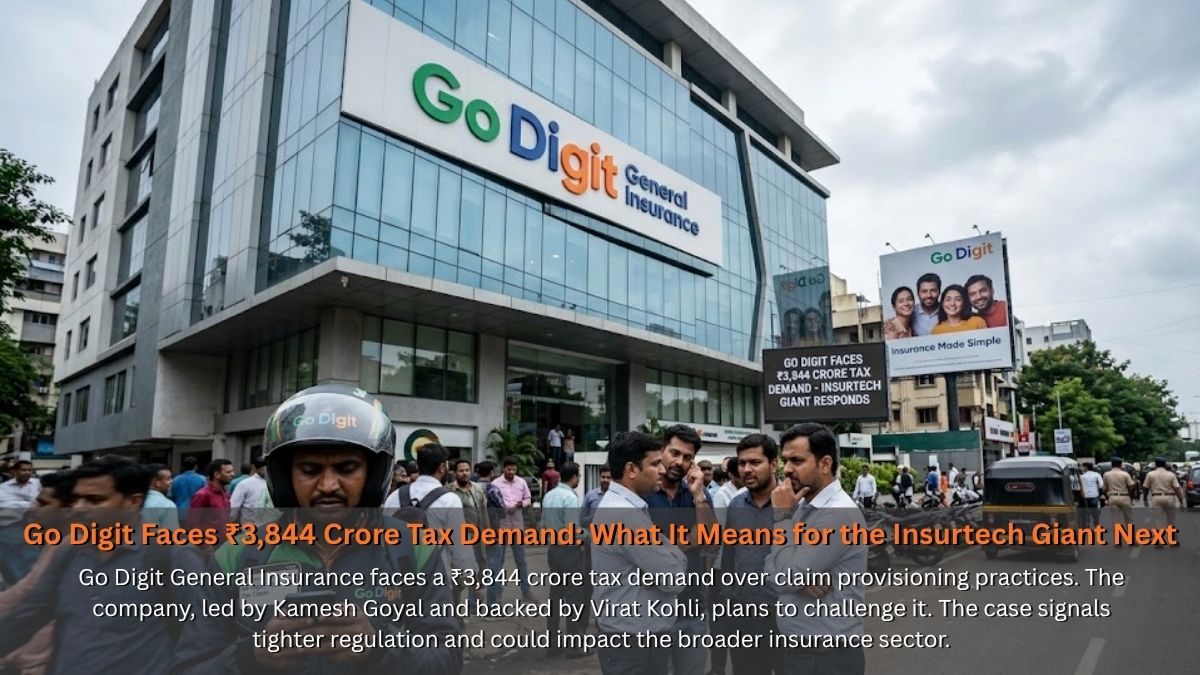
News Summary
India’s fast-growing insurtech player Go Digit General Insurance has received a massive Tax Demand of ₹3,844 crore from the Income Tax Department, triggering fresh debate across the startup ecosystem, fintech sector, and regulatory landscape. The demand primarily relates to the disallowance of certain claim provisions made by the company in previous financial years, an issue that industry insiders say may not be limited to a single firm but could affect multiple insurance players.
Founded by Kamesh Goyal and backed by high-profile investor Virat Kohli, Go Digit has emerged as one of India’s most prominent digital-first insurance startups. The company built its reputation by simplifying insurance products and leveraging technology to improve customer experience. However, this sudden tax notice introduces a major financial and strategic challenge at a time when the company is expanding aggressively.
According to reports, the tax authorities have raised concerns around how insurance companies account for claim provisions. This tax liability notice includes interest and penalties, making the total amount substantial. Importantly, Go Digit has stated that it will challenge the demand through legal channels, maintaining that its accounting practices comply with existing norms.
This development comes amid increased scrutiny of financial reporting standards in India’s insurance sector. It also reflects broader trends in regulatory tightening across fintech and insurtech startups. While the final outcome will depend on legal proceedings, the case could set a precedent for how tax authorities treat provisioning practices across the industry. The situation raises critical questions. How will this impact Go Digit’s financial health? Will other startups face similar tax assessments? And what does this mean for India’s rapidly evolving insurtech landscape?
1. The Tax Demand Explained
1.1 What Is the ₹3,844 Crore Tax Demand?
A ₹3,844 crore tax demand is not a routine notice. It is the kind of number that makes even seasoned professionals pause and reassess. In this case, the demand issued to Go Digit General Insurance includes not just the core tax amount, but also accumulated interest and potential penalties. At the heart of the dispute lies something that sounds technical but is actually central to how insurance companies operate: claim provisions. Every insurer sets aside money today for claims that will be settled tomorrow. It is a cautious, responsible practice, built on uncertainty. After all, insurance is a business of predicting risk, not controlling it.
The tax authorities, however, believe that Go Digit may have set aside more than what was justified or calculated these provisions in a way that does not align with tax rules. From their perspective, this could mean the company claimed higher deductions than it should have, ultimately reducing its taxable income. This is where interpretation becomes conflict. What one side sees as prudent financial planning, the other may see as aggressive accounting. And in industries like insurance, where future liabilities are always estimated, that line is rarely black and white.
1.2 Why This Tax Dispute Matters
It’s easy to look at this as a single company’s problem. But that would be missing the bigger picture. Insurance, by nature, operates on shared principles. If one company’s provisioning methods are questioned, it quietly puts the entire sector on notice. Many insurers use similar frameworks to estimate future claims. If those assumptions are now under scrutiny, it could trigger a wave of reassessments across the industry.
There’s also a deeper signal here. The regulatory environment in India is evolving, and enforcement is becoming sharper. Authorities are no longer just setting rules, they are actively testing how those rules are applied in real-world scenarios. For startups and fintech-driven companies, this adds another layer of pressure. Growth is no longer enough. Clean, defensible compliance is becoming just as important as innovation.
1.3 Company’s Response to the Tax Liability Notice
Go Digit’s response has been measured, but firm. The company has clearly stated that it does not agree with the tax department’s conclusions and plans to challenge the demand through legal channels. What stands out is the way the company frames the issue. It is not presenting this as an isolated mistake, but as a broader interpretation gap within the industry. In simpler terms, they are saying: “This isn’t just about us. This is about how the rules are understood.”
That stance reflects confidence, but also an understanding of how such disputes typically unfold. Tax battles of this scale are rarely resolved overnight. They move through layers of appeals, arguments, and technical clarifications. For customers and investors, the key reassurance from Go Digit has been stability. The company has indicated that its operations remain unaffected, which is crucial. In moments like these, perception matters just as much as reality.
2. Background of Go Digit: A Startup Success Story
2.1 Founding Journey
Go Digit was born in 2016, at a time when insurance in India still felt complicated, paperwork-heavy, and, frankly, frustrating for most people. Kamesh Goyal, after years of experience in the global insurance space, saw something others had accepted as normal and decided it didn’t have to be that way. The idea wasn’t revolutionary in theory: make insurance simple, transparent, and digital. But in execution, it required rethinking everything from customer onboarding to claims settlement. There’s something very human about that starting point. It didn’t come from chasing trends. It came from observing pain points and deciding they were worth solving.
2.2 Growth in the Indian Startup Ecosystem
The timing worked in Go Digit’s favor, but timing alone doesn’t build a company. India was going through a digital shift. Smartphones were everywhere, internet access was expanding rapidly, and people were becoming more comfortable transacting online. Go Digit positioned itself right at the intersection of this change. It spoke the language of a new generation of consumers who didn’t want to fill forms or wait days for approvals. The result was fast traction, especially in urban and semi-urban markets. Customers who had previously avoided insurance started engaging with it, not because they suddenly loved insurance, but because it finally felt accessible. That’s an important distinction. The company didn’t just sell policies. It reduced friction. And in a country like India, removing friction can be more powerful than adding features.
2.3 Funding and Investors
Strong ideas attract attention, but consistent execution attracts capital. Go Digit managed both. The company secured funding from well-known global investors, including Fairfax Group. This wasn’t just about money. It was about validation. When experienced investors back a company, they are effectively betting on its ability to scale, survive challenges, and create long-term value. This funding allowed Go Digit to invest heavily in technology, customer experience, and product development. It also placed the company among the more closely watched startups in India’s fintech and insurtech space. But with visibility comes scrutiny. And today’s tax dispute is, in many ways, a reflection of how far the company has come. Smaller companies rarely face such large-scale regulatory attention.
3. Business Model and Revenue Streams
3.1 How Go Digit Works
At its core, Go Digit is built to simplify something that most people find confusing. Buying insurance, filing claims, understanding coverage, these are processes that traditionally felt overwhelming. The company approached this with a digital-first mindset. Policies can be purchased online in minutes. Claims can be initiated with minimal documentation. The interface is designed to feel less like a financial product and more like a consumer app. But what really defines the experience is speed. Customers don’t just want solutions, they want them quickly. And Go Digit has tried to build its entire system around that expectation.
3.2 Revenue Model
Like any insurance company, the primary source of revenue is premiums paid by customers. But that’s only one part of the equation. Insurance is also about managing and investing large pools of capital. The funds collected are strategically invested, generating additional income. This creates a balance between underwriting performance and investment returns. On top of that, Go Digit has leaned into partnerships and digital distribution channels. By integrating with platforms where customers already spend time, it reduces acquisition costs and expands reach without relying solely on traditional agents.
3.3 Product Offerings
Go Digit’s product range reflects how consumer expectations are changing. Instead of rigid, one-size-fits-all policies, the company offers more flexible options. Motor insurance, health insurance, travel insurance, all are designed with customization in mind. Customers can tweak coverage based on their needs rather than fitting themselves into predefined plans.
One interesting shift is toward usage-based models. These are policies that adapt based on how often or how intensively a product is used. It’s a small but meaningful step toward making insurance feel fairer and more personalized. From a real-world perspective, this matters. People don’t just compare prices anymore. They compare relevance. And products that feel tailored tend to build stronger trust over time.
4. The Core Problem Go Digit Solves
4.1 Complexity in Insurance
If you’ve ever tried buying insurance the traditional way, you already know the feeling. Endless forms, confusing jargon, and a lingering doubt whether you actually understood what you just signed up for. For years, insurance in India has felt less like protection and more like a process to endure. Customers weren’t just buying policies, they were navigating uncertainty. Terms like exclusions, deductibles, and claim conditions were often buried in fine print. And when it mattered most, during a claim, many people discovered gaps they didn’t even know existed. This complexity created a quiet disconnect. People knew insurance was important, but they didn’t trust the experience. And when trust is missing in a financial product, adoption slows down, no matter how necessary the product is.
4.2 Digitization as a Solution
Go Digit stepped into this gap with a very clear intent: remove friction, not just add features. Instead of asking customers to adapt to insurance, it tried to make insurance adapt to customers. Policies could be purchased in minutes, not days. Interfaces were designed to be understood without needing an expert. Claims could be initiated with a few clicks, sometimes even through a smartphone video instead of physical inspection.
This shift may sound simple on paper, but in practice, it changes everything. When a customer can file a claim quickly and actually see it processed without constant follow-ups, it builds something rare in this industry, confidence. From real user experiences, the biggest difference isn’t just speed, it’s clarity. People feel more in control. They know what they are buying, and more importantly, what they can expect when something goes wrong.
4.3 Impact on the Market
What Go Digit did wasn’t just improve its own product, it quietly forced the industry to rethink itself. When one player makes insurance easier to understand and faster to access, it raises expectations across the board. Customers begin to question why others can’t offer the same experience. Traditional insurers, many of whom relied on legacy systems, suddenly had to accelerate their digital transformation. Online policy issuance, app-based claims, simplified documentation, these are no longer differentiators, they are becoming the baseline. In that sense, Go Digit didn’t just solve a customer problem. It pushed an entire sector forward.
5. Industry Context and Growth Trends
5.1 Rise of Insurtech in India
India’s insurtech space is no longer an emerging story, it’s an active transformation. Startups are using technology not just to sell insurance, but to rethink how risk is assessed, priced, and managed. Artificial intelligence is helping detect fraud and speed up claims. Data analytics is enabling more personalized policies. Automation is reducing operational delays that once defined the industry.
This shift is also attracting serious investment. Investors see insurance as a massive, underpenetrated market in India, and technology as the key to unlocking it. But beyond funding and technology, there’s a human layer to this growth. More people are becoming aware of financial protection. Health crises, rising medical costs, and economic uncertainty have made insurance feel less optional and more essential.
5.2 Regulatory Environment
With innovation comes attention, and with attention comes regulation. Indian regulators are actively trying to balance two things: encouraging innovation while ensuring consumer protection. It’s not an easy balance to strike. Move too slowly, and innovation suffers. Move too aggressively, and risks go unchecked. The tax demand faced by Go Digit fits into this broader picture. It reflects a system that is becoming more vigilant, more willing to question how companies interpret and apply financial rules. For companies, this means one thing. Growth can no longer rely only on speed and innovation. It has to be backed by strong compliance, clear accounting practices, and the ability to defend decisions when questioned.
5.3 Market Competition
Competition in the insurance space today is layered and intense. On one side, you have digital-first platforms like Policybazaar, which have built strong customer acquisition engines and brand recall. On the other, there are traditional insurers with decades of trust and deep distribution networks. For a company like Go Digit, this creates constant pressure. It has to innovate faster than traditional players while also building trust at a pace comparable to them. But competition isn’t entirely negative. It forces companies to stay sharp. It pushes them to improve products, pricing, and service quality. In the long run, it’s the customer who benefits the most.
6. Competitors and Market Position
6.1 Direct Competitors
Go Digit operates in a space where several digital-first insurers are trying to solve similar problems. These companies focus heavily on user experience, automation, and faster claims. The competition here is not just about pricing. It’s about who can make insurance feel the least intimidating. Who can turn a traditionally complex product into something simple enough for anyone to understand.
6.2 Indirect Competitors
Then there are the traditional insurers. These are companies that may not have started as digital-first, but they bring something equally powerful, credibility built over years. Many customers still prefer established names when it comes to financial decisions. Trust, once built over decades, is not easily replaced by technology alone. However, these players are adapting. They are investing in digital platforms, improving customer interfaces, and trying to match the speed of newer entrants.
6.3 Competitive Advantage
What sets Go Digit apart is not just technology, it’s how that technology is used. The company’s real strength lies in simplicity. It has consistently focused on making processes easier rather than adding unnecessary complexity. The user journey, from buying a policy to filing a claim, feels more intuitive compared to traditional systems.
In real terms, this translates into fewer customer complaints, faster resolutions, and a stronger emotional connection with users. People remember how easy or difficult an experience felt, especially when it involves money and risk. That emotional layer is often underestimated, but it can become a lasting competitive advantage.
7. Financial and Strategic Impact of the Tax Demand
7.1 Immediate Financial Implications
A ₹3,844 crore tax demand is not something any company can ignore. Even for a well-funded startup, it represents a significant financial exposure. While the final outcome will depend on legal proceedings, the immediate impact is psychological as much as financial. It forces the company to reassess liquidity, allocate resources carefully, and prepare for multiple scenarios. In practical terms, it may also influence how aggressively the company invests in new initiatives in the short term.
7.2 Impact on Growth Plans
Growth in startups is often fueled by confidence, both internal and external. A large tax dispute can slow that momentum. Expansion plans may need to be recalibrated. New product launches could be timed more cautiously. Even hiring decisions might be influenced by the need to maintain financial discipline. This doesn’t mean growth stops. It just becomes more measured. Companies in such situations often shift focus from rapid expansion to sustainable scaling.
7.3 Investor Sentiment
Investors don’t panic easily, but they do pay attention. A case of this scale naturally raises questions. How will it impact future profitability? Will it affect valuations? Is there a broader regulatory risk? In the short term, this can lead to caution. Investors may take a wait-and-watch approach until there is more clarity. However, long-term confidence depends on how the company handles the situation. If Go Digit manages to navigate the dispute transparently and effectively, it could actually strengthen investor trust. Because in the end, investors are not just betting on growth. They are betting on resilience.
8. Broader Implications for Indian Startups
8.1 Regulatory Tightening
There was a time when startups in India operated with a certain level of flexibility. The focus was on growth, innovation, and capturing market share. Compliance, while important, often took a back seat in the early stages. That phase is clearly evolving. Cases like the one involving Go Digit General Insurance send a strong message that regulators are no longer passive observers. They are watching closely, questioning assumptions, and, when needed, stepping in with force.
For startups, this shift feels uncomfortable at first. It slows things down. It adds layers of scrutiny. But in reality, it’s also a sign of maturity in the ecosystem. Markets that grow eventually get regulated more tightly. It’s a natural progression. The real takeaway is simple but not easy to execute: compliance cannot be an afterthought anymore. It has to be built into the system from day one, not patched later when things get complicated.
8.2 Impact on Fintech Sector
The fintech and insurtech space thrives on innovation, but it also operates in one of the most sensitive areas, money. That alone makes it vulnerable to regulatory attention. When a large player faces a tax dispute of this scale, it creates a ripple effect. Other companies start asking hard questions internally. Are our accounting practices defensible? Are we interpreting regulations too loosely? What happens if we are audited tomorrow?
This often leads to increased compliance costs. More audits, more legal consultations, more structured financial reporting. On paper, it looks like an added burden. In practice, it’s an investment in survival. From real-world experience across startups, these moments often separate companies that were built for the long run from those that were optimized only for speed. The ones that adapt quickly tend to come out stronger, even if the process feels exhausting in the short term.
8.3 Lessons for Venture-Backed Startups
Venture-backed startups live in a high-pressure environment. There’s always a push to grow faster, expand wider, and outpace competition. But situations like this force a pause, and sometimes that pause is necessary. One of the biggest lessons here is around financial transparency. It’s not just about keeping clean books. It’s about being able to explain every assumption, every provision, and every decision with clarity and confidence.
Investors today are not just looking at revenue graphs. They are looking deeper, at governance, risk management, and regulatory alignment. A startup that can demonstrate discipline in these areas stands out far more than one that is only chasing aggressive growth numbers. There’s also a human side to this. Founders often carry the weight of these decisions personally. When things go right, the credit is shared. When challenges like this arise, the responsibility feels very individual. That’s why building strong financial and legal teams early on is not a luxury, it’s a necessity.
9. Industry-Wide Debate on Taxation
9.1 Accounting Practices in Insurance
At the center of this entire issue is a concept that most customers never see but every insurer depends on, claim provisioning. Insurance companies are constantly estimating the future. They set aside money today for claims that haven’t happened yet but are expected to happen. It’s a delicate balance between caution and accuracy.
The challenge is that these are estimates, not exact numbers. And when estimates are involved, interpretation follows. What one company considers prudent provisioning, another authority might see as excessive. This is not unique to one company. It’s an industry-wide practice, and that’s exactly why this case has triggered such intense discussion. Because if one interpretation is challenged, it raises questions about everyone else following similar methods.
9.2 Need for Clarity
One thing most experts seem to agree on is the need for clearer guidelines. Ambiguity creates friction. It leads to disputes that take years to resolve, draining both financial and emotional energy from companies. For startups, especially, this uncertainty can be particularly stressful. Clearer rules don’t just help regulators. They help businesses plan better. They reduce the risk of sudden shocks and allow companies to focus more on building products rather than defending past decisions. In conversations across the industry, there’s a growing sense that alignment between regulators and companies is not just desirable, it’s necessary for sustainable growth.
9.3 Possible Outcomes
The outcome of this case will go beyond one balance sheet. It has the potential to set a precedent. If the tax authorities’ position is upheld, it could lead to stricter interpretations across the sector. Companies may need to revisit their accounting practices and adjust their financial strategies accordingly. If the company’s stance is validated, it could reinforce existing industry practices and provide some relief to others operating under similar frameworks. Either way, the ripple effects will be real. Policies may change. Internal controls may tighten. And future tax assessments could become more structured and predictable.
10. Future Outlook: What Lies Ahead After the Tax Demand
10.1 Legal Battle Ahead
Disputes of this magnitude rarely resolve quickly. The road ahead for Go Digit General Insurance will likely involve multiple layers of legal proceedings, appeals, and technical arguments. These cases are not just about numbers. They are about interpretation, precedent, and sometimes even philosophy, how rules should be applied in a rapidly changing industry. For the company, this means preparing for a long journey. One that requires patience, strong legal strategy, and consistent communication with stakeholders.
10.2 Strategic Adjustments
Challenges like this often force companies to look inward. Not just at what went wrong, but at what can be strengthened. Go Digit may choose to revisit certain financial strategies, tighten internal controls, or adopt more conservative approaches in areas where interpretation risks exist. Cost optimization could also become a focus, not as a reaction, but as a precaution. These adjustments are not necessarily signs of weakness. In many cases, they are signs of maturity. Companies that survive tough phases often emerge more disciplined and resilient.
10.3 Long-Term Industry Impact
Zooming out, the bigger story is about how this shapes the insurtech sector in India. If there’s one likely outcome, it’s stronger compliance frameworks. Companies will invest more in governance, risk management, and regulatory alignment. In the long run, this could actually benefit the ecosystem. It builds trust, not just with regulators, but with customers and investors as well. And trust, especially in financial services, is everything.
11. Learning for Startups and Entrepreneurs
There’s something deeply instructive about situations like this. Not in a theoretical sense, but in a very real, grounded way. First, compliance is not optional. It’s easy to deprioritize it when you’re building fast and chasing growth. But eventually, it catches up. And when it does, the cost of fixing things later is always higher than doing them right from the beginning. Second, financial transparency builds trust. Not just with regulators, but with investors, partners, and even customers. When your numbers are clear and your assumptions are defensible, it creates confidence that goes beyond spreadsheets.
Third, adaptability matters more than perfection. No startup gets everything right. What matters is how quickly and effectively you respond when challenges arise. The ability to adjust, learn, and move forward is what defines long-term success. And finally, think beyond the immediate win. Short-term growth can look impressive, but sustainable businesses are built on strong foundations. Governance, discipline, and clarity may not feel exciting in the early days, but they are what hold everything together when things get tested. Because at the end of the day, building a company is not just about scaling fast. It’s about staying strong when the ground beneath you starts to shift.
About foundlanes.com
foundlanes.com is India’s leading startup idea discovery platform. It helps entrepreneurs find actionable startup opportunities, market insights, and industry-specific guidance to turn ideas into real businesses. With deep research and practical resources, foundlanes supports founders at every stage, from idea validation to launch and growth.