


Introduction
Building a gaming app sounds technical when you first hear it. But in reality, Build a Gaming App is closer to trying to create something people can feel, even when they don’t know why they keep coming back to it. Think about how games show up in everyday life now. Someone is bored for a few minutes, they open a game. Someone is stressed, they open a game. Waiting for a train, avoiding a long day, or just trying to switch their brain off for a bit. It’s become this quiet habit that fits into the small gaps of life without asking for permission.
That’s why people are now seriously looking at how to build a gaming app, not as a side project, but as a real business idea. Because games don’t just “get used” like apps. They get lived in, even if only for a few minutes at a time. At the center of it, a game is not really about code or screens. It’s about emotion, even if it sounds a bit dramatic to say that. It’s the feeling of almost winning. The frustration of losing by a tiny margin. The satisfaction of improving without anyone telling you that you are improving. These small reactions are what make people stay longer than they planned. And honestly, that’s where the magic and the challenge both sit.
Some teams try to build something huge right away
Some teams try to build something huge right away, like complex multiplayer worlds or advanced systems. Others start small, just one simple idea that feels good to play. A lot of the time, the simplest games travel the farthest because they don’t get in the way of the player. They just work. What’s interesting right now is how open this space has become. You don’t need a massive studio or a big office to start. A few people with an idea, some basic tools, and a lot of testing can actually put something out there that real users play. And if it clicks, it spreads faster than most traditional apps ever could.
But building a gaming app is not a straight road. It’s messy in a very real way. You build something, people play it differently than you expected, you change it, they react again, and the game slowly starts to take its own shape. Sometimes it becomes what you imagined. Sometimes it becomes something completely different.
And then there’s the harder part nobody talks about much. Keeping people interested. Because getting downloads is one thing. Making someone return again without forcing them is something else entirely. That’s where small details matter more than big ideas. In the end, when people ask how to build a gaming app, they are really asking something deeper without realizing it. They’re asking how to create something that doesn’t just function, but connects. Something that fits into people’s routines without feeling like work. And that’s really what makes this space so exciting right now.
1. Startup Idea Overview: What building a gaming app really means
When people first think about how to build a gaming app, they usually imagine screens, code, characters, maybe some flashy graphics. But if you’ve actually been close to this space, you quickly realize it’s not really about any of that in the beginning. It’s about attention. Simple as that.
A gaming app is basically something you build to hold someone’s attention for a few minutes… and then hopefully bring them back again tomorrow, and the day after that. And if you can do that at scale, it stops being just an app. It becomes a business that runs on human habits. That’s why gaming startups don’t all look the same. Some are light and casual, almost like digital time-pass. Some are competitive, where people take wins and losses seriously. Slow and strategic, where users build progress over weeks. And then there are apps that mix gaming with money, social interaction, or even learning without people really noticing it.
The interesting thing is, the “game” part is just the surface. Underneath it, you’re actually building behavior loops. You’re trying to create that small moment where someone thinks, “okay, one more round,” even when they were about to close the app. And here’s something most first-time founders don’t realize. The hardest part is not building the game. It’s making people care enough to stay inside it for more than a few minutes. So before anything else, before design or development, you’re really trying to answer one question: why would someone choose this over everything else on their phone?
2. Problem Statement: Why most gaming apps quietly disappear
The gaming space looks exciting from the outside. Big numbers, viral success stories, massive revenues. But what you don’t see is the graveyard of apps that never made it past the first few days of user attention. Most games fail very quietly. Someone downloads it out of curiosity. They play for a bit. Maybe they enjoy it for a minute or two. And then… they don’t open it again.
Not because it’s terrible. Sometimes it’s just not interesting enough to pull them back. Sometimes it feels confusing in the first 30 seconds. And sometimes it just doesn’t give any real reason to continue. Another issue is how crowded everything has become. There are so many games doing almost the same thing that even good ideas struggle to stand out. You can build something decent and still get buried under thousands of similar apps. A lot of early builders also fall into the same trap. They spend too much time polishing visuals or adding features, thinking that will make the game successful. But users rarely stay because something looks good. They stay because something feels good to play.
And “feels good” is a very specific thing. It’s that smooth first interaction. That small reward after a quick effort. That sense of progress without effort feeling heavy. The games that survive usually don’t try to impress people immediately. They just make it easy to start and quietly build interest over time. In a way, success here is less about adding more and more features, and more about removing everything that makes people hesitate.
3. Target Audience: Who you’re actually building this for
If you strip everything else away, building a gaming app is really about understanding people who are just looking for small breaks in their day. Most users are young, usually between 16 and 35. But calling them “gamers” doesn’t fully describe them. Many of them don’t identify as gamers at all. They’re students, working professionals, or just people scrolling through their phones in between life.
They don’t sit down to “play games” for hours every time. Most of the time, it’s short moments. Waiting somewhere. Taking a break. Avoiding boredom. Switching off from work or studies. And that’s important, because it changes how the game has to feel. It has to start fast. No long tutorials. No confusion. Just instant entry. Then there’s another group that behaves differently. These are the more involved players. They care about ranking, competition, progress. They stick around longer, play more seriously, and sometimes even spend money inside the game because they feel invested in it.
In countries like India, there’s also a very real practical layer to all of this. Many users are on mid-range phones. Internet speed and storage still matter. So games that are heavy or slow automatically lose a big part of the audience before they even begin. Across all of this, one thing stays consistent. People don’t want complexity. They want something that fits easily into their day, gives them a small sense of reward, and doesn’t demand too much effort to get started. If your game can respect that, it already has a better chance than most.
4. Market Opportunity & Timing: Why this moment feels different
If there was ever a right time to build a gaming app, it honestly feels like now. Gaming isn’t a “trend” anymore. It’s just part of how people spend time on their phones. And that shift didn’t happen loudly. It just slowly became normal. In India, you can see it everywhere. People on low-cost smartphones playing games during breaks, while traveling, late at night, or just when they want to disconnect for a bit. Affordable data and better internet coverage have quietly opened the doors for millions of new players who weren’t even part of this world a few years ago.
At the same time, building games is no longer locked behind big studios. Tools like Unity and Unreal have made it possible for small teams, even solo developers, to actually bring ideas to life. You don’t need a massive setup anymore. You need clarity, patience, and a playable idea. What’s also changing is the type of games people want. It’s not just about traditional gameplay anymore. Social interaction, real-time competition, and even learning through game mechanics are becoming normal expectations. That’s why you’ll see so many searches today around mobile game development guides and beginner-friendly game building. People are realizing this is no longer an “expert-only” space. There’s still room here. But it’s moving fast.
5. USP & Value: Why someone would choose your game over another
This is where most gaming ideas quietly fall apart. Because having a game is not enough. There are already thousands of them. The real question is simple but uncomfortable: why would someone care about yours? In practice, strong gaming apps usually win on one of three things. Some are incredibly simple. You understand them in seconds, and that’s exactly why people keep playing. No learning curve, no confusion. Just instant play.
Others go deeper. They build a sense of progress. Rankings, upgrades, competition, or a feeling that you’re improving over time. People don’t just play them once. They return because they feel invested. And then there are games that just feel smoother than everything else. Better controls. Less friction. Faster response. Easier access. Sometimes small improvements like that make a big difference. But above all, what matters is clarity. If someone opens your game and can’t understand why it’s fun within a few seconds, you’ve already lost them.
6. Business Model: How gaming apps actually survive
Most people don’t think about money when they first imagine a game. But eventually, every game has to figure it out. And there isn’t just one way to do it. Some games rely on ads. You play for free, and ads quietly support everything in the background. This is very common in simple, fast-play games. Some use in-app purchases. Players buy skins, upgrades, extra lives, or special features when they feel connected enough to the game. Then there are subscription-based models or hybrid systems that mix everything together depending on how the user behaves.
The tricky part is balance. If monetization feels too aggressive, people leave. If it’s too soft, the game doesn’t sustain itself. So the real challenge is not just making money, but making sure the experience doesn’t feel interrupted by it. Most successful games lean on a freemium model. Entry is free. Value builds slowly. And monetization happens naturally for engaged users. When it works, it doesn’t feel forced at all.
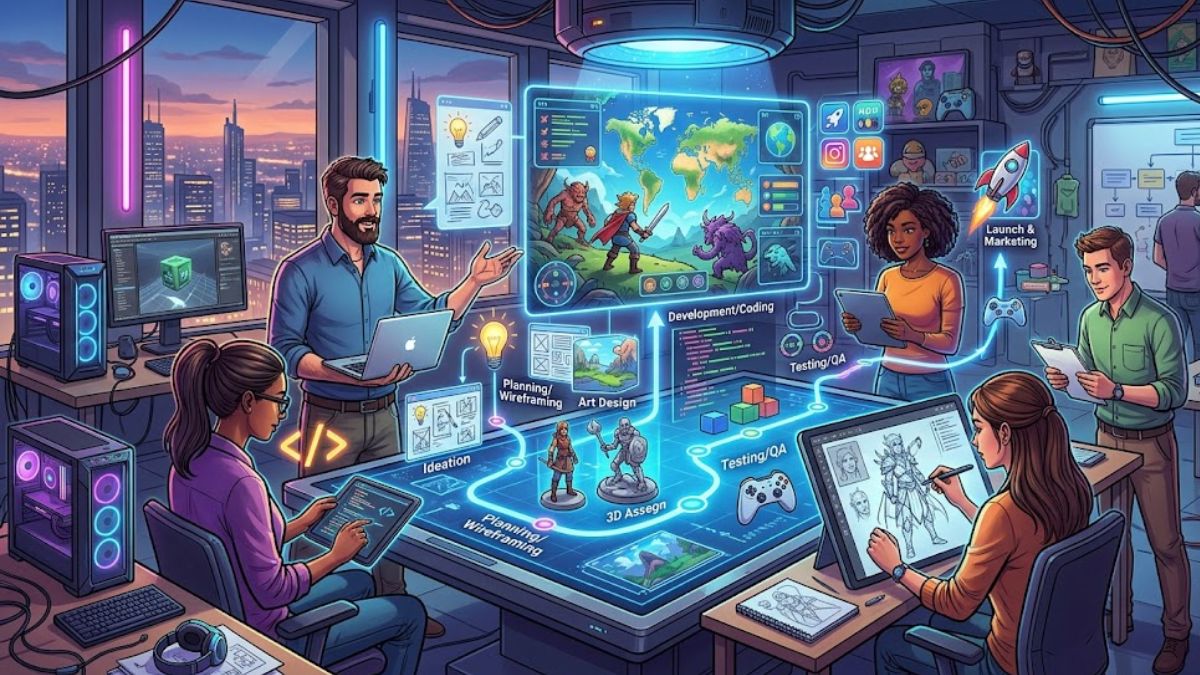
7. Execution Plan: Turning an idea into something playable
This is where ideas either become real or disappear. Most founders start with too much. Too many features, too many ideas, too many directions. But in gaming, that usually backfires. The smarter approach is simple: build the smallest version of the game that is actually playable. Not perfect. Not complete. Just something people can interact with and respond to. That first version will feel rough. It always does. But it’s the only way to understand how real users behave.
Once people start playing, everything becomes clearer. Where they get bored. Where they get confused. What they enjoy without realizing it. That feedback loop is more valuable than any internal planning. After that, you slowly refine. Improve mechanics. Fix friction. Adjust difficulty. Tighten the experience. And only then do you think about scaling, launching properly, and expanding beyond early users.
8. Budget & Resources: What it actually takes
There’s a misconception that gaming apps always need huge budgets. That’s not true at the beginning. A simple MVP can be built with a small team and basic tools. The real investment is not money upfront. It’s time, iteration, and patience. As things grow, costs naturally increase. Better design, backend systems, servers for multiplayer, analytics, marketing, all of that starts coming in later. But in the early stage, the biggest expense is usually not infrastructure. It’s figuring out what actually works. And that can’t be rushed.
9. Brand Strategy: What your game feels like to people
Branding in gaming is not about logos or color schemes. It’s about feeling. Every game has a personality, even if it’s not intentional. Some feel fun and light. Some feel competitive and intense. Feel relaxing, almost like a break from everything else. Players don’t always explain this, but they feel it immediately. That’s why consistency matters. From visuals to tone to gameplay, everything should feel like it belongs to the same world. Because in gaming, people don’t just remember what they played. They remember how it made them feel.
10. Vendor & Partner Strategy: You don’t build everything alone
One thing founders quickly learn in gaming is that you can’t do everything by yourself, at least not if you want the product to feel good. At some point, you need help. Maybe it’s an animator who can bring characters to life in a way you simply can’t. Maybe it’s a design studio that understands how to make visuals feel smooth and intentional. Or maybe it’s an ad network partner who knows how to actually monetize traffic without ruining the user experience.
The tricky part is not finding partners. It’s finding the right ones. Because in gaming, experience matters. A small mismatch in design quality or animation style can completely change how a game feels. And once users feel that disconnect, they don’t really explain it. They just leave. Good gaming startups quietly rely on people who have done this before, even if it costs more or takes longer. Because in the end, quality is what keeps users inside the game.
11. Go-To-Market: Getting people to actually play your game
This is usually the hardest part, and honestly, the most unpredictable. You can build a good game and still struggle to get people to notice it. That’s just reality. Most gaming apps don’t grow because they exist. They grow because someone somewhere talks about them, shares them, or shows them in a way that feels real. App stores help, but they’re crowded. So visibility becomes a fight. Influencers play a big role here. A simple gameplay video from the right creator can sometimes do more than weeks of planning.
Social media also matters, especially short-form content where people can instantly see what the game feels like without downloading it first. Paid ads come later, usually when things are already working and you want to scale. But they rarely fix a weak game. They only amplify what already exists. At the end of the day, getting users is less about shouting louder and more about giving people a reason to care enough to click.
12. Growth & Retention: The part nobody sees but everyone feels
Getting users is one thing. Keeping them is something else entirely. Most games don’t die because they are bad. They die because people stop coming back. That’s why retention becomes the real heartbeat of a gaming app. Small things matter more than people expect. A daily reward that feels just satisfying enough. A progression bar that makes users curious. A ranking system that quietly creates competition without forcing it.
And then there’s timing. Games that feel alive usually keep changing a little. New challenges. Small updates. Limited-time events. Nothing too dramatic, just enough to remind users that the game is still active, still moving. Because when a game feels static, people slowly forget it exists. But when it feels like it’s growing with them, they stay longer than they planned.
13. Team Structure: The small group behind a big experience
Most early gaming startups don’t start with big teams. They start with a few people trying to figure things out together. Usually there’s someone handling game design, thinking about what makes it fun and how it should flow. A developer who turns that idea into something playable. A UI/UX designer who makes sure it doesn’t feel clumsy or confusing. And someone focused on growth, trying to figure out how people will actually discover it.
In the beginning, not everything is in-house. That’s normal. Art, animation, even some technical parts are often outsourced. Not because teams want to, but because it’s the only practical way to move faster without losing focus. Over time, if things work, teams grow. But in the early days, it’s usually small, messy, and very hands-on. Everyone ends up doing a bit of everything anyway. And strangely, that’s often where the best ideas come from.
14. Risks, Challenges & What actually goes wrong in gaming startups
On paper, building a gaming app sounds exciting. In reality, it’s full of small problems that slowly pile up if you’re not careful. The biggest one is competition. There are always more games coming out than people expect, and most of them look similar at first glance. So standing out is not just hard, it’s constant work. Then comes retention. This is where most games quietly lose. People try the game, maybe even enjoy it, but don’t come back the next day. And in gaming, that silence is dangerous. No complaints, no feedback, just disappearance.
Monetization is another tricky balance. If you push too hard, users leave. If you don’t push at all, the game doesn’t sustain itself. Finding that middle ground takes time, and usually a lot of failed attempts. The only real way teams handle this is by staying close to users. Watching how they behave. Listening to what they don’t say. Updating the game often, even in small ways, just to keep it feeling alive. Because in the end, most of these problems don’t get solved in one shot. They get managed slowly, through repetition and observation.
15. Legal, compliance & the basics nobody wants to think about early on
This part is not exciting, so most people push it aside in the beginning. But it becomes important sooner than expected. Every gaming app has to follow platform rules like app store guidelines. That includes how you design payments, how you collect data, and how you present your product.
Then there’s data privacy. Even simple things like user accounts or analytics need to be handled carefully. Users may not always think about it, but regulations do. And depending on the type of game, especially if money is involved, there can be additional legal layers that vary by region. It’s not something that defines your game, but ignoring it can quietly create problems later. Most teams just handle it step by step as they grow, instead of trying to perfect everything from day one.
16. Future outlook: Where all of this is actually heading
If you look closely, gaming is not standing still. It’s slowly changing shape. One big shift is AI. Not in a hype way, but in very practical ways. Games will increasingly use AI to help design levels, generate content, adjust difficulty, and even personalize experiences for different players without manual effort every time. Cloud gaming is also growing, which removes a lot of hardware limitations. That means more complex experiences will become accessible on simpler devices. But maybe the most interesting change is not technical. It’s social.
Games are no longer just isolated apps you open and close. They are becoming spaces where people interact, talk, compete, and spend time together. In some cases, they feel more like digital hangouts than traditional games. And that changes everything about how they are built. For smaller founders, this actually creates an opportunity instead of a threat. You don’t need to compete with massive studios head-on. The real space is in building focused, smaller experiences that solve one clear engagement idea really well. Because in the end, the next successful gaming apps probably won’t be the biggest ones. They’ll be the ones that quietly understood what people wanted to feel, and built around that.
About foundlanes
This article is part of foundlanes.com mission to simplify startup thinking for founders in India and emerging markets. The platform focuses on breaking down complex business ideas into practical, execution-ready insights that help early-stage entrepreneurs move from idea to launch with clarity.