


Summary
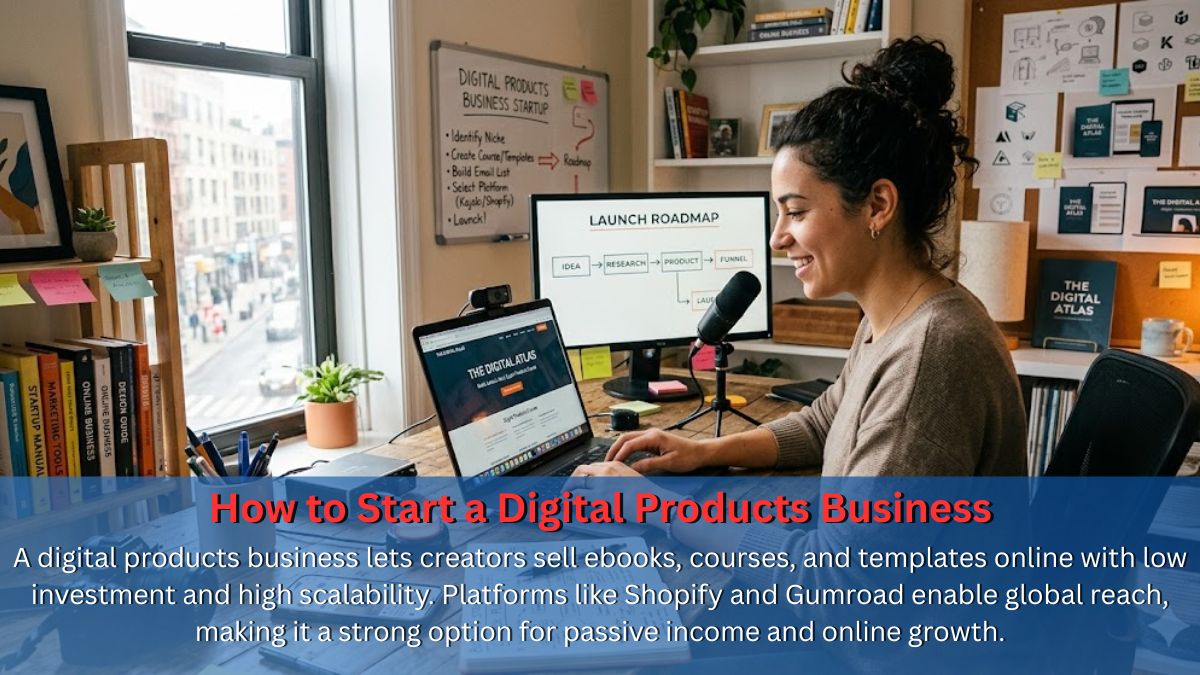
The idea to start a digital products business has rapidly gained momentum as entrepreneurs search for scalable, low-investment ventures in the digital economy. A digital products business focuses on creating and selling intangible products such as ebooks, online courses, templates, stock photos, digital art, software tools, and downloadable resources. Unlike traditional businesses that depend on inventory, shipping, and physical logistics, digital products are created once and can be sold repeatedly with minimal incremental cost.
The rise of digital platforms, creator economies, remote learning, and online marketplaces has made starting a digital product business more accessible than ever. Individuals with knowledge, creativity, or technical skills can package their expertise into downloadable assets that customers can instantly access. This model is particularly attractive because it offers scalability and the potential for passive income digital products, where revenue continues even after the initial product creation. The opportunity is relevant for freelancers, educators, designers, developers, marketers, and subject-matter experts who want to monetize their expertise online. Students, professionals, content creators, and small business owners are also entering the space by building niche-focused digital products tailored to specific audiences.
Geographically, the market is global
Geographically, the market is global. Digital products can be sold to customers across countries through platforms such as Shopify, Gumroad, Etsy, Udemy, and personal websites. In India, the rapid expansion of digital payments, smartphone penetration, and online education has accelerated adoption of digital downloads business models. Timing also plays a critical role. The creator economy is booming, with millions of people consuming online learning, digital templates, and downloadable resources daily. Entrepreneurs who enter the market now can tap into growing demand for high demand digital products that solve practical problems.
The cost of launching such a venture can be surprisingly low. Many founders begin with budgets between ₹10,000 and ₹1 lakh depending on tools, branding, and marketing investments. With the right strategy, launching a digital product business can become a sustainable and profitable venture within a relatively short period.
1. Startup Idea Overview: The Core Concept of a Digital Products Business
A digital products business revolves around creating intangible goods that customers can download, access, or use online. These products do not require physical manufacturing or shipping. Instead, they are delivered instantly through digital platforms. The most common examples include ebooks, educational courses, templates, music files, stock photography, design assets, software plugins, productivity tools, and digital planners.
The key advantage is scalability. Once a digital product is created, it can be sold to thousands of customers without additional production costs. This creates strong profit margins compared to traditional retail businesses. Many entrepreneurs choose to start a digital products business because it allows them to transform knowledge or skills into monetizable assets. A designer can sell templates, a writer can publish ebooks, and a photographer can build a stock photos business.
Another defining feature of this business model is automation. Payments, downloads, and delivery can be handled automatically by platforms and payment gateways. As a result, the digital product economy has created thousands of solo founders who run profitable online businesses without large teams or physical infrastructure.
2. Problem Statement & Solution
2.1 Challenges in Traditional Knowledge-Based Businesses
Traditionally, professionals such as trainers, consultants, and educators relied on time-based services. Their income depended directly on the number of hours they could work. This model limits scalability because there is a cap on how many clients a person can serve. Similarly, content creators often struggled to monetize their knowledge beyond advertisements or freelance work.
2.2 Digital Products as the Scalable Solution
Digital products solve this challenge by transforming knowledge into repeatable assets. An online course or ebook can reach thousands of people simultaneously. Templates and design resources can be purchased repeatedly without additional work. This approach enables creators to generate digital products that make money while reducing dependence on time-based income.
For customers, digital products provide instant access to solutions. A startup founder can download a business template, a student can access a learning course, and a marketer can purchase ready-to-use marketing assets. The model therefore benefits both creators and customers by offering convenience, affordability, and accessibility.
4. Target Audience & Customer Persona
A digital products business typically serves niche audiences rather than mass markets. Successful founders identify a specific group of users with a clear need. This focus increases the chances of creating products that customers are willing to pay for. Common customer segments include entrepreneurs, freelancers, students, creators, marketers, designers, and educators. For instance, entrepreneurs may purchase business plan templates, while social media managers may buy ready-made content calendars.
Students and professionals often invest in online course creation platforms to acquire new skills such as coding, marketing, or design. Creators and influencers may buy design assets, presets, or social media templates. Understanding customer behavior is essential. Buyers of digital products value convenience, speed, and expertise. They want solutions that save time or improve productivity. A well-defined customer persona helps entrepreneurs build products that address real-world problems rather than generic ideas.
5. Market Opportunity & Timing
The global digital products market has expanded dramatically over the last decade. Online learning alone has become a multi-billion-dollar industry. Millions of learners now prefer digital courses because they are flexible and accessible. Similarly, the demand for downloadable tools, design assets, and productivity resources continues to grow. This environment has created numerous opportunities for profitable digital product ideas.
Technological developments have also reduced barriers to entry. Platforms now allow creators to host and sell products without technical expertise. In India, the increasing adoption of digital payments and online platforms has further accelerated growth. Consumers are comfortable purchasing digital goods through UPI, wallets, and online payment gateways. Another key trend is the rise of the creator economy. Individuals are building personal brands and monetizing their audiences through best digital products to sell online. Because demand continues to rise, the timing is favorable for entrepreneurs looking to enter this market.
6. USP & Value Proposition
To succeed in this competitive market, entrepreneurs must define a clear unique selling proposition. A digital product should either solve a problem faster, provide higher quality, or offer a unique perspective compared to existing solutions. For example, a productivity template designed specifically for startup founders may stand out in a crowded market. Similarly, niche educational courses often outperform generic programs.
The strongest value proposition focuses on practical outcomes. Customers purchase digital products when they believe the product will save time, increase income, or improve skills. A well-designed product also emphasizes usability. Clear instructions, professional design, and structured content increase customer satisfaction. By focusing on customer outcomes, founders can build digital products that make money consistently.
7. Business Model & Pricing Strategy
Digital product businesses typically operate on several revenue models. The simplest model involves selling individual downloads such as ebooks, templates, or digital planners. Another approach is subscription-based access to libraries of content or courses. Some entrepreneurs combine multiple revenue streams, including memberships, licensing, and premium services.
Pricing varies widely depending on the product category. A simple template may cost ₹199, while a comprehensive course may sell for ₹10,000 or more. The high margin nature of digital products allows founders to experiment with pricing strategies. Bundles, limited-time offers, and tiered pricing are common techniques used to increase revenue. Because the cost of reproduction is nearly zero, even modest sales volumes can generate strong profitability.
8. Execution Plan & Launch Strategy
Building a digital product business sounds simple when you say it out loud. Create something, put it online, and people will buy. But in reality, this phase is where most ideas either find direction or quietly fade away. What separates those two outcomes is not luck. It’s clarity in execution.
8.1 Identifying Profitable Product Ideas
Everything starts with understanding what people are already struggling with. The biggest mistake beginners make is trying to come up with a “unique idea.” In digital products, uniqueness matters far less than usefulness. What actually works is solving a problem that already exists and keeps coming back in people’s lives. If you spend time on platforms like Reddit or YouTube, you’ll notice a pattern. People ask the same questions again and again. How to start something, how to fix something, how to improve something. These repeated questions are signals. They show where demand already exists.
The goal is to listen carefully. When someone is actively searching for a solution, they are much more likely to pay for something that genuinely helps them. That’s why the best digital products are not built around trends. They are built around problems that don’t go away easily. It could be a student struggling with interviews, a freelancer trying to find clients, or a small business owner trying to grow online. These are real, ongoing challenges. When you solve something like that, you’re not just creating a product. You’re creating relevance.
8.2 Creating the Minimum Viable Product
Once the idea feels right, the next instinct is usually to build something perfect. That instinct can slow everything down. A minimum viable product, or MVP, is about resisting that urge. It’s about putting something simple into the world and learning from real users instead of assumptions. This could be a short course instead of a full program. A basic template instead of a full toolkit. A concise ebook instead of a detailed guide. At this stage, the goal is not scale. It’s validation. When someone actually pays for your product, even a small amount, it changes everything. It proves that the idea has value beyond your own belief in it. But more importantly, it gives you feedback.
And that feedback is often very honest. Users will tell you what confused them, what helped them, what felt missing. Sometimes it’s uncomfortable to hear, but it’s also incredibly valuable. Because it shows you exactly where to improve. Over time, these small iterations turn a simple MVP into a product that truly works.
8.3 Launching the First Product
The way you launch your first product can shape how it performs for a long time. A common mistake is building something in isolation and then trying to sell it suddenly. This often leads to silence. Not because the product is bad, but because no one knew it existed. The smarter approach is to build an audience before the launch. This doesn’t mean you need millions of followers. Even a small, engaged group of people is enough. What matters is that they trust you and care about what you’re building.
Platforms like Instagram and LinkedIn are often used to share insights, document progress, and start conversations. Over time, this builds anticipation. When the product finally launches, it doesn’t feel like a cold offer. It feels like the next step in a journey people have been following. Pre-orders and early access offers can play a powerful role here. They do two things at once. They generate initial revenue, and they confirm that people are willing to pay. That combination is incredibly motivating in the early stages. A launch doesn’t have to be perfect. It just has to be real.
9. Budget, Resources & Infrastructure
One of the reasons digital product businesses feel so accessible is because the barrier to entry is low. You don’t need inventory. You don’t need a warehouse. don’t need to worry about logistics or shipping delays. That removes a huge layer of complexity. But that doesn’t mean there are no costs. There are basic expenses that almost every founder encounters. A domain name to create your online presence. Hosting services to keep your website running. Payment gateways to process transactions smoothly. Marketing tools to reach your audience.
Then there are tools for creation. Design software, video editing platforms, course builders. Some are free, many are subscription-based. At first, it can feel overwhelming deciding what to use. The key is to start simple. You don’t need the best tools. You need tools that work. In the early days, many founders operate alone. They write content, design visuals, handle customer queries, and manage sales. It’s demanding, but it also builds a deep understanding of the business.
As things grow, outsourcing becomes an option. Tasks like graphic design, editing, or website development can be handled by specialists. This allows the founder to focus on strategy and product improvement. Compared to traditional businesses, the financial risk is much lower. You’re not investing heavily upfront. You’re building gradually, learning as you go, and scaling based on real demand. That makes the journey less risky, but not less challenging.
10. Brand Strategy
In a crowded digital space, your product alone is not enough. People don’t just buy what you create. They buy who they believe you are. That’s where branding comes in. A strong brand is not just a logo or a color scheme. It’s a feeling. It’s the impression people get when they come across your work. It starts with clarity. What do you stand for? What problem are you solving? Who are you helping?
When this is clear, everything else becomes easier. The name, the visuals, the messaging, they all begin to align naturally. Consistency plays a huge role. When someone sees your content on different platforms, it should feel familiar. The tone, the style, the message, everything should connect. But beyond visuals, the voice of the brand matters deeply.
In digital product businesses, founders often become the face of the brand. They share knowledge, experiences, and insights. Over time, this builds credibility. People begin to see them not just as sellers, but as guides or mentors. And that trust directly impacts sales. Because when someone believes you understand their problem, they are far more likely to believe your product can help.
11. Vendor & Partner Strategy
Even though digital products don’t require physical supply chains, they still rely on a network of partners. Payment gateways are one of the most critical. They ensure that transactions are smooth, secure, and reliable. Any friction here can directly affect conversions. Then there are hosting providers and platform tools. These are the invisible layers that keep your business running. When they work well, no one notices. When they fail, everything stops.
Marketplaces can also be powerful partners. Platforms that specialize in selling digital products give creators access to a wider audience. They can help generate early traction, especially for new founders. But they come with trade-offs. Fees can be high. Control over pricing and customer data can be limited. And over time, this can affect long-term growth. That’s why many founders eventually move toward building their own sales channels. A personal website, direct payment systems, and owned audiences give more control and flexibility. It’s not about choosing one over the other. It’s about understanding when each approach makes sense.
12. Go-to-Market & Customer Acquisition Channels
No matter how good your product is, it won’t succeed if people don’t know it exists. Customer acquisition is where effort meets visibility. One of the most effective approaches in digital products is content marketing. When you share useful content consistently, whether through blogs, videos, or social posts, you start building authority. People begin to associate your name with a certain kind of value. Platforms like YouTube allow creators to go deep into topics, while platforms like Instagram help capture attention quickly.
But content alone is not enough. It needs to lead somewhere. That’s where email marketing becomes powerful. When someone subscribes to your email list, they are giving you permission to reach them directly. This creates a more personal connection. Many founders offer free resources, like guides, templates, or mini-courses, to attract these subscribers. It’s a simple exchange. Value for attention. Over time, these subscribers become customers.
Paid advertising can accelerate this process, but it works best when the product is already validated. Otherwise, it can become expensive without delivering results. The real strength comes from combining these channels. Content builds trust. Email nurtures relationships. Paid ads scale reach. Together, they create a system that doesn’t just attract customers, but keeps them engaged. And in a digital product business, that ongoing relationship often matters more than the first sale.
13. Growth & Retention Strategy
Growth in a digital product business rarely happens through a single breakthrough product. It builds layer by layer. What starts as one useful template or ebook often becomes an ecosystem of solutions. Founders who last in this space understand that customers are not just buying a product, they are buying progress. In real-world scenarios, the first product is usually simple. It solves one clear problem. But as customers begin using it, they start asking deeper questions. They want more clarity, more depth, more guidance. This is where expansion begins naturally. A basic ebook turns into a structured course. A course evolves into a complete toolkit. Over time, a brand that started with one product becomes a trusted learning resource.
Retention is where most businesses either compound or collapse
Retention is where most businesses either compound or collapse. Selling once is easy compared to earning repeat trust. Customers stay when they feel supported even after the purchase. This is why communities have become powerful. Private groups, email newsletters, and regular updates create a sense of belonging. People don’t just consume the product, they stay connected to the creator. There is also a psychological layer to retention. When customers see that a product is being updated, improved, and actively maintained, they feel reassured about their decision. It signals that the founder is still invested. That emotional trust often translates into repeat purchases.
Many founders eventually introduce membership models. This shifts the business from one-time sales to recurring revenue. But memberships only work when there is continuous value. People will not pay every month unless they feel they are growing every month. From experience, sustainable growth in digital products comes from listening more than selling. The founders who win are the ones who treat feedback like direction. They refine, rebuild, and relaunch based on real user needs. Over time, this creates not just customers, but advocates.
14. Team Structure & Responsibilities
In the beginning, it is usually just one person doing everything. There is no glamour in that stage. It is messy, exhausting, and deeply personal. The founder is the creator, marketer, customer support agent, and problem solver all at once. This phase teaches something invaluable. It builds clarity. When you handle customer queries yourself, you understand their frustrations. When you design your own product, you understand its gaps. That early hands-on experience shapes better decisions later.
As the business starts growing, cracks begin to show. There are only so many hours in a day. This is when founders face a critical decision. What to delegate and what to hold on to. Typically, the first areas to expand are content and marketing. A skilled content creator can bring consistency. A marketing specialist can bring reach. These roles directly impact growth, so they often come first. Design and user experience follow closely. In digital products, perception matters as much as substance. A well-designed product builds trust instantly. Poor design, even with great content, can push customers away.
Customer support becomes essential sooner than expected. As sales increase, so do questions, complaints, and feedback. Ignoring this area can quietly damage the brand. A responsive support system, even if small, makes a big difference. Technical work is often outsourced. Website development, automation, and integrations do not always require full-time hires. Freelancers and specialists can handle these efficiently without increasing long-term costs. The strongest teams in this space are not large. They are lean, focused, and aligned. Everyone knows their role, and more importantly, understands the customer. Growth does not come from adding more people. It comes from adding the right people at the right time.
15. Risks, Challenges & Mitigation
On the surface, digital product businesses look simple. Low investment, no inventory, global reach. But beneath that simplicity lies a different kind of pressure. Competition is relentless. The barrier to entry is low, which means new products are launched every day. In crowded niches like online courses or design templates, standing out is not easy. Many founders experience the same frustration. They build something valuable, but it gets lost in noise. Then there is the issue of piracy. It is one of the most emotionally draining challenges. You spend weeks or months creating something, and within days, it appears on unauthorized platforms for free. It feels unfair, almost personal.
Market saturation adds another layer of difficulty. Customers today are overwhelmed with choices. They are more skeptical. They take longer to decide. Trust has become the biggest currency. But experienced founders approach these challenges differently. Instead of trying to compete everywhere, they go deeper into a niche. They focus on a specific audience with a specific problem. This reduces competition and increases relevance. Brand becomes a powerful defense. People may copy a product, but they cannot copy trust. When customers connect with a brand, they are less likely to look for alternatives, even if cheaper options exist.
Continuous improvement is another key strategy. Products that evolve stay relevant. Updates, new features, and additional resources make it harder for competitors to replicate value quickly. There is also a mindset shift required. Instead of fearing competition, successful founders study it. They learn what works, what fails, and where gaps exist. Over time, this builds resilience. In reality, every digital product business faces these challenges. The difference lies in how founders respond. Those who adapt, refine, and stay consistent are the ones who survive.
16. Legal, Compliance & Fundamentals
Legal aspects are often ignored in the early stages. Not because they are unimportant, but because they feel distant. When you are focused on building and selling, paperwork rarely feels urgent. But this is where many founders make costly mistakes. Registering the business is one of the first steps toward legitimacy. It builds credibility with customers and partners. It also simplifies financial management and compliance as the business grows. Taxes are another area that requires attention. Digital sales, especially across regions, can become complex. Understanding GST and digital commerce rules early helps avoid complications later.
Policies are not just formalities. Terms of service, privacy policies, and refund policies act as safeguards. They protect both the business and the customer. More importantly, they signal professionalism. Copyright is deeply personal in digital products. What you create is your intellectual property. Protecting it is not just a legal necessity, it is about respecting your own work. At the same time, founders must ensure they are not unknowingly using content they do not own. From real experience, founders who take legal foundations seriously early on move with more confidence. There is less fear, fewer surprises, and stronger trust from customers. It may not feel exciting, but it is essential. A strong legal and compliance base does not just protect the business. It allows it to grow without hesitation.
17. Future Outlook
The long-term outlook for entrepreneurs who start a digital products business appears highly promising. The global shift toward online learning, remote work, and digital collaboration continues to expand the market for digital solutions. More professionals are turning their expertise into downloadable assets, courses, and tools. At the same time, consumers increasingly prefer flexible and self-paced learning resources.
Advancements in artificial intelligence, automation, and creator platforms will likely accelerate the growth of digital products that make money. Entrepreneurs who focus on solving real problems and building strong communities can build sustainable digital businesses over the next decade. For founders exploring high demand digital products, the opportunity lies not only in creating valuable products but also in building trusted brands. Those who successfully combine expertise, audience engagement, and smart distribution strategies will define the next generation of digital entrepreneurship.
About foundlanes.com
foundlanes.com is India’s emerging platform dedicated to startup ideas, founder journeys, and deep-dive business insights. The platform aims to simplify entrepreneurship by publishing practical startup ideas, case studies, and execution frameworks that help aspiring founders transform concepts into real businesses. foundlanes focuses on actionable content designed for students, professionals, and early-stage entrepreneurs who want to explore new opportunities in India’s rapidly evolving startup ecosystem. Through detailed analysis of emerging industries and innovative business models, foundlanes seeks to empower the next generation of founders with knowledge, strategy, and inspiration.