


Summary
Starting a gym franchise is one of the most accessible ways to enter the fitness industry without reinventing the wheel. It gives first-time founders a proven playbook, a recognized brand, and operational support that reduces the trial-and-error that independent gyms face. Demand for organized fitness continues to rise in urban and mid-tier markets across India, and franchise brands are expanding into neighborhoods where disposable incomes, youth populations, and lifestyle-driven spending are growing. For anyone exploring how to start a gym franchise, the opportunity sits at the intersection of rising health awareness, affordable real estate options, and the surge in structured fitness habits that started with boutique chains and continued after the pandemic.
People choose a franchise gym because trust matters in this category. A name that is already known, whether it is Anytime Fitness or Gold’s Gym, makes it easier for potential members to sign up. These brands also provide standardized training modules, support with layout design, guidance on equipment procurement, and pre-launch marketing. Franchise owners benefit from predictable membership models, cross-selling opportunities like personal training, and reliable systems that help maintain retention.
The cost to start such a business varies widely
The cost to start such a business varies widely. Entry-level fitness franchises in India can begin with a moderate investment, while premium global players can go significantly higher. Expenses are driven by franchise fees, equipment packages, leasing costs, build-out requirements, and mandatory training programs. Timelines depend on real estate readiness, but most franchise setups move from agreement to launch within six to nine months. Locations range from premium malls in major metros to high-street commercial spaces in cities such as Bengaluru and Pune, where fitness penetration is already strong.
Running a gym franchise appeals to operators who are comfortable managing teams, building community, and handling local marketing. It suits founders who prefer structured systems instead of experimentation. For many, the business becomes attractive because margins can scale once membership crosses a steady base and fixed costs stabilize. With India’s fitness economy on an upward curve, this segment continues to draw attention from first-time entrepreneurs, professionals shifting careers, and investors looking for stable revenue businesses with strong unit economics.
1. Startup Idea Overview
A gym franchise is a structured business that allows an entrepreneur to operate a fitness center using the brand, training, and operational systems of an established chain. This model reduces the uncertainty that comes with starting a fitness center independently. The idea solves two core problems in the Indian fitness landscape. First, customers need reliable and consistent quality in equipment, hygiene, and coaching. Second, founders want a predictable operating model that avoids experimenting with training programs, staffing structures, and pricing.
The solution offered by franchise brands is straightforward. They give franchisees a blueprint covering layout design, equipment selection, staff training, sales scripts, and membership management. They also provide brand recognition, which shortens the ramp-up period. Established chains like Snap Fitness and Planet Fitness have refined these systems over years, making it easier for entrepreneurs to plug in and begin operations.
For the Indian market, this idea is especially relevant because fitness preferences have matured. People now expect structured programs, trained instructors, clean environments, and digital tracking. Independent gyms that lack standardized processes often struggle to match these expectations. A franchise brings the needed reliability along with marketing support that can help a new branch gain traction quickly.
2. Problem Statement & Solution
India’s fitness industry has grown steadily, but inconsistency is still a major challenge. Many standalone gyms vary widely in equipment quality, maintenance standards, coaching expertise, and membership experiences. Customers often struggle to find a place that feels trustworthy. Unorganized operators also face high churn because they lack structured programs or retention strategies.
A gym franchise addresses these gaps by offering a uniform experience. Members know what to expect from the brand before they walk in. For founders, the franchise removes ambiguity. It defines every element from interior design to safety rules. Brands already have tested playbooks for membership acquisition, digital marketing, retention, and upselling. This reduces the failure rate that commonly affects new independent gyms.
The solution also extends to backend systems. Franchise brands offer CRM tools, operational dashboards, and standardized SOPs. These help track sales, monitor trainer performance, and optimize class schedules. For a founder, this stability is a key advantage because it shortens the learning curve and improves profitability from the early months.
3. Target Audience & Customer Persona
The ideal customer for a franchise gym tends to be someone who values consistency. They prefer structured programs, verified trainers, and a brand they can trust. These are typically professionals between 22 and 45 who live in urban and semi-urban neighborhoods and have stable disposable incomes. They are familiar with brands and appreciate predictable service levels.
This group focuses on fitness as part of a broader lifestyle. They often compare gyms not only on price but also on hygiene, equipment maintenance, community feel, and trainer quality. They expect gyms to run standardized training programs, supported by personal trainers educated in franchise training methodologies. look for options beyond basic equipment, such as group classes, transformation programs, functional workouts, and digital tracking. For franchisees, this audience is easier to attract because brand recognition reduces skepticism. They are more likely to commit to long-term memberships when the gym format feels organized and reliable. Their behavior aligns with predictable monthly revenue for the operator.
4. Market Opportunity & Timing
India’s fitness industry has expanded rapidly over the past decade. Urbanization, rising health awareness, and digital exposure have all contributed to the shift. Even during slowdown periods, fitness demand has proven resilient. The country’s young demographic, with more than half under the age of 30, continues to prioritize wellness. This fuels steady membership growth for organized players.
Tier-2 and tier-3 cities are also emerging as strong markets. These areas have rising annual incomes and limited access to high-quality fitness centers. Franchise brands have already begun tapping these regions, recognizing the appetite for structured workout formats. Cities like Indore and Coimbatore are becoming important expansion hotspots.
Timing is favorable because real estate prices in commercial pockets have stabilized. Equipment manufacturers and financing partners provide flexible payment plans, making setup more affordable. Customers are now familiar with monthly subscriptions, digital access, and transformation programs, which aligns well with franchise gym models. Market analysis indicates that organized players continue to capture increasing share, driven by their reliability and strong support ecosystems.
5. USP & Value Proposition
A gym franchise delivers predictable quality, structured programs, and efficient operations. Its value proposition lies in consistency. Members know that when they walk into a franchise location, the standards will match what they have seen elsewhere from the brand. For a founder, the appeal lies in step-by-step guidance. From franchise training programs to brand support services, the system reduces operational risk.
Another key differentiator is faster trust-building. A recognized brand removes the hesitation that customers usually feel when joining a new gym. It improves conversion rates, especially during pre-launch sales. Support from the franchisor also ensures that the gym remains competitive with new trends. Most chains update their workout formats, digital features, and program designs regularly. This helps each outlet stay relevant. The franchise model also enhances retention. Members stay longer when coaching quality, hygiene, and engagement programs remain consistent. The result is a predictable membership base that supports stable monthly revenue.
6. Business Model & Pricing Strategy
The business model for a gym franchise revolves around predictable monthly revenue. Most franchises follow a membership-first model supported by add-on services such as personal training, transformation programs, and specialized classes. Memberships usually operate on monthly, quarterly, or annual plans, and branded franchises often see better conversion rates because of established trust. This creates a stable revenue base that can grow as footfall increases.
Franchisors typically provide structured pricing guidelines, including recommended membership rates and upsell strategies. While these may vary by city, the goal is to balance affordability with the brand’s positioning. High-end global brands often adopt premium pricing to match their equipment standards and training expertise, while mid-market brands prioritize volume. Franchise investment structure includes franchise fees, ongoing royalty payments, and occasionally marketing contributions. These costs support brand expansion, training updates, and marketing support.
Margins depend on efficient staffing, high occupancy rates, and consistent renewals. Personal training contributes significantly to profitability because it carries higher margins. Large-format gyms also create space for group classes, which improve retention. Equipment financing options, which many partner banks and suppliers offer, help franchisees manage upfront expenses. This keeps the model viable for first-time founders who prefer predictable repayment terms instead of large one-time purchases.
7. Execution Plan & Launch Strategy
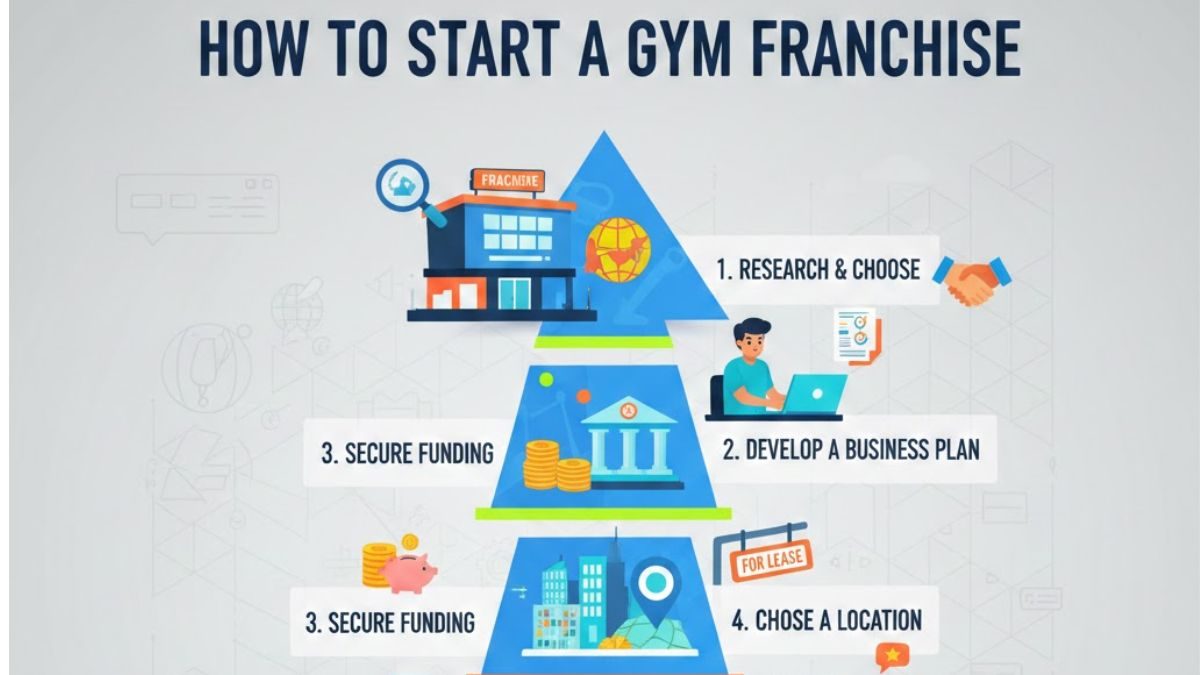
The journey to start a gym franchise begins with selecting the right brand. It’s essential to assess each franchisor’s reputation, support ecosystem, and business model. Once the franchise agreement is signed, the site selection process begins. Franchisors provide guidelines on ideal floor space, neighborhood profiles, footfall patterns, and structural requirements. This ensures the location meets brand standards and offers strong revenue potential.
The next phase is layout planning and equipment procurement. Franchisors share approved vendors and pre-designed layouts that optimize movement, zoning, safety, and member experience. Equipment packages are usually standardized. This allows a franchisor to maintain uniform quality across outlets. During this time, the founder receives training on operations, HR, sales, and local marketing. These programs prepare the team for daily processes such as member onboarding, lead management, safety protocols, and class scheduling.
Pre-launch marketing is one of the most critical steps. Brands often run campaigns to build anticipation and collect early sign-ups. This includes digital ads, social media outreach, on-ground promotions, and referral-based incentives. A franchise’s brand recognition helps attract leads even before the gym opens. The launch window typically spans one to two weeks and focuses on converting leads into paying members. After launch, the first ninety days are about strengthening the base, optimizing operations, and stabilizing trainer performance.
8. Budget, Resources & Infrastructure
Setting up a gym franchise requires a substantial but manageable investment. The largest expenses come from franchise fees, equipment procurement, leasing deposits, and interior build-out. Entry-level franchises may require moderate capital, while global brands can fall into higher ranges. Costs vary depending on the size of the space, the type of equipment chosen, and the location’s rental value.
Equipment financing is often available through banks and leasing partners. This spreads the investment across several years and eases cash flow. Infrastructure includes flooring, mirrors, air conditioning, lighting, locker rooms, showers, CCTV, music systems, and access control technology. Founders should also budget for software subscriptions such as CRM tools, attendance systems, and digital marketing platforms. These systems play a central role in managing memberships and communication.
Resource planning includes hiring certified trainers, front-desk staff, housekeeping, and a fitness manager. Many franchises offer structured training for employees to ensure they maintain brand standards. The founder’s own involvement is important during the first six months. It helps streamline daily operations, control costs, and build a strong local community that keeps members coming back.
9. Brand Strategy
A gym franchise benefits from an existing brand identity, but each outlet still needs to build its own local presence. The brand name logic, logo direction, and color palette are usually pre-set by the franchisor. This ensures consistency across all branches. Brand voice tends to combine expertise, reliability, and motivation, making it relatable for fitness-focused customers. Founders must use the approved branding across signage, social media, merchandise, and local advertising.
Positioning plays a central role. Some brands cater to premium clients with advanced machines and wellness features. Others focus on affordability and accessibility. Understanding this positioning helps the franchisee plan local marketing and pricing. Strong brand presence in the neighborhood often begins with hyperlocal campaigns, school and corporate tie-ups, and consistent digital communication. The goal is to build a community that associates the gym with trust, consistency, and results.
The brand strategy must also align with evolving fitness trends. Many franchise chains introduce new programs, challenges, and seasonal campaigns to keep members motivated. Franchisees must execute these initiatives consistently to maintain competitiveness. The more integrated the outlet is with the brand’s broader campaigns, the better its visibility and retention.
10. Vendor & Partner Strategy
Vendor selection shapes both operational quality and long-term maintenance costs. Franchisors typically maintain approved vendor lists for equipment suppliers, flooring specialists, and interior contractors. These vendors meet the brand’s safety and performance standards, which reduces the risk of mismatched equipment or construction errors. Working with vetted partners also ensures timely deliveries, proper installation, and access to warranties.
Beyond equipment suppliers, franchisees collaborate with software partners, payroll processors, cleaning service companies, and marketing agencies. Choosing reliable partners helps streamline operations. Local partnerships can be equally beneficial. Tie-ups with nutritionists, physiotherapists, or sports stores can create cross-promotional opportunities. Collaborative programs with offices and residential complexes often help drive early memberships.
Partner strategy also extends to financing institutions. Many banks and NBFCs offer equipment loans, working capital lines, and POS solutions tailored to fitness businesses. Strong financial partnerships help maintain cash flow and support expansion if the gym performs well. The goal is to build a network of partners that strengthens every aspect of the business from launch to daily operations.
11. Go-to-Market & Customer Acquisition Channels
A gym franchise succeeds when its early customer acquisition strategy is well executed. The most effective approach begins even before the doors open. Pre-launch sales often drive the first wave of memberships, and this phase demands an organized plan. Digital channels usually lead the charge. Targeted ads on social platforms reach potential customers living within a few kilometers of the gym. These ads highlight limited-time launch offers, brand credibility, and early sign-up benefits. Because franchise brands already have recognition, people respond with more trust compared to local independent gyms.
On-ground activation is just as important. Teams visit corporate offices, residential societies, and colleges to build awareness and collect leads. These interactions create a sense of familiarity, which boosts conversions during the opening week. Referral programs work well for gyms because fitness spreads through social circles. When early members invite friends, retention improves and acquisition costs come down. This makes word-of-mouth an essential channel.
Strong search presence also plays a long-term role. Many franchises invest in SEO and local listings, which help people discover the gym when they search for fitness centers nearby. Partnerships with apps that list gyms and training centers also contribute steady traffic. Over time, community events, transformation challenges, and group workshops keep engagement high and ensure that new leads keep flowing in.
12. Growth & Retention Strategy
Scaling a franchise gym depends on consistent member retention. Early traction is important, but long-term success relies on how effectively the gym keeps its members engaged. Standardized training programs help maintain quality. Franchise chains update their modules regularly, giving members new workouts and challenges. This variety reduces monotony and encourages regular attendance.
Community-building initiatives create strong emotional ties to the gym. Events like fitness challenges, weekend boot camps, or themed group workouts help foster loyalty. Trainers play a major role in this process. When trainers maintain consistent relationships with members through progress tracking and personalized guidance, retention improves. Gyms that invest in developing their staff often see better results.
Data tracking is another pillar of retention. CRM tools provided by the franchisor help monitor attendance patterns, renewal probabilities, and customer feedback. Early identification of drop-off signals allows the team to intervene with personalized follow-ups. Upselling personal training is also a key factor. It not only increases revenue but also strengthens the member’s commitment to the facility. Growth eventually comes from expanding membership capacity, adding specialized programs, and improving local marketing. Once the outlet stabilizes, the owner can explore opening a second unit if the franchisor supports multi-unit operations. Many successful franchise owners scale this way because the learning curve becomes easier with each outlet.
13. Team Structure & Responsibilities
A gym franchise relies on a well-organized team that understands both operations and customer experience. The founder often acts as the first line of oversight. Their presence ensures that daily activities run smoothly and that brand standards are maintained. Over time, some responsibilities can be delegated, but early involvement is crucial for quality control.
A fitness manager or general manager is usually the central point of contact. They handle staff coordination, class scheduling, equipment maintenance, and customer issues. Trainers form the core of the member experience. They lead group sessions, manage one-on-one training, and provide safety supervision. Their expertise and communication style influence both customer satisfaction and retention.
Front-desk executives handle lead management, membership sales, renewals, and attendance tracking. They must be trained in brand messaging and sales scripts provided by the franchisor. Housekeeping ensures the facility stays clean and meets hygiene expectations. Many franchises also work with outsourced specialists for accounting, digital marketing, and payroll processing. This structure helps maintain operational efficiency without inflating costs.
14. Risks, Challenges & Mitigation
A gym franchise, like any business, faces several risks. One of the most common challenges is inconsistent footfall after the initial enthusiasm fades. If the gym fails to build strong community engagement in its early months, churn can rise. This risk can be mitigated with proactive retention programs and trainer-led engagement routines that maintain energy on the floor. Consistent follow-ups with inactive members also help reduce drop-offs.
Operational costs can escalate if staffing is not optimized. Overstaffing or hiring underqualified trainers can weaken the business. This is why franchisors insist on certification standards and structured hiring processes. Outsourcing some roles helps maintain cost flexibility. Another challenge is equipment maintenance. A single machine breakdown can impact customer experience. Following brand-recommended maintenance schedules and working with branded vendors reduces downtime.
Competition is another ongoing risk, especially in areas where multiple gyms operate within close radius. Franchise outlets mitigate this by leveraging brand recognition, superior training programs, and consistent marketing. Economic fluctuations can also affect membership renewals. Offering flexible plans, seasonal discounts, and corporate partnerships helps balance demand during slow periods.
15. Legal, Compliance & Fundamentals
Setting up a gym franchise in India involves multiple regulatory steps. The business must be registered under an appropriate structure, such as a private limited company or LLP. Franchise agreements outline responsibilities, fees, territory rights, and operational protocols. These legal documents must be reviewed carefully to avoid future conflicts. Compliance includes obtaining trade licenses, fire safety clearances, and local municipal permissions. Many cities require health and sanitation certificates due to the nature of the business.
Employment contracts for trainers and staff should be formalized to avoid turnover-related issues. Clear policies on working hours, incentives, and conduct maintain professionalism. Insurance coverage is essential. Most franchise brands mandate policies that cover equipment, property damage, and third-party liability. This protects the business against accidents or unforeseen incidents.
Music licensing is another aspect that gym owners often overlook. Playing commercial music in public spaces requires proper licensing from performing rights organizations. Franchisors typically guide franchisees through this process. Adhering to compliance ensures smooth operations and builds trust with customers.
16. Long-Term Vision & Goals
A well-run gym franchise can evolve into a multi-unit operation within a few years. The long-term vision usually begins with stabilizing the first outlet, achieving steady membership growth, and maintaining strong renewal rates. Once the gym reaches predictable profitability, expansion into nearby neighborhoods becomes the next step. Many franchise owners follow a hub-and-spoke approach. They build one flagship location and then open smaller or more specialized units in surrounding areas.
A three-to-five-year roadmap typically includes growing membership capacity, creating a strong personal training culture, and refining operational efficiency. In mature markets such as Mumbai or Hyderabad, franchise owners diversify through corporate partnerships and premium programs. In emerging cities, the focus shifts to building brand dominance and capturing underserved pockets where competition remains low.
Success metrics cover multiple layers: the membership base, average revenue per member, retention rate, break-even timeline, EBITDA margins, and customer satisfaction scores. Franchise networks that consistently update their offerings, invest in staff development, and adopt new fitness formats tend to outperform others. Over time, a gym franchise can become part of a broader wellness ecosystem that includes nutrition counseling, physiotherapy tie-ups, and digital training products. The goal is to create a trusted community hub built around movement and long-term health.
Future Outlook
The future of starting a gym franchise in India remains promising, thanks to demographic trends, rising fitness consciousness, and steady demand for structured workouts. The industry is moving toward hybrid models that combine in-person training with digital engagement. While physical gyms remain the core, franchise brands increasingly build tech-enabled systems that track progress, personalize training, and support at-home sessions. This blended approach helps retain members even during seasonal slowdowns.
Another trend shaping the next few years is the shift toward specialized formats. Functional fitness, high-intensity training, and boutique group programs continue to attract younger audiences. Franchise chains are already integrating these formats into their core offerings to stay competitive. There is also growing interest from investors in wellness-focused ventures. As disposable incomes rise and urban lifestyles become more health-oriented, fitness will continue to be part of mainstream spending.
Franchise entrepreneurs exploring how to start a gym franchise today are positioned to capture long-term growth if they focus on consistent execution, quality staffing, and community-building. Cities like Chennai and Ahmedabad are seeing new traction as organized players expand their reach. With the right brand partnership and disciplined management, a gym franchise can develop into a scalable, profitable business that stands strong for many years.
About foundlanes.com
foundlanes.com is India’s leading startup idea discovery platform. It helps entrepreneurs find actionable startup opportunities, market insights, and industry-specific guidance to turn ideas into real businesses. With deep research and practical resources, foundlanes supports founders at every stage, from idea validation to launch and growth.