


Introduction
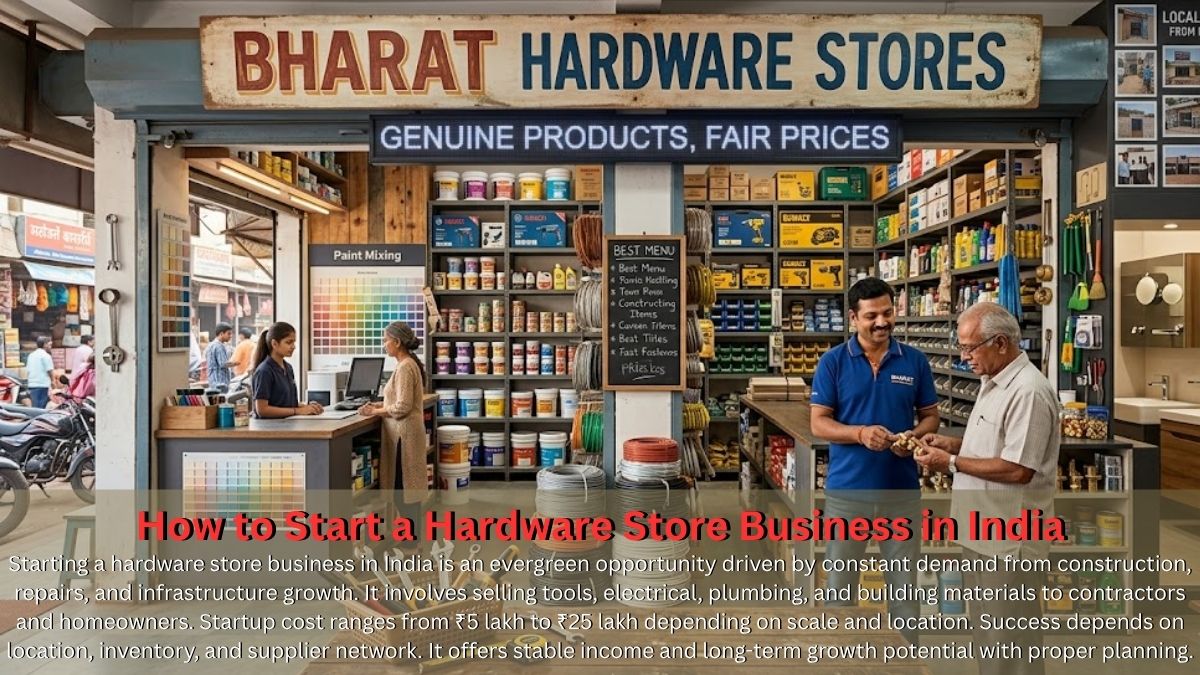
Starting a hardware store business in India is one of the most practical and evergreen entrepreneurial opportunities today. At its core, a hardware store is a retail business that sells tools, construction materials, plumbing supplies, electrical items, and repair essentials. The demand for such stores exists across urban cities, semi-urban towns, and even rural areas, driven by constant construction activity, home repairs, and infrastructure growth.
India’s real estate expansion, government-led infrastructure projects, and increasing DIY culture have created a consistent demand for hardware supplies. From small contractors and electricians to homeowners and builders, a wide range of customers rely on local hardware shops for daily needs. This makes the business highly relevant, especially for first-time entrepreneurs looking for stable, cash-flow-driven ventures.
Anyone with basic business understanding, supplier connections, and location insight can start a hardware shop in India. The business works best in areas with residential development, construction activity, or high footfall markets. It can be started anytime, but entering during a construction boom or festive renovation season can accelerate early growth. The “how” involves careful planning. From selecting the right location and sourcing inventory to setting up supplier relationships and pricing strategies, each step matters. On average, the hardware shop startup cost in India can range from ₹5 lakh to ₹25 lakh depending on scale, inventory size, and location. With proper execution, the hardware business profit in India can be steady and scalable over time.
1. Startup Idea Overview
A hardware store is not a flashy business idea, but it is one of the most dependable ones in India. It works quietly in the background of every building, every renovation, and every repair. Whether it is a leaking tap in a small home or a full-scale construction project, the need for hardware never really stops. At its core, the idea is simple. You create a place where people can walk in and find everything needed for building, fixing, and maintaining things. This includes basic tools, plumbing items, electrical supplies, cement-related accessories, fasteners, and everyday repair essentials.
What makes this idea powerful in India is not just demand, but consistency. Unlike trend-based businesses that rise and fall quickly, hardware demand stays stable across seasons. Even during economic slowdowns, repairs continue, buildings still get completed, and homes still need maintenance. But the real opportunity is not just opening a shop. It is about fixing how the experience feels for customers. In many Indian towns, hardware buying is still frustrating. People move from one shop to another, asking for items that may or may not be available. Sometimes they are overcharged. Sometimes they are given incorrect advice. That frustration is exactly where a well-run hardware store can win trust.
A strong hardware store business setup today is very different from the traditional image of a dusty shop. Modern stores are becoming cleaner, more organized, and more customer-focused. Inventory is tracked properly. Billing is faster. Products are grouped in a way that even a non-technical customer can understand. In some cases, owners are even using WhatsApp catalogs to take orders and send home deliveries. Contractors now expect quick response times, clear pricing, and availability without repeated visits.
So the real idea is not just “selling tools.” It is becoming a dependable supply partner for a local ecosystem of builders, electricians, plumbers, and homeowners. When done right, the shop becomes part of people’s daily work life. That is where loyalty is built, not through advertising, but through reliability.
2. Problem Statement & Solution
The hardware retail market in India still feels unstructured in many places. If you walk into a typical local market, you will notice something very common. Every shop has slightly different pricing. Stock availability is unpredictable. And product knowledge depends entirely on the shopkeeper’s experience, not a system. This creates real pressure on customers. A contractor, for example, cannot afford to waste half a day searching for a missing item. A plumber often needs specific fittings urgently, sometimes in the middle of a job. Even homeowners, who may be buying items for the first time, often feel lost and unsure about what to choose.
There is also a deeper issue that many people do not talk about openly. Trust. In many smaller markets, customers often feel uncertain whether they are being charged fairly or sold the right quality product. That hesitation slows down decision-making and reduces repeat business for many shops. This is where a structured hardware shop business plan changes the experience completely. The solution is not complicated, but it requires discipline.
First, inventory must be planned properly. A good hardware store does not just stock random items. It studies local demand patterns. For example, in a construction-heavy area, cement-related accessories and plumbing materials will move faster. In a residential zone, repair tools and electrical fittings may dominate. Second, transparency becomes a competitive advantage. When pricing is clear and consistent, customers start trusting the store. That trust slowly becomes more valuable than discounts.
Third, service quality makes the difference. A knowledgeable staff member who can guide a confused homeowner is often more valuable than any advertisement. In fact, many successful store owners in India quietly admit that most of their growth came from “explaining things properly” rather than marketing. Now comes the modern layer. Technology is quietly changing this traditional business. Even simple tools like WhatsApp ordering or digital billing systems have improved efficiency. Contractors no longer need to physically visit the shop every time. They can send a list, get a quote, and receive delivery.
Some stores also track inventory digitally, which reduces the common problem of “item available in system but not on shelf.” This small improvement alone reduces customer frustration significantly. So the solution is not about reinventing the hardware business. It is about fixing friction points. Better availability, better communication, better organization. When these three improve, even a small shop can outperform larger competitors.
3. Target Audience & Customer Persona
A hardware store in India does not serve a single type of customer. It serves an entire ecosystem that is connected to construction, repair, and maintenance work. This is what makes the business both interesting and demanding. The most consistent customers are contractors. These are people who handle multiple projects at once. For them, time is more important than anything else. They care about three things: availability, speed, and credit flexibility. If a store can consistently deliver materials without delay, contractors naturally stick to it. Many long-term hardware shop owners in India will tell you that just 10 to 15 regular contractors can sustain a large portion of monthly sales.
Then come electricians and plumbers. Their behavior is slightly different. They usually buy specific items in smaller quantities, but with high urgency. A missing switchboard component or pipe fitting can stop their entire job. So they value stores that understand their work and keep essential items always in stock. Carpenters and interior workers form another important group. They often look for tools, fittings, and finishing materials. Their purchases are sometimes seasonal, linked to project flow, but when they buy, they often buy in bundles.
Homeowners are a different world altogether. This segment is emotional and often unsure. A person renovating their home may not know the exact product name or specification. They depend heavily on guidance. In many cases, they trust the shopkeeper’s recommendation more than online research. This is where human interaction becomes extremely important.
There is also a growing segment that did not exist strongly a decade ago. DIY customers. These are young homeowners or renters who try small repairs themselves. They often come in asking basic questions and looking for affordable solutions. This segment is still small in many towns, but it is growing steadily.
A typical real-world scenario looks like this. A contractor enters early morning, picks up bulk items for the day’s work, negotiates a rate, and leaves within minutes. Later, a plumber walks in urgently asking for a specific fitting that he forgot to carry. In the evening, a homeowner enters confused about leakage issues and leaves with both product and advice. A good hardware store owner learns to switch between these personalities smoothly. That adaptability becomes a hidden skill that defines long-term success in this business.
4. Market Opportunity & Timing
The opportunity in the Indian hardware retail space is closely tied to how India is building itself today. Every road, every house, every commercial building creates continuous demand for materials. This is not a one-time cycle. It is ongoing and deeply connected to daily life.
One of the strongest drivers is infrastructure expansion. Across India, especially in Tier 2 and Tier 3 cities, construction activity has increased steadily over the years. New housing projects, roads, and small commercial spaces are being built at a fast pace. Each of these projects depends heavily on hardware supply chains.
At the same time, rural and semi-urban markets are still under-served. In many of these areas, hardware stores exist, but they are often small, unorganized, and limited in variety. Customers frequently travel long distances to find specific items. This creates a natural gap for better-organized stores. Another important shift is happening in household behavior. Home improvement is no longer seen as a luxury activity. Even middle-income families are investing in repairs, renovations, and upgrades. Small changes like modular kitchens, bathroom fittings, and electrical upgrades are becoming common.
This has created a steady rise in demand for reliable tools and equipment stores. Even during slower economic periods, these needs do not disappear. A broken pipe still needs fixing. A leaking roof still needs repair. Timing also plays a critical role. Right now, India is in a phase where urbanization and infrastructure development are moving together. This combination creates consistent demand across multiple customer segments. Contractors, builders, and homeowners are all active at the same time.
There is also a psychological shift happening. People are becoming more quality-conscious. They are willing to pay slightly more for reliable products and better service. This benefits organized and semi-organized hardware stores that focus on trust and consistency.
So the opportunity is not just large. It is layered. It exists in cities, in towns, and in rural markets. exists in bulk construction demand and in small home repairs. And most importantly, it exists every single day, not in cycles. For anyone thinking about entering this space, the real question is not whether demand exists. The real question is whether they can build a system that customers trust enough to return to again and again.
5. USP & Value Proposition
In a hardware store business, the real competition is not just price. It is reliability under pressure. When a customer walks in, they are usually not browsing casually. They are solving a problem that is already delaying work. A leaking pipe, a broken fitting, or a construction delay. That urgency defines everything.
So the unique selling proposition is not a slogan. It is how dependable your shop becomes in real situations. When a contractor knows that “this shop will have it,” that trust becomes stronger than any discount. In many Indian towns, customers still experience uncertainty. One shop has the item but not the brand they want. Another shop has the brand but not enough stock. A third shop may overcharge during urgent situations. This inconsistency is where most frustration comes from.
A strong hardware store fixes this by becoming predictable in the best way. Stock availability becomes consistent. Prices do not change randomly. And most importantly, the customer is not left guessing. Value comes alive when the store goes beyond selling. For example, a plumber walking in confused about fittings does not just want a product. He wants confirmation that it will fit his job. A homeowner repairing a bathroom does not just want a tap. He wants reassurance that it will not leak again next month.
This is where expert guidance becomes part of the product itself. In successful stores, staff slowly become advisors, not just sellers. People start relying on them for decisions. Another powerful value layer is convenience. Bundled solutions quietly change the game. Instead of selling items separately, offering ready sets like a complete bathroom repair kit or a basic electrical repair package saves time for customers. It reduces confusion and speeds up purchase decisions.
Delivery also plays a big role, especially in growing towns. A shop that can send materials to a site quickly often wins repeat orders without competition even realizing it. So the real value proposition is simple in words but difficult in execution. Be available, be honest, be consistent, and reduce customer stress. That is what turns a local hardware shop into a trusted partner in construction and repair work.
6. Business Model & Pricing Strategy
The hardware store business model looks simple from the outside. Buy from wholesalers, sell to customers, and earn margin. But in reality, it runs on relationships, timing, and small pricing decisions made every single day. Revenue comes from multiple layers of customers. Walk-in retail buyers bring steady daily cash flow. Contractors bring bulk orders that create spikes in revenue. And repeat customers create predictable monthly cycles.
Margins are not uniform across products. Basic consumables like nails, screws, and small fittings usually have thin margins but move quickly. They may not earn much per piece, but they create constant cash flow.
On the other side, branded tools, electrical equipment, and specialized plumbing items carry better margins. However, they also require better product knowledge and sometimes longer selling cycles. Bulk contractor sales sit somewhere in between. They are less about margin and more about volume and trust. Many successful shop owners in India quietly build their entire business around 10 to 20 reliable contractors who place regular orders.
Pricing strategy is where experience matters the most. If prices are too high, customers leave immediately. If prices are too low, the business struggles to survive. So the balance is delicate. One of the most effective approaches is consistency. Customers prefer a shop that does not surprise them with frequent price changes. Even if prices are slightly higher than competitors, predictability builds loyalty. Another important layer is relationship pricing. Regular customers often receive small discounts or flexible terms. This is especially true for contractors who buy frequently. Credit facilities, when managed carefully, can strengthen long-term relationships, but they also require discipline to avoid cash flow stress.
The smartest hardware stores also understand timing psychology. A customer in urgency is not thinking like a casual buyer. Charging fairly during urgent needs, rather than exploiting them, builds long-term reputation. In the end, the business model is not just about transactions. It is about rhythm. Daily small sales, weekly bulk orders, and monthly contractor cycles together form a stable income system when managed properly.
7. Execution Plan & Launch Strategy
Starting a hardware store is not just about opening a shop. It is about entering a network of builders, workers, and suppliers who already operate with their own habits and expectations. The first step is understanding the local market deeply. Not on paper, but on ground. Which areas are under construction. Which contractors are active. What existing shops are doing well and where they are failing. This observation phase often decides success more than capital does.
Location selection is emotional and practical at the same time. A good location is usually close to construction activity or dense residential clusters. Visibility matters because many customers choose based on familiarity. If they have seen your shop multiple times, they are more likely to walk in during urgency. Once location is decided, layout becomes important. A well-organized hardware store reduces confusion. Customers should not feel lost inside. Clear sections for plumbing, electrical, tools, and repair items make decision-making faster. A chaotic store creates stress, and stressed customers often leave without buying.
Inventory planning is where most beginners struggle. The mistake many new owners make is buying too many slow-moving items. A smarter approach is to start with high-demand essentials and expand gradually based on actual sales patterns. Building supplier relationships early is critical. Wholesalers are not just vendors; they are partners in cash flow. Good credit terms, reliable delivery, and fair pricing from suppliers directly affect how smoothly the shop runs.
Marketing at launch should feel local and personal. This is not a digital-first product. It is a neighborhood business. Contractors visiting nearby sites, small banners in construction zones, and word-of-mouth introductions work better than expensive advertising. Offering small launch discounts or introductory pricing can help bring early footfall, but the real goal is not one-time sales. The goal is to convert first-time visitors into repeat customers.
8. Budget, Resources & Infrastructure
The investment required to start a hardware store varies widely depending on location and scale, but the structure of spending is fairly predictable. A small neighborhood store may begin with a modest investment, while a larger store in a busy market requires significantly more capital. But in both cases, the biggest chunk of money goes into inventory.
Inventory is not just stock. It is trust sitting on shelves. If customers do not find what they need, they will not return. That is why hardware stores often feel “overstocked” compared to other retail businesses. Shop rent is another major cost, especially in high-demand construction zones. Location often decides customer flow, so many owners prefer paying slightly higher rent if it guarantees visibility. Interior setup is often underestimated. Shelving, labeling, and product organization directly affect how quickly customers can find items. A poorly organized shop silently loses sales every day.
Working capital is equally important. Unlike many businesses, hardware stores often deal with credit cycles. Money goes out to suppliers and comes in from customers at different times. Without buffer capital, even a profitable store can struggle with cash flow. Basic tools like billing systems and inventory tracking software are becoming more important. Even small improvements in billing speed or stock accuracy reduce daily friction. Logistics is another growing cost factor. In many towns, customers now expect delivery, especially contractors. Even a simple two-wheeler delivery setup can significantly improve service perception.
9. Brand Strategy
Branding in a hardware store business is subtle but powerful. It does not rely on flashy marketing. It is built slowly through behavior, consistency, and trust. A good brand name is usually simple, local, and easy to remember. It should feel familiar even to someone hearing it for the first time. In many Indian towns, names connected to strength, trust, or locality perform well because they feel grounded. The logo does not need complexity. In fact, simplicity works better. Visual identity in this space is less about creativity and more about recognition. When someone sees your signboard from a distance, they should immediately understand what you offer.
Colors also matter more than people think. Strong, bold tones often work because they reflect durability and construction-related energy. The brand should feel practical, not decorative. But the most important part of branding is tone. A hardware store brand is not loud or overly promotional. It is calm, reliable, and solution-focused. Customers should feel that they can depend on it during urgent situations. Over time, the brand becomes associated not with advertising, but with experiences. A contractor remembers that “this shop never disappointed me.” That sentence is more powerful than any marketing campaign.
10. Vendor & Partner Strategy
In a hardware store, vendors are not behind-the-scenes players. They are the backbone of daily operations. If they fail, the entire business feels it immediately. Choosing the right vendors is not just about price comparison. It is about reliability during demand spikes. Some suppliers may offer slightly cheaper rates but fail during urgent restocking needs. Others may be slightly expensive but extremely dependable. Over time, dependability often wins. Product range is another important factor. A vendor who can supply multiple categories reduces complexity. Instead of managing many small suppliers, a store can build stronger relationships with fewer, more reliable partners.
Credit terms often define survival in this business. Many hardware stores operate on cycles where payment comes after sales. Vendors who offer flexible credit terms give breathing space during slow weeks. Delivery speed is also critical. In construction-driven markets, delays can stop entire projects. A supplier who delivers quickly indirectly helps maintain customer satisfaction. On the partnership side, contractors play a role similar to informal business partners. They are not employees, but their buying behavior often shapes revenue stability.
Successful store owners invest time in building trust with contractors. Small gestures like priority service, flexible pricing during bulk orders, or quick response times create loyalty that lasts for years. In many cases, the strongest hardware stores are not the ones with the biggest shops. They are the ones with the strongest network of suppliers and contractors who consistently depend on them.
11. Go-to-Market & Customer Acquisition Channels
In a hardware store business, customers rarely arrive because of fancy advertising. They come because the store becomes part of their daily working life. This is a very ground-level, relationship-driven business. If someone trusts you once during a critical repair moment, they usually come back again without thinking twice. The strongest channel, without question, is word of mouth. It does not feel like marketing, but it behaves like the most powerful system in this business. A contractor who gets timely delivery once will quietly tell others on-site. A plumber who finds the right fitting quickly will return the next day without searching elsewhere. This slow, invisible spread of trust is what builds real customer base in hardware retail.
Offline presence still plays a huge role. Many successful shop owners will tell you they never understood marketing in a formal sense, but they understood visibility. A simple board placed near a construction-heavy road can bring daily walk-ins. A banner near a building site often converts directly into contractor relationships. Pamphlets distributed in newly developing residential areas still work surprisingly well because the audience is highly relevant.
But the real “field strategy” is visiting construction sites. This is where many beginners underestimate effort. Owners who physically go and meet contractors, masons, electricians, and site supervisors often build stronger pipelines than those who wait in their shops. These conversations are not sales pitches. They are informal introductions like “If you need anything urgently, call me.” That simple line often becomes a long-term business relationship.
Now, the digital layer is slowly becoming part of this ecosystem, even in small towns. Google Maps listing is no longer optional. When someone searches for “hardware shop near me,” visibility there directly translates into footfall. A poorly listed or unclaimed shop silently loses customers every day without even knowing it.
WhatsApp has quietly become the most practical digital tool in this business. Customers prefer sending a list instead of physically visiting. Contractors send photos of materials needed, and shops respond with availability and pricing. Over time, this reduces unnecessary visits and increases efficiency for both sides. Some shops also maintain a basic digital catalog, not as a complex e-commerce system, but as a simple product list shared through messages. This small step makes ordering faster and reduces confusion. The reality is simple. Go-to-market in hardware is not about campaigns. It is about becoming visible, reachable, and dependable at the exact moment someone needs a solution.
12. Growth & Retention Strategy
Growth in a hardware store does not happen in sudden spikes. It happens quietly, through small decisions repeated over months. One more product category added. more contractor relationship strengthened. One more delivery made on time during urgency. At the core, expansion is driven by two things: range and relevance. A store that only sells basic tools eventually hits a ceiling. But when it starts adding categories like paints, sanitary fittings, tiles accessories, adhesives, or electrical panels, something changes. Customers start treating it as a “complete solution point” instead of a partial shop.
This shift is extremely important. Because once a customer believes they can find everything in one place, their loyalty increases naturally. They stop comparing prices across multiple shops for every small requirement. However, expansion must feel organic. Many new owners make the mistake of adding too many categories too quickly. This leads to messy inventory and blocked capital. The smarter approach is to expand based on actual demand patterns. If plumbers are buying frequently, strengthen plumbing range first. If builders are increasing orders, focus on construction-related materials.
Retention, on the other hand, is where emotional business really shows up. In this industry, customers do not stay because of marketing. They stay because of reliability. A contractor does not remember discounts. He remembers whether material arrived on time during a critical stage of work. A plumber does not remember brochures. He remembers whether the shop helped him find the exact fitting when he was stuck at a site.
Trust is built in these small, high-pressure moments. Consistency is the biggest retention tool. Same pricing behavior. Same availability pattern. Response speed. Over time, this predictability becomes comfort. Many successful hardware shop owners in India also build informal loyalty systems. Not formal points or apps, but human-based recognition. Knowing regular customers by name. Keeping their usual items ready. Offering small flexibility in credit during tough cycles. These gestures feel small but create deep loyalty.
Contractors are especially important in retention strategy. Even a small group of 10 to 30 regular contractors can stabilize monthly revenue. Many stores quietly depend on this group for survival, and in return, they prioritize them during shortages or high demand periods. Retention is not about locking customers in. It is about making them feel that leaving would actually make their work harder.
13. Team Structure & Responsibilities
A hardware store often begins as a very personal business. In the early days, the owner is everywhere at once. He handles customers, manages inventory, talks to suppliers, and even helps with loading materials. This phase feels intense, but it also builds deep understanding of how the business really works. At the start, the team is usually very small. One or two helpers are enough. Their role is not just physical work. They slowly learn product locations, customer behavior, and daily flow of the store. In many Indian shops, these helpers become long-term pillars of the business because they understand the shop better than anyone else over time.
As the business grows, roles slowly start separating. A dedicated salesperson becomes important because customer interaction starts increasing. This person is not just selling products. He is guiding customers, managing inquiries, and sometimes even handling pricing conversations. Inventory management becomes another critical role as the scale increases. In small shops, stock is remembered mentally. But as the shop grows, this no longer works. Misplaced items, forgotten reorders, or overstocking slow-moving goods can quietly drain profits. A dedicated inventory handler helps bring structure to this chaos.
Delivery also becomes a separate responsibility in growing markets. In many towns, customers expect quick delivery, especially contractors working on tight timelines. Having a reliable delivery person or system can significantly improve customer satisfaction. At a more advanced stage, owners start outsourcing certain functions. Accounting is often the first. It requires discipline, accuracy, and compliance knowledge, and handling it professionally reduces long-term risk.
Digital marketing or online presence management is another area that can be outsourced. While not essential in early stages, it becomes useful when the store starts building brand identity beyond local word-of-mouth. The key point in team structure is simple. In the beginning, everything runs on the owner’s involvement. But as growth happens, the business slowly shifts from being “owner-driven” to “system-driven.” That transition decides whether the store remains small or becomes scalable.
14. Risks, Challenges & Mitigation
Every hardware store looks stable from the outside. Constant customers, daily sales, visible activity. But inside, the business carries quiet risks that many people only understand after entering it. One of the biggest challenges is inventory mismanagement. This is not always visible immediately. It starts slowly. Some products stop moving. Some items get overstocked due to poor demand estimation. Over time, capital gets stuck in slow-moving inventory. This reduces cash flow without obvious warning signs.
Many new store owners experience this emotionally. They look at shelves filled with products and feel like business is strong, but in reality, money is locked inside unsold stock. This gap between appearance and reality is one of the hardest lessons in this business. Another major challenge is price fluctuation. Construction-related materials often move with market rates. When prices change suddenly, maintaining consistent margins becomes difficult. If prices rise after stock purchase, profits increase. But if prices fall, older stock may need to be sold at lower margins or even loss.
Competition is another reality. In most areas, there are already established hardware shops. Some are older, some have stronger contractor relationships, and some compete aggressively on price. Entering this environment requires patience. New shops rarely win immediately. They win slowly through trust. There is also a psychological challenge many owners face. Early months can feel slow. Customer flow may not be consistent. Revenue may fluctuate. This period tests patience more than capital. Many businesses fail not because of poor demand, but because owners expect fast results in a slow-building industry.
Mitigation starts with planning. Inventory must be based on real demand, not assumptions. Watching what sells daily helps avoid overstocking mistakes. Even simple observation in the first few months can prevent large financial losses later. Supplier relationships also act as a safety net. Good vendors provide flexibility during slow cycles. They may offer credit extensions or replacement support for unsold goods. These relationships are not built overnight. They come from consistent communication and trust.
Customer understanding is another key mitigation factor. When a store understands local demand deeply, mistakes reduce naturally. Talking to contractors, observing purchase patterns, and asking simple questions like “what is moving this month” often provides better insight than formal market reports. Ultimately, risks in this business do not disappear. They are managed. And the stores that survive long-term are not the ones that avoid challenges, but the ones that learn to stay steady through them.
15. Legal, Compliance & Fundamentals
Most people who think about starting a hardware store imagine shelves, customers, and daily sales. Very few think about compliance in the beginning. But in real business life, legality is not optional. It quietly decides how stable your business will be when it starts growing.
The first step is GST registration. In a hardware store, transactions move fast and involve both retail and wholesale customers. Once turnover crosses the threshold, GST becomes mandatory. But even before that point, many shop owners prefer registering early because it allows them to deal with contractors and businesses more smoothly. Contractors often prefer billing purchases properly for their own accounting and project costing.
Then comes the shop and establishment license. This is a basic requirement in most states and essentially legalizes the existence of your business location. It may feel like paperwork, but in practice, it gives your business identity. Without it, scaling becomes difficult later. A trade license from the local municipal body is also required in many areas. This ensures that your shop is compliant with local rules related to commercial activity. It is often one of those things people delay, but experienced business owners know it avoids unnecessary issues later.
Beyond registrations, the real discipline begins with billing and tax compliance. Hardware businesses often deal with both cash and credit transactions. Without proper billing systems, confusion builds quickly. Even a small mismatch in stock and sales records can create financial blind spots. Many successful shop owners say something interesting after a few years in the business. They do not remember every sale, but they always remember the importance of “clean books.” Because in this business, money flows daily, but clarity comes only when records are maintained properly.
Supplier agreements are another quiet but important part of fundamentals. Most early-stage owners rely on trust-based verbal arrangements. That works in the beginning, but as volume increases, written clarity becomes important. Credit terms, delivery expectations, return policies, and pricing agreements need to be understood clearly.
Good record keeping is not just for compliance. It is for survival. It helps track which products are moving, which are stuck, and where money is actually going. Many businesses fail not because they lack sales, but because they lose visibility on their own numbers. In simple terms, legal and compliance work is not about avoiding trouble. It is about building a structure that can hold the weight of growth when the business starts expanding.
16. Long-Term Vision & Goals
A hardware store often starts with a very local mindset. One shop. One neighborhood. One group of regular customers. But over time, something changes when the business is run with consistency and patience. The shop stops feeling like just a shop. It starts becoming a small ecosystem of trust. The long-term vision for this business is not limited to daily retail sales. The real growth path often begins when the owner realizes that demand is not limited to one location. If one area needs reliable supply, nearby areas likely need the same thing.
This is where expansion naturally becomes a possibility. Opening a second store is not just about copying the first one. It is about replicating systems, supplier networks, and customer behavior understanding. Many successful hardware businesses in India quietly grow this way, one location at a time, without loud branding.
Another strong long-term direction is moving toward wholesale distribution. Once a store builds strong supplier relationships and understands demand cycles deeply, it can start supplying other smaller shops. This changes the entire scale of the business. Margins may become thinner per unit, but volume and stability increase significantly.
Digitization slowly becomes part of this journey. Not in a flashy way, but in a practical way. Many stores begin with simple WhatsApp ordering systems. Over time, some move to basic online catalogs or ordering platforms. This does not replace the physical store. It extends it.
In some cases, even a simple mobile ordering system reduces daily pressure on staff. Contractors can send lists directly. Staff can prepare orders in advance. This reduces confusion and improves speed during peak hours. The deeper long-term goal, however, is not just expansion or digitization. It is recognition. Becoming the first name people think of when they need hardware in a locality. That kind of position is not built through advertising. It is built through years of consistent service, honest pricing, and reliability during urgent moments.
There is also a quiet emotional side to this journey. Many small business owners start with uncertainty. But over time, when regular customers start returning without asking for comparisons, something shifts. The business becomes less about chasing customers and more about serving people who already trust you. That is when the hardware store stops feeling like a daily struggle and starts feeling like a stable, respected local institution.
17. Future Outlook
The future of the hardware store business in India is not uncertain. In fact, it is one of the most structurally stable retail segments in the country. The reason is simple. As long as people build homes, repair infrastructure, and maintain buildings, hardware demand will continue.
India’s ongoing infrastructure development plays a major role in this stability. Roads, housing projects, commercial spaces, and rural development initiatives all depend on construction materials and tools. This creates a constant baseline of demand that does not disappear during economic cycles. At the same time, a subtle shift is happening in customer expectations. People are no longer satisfied with just availability. They now expect speed, guidance, and reliability. Even in smaller towns, customers are becoming more aware of quality differences and pricing fairness.
This shift is slowly pushing the market from unorganized to semi-organized. Shops that adapt to this change will naturally move ahead. Shops that remain static may struggle even if demand exists. Another important trend is the blending of offline and digital behavior. Customers still prefer physical stores for trust and urgency, but they increasingly use digital tools for convenience. WhatsApp ordering, Google searches, and online price comparisons are becoming part of the buying journey.
This does not mean hardware stores will become fully online. Instead, they will become hybrid in nature. The physical shop will remain the core, but digital touchpoints will support speed and accessibility. In the coming years, stores that invest in simple systems like inventory tracking, faster billing, and delivery coordination will quietly outperform those that rely only on manual processes.
There is also a generational shift happening. Younger entrepreneurs entering this business are more open to structure and systems. They are less dependent on memory and more focused on processes. This will gradually professionalize the industry. But despite all changes, one thing will remain unchanged. Trust will always be the foundation. Whether it is a small village shop or a large urban outlet, customers will continue to return to places where they feel understood, respected, and not misled.
That is the real future of this business. Not disruption in the dramatic sense, but steady evolution toward more organized, more reliable, and more customer-aware operations. In the end, a hardware store is not just a retail outlet. It is a support system for everyday construction and repair life. And as long as that need exists, this business will continue to grow quietly, steadily, and strongly across India.
About foundlanes.com
foundlanes.com is India’s leading startup idea platform, focused on delivering practical, research-driven, and execution-ready business ideas. The platform helps aspiring entrepreneurs discover opportunities, understand market dynamics, and take actionable steps toward building successful ventures. From traditional businesses like hardware stores to modern digital startups, FoundLanes bridges the gap between ideas and execution with clarity and depth.