


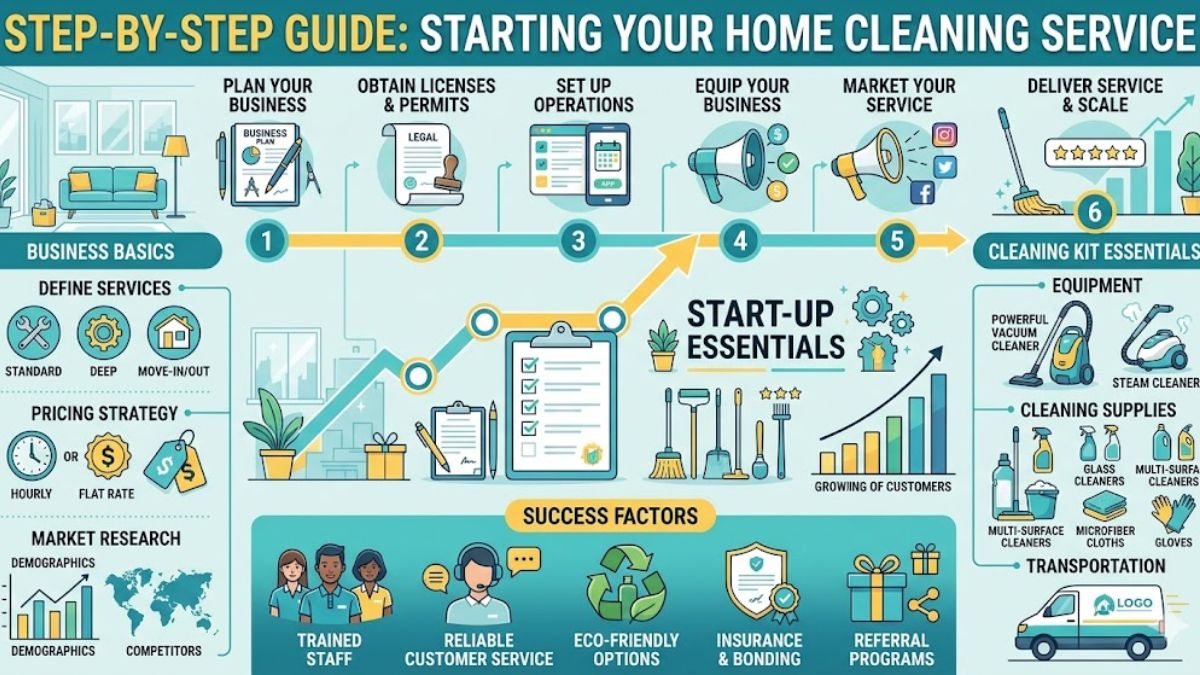
Introduction
Starting a home cleaning service in India today is no longer a small side hustle idea. It is a serious, scalable business opportunity driven by changing lifestyles, rising disposable income, and increasing demand for convenience. At its core, the idea is simple. You provide professional cleaning services to households that either lack time, trust, or tools to maintain their spaces regularly.
The demand exists because urban households are busier than ever. Dual-income families, working professionals, and even elderly homeowners are actively looking for reliable residential cleaning services. The traditional unorganized cleaning help system is inconsistent and lacks professionalism. This creates a gap that a structured, trained, and branded cleaning business can fill. This opportunity is open to anyone willing to build a service-oriented business. Whether you are a first-time founder, someone looking to start a small cleaning business from home, or an entrepreneur exploring low-investment startups, this space is accessible. You can begin from a single neighborhood and scale gradually.
Geographically, the opportunity is strongest in urban and semi-urban India. Cities like Tier 1 and Tier 2 markets are witnessing rapid growth in demand for organized home services. Timing also plays a key role. Post-pandemic awareness about hygiene has significantly increased, making cleaning services more essential than optional. The how is straightforward but requires execution discipline. You need a clear home cleaning business plan, trained staff, the right cleaning tools and equipment for business, and a strong local marketing strategy. Costs can start as low as ₹30,000 to ₹1.5 lakh depending on scale, making it one of the most practical startup ideas today.
1. Startup Idea Overview
The idea to start a home cleaning service revolves around solving a very real and everyday problem. Most households struggle to maintain deep cleanliness due to time constraints, lack of proper tools, or unreliable domestic help. This creates an opportunity to build a structured residential cleaning service setup. Unlike traditional maid services, a modern home cleaning business focuses on professional execution. This includes trained staff, defined processes, quality cleaning chemicals, and customer-friendly booking systems. The service is positioned as reliable, hygienic, and time-efficient.
Entrepreneurs who want to launch a home cleaning company are essentially building a service brand that combines trust with convenience. The model can begin small, focusing on a few households, and expand into a full-scale operation covering multiple areas. The simplicity of the idea is what makes it powerful. Cleaning is a recurring need. That means repeat customers, predictable demand, and strong potential for long-term growth.
2. Problem Statement & Solution
2.1 The Problem in the Current Market
If you look closely at how home cleaning works across most Indian households, you’ll notice something that people rarely say out loud but almost everyone experiences. It’s unpredictable. For years, families have relied on individual domestic workers. These are people who often learn on the job, without formal training, without standardized tools, and without any consistent method of doing things. One person might clean thoroughly, another might rush through the same task. Some days the work feels satisfactory, other days it doesn’t. There’s no system behind it. No benchmark. No accountability. And over time, that inconsistency starts to feel frustrating.
Now think about tasks beyond daily cleaning. Deep cleaning a kitchen that hasn’t been properly scrubbed in months. Removing stubborn grease. Cleaning a sofa that has absorbed dust for years. Sanitizing a bathroom thoroughly. These are not small jobs. They require effort, proper tools, and some level of expertise. But in the current unorganized setup, these tasks are either avoided or done poorly. That gap is where dissatisfaction builds. Then comes the bigger issue, trust.
Letting someone into your home is not a small decision. It’s a personal space. Families worry about safety, reliability, and professionalism. When there’s no formal structure, no verification, no accountability, hesitation becomes natural. So the problem is not just about cleaning. It’s about inconsistency, lack of specialization, and a deep trust deficit. And once you start seeing it this way, you realize the market is not just unorganized. It’s underserved.
2.2 The Practical Solution
Starting a home cleaning business is not just about offering a service. It’s about bringing order to something that has been chaotic for a long time. The first real shift comes from standardization. When you train your staff properly, when you define exactly how a service should be delivered, when you use the right tools for the right job, you remove guesswork. The customer knows what to expect. And more importantly, they get it consistently. That consistency builds confidence. Then comes the role of structure.
Even something as simple as clear service packages can make a huge difference. Instead of vague promises, customers see defined offerings, deep cleaning, sofa cleaning, kitchen cleaning, bathroom sanitization. Each with a clear scope, clear pricing, and clear timelines. Suddenly, the experience feels professional. Technology, even at a basic level, adds another layer of trust.
You don’t need a complex app to start. A simple WhatsApp booking system, a basic website, or even structured communication can make the process smoother. Customers want convenience. They don’t want to chase service providers or negotiate every time. When booking becomes easy and predictable, usage increases naturally. Branding also plays a surprisingly powerful role.
A uniform, a logo, a proper name, these things may seem small, but they change perception instantly. A customer feels more comfortable hiring a service that looks organized and accountable. And then there’s the checklist. A well-defined cleaning checklist is not just an operational tool. It’s a promise. It tells the customer exactly what will be done, leaving no room for confusion. It also ensures that your team delivers consistently, regardless of who is assigned to the job. When all these elements come together, trained staff, structured services, basic technology, and professional branding, you don’t just solve a problem. You create a completely different experience.
3. Target Audience & Customer Persona
Understanding who you are serving is where most businesses either succeed quietly or struggle endlessly. In the case of home cleaning services, the audience is not random. It’s quite specific, once you start paying attention. The core customer base is urban households with disposable income. These are people who are constantly balancing work, family, and personal time. Cleaning, especially deep cleaning, becomes something they postpone, not because they don’t care, but because they simply don’t have the time or energy.
For them, convenience is not a luxury. It’s a necessity. A typical customer might be a working professional living in an apartment. Their day is already packed. Weekends are often the only time they get to rest or spend with family. The idea of dedicating hours to cleaning feels exhausting. So they outsource. But they don’t just want someone to clean. They want reliability. They want to know that the job will be done properly without constant supervision. Then there are nuclear families.
3.1 With fewer people at home, responsibilities increase
With fewer people at home, responsibilities increase. Managing everything becomes harder. Professional cleaning services step in as support systems, not replacements, but extensions of the household. Another important segment is elderly homeowners. For them, physical tasks like deep cleaning can be difficult or even risky. Having access to a trusted service brings not just convenience, but peace of mind. And then there’s a growing segment that often gets overlooked, young renters and bachelors.
This group behaves differently. They may not need regular services, but they rely heavily on one-time or occasional cleaning. Moving into a new place. Preparing for guests. Cleaning before vacating a house. Their needs are specific, but frequent enough to create demand. Across all these segments, certain patterns are clear. Customers value transparency. They don’t like hidden costs. They want to know what they’re paying for. Value safety. Want to feel comfortable letting someone into their home. And they value convenience. Easy booking, clear communication, and timely service matter more than anything else. Understanding these behaviors is not optional. It shapes everything, from pricing to service design to customer experience.
4. Market Opportunity & Timing
If you step back and look at the bigger picture, the timing for entering the home cleaning business in India feels almost perfect. The demand is not being created. It already exists. For years, it existed in an unorganized form. Now, it’s slowly shifting toward structured services. Urbanization is one of the biggest drivers. As more people move into cities, living spaces change. Apartments replace independent houses. Space becomes limited. Cleaning becomes more frequent but also more challenging. At the same time, lifestyles are evolving.
People are busier. Work hours are longer. Commutes take time. The idea of spending hours cleaning is becoming less appealing. Convenience is becoming a priority. We’ve already seen this shift in food delivery, groceries, transportation. Home services are following the same pattern. Another major factor is awareness. In recent years, especially after global health concerns, people have become far more conscious about hygiene. Cleaning is no longer just about appearance. It’s about health.
This has changed customer expectations. Basic cleaning is no longer enough. People want thorough sanitization. They want professional-grade results. They are willing to pay for it. And yet, despite this growing demand, the market remains fragmented. There are organized players, yes. But there are still large gaps, especially in local markets and smaller cities. This creates an opportunity. For someone starting out, this is a rare combination.
High demand. Increasing awareness. Evolving customer behavior. And still enough room to build something meaningful. But opportunity alone is not enough. Execution will decide everything. Because in a service business like this, growth doesn’t come from just entering the market. It comes from delivering consistently, building trust slowly, and understanding that every home you serve is not just a transaction. It’s a relationship.
5. USP & Value Proposition
If you step into the home cleaning market today, you’re not entering an empty space. You’re stepping into a crowded, often confusing landscape where dozens of small providers are offering “cleaning” as a service. So the real question is not what you offer. It’s why someone should choose you over everyone else. That’s where your value proposition begins. The first and most powerful differentiator is reliability. This sounds simple, almost obvious. But in reality, it’s rare.
Most customers don’t expect perfection. What they truly want is consistency. If you say your team will arrive at 10 AM, they should arrive at 10 AM. If you promise a certain level of cleaning, it should be delivered without excuses. When that reliability becomes consistent, something shifts. Customers stop “trying you out” and start trusting you. And trust, in a service business, is everything. It’s what turns one-time users into repeat customers. It’s what drives referrals without you asking for them.
5.1 The second pillar is quality. Not just visible cleanliness
The second pillar is quality. Not just visible cleanliness, but the kind of quality that customers feel the moment they walk into their home after a service. The smell, the shine, the attention to detail. This is where tools and training come into play. Using the right equipment, vacuum cleaners that actually remove deep dust, proper brushes for different surfaces, safe but effective chemicals, these things don’t just improve results. They create a noticeable difference. And customers notice.
They may not always understand the technical side, but they can feel the outcome. And once they experience that difference, it becomes their new expectation. Then comes convenience. In today’s world, convenience is not a bonus. It’s a baseline. Customers don’t want to make multiple calls, negotiate pricing, or follow up repeatedly. They want a simple process, easy booking, clear communication, flexible timing, and transparent pricing. The smoother the experience, the more likely they are to return. Beyond these fundamentals, your USP can go deeper.
Some businesses differentiate through eco-friendly cleaning. Using non-toxic, sustainable products appeals to a growing segment of conscious customers. Others focus on specialization. Deep cleaning packages, post-construction cleaning, move-in/move-out services, these are high-value offerings that require skill but also command better pricing. When you combine reliability, quality, convenience, and a clear specialization, you’re no longer just another cleaning service. You become a brand people remember. And in a market driven by trust and experience, that’s what truly sets you apart.
6. Business Model & Pricing Strategy
At its core, a home cleaning business is simple. You provide a service. The customer pays for it. But building a sustainable business around that simplicity requires careful thinking. Most cleaning businesses operate on a service-based model. Customers either book individual services when needed or opt for recurring packages. One-time services bring quick revenue. Deep cleaning, sofa cleaning, or kitchen cleaning jobs often have higher ticket sizes. But the real stability comes from recurring customers. Weekly or monthly cleaning contracts create predictable income. They reduce the constant need to find new customers. Over time, they build a base that keeps your business running even during slow periods.
Pricing, however, is where many new businesses struggle. If you price too low, you attract customers but struggle to sustain operations. If you price too high without building trust, customers hesitate. So pricing needs to be thoughtful. In most markets, basic cleaning services typically fall in the ₹500 to ₹1,000 range, depending on the size of the home and scope of work. Deep cleaning services, which require more time, effort, and equipment, can range anywhere between ₹2,000 to ₹8,000 or even higher. But pricing is not just about numbers.
6.1 It’s about perceived value
It’s about perceived value. If a customer feels the service is worth what they’re paying, they don’t negotiate. If they don’t, even a lower price feels expensive. Margins in this business can be healthy, often between 20% to 40%. But those margins depend heavily on efficiency. How well you manage your team. How quickly you complete jobs without compromising quality. Effectively you reduce idle time and travel costs.
These small operational decisions directly impact profitability. Initial costs also need to be managed carefully. Equipment, salaries, and marketing are your main expenses. Overspending early can put pressure on cash flow. Starting lean gives you room to learn and adjust. Because in the early stages, you will make mistakes. And having financial flexibility helps you survive those mistakes.
7. Execution Plan & Launch Strategy
A lot of people spend weeks, sometimes months, planning a business. Very few actually start. In a service business like home cleaning, execution matters far more than perfect planning. The first step is clarity. What exactly are you offering? Are you focusing on basic daily cleaning, deep cleaning, or specialized services? Trying to do everything at once can dilute your efforts. Starting with a focused offering makes it easier to deliver quality. Next comes tools and setup.
You don’t need the most expensive equipment to begin, but you do need the right basics. A good vacuum cleaner, durable mops, proper brushes, and effective cleaning solutions can make a noticeable difference in service quality. Then comes hiring. Even a small team of two or three people is enough to start. But hiring is not just about filling positions. It’s about building a team that represents your business. Training becomes critical here.
Your team needs to understand not just how to clean, but how to interact with customers, how to handle different situations, and how to maintain professionalism inside someone’s home. Starting small is often the smartest move. Instead of trying to cover an entire city, focus on a specific area, a locality, a housing society, or a cluster of apartments. This reduces travel time, improves efficiency, and helps you build a strong local presence. Early customers are your foundation. Offering introductory pricing or small discounts can help attract them. But more importantly, delivering an excellent experience ensures they come back and recommend you to others. Marketing should not wait. Word-of-mouth is powerful, but it needs a starting push. Local ads, WhatsApp groups, social media, and even simple flyers can help you get initial traction. At this stage, your goal is not perfection. It’s momentum.
8. Budget, Resources & Infrastructure
One of the most practical advantages of starting a home cleaning business is that it doesn’t require heavy infrastructure. You don’t need a large office. You don’t need expensive setups. In fact, many successful businesses in this space begin from home. This makes it accessible. With a budget ranging between ₹30,000 to ₹1.5 lakh, you can get started. This typically covers basic equipment, cleaning supplies, simple branding, and initial marketing efforts. The key is to spend wisely. Invest in tools that improve efficiency. Avoid unnecessary expenses that don’t directly impact service quality or customer acquisition.
Transportation is another factor to consider. If you’re operating in a limited area, a two-wheeler may be enough. As you expand, you might need a small vehicle to carry equipment and move your team efficiently. In the beginning, your team will be small. And that’s okay. A small, well-trained team can handle initial demand effectively. As your customer base grows, you can gradually expand your workforce. What matters is not how big you start. It’s how well you manage what you have. Because in a business like this, growth doesn’t come from scale alone. It comes from consistency. From showing up on time. From delivering quality every single time. Building trust, one home at a time. And once that trust is built, growth follows naturally.
9. Brand Strategy
When people think about a home cleaning service, they don’t just think about mops and chemicals. They think about trust. Because at the end of the day, they are letting someone into their personal space. And that decision is rarely based on price alone. It’s based on how the brand makes them feel. That’s why branding in this business is not decoration. It’s foundation.
It starts with the name. A good brand name doesn’t need to be complicated. In fact, the simpler it is, the better. What matters is what it communicates. Cleanliness. Reliability. Professionalism. When someone hears your name for the first time, they should immediately have a sense of what you stand for. Then comes the visual identity. Your logo, colors, and overall look may seem like small details, but they shape perception instantly. Colors like blue and green work well because they subconsciously signal freshness, hygiene, and safety. A clean, simple logo is easier to remember and easier to trust. But branding goes beyond visuals.
9.1 It’s in the way you communicate. Every message
It’s in the way you communicate. Every message, whether it’s a WhatsApp reply, a phone call, or a social media post, should feel consistent. Calm, clear, and reassuring. Customers don’t want complicated language. They want clarity. They want to know what will happen, when it will happen, and what it will cost. That consistency builds familiarity. And familiarity builds trust. Positioning is where many businesses make a silent but critical decision. Are you a budget-friendly service? Or are you positioning yourself as a premium, high-quality provider?
There is no right or wrong choice. But there is a wrong approach, trying to be both. If you position yourself as affordable, your focus will be on volume, efficiency, and competitive pricing. If you position yourself as premium, your focus shifts to quality, experience, and attention to detail. This choice will influence everything, your pricing, your marketing, your hiring, even the kind of customers you attract. A strong brand is not built overnight. It’s built through repetition. Through delivering the same promise again and again until customers start believing it without questioning. And once that happens, your brand starts working for you.
10. Vendor & Partner Strategy
Behind every good cleaning service, there’s a system that customers never see. The products you use. The tools your team carries. The suppliers you depend on. These decisions quietly shape the quality of your service. Choosing the right vendors is not just about cost. It’s about reliability. If your cleaning chemicals are inconsistent, your results will be inconsistent. Tools break down frequently, your team slows down. If supplies run out unexpectedly, your entire operation gets disrupted.
These are the kind of problems customers may never fully understand, but they will definitely feel the impact. That’s why quality should never be compromised. Using low-grade products might save money in the short term, but it can damage surfaces, leave poor results, and most importantly, damage your reputation. And reputation, once lost, is hard to rebuild. Reliable suppliers become long-term partners.
Over time, you develop a rhythm with them. You know what to expect. They understand your requirements. This stability allows you to focus on what truly matters, delivering great service. Then there’s the power of partnerships. This is where growth can accelerate quietly but significantly. Collaborating with housing societies can give you access to a concentrated customer base. Property managers and real estate agents often need cleaning services for new tenants or property handovers. These are recurring opportunities. Instead of chasing individual customers every day, partnerships create a steady flow of work. And in a service business, predictability is a huge advantage.
11. Go-to-Market & Customer Acquisition Channels
Starting a home cleaning business is one thing. Getting your first 50 customers is another. Customer acquisition is often where reality hits. You may have the best service, the best team, even the best pricing, but if people don’t know you exist, none of it matters. The first focus should always be local visibility. This is a hyperlocal business. People prefer services that are nearby, accessible, and responsive. So instead of trying to reach everyone, start by becoming known in a specific area.
Social media can be surprisingly powerful here. Before-and-after photos are not just content. They are proof. They show real results. Help customers visualize what they can expect. And that builds trust faster than any advertisement. Consistency matters more than perfection. Posting regularly, engaging with comments, responding to queries quickly, these small actions create a sense of reliability. Local SEO is another long-term asset.
When someone searches for cleaning services in their area, your business should appear. Optimizing for relevant keywords, maintaining updated listings, and collecting customer reviews all contribute to this visibility. And reviews matter more than most people realize. A potential customer may not know you. But they trust the experience of others. A few genuine positive reviews can influence decisions more than any marketing campaign. At the same time, don’t underestimate offline channels. Pamphlets in residential societies, small banners, referrals through existing customers, these methods may feel old-fashioned, but they work. Especially in local markets where trust spreads through word-of-mouth. The goal in the early stage is simple. Be visible. Be consistent. Reliable. The rest follows.
12. Growth & Retention Strategy
Getting customers is hard. Keeping them is where real growth happens. In a home cleaning business, repeat customers are the backbone of sustainability. One-time services bring revenue, but recurring customers build stability. This is why subscription plans are powerful. Weekly or monthly cleaning packages not only ensure regular income but also strengthen the relationship with the customer. Over time, your team becomes familiar with their home, their preferences, and their expectations.
That familiarity improves service quality naturally. But retention is not just about offering packages. It’s about experience. Every interaction matters. Showing up on time. Completing the job thoroughly. Being respectful inside someone’s home. These things may seem basic, but they are often the reason customers choose to stay or leave. Satisfied customers don’t just come back. They refer. And referrals are the most valuable form of growth. They come with built-in trust.
12.1 As your base grows, expansion becomes the next step
As your base grows, expansion becomes the next step. But expansion should be gradual. Covering too large an area too quickly can reduce service quality. It increases travel time, complicates scheduling, and puts pressure on your team. Growing step by step allows you to maintain standards while scaling operations. Adding new services is another way to grow. Once customers trust you, they are more likely to try additional offerings, deep cleaning, sofa cleaning, sanitization, or even specialized services. This increases revenue per customer without the need to acquire new ones.
Retention strategies can go a step further. Loyalty programs, small discounts for repeat bookings, personalized offers, these gestures make customers feel valued. And when customers feel valued, they stay longer. In the end, growth in this business is not about aggressive expansion. It’s about consistency. Doing the job well. Building trust slowly. And turning first-time customers into long-term relationships. Because once that foundation is strong, growth stops feeling forced. It starts happening naturally.
13. Team Structure & Responsibilities
In the early days of building a home cleaning business, the “team” is often just one person trying to hold everything together. That person is you. You’re answering customer calls, managing bookings, buying supplies, training staff, handling complaints, and somehow still trying to think about growth. It’s messy, exhausting, and honestly, a little overwhelming at times. But it’s also where you learn the most.
Because when you handle everything yourself, you understand the business at a very real level. You see where things break. You notice what customers care about. Learn which parts of the operation actually drive value. And that understanding becomes your biggest advantage later. As the business starts to grow, even slightly, you’ll feel the pressure first in operations.
Bookings increase. Schedules get tighter. Coordination becomes harder. This is usually the point where bringing in a supervisor or operations manager becomes necessary. This person becomes your bridge between planning and execution. They ensure teams reach on time. They handle day-to-day issues. Keep things moving when you’re pulled into other responsibilities. A good operations person doesn’t just manage tasks, they prevent chaos. At the same time, not everything needs to be handled in-house.
13.1 Certain functions, like digital marketing or accounting
Certain functions, like digital marketing or accounting, can be outsourced effectively. Hiring full-time for these roles too early can strain your budget. Outsourcing gives you access to expertise without long-term commitment. But structure is not just about hiring people. It’s about clarity. Who is responsible for what? Who handles customer complaints? Tracks inventory? Ensures service quality? When these roles are clearly defined, even a small team operates more smoothly. And as you scale, this clarity becomes the difference between controlled growth and constant firefighting. Because a business doesn’t grow just by adding more people. It grows by building systems that allow people to work together without friction.
14. Risks, Challenges & Mitigation
No matter how promising the opportunity looks, every business comes with its own set of challenges. And in a service business like home cleaning, those challenges are very real, and very immediate. One of the biggest operational challenges is staff turnover. This is a field where workers often move between jobs, look for better pay, or leave without much notice. When that happens, service quality can drop overnight. A well-trained team member leaving means you’re suddenly back to training from scratch.
The only way to manage this is proactively. Create an environment where people feel respected. Pay on time. Offer small incentives for consistency. Provide basic training that makes their work easier and more professional. When workers feel valued, they are more likely to stay. Then come customer complaints. No matter how careful you are, mistakes will happen. A missed spot. A delay. A misunderstanding. What matters is not avoiding complaints entirely, that’s unrealistic. What matters is how quickly and sincerely you respond.
14.1 A customer who feels heard is often more forgiving than one who feels ignored
A customer who feels heard is often more forgiving than one who feels ignored. Sometimes, a simple apology and a quick fix can turn a negative experience into a positive one. Financial risks are another layer. Demand in this business can fluctuate. Some weeks are busy, others are slow. Costs, especially labor and supplies, can increase over time. This is where discipline matters.
Maintaining a small buffer fund gives you breathing space during slower periods. It allows you to pay salaries, manage expenses, and avoid panic decisions. And then there’s competition. New players can enter the market easily. Prices can be undercut. Customers may try different services. You can’t control competition. But you can control how you position yourself. Strong branding, consistent service, and a focus on customer experience create differentiation that price alone cannot compete with. Challenges don’t disappear as you grow. They evolve. But if you build the habit of addressing them early and honestly, they become manageable instead of overwhelming.
15. Legal, Compliance & Fundamentals
This is the part many people tend to overlook in the beginning. Not because it’s unimportant, but because it doesn’t feel urgent. But getting the basics right early saves you from bigger problems later. Starting a home cleaning business doesn’t involve heavy legal complexity, but there are a few essentials you cannot ignore. Depending on your revenue, GST registration may become necessary. Even if you’re starting small, it’s worth understanding when and how this applies to your business.
Local regulations can vary. Some cities may require specific licenses or permissions. It’s always better to check these requirements early rather than deal with unexpected issues later. Then comes employee documentation. Even with a small team, having basic agreements in place is important. It sets expectations clearly, roles, responsibilities, payment terms, and conduct. It also protects both sides. Insurance is another layer that often gets ignored.
Accidents can happen. Equipment can get damaged. Having basic coverage reduces risk and gives you peace of mind. And then there’s documentation. Invoices, records, expense tracking, these may feel like administrative work, but they are critical. They help you understand your business better. They keep things transparent. And they make future growth smoother. Think of compliance not as a burden, but as a foundation. When your basics are strong, you operate with confidence.
16. Long-Term Vision & Goals
In the beginning, the goal is simple. Get your first few customers. Deliver good service. Survive the early chaos. But once the business stabilizes, the question changes. Where do you want this to go? For some, the goal is to build a steady local business. Something reliable, profitable, and manageable. For others, the vision is bigger. Expanding into multiple neighborhoods. Then multiple cities. Building a brand that people recognize and trust across regions.
And that kind of scale is possible in this industry. But scaling requires a shift in thinking. What works for 10 customers may not work for 1,000. This is where technology starts playing a bigger role. Simple tools like booking systems, customer databases, and scheduling software can make operations smoother. Over time, more advanced systems, mobile apps, CRM platforms, automated workflows, can transform how the business runs.
Technology doesn’t replace service. It supports it. It reduces manual effort, improves coordination, and enhances customer experience. Brand building also becomes more important as you grow. A recognizable brand allows you to charge better prices. It creates loyalty. It reduces dependence on constant marketing. People don’t just choose a service. They choose a name they trust. Diversification is another natural step. Once your base service is strong, you can expand into related areas, commercial cleaning, office maintenance, post-construction cleaning, or even specialized services like sanitization. Each new service adds another layer of revenue. But expansion should always follow strength. Build one thing well first. Then grow.
17. Future Outlook
If you look at where the home cleaning industry in India stands today, it’s still in transition. A large part of the market remains unorganized. But customer expectations are changing quickly. People are becoming more conscious about hygiene. More selective about who they hire. More willing to pay for quality and reliability. This shift is creating opportunity. Not just for large companies, but for small, well-run businesses that focus on doing things right. The barrier to entry is low. You don’t need massive capital to start. But sustaining and growing the business requires something deeper. Consistency. Professionalism. Attention to detail. Because in this industry, customers remember how you made them feel.
Did the service reduce their stress? Did it save their time? It make their home feel better? If the answer is yes, they come back. If not, they move on. The future will likely bring more competition, but also more awareness. Customers will expect better service, clearer communication, and higher standards. And that’s a good thing. Because it rewards businesses that take their work seriously. For entrepreneurs, this space offers something rare. A chance to start small, learn quickly, and build something meaningful over time. Whether you want to run a local operation or scale into a larger brand, the path exists. But like any business, the outcome depends on execution. Those who focus on trust, deliver consistently, and keep improving will not just survive. They will stand out.
About foundlanes.com
foundlanes.com is India’s leading startup idea discovery platform. It helps entrepreneurs find actionable startup opportunities, market insights, and industry-specific guidance to turn ideas into real businesses. With deep research and practical resources, foundlanes supports founders at every stage, from idea validation to launch and growth.