


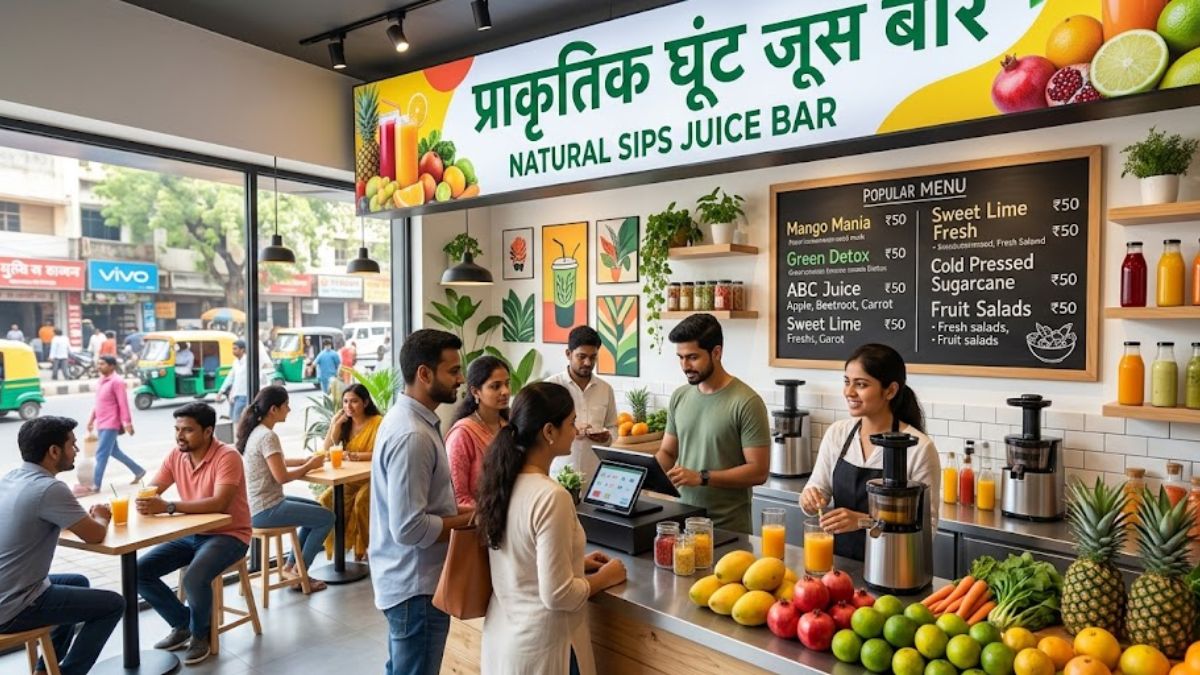
Introduction
Starting a juice shop in India is one of the most accessible and practical small business ideas today. It answers a growing consumer need for fresh, healthy, and affordable beverages while requiring relatively low investment compared to other food businesses. From busy urban streets to tier-2 towns, juice shops have become a familiar and trusted part of daily consumption habits. Whether it is a morning glass of orange juice or a post-workout protein smoothie, the demand is consistent and rising.
The idea of starting a juice shop revolves around offering freshly prepared fruit juices, shakes, and healthy drinks to customers who are increasingly shifting away from carbonated beverages. This shift is driven by health awareness, fitness culture, and lifestyle changes. Entrepreneurs, students, and small business owners are particularly drawn to this model because it can be started with a modest budget, even under ₹1 lakh in some cases, and scaled gradually.
A juice shop business in India can be launched in high-footfall areas such as markets, near gyms, schools, offices, or hospitals. The best time to start is now, as the market is expanding due to increasing health consciousness. The process involves selecting the right location, procuring equipment, sourcing fruits, getting licenses like FSSAI registration for juice shop, and creating a simple but effective business plan. In terms of cost, a small fruit juice shop setup can begin between ₹50,000 to ₹2 lakhs depending on scale, while profit margins can range from 40% to 70% due to low raw material costs and high perceived value. With the right execution, branding, and customer retention strategies, this simple business can evolve into a scalable juice bar brand.
1. Startup Idea Overview
The idea of a juice shop might sound simple on the surface, but it actually sits at the intersection of everyday habit, health awareness, and fast-moving urban lifestyles. At its core, it is a business that transforms raw, seasonal fruits into fresh beverages that people can consume instantly without effort. What makes it powerful is not complexity, but repeat usage. People don’t buy juice as a luxury. They buy it as a quick fix for thirst, health, or energy during their day.
In India, this demand has always existed in an unstructured way. From small roadside carts squeezing oranges in front of customers to modern café-style juice bars in malls, the culture of fresh juice is already deeply embedded in daily life. But the real opportunity is not in proving demand. It is in organizing it. A properly designed juice shop business in India focuses on consistency, hygiene, branding, and experience, turning something informal into a reliable, trusted product that customers can return to every day without hesitation.
What makes this idea especially strong is its emotional positioning. People are increasingly aware of what they consume. After long exposure to sugary sodas and processed drinks, there is a natural shift toward freshness. A juice shop becomes more than a store; it becomes a small daily health decision for customers. Whether it is a mango juice in summer heat, a sugarcane drink after work, or a simple detox mix after a heavy meal, the product fits naturally into real human routines.
2. Problem Statement & Solution
2.1 The Problem in the Market
The juice market in India is large, but it is fragmented and inconsistent. On one side, you have roadside vendors who offer freshness but often struggle with hygiene standards, water quality concerns, and inconsistent taste. Customers may love the affordability, but there is always a lingering hesitation about cleanliness, especially in urban environments where awareness about health is much higher.
On the other side, packaged juices offer convenience and branding, but they come with their own trade-offs. Most are processed, stored for long periods, and often contain added sugars, preservatives, and artificial flavoring. This removes the “freshness factor” that customers actually want when they think of juice. So people are stuck between two imperfect options: fresh but unsafe, or safe but not truly fresh.
This gap creates a quiet frustration in the market. Customers don’t always articulate it, but they feel it every time they buy juice. They want something they can trust without thinking twice. That emotional gap is where most juice businesses either fail or succeed.
2.2 The Solution Offered
A structured juice shop business solves this by combining three things that are often missing together in this industry: hygiene, consistency, and transparency. When customers can actually see fruits being cut, blended, and served in front of them, trust builds naturally. Clean counters, proper storage of fruits, filtered water usage, and standardized preparation processes immediately change the perception of the product.
But the real strength is consistency. A customer should get the same taste and quality whether they come today or after two weeks. That is where standard recipes, portion control, and staff training become critical. Once this consistency is achieved, the juice shop stops being just a street-level vendor and starts behaving like a reliable brand. Entrepreneurs who treat it seriously, almost like a micro food brand rather than a stall, tend to see much stronger results. Even in competitive areas, customers gradually shift toward outlets where they feel safe, respected, and confident about what they are consuming. Over time, this creates loyalty that is surprisingly strong for such a low-ticket product.
3. Target Audience & Customer Persona
The beauty of a juice shop business is that it does not rely on a single customer type. It naturally fits into multiple daily routines, which is why footfall can remain steady throughout the day if location is right. Urban professionals are one of the most consistent customer groups. They are often short on time and actively look for quick refreshment options during office breaks or while commuting. For them, juice is not just a drink, it is a small reset between long working hours.
Students form another highly active segment. Around colleges, coaching centers, and tuition hubs, juice shops often become informal meeting points. Price sensitivity exists, but frequency of purchase is high, which balances volume and revenue. Fitness-conscious customers bring a different kind of value. They are more selective, often preferring detox drinks, protein smoothies, or low-sugar options. Even though their volume may be lower compared to students, their willingness to pay for quality is higher, which improves overall margins.
Families and daily commuters also add stability to the business. They may not visit every day, but they create consistent baseline demand, especially during evenings and weekends when consumption patterns shift toward leisure and refreshment. A typical customer, if you look closely, is someone between 18 to 40 years old who values health, wants convenience, and is willing to spend a small but meaningful amount for something they trust. That combination makes this market surprisingly stable once trust is built.
4. Market Opportunity & Timing
The Indian beverage market is going through a quiet but important transformation. People are becoming far more conscious about what they consume, not in a dramatic way, but in everyday decisions. This shift is being driven by rising gym culture, increased awareness around nutrition, and a general move toward wellness-oriented lifestyles.
What is interesting is that this shift is not limited to metro cities anymore. Tier-2 and tier-3 cities are experiencing the same change, often at a faster adoption rate because new businesses can shape customer expectations from the beginning. Cities like Jamshedpur, Indore, Surat, and Lucknow are seeing a steady rise in organized juice outlets that focus on hygiene and branding rather than just selling cheap drinks.
Modern juice shop business models are also very different from traditional stalls. Today, even small outlets use digital payments, branded packaging, social media visibility, and sometimes even delivery integrations. This makes the business feel more structured and trustworthy to customers. The timing is strong because entry barriers are still relatively low compared to many other food businesses. You don’t need massive infrastructure, but you do need discipline in execution. That combination of low setup cost and growing demand creates a rare window where small entrepreneurs can enter early and still build meaningful local dominance if they execute well.
5. USP & Value Proposition
The real success of a juice shop rarely comes from just selling drinks, it comes from what customers feel every time they walk in. Freshness is the first and most important promise. When a customer watches fruits being cut, peeled, and blended right in front of them, it creates a sense of trust that no packaged drink can replicate. That moment of visibility matters more than people realize. It removes doubt and replaces it with confidence.
Hygiene is the second pillar, and in many ways, it is what decides whether a customer comes back or not. Clean counters, properly washed fruits, filtered water, and neat preparation areas silently communicate professionalism. Even if the customer doesn’t consciously think about it, they feel it. In this business, perception is everything, and hygiene builds that perception faster than any marketing campaign. Customization is where a juice shop starts to feel personal instead of transactional. When someone can ask for no sugar, extra protein, or a specific detox blend based on their health goals, the drink stops being generic. It becomes “their drink.” That small emotional shift increases loyalty significantly. Customers don’t just return for juice, they return because they feel understood.
Speed completes the experience. In real life, most juice purchases are impulsive. People are walking between work, college, or errands. If they have to wait too long, interest drops instantly. A well-run juice shop understands this psychology and delivers within minutes. That quick turnaround turns juice from a product into a habit, something people can comfortably fit into their daily routine without planning.
6. Business Model & Pricing Strategy
At its core, a juice shop runs on a simple but powerful revenue model: high frequency, low-ticket sales. The real strength lies in volume and repetition rather than large individual transactions. When location and execution are right, customers start treating it as part of their daily rhythm instead of an occasional purchase.
Pricing plays a very psychological role here. Basic juices like orange, watermelon, or pineapple are usually kept in the ₹30–₹60 range because they act as entry points. These are the “comfort choices” that bring people in without hesitation. Once inside, customers naturally explore premium options like kiwi, avocado blends, or mixed fruit combinations priced between ₹100–₹150. This layered pricing structure works because it mirrors real human behavior, starting simple and gradually upgrading based on curiosity or need.
One of the most underrated advantages of this business is margin structure. Fruits, when sourced in bulk and managed properly, offer strong cost efficiency. A single fruit can often be converted into multiple servings, and wastage can be controlled with good planning. This creates healthy margins even at relatively low pricing. Over time, smart operators introduce small psychological levers like combo offers, loyalty cards, or weekly subscription plans. These are not just sales tactics, they are retention tools. A subscription model, even something as simple as “daily morning juice,” can stabilize revenue and turn unpredictable walk-ins into predictable income.
7. Execution Plan & Launch Strategy
7.1 Planning the Setup
The first real decision that shapes everything is location. A juice shop is not a destination business; it is a visibility business. It survives on footfall, not destination intent. That is why areas near colleges, gyms, offices, bus stops, and markets perform significantly better than isolated spots. Even a small 100–200 sq ft space is enough if the location is right, because this business is more about flow than size.
Once the location is fixed, setup becomes about efficiency. The juice shop setup is not complex, but it needs discipline. Equipment like juicers, blenders, refrigeration units, and clean storage systems form the backbone of daily operations. What often gets ignored by beginners is cold storage management. Fresh fruits define quality, and without proper storage, both cost and taste suffer quickly.
7.2 Licenses and Registrations
On the compliance side, a juice shop license in India is not optional, it is essential for long-term survival. The most important requirement is FSSAI registration, which ensures that food safety standards are officially recognized. It is not just a legal formality, it also improves customer trust when displayed visibly in the shop. Depending on scale, additional registrations like GST and local municipal permissions may be required. While many small operators initially overlook documentation, businesses that formalize early tend to scale more smoothly without regulatory friction later. In food businesses especially, compliance builds credibility.
7.3 Launching the Business
The biggest mistake new owners make is launching with too many options. A strong juice shop usually starts with a small, focused menu. This helps control inventory, reduce confusion, and maintain consistency in taste. A limited menu also allows staff to become efficient faster, which directly improves customer experience.
A soft launch phase is often where real learning happens. Instead of heavy advertising, the focus is on observing customer behavior. What sells first, what gets repeated, what gets ignored. This feedback loop is extremely valuable because it shapes the final menu in a practical way rather than assumptions. Over time, the menu expands naturally based on demand rather than guesswork, which keeps the business aligned with real customer preference instead of internal bias.
8. Budget, Resources & Infrastructure
The beauty of a juice shop business in India is its accessibility. Entry does not require massive capital, which is why it attracts many first-time entrepreneurs. A basic setup can start under ₹1 lakh if it is a small roadside or compact stall model. This includes basic equipment, initial fruit inventory, and minimal branding. A more structured setup, with better interiors, seating, and branding, typically ranges between ₹2–₹5 lakhs. At this stage, the business starts shifting from a stall mindset to a small retail experience. Customers begin to perceive it differently, not just as a quick stop, but as a trusted outlet.
Equipment forms the operational core. Juicers, blenders, cutting tools, refrigeration units, and storage containers must be reliable because breakdowns directly affect sales. Unlike many businesses, downtime in a juice shop is immediately visible in lost customers. Manpower needs are intentionally low. Most shops start with one or two people managing preparation and service. This keeps overheads light and allows owners to stay directly involved in quality control, which is often the difference between average and excellent execution.
9. Brand Strategy
Branding in a juice shop is often underestimated, but in reality, it decides long-term survival. When products are similar across competitors, branding becomes the only real differentiator. A strong brand creates recall, trust, and emotional familiarity.
The name of the shop should be simple and instantly connected to freshness, health, or energy. Complicated or abstract names rarely work in this segment because customers make decisions quickly. Visual identity also plays a silent but powerful role. Colors like green, orange, and yellow naturally trigger associations with fruits, freshness, and vitality, making the shop more inviting without any verbal communication.
Beyond visuals, the real brand is built through consistency. If a customer receives the same taste, hygiene level, and service experience every time, trust builds naturally. Over time, that trust becomes more valuable than price. People start choosing the shop not because it is the cheapest, but because it feels reliable. In many ways, even a small juice shop can become a strong local brand if it focuses on repetition, discipline, and experience rather than just sales volume.
10. Vendor & Partner Strategy
In a juice shop business, everything quietly begins and ends with one thing: the quality of fruits. No branding, no interior design, and no marketing can fix a bad raw material. That is why choosing the right fruit vendors becomes one of the most emotionally and financially important decisions for the business. Most successful juice shop owners rely heavily on local wholesale fruit markets because that is where freshness and pricing balance each other. But the real difference is not just where you buy, it is who you build trust with. Over time, strong relationships with vendors lead to better sorting of fruits, priority during shortages, and sometimes even better pricing during peak seasons. This relationship-based supply chain often becomes an invisible advantage that outsiders don’t notice, but operators deeply rely on.
Another layer that often gets overlooked is packaging. If the shop offers takeaway or delivery, packaging stops being a small detail and becomes part of the brand experience. A juice that leaks, looks messy, or loses temperature too quickly can completely change customer perception. Clean, sturdy, and visually appealing packaging silently communicates professionalism. In many cases, customers judge the entire brand based on how the product survives after leaving the shop.
11. Go-to-Market & Customer Acquisition Channels
In the early days, a juice shop does not grow because of ads or strategy decks. It grows because people see it, feel it, and try it. Location visibility is the first and strongest acquisition channel. A well-placed signboard with clear pricing, bright colors, and visible fruit displays often does more marketing than any digital campaign. People walking by should instantly understand what is being sold and feel a small pull of curiosity.
But once the shop stabilizes, digital presence starts playing a much bigger role than most people expect. Instagram becomes a visual menu where freshness can actually be shown instead of described. WhatsApp becomes a surprisingly powerful retention tool, where regular customers get updates about new juices, seasonal specials, or small offers. These channels are not about scale in the beginning, they are about staying in the customer’s mind.
Online delivery platforms add another layer of reach, especially in urban areas where people want convenience without stepping out. Even though margins may slightly reduce due to platform commissions, the trade-off is access to customers who may never physically pass by the shop. Over time, this combination of offline visibility and online presence creates a balanced acquisition system that keeps demand steady throughout the day.
12. Growth & Retention Strategy
Real growth in a juice shop does not come from attracting new customers alone, it comes from making existing customers return without thinking twice. Retention is where the business becomes stable. When someone starts associating a shop with freshness, consistency, and reliability, price stops being the main decision factor.
One of the most effective retention tools is simple variation. Introducing seasonal fruits, limited-time combinations, and small experimental flavors keeps curiosity alive. Customers don’t just come back for the same drink; they come back to see what is new. That emotional curiosity is often stronger than discounts.
Loyalty programs also play a quiet but powerful role. Something as simple as “buy 10 get 1 free” or digital stamp cards can significantly increase repeat visits. These systems work not because of financial benefit, but because they create a sense of belonging. Once the first outlet becomes stable, expansion naturally becomes a possibility. Some owners choose a second location, while others move toward franchising. But the key condition is stability. Growth without operational control often leads to inconsistency, which can damage the original brand.
13. Team Structure & Responsibilities
In the early stage of a juice shop, the founder is not just a decision-maker, they are often the backbone of the entire operation. From procurement to customer interaction, everything flows through them. This hands-on involvement is not optional; it is what shapes quality standards and customer experience in the beginning.
A small team is usually enough to run operations smoothly. One person focuses on juice preparation, ensuring speed and consistency. Another handles billing, customer interaction, and maintaining cleanliness. This division may look simple, but it is critical because in a fast-moving environment like a juice shop, even small delays or hygiene lapses can affect customer perception immediately.
As the business grows, roles start becoming more defined. Preparation, inventory management, customer service, and cleaning gradually get separated into dedicated responsibilities. At a slightly larger scale, owners often outsource accounting and digital marketing to professionals. This helps them focus more on operations and quality control instead of getting stuck in administrative work. What often determines success here is not the size of the team, but how disciplined the team is in following standards every single day.
14. Risks, Challenges & Mitigation
The juice shop business may look simple from the outside, but it carries very real operational risks that directly affect profitability. The biggest and most constant challenge is perishability. Fruits do not wait. They ripen, spoil, and lose quality quickly. This means even small mistakes in inventory planning can lead to direct financial loss. Over-ordering leads to wastage, while under-ordering leads to missed sales opportunities.
Seasonality is another reality that every juice shop experiences. Some fruits are abundant and cheap in certain months, while in other seasons they become expensive or unavailable. At the same time, customer demand also shifts with weather. For example, summer brings high demand and strong sales, while colder months can slow down footfall. Businesses that survive this cycle are the ones that adapt their menu dynamically instead of relying on fixed offerings.
Competition is perhaps the most visible challenge. In many areas, multiple juice vendors operate within the same radius. In such an environment, price alone cannot sustain a business. Customers quickly move toward outlets that feel cleaner, more reliable, and more consistent. This is where branding, hygiene, and experience become survival tools rather than optional improvements.
The most effective way to handle these risks is not through one big solution, but through consistent small systems: better inventory tracking, flexible menu planning, strict hygiene discipline, and continuous attention to customer feedback. Over time, these small controls create a business that is not just reactive, but stable and resilient in a highly competitive environment.
Future Outlook
The future of the juice shop business in India looks promising. As health awareness continues to grow, the demand for fresh and natural beverages will only increase. Entrepreneurs who start a juice shop today with a strong focus on quality, hygiene, and branding can build sustainable and scalable businesses. With relatively low investment and high margins, this remains one of the best juice business ideas India has to offer.
About foundlanes.com
foundlanes.com is India’s leading startup idea discovery platform. It helps entrepreneurs find actionable startup opportunities, market insights, and industry-specific guidance to turn ideas into real businesses. With deep research and practical resources, foundlanes supports founders at every stage, from idea validation to launch and growth.