


Introduction
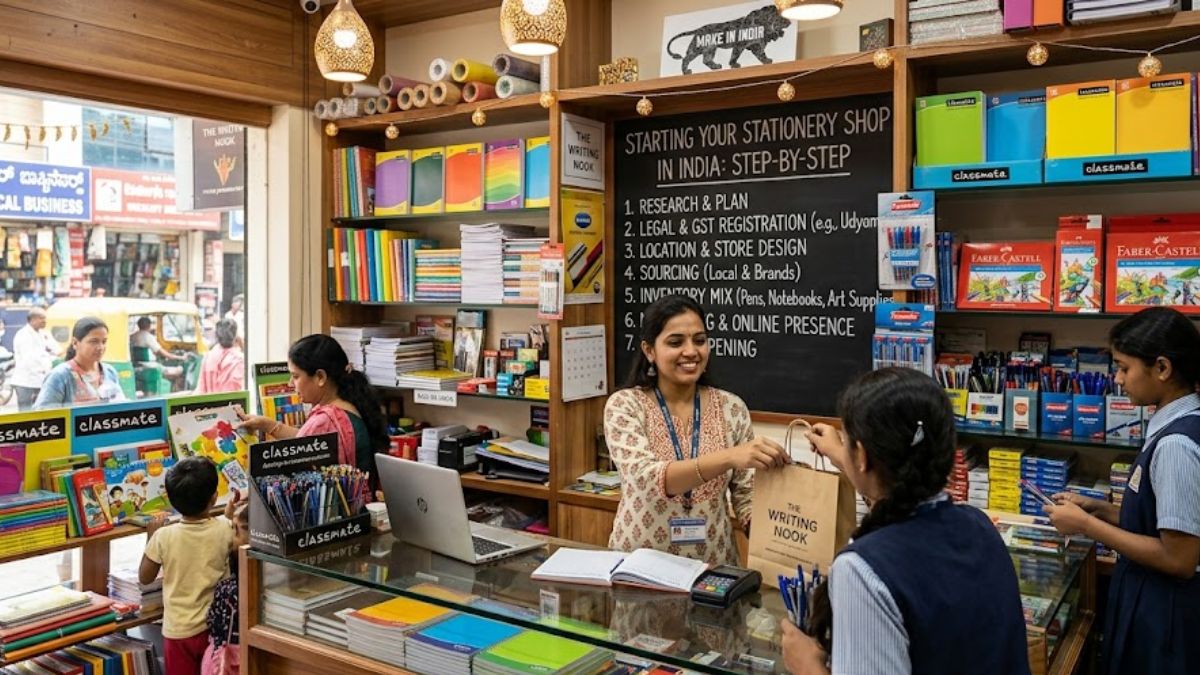
Starting a stationery shop in India is one of the most practical and evergreen small business ideas, especially in a country where education, office work, and documentation remain deeply rooted in daily life. Whether it is school students buying notebooks, college-goers picking up project materials, or offices needing regular supplies, the demand for stationery products is consistent and recurring. This makes the idea not just stable but also scalable with the right execution.
The appeal of this business lies in its simplicity and accessibility. Anyone from a first-time entrepreneur to a small-town retailer can start a stationery shop with relatively low investment. It can be launched in urban markets, semi-urban areas, or even villages, depending on demand and competition. The timing is also right, as India’s growing population of students and expanding corporate ecosystem continues to fuel demand for school and office supplies.
If you are wondering how to start a stationery shop, the process involves understanding your local market, sourcing products from reliable wholesale suppliers, setting up a small retail space, and building customer trust through pricing and product availability. The initial investment can range from ₹50,000 to ₹5 lakh depending on scale, location, and inventory choices. In this detailed guide crafted for FoundLanes.com readers, we break down everything you need to know about how to open a stationery shop in India, from planning and budgeting to branding and growth strategies. Whether you aim for a small neighborhood store or a larger retail outlet, this roadmap will help you build a profitable stationery business step by step.
1. Startup Idea Overview: Starting a Stationery Shop in India
Starting a stationery shop in India may sound simple on the surface, but when you look closely, it sits at the intersection of necessity, habit, and daily human life. It is one of those rare businesses that quietly survives every wave of digital change because it is tied to education, offices, and basic documentation needs that never really disappear.
At its core, a stationery shop setup in India is about providing everyday essentials like notebooks, pens, pencils, files, registers, art supplies, and printing materials. But in practice, the successful ones go beyond that. They become small community supply hubs where students rush in before exams, parents buy school materials at the last minute, and office workers rely on bulk supplies to keep operations running smoothly.
What makes this idea powerful is its stability. Unlike trend-based businesses that rise and fall quickly, stationery demand remains steady throughout the year. There are predictable spikes, especially during school admissions, new academic sessions, and exam seasons. These cycles create a rhythm that business owners can actually plan around. Many shop owners eventually realize that once trust is built in the locality, customers stop comparing prices every time and simply return out of habit and reliability. That loyalty becomes the real foundation of income.
2. Problem Statement & Solution
2.1 Market Gaps in the Stationery Business
In many parts of India, especially in tier-2 and tier-3 cities, the stationery experience is still unorganized. Customers often walk into small shops expecting basic items but end up facing limited choices. A student looking for a specific type of notebook or a particular pen brand may not find it. Office buyers needing bulk supplies often struggle with inconsistent availability.
There is also a subtle but important issue of pricing inconsistency. Many small retailers do not have strong access to wholesale stationery markets, which forces them to buy at slightly higher costs. This difference eventually gets passed on to customers. Over time, people start feeling that they are paying more without getting better variety or service. These gaps might look small individually, but together they create frustration. And frustration in everyday essentials creates opportunity for a better-organized business model.
2.2 Practical Solution Through a Modern Stationery Store
A well-planned stationery shop does not just fill shelves, it solves these frustrations systematically. The first real shift comes from sourcing. When you connect directly with stationery wholesale markets in India, you immediately gain control over pricing and variety. This allows you to offer better rates without hurting margins. The second shift is inventory discipline. Instead of randomly stocking items, successful shop owners observe demand patterns. They understand which products move fast during school season and which items are essential for office buyers. Over time, this creates a rhythm where stock availability becomes predictable and customers start trusting the shop for consistency.
Then comes value addition. A modern stationery store rarely survives on product sales alone. Services like photocopying, printing, lamination, spiral binding, or even basic document work can completely change footfall. In many real-world cases, these services become the daily traffic driver, while stationery sales naturally follow. A student coming for photocopy often ends up buying notebooks or pens without even planning to. That small behavior shift is where profitability quietly grows.
3. Target Audience & Customer Persona
The strength of a stationery business lies in how well it understands human behavior at a very local level. It is not a mass market abstract concept, it is deeply personal and hyper-local.
3.1 Primary Customers
Students are the backbone of this business. From school children to college students, their needs are constant and recurring. They don’t just buy once, they keep coming back throughout the academic year. Their requirements also change frequently, from notebooks and pens to project materials, charts, and exam supplies. What makes this segment interesting is emotion. Parents often accompany younger children, and buying stationery becomes a small but meaningful routine. If the shop feels friendly, organized, and reliable, it quickly becomes a trusted stop for years.
3.2 Secondary Customers
Office professionals and small business owners form the second major group. Their demand is different but equally consistent. They need files, registers, printer paper, envelopes, billing books, and bulk office essentials. Unlike students, they value speed and reliability even more than variety. For them, a good stationery shop is not just a store, it is a backup system. When something runs out at the last moment, they want a place they can trust without hesitation. That trust often leads to bulk repeat orders, which quietly stabilize monthly revenue.
3.3 Behavioral Insights
Across both groups, the behavior is surprisingly similar. People prioritize three things: convenience, availability, and fair pricing. Most customers are not constantly comparing shops. They stick with the one that saves time and consistently has what they need. This is where the emotional layer of the business becomes important. A shop that remembers regular customers, keeps frequently used items in stock, and maintains a clean, organized space naturally builds loyalty. Over time, that loyalty becomes more valuable than aggressive pricing strategies.
4. Market Opportunity & Timing
India’s stationery demand is deeply tied to its education system and growing workforce. Every year, millions of students enter schools, colleges, and coaching institutes, which automatically drives consumption of basic supplies. At the same time, the rise of startups, small offices, and freelance work culture continues to increase demand for office essentials. Even with digital tools becoming more common, physical stationery has not reduced in importance. Documentation, exams, official paperwork, and creative work still rely heavily on physical materials.
The opportunity becomes even stronger in semi-urban and developing areas. In many of these regions, organized retail is still limited. Most shops are small, fragmented, and inconsistent in service. This creates a clear gap for entrepreneurs who are willing to build a more structured, customer-focused stationery business. What makes the timing even more interesting is the entry barrier. It does not require massive investment, complex technology, or advanced infrastructure. It requires observation, consistency, and understanding of local demand patterns. That combination makes it one of the most practical small business opportunities in India today.
5. USP & Value Proposition
In a competitive local market, survival is not about being the cheapest shop, it is about being the most reliable one. A strong stationery shop builds its identity around consistency. Customers should never feel unsure whether they will find what they need. One powerful advantage is variety. A shop that offers a wider range of products naturally attracts more footfall because people prefer solving all their needs in one place instead of visiting multiple stores.
Another major differentiator is supply control. When a shop sources directly from stationery wholesale suppliers, it gains better pricing power. This allows competitive pricing without sacrificing margins, which is critical for long-term sustainability. But the most underrated USP is experience. A clean, organized, and easy-to-navigate store changes everything. When customers can quickly find what they need without confusion, it creates a sense of comfort. That comfort slowly turns into habit, and habit turns into loyalty. In the end, a successful stationery business is not just about selling pens and notebooks. It is about becoming part of everyday life in a community, quietly supporting education, work, and small moments of daily routine.
6. Business Model & Pricing Strategy
A stationery shop runs on one of the most practical and easy-to-understand business models in retail. You buy products in bulk from wholesalers and sell them at a small markup. On paper, it looks simple, but the real outcome depends on how well you manage pricing balance, inventory flow, and customer behavior. Most products sit in a margin range of 15% to 40%, but this number does not tell the full story. The real game is in how fast items move. A product with a low margin like pens or notebooks can still generate strong profit because it sells every day. On the other hand, premium items like art kits, geometry boxes, branded diaries, or specialty supplies may sit longer but give you higher profit per sale.
Over time, successful shop owners learn something important. Not every product needs to make high profit. Some products are just there to bring customers into the shop. Once they are inside, they naturally end up buying additional items. That invisible mix of footfall and upselling is where real earnings grow. A balanced pricing strategy usually works best in real-world conditions. Daily-use items are priced competitively because customers are very aware of those prices. Even a small difference of ₹2 or ₹5 can influence their decision. But niche or premium products give you breathing space, where pricing can be slightly higher without resistance.
If you really want to understand how profitable a stationery business in India can be, the answer is not fixed. Two shops on the same street can have completely different results. The difference comes from location quality, customer loyalty, stock management, and how quickly inventory rotates. A well-managed shop with steady footfall often performs far better than a larger shop with poor execution. In many real cases, owners realize that profit is not made on individual products but on consistency. Daily small sales, repeated customers, and controlled wastage create a stable income cycle that builds slowly but reliably over time.
7. Execution Plan & Launch Strategy
7.1 Step-by-Step Approach
Starting a stationery shop in India is less about complexity and more about execution discipline. The first real step is market observation. Before investing anything, it helps to simply spend time in the chosen area. Watch what existing shops are selling, what customers are asking for, and what is consistently missing. This gives you clarity that no online research can fully replace.
Location selection becomes the next critical decision. A shop near schools, colleges, coaching centers, or busy office clusters immediately changes your chances of success. These areas naturally generate repeat demand. In many cases, even a slightly higher rent is worth paying if footfall is guaranteed.
After that comes sourcing. Building relationships with stationery wholesale markets in India is where many new entrepreneurs either win or struggle. Good suppliers not only give better pricing but also ensure steady availability. Over time, these relationships become one of the strongest assets of the business. The final step before launch is setup. This is where many beginners underestimate importance. A clean layout, clear product placement, and easy navigation inside the shop can directly influence sales. Customers should not feel confused while searching for basic items. A well-arranged shop often sells more without needing any extra effort because people naturally notice more products.
7.2 Soft Launch Strategy
A soft launch is often where the real learning begins. Instead of opening with full expectations, smart shop owners test the market first. They start with limited inventory, observe customer behavior, and adjust quickly. Small discounts or introductory offers can help bring initial footfall. But the real value of this phase is feedback. Customers will directly tell you what is missing, what is overpriced, and what they expect from a local stationery store. This feedback is more valuable than any business plan on paper.
Many first-time owners experience something interesting here. They realize that demand is not always what they assumed. Some items they thought would sell fast may stay untouched, while unexpected products move quickly. This stage helps refine inventory decisions before scaling up. Over time, this adjustment process becomes the foundation of a stable business model.
8. Budget, Resources & Infrastructure
The cost of starting a stationery shop in India varies widely, but what matters more than the number is how intelligently the money is used. A small setup can begin with around ₹50,000 to ₹1 lakh, while a more structured store may go up to ₹3 lakh to ₹5 lakh or more depending on size and location.
But in real-world experience, many shop owners later say that the initial investment was less important than how they managed their early months. Even a well-funded shop can struggle if inventory is poorly chosen or location is weak. On the other hand, a small shop in the right area can grow steadily through consistent daily sales. The main cost components include shop rent and deposit, initial inventory purchase, shelving and display setup, and a basic billing system. Among these, inventory often becomes the most critical decision. Many beginners either overstock too early or buy the wrong mix of products, which leads to blocked capital.
One of the most important lessons in this business is simple but often learned the hard way. Cash flow matters more than stock size. Keeping money moving through the business ensures flexibility. It allows you to restock fast-moving items and remove slow-moving ones without pressure.
Infrastructure does not need to be fancy, but it must be functional. Good lighting, visible product arrangement, and easy billing make a noticeable difference in customer experience. Over time, these small details quietly influence whether customers return or look for alternatives. In the end, a stationery shop grows not because of a big one-time investment, but because of steady decisions made every day with awareness of what customers actually need.
9. Brand Strategy
A stationery shop may look like a simple retail setup from the outside, but branding is what quietly separates an average store from a trusted local name. In this business, your brand is not just a nameboard outside the shop. It is the feeling customers carry when they think about where to buy their everyday essentials.
The first step is choosing a name that feels natural, easy to pronounce, and memorable for local customers. Complicated or overly modern names often get ignored in small markets. What works better is simplicity that sticks in memory, especially for students and parents who repeatedly visit the shop. The logo does not need to be flashy. In fact, simplicity works better here too. A clean design with basic stationery symbols can build recognition over time. The goal is not to impress people once, but to make sure they recognize you instantly every time they pass by.
But real branding in this business is built through behavior, not design. Customers slowly start associating your shop with three things: reliability, fair pricing, and convenience. If they walk in once and find exactly what they need without stress, that memory stays. If they come again and experience the same consistency, trust begins to form. Over time, successful stationery shops naturally evolve into “default shops” for their area. People stop thinking before visiting. That is the strongest form of branding in local retail.
10. Vendor & Partner Strategy
Behind every stable stationery shop is a strong supplier network that most customers never see. Vendors decide your pricing power, your stock availability, and indirectly your reputation in the market.
The biggest mistake beginners make is treating suppliers as one-time contacts instead of long-term partners. In reality, the relationship you build with wholesalers often determines how smoothly your business runs during peak demand seasons like school reopening months or exam periods. Good vendors are not just about low prices. They are about consistency. If a supplier can deliver the same quality and stock on time every time, your shop becomes more reliable in the eyes of customers. On the other hand, even slightly cheaper suppliers can hurt your business if they create delays or inconsistent product quality.
Most successful shop owners build relationships gradually through local wholesale markets. Once trust is established, they often get access to better pricing, priority stock during shortages, and flexible credit arrangements. These small advantages matter a lot in a business where margins are tight and timing is everything. Over time, your vendor network becomes a hidden strength. It is what allows you to survive sudden spikes in demand without losing customers.
11. Go-to-Market & Customer Acquisition Channels
When you start a stationery shop, the first few weeks decide how quickly you build momentum. Visibility is everything. If people do not know your shop exists, even the best inventory will not help. Local marketing is where most real success comes from. Simple actions like distributing flyers near schools, colleges, coaching centers, and offices can create immediate awareness. Opening discounts also work well because they give people a reason to try your shop once. And in this business, that first visit is often the hardest to earn.
There is also a quieter but very powerful channel that many beginners underestimate: presence in local memory. When a student hears about your shop from a friend, or a parent sees it during daily travel, it slowly becomes familiar. That familiarity turns into trust over time.
Digital visibility also plays a growing role now. Listing your shop on Google Maps or local directories may sound small, but it helps new customers find you without effort. Many people today simply search “stationery shop near me” and choose from visible results. However, the strongest channel in this business still remains word-of-mouth. If one customer has a good experience, they naturally bring others. A satisfied student tells classmates. A satisfied office buyer tells colleagues. That chain reaction builds organic growth that no advertisement can fully replace.
12. Growth & Retention Strategy
Once your shop stabilizes, the focus naturally shifts from attracting customers to keeping them. In stationery retail, retention is where real long-term profit lives. Consistency becomes your biggest asset. Customers should never feel uncertain about availability or pricing. Even small inconsistencies can push them toward competitors. On the other hand, a shop that always has stock ready becomes part of their routine.
Relationships matter more than transactions here. Regular customers start expecting familiarity. They remember how they are treated, whether they are greeted properly, and whether their needs are understood without explanation. These emotional micro-moments decide loyalty more than discounts.
Over time, simple retention strategies like small loyalty discounts or bulk purchase benefits can make a noticeable difference. Office buyers especially appreciate predictable pricing and occasional value offers. Growth also comes from subtle expansion. Adding related categories like school bags, art materials, greeting cards, or basic gift items increases average bill value without requiring a completely new customer base. Many successful shops quietly evolve this way without even realizing it at first.
13. Team Structure & Responsibilities
In the early stage, a stationery shop is often run like a personal project. The owner manages purchasing, sales, customer interaction, and basic accounting. This hands-on phase is actually important because it builds deep understanding of what sells and what does not.
As the business grows, workload naturally increases. At that stage, even one or two assistants can make a big difference. They help manage billing, organize shelves, and handle day-to-day customer flow. This allows the owner to focus on sourcing, pricing decisions, and expansion planning.
Eventually, some tasks become better handled externally. Accounting, GST filing, and compliance work are often outsourced to professionals. This reduces errors and frees mental space for business decisions that actually drive growth. The key idea is simple. You do not scale by doing everything yourself. You scale by slowly shifting from execution to supervision.
14. Risks, Challenges & Mitigation
Like any retail business, a stationery shop comes with its own set of challenges. The most visible one is competition. In many areas, multiple shops operate within close distance. Price wars can sometimes happen, but long-term survival rarely depends on being the cheapest. It depends more on service quality and consistency.
Inventory management is another silent risk. Stocking too much of the wrong product can lock your money for months. Stocking too little of fast-moving items can lead to lost sales. Over time, successful shop owners develop a natural sense of demand patterns, but in the beginning, tracking sales carefully is essential.
Seasonality also plays a role. Certain months bring high demand, especially during school openings, while other periods may feel slower. A balanced inventory mix helps smooth out these fluctuations so revenue does not feel unstable. The real mitigation strategy in this business is discipline. Regular review of stock, careful observation of customer behavior, and willingness to adjust quickly make a huge difference.
15. Legal, Compliance & Fundamentals
Running a stationery shop also involves basic legal setup, even if it feels like a simple business. A shop and establishment registration is usually required depending on your state rules. It ensures that your business operates legally and can function without regulatory issues.
If your turnover crosses the required threshold, GST registration becomes necessary. Even if you start small, maintaining proper billing from day one helps avoid complications later. Clear invoicing, proper purchase records, and compliance with local regulations may not feel exciting, but they build long-term stability. Many small businesses face issues later simply because they ignored these basics in the beginning.
16. Long-Term Vision & Goals
A stationery shop does not have to remain a small local store forever. With consistent execution, it can evolve into a much larger retail identity. Some shop owners expand into multiple branches in nearby areas. Others move into wholesale distribution, supplying to smaller retailers. Some even develop private-label products over time once they understand customer demand deeply. There is also a growing opportunity in blending offline and online presence. Accepting bulk orders through messaging apps or local delivery systems can extend reach beyond walk-in customers. The long-term path depends on ambition, but the foundation remains the same: trust built through consistency over time.
17. Future Outlook
Despite rapid digital growth, the stationery business in India continues to remain stable and relevant. Education is expanding, corporate work still depends on documentation, and creative industries continue to rely on physical materials. What is changing is how the business is run. Shops that adopt better inventory systems, improved customer service, and simple digital visibility are gradually outperforming traditional setups.
The real opportunity today is not just starting a stationery shop, but building it in a way that feels modern, organized, and reliable. Customers are not just looking for products. They are looking for convenience and trust in one place. If that balance is achieved, this business does not just generate income. It creates a steady, predictable flow of daily demand that can support long-term financial stability.
About foundlanes.com
foundlanes.com is India’s leading startup idea discovery platform. It helps entrepreneurs find actionable startup opportunities, market insights, and industry-specific guidance to turn ideas into real businesses. With deep research and practical resources, foundlanes supports founders at every stage, from idea validation to launch and growth.