


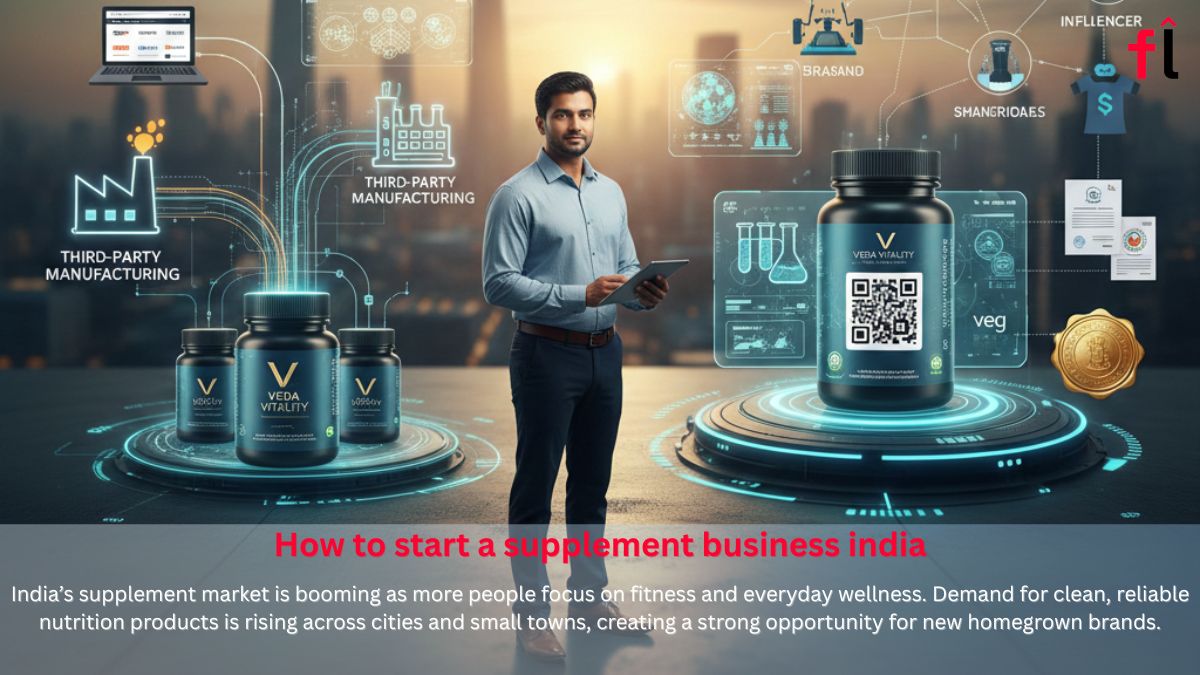
Summary
Starting a supplement business in India is no longer a niche idea reserved for fitness influencers or large FMCG companies. It has grown into a serious entrepreneurial opportunity driven by rising health awareness, a surge in sports nutrition demand, and a shift toward preventive wellness. For anyone exploring how to start a supplement business, the first question is simple. What exactly does it take to enter a nutraceutical market that has become both competitive and full of room for innovation?
India has moved from a market dominated by a few global protein powder brands to a country where consumers buy multivitamins, herbal blends, pre-workouts, immunity boosters, Omega-3 capsules and plant-based protein as part of everyday routines. The demand is rising in metros, Tier II cities and even smaller towns. This shift helps create openings for homegrown supplement brands built on credibility, transparent sourcing and strong regulatory compliance. Young professionals, gym enthusiasts, endurance athletes, students and working parents now look for reliable brands they can trust. This is the gap new startup founders can fill.
India’s nutraceutical market is still under-penetrated
The idea works because India’s nutraceutical market is still under-penetrated compared with global standards. Rising disposable incomes, the growth of e-commerce, influencer-led fitness culture, and the government’s tightening of FSSAI guidelines have created a more level playing field for serious founders. The entry cost depends on the path you choose. Private label manufacturing keeps the budget low. Building your own production line requires more capital but offers more control. In general, founders need between INR 5 lakh and INR 25 lakh to build a lean but credible launch-ready brand.
Anyone looking to start a supplement business in India today must understand how regulations work, how to select manufacturers, how to build trust, and how to compete in markets where misinformation is common. The right timing is now, because India’s nutraceutical demand is projected to keep expanding for the next decade. With a solid execution plan, the model works across both online and retail channels. The following guide breaks down everything from customer personas to vendor strategy, pricing, margins, compliance, long-term vision and early go-to-market steps. This is a complete roadmap for launching a new-age supplement brand designed for FoundLanes.com readers.
1. Startup Idea Overview
The idea of starting a supplement business in India sits at the intersection of consumer wellness and scientific nutrition. The core proposition is to create a brand that offers safe, regulated, high-quality nutraceutical products that people can trust. Consumers often complain about supplements that fail to meet label claims, use poor-quality ingredients or lack transparency about sourcing. Many want clean formulations backed by proven benefits and verified manufacturing standards. The opportunity lies in building a brand that solves these concerns with consistency.
A supplement business is more than selling protein or multivitamins. It can grow across categories like sports nutrition, herbal blends, daily wellness capsules, gut health solutions, immunity products and plant-based alternatives. The model works because it can be customized for different customer segments and price points. The rise of direct-to-consumer brands has changed how people discover and evaluate supplements. Founders can start with a single flagship product, validate demand and then expand into ranges.
The value creation happens through product formulation, quality assurance, brand positioning and customer education. Most consumers struggle to understand ingredient labels. A brand that communicates clearly and focuses on science-backed benefits gains trust. When you start a supplement business, you are not only selling a product but also offering clarity in a sector that has long suffered from confusion. This gives new founders room to build credibility quickly.
2. Problem Statement and Solution
India’s supplement industry has grown, but not without issues. The biggest problem is inconsistency in product quality. Many brands import low-grade raw materials, use inaccurate dosage claims or package supplements in a way that misleads customers. As health awareness increases, customers want factual information, not exaggerated marketing. This mismatch between expectations and reality keeps the market scattered and unreliable.
Another issue is the lack of trustworthy Indian brands that openly share their sourcing, certifications and testing processes. People end up relying on international names because they assume global brands follow superior standards. The gap is not a lack of demand. The gap is the absence of transparent, science-driven local brands. Rising counterfeit products on e-commerce platforms add another layer of concern, especially in the sports nutrition segment.
A supplement startup can solve these issues with a simple but powerful approach. It can work with FSSAI-certified manufacturers, choose validated formulations, implement batch-wise lab testing and share results publicly. It can simplify labels and avoid unnecessary fillers. can build trust using education-led content around how each formulation works. The solution is credibility, consistency and genuine product value. When customers see a brand commit to these fundamentals, loyalty follows.
3. Target Audience and Customer Persona
A supplement business serves multiple consumer segments, each with distinct motivations. The largest group includes young professionals aged 22 to 35 living in urban areas. They are actively trying to improve their fitness or maintain a consistent health routine. They follow advice from trainers, influencers and nutritionists. prefer brands that look modern, offer clean formulations and provide clear proof of efficacy.
The next segment includes gym-goers, bodybuilders and fitness enthusiasts who consume pre-workouts, whey protein, creatine and amino acid supplements. This audience values performance-based results. They pay attention to ingredient ratios and respond well to transparent lab test reports. Many are open to switching brands when they see authenticity and better pricing.
A rapidly growing persona includes women aged 25 to 40 who buy supplements for daily wellness, hormonal balance, hair health and immunity. They look for credibility, safe ingredients and lower side effects. Another major segment includes older adults who buy Omega-3, calcium, multivitamins and joint supplements. They rely on doctor recommendations and often prefer brands with pharmaceutical-style communication.
Students and young adults form an emerging group interested in brain health, focus blends, energy products and plant-based protein. With rising competition exams and digital learning fatigue, mental wellness supplements are gaining traction. A new brand can succeed by targeting two or three personas instead of spreading thin. Each segment offers consistent demand and long-term retention opportunities.
4. Market Opportunity and Timing
India’s nutraceutical business has reached a stage where growth is predictable and steady. The market is projected to continue expanding through the next decade. The rise of lifestyle diseases, preventive health habits and gym culture has created stable consumer demand. Sports nutrition alone is seeing rapid growth due to athletes, fitness centers and influencer-led awareness. This shift makes it a strong time to start a supplement business with specialized products.
The timing is ideal for several reasons. E-commerce has made supplement buying easier. Consumers read reviews, compare brands and look for certifications. This transparency rewards brands that maintain quality. Another factor is regulatory tightening by FSSAI. Earlier, the market was filled with unregulated products. New compliance norms have reduced the presence of unreliable brands, which has improved consumer trust in certified ones.
Plant-based, vegan and herbal formulations are seeing momentum. India’s tradition of Ayurveda blends well with modern nutraceutical innovation. This combination opens doors for categories like ashwagandha blends, moringa capsules, herbal immunity boosters and digestive enzymes with Ayurvedic ingredients. With the right execution, founders can position their brand across both modern and traditional health categories.
5. USP and Value Proposition
A successful supplement brand in India needs a clear value proposition. Consumers are overwhelmed by choices, so a founder must define why their brand exists and how it stands apart. The strongest USP begins with trust. In a sector where misinformation spreads easily, authenticity becomes a differentiator. When a brand commits to transparent sourcing, third-party testing and honest product labeling, customers respond positively.
Another strong USP is clean formulations. Many supplements include additives that do nothing for the consumer. A brand built around minimalist ingredient lists and science-backed dosages can position itself as a reliable choice. Customers now look for supplements that align with their lifestyle. Vegan, sugar-free, gluten-free and non-GMO claims matter when they are genuine and backed by certifications.
A brand can also differentiate through education. Most people search online for nutritional information but often find unreliable sources. A founder who invests in expert-led content, clinical insights and product explainer videos can build a loyal community around clarity. This approach helps consumers trust the brand beyond the product. In a crowded nutraceutical business landscape in India, education-driven marketing becomes a competitive asset.
Customer service can be another part of the USP. Easy returns, subscription plans and quick customer support create a sense of reliability. When combined with competitive pricing, a brand can reach a wide customer base. A well-defined value proposition ties these elements together. It explains why the brand exists, how it makes consumers’ lives better and what they can expect from every product.
6. Business Model and Pricing Strategy
A supplement business operates on a clear and scalable business model. Most founders choose between two approaches. The first is private-label manufacturing. It requires lower capital because the production is handled by third-party vendors certified under FSSAI. Founders can focus on branding, marketing and distribution. This model suits first-time entrepreneurs who want a faster launch. The second approach is setting up in-house manufacturing. It requires a higher budget but provides more control over formulations, quality standards and long-term margins.
Revenue comes from selling supplements through online marketplaces, direct-to-consumer websites, social media channels, gyms, clinics and retail stores. Subscription models are powerful because supplements are repeat-purchase products. When customers take daily vitamins or protein, they develop a habit. Offering monthly refill plans helps stabilize revenue.
Pricing depends on product type. Protein supplements require higher raw material costs, especially if they use imported whey. Vitamins, herbal capsules and gummies have lower production costs and better margins. On average, private-label products in India offer margins between 40 and 60 percent. Brands with in-house manufacturing can achieve higher margins once scale increases.
A smart pricing strategy balances affordability and perceived quality. If the price is too low, customers question the formulation. If the price is too high, the brand struggles to reach a mass audience. A credible supplement brand positions itself within a reasonable premium range and justifies pricing with transparent quality, clean formulations and verifiable outcomes.
7. Execution Plan and Launch Strategy
Launching a supplement business requires methodical steps. The first step is identifying the product category. Founders should choose one or two flagship products instead of launching a full range. This helps maintain focus. Protein powder, multivitamins, ashwagandha capsules, Omega-3 and gut health blends are strong starting options depending on the target audience.
Once the product category is finalized, the next step is selecting a manufacturer. The vendor must hold FSSAI certification, GMP approval and the capability to run batch-wise testing. Founders should ask for sample production runs, raw material sourcing details and past brand portfolios. After selecting a manufacturer, work begins on formulation. Clear dosage levels, scientific justification and ingredient transparency should guide this stage.
The next step is packaging and labeling. A supplement label must include accurate ingredient lists, nutritional information, usage directions, FSSAI details and warnings. A strong packaging design helps the product stand out while maintaining regulatory clarity. After packaging, founders should file necessary documentation to comply with Indian nutraceutical regulations.
A minimum viable product launch usually begins online. A simple landing page, social media presence and early customer sampling help validate product-market fit. Influencer partnerships, expert reviews and gym collaborations provide initial traction. Once the MVP gains positive feedback, the brand can expand into new SKUs, marketplaces and retail partnerships. A phased launch ensures controlled growth.
8. Budget, Resources and Infrastructure
Starting a supplement business in India can be done with a lean budget. For founders choosing private-label supplements, costs range from INR 5 lakh to INR 15 lakh depending on product complexity. This includes initial inventory, packaging, branding, lab testing, web development and basic marketing. Founders opting for their own production unit require INR 20 lakh to INR 50 lakh or more, depending on machinery, space and compliance requirements.
The largest cost component for most new brands is inventory. Supplements must be produced in batches. Minimum order quantities vary by manufacturer. Most private-label vendors require commitments between 300 to 1,000 units per SKU. Founders should choose limited inventory to reduce financial strain. Raw material costs vary by ingredient quality. Imported whey, Omega-3 and collagen cost more, while herbal formulations use locally available ingredients and are more budget-friendly.
Resources include a small team. A brand can begin with a founder, a digital marketer, a designer and a part-time nutrition consultant. Most operations like logistics, packaging, production and warehousing can be outsourced. Tools such as Shopify, WooCommerce, CRM dashboards and marketplace management platforms make operations manageable.
Infrastructure needs depend on the business model. Private-label founders need no physical setup. Those building a production unit require a clean facility, testing equipment, storage space and strict hygiene protocols. Founders must also factor in regulatory spending for FSSAI license fees, lab tests and documentation. When planned carefully, infrastructure remains manageable and scalable.
9. Brand Strategy
A supplement brand in India needs a strong identity to break through the noise. The name should be easy to remember, meaningful and reflective of the brand promise. Names that signal wellness, performance, purity or science work well. The logo should remain simple, clean and visible across packaging sizes. Colors influence perception. Blue, green, black and white are common in wellness branding, but unique combinations can help the brand stand apart.
Brand voice should feel reliable and conversational. Consumers want clarity, not exaggerated health claims. The tone must balance credibility with accessibility. A science-heavy voice may alienate new users, while an overly casual tone may hurt trust. A founder should aim for a voice that explains benefits clearly, avoids jargon and respects customer intelligence.
Positioning is crucial. A brand can position itself as premium, science-backed, herbal, vegan, performance-driven or value-focused. The choice affects pricing, partnerships, marketing and customer profile. Founders should research competitors, identify whitespace in the market and craft a positioning statement that reflects long-term goals.
Consistency matters. The website, social media, product packaging and email communication should feel uniform. When customers recognize a consistent brand identity, trust grows naturally. In a nutraceutical business, perception influences purchase decisions significantly.
10. Vendor and Partner Strategy
A supplement business depends heavily on reliable vendors. The relationship with the manufacturer defines product quality, consistency and compliance. Founders should evaluate manufacturers based on certification standards, capacity, ingredient sourcing practices and transparency. A strong manufacturing partner should have FSSAI approval, GMP certification and documented quality control procedures. They should be willing to share batch test results and provide insight into raw material origins.
Selecting ingredient vendors is another critical decision. Even if production is outsourced, founders should know where key ingredients come from. High-quality whey often comes from select suppliers in Europe and the United States. Herbal ingredients usually come from certified farms or extraction labs in India. The goal is to ensure ingredients meet the claimed standards and remain free from contamination, adulteration or dilution.
Packaging partners play a major role too. Bottles, jars, pouches and capsules must meet hygiene standards. Label printing vendors must follow regulations regarding FSSAI labeling norms. Packaging affects customer perception. Low-quality packaging creates doubt about the product inside. Founders must choose partners capable of maintaining consistency through frequent supply cycles.
Beyond manufacturing and packaging, partnerships with nutritionists, fitness coaches, gyms, and healthcare professionals help strengthen credibility. They act as bridges between the brand and target customers. Influencer partnerships should go beyond one-off promotions. Long-term collaboration builds authentic advocacy.
Good vendor and partner strategy is about stability. A supplement brand that maintains long-term relationships with trusted partners reduces operational interruptions and builds a reputation for reliability. For a new entrant trying to start a supplement business in India, such stability is essential for growth.
11. Go-to-Market and Customer Acquisition Channels
Launching a supplement brand requires a thoughtful distribution and customer acquisition strategy. Most new brands begin online. E-commerce offers access to a broad audience without high upfront investment. A direct-to-consumer website becomes the brand’s primary home. It allows founders to control storytelling, communicate certifications and showcase customer testimonials. A well-built site improves conversion and retention.
Marketplaces like Amazon, Flipkart and health-focused platforms help boost early discoverability. These platforms have high-intent customers searching for protein, multivitamins and Ayurvedic supplements. Listing products with optimized keywords, high-quality images and detailed descriptions can increase visibility. Positive reviews become social proof that drives new buyers.
Social media channels like Instagram, YouTube and Facebook remain effective for building awareness. Consumers in the fitness and wellness sector often seek advice from influencers. Partnership with micro-influencers provides authenticity. Video explainers simplify complex formulations. Regular educational content helps position the brand as a trustworthy source of knowledge.
Offline channels also matter. Gyms, sports clubs, coaching centers and wellness clinics can become powerful early distribution partners. Trainers and nutritionists hold influence over customer decisions. Product sampling at local fitness centers builds direct engagement. Pharmacies and specialty health stores offer credibility for certain categories like Omega-3, vitamins and herbal supplements.
Email marketing and retargeting ads help convert customers who show interest but do not immediately purchase. Since supplements are repeat-use products, every customer acquired has long-term potential. The right acquisition strategy balances reach, cost-effectiveness and community building.
12. Growth and Retention Strategy
Long-term growth in the supplement business depends on customer trust and product efficacy. Retention becomes easier when customers notice real benefits. A strong retention strategy begins with transparency. Brands that share lab test reports, ingredient insights and usage guides help customers stay informed. When customers understand how and why a product works, they are more likely to continue using it.
Subscription models are effective for improving retention. Customers who consume daily tablets, capsules or powders prefer automated deliveries. A brand that offers timely dispatches, flexible pause options and discounts for subscribers can build predictable revenue. Personalized emails highlighting progress, nutrition tips and reminders also help maintain engagement.
Product diversity can drive growth. Once a flagship product gains traction, founders can introduce complementary products. A customer who buys whey protein may also buy BCAAs or multivitamins. Someone taking an immunity supplement may buy a probiotic or Omega-3. Bundling products helps increase average order value.
Customer feedback loops are essential. Founders should study reviews, complaints and recurring questions. This helps refine formulations, packaging and communication. Brands that adapt based on customer insights build stronger loyalty than brands that operate only on marketing-driven assumptions.
Scaling requires smart channel expansion. A brand can move from online-only distribution to retail partnerships, international markets and specialized wellness centers. Growth also depends on operational readiness. Consistent inventory, reliable delivery and strong customer support keep retention healthy. When trust compounds, growth follows naturally.
13. Team Structure and Responsibilities
A supplement startup can begin with a lean team, but clarity in roles is essential. The founder usually handles strategy, vendor negotiation and compliance oversight. A co-founder or early team member with expertise in fitness, nutrition or health sciences strengthens credibility. Their role includes reviewing formulations, ensuring accuracy in communication and guiding scientific content.
A digital marketer handles website traffic, campaigns, SEO and social media presence. They work closely with designers who build packaging, product visuals and advertising creatives. A content specialist helps build educational material that simplifies supplement usage, clarifies dosage instructions and highlights product value.
As operations scale, a supply chain manager becomes important. They coordinate with manufacturers, packaging partners, logistics providers and marketplaces. Their role ensures inventory remains consistent. A customer support lead helps manage queries, returns, subscription plans and feedback loops.
Some functions can be outsourced early on, such as accounting, compliance documentation, performance marketing and packaging design. Outsourcing helps control costs while ensuring professional execution. As the brand grows, hiring full-time specialists becomes practical.
The strength of the team is not in size but in coordination. Clear responsibilities help maintain quality and ensure smooth execution across all functions.
14. Risks, Challenges and Mitigation
The supplement industry carries unique risks. The biggest challenge is regulatory compliance. FSSAI rules for nutraceuticals evolve frequently. Brands must stay updated to avoid legal issues. Working with experienced consultants and manufacturers helps reduce compliance-related risks.
Product quality is another concern. Raw material quality fluctuates based on global supply chains. Brands must use batch testing and strict quality checks to maintain consistency. Transparent reporting helps build trust and protect brand reputation.
Competition is intense. Many brands enter the industry, but only those with strong differentiation survive. To mitigate competitive pressure, founders should avoid price wars and focus on brand identity, formulation quality and scientific communication.
Inventory risk is real because supplements have expiry dates. Over-ordering increases the chance of dead stock. Founders should begin with small batches and scale gradually based on demand.
Reputation risk is another factor. Negative reviews or product recalls can damage a brand quickly. Active customer support and honest communication help manage such situations. Brands that address issues with clarity tend to recover faster.
Marketing challenges include rising ad costs and reliance on influencers who may promote multiple brands. Mitigation requires building organic content channels and community-driven outreach programs.
Every risk has a strategic response. Founders who plan ahead and commit to quality can navigate challenges effectively.
15. Legal, Compliance and Fundamentals
India’s nutraceutical regulations fall under FSSAI. Anyone planning to start a supplement business must secure the relevant licenses before selling products. A basic FSSAI registration works only for small-scale food businesses. For supplements, founders need a nutraceutical-specific FSSAI license that covers manufacturing, labeling and distribution.
Labels must comply with FSSAI guidelines. They must list ingredients, nutritional values, recommended usage, warnings and contact details. Claims must align with permitted language under nutraceutical regulations. Misleading claims can lead to penalties.
Importing raw materials requires additional documentation. Customs clearance and quality certifications must be maintained. For herbal supplements, brands must ensure ingredients come from certified sources. Manufacturing units need GMP compliance, hygiene audits and proper record-keeping.
Contracts matter. Agreements with manufacturers, logistics providers, designers and retailers protect both parties. Clear terms help prevent disputes related to quality, timelines or inventory returns.
When compliance is handled correctly, it becomes a competitive advantage. Customers prefer brands that show regulatory discipline. Founders who take compliance seriously set their company up for long-term stability.
16. Long-Term Vision and Goals
A supplement business in India has room to grow far beyond a small online brand. The long-term vision should align with how the market is evolving. The next three to five years will bring sharper demand for personalized nutrition, plant-based formulations, clean-label supplements and science-backed blends. A founder who builds a brand with strong fundamentals can expand into a full-scale nutraceutical portfolio that caters to different age groups, health needs and regional markets.
A practical long-term goal is to shift from private-label manufacturing to partial in-house production once volumes grow. This provides control over raw materials, quality consistency and margins. Another direction is expanding geographic reach. After establishing a presence in India, brands can target markets in Southeast Asia, the Middle East and Africa where Indian supplements are gaining traction.
Scientific validation will become a strong differentiator. Brands that conduct clinical trials or partner with research institutions can elevate trust. Over time, founders can introduce advanced categories like nootropics, collagen peptides, plant proteins, Ayurvedic nutraceutical blends and condition-specific formulations. Subscription-based models and personalized plans driven by data can help deepen customer relationships.
A strong omnichannel presence will define mature brands. Offline retail, specialty nutrition stores and wellness clinics can complement online distribution. Customer loyalty will come from predictable quality, stable results and honest communication. A brand that commits to these principles from day one can evolve into a trusted wellness company that supports long-term health goals of millions of Indians.
When viewed through this lens, the decision to start a supplement business is more than a commercial opportunity. It becomes a long-term play in a sector that shapes how people approach preventive health. Brands that prioritize transparency, scientific communication and regulatory discipline will lead this evolution.
About FoundLanes.com
foundlanes.com is India’s leading startup idea platform built for new-age founders, operators and students who want to explore future-ready business ideas. The platform curates in-depth startup concepts, market insights, execution guides and founder-focused content that turns ideas into actionable business plans. foundlanes serves as a discovery engine for India’s next generation of entrepreneurs by delivering clear, credible and practical insights in every article.