


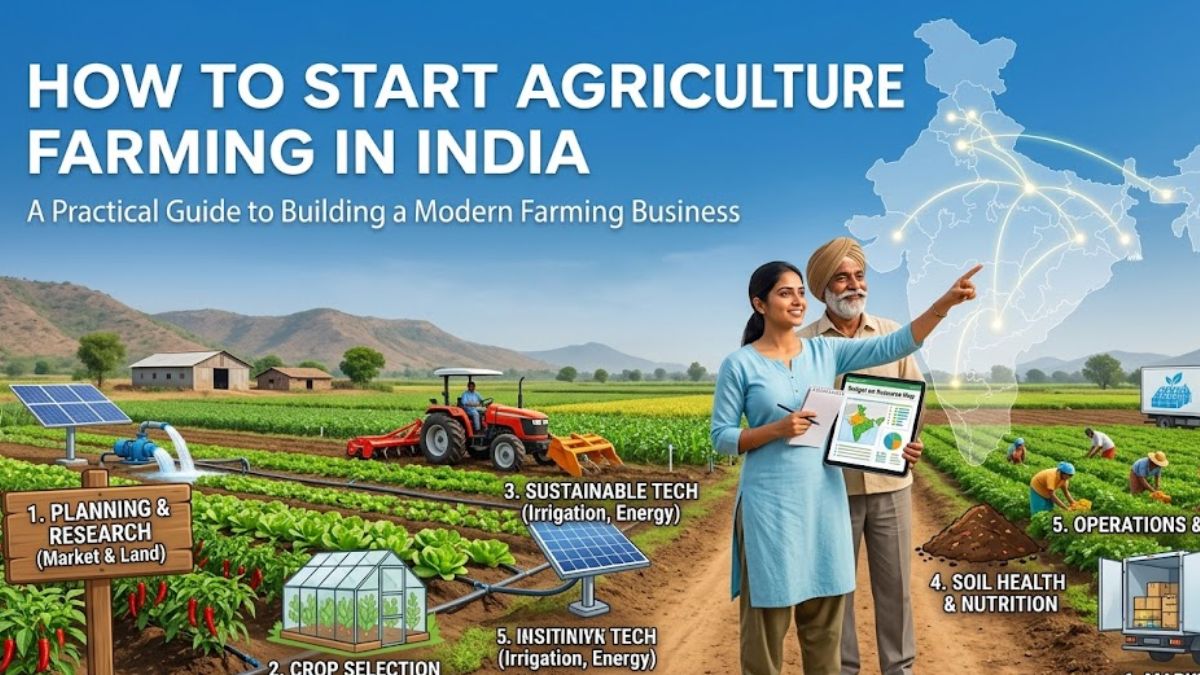
Introduction
Agriculture Farming in India doesn’t look the way it used to, and honestly, it doesn’t feel the same either. For a long time, farming was something people simply “inherited.” Land came from family, knowledge came from experience, and everything followed the same cycle year after year. No big questions, no big experiments. Just routine. But that’s changing now.
Walk into any village or small town today and you’ll notice something different. Young people are starting to ask questions like, “Can farming actually make money?” or “Can this be turned into a proper business?” Some of them are coming back from cities. Others never left. But instead of treating farming as a fallback option, they are starting to see it as something they can build on. And that shift is important.
Because now, farming is not just farming anymore. It’s planning, it’s business thinking, it’s technology, and sometimes even branding. You’ll see people talking about hydroponics in rented spaces, organic vegetables being sold directly on Instagram, and small farmers experimenting with export crops they never would have considered before. So when someone searches for how to start agriculture farming today, the real answer is no longer simple. It’s not just “buy land, grow crops, sell harvest.” It’s more layered than that.
India still produces a huge share of the world’s food, but if we’re honest, the system underneath is still uneven. Many farmers are working with small land pieces, old methods, and limited access to buyers. A lot of effort goes in, but the return doesn’t always match it. And that gap is exactly where new opportunities are showing up.
Because now there is demand for things that didn’t matter as much before. People want cleaner food. They are willing to pay more for organic vegetables, chemical-free fruits, and safer dairy. Even crops like medicinal plants or exotic produce are finding a place in urban markets. Farming is slowly connecting directly with lifestyle choices in cities. At the same time, things behind the scenes are also changing. Drip irrigation, greenhouse farming, soil testing tools, mobile-based crop tracking, and better logistics are quietly entering the picture. Not everywhere, not for everyone, but enough to shift how farming is being done in many places.
You can already see this mix in states like Maharashtra, Punjab, Karnataka, Telangana, Gujarat, and Uttar Pradesh. In some fields, nothing has changed for decades. In others, you’ll find first-generation farmers experimenting with new crops, selling directly to buyers, or trying small startup-style farming models. And that’s where it gets interesting. Because most people entering farming today are not doing it with full clarity. They’re figuring it out as they go. The questions are usually the same. Where do I start? How much money do I really need? What if I choose the wrong crop? Can this actually become stable income, or is it just trial and error?
Those are real concerns. And they matter. This guide is meant to slow things down a bit and make it less confusing. Not with big promises, but with a practical view of what actually works on the ground. From understanding how the opportunity looks today, to choosing what kind of farming makes sense, to planning investment, setup, risks, and long-term thinking.
Whether someone is thinking about a small piece of land or a bigger agri-business idea, the goal is simple. To help make sense of modern farming in India without the noise, without the hype, and without making it feel bigger than it really is when you are just starting out.
1. Startup Idea Overview
Starting an agriculture farming business today doesn’t feel anything like the old idea of farming most people grew up seeing. Earlier, it was simple in structure but difficult in reality. You planted what your family always planted, waited for the season, and hoped the weather and market both treated you fairly. There wasn’t much room to question the system or redesign it.
But modern farming has quietly shifted into something very different. It is no longer just about “growing crops.” It is about building a thoughtful, planned business around food. The focus has moved toward clarity, intention, and control. What to grow is no longer decided only by tradition or habit, but by asking harder questions like what people actually want to buy, what survives better in your soil, and what can realistically bring stable income across seasons.
Today’s agri-entrepreneurs are thinking more like planners than cultivators. Some choose organic vegetables because they see urban demand rising every year. Others invest in greenhouses so they are not fully dependent on unpredictable weather. A few go into hydroponics, where soil is not even the main factor anymore. And then there are people who build niche farms around mushrooms, dragon fruit, saffron, aloe vera, marigold, or medicinal plants, simply because they understand that specialization often earns more than volume.
What is interesting is not just what they grow, but how they think. Farming is no longer random. It is becoming structured. Even small decisions like irrigation method, crop timing, and distribution channels are now tied to business logic. The idea is simple but powerful: reduce uncertainty, improve quality, and sell closer to where demand actually exists.
At the heart of it, agriculture startups are trying to fix something very basic that was ignored for years. Food production is not just about producing more. It is about producing smarter. India has always had abundance in agriculture, but not always efficiency. And that gap is where modern farming businesses are finding their space.
Even a small farm today can behave like a startup if it is planned well. A single acre, if managed properly with drip irrigation, planned crop cycles, and direct selling to nearby households or local businesses, can generate returns that surprise many first-time farmers. The scale does not have to be large at the beginning. What matters more is clarity, consistency, and understanding your market before you even plant the first seed. Slowly, farming is shedding its old identity. It is no longer seen only as physical labor tied to rural life. It is becoming a space where decisions, systems, and execution matter just as much as land and soil. In many ways, it is turning into one of the most grounded forms of entrepreneurship in India today.
2. Problem Statement & Solution
2.1 What Is Broken in Indian Agriculture
There is a hard truth that most people inside agriculture already know but rarely say out loud. Farming in India carries a lot of effort, but not always equal reward. You can put in months of work, wake up before sunrise, manage everything carefully, and still end up unsure about how much you will actually earn. That uncertainty sits at the center of the entire system.
One of the biggest emotional and financial struggles farmers face is price instability. The same crop can sell at very different rates within a few days, depending on mandi conditions, middlemen, transport gaps, and demand fluctuations. This creates a constant sense of unpredictability. It is not just about money, it is about not knowing what your effort will be worth when harvest finally comes. Another deep issue is access. Many farmers grow good produce but never reach the right buyers. The journey from field to customer is long, layered, and often controlled by multiple intermediaries. By the time the produce reaches the end consumer, prices rise, but the farmer’s share does not grow proportionally. That imbalance creates frustration that has existed for decades.
There is also the quiet burden of fragmentation. Most farmers work with small landholdings. That limits their ability to invest in machines, irrigation systems, or advanced techniques that could actually improve output. So even when someone wants to modernize, the structure around them makes it difficult to scale meaningfully. And then comes wastage, which is probably one of the most painful realities. Fruits and vegetables that take months of care can spoil in days if storage or transport fails. That loss is not just financial. It feels personal because it represents time, energy, and hope that never reaches the market.
2.2 How Modern Farming Businesses Solve These Problems
Modern agriculture startups are not trying to “fix everything” in one go. What they are doing is more practical. They are slowly removing friction points one by one, starting from how food is grown to how it is sold. The shift begins with intention. Instead of growing first and thinking later, farmers now try to understand demand first and then plan cultivation around it. Technology plays a quiet but powerful role here. Drip irrigation reduces water stress and makes farming more predictable. Soil testing helps avoid blind decisions. Greenhouse farming reduces weather dependency. And simple digital tools now help farmers track costs, monitor growth, and even plan harvest cycles more scientifically than before.
But the bigger shift is happening in how food is sold. Direct-to-consumer models are changing everything. Instead of sending produce through multiple hands, many small farms now connect directly with customers, restaurants, or local stores. Some take subscription orders. Others deliver weekly baskets of fresh vegetables. This removes distance, both physical and financial, between the farmer and the buyer.
Organic farming has also added a new layer of opportunity. Urban consumers are not just buying food anymore; they are buying trust. They want to know where their food comes from, how it was grown, and what went into it. This emotional shift allows farmers who focus on quality to earn better margins than before. What ties all of this together is a change in mindset. Farming is no longer only about production. It is about building systems that are cleaner, more predictable, and more connected to real demand. The solution is not just better crops. It is better thinking around the entire journey of food.
3. Target Audience & Customer Persona
The people who buy from modern farming businesses are not a single group. They are very different from each other, but they all share one thing in common: they care more about quality and consistency than just price alone. Urban middle-class consumers are one of the strongest drivers of this change. Many of them have become more conscious about what they eat. Health concerns, lifestyle changes, and awareness about chemicals in food have quietly shifted their buying habits. They are not just looking for vegetables anymore. They are looking for reassurance. When they buy organic produce or residue-free food, they are also buying peace of mind.
There is also an emotional angle here that is often overlooked. People living in cities are increasingly disconnected from where their food comes from. So when they find a reliable source, whether it is a farm subscription or a trusted brand, they tend to stay loyal. It creates a relationship that goes beyond a simple transaction.
Restaurants, cafes, and hotels represent another very important segment. For them, consistency matters more than anything else. A restaurant cannot afford variation in taste or supply. They need steady access to herbs, lettuce, microgreens, exotic vegetables, and seasonal fruits. Even small disruptions can affect their entire menu planning. So when they find a dependable farm partner, they value that relationship deeply. There is also a growing institutional demand from grocery platforms and retail chains. These businesses are scaling fast, and they need reliable sourcing partners who can maintain quality standards at volume. For farmers, this creates a chance to move beyond local markets and enter structured supply networks.
In rural and semi-urban areas, the audience looks different again. Here, agriculture startups often serve other farmers. It might be through better seeds, advisory services, irrigation systems, or even equipment rentals. In these cases, trust is built slowly, often through word of mouth and real results on the ground. What becomes clear is that farming today is not just about what you grow. It is about who you are growing it for. That understanding changes everything, from crop choice to pricing to long-term strategy.
4. Market Opportunity & Timing
India’s agriculture sector has always been massive, but what is different now is not its size, it is its direction. For a long time, agriculture remained powerful but under-optimized. It produced in large volumes but struggled with efficiency, storage, and value addition. Today, that imbalance is becoming more visible, and that visibility is opening doors for change.
One of the strongest shifts is happening in food awareness. People are no longer passive consumers. They ask questions about what they eat, where it comes from, and how it is grown. This is slowly turning food into a value-driven market instead of just a commodity market. Organic farming, clean-label produce, and traceable food sources are no longer niche ideas. They are becoming everyday expectations in many cities. At the same time, distribution itself is changing shape. With the rise of quick commerce and hyperlocal delivery, food no longer has to travel through long, slow chains. It can move directly from farm to kitchen in a much shorter time. This has reduced spoilage, improved freshness, and created space for smaller farms to compete with larger suppliers.
Weather unpredictability is another silent force pushing innovation. Farmers can no longer fully rely on traditional seasonal patterns. This uncertainty is pushing more people toward controlled environments like greenhouses and drip-based systems. What used to be optional is slowly becoming necessary for stability. Support systems are also improving. Government schemes around irrigation, solar pumps, cold storage, and agri-infrastructure are making entry easier for new farmers. While challenges still exist in execution, the availability of support has never been higher than it is today.
And perhaps the most important factor is mindset. A new generation is looking at agriculture differently. Not as a fallback, but as a serious business opportunity. Some are returning from cities. Some are first-generation entrepreneurs. But all of them share a similar approach: they are treating farming like a system to be designed, not just a tradition to be followed. For anyone thinking about starting today, the opportunity is not just about land or crops. It is about timing. The system is changing, slowly but clearly, and those who enter with clarity and patience are finding that farming can be both practical and deeply rewarding in ways that were not visible before.
5. USP & Value Proposition
Every farming business, no matter how small or large, eventually hits the same reality. If you look the same as everyone else, you get treated like everyone else. In agriculture, that usually means pressure on price, unstable demand, and very thin margins. So the real question is not just “what are you growing,” but “why should anyone choose you over the next farm?” This is where the idea of a clear USP quietly becomes the difference between a struggling farm and a stable one. Some farms win simply because their produce feels safer. Others win because they picked one thing and did it better than anyone else nearby. In today’s market, quality is no longer optional. It is expected. But what separates successful farms is how they position that quality in the mind of the buyer.
A farm growing pesticide-free vegetables, for example, is not just selling food. It is selling a feeling of safety. A parent buying those vegetables is not thinking about farming methods. They are thinking about their child’s health. That emotional layer is powerful. Similarly, a hydroponic farm is not just selling lettuce. It is selling freshness, consistency, and the comfort of knowing that weather or soil will not ruin supply.
Specialization also plays a huge role here. Farms that try to grow everything often end up competing with everyone. But farms that focus on one or two strong categories like mushrooms, dragon fruit, saffron, or medicinal herbs often build stronger identity in the market. Buyers remember them. And more importantly, they return to them. Technology quietly strengthens this positioning. When a farm uses smart irrigation, soil testing, or controlled environments, it is not just improving output. It is building reliability. And reliability is something buyers value more than anything else when supply consistency matters.
At the end of it, a strong value proposition in agriculture is not about fancy language or branding tricks. It comes from something simpler and more honest. Can people trust what you grow? Can they depend on it again and again? If the answer is yes, everything else becomes easier over time.
6. Business Model & Pricing Strategy
Farming becomes very different the moment you stop thinking of it as just “selling crops” and start seeing it as a system of revenue choices. Most people assume agriculture has one income path. In reality, it has several layers, and the way you combine them often decides how stable your business becomes. The most common starting point is still direct crop sales. You grow, harvest, and sell through mandis, wholesalers, retailers, or local buyers. It is simple, but it is also unpredictable. Prices change quickly, and farmers often have very little control over timing or negotiation. This is where many people feel the pressure the most, because effort does not always translate into fair return.
But when farmers move closer to the consumer, something shifts. Selling directly to households, restaurants, or small businesses reduces dependency on middle layers. Even if volumes are smaller, margins often improve. More importantly, there is a sense of control that comes with it. You start to understand who is buying your produce and why.
Subscription farming has taken this idea even further. Instead of chasing buyers every week, farmers now have customers who commit in advance. A family paying monthly for fresh vegetables creates stability that traditional farming rarely offers. It smooths income flow and reduces uncertainty, which is often the hardest part of farming emotionally and financially.
Then there is premium farming, which is less about volume and more about value. Crops like organic vegetables, mushrooms, saffron, hydroponic greens, and medicinal plants may not always require large land, but they can bring significantly higher returns when done properly. The key here is not just growing them, but maintaining consistency. Premium buyers expect standards to stay steady, not fluctuate.
Value addition is another turning point that many farmers discover later in their journey. Raw crops have limited pricing power, but processed products change that equation. Turning turmeric into powder, fruits into pickles, herbs into oils, or vegetables into ready-to-cook kits creates entirely new revenue streams. It is often here that small farms start thinking like real businesses. And then there is agritourism, which is less about agriculture alone and more about experience. People from cities want to disconnect from their routine life. Visiting a farm, staying there for a weekend, or learning how food is grown creates emotional value that can also be monetized. It is not for everyone, but where it fits, it can be surprisingly powerful.
Pricing in farming is never fixed. It is shaped by weather, demand, competition, and timing. But one truth stays consistent. The more predictable your supply and the more direct your customer connection, the stronger your pricing position becomes over time.
7. Execution Plan & Launch Strategy
7.1 Choosing the Right Farming Model
Starting a farming business often begins with excitement, but it quickly turns into confusion when reality sets in. There are too many options, too many crops, and too many opinions. The truth is, there is no single “best” farming model. There is only what fits your situation, your land, your climate, and your willingness to learn. Some people start with vegetables because they want quicker results. They want to see money flow faster, even if margins are smaller. Others choose orchards or long-term crops because they are thinking ahead, accepting that patience will matter more than speed. And then there are those who step into controlled farming systems, where investment is higher but results are more stable over time.
The emotional part of this decision is often underestimated. Choosing a crop is not just a technical choice. It is a commitment. Because once you plant, you are tied to that decision for months, sometimes years. That is why most experienced farmers spend more time observing markets and climate than rushing into planting.
7.2 Land Selection and Soil Assessment
Land is not just land in farming. It is the foundation of everything that comes after. A wrong decision here does not just reduce yield, it affects motivation. Many first-time farmers only realize this after they struggle with water access, poor soil, or drainage issues that were invisible during initial planning.
Soil testing is often ignored, but it quietly decides half the outcome of your effort. Two farms in the same region can perform completely differently just because one understood soil conditions properly and the other didn’t. Water availability is equally important, because irrigation challenges often become the most stressful part of daily farming life. Leasing land instead of buying it is something many beginners eventually prefer. It reduces financial pressure and allows room to experiment without feeling trapped. Farming already carries uncertainty. Reducing upfront risk often gives people the mental space they need to actually learn.
7.3 Building Initial Infrastructure
Infrastructure in farming is where ideas start becoming real. It is the point where planning turns into physical systems. Even simple setups like fencing, irrigation lines, and storage spaces can completely change how smoothly a farm runs day to day. When farming becomes more advanced, infrastructure starts shaping outcomes even more. Greenhouses, polyhouses, and shade nets are not just protective structures. They create control in an environment that is otherwise unpredictable. Hydroponic systems take this even further by removing soil from the equation entirely and relying on controlled nutrient delivery.
For many farmers, this stage feels overwhelming at first. There is a lot to learn, and mistakes can be expensive. But over time, this is also where confidence begins to grow because systems replace guesswork.
7.4 Starting Small Before Scaling
One of the most painful mistakes in farming is starting too big too soon. It usually comes from excitement or pressure to succeed quickly. But agriculture does not reward speed. It rewards understanding. Starting small is not about limiting ambition. It is about protecting learning. A small farm teaches you things no book or video can fully explain. How crops actually behave in your soil. How weather shifts affect timing. Buyers respond in real situations, not theory.
Many successful farmers still remember their first small plots more clearly than their later expansions, because that is where they truly understood what farming demands from them emotionally and practically.
7.5 Launching the Brand
Branding in farming feels strange at first because people don’t usually associate agriculture with storytelling. But that has changed. Buyers today want to know who is behind their food. They want to see faces, farms, and real effort. They want transparency, not just products. Building a farm brand is less about design and more about honesty. Showing how crops are grown, sharing daily farming life, and being open about challenges creates trust. And trust is what turns one-time buyers into repeat customers.
Social media has quietly become one of the strongest tools in this space. Not because it is trendy, but because it removes distance. A short video of harvesting or a simple update about crop growth can do more for trust than any advertisement.
8. Budget, Resources & Infrastructure
Money in farming is never just a number on paper. It is pressure, hope, and uncertainty all mixed together. Every decision feels connected to risk because returns are never fully guaranteed. That is why budgeting in agriculture is less about calculation and more about survival planning. Costs vary widely depending on how you choose to farm. Traditional farming may seem cheaper at the start, but it often carries hidden costs in terms of yield instability and market fluctuations. Modern systems like drip irrigation or greenhouse farming require higher upfront investment, but they often reduce long-term uncertainty and waste.
Operational expenses tend to repeat every season. Seeds, labor, fertilizers, irrigation maintenance, transport, and storage all need continuous attention. Many new farmers underestimate how quickly these small costs accumulate. It is not one big expense that creates pressure. It is the steady flow of many small ones. What often surprises people is that modern farming, while expensive initially, can actually feel more controlled financially. When systems are in place, there is less guesswork, fewer losses, and better planning. That stability can be worth more than the initial savings of traditional methods.
Government support also plays a quiet but important role. Subsidies for irrigation systems, solar pumps, cold storage, and protected farming reduce the burden for beginners. Many farmers only realize later how much difference these schemes can actually make when used properly.
9. Brand Strategy
Branding in agriculture used to feel unnecessary. Food was food, and buyers didn’t ask many questions. But that world is gone now. Today, people don’t just buy vegetables or fruits. They buy trust, safety, and consistency wrapped in a name they can remember. A strong farm brand starts with something simple. Clarity. People should immediately understand what you stand for. Whether it is freshness, chemical-free farming, sustainability, or premium quality, that message should stay consistent everywhere.
But real branding in farming is not built in offices. It is built in fields. It comes from how honest the process is. When customers see real farming conditions, real harvests, and real effort, they start connecting emotionally. That connection is far more powerful than any marketing campaign. Social media has become a natural extension of this storytelling. Not in a polished or corporate way, but in a raw and real way. A farmer showing early morning work, crop growth updates, or even failures builds more trust than perfect advertisements ever could.
Over time, this creates something deeper than a business. It creates familiarity. People begin to feel like they know the farm, even if they have never visited it. And in agriculture, that sense of trust is what turns a small setup into a long-term brand.
10. Vendor & Partner Strategy
In farming, people often focus only on land and crops, but the truth becomes clear very quickly once you step into real operations. Agriculture is quietly held together by relationships. The seed supplier you trust, the person who delivers fertilizer on time, the technician who fixes your irrigation line, the truck driver who shows up at 4 AM for harvest pickup, all of them decide how smooth or stressful your season becomes.
When things go right, it feels simple. But when even one link breaks, everything feels heavier than expected. A delayed input can affect sowing. A missed pickup can spoil fresh produce. A low-quality batch from a supplier can damage an entire season’s effort. That is why experienced farmers stop thinking only in terms of price and start thinking in terms of reliability. Because in farming, the cheapest option is not always the one that saves money. Sometimes it quietly costs more in stress, loss, and uncertainty.
As farming becomes more modern, partnerships are also changing. It is no longer just about local vendors. Many farmers now work with agri-tech companies that bring in weather forecasting tools, soil testing support, drone monitoring, and even digital farm management systems. These tools don’t replace experience, but they reduce blind spots. They help farmers make decisions with more confidence instead of guesswork.
At the same time, distribution partnerships quietly decide how stable income becomes. Selling produce is not just about finding buyers, but finding buyers who stay consistent. A restaurant that orders every week or a retail chain that commits to regular sourcing brings a level of stability that one-time sales never can. Over time, these relationships become more valuable than individual transactions.
What many farmers learn the hard way is that clarity matters in partnerships. Verbal trust is not enough when money, timing, and quality are involved. Clear expectations around delivery, quality standards, and payment terms protect both sides. And when that structure exists, partnerships stop feeling stressful and start feeling supportive.
In the end, farming is not just about what you grow. It is about who stands with you while you grow it.
11. Go-to-Market & Customer Acquisition Channels
Selling farm produce sounds simple on paper, but in reality, it is often the part where many farming businesses struggle the most. Growing food takes effort, but selling it consistently takes understanding, communication, and patience. You are not just moving products. You are building trust with people who may never see your farm in person.
Digital platforms have quietly changed this space in a big way. Social media is no longer just for branding. It has become a direct bridge between farmers and customers. A simple video of harvesting vegetables or a small update about crop growth can create real curiosity and trust. People today want to see the story behind their food, not just the final product. That emotional connection often becomes the reason they buy and stay.
But digital alone is not enough. Real-world presence still matters deeply in agriculture. Farmers’ markets, local food fairs, and community events create something that screens cannot fully replace. When a customer meets the person growing their food, something shifts. Questions become conversations. Conversations slowly turn into relationships. And those relationships often last longer than any online interaction.
Restaurant and hotel partnerships bring another layer of stability. Unlike individual buyers, businesses need consistency. They care about timing, quality, and reliability more than anything else. Once trust is built, these partnerships can become steady monthly income sources. But they also demand discipline. A single failure in supply can break trust that took months to build.
Referral marketing plays a surprisingly powerful role here. In food, people talk. If someone trusts a farm, they will recommend it to others without hesitation. That kind of word-of-mouth growth feels slow at first, but it is incredibly strong because it is built on personal experience, not advertising.
Subscription models are where many modern farms find real balance. When customers commit weekly or monthly, uncertainty reduces on both sides. Farmers get predictable demand, and customers get regular supply. It creates a rhythm that feels more stable than traditional selling methods, and over time, it makes the entire business easier to manage emotionally and financially.
12. Growth & Retention Strategy
Growth in farming is not as straightforward as simply producing more. In fact, scaling too fast is often where many agriculture businesses struggle. Real growth happens when systems become stronger, not just bigger. It is a slow layering of better processes, better understanding, and better decision-making.
Most successful farming journeys begin with focus. One crop, one model, one clear direction. Once that foundation feels stable, expansion becomes safer. Some farms grow by adding new crops that complement existing ones. Others expand into new regions or markets. And some move into processing, where raw produce becomes packaged goods with higher value and longer shelf life.
But growth without consistency rarely works in agriculture. Customers may forgive delays once, but not repeatedly. A farm’s reputation is built slowly and can be damaged quickly. That is why reliability becomes more important as scale increases. It is not enough to grow more. You have to grow without breaking trust.
Technology starts playing a bigger role at this stage. As operations expand, manual tracking becomes difficult. Tools that monitor crop health, water usage, demand patterns, and inventory help reduce confusion. Data slowly replaces guesswork. Decisions become less emotional and more informed, which is essential when managing larger operations.
Retention, however, is where the real depth lies. In farming, customers don’t just stay because of price or convenience. They stay because they feel connected. When people understand how food is grown, when they see transparency, when they feel like part of the journey, they rarely switch easily. That emotional connection becomes a hidden strength that many traditional businesses overlook.
Over time, farming businesses that survive and grow are not just the ones that produce well. They are the ones that stay consistent enough for people to trust them again and again.
13. Team Structure & Responsibilities
In the early days of a farming startup, everything usually rests on very few shoulders. Often, it is the founder doing almost everything at once. Managing land, checking crops, talking to buyers, handling logistics, and sometimes even solving unexpected problems in the middle of the night. It is exhausting in a way that is hard to explain unless you have lived it.
But this phase also builds deep understanding. When you are involved in every part of the process, you start seeing details that are invisible from outside. You learn how small decisions affect yield, how timing impacts quality, and how human effort directly shapes results. This hands-on experience becomes the foundation of everything that comes later.
As the business grows, it becomes impossible to do everything alone. That is when roles slowly start forming. Field workers handle daily operations. Agricultural experts help with soil, pests, and crop planning. Logistics partners manage transport. Marketing or sales support starts building customer relationships. Each role removes pressure from the founder and allows the system to become more stable. But hiring in agriculture is not always easy. It is not just about skill. It is about trust. Farm work depends heavily on consistency, and even small gaps in labor can affect outcomes. That is why many farmers value reliability over everything else when building teams. A dependable worker often becomes more valuable than a highly skilled but inconsistent one.
At larger stages, specialization becomes necessary. Finance, marketing, supply chain, and technology all need focused attention. Some functions are even outsourced because it allows the core team to stay focused on farming itself rather than getting lost in administrative complexity. In the end, a farming team is not just a workforce. It is a support system that quietly holds the business together when things get unpredictable.
14. Risks, Challenges & Mitigation
Farming has a way of teaching humility very quickly. No matter how carefully you plan, there is always a point where nature reminds you that it is still in charge. You can prepare the soil, invest in the best seeds, set up irrigation, and follow every recommended practice, and still wake up one morning to find that a sudden weather shift has changed everything. That uncertainty is not just operational, it is deeply emotional. It affects sleep, decision-making, and sometimes even confidence in continuing the work.
Weather is the most immediate and visible challenge, but its real impact goes much deeper than numbers on a yield sheet. A heatwave does not just reduce production, it slowly drains motivation because you watch something you nurtured respond in a way you cannot control. Irregular rainfall creates a similar emotional strain. There is a constant waiting, adjusting, and hoping cycle. Many farmers quietly carry this pressure without ever expressing it, because it becomes part of daily life rather than an exception.
Then there are pests and crop diseases, which often arrive without warning. One week everything looks healthy, green, and stable. The next week, small signs of damage begin to spread. What makes this difficult is not just the loss, but the speed at which it happens. It forces decisions under pressure. Should you act immediately, or wait and observe? Should you invest more to save the crop, or accept the loss and move on? These are not just technical decisions, they are emotional ones.
Market fluctuations add another layer that is often misunderstood from the outside. Even after months of hard work, the final price of your produce can feel disconnected from your effort. Sometimes it feels fair, sometimes it does not. That unpredictability creates frustration because control ends at the farm gate. Beyond that, external forces decide value. Over time, farmers learn to accept this reality, but acceptance does not always remove the disappointment.
Climate change has made all of this more unpredictable. Seasons no longer behave the way they used to. Rain arrives late, heat lasts longer, winters shift slightly but noticeably. This subtle instability forces farmers to rethink long-standing practices. Some move toward protected farming to reduce exposure. Others diversify crops to spread risk. Many simply learn to adapt continuously, knowing that stability is no longer guaranteed in the way it once felt.
Mitigation in modern farming is not about removing risk completely. That expectation itself leads to frustration. Instead, it is about reducing how deeply each risk can affect the overall system. Diversification helps prevent total dependency on one crop. Insurance provides financial cushioning during unavoidable losses. Technology adds an early layer of warning that allows small corrections before problems become irreversible. These do not eliminate uncertainty, but they make it more manageable.
At a deeper level, financial discipline becomes one of the most important survival tools. Many farming businesses struggle not because they fail to produce, but because they expand too quickly or spend without buffers. Those who last longer tend to move slowly, reinvest carefully, and keep reserves for difficult seasons. Farming rewards patience more than ambition when it comes to stability.
In the end, farming is not built on certainty. It never has been. But those who stay in it long enough begin to understand something important. The goal is not to remove uncertainty, but to build the strength to move through it without losing direction.
15. Legal, Compliance & Fundamentals
Legal structure in agriculture is often something people ignore in the beginning because the focus naturally stays on land, crops, and survival. In the early days, paperwork feels secondary. But as the business starts growing, this lack of structure can quietly become a barrier. Not because farming itself is heavily restricted, but because scaling requires trust, and trust often comes from proper compliance.
At a basic level, most agriculture businesses in India eventually require formal setup elements like business registration, GST compliance, and licensing depending on the nature of what is being sold. If the business moves into packaged food or processed goods, FSSAI registration becomes important. These steps may feel technical, but they also change how the business is perceived by buyers, especially institutional ones.
For farms focusing on organic produce, certification becomes more than just a label. It becomes a form of reassurance. Customers are not present on the farm, so they rely on signals of trust. Organic certification helps bridge that gap. It also opens doors to premium pricing and larger retail partnerships, because buyers feel more confident about consistency and process. Export-oriented farming brings another layer of responsibility. Once produce moves beyond domestic markets, standards become stricter. APEDA registration and compliance with international quality norms are often required. While this may feel overwhelming initially, it also pushes farms to improve quality systems, which often benefits them even in local markets.
There are also quieter but very real compliance areas that many farmers only understand through experience. Land lease agreements, water usage permissions, pesticide regulations, and labor-related rules all exist as part of the operational landscape. They may not always be at the forefront, but they influence long-term stability more than people realize.
One of the most common gaps in small farming businesses is documentation. In the beginning, everything is informal because trust is personal. But as operations grow, informal systems start creating friction. Clear contracts with buyers, vendors, and distributors slowly become necessary, not because of mistrust, but because clarity prevents misunderstandings when volumes and money increase. What becomes clear over time is that legal structure in farming is not about restriction. It is about readiness. The more structured the business becomes on paper, the easier it becomes to grow beyond local limitations.
16. Long-Term Vision & Goals
The future of agriculture in India is slowly moving toward something very different from its past identity. It is no longer just about production. It is becoming about systems, intelligence, and connection. Farming is starting to sit at the intersection of food, technology, and consumer behavior in a way that feels much more integrated than before. Over the next few years, farming is likely to become more data-driven than ever. Decisions that were once based on experience alone will increasingly be supported by information. Soil conditions, weather patterns, water usage, and crop performance will all be tracked more closely. This does not replace traditional knowledge, but it strengthens it with clarity. Farmers will not just “feel” what is happening; they will be able to see it more clearly.
At the same time, consumer expectations will continue to rise. People are already becoming more conscious about what they eat, and that awareness is only going to deepen. Food will not just be judged by taste or price, but by origin, safety, and transparency. This creates long-term space for organic farming, specialty crops, and direct-to-consumer agricultural brands that can build trust over time.
Investment interest in agriculture is also slowly shifting. What was once seen as a traditional sector is now being looked at through a startup lens. Agri-tech platforms, supply chain innovations, climate-focused farming models, and food processing businesses are all attracting attention. This is changing how capital flows into the sector and opening doors for more structured growth.
For anyone entering farming today, the opportunity is no longer limited to cultivation alone. The real long-term value will come from building connected systems around agriculture. That includes production, distribution, branding, processing, and customer relationships working together instead of operating separately. In many ways, future farming businesses may feel less like traditional farms and more like hybrid organizations that combine fieldwork with technology and consumer engagement. Data will guide decisions, efficiency will shape margins, and trust will define long-term survival.
Platforms like FoundLanes.com continue to highlight this shift because agriculture is no longer just a rural story. It is becoming a modern startup space where innovation meets necessity. And for those willing to look beyond the old definition of farming, the sector still holds a sense of opportunity that feels both practical and deeply meaningful at the same time.mous potential to build scalable and meaningful businesses in the coming decade.
About foundlanes.com
foundlanes.com is India’s leading startup idea discovery platform. It helps entrepreneurs find actionable startup opportunities, market insights, and industry-specific guidance to turn ideas into real businesses. With deep research and practical resources, foundlanes supports founders at every stage, from idea validation to launch and growth.