


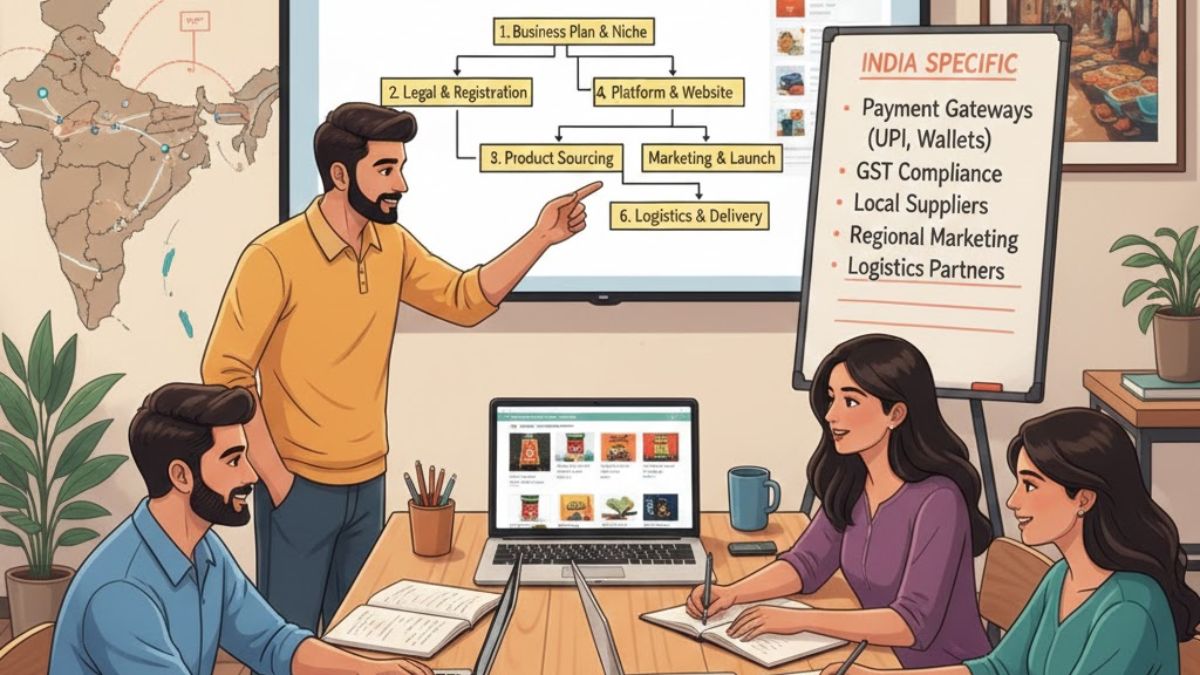
How to Start an Ecommerce Business in India: Turning a Small Room Dream Into a Real Brand
Imagine sitting alone in your small bedroom, laptop glowing, fingers trembling with a mix of fear and hope. You’ve spent weeks researching suppliers, designing your first products, and imagining the moment someone—anyone—will click “buy.” That click is not just a transaction. It’s a recognition, a validation, a heartbeat that says, your dream matters.
Starting an ecommerce business in India is more than logistics, platforms, or payments—it’s a human journey. It’s for the mother who wants to turn her handmade crafts into income, the college student whose late-night hustle finally takes shape, and the passionate dreamer who refuses to let high rents or crowded malls define their future.
The world is finally ready for these dreams. Internet penetration has brought millions of Indians online. Mobile payments make transactions instant. Delivery networks span cities, towns, and villages. Yet, beyond the numbers and statistics, the story is deeply personal. It’s about courage—the courage to start despite uncertainty, to face every “no” or delayed shipment, and to keep moving because the first sale, the first positive review, or the first repeat customer is worth every sleepless night.
This guide is for those who feel the fire of an idea burning inside them. It walks you through how to start your ecommerce business in India—step by step—but it also holds space for the emotional reality of entrepreneurship: the doubt, the hope, the joy, and the satisfaction of building something meaningful.
1. Startup Idea Overview
Every ecommerce startup begins long before the website goes live. It starts as a quiet pull. A problem you keep noticing. A product you wish existed. A gap that feels personal. Sometimes it is practical, like affordable eco friendly skincare that actually works. Sometimes it is emotional, like handcrafted jewelry that carries meaning, not just polish. Often, it comes from your own life. Something you struggled with. Something you once needed.
At this stage, the idea is not impressive on paper. It is fragile. It lives mostly in your head, showing up late at night when the world slows down. You imagine how it could help someone. Then doubt follows right behind it. Will anyone really pay for this? Is the market already crowded? Am I good enough to build this? This doubt is not a weakness. It is part of the process. Anyone who has actually built an ecommerce business will tell you this. The barrier is rarely technology or capital at the start. It is emotional resilience. Ecommerce makes it easier to launch, but it does not make it easier to believe.
1.1 You research products, suppliers, packaging, pricing
In the early days, you work without applause. You research products, suppliers, packaging, pricing. You study competitors and still feel unsure. Friends may encourage you, but they are not placing orders. Family supports you, but they cannot remove the fear. You keep going anyway, because the idea refuses to leave you alone.
Then one day, usually when you least expect it, the first order comes in. It is a small notification. One customer. One payment. From the outside, it looks insignificant. But if you have been there, you know what it really is. It is not revenue. validation. proof that a stranger trusted you enough to take out their card and say yes. Proof that this thing you built in silence now exists in someone else’s world.
That first order changes you. It turns theory into reality. It gives weight to your effort. Suddenly, the late nights feel justified. The uncertainty does not disappear, but it becomes manageable. You are no longer guessing if this can work. You know it can. From that moment on, the startup is no longer just an idea. It is a responsibility. To deliver quality. To listen to customers. improve relentlessly. Ecommerce success does not come from one viral moment or clever ads alone. It comes from showing up every day, learning from mistakes, and staying deeply connected to why you started in the first place.
A strong ecommerce idea is not about trends. It is about empathy. It is about understanding a real need and caring enough to serve it well, even when growth is slow and feedback is uncomfortable. When you build from that place, results follow. Not overnight, but steadily. And when they do, they last. This is where every meaningful ecommerce journey truly begins. Not with a store, but with conviction.
2. Problem Statement & Solution
The traditional business world can be unforgiving in ways most people only understand once they step into it. Rent drains you before your first sale. Salaries add pressure long before revenue becomes predictable. Footfall depends on luck, location, and timing. Many strong ideas never fail because they are bad. They fail because the system demands too much, too early. The weight of fixed costs crushes potential before it has a chance to breathe.
Ecommerce changes that equation. Not by removing struggle, but by shifting control back to the founder. It gives you the ability to start small and stay alive long enough to learn. You can test a product without signing long leases. You can adjust pricing without panic. listen to customers in real time and let their response guide your next move. Growth becomes a conversation, not a gamble.
2.1 For first time founders, this is everything
For first time founders, this is everything. You are no longer betting your future on a single opening day. You are building step by step, order by order. One product listing. One review. One improvement at a time. Ecommerce rewards attention and patience more than spectacle. There is also something deeply human about it that often gets overlooked. Every order is not just a transaction. It is a signal. Somewhere, someone chose what you made. They trusted a brand that may not yet be famous. When you pack that order, you are not just shipping a product. You are sending proof of your effort across cities, towns, and screens.
That quiet connection is powerful. You may never meet your customer, but your work reaches their life. It sits on their shelf. solves a small problem. brings a moment of satisfaction. This is how real businesses are built today. Not through massive launches, but through thousands of invisible connections that slowly add up to something meaningful. Ecommerce does not guarantee success. Nothing does. But it gives ideas room to survive. And sometimes, survival is all a good idea needs to become a great business.
3. Target Audience & Customer Persona
Your customers are not data points on a dashboard. They are people moving through busy, complicated lives. A young professional scrolling between meetings, looking for something reliable because they do not have time for trial and error. A parent ordering late at night after the house is finally quiet, choosing convenience because their energy is already spent elsewhere. A student balancing ambition and budget, hoping for value without compromise. An elderly buyer taking a cautious step into online shopping, guided more by trust than price.
When you build an ecommerce business long enough, you stop seeing audiences as segments and start seeing patterns of human behavior. You notice why people abandon carts, not just that they do. You understand why they read reviews twice, why they ask the same questions repeatedly, why delivery speed matters more than discounts for some, and why reassurance matters more than features for others. This understanding does not come only from market research or analytics tools. It comes from listening. From reading customer messages carefully. From noticing frustration in feedback and relief in gratitude. Empathy becomes a competitive advantage. You begin to design not just for conversion, but for comfort. Clear product descriptions. Honest pricing. Simple returns. Communication that sounds human, not scripted.
2.2 When you truly know your customer, decisions become clearer
When you truly know your customer, decisions become clearer. You know which products to launch next and which ones to drop. You know how to speak without overselling. where to simplify instead of adding more. The business starts to feel less like pushing sales and more like solving small, everyday problems at scale.
A strong ecommerce brand succeeds not because it shouts the loudest, but because it understands the deepest. Sales follow when customers feel seen. Loyalty grows when they feel respected. And long term success comes when your business quietly earns a place in their daily lives by making things a little easier, a little better, and a little more human.
4. Market Opportunity & Timing
India is ready in a way it has never been before. Millions of people are comfortable buying on their phones. Digital payments feel natural, not risky. Delivery networks reach places that once felt unreachable. What used to take years of infrastructure and capital is now available from day one. This convergence has opened the door for a new generation of founders who do not need permission to begin.
But timing alone does not build enduring businesses. Plenty of stores launch at the right moment and still disappear. The difference is not speed or technology. It is intention. A human first approach is no longer optional. Customers have choices everywhere. What they remember is how you made them feel. When you truly understand your customer, product decisions change. You stop chasing trends and start solving real problems. You choose quality over shortcuts. communicate clearly. Deliver when you say you will. Care becomes visible in small details that most competitors overlook.
These touchpoints matter more than most founders realize. The weight of the package. The way it opens. A short thank you note that sounds sincere, not automated. Packaging that protects rather than impresses. These moments quietly tell the customer whether you respect them. Trust is built here, not in advertisements. The opportunity in India is not just financial. It is relational. Ecommerce at scale can still feel personal if you design it that way. Technology will get you noticed, but humanity will keep you chosen. In a market that is ready for solutions, the brands that thrive will be the ones that remember there is a person on the other side of every order.
5. USP & Value Proposition
Your Unique Selling Proposition is not a clever line on your homepage. It is the quiet reason someone chooses you when ten other tabs are open. It lives in the moments where customers compare, hesitate, and finally decide. Ethical sourcing. Reliable delivery. Thoughtful personalization. Sustainable choices. Any of these can matter, but only if they are real and consistently lived, not just claimed.
In practice, a strong value proposition shows up in behavior. It is how quickly you respond when something goes wrong. It is whether your product looks exactly like it did in the photos. whether your brand voice feels honest or rehearsed. Over time, customers learn who keeps their promises and who only markets them.
Today’s buyers are not just shopping for utility. They are looking for alignment. They want to support businesses that reflect their values, or at least respect them. notice when effort is genuine. sense when a brand actually cares about quality, impact, and experience, not just margins. When your product carries your intent, it feels different. It feels considered. It feels human. Customers may not always articulate why they trust you, but they feel it. And feeling is what turns a first purchase into a second one.
Your value proposition is ultimately a promise you make repeatedly. We will show up. We will listen. will improve. treat your order like it matters, because it does. In a crowded market, heart is not a soft advantage. It is the one thing that cannot be copied.
6. Business Model & Pricing Strategy
Revenue is often talked about in spreadsheets and projections, but when you are building a business, it feels far more personal. Every rupee earned is a signal that someone trusted you enough to pay. It is recognition. It is validation. tells you that your work has value beyond intention. Pricing, then, is never just a calculation. It is communication. Set it too low and customers may question quality or longevity. Set it too high and you risk excluding the very people you want to serve. Thoughtful pricing sits in the middle. It covers your costs, supports growth, and still feels fair to the person on the other side of the screen.
Experienced founders learn this through trial, not theory. You adjust prices after feedback. You watch how customers react, not just whether they buy, but whether they return. Sustainable pricing allows you to deliver consistently without cutting corners. It gives you room to improve packaging, customer support, and fulfillment, which customers feel even if they never see the backend.
Your business model should make this balance possible. Clear margins. Predictable costs. Simple offerings that are easy to understand. Complexity looks impressive early on, but clarity builds trust over time. Discounts, bundles, and offers also carry meaning. Used carelessly, they train customers to wait and devalue your product. Used thoughtfully, they feel like appreciation. A bundle that saves time. A limited offer that helps someone decide. A loyalty benefit that says we see you and we value your return.
When pricing is aligned with purpose, it strengthens the relationship. Customers feel respected, not manipulated. And when that happens, revenue stops being just a metric. It becomes the natural outcome of trust built patiently, one honest transaction at a time.
7. Execution Plan & Launch Strategy
Execution is the moment where imagination steps into the real world. This is where ideas stop being protected by intention and start being judged by experience. You research your niche not to sound informed, but to avoid costly mistakes. speak to suppliers, test samples, compare platforms, and make choices that feel heavy because they matter. You launch small because survival comes before scale.
In the beginning, nothing is automated in your mind. You notice everything. Every order notification. Every address. message. You learn quickly that execution is not glamorous. It is repetitive, detail driven, and often lonely. But it is also honest work.
When you pack your first few orders, you handle them differently. Carefully. Slowly. Each package feels fragile, even if the product is not. It carries your effort, your belief, and your story. You double check labels. You worry about delivery. hope the customer smiles when it arrives.
Problems arrive early and without warning. A shipment gets delayed. A customer is unhappy. A return request feels like rejection. These moments sting because the business still feels like an extension of you. But they are also teachers. They show you where systems need strengthening and where patience needs deepening. Resilience is not learned in success. It is built in these uncomfortable moments. Then, quietly, a repeat order comes in.
It does not announce itself as a milestone, but it is one. Someone came back. They trusted you again. That moment is different from the first sale. It means the experience held up. It means your dream did not just reach someone’s life, it earned a place in it. Execution is not about perfection. It is about showing up, learning fast, and treating every order like it matters. Because in the early days, it truly does.
8. Budget, Resources & Infrastructure
Money sets the stage, but passion drives the performance. A small home-based ecommerce venture might launch with ₹2–3 lakh, enough to cover basic inventory, packaging, a simple website, and essential tools. A larger operation could easily need ₹10 lakh or more to secure reliable suppliers, professional-grade packaging, and smoother logistics. These resources are the scaffolding that supports your dream—they matter, but they are not the whole story.
The real investment is emotional. Every hour spent researching products, negotiating with suppliers, or improving your website is part of the invisible backbone of your business. Every late-night customer query answered, every complaint handled with patience, every moment of uncertainty when stock runs low—it all adds up. You are not just spending capital; you are committing energy, attention, and resilience.
Infrastructure is more than warehouses and websites. It is systems that let you keep promises—tracking orders accurately, maintaining quality, ensuring timely delivery. Even small tools, when used thoughtfully, can multiply your effectiveness and free mental space for creativity and customer care.
The early days teach that money alone cannot carry a business. Emotional investment—the willingness to endure setbacks, to respond personally, to keep refining—is what turns scaffolding into a structure that lasts. Without it, even the most well-funded launch can crumble. With it, every rupee spent carries meaning, and every resource becomes a lever to transform effort into trust, satisfaction, and growth.
9. Brand Strategy
Your brand is more than a name or a logo. It is a pulse that connects your business to the people you serve. Every choice—colors, typography, packaging, social media voice—is a reflection of who you are and what you stand for. Together, they tell a story long before a customer interacts with your product. A cohesive, human-centered brand signals care, consistency, and credibility.
Branding is emotional. Customers rarely remember specifications; they remember how they felt. Did your website feel welcoming or cold? Did your packaging make them smile? your messages feel personal or generic? These moments linger. They shape trust, loyalty, and the way your business lives in someone’s mind.
Consistency is the quiet hero here. When every interaction—post, unboxing, customer support—feels aligned, the brand becomes familiar and reliable. When it wavers, customers hesitate. Emotional resonance transforms a product into an experience. A heartfelt brand doesn’t just sell; it makes people feel seen, valued, and understood. That feeling becomes the invisible glue that keeps them coming back.
10. Vendor & Partner Strategy
Vendors and logistics partners are more than service providers—they are extensions of your business, almost part of your family. Every product you sell, every package you send, carries their mark as much as yours. Their reliability directly shapes customer experience and, by extension, the trust you are working so hard to build.
Choosing the right partners goes beyond cost or speed. It is about shared values: commitment to quality, attention to detail, and respect for timelines. A supplier who cuts corners or a delivery partner who misses deadlines doesn’t just cause inconvenience—they erode the emotional investment you pour into every order.
Strong partnerships simplify execution and reduce anxiety. You can plan confidently, knowing the people behind your supply chain are as invested in success as you are. Every smooth delivery, every on-time shipment, reinforces customer trust and validates the countless hours, late nights, and careful decisions that went into building your business. In the end, partnerships aren’t just operational—they are part of the story you tell with every product you deliver.
11. Go-to-Market & Customer Acquisition Channels
Marketing is not just a series of campaigns—it is a conversation. Ads, social media posts, influencer partnerships, and emails are simply the mediums. The heart of marketing is human connection, the ability to make someone care about what you create and why. Storytelling is the bridge that links your effort to their lives. Share your “why.” Explain the thought behind your product. Show how it solves a real problem, no matter how small, and why it matters to you.
Every interaction is an opportunity to build trust. A carefully crafted post, a sincere reply to a comment, a personalized thank-you email—these moments signal that your business is run by people, not robots. Authenticity cannot be faked; customers sense when effort is genuine versus performative.
When communication carries honesty and care, it does more than sell a product. It builds loyalty. First-time buyers become repeat customers. Repeat customers become advocates. And advocates become part of your story, sharing your vision with people you might never reach otherwise. In ecommerce, where screens separate you from your customer, storytelling and human connection are the ties that make your brand unforgettable.
12. Growth & Retention Strategy
Growth is never just numbers—it is deeply human. Each repeat customer represents trust earned, not just revenue. Every time someone returns, they are telling you: “I believe in what you do. I trust you to deliver.” That is a form of validation no metric can fully capture.
Scaling, then, is not just about adding more products or reaching new regions. It is about expanding relationships while preserving the care and attention that built them in the first place. Thoughtful personalization, loyalty programs, and proactive engagement are the tools that make customers feel seen and valued, even as your business grows.
The challenge of scaling is maintaining intimacy at scale. Processes, automation, and systems help efficiency, but they cannot replace authenticity. Growth that loses the human element risks eroding trust faster than it builds revenue.
Sustainable scaling balances ambition with empathy. It is measured not just by sales targets, but by the depth of customer connection. When done right, expansion does not dilute care—it amplifies it. Your business grows, and so does its ability to touch more lives meaningfully, one authentic interaction at a time.
13. Team Structure & Responsibilities
The early days of an ecommerce venture are a test of endurance and versatility. Founders wear many hats—sourcing products, managing inventory, handling marketing, troubleshooting operations, and responding to every customer query. It can feel overwhelming, but it is also where the foundation of your business is built.
Early hires are more than support—they are extensions of your vision. Skills matter, but alignment with your mission matters more. A team that believes in what you are creating will care in ways that go beyond task completion. They notice details, anticipate problems, and treat every order as if it were their own.
Culture is the invisible glue that keeps everyone moving in the same direction. Clear communication, shared values, and mutual respect allow your team to carry your emotional commitment forward. Each customer interaction reflects this dedication, whether it is a friendly support call, carefully packed shipment, or a thoughtful marketing message.
In an environment where every decision impacts the customer experience, a team that shares your passion becomes one of your strongest advantages. They transform your vision into consistent action, making the business feel human at scale.
14. Risks, Challenges & Mitigation
Challenges in ecommerce hit harder than numbers on a balance sheet—they feel personal. Cash flow shortages keep you awake at night. Competition makes every small win feel precarious. Logistics hiccups, delayed shipments, or product defects strike at the core of your effort, reminding you that your dream is only as strong as the systems supporting it.
Overcoming these challenges requires more than strategy—it demands emotional resilience. Adapt quickly, learn from mistakes, and persist even when progress feels slow. Each setback carries lessons: why a shipment failed, what a competitor did differently, how a customer’s frustration reveals a gap in service. The insights you gain are invaluable, shaping smarter decisions and stronger operations.
Resilience also builds confidence. The first time you turn a near-disaster into a loyal customer experience, you realize you are capable of more than you imagined. Each problem solved reinforces that your business is not just surviving—it is growing, learning, and becoming more human-centered with every challenge you overcome.
15. Legal, Compliance & Fundamentals
Compliance in ecommerce is more than a box to tick—it is a demonstration of respect for your customers and your own business. GST registration, accurate accounting, secure payment gateways, and adherence to consumer protection laws are all signals that you take your obligations seriously. They tell customers that your business is reliable, professional, and trustworthy.
Following regulations does more than avoid fines. It protects your reputation, ensures smooth operations, and reinforces the confidence customers place in you with every order. A secure payment process, for example, is not just technical—it reassures people that their money and data are safe. Transparent accounting and proper filings show that your business is sustainable, organized, and accountable.
In the early days, compliance can feel tedious compared to the excitement of product development or marketing. Yet it is foundational. It reflects care, integrity, and foresight—qualities that customers sense even if they cannot quantify them. Treating legal responsibilities as part of your commitment to excellence strengthens trust and signals that your business is built to last.
16. Long-Term Vision & Goals
In three to five years, success is measured in more than just revenue. It is found in repeated validation—that quiet assurance that your work truly matters. It shows up in the trust your brand earns across cities, in the loyalty of customers who return time and again, and in the knowledge that every sleepless night, every sacrifice, and every tough decision contributed to something real.
Success is also emotional. It is the relief of seeing systems you built function smoothly, the pride in a team that shares your mission, and the satisfaction of a product that improves someone’s life in ways you may never fully witness. Your business becomes a living story of persistence, care, and belief.
When it all comes together, your dream is no longer just an idea on paper—it is a human story that touches lives, builds connections, and creates impact. Financial growth is the visible marker, but the true achievement lies in the human trust and relationships your business has nurtured along the way.
Future Outlook
Ecommerce in India is more than technology or growth metrics—it’s about human stories, dreams, and connections. Each order is trust, each delivery is hope, and each customer relationship is a reminder that your work matters. Entrepreneurs who embed empathy, persistence, and care into every part of their business will not only survive—they will leave a mark.
The FoundLanes View
At foundlanes, Culture Circle’s journey stands out not just for its headline-grabbing numbers but for what it reveals about building modern Indian startups—where trust, verification, and transparency can drive rapid adoption, even as losses widen. The Culture Circle 10x revenue growth reflects a clear market insight executed at speed, alongside the inevitable pressure of scaling through heavy spending on technology, hiring, and marketing. Stories like this matter because they show entrepreneurship as it truly unfolds: fast, demanding, and full of trade-offs, where short-term financial strain is often the price paid for long-term relevance and scale.