


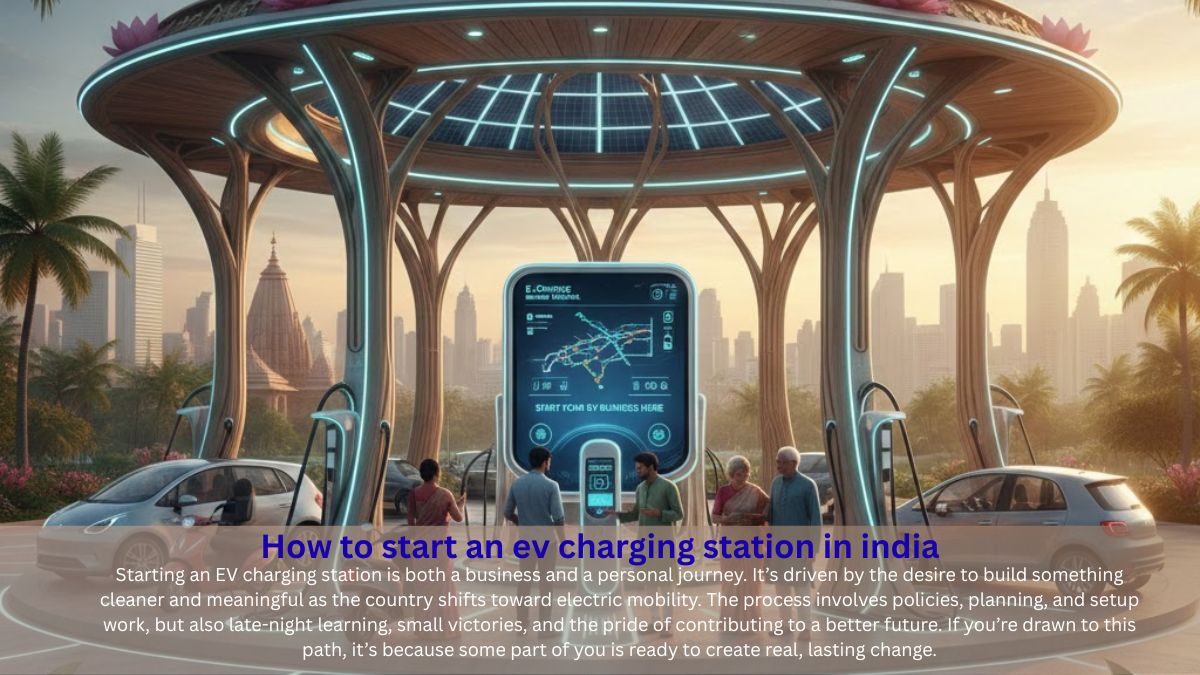
Summary
Starting an EV charging station is more than a business idea. For many founders, it begins as a quiet ache inside the heart. A feeling that the world deserves better than the fumes that cling to our cities, the constant hum of engines that have shaped our past but weigh heavily on our future. When people ask what it takes to start an EV charging station in India, they often expect a technical roadmap, a cost sheet, a government guideline, a checklist. But beneath the spreadsheets and approvals lies a very human story. A story of hope, of frustration, of ambition, of wanting to build something cleaner, kinder, and more meaningful.
The electric mobility revolution unfolding across the country
The electric mobility revolution unfolding across the country is not just a shift in technology. It is a shift in the way we breathe, the way we live, the way we imagine our tomorrow. And when you step into this space as an entrepreneur, you are no longer just starting a business. You are becoming a small, almost invisible but essential part of a movement far larger than yourself. Why are people choosing this path now? Because change no longer feels optional. the air tastes different in winter, because parents worry about the sky turning grey, because the world feels like it is asking us quietly, urgently to do better. Because there are days when the traffic lights turn red and we wonder what all this progress is worth if it keeps taking pieces of our lungs.
For new founders, the first question is always “How?” But perhaps the more honest question is “Where do I even begin?” How does an ordinary person take a vision so enormous and translate it into wires, chargers, land agreements, electricity connections, and a place where people come to fill their vehicles with energy instead of fuel? When does this idea become real enough to chase? And who are you becoming in the process?
This guide is not just about policies or installation steps
This guide is not just about policies or installation steps. It is about the emotional journey of building something that affects real people. It is about the late nights spent researching subsidies, the shaky hands while signing your first vendor contract, the excitement of seeing your first customer plug in their vehicle, the sudden fear when the electricity bill arrives, the pride when you realize you are powering a cleaner future. Starting an EV charging station in India is not easy. But nothing worth doing ever is. And if you’re reading this, something inside you already knows that your life is ready for the next chapter one where you contribute to the kind of progress that actually matters.
1. Startup Idea Overview
The idea of setting up an EV charging station often comes to people slowly. It is not the kind of startup idea that strikes like lightning. Instead, it grows inside you in small, almost invisible ways. Maybe you first noticed it when a friend bought an electric scooter and complained about not having anywhere convenient to charge it. Maybe you saw a charging kiosk at a mall and felt a strange tug in your chest like something was calling you. Or maybe you watched a documentary about climate change that kept you awake at 3 AM, making you confront a truth you had been avoiding for years. Whatever the trigger was, the idea didn’t feel like a business plan. It felt like a responsibility. A whisper telling you that you could be part of something meaningful.
Electric vehicles promise a future where cities sound quieter, where air smells cleaner, where children grow up without inhalers as standard school supplies. The shift is already happening and you can see it on the roads silent two-wheelers that glide instead of roar, compact four-wheelers that run without a drop of petrol, fleets of e-rickshaws weaving through traffic without leaving behind a smoky trail. And people, everyday people, are searching for places to charge them. The real problem today is painfully simple. There are not enough charging stations for the number of EVs hitting the roads. A person buying an EV feels excitement mixed with anxiety. Range anxiety. Charging anxiety. The fear of being stranded. The fear of inconvenience. fear of stepping into a future that isn’t fully ready. Your startup your EV charging station becomes the bridge that turns fear into confidence.
1.1 It becomes the reassuring presence someone counts on during their long journey home
It becomes the reassuring presence someone counts on during their long journey home. It becomes the quiet corner where a delivery rider takes a sip of tea while his scooter powers up. becomes the space where a young woman charges her car at night before driving to her first day at a new job. becomes part of their life without them ever knowing your name. That is the emotional power of this business. You don’t just give energy. You give peace of mind.
From a practical lens, an EV charging station is simply a space equipped with chargers, a stable electricity supply, a safe environment, and a payment system. But beneath these practicalities lies a deeper truth: you are building infrastructure people rely on. Something that shapes daily routines, decisions, and even purchasing patterns. The core idea also solves a national-scale problem. The government has set ambitious goals for EV adoption and is creating policies, subsidies, and infrastructure guides to nudge entrepreneurs like you forward. If you explore the official guidelines from the Ministry of Power or the Bureau of Indian Standards (links like https://powermin.gov.in or https://bis.gov.in), you will find that the country isn’t just encouraging EV charging stations—it is quietly depending on them.
1.2 But the emotional journey of this idea goes beyond policies
But the emotional journey of this idea goes beyond policies. It becomes real the first time you stand at your chosen location maybe an empty plot, maybe a corner of a parking garage, maybe a dusty roadside and you imagine a future that doesn’t exist yet. You imagine the bright blue chargers humming softly, the digital screens glowing in the evening, the vehicles lined up, silent and patient. Imagine strangers relying on you. You imagine being part of the invisible network that helps a nation breathe easier. This idea becomes a dream, and then the dream becomes a plan.
1.3 Begin researching brands like Tata Power EZ Charge
You start reading more. begin researching brands like Tata Power EZ Charge, ChargeZone, Statiq, Fortum, and Ather Grid. learn that each charger type slow AC, fast DC, ultra-fast serves different kinds of people. You learn about tariff structures, transformer capacity, sanctioned load, and metering. learn that even a small charging station can impact hundreds of lives without you ever realizing it. At some point, you start imagining your first customer. A commuter stopping by after a long day. A delivery rider worried about making his next run. A tourist charging up before continuing a family trip. A cab driver sitting in the shade, exhausted but relieved that your station exists. These people become the emotional reason behind your decision. You want to be the person who solves a real problem for real people.
And that is when the startup idea finally feels alive. When it no longer feels like a business blueprint downloaded from somewhere, but something rooted in your own emotions. Something that makes you feel proud, nervous, excited, overwhelmed, all at once. In that moment, you are no longer just thinking about how to start an EV charging station. You are thinking about how to build a piece of the future. In the quiet moments on bus rides, in elevators, lying awake in bed you start imagining yourself at the inauguration. Maybe there is a ribbon. Maybe not. you stand there alone, watching the charger light blink for the first time. your parents are there, smiling, proud. no one understands your journey, but that’s okay, because you do. The idea becomes bigger than you. And that is when it begins.
2. Problem Statement & Solution
Most entrepreneurs don’t begin their EV charging journey by studying policy documents or reading tariff charts. They begin by feeling something. Something sharp. Something uncomfortable. that whispers, “This isn’t right.” The problem doesn’t show up like a business opportunity at first. It shows up like daily frustration. Maybe you watched a delivery worker push his electric scooter across the road because he ran out of charge and had nowhere to plug in. you saw a family stranded on a highway inside an EV that had lost power, the children tired and confused while the father paced in circles, helpless. you read a newspaper headline about rising pollution levels and felt a strange mix of anger and sadness settle into your chest.
The brokenness of the current charging landscape isn’t theoretical. You can see it in human moments—moments that stay in your mind because of how unfair they feel. EV owners want to believe in a cleaner future. Many of them spend late nights researching the best models, checking real-world range reports, looking up subsidies, comparing charging speeds. They want to do the right thing. They want to choose a vehicle that harms the planet less. But the moment they try to live with their decision, reality hits harder than expected.
2.1 Charging points are scarce
Charging points are scarce. Navigation apps often show dead locations. Chargers malfunction without reason. Customer support numbers ring without answers. Some charging stations are hidden inside basements with broken lights and no signage. Others are so often occupied that you end up waiting for hours behind a line of frustrated drivers. And in that space of frustration, something becomes painfully clear: A future built on electric mobility cannot survive without reliable charging. That is where your solution steps in not as a technical installation, but as an emotional reassurance.
A good charging station solves more than an energy problem. It solves a fear. A doubt. A hesitation that keeps thousands of people from shifting to electric vehicles. Your station becomes the comforting presence in a world that often feels rushed and indifferent. A well-lit space. A predictable experience. A place where technology works. A place where people feel safe, even if they arrive late at night. place where the charger doesn’t just provide electricity but gives people something they rarely find in chaotic cities: a sense of reliability. This is not simply a solution. It is a promise that you are choosing to make to strangers. A promise that says: “You will never be stranded. Not if I can help it.”
It might feel poetic, but it is also practical. A dependable charging station reduces range anxiety, accelerates EV adoption, and directly supports the national sustainability mission. And as companies like Tata Power EZ Charge (https://www.tatapower.com/ezcharge) and Statiq (https://www.statiq.in) expand networks across the country, the need for more stations—smaller, localized, community-centered ones keeps growing. The market is ready, but the problem is still painfully real. And the solution still needs more hands, more hearts, more brave founders willing to build something that matters.
3. Target Audience & Customer Persona
When you build an EV charging station, you are not building for “users.” You are building for people—real people whose lives are quietly shaped by your work. If you stand at your charging station for just one week and pay attention, you will see an entire spectrum of humanity pass before you. You will see a young software engineer rushing to charge her compact EV before heading to her 7 AM shift. She arrives with her hair still damp from a hurried shower, her laptop bag slung over her shoulder, her eyes carrying that familiar blend of ambition and exhaustion. She plugs in the charger, checks her phone, and breathes a little easier.
You will see delivery riders men in faded jackets, women balancing responsibility and speed arriving at your station during the busiest hours. Their livelihood depends on timing, and charging delays can eat into their daily income. For them, your station is not just a port. It is dignity. It is hope. survival. You will see families on weekend road trips, their laughter echoing through the station as children run around while the car charges. They treat your station like a brief sanctuary in their journey. A pause that holds memories.
You will see cab drivers resting in their seats, sipping tea from paper cups sold nearby, their backs aching from long hours on the road. When they look at your chargers, they don’t see machines. They see opportunity. More uptime. More earnings. stability for their families. Your audience isn’t one category. It is hundreds of stories woven together. But if we speak in business terms, the core audience includes:
3.1 Daily commuters with personal EVs
Daily commuters with personal EVs. Delivery riders and gig workers. Fleet owners, cabs, and ride-share operators. Highway travelers. Commercial EV operators. Apartment dwellers without home charging access. Environmental-conscious early adopters. And soon, everyone. The emotional thread binding them all is simple: They need a place to charge without stress. They need simplicity, predictability, and safety.
And here lies the most beautiful part of your customer persona:
- They trust you before they even know you.
- They trust you to install the charger correctly.
- To maintain the equipment.
- To ensure safety.
- To provide fair pricing.
- To keep the station clean, lit, and accessible.
Your audience is large, diverse, and rapidly growing. But more importantly, they are rooting for you even if silently because your success makes their life easier.
4. Market Opportunity & Timing
There are moments in history when entire industries shift direction. These moments are rarely loud. They begin as murmurs. A few vehicles on the road. few innovators. few bold policies. And then suddenly, the murmur becomes a movement. Right now is that moment for electric mobility. The country is moving toward EVs with a speed that was unimaginable a decade ago. Policies are shifting. Subsidies are expanding. Manufacturers are building more models. Consumers are embracing change. This is not a future trend. It is a current reality unfolding in front of us every day.
But the biggest signal of opportunity isn’t the number of EVs on the roads. It is the emotional shift in people’s minds. There was a time when EVs were seen with suspicion. Now they are seen with admiration. People want to be part of the movement. They want to be part of the solution. They want to breathe cleaner air, spend less on fuel, and feel proud of their choices. The timing is perfect because the market is hungry. Not for more vehicles but for more charging stations.
Government bodies continue releasing guidelines through official portals like (https://powermin.gov.in), encouraging public and private participation in charging infrastructure. Startups are raising funding at record levels. Investors who once doubted EV-as-a-service models now see them as essential. But the opportunity is not just financial. It is emotional. People want to trust this new system. They want to shift to EVs without fear.
This is the moment when early founders become industry leaders. When small stations become local landmarks. When a simple business becomes part of national progress. Timing like this does not come often. And those who step in now will shape the roads of tomorrow.
5. USP & Value Proposition
Every founder eventually reaches a moment when they look at the competition and feel a flicker of fear. You scroll through websites of established charging networks. see polished videos on LinkedIn. read news about startups closing funding rounds worth tens of crores. And for a moment, your heart tightens: Why would anyone choose my station? What do I have that they don’t? This fear is understandable. It is also deeply human. Every entrepreneur no matter how experienced faces the quiet tremor of self-doubt.
But this fear becomes smaller the moment you remember the truth:
- Your USP is not a charger. It is you.Anyone can install machines.
- Anyone can buy equipment.
- Anyone can follow government guidelines.
But not everyone will care the way you will. Not everyone will obsess over reliability. Not everyone will clean the floors, check the lights, ensure safety, respond to customer calls, monitor equipment health, or speak kindly to a driver who arrives tired after a long shift. A charging station is not only a business of hardware. It is a business of trust. Your USP is the consistency you bring even when no one is watching. Your value proposition is the emotional comfort you offer something hardware alone can never provide.
Maybe you will focus on:
- Better uptime.
- Better cleanliness.
- Better lighting for late-night users.
- Better instructions for first-time EV owners.
- Better safety and surveillance.
- Better human support.
- Better transparency in pricing.
5.1 Maybe your chargers won’t be the fastest in the city
Maybe your chargers won’t be the fastest in the city, but your station will be the most reliable. you won’t have the biggest network, but your customers will remember how your station made them feel. In a world where noise is constant, authenticity becomes your advantage. If you decide to add features like live charger availability on apps like ChargeZone (https://chargezone.com) or Tata Power EZ Charge (https://www.tatapower.com/ezcharge), users will appreciate the effort. you add QR-based payments instead of complex subscription models, they will appreciate the simplicity. place a small seating area where cab drivers can rest, they will remember your kindness. Your USP is not a slogan. It is an experience. And experiences don’t need to shout. They leave quiet marks on people’s lives—marks they don’t forget.
6. Business Model & Pricing Strategy
There is a moment in every founder’s EV journey when the financial side becomes unavoidable. You sit down with a notebook maybe at midnight, maybe at dawn and you begin writing numbers. Tariffs. Charger costs. Land costs. Maintenance. Electricity bills. You stare at the page and feel both excitement and fear swirling like two storms inside your chest. Because a charging station is not just a place where people plug in their vehicles. It is a place where economics, humanity, and responsibility meet.
A simple business model becomes emotional when you realize who depends on it. Delivery riders cannot afford unpredictable pricing. Cab drivers cannot tolerate downtime. Families on road trips cannot risk unreliable charging points. And you, as the founder, cannot build a business that collapses under its own expenses. So you build something balanced. Something honest. Most charging stations earn revenue through: Charging fees (per unit). Parking or service fees. Partnership commissions (if listed on aggregator apps). Subscription plans for fleets. Corporate charging agreements. Day-night tariff optimization.
You begin to understand how pricing shapes trust. learn about the electricity tariff slabs in your region, the cost of sanctioned load, and the fine line between affordability and sustainability. You read state EV policies late at night.
And then you realize something profound:
- Your pricing is not a number. It is a relationship.
- If your rates are fair, customers return.
- If your rates are transparent, they trust you.
- If your rates are predictable, they depend on you.
You create a business model that respects people’s realities. ensure margins that sustain operations without exploiting the public. You remember that your station might become a lifeline for someone who is barely managing to get through the month. In that moment, pricing becomes emotional, not mathematical.
7. Execution Plan & Launch Strategy
Launching an EV charging station is not a single event. It is a journey made of tiny steps that feel insignificant when isolated but powerful when combined. And each step carries its own emotional weight. The first step is always research, and it often begins in silence. At a desk. On a bed. On a park bench. You read everything you can find. watch YouTube videos posted by early EV adopters. You follow forums where people discuss battery performance.
And with each piece of information, the fog begins to clear. The idea becomes sharper. The next step is choosing a location. This is where your heart and your logic collide. You walk through neighborhoods, visit parking lots, talk to property owners. You imagine chargers standing where there are none. It feels like envisioning a city before it is built. You experience disappointment when a promising site becomes unavailable. You feel hope when someone says, “Yes, let’s talk.” learn that entrepreneurship is not just thinking it is negotiating, persuading, and imagining. When the site is finalized, something magical happens. You stand there, maybe alone, maybe with a silent smile, maybe with tears in your eyes. Because now, it is no longer a dream. It is a plan.
And then comes the real work:
- Choosing charger brands.
- Understanding AC vs DC requirements.
- Evaluating power load.
- Applying for electricity connection upgrades.
- Designing the layout.
- Planning lighting, cabling, conduit lines.
- Ensuring safety with fire-proof materials.
- Coordinating with technicians.
- Listing your station on apps.
7.1 Each step teaches you two things:
Patience and resilience. There will be delays. There will be mistakes. will be moments when you question everything. But there will also be moments of triumph the first time the charger powers on, the first time the app recognizes your station, the first time someone thanks you for your service. Your launch isn’t marked by applause. It is marked by quiet pride. A sense of accomplishment that settles in your bones. A moment when you look at the station with its glowing lights and humming chargers and realize: I made this possible.
8. Budget, Resources & Infrastructure
Budgeting feels impersonal when you first think about it. Rupees, costs, invoices, vendor quotes. But when you look deeper, you realize a budget tells a story a story of priorities, of courage, of how far you’re willing to go for something you believe in. Setting up an EV charging station requires not only money but emotional clarity. The first time you see charger prices AC chargers costing anywhere from ₹30,000 to ₹1,50,000 and DC fast chargers crossing ₹8–10 lakh you may feel overwhelmed. It is the moment many founders hesitate. The moment when dreams collide with realities.
But budgeting teaches you something powerful:
- Commitment is not measured in comfort. It is measured in sacrifice.
- You begin gathering resources one by one.
- Maybe you take out savings you had kept for emergencies.
- Maybe you speak to a friend about a small loan.
- Maybe you negotiate with vendors until your voice cracks from exhaustion.
- Maybe you convince your family that this risk is worth taking.
Infrastructure planning adds another emotional layer.
You watch technicians lay cables in the sun. You check transformer capacity with a nervous heartbeat. inspect every corner of the site, making sure no detail is neglected. stand under the half-installed canopy imagining how rain will sound on the roof. Test the charger with trembling hands during the first trial run. And slowly, everything starts to take shape. The wires, the pipes, the concrete, the signage, the meter all of it begins to look like a place where the future will quietly unfold. A budget is not just a financial map. It is a portrait of your determination.
9. Brand Strategy
Branding is not a logo. It is not a color palette. It is not a slogan someone writes on a laptop at midnight. Branding is the story people tell about you when you are not in the room. It is the feeling they carry after visiting your charging station. It is the quiet impression you leave on their day. You may begin with a blank notebook, drawing rough shapes, exploring names, testing words on your tongue. Some names feel empty. Some feel loud. But then, suddenly, one name will feel right. You won’t know why. You won’t know how. just feel a pulse a soft emotional click as if the name chose you instead of the other way around.
9.1 The emotional journey of branding is filled with unexpected tenderness
The emotional journey of branding is filled with unexpected tenderness. You imagine someone pulling into your station late at night. imagine them glancing at the signboard your signboard and feeling safe, even for a moment. You imagine your brand name appearing on apps like Tata Power EZ Charge, Statiq, or ChargeZone, glowing quietly on a map. A good brand does not shout. It whispers reassurance.
The logo becomes more than a graphic. It becomes a symbol of trust for the rider who charges every night after a long shift. becomes a symbol of relief for the family traveling with children. It becomes a symbol of pride for you the founder who has poured pieces of your soul, your savings, your sleepless nights into this station. Brand voice matters too. You write your messages with warmth. You choose gentle words for instructions. design signage that is simple and human, not cold and technical. Because your brand is not a machine. It is a presence. Positioning becomes emotional when you realize you are not competing to be the biggest. You are competing to be the most dependable. That becomes your guiding philosophy. That is how a brand is born not from a design tool, but from the deepest parts of your intention.
10. Vendor & Partner Strategy
Finding the right vendors for your charging station is like choosing the right people for a long, unpredictable journey. It is not only about price or speed. It is about trust. You spend days comparing quotations, reading reviews, visiting sites where chargers from different companies are installed. You watch technicians at work. observe how they speak, how they explain, how they treat their equipment.
Some vendors talk fast and promise the world. Some keep delaying replies. sound confused as they explain their own chargers. And then, suddenly, you meet someone who listens truly listens to what you want to build. Someone who speaks with honesty, not drama. Someone who cares about uptime, not shortcuts. And in that moment, you feel a soft relief settling into your chest. Because you are not just buying a charger you are choosing a long-term relationship.
10.1 The emotional weight of partnership becomes clear when installation day arrives.
The emotional weight of partnership becomes clear when installation day arrives. You watch the team unload the charger. You watch them test connections. watch them crouch on the floor, hands covered in dust, tightening every nut and bolt. These strangers are helping build your dream. You feel grateful in ways you cannot express. Selecting payment gateway partners, software platforms, and aggregator apps feels similar. You test dashboards, compare transaction fees, and read every line of the agreement so that your customers will experience simplicity, not frustration.
Partners must align with your values. They must respect the human side of your startup. They must understand that a charging station is not just an electrical service it is a lifeline for many. When you finally assemble a team of vendors and partners you trust, you feel stronger. Less alone. More confident. A sense of belonging forms around your idea, like the early bones of a future ecosystem. And suddenly, you realize: Your dream is no longer just yours. Others have joined it.
11. Go-to-Market & Customer Acquisition Channels
Launching your charging station into the world is a moment you imagine dozens of times before it happens. You imagine cars rolling in. You imagine scooters lining up. imagine your charger’s lights glowing like a quiet promise in the night.
But customers don’t magically appear.
- You must reach them.
- You must invite them.
- You must earn their trust.
At first, you learn the obvious routes listing on apps like Tata Power EZ Charge, Statiq, and ChargeZone so riders can find your station on maps. But the emotional side of marketing begins when you start seeing your location appear on Google Maps after submitting a request through. The first time you type your brand name in the search bar and it appears it feels unreal. Like the world finally acknowledges your presence. Then comes social media.
You write your first post on Instagram or LinkedIn. Your hands tremble slightly. It feels vulnerable, like opening your heart in a public square. You tell your story honestly. You share the struggles, the small victories, the purpose behind your station.
People respond.
- Sometimes with emojis.
- Sometimes with long messages.
- Sometimes with questions.
- Sometimes with gratitude.
Word of mouth begins quietly. A cab driver tells another. A delivery rider mentions your station in a WhatsApp group. A local EV community adds you to their charging recommendations. Slowly, your station becomes part of local habits. You may even collaborate with nearby shops, cafes, or food stalls. A cup of tea becomes part of your brand experience. A shaded bench becomes part of your marketing. Simple, human touches these become your unique channels of growth. You realize marketing is not about shouting louder. It is about connecting deeper.
12. Growth & Retention Strategy
Growth in the EV charging business is not explosive. It is organic. Earned. Human. You grow when someone chooses your station a second time. grow when a rider tells a friend, “Go there, it’s reliable.” grow when people feel safe under your lights at midnight. You grow when fleets sign monthly agreements because your uptime is consistent. Retention is emotional. People return to places that make them feel understood.
So you invest in small things:
- You keep the station clean.
- You fix equipment fast.
- You maintain lighting so no one feels scared at night.
- You add CCTV so families feel safe.
- You answer phone calls even when you’re exhausted.
- You show up whenever the charger needs you.
Growth becomes a story of character, not just strategy. And as more EVs appear on the roads, your station becomes part of the new ecosystem, quietly expanding its capacity, maybe adding new chargers, maybe opening a second location. But no matter how much you grow, you continue remembering your first customers the ones who arrived hesitantly, not knowing if the charger would even work, and left feeling grateful. Retention is not a technique. It is a relationship.
13. Team Structure & Responsibilities
In the beginning, an EV charging station doesn’t feel like a business. It feels like a single person trying to hold up an entire vision with bare hands. And that person is you. You walk into the site on the first day with a mix of fear, excitement, and uncertainty swirling inside you, knowing you’re building something that didn’t exist yesterday. No team. No safety net. certainty. You are the founder because you dared to dream this into reality. But in the same breath, you become the electrician because when a connector overheats at midnight, no one else will show up.
You become the marketer because customers won’t magically appear. You become the cleaner because dust on a charger creates doubt in a rider’s mind. become the support representative because people expect answers instantly. become the problem solver because every day brings a new surprise. become the worrier because anything that goes wrong feels personal. And above all, you become the dreamer, because only a dreamer carries on despite the chaos.
Real experience teaches you what books will never tell you. You wipe dust from the charger faceplate not once but countless times because cleanliness affects trust. troubleshoot error codes while your eyes sting at 2 AM, scrolling through technical PDFs like a student cramming for an exam you didn’t choose. call the electricity department almost daily, learning patience the hard way. upload photos to apps because visibility determines survival. update spreadsheets because numbers are truth, even when they hurt. You check CCTV footage at odd hours because safety is your responsibility. sit for hours at the station, quietly observing vehicles charge, always half-afraid something will malfunction.
13.1 These early days reshape you.
These early days reshape you. They sharpen your instincts. They deepen your humility. teach you that entrepreneurship is not glamorous it is gritty, uncertain, and deeply emotional. And then comes the moment when your hands can’t carry everything anymore. Not because you are weak, but because the business is growing. So you hire someone. Maybe a technician with modest experience. Maybe an assistant who doesn’t know everything but is willing to learn.
Experience teaches you that hiring is not a technical decision it is an emotional one. You are not searching for perfection. You are searching for sincerity. want someone who will treat your station with the same care you poured into it. Someone who understands that the charger is not just a machine it’s the heart of your dream. You show them everything with patience. You teach them how to reset the charger gently, how to listen to customers, how to handle frustration without reacting. explain why every rider deserves respect. teach them what you learned the hard way.
Something beautiful happens over time. A tiny team of two or three people slowly becomes a family. Not the type of family described in corporate brochures, but a real one. You rely on one another. You celebrate small victories like landing your first fleet contract or hitting your first 20 charges in a day. worry together when revenue dips. share food, stories, and silence. These bonds become the backbone of your charging station. This is how a business transforms into a community through shared effort, shared pain, and shared hope.
14. Risks, Challenges & Mitigation
Running an EV charging station often feels like standing beneath a sky full of unpredictable storms. Some pass quickly. Others linger for weeks. But every founder who has lived through this industry knows the weight these storms carry. There are days when everything seems to go wrong. A charger suddenly fails for reasons you can’t explain. Electricity supply dips without warning, and you watch customers grow impatient. Vendors promise callbacks that never come. Software apps glitch in the worst moments. Bills rise while revenue stays flat. Landowners try to change terms midway. State regulations shift overnight, sending you into yet another round of document verification. Heavy rain damages outdoor components. Seasonal slowdowns push your monthly numbers below expectations.
These moments test your spirit. They make your chest feel tight. They make you question whether you made the right decision. Every founder who has lived this will tell you that the emotional pressure is often harsher than the financial one. But you continue, because the only real mitigation strategy is resilience paired with smart preparation. Experience eventually teaches you what works and what doesn’t. You learn to never compromise on equipment quality because cheap components cost more in long-term breakdowns. keep spare cables and connectors because downtime is the enemy of trust. build relationships with local electricians because response time matters more than expertise.
14.1 Monitor uptime obsessively
You monitor uptime obsessively, checking dashboards multiple times a day. negotiate land contracts carefully, focusing on stability over short-term savings. to ensure you remain aligned with evolving rules. create a financial buffer because you now understand that some months will test your survival. diversify your chargers slow, fast, different kilowatt levels to stabilize revenue sources. build relationships with delivery fleets and ride-hailing companies because consistent usage brings peace of mind. Challenges stop scaring you after a while. You begin to see them as experiences that shaped you into someone stronger, wiser, and more grounded. One day, you catch yourself explaining a problem to a new founder, and you realize you’re speaking with authority you never knew you earned.
Every difficulty becomes a story you later tell with pride.
- You survived it.
- You grew through it.
- You became resilient because of it.
15. Legal, Compliance & Fundamentals
Legal compliance in the EV charging industry is not glamorous, but it holds the quiet power of stability. And strangely, it takes you on its own emotional journey. The first time you enter a government office with your documents in hand, your heart beats faster. You fear mistakes. You fear delays. fear being asked for something you didn’t know existed. But you still walk in, because you know you’re stepping into the real world of entrepreneurship. You gather endless documents. Land agreements signed with trembling hands. Electricity load applications that require multiple visits. Business registration papers that make the dream official. Safety compliance certificates that remind you of your responsibility. GST registration because you want to run this the right way. Fire safety plans that protect lives. Vendor invoices for proof of equipment. Technical certifications from BIS and suppliers, confirming your chargers meet standards.
Each document becomes a small victory, a step forward. You begin reading policies at night, highlighter in hand, trying to make sense of wording that feels both important and intimidating. Reading line by line, afraid of missing something. Compliance slowly becomes a source of comfort. It reassures you that your station stands on solid ground. It reminds you that you’re building something real, something legitimate, something measurable. The world may not see the effort behind this paperwork. But you will remember it. And years later, when everything is streamlined and smooth, you’ll smile at the memory of those early days when each stamp felt like a small miracle.
16. Long-Term Vision & Goals
There comes a quiet moment usually unexpected when you stand at your charging station and watch a stranger plug their vehicle into your charger. They don’t look at you. They don’t know your story. Just charge and leave. But in that simple act, something inside you softens. The charger light turns green. hum of electricity fills the air. driver relaxes as their battery fills. station glows under the evening light.
In that moment, you feel something indescribable. Something tender, something warm, something deeply fulfilling. Because this person trusted a station you built. A station that didn’t exist before you imagined it. This is what long-term vision truly feels like not loud speeches or big promises, but a quiet belief that what you built matters. In the next 3–5 years, you might expand into highways, add fast chargers, create partnerships, or even build a recognizable regional brand. You might become someone younger entrepreneurs come to for guidance. You might open multiple stations until the map looks different because of your decisions.
16.1 But growth isn’t the only part of the vision
But growth isn’t the only part of the vision. The deeper vision is to contribute to a country striving for cleaner air, quieter streets, and sustainable mobility. A world where EV adoption isn’t a trend but a lifestyle. A world where your work quietly improves someone’s daily commute, someone’s peace of mind, someone’s future. Your charging station may look small on the map, but it is part of a revolution happening across thousands of towns and cities. And revolutions are built through countless small steps, taken by people with stubborn hope.
One day, years from now, a regular customer might casually say, “Your station helped me so many times.” They may say it lightly. But those words will land heavily in your heart. Because you’ll know what it took to make that help possible. And you’ll realize that in a world full of noise, few people get the chance to build something that shapes the future. And that makes all the struggle worth it.
About foundlanes.com
foundlanes.com is India’s leading startup idea and deep-dive platform built for founders, operators, and serious entrepreneurs. We go beyond surface-level advice to deliver grounded, research-backed, and experience-driven startup content. Every guide on foundlanes.com is designed to help readers think clearly, act strategically, and build sustainably.