


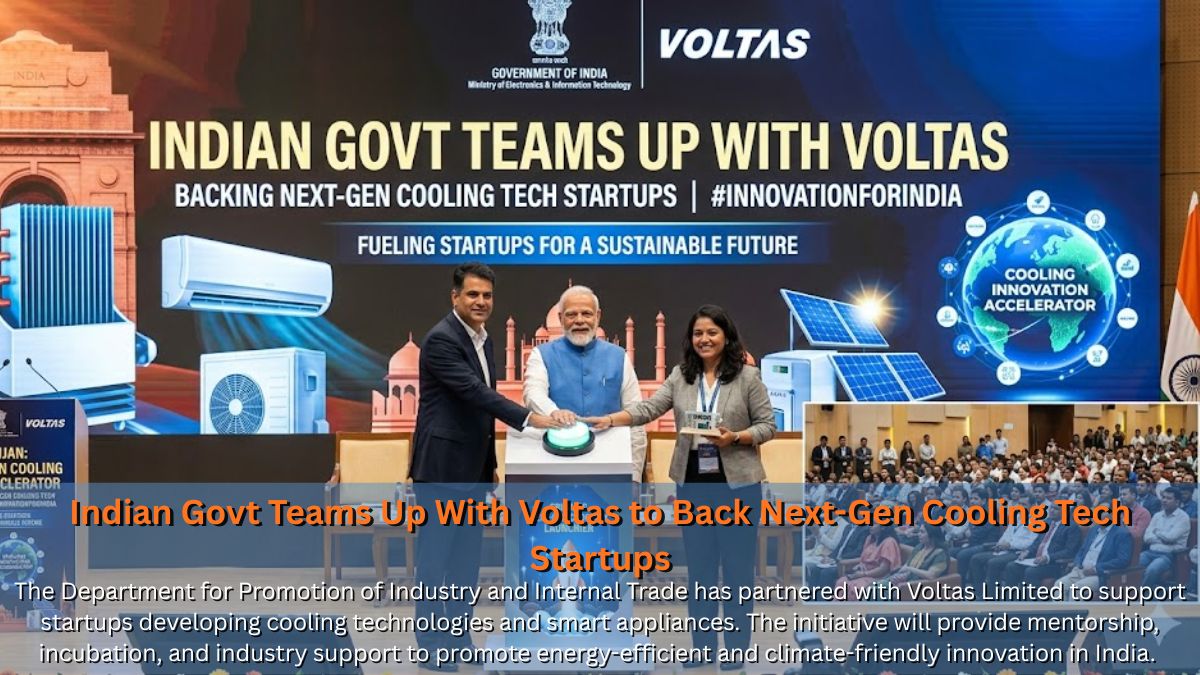
News Summary
India’s push to strengthen its deep-tech and climate technology ecosystem has taken a fresh step forward. The Indian Govt Teams Up with leading engineering company Voltas Limited to accelerate innovation in cooling technologies and smart appliances. The initiative is led by the Department for Promotion of Industry and Internal Trade (DPIIT) under the Ministry of Commerce and Industry. Through a new memorandum of understanding (MoU), the government and Voltas plan to support emerging startups working in cooling technology, HVAC systems, smart appliances, and energy-efficient solutions. The partnership focuses on deep-tech innovation, mentorship, startup incubation, and industry collaboration. It aims to help early-stage startups build products, test prototypes, and scale their technologies in India’s rapidly growing cooling industry.
India’s demand for cooling systems is rising sharply. Urbanization, rising incomes, and climate change are pushing the demand for air conditioners, refrigeration solutions, and cold-chain technologies. Experts expect India’s cooling market to expand significantly over the next decade. However, energy efficiency, environmental impact, and sustainable manufacturing remain key concerns. The DPIIT–Voltas collaboration seeks to address these challenges by nurturing startups that can develop energy-efficient cooling systems and intelligent appliances. The partnership will also help startups gain access to industry expertise, testing infrastructure, mentorship programs, and market linkages.
Government officials say the initiative
Government officials say the initiative fits within India’s broader goal of building a strong startup ecosystem driven by innovation and sustainability. For startups, the collaboration offers a gateway to industry networks, business resources, and potential funding opportunities. The move also highlights a broader trend. Corporates and the government are increasingly collaborating to nurture deep-tech startups in sectors like clean energy, AI, manufacturing technology, and climate innovation.
Ultimately, this partnership reflects a larger strategy. India wants to build global leadership in climate-friendly technologies and smart manufacturing solutions. By enabling startups to innovate in cooling and smart appliances, the government hopes to create new business opportunities, strengthen domestic manufacturing, and support sustainable growth.
1. Indian Govt Teams Up With Voltas: A New Push for Cooling Tech Startups
India’s startup ecosystem continues to evolve with strong support from government and industry leaders. Recently, the Indian Govt Teams Up with Voltas Limited to boost innovation in cooling technologies and smart appliances. The collaboration is driven by the Department for Promotion of Industry and Internal Trade (DPIIT). The department works under the Ministry of Commerce and Industry and plays a central role in supporting Indian startups. The agreement aims to create opportunities for emerging startups, AI startups, and deep-tech innovators developing solutions in cooling technology. These solutions include smart air conditioners, energy-efficient appliances, intelligent refrigeration systems, and advanced HVAC technologies. Moreover, the partnership reflects a growing trend where government agencies collaborate with large companies to strengthen the startup ecosystem, attract venture capital, and encourage tech investment.
1.1 Background of India’s Cooling Technology Sector
India’s cooling demand is expanding quickly. Rapid urbanization and climate change are key drivers. Experts estimate that the number of air conditioners in India could increase sharply by 2037. At the same time, rising temperatures are creating strong demand for cooling infrastructure. However, the growth also brings challenges. Cooling equipment consumes large amounts of electricity. Therefore, improving efficiency and reducing environmental impact has become essential. The Indian Govt Teams Up initiative aims to address these issues through innovation, disruptive tech, and startup-driven solutions.
1.2 Role of DPIIT in India’s Startup Ecosystem
The Department for Promotion of Industry and Internal Trade plays a crucial role in nurturing the startup ecosystem.
DPIIT manages several startup initiatives such as:
- Startup recognition programs
- Startup incubators and accelerators
- Mentorship platforms
- Policy support for startup founders
Over the past decade, the department has helped thousands of Indian startups grow across sectors including fintech, clean energy, AI, and logistics. Through partnerships like the one with Voltas, DPIIT aims to strengthen innovation ecosystems that support venture-backed startups.
2. Voltas Limited: The Industry Partner Driving Cooling Innovation
2.1 Company Background
In India’s cooling and engineering industry, few names carry as much weight as Voltas Limited. For decades, the brand has quietly powered everything from household air conditioners to large-scale industrial climate systems that keep factories, malls, and airports running smoothly. The company was founded in 1954 and later became part of the iconic Tata Group, one of India’s most trusted and respected business conglomerates. Being associated with the Tata legacy brought with it a strong culture of reliability, engineering excellence, and long-term thinking. Over the years, Voltas has grown into one of India’s largest engineering solutions providers, operating across multiple sectors that support both industry and everyday life.
The company’s core business areas include:
- Air conditioning and refrigeration
- Engineering services
- Infrastructure solutions
- Heating, Ventilation and Air Conditioning (HVAC) systems
But Voltas is not just another appliance manufacturer. It has played a critical role in shaping India’s cooling ecosystem.
From cooling massive commercial buildings to supplying air conditioning systems for homes across the country, Voltas has become a market leader in India’s air conditioning sector. Walk into a mall, a hospital, a corporate office, or even a metro station in India, and there is a good chance that somewhere behind the scenes, Voltas technology is managing the temperature. What makes the company particularly interesting in today’s startup-driven economy is its willingness to collaborate with emerging innovators. Instead of viewing startups as competition, Voltas increasingly sees them as partners that can accelerate the future of cooling technology. That mindset is exactly what makes the new collaboration with Department for Promotion of Industry and Internal Trade (DPIIT) so significant.
2.2 Voltas’ Role in Supporting Emerging Startups
Hardware startups often face a brutal reality. A founder might have a brilliant engineering idea. Maybe a new type of energy-efficient cooling system or a smart air conditioner powered by AI. But turning that idea into a real product is incredibly difficult. Unlike software startups that can build and launch products with just laptops and servers, hardware startups need laboratories, manufacturing support, testing facilities, and industry expertise. And that’s where a company like Voltas becomes invaluable. Under the new collaboration, Voltas will work closely with startups to help them transform raw innovation into market-ready solutions.
Selected startups will gain access to several crucial resources, including:
- Industry Mentorship
Startup founders will get direct guidance from experienced engineers and industry professionals who understand the complexities of cooling technologies and HVAC systems. - Technical Guidance
Building cooling systems involves complex thermodynamics, refrigerants, energy optimization, and safety compliance. Voltas engineers can help startups refine their technologies and avoid costly mistakes. - Product Testing Facilities
One of the biggest barriers for hardware startups is testing their prototypes in real-world conditions. Through this collaboration, startups will be able to test and validate their solutions using industry-grade infrastructure. - Market Insights
Understanding customer needs is just as important as building the technology. Voltas brings decades of experience in consumer and industrial markets, helping startups design products that people will actually buy.
This approach effectively bridges the gap between startup imagination and real-world implementation. Many founders in deep-tech sectors struggle for years simply because they lack access to the right ecosystem. An idea might remain stuck at the prototype stage due to limited infrastructure or industry exposure. The Voltas partnership can dramatically change that. Instead of navigating the complex hardware ecosystem alone, startups will have the support of an established industry leader that has already solved many of these challenges. In many ways, this partnership reflects a broader shift in India’s innovation ecosystem. Large corporations are increasingly realizing that the future of technology will be built collaboratively, not in isolation.
3. How the DPIIT–Voltas Startup Program Works
The collaboration between Department for Promotion of Industry and Internal Trade and Voltas Limited is not just symbolic. It has been designed as a structured program that actively identifies and supports promising startups. At its core, the initiative aims to discover breakthrough technologies in cooling and smart appliances, two sectors that are becoming increasingly critical as India’s economy grows and urbanizes.
3.1 Startup Selection Process
The program will focus on identifying deep-tech startups that are developing innovative solutions in cooling technologies and smart appliances.
These startups may be working on technologies such as:
- Energy-efficient cooling systems that consume significantly less electricity
- Smart air conditioning solutions capable of adjusting cooling automatically
- IoT-enabled appliances connected to intelligent building systems
- Sustainable refrigeration technologies designed to reduce environmental impact
The selection process will prioritize startups that demonstrate strong engineering capability, scalable technology, and real-world application potential.
Once selected, startups will receive:
- Industry mentorship
- Access to technical resources
- Product development support
- Market exposure and networking opportunities
This support structure significantly increases the chances that a promising prototype will evolve into a commercially viable product. For many founders, this kind of ecosystem support can mean the difference between a brilliant idea that fails quietly and a technology that transforms an entire industry.
3.2 Startup Working Model
Startups in the cooling technology sector typically follow a technology-driven innovation model. The journey usually begins with research and development.
Engineers and founders start by developing innovative solutions to improve cooling efficiency. These innovations may include:
- AI-powered temperature management systems
- Smart sensors that monitor environmental conditions
- Energy optimization algorithms for large buildings
- Advanced refrigerant technologies with lower environmental impact
Once the core technology is developed, the next stage is prototype development. This is where founders build early versions of their products and begin testing them under controlled conditions. However, real-world testing is where most challenges emerge. Cooling systems behave differently in homes, factories, and commercial buildings. This is exactly where partnerships with companies like Voltas become critical. Access to real-world testing environments allows startups to refine their solutions and improve performance. Finally, startups move toward commercial scaling.
This stage involves forming partnerships with:
- Manufacturers
- Distributors
- Retailers
- Infrastructure developers
Through these collaborations, startups can bring their innovations to a much larger market. This model allows young companies to combine engineering innovation with business scalability, which is essential for long-term success.
4. Revenue Model of Cooling Technology Startups
Cooling technology startups are not limited to a single revenue stream. Instead, they often operate with multiple monetization strategies that allow them to grow sustainably.
4.1 Hardware Sales
One of the most straightforward revenue models is selling hardware products directly to consumers or businesses.
These products may include:
- Smart air conditioners
- Advanced refrigeration units
- Intelligent HVAC controllers
- Energy-efficient cooling systems for commercial buildings
The demand for such products is growing rapidly as both consumers and businesses look for ways to reduce electricity costs and improve sustainability.
4.2 Software and Data Services
Some startups take their innovation a step further by offering software platforms that manage energy efficiency. For example, smart cooling systems can collect real-time data about temperature, humidity, and energy consumption. Using analytics and machine learning, businesses can then optimize cooling operations in offices, factories, or shopping malls. These platforms are often offered through subscription-based models, creating recurring revenue streams that provide long-term financial stability.
4.3 Licensing Technology
Another powerful revenue strategy is technology licensing. Instead of manufacturing products themselves, some startups license their cooling innovations to large manufacturers. This allows startups to scale their technology rapidly without building expensive manufacturing infrastructure. Large companies integrate the startup’s technology into their own products, while the startup earns royalties or licensing fees. For young companies with breakthrough technologies, this model can be extremely profitable.
5. Problems These Startups Are Trying to Solve
Cooling technology might sound like a niche industry, but it actually sits at the center of some of the world’s most pressing challenges. From energy consumption to climate change, cooling solutions play a critical role in shaping the future.
5.1 Reducing Energy Consumption
Cooling devices already account for a massive share of global electricity usage. As temperatures rise and urbanization accelerates, the demand for cooling is expected to increase dramatically. Startups in this sector are working on technologies that reduce electricity consumption without compromising performance. Smarter systems, better insulation, and advanced energy management tools can significantly lower power usage. For businesses and households, this translates into lower electricity bills and improved energy efficiency.
5.2 Addressing Climate Impact
Traditional cooling systems rely on refrigerants that can contribute to environmental damage. Many startups are exploring alternatives that are more sustainable and environmentally friendly. These innovations aim to reduce carbon emissions while maintaining high cooling performance. If successfully adopted at scale, such technologies could play a major role in fighting climate change.
5.3 Building Smart Infrastructure
Modern cities are evolving into intelligent ecosystems. Buildings are becoming smarter, connected, and increasingly automated. Cooling systems are a critical part of this transformation. Startups are developing smart appliances that automatically adjust cooling levels based on real-time usage patterns. Imagine an office building where the cooling system automatically reduces power consumption in empty meeting rooms or adjusts temperature based on outdoor weather conditions. These systems are not just convenient. They are also far more energy efficient. And as India continues to build smart cities and modern infrastructure, such innovations will become increasingly essential.
6. Industry Growth Trends in Cooling Technology
India’s cooling industry is entering a defining decade. For many years, air conditioning and refrigeration were seen as lifestyle upgrades. Today, they are becoming essential infrastructure. Homes, hospitals, offices, data centers, and factories all depend on reliable cooling systems to function efficiently.
The shift is happening because India itself is changing rapidly. Cities are growing larger, summers are becoming harsher, and technology is entering every corner of daily life. Industry experts believe the demand for cooling solutions in India could multiply several times over the next two decades. This surge is not driven by a single factor. It is the result of several powerful trends that are reshaping how people live, work, and build infrastructure. Understanding these trends helps explain why collaborations between the government and companies like Voltas Limited matter so much for the future.
6.1 Rising Urbanization
Urbanization is one of the strongest forces driving demand for cooling technologies in India. Every year, millions of people migrate from small towns and rural areas to large cities in search of better jobs, education, and opportunities. As a result, cities are expanding at an unprecedented pace.
New apartment complexes, office buildings, shopping malls, hospitals, and industrial parks are being constructed across the country. Every one of these spaces requires reliable cooling systems. But the demand is not limited to large commercial buildings anymore. A few decades ago, owning an air conditioner was considered a luxury in many Indian households. Today, it is gradually becoming a basic necessity, especially in densely populated urban areas where rising temperatures and crowded living conditions make indoor comfort increasingly important.
Engineers working in the HVAC industry often point out a simple truth: when a city grows vertically with high-rise buildings and glass structures, the need for efficient cooling multiplies. This is why India’s urban expansion is directly linked to the growth of the cooling industry. As cities evolve into modern metropolitan hubs, cooling systems become part of the city’s core infrastructure, just like electricity and water supply. For startups building innovative cooling technologies, this urban transformation presents enormous opportunity.
6.2 Climate Change and Rising Temperatures
Another powerful factor accelerating the demand for cooling solutions is climate change. Across India, summers have been becoming hotter and longer. Heatwaves that once occurred occasionally are now happening more frequently and lasting longer. In several parts of the country, temperatures regularly cross 45°C during peak summer months. For millions of people, this makes cooling systems not just about comfort but about health and safety.
Hospitals rely heavily on controlled temperatures to store medicines and operate critical equipment. Data centers need stable cooling environments to prevent servers from overheating. Even agriculture increasingly depends on cold storage systems to reduce food waste. This growing demand creates a complex challenge. Traditional cooling systems consume large amounts of electricity and rely on refrigerants that can contribute to environmental damage. If cooling demand grows rapidly without technological innovation, it could significantly increase energy consumption and carbon emissions.
This is exactly why climate-focused startups are stepping into the sector. Many emerging companies are now developing energy-efficient cooling technologies, advanced refrigerants, and smart systems that reduce power consumption. Their goal is simple but ambitious: make cooling accessible to millions of people without worsening the climate crisis. For investors and policymakers, this makes cooling technology one of the most important areas in the global climate innovation landscape.
6.3 Smart Appliances and the Rise of IoT
Another major transformation happening in the cooling industry is the rise of smart appliances. Today’s consumers expect far more than basic functionality from home devices. People want appliances that are intelligent, connected, and capable of adapting to their lifestyles. This shift is pushing companies to integrate Artificial Intelligence, sensors, and Internet of Things (IoT) technologies into cooling products. Modern smart air conditioners can already perform tasks that were unimaginable a decade ago. They can monitor indoor temperature patterns, adjust cooling automatically, and even learn user preferences over time.
Some advanced systems can also connect with smartphones, allowing users to control cooling settings remotely. For example, imagine returning home from work during a hot summer evening. Instead of walking into a warm house, a smart AC can automatically start cooling the room before you arrive. Behind the scenes, these systems use sensors, connectivity, and machine learning algorithms to optimize performance.
From an industry perspective, this shift toward intelligent appliances opens new doors for startups specializing in:
- Smart home technologies
- Energy analytics platforms
- IoT-enabled climate control systems
Companies like LG Electronics and Daikin Industries have already begun integrating such technologies into their products. But the real innovation often comes from smaller startups experimenting with new ideas at the intersection of hardware and software.
7. Funding Opportunities for Cooling Startups
Partnership initiatives like the collaboration between the Department for Promotion of Industry and Internal Trade and Voltas Limited can significantly change the funding landscape for cooling technology startups. One of the biggest challenges deep-tech founders face is access to capital. Unlike software startups that can launch products relatively quickly, deep-tech companies often require years of research and development before their technology reaches commercial viability.
Developing a new cooling system, for example, may involve:
- Laboratory research
- Engineering design and prototyping
- Field testing in real-world conditions
- Regulatory compliance and safety certifications
All of these steps require significant financial investment.
However, once the technology proves successful, the potential for growth can be enormous. A startup that develops a breakthrough energy-efficient cooling solution could quickly attract partnerships with manufacturers, real estate developers, and infrastructure companies. Investors are increasingly aware of this opportunity. Venture capital firms around the world are now actively looking for startups working on clean energy, climate technology, and sustainable infrastructure. Cooling innovation sits right at the intersection of these sectors.
That means founders building next-generation cooling technologies may find growing interest from angel investors, venture capital funds, and corporate investment arms. Government-backed programs and industry collaborations further reduce risk for investors by providing credibility and technical validation. In simple terms, when a startup receives support from recognized institutions and companies, investors gain confidence that the technology has real-world potential.
8. Direct and Indirect Competitors in the Cooling Market
The cooling technology sector is highly competitive, with both large multinational corporations and emerging startups competing for market share. Understanding this competitive landscape is essential for any startup entering the industry.
8.1 Direct Competitors
The biggest competitors in the cooling industry are established global and domestic manufacturers.
Major players include companies such as:
- Blue Star Limited
- Daikin Industries
- LG Electronics
These companies dominate the HVAC market with extensive manufacturing capacity, established distribution networks, and strong brand recognition. They have spent decades building engineering expertise and large-scale production infrastructure. For startups, competing directly with such giants can be extremely challenging. However, many young companies do not attempt to replace these players. Instead, they focus on developing specialized technologies that large manufacturers can integrate into their products. This collaborative approach often leads to partnerships rather than head-to-head competition.
8.2 Indirect Competitors
Not all competition comes from traditional HVAC companies. A new generation of startups is emerging in adjacent sectors that influence how cooling systems operate.
These include startups working in:
- Smart home automation
- Energy management platforms
- Climate technology solutions
Such companies may not manufacture cooling equipment themselves, but they develop software platforms and intelligent systems that interact with cooling infrastructure. For instance, an energy analytics startup might design a platform that optimizes cooling efficiency across large commercial buildings. Instead of competing with HVAC manufacturers, these startups often collaborate with them, creating integrated solutions that combine hardware and software innovation.
9. India’s Deep-Tech Startup Ecosystem
India’s startup ecosystem has undergone a remarkable transformation over the past decade. Not long ago, most Indian startups focused primarily on internet services and consumer apps. Today, the landscape has expanded dramatically. The country now hosts over 100 unicorn companies, spanning industries such as fintech, artificial intelligence, logistics, healthcare, and enterprise software. Behind this growth lies a strong ecosystem of government initiatives, private investors, and startup support organizations. Programs introduced by institutions like the Startup India and the Department for Promotion of Industry and Internal Trade have played a major role in nurturing early-stage startups.
Across the country, incubators and accelerators now provide founders with:
- Mentorship from experienced entrepreneurs
- Access to research facilities
- Industry partnerships
- Funding opportunities
For deep-tech startups working in areas like cooling technology, such support systems are especially valuable. Engineering-focused companies often require longer development cycles and greater capital investment compared to traditional digital startups. Government-backed initiatives and corporate collaborations help bridge this gap by giving founders access to both technical expertise and industry networks.
The partnership between Department for Promotion of Industry and Internal Trade and Voltas Limited reflects this larger strategy. It signals a clear shift toward strengthening India’s deep-tech innovation ecosystem, where startups are not only encouraged to experiment but also given the resources needed to turn complex engineering ideas into real-world solutions.
And if this momentum continues, India’s next generation of climate-tech and cooling innovators may not just serve the domestic market. They could end up building technologies that influence cooling infrastructure around the world.nnovation.
10. Global Startup Trends in Climate Technology
Over the last decade, the global startup ecosystem has undergone a noticeable shift. For years, most venture capital flowed heavily into consumer internet platforms, social media applications, and e-commerce companies. But today, a different category of innovation is capturing the attention of investors across the world: climate technology. Climate tech is no longer seen as a niche sector driven only by environmental concerns. It has rapidly evolved into one of the fastest-growing investment areas globally, attracting billions of dollars in funding every year.
The reason is simple. The world is facing a series of complex environmental and energy challenges, and solving them requires bold technological innovation. Governments alone cannot solve these problems. Corporations cannot do it alone either. Increasingly, startups are emerging as the engines of experimentation and breakthrough ideas.
Across the globe, investors are funding startups that are developing solutions in areas such as:
- Renewable energy infrastructure
- Smart energy management platforms
- Sustainable manufacturing systems
- Carbon capture technologies
- Advanced cooling solutions
These sectors may appear very different on the surface, but they are deeply connected by a common mission: reducing energy consumption and building more sustainable systems for the future. Cooling technology is one of the most important areas within this broader climate innovation movement. According to global energy experts, cooling demand is expected to increase dramatically over the coming decades. Rising global temperatures, rapid urbanization, and growing middle-class populations are all contributing to this surge. Without innovation, this increase in cooling demand could lead to a massive rise in electricity consumption and greenhouse gas emissions.
This is precisely why startups working on energy-efficient cooling technologies, smart HVAC systems, and sustainable refrigeration solutions are attracting increasing attention from global investors. India, in particular, holds a unique position in this evolving landscape. The country offers a combination of factors that make it highly attractive for climate-tech innovation.
10.1 First, India represents one of the largest emerging
First, India represents one of the largest emerging markets for cooling solutions. With a population of over a billion people and rapidly expanding urban infrastructure, the demand for efficient cooling technologies is expected to grow substantially in the coming years. Second, India possesses a strong base of engineering talent. Every year, thousands of engineers graduate from universities across the country, bringing fresh ideas and technical expertise into the startup ecosystem. This pool of talent gives Indian startups a powerful advantage when it comes to building deep-tech solutions. Third, the growing collaboration between government institutions and industry leaders is strengthening the innovation ecosystem.
For instance, partnerships involving organizations like the Department for Promotion of Industry and Internal Trade and companies such as Voltas Limited are creating platforms where startups can experiment, test technologies, and access real industry infrastructure. Such collaborations send a strong signal to global investors. They demonstrate that India is not only a large consumer market but also a serious hub for technological innovation in climate solutions. If this momentum continues, India could emerge as a major center for the development of next-generation cooling technologies that serve both domestic and global markets.
11. Lessons for Startups and Entrepreneurs
Beyond the immediate technological implications, the collaboration between the Department for Promotion of Industry and Internal Trade and Voltas Limited offers several meaningful lessons for startup founders and entrepreneurs. These lessons go far beyond the cooling industry. They apply to anyone building a startup in complex, technology-driven sectors.
11.1 The Power of Strategic Partnerships
One of the most important lessons is the value of collaboration between startups and established companies. Startups are naturally agile. They move quickly, experiment with new ideas, and challenge traditional approaches. However, they often lack the infrastructure, industry connections, and market access required to scale their innovations. Large corporations, on the other hand, possess decades of experience, global supply chains, manufacturing capacity, and established customer networks. When these two worlds collaborate, something powerful happens.
Startups gain access to the resources they need to refine and commercialize their technologies. Corporations gain exposure to fresh ideas and innovative approaches that may not emerge within traditional corporate structures. This combination of startup agility and corporate expertise can dramatically accelerate innovation. For founders, this highlights an important mindset shift. Instead of viewing large companies purely as competitors, startups should also consider them as potential partners. Strategic collaborations can often open doors that would otherwise take years to unlock.
11.2 Focus on Solving Real Problems
Another important lesson from this initiative is the importance of building startups that address genuine, large-scale challenges. Some of the most successful startups in the world have been built around solving real problems that affect millions of people. Cooling technology is a perfect example.
At first glance, cooling systems may appear like a mature industry with little room for innovation. But when viewed through the lens of energy efficiency, climate impact, and smart infrastructure, the opportunities become enormous. Billions of people around the world are expected to require cooling systems in the coming decades. Making those systems more efficient, sustainable, and intelligent is not just a business opportunity. It is a global necessity. Startups that focus on solving such meaningful challenges often attract stronger investor interest, deeper customer engagement, and long-term market relevance.
11.3 The Patience Required for Deep-Tech Innovation
Deep-tech startups operate very differently from typical software companies. Building a mobile application may take months. Developing a breakthrough cooling technology can take years of research, engineering, testing, and refinement. Many founders underestimate this timeline when entering deep-tech industries. Scientific research, product development, safety testing, and regulatory approvals all take time. There are rarely overnight success stories in this field. But the rewards can be significant.
Once a deep-tech startup successfully commercializes its technology, it often gains strong competitive advantages because the underlying innovation is difficult to replicate. The cooling industry illustrates this perfectly. Developing a highly energy-efficient cooling system or a sustainable refrigerant technology requires extensive engineering expertise. However, once such a technology proves effective, it can reshape entire markets. For founders entering deep-tech sectors, patience and long-term thinking are essential qualities.
11.4 The Importance of Government Support
Finally, the collaboration highlights the growing role governments play in supporting innovation ecosystems. Around the world, governments are recognizing that startups are critical drivers of economic growth and technological advancement. Programs launched by initiatives such as Startup India and the Department for Promotion of Industry and Internal Trade provide founders with access to mentorship, funding opportunities, incubation support, and policy incentives. These programs can significantly reduce the barriers that early-stage startups face. For entrepreneurs, the lesson is clear.
Government initiatives are not just policy announcements. They are real opportunities that founders can leverage to access networks, infrastructure, and financial support. Entrepreneurs who actively engage with these programs often gain valuable advantages that accelerate their startup journey. In many ways, the collaboration between Department for Promotion of Industry and Internal Trade and Voltas Limited represents more than a single initiative. It reflects a broader shift in how innovation is being built in India.
Instead of isolated efforts, the future of technology is being shaped through collaboration between startups, corporations, investors, and government institutions. For entrepreneurs watching this transformation, the message is both inspiring and practical. The opportunities are growing. The support systems are expanding. And for founders willing to tackle complex challenges with patience and creativity, the coming decade may offer some of the most exciting possibilities the startup ecosystem has ever seen.
About foundlanes.com
foundlanes.com is India’s leading startup idea discovery platform. It helps entrepreneurs find actionable startup opportunities, market insights, and industry-specific guidance to turn ideas into real businesses. With deep research and practical resources, foundlanes supports founders at every stage, from idea validation to launch and growth.