


News Summary
Some moments do not arrive with loud celebrations. They happen quietly, far away from crowded streets and breaking news debates, yet they leave behind a feeling that stays with people long after the moment is over. The successful maiden salvo launch of the NASM-SR missile off the Odisha coast felt exactly like that.
Out in the Bay of Bengal, under a wide grey sky and surrounded by endless water, a Sea King helicopter of the Indian Navy moved steadily across the airspace. Inside control rooms, scientists watched screens without blinking. Naval officers listened carefully to every update coming through their headsets. Engineers who had spent years working on calculations, systems, and simulations stood waiting for the few seconds that would decide whether years of effort had truly worked in real conditions. Then came the launch. One missile. Then another.
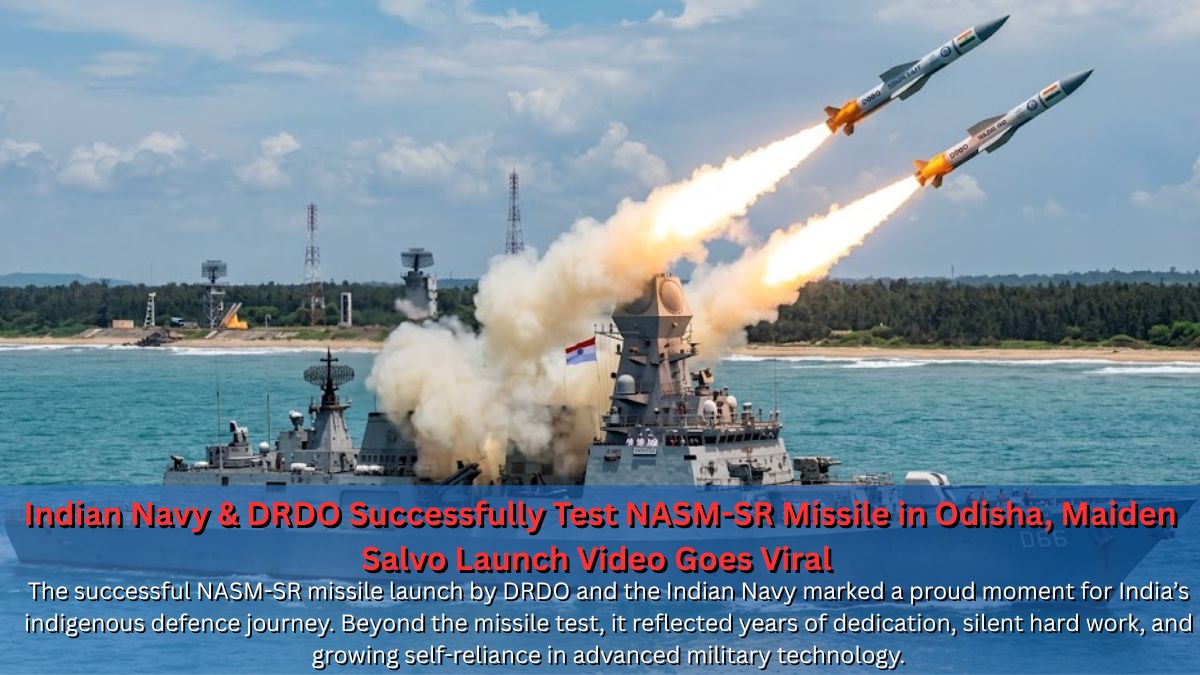
Within moments, both missiles cut across the sky with precision, heading toward their targets exactly as they were designed to do. The mission was successful. India had completed the maiden salvo launch of the NASM-SR missile system, an indigenous anti-ship weapon developed through years of patient work by DRDO and the Indian Navy. But the real story was never only about the missile. It was about the people behind it.
The defence scientists
The young engineers who probably spent nights inside labs instead of at home with family. The defence scientists who worked for years knowing that one small mistake could undo everything. The naval teams who trained repeatedly for missions the public would never even hear about. The technicians checking every wire, every system, every signal again and again because in defence technology there is no space for guesswork. When the launch succeeded, many of those people likely did not scream or celebrate wildly. That is usually not how these moments happen. Sometimes success in places like this arrives quietly. A deep breath. A small smile. Someone removing their headset slowly. Someone else finally relaxing after carrying pressure for months.
Soon after, videos of the launch began spreading online. Across social media, people watched the missiles rise above the sea over and over again. Some called it historic. Some called it powerful. But many reactions were simpler and more emotional than that. People felt proud. Not the loud kind of pride people show for a few minutes online. A quieter kind. The feeling of watching something built by Indian hands, Indian minds, and Indian effort succeed on such a critical stage.
For years, India depended heavily on foreign defence systems. Every successful indigenous project changes that story little by little. That is why moments like these feel personal even to ordinary citizens who may never fully understand missile systems or military technology. Because somewhere deep down, people understand what it means when a country slowly learns to stand stronger on its own.
The launch was monitored
The launch was monitored from the Integrated Test Range at Chandipur in Odisha using radar systems, telemetry equipment, and advanced tracking technology. Reports suggest the NASM-SR missile can strike targets around 55 kilometres away and operate in difficult weather conditions using fire-and-forget capability. Defence Minister Rajnath Singh congratulated DRDO teams, the Indian Navy, the Indian Air Force, and industry partners after the successful mission. Official statements described the launch as a major milestone for India’s maritime defence capability.
But outside official language and technical briefings, the emotions surrounding the moment told a different story. In a world filled with constant noise, political arguments, and endless headlines, this felt like one of those rare moments where people paused for a second and simply felt connected to something bigger than themselves. A missile launch lasted only a few seconds in the sky over the sea. But for the people who built it, tested it, trusted it, and watched it succeed, it carried the weight of years.
2. India’s NASM-SR Missile Test Felt Bigger Than Just Another Defence Trial
What happened over the Bay of Bengal was not merely a technical exercise or another scheduled weapons test. For many people inside India’s defence community, the successful launch of the NASM-SR missile carried a deeper emotional meaning. It reflected how far India has come in its long and often difficult journey toward building advanced military technology with its own hands. For decades, India relied heavily on imported defence systems. Critical technologies often came with restrictions, conditions, and dependence on foreign suppliers. Every indigenous success story slowly changes that reality. That is why moments like this feel important not only inside military circles but also among ordinary citizens who see self-reliance as something bigger than policy language.
2.1 The successful launch
The successful launch also showed growing confidence inside India’s defence establishment. Scientists, naval officers, engineers, technicians, and manufacturers worked together to develop a system designed specifically for India’s strategic needs. Nothing about such projects happens quickly. Years of research, repeated testing, failures, redesigns, and pressure sit quietly behind every successful launch. According to official reports, the trial involved firing two missiles one after another from the same Sea King helicopter platform near the Odisha coast. In defence operations, this is known as a “salvo launch.”
The term may sound technical, but the idea behind it is simple and serious. In real combat situations, launching multiple missiles rapidly gives enemy ships very little time to react. Defence systems become overwhelmed. Response windows shrink. The pressure on enemy vessels increases instantly. But for the teams involved in this mission, those few seconds of successful launch probably carried the weight of many years. Inside monitoring stations, people would have watched every signal carefully. Every movement on radar screens mattered. Every second between launch and impact mattered. Defence technology does not forgive mistakes easily. That is why successful missions often bring relief before celebration. The test validated not only the missile’s targeting ability but also India’s growing capability to handle advanced naval strike operations using indigenous systems.
2.1 What Exactly Is the NASM-SR Missile?
The NASM-SR stands for Naval Anti-Ship Missile Short Range. On paper, it is an air-launched anti-ship missile system developed for maritime warfare. But behind that technical description lies years of scientific effort and strategic planning. This is India’s first indigenous air-launched anti-ship missile designed specifically for naval helicopter operations. That alone makes it significant. Modern naval warfare depends heavily on precision, speed, and survivability. Enemy ships today carry sophisticated radar systems, interception technology, and electronic warfare capabilities. Designing a missile that can survive in such an environment is an enormous challenge.
According to reports, the NASM-SR missile includes sea-skimming capability. This means the missile flies extremely close to the sea surface while approaching its target. To someone outside defence circles, that may sound like just another feature. In reality, it is one of the most difficult aspects of missile engineering. Flying low above moving ocean surfaces while maintaining speed, stability, and targeting precision requires advanced guidance systems and highly accurate control mechanisms. The lower the missile flies, the harder it becomes for enemy radar systems to detect and respond in time.
The missile also reportedly supports fire-and-forget capability. This means once the missile is launched, it can independently track and engage its target without requiring constant guidance from the launch platform. In actual combat situations, this becomes critically important because helicopters or aircraft launching the missile can move away immediately instead of staying exposed near hostile zones. For naval crews operating in dangerous environments, that difference can save lives.
2.2 Why This Maiden Salvo Launch Mattered Emotionally and Strategically
From a military perspective, the maiden salvo launch demonstrated several operational capabilities at once. But beyond military terminology, it also represented confidence. India successfully showed that an indigenous helicopter platform could launch multiple anti-ship missiles rapidly and accurately during simulated combat conditions. That is not a small achievement. The first major success involved simultaneous offensive capability. Launching missiles quickly from the same platform requires precision coordination between guidance systems, targeting systems, launch mechanisms, and flight control operations. Second, the launch demonstrated rapid deployment under operational conditions. In naval warfare, speed often decides survival.
Third, and perhaps most importantly, the test reportedly proved waterline strike capability. This matters because strikes near the waterline can cause severe structural damage to ships. Even a powerful vessel becomes vulnerable when hit in critical lower sections near sea level. According to official statements, telemetry systems, radar tracking, and electro-optical monitoring systems at the Integrated Test Range in Chandipur confirmed that all mission objectives were achieved successfully.
But outside technical validation reports, the emotional side of the story felt equally important. For years, India’s scientists and defence teams worked toward building stronger indigenous systems quietly, often without public attention. Many of those involved probably spent large portions of their careers working toward moments exactly like this. That is why successful tests in defence programs are rarely only about machines. They are also about people finally seeing years of invisible effort come alive for a few seconds in the sky.
3. The Long Journey of DRDO and India’s Indigenous Missile Dream
India’s defence research journey did not begin with advanced missiles or modern naval systems. It started decades ago with a much simpler but far more difficult ambition: learning how to build critical defence technologies independently. When DRDO was established in 1958, India’s defence manufacturing ecosystem was still in its early stages. Resources were limited. Technological expertise was developing slowly. The country depended heavily on foreign suppliers for critical military systems.
Then came years of geopolitical pressure, technology restrictions, sanctions, and strategic challenges. Those experiences changed India’s thinking completely. The country slowly realized that true strategic independence could never come without technological self-reliance. That realization shaped the future of DRDO.
Over time, the organization expanded into missile development, aerospace engineering, electronic warfare systems, radar technology, naval defence systems, and advanced combat platforms. None of this happened overnight. There were failed tests. Delays. International restrictions. Budget limitations. Public criticism. Pressure from strategic rivals. But despite all of that, the work continued. Today, DRDO stands among the world’s largest defence research organizations, not because the journey was easy, but because the country stayed committed to building long-term capability.
3.1 How India Slowly Built Its Missile Programs
India’s missile development journey accelerated during the 1980s under the Integrated Guided Missile Development Programme. This program became one of the turning points in India’s defence history.
It led to the development of systems like:
- Agni missiles
- Prithvi missiles
- Akash air defence systems
- Nag anti-tank missiles
- BrahMos cruise missiles
Each of these projects carried its own challenges, setbacks, and breakthroughs. Behind every successful missile system were years of trial failures, redesigns, testing cycles, and pressure-filled evaluations.
The NASM-SR missile now becomes part of that larger story. It represents another step in India’s slow but determined effort to reduce dependence on imported military technology. For many defence scientists who spent decades building indigenous systems, moments like this carry emotional significance beyond headlines.
Because every successful indigenous platform proves something important.
- That India can build.
- India can innovate.
- India can compete.
3.2 India’s Push Toward Indigenous Defence Manufacturing
India still imports a large portion of its military hardware. But over the last several years, there has been a visible shift toward domestic defence production. The government has pushed aggressively for indigenous manufacturing under the Atmanirbhar Bharat initiative. This push is changing the defence ecosystem itself. Earlier, defence technology remained dominated mostly by government organizations. Today, private companies, startups, drone manufacturers, electronics firms, and aerospace businesses are increasingly becoming part of the ecosystem.
Young engineers who once looked only toward software jobs are now entering aerospace, AI defence systems, military electronics, and drone technology sectors. That shift matters. Because defence innovation no longer depends only on one organization. It now involves an entire ecosystem slowly growing around strategic technology development. The NASM-SR project reflects this larger transformation happening quietly across India’s defence industry.
4. The Technology Behind the NASM-SR Missile
Many technical details about the NASM-SR missile remain confidential for obvious security reasons. Still, enough information has emerged to show why defence experts are paying close attention to this system.
Reports suggest the missile includes advanced features such as:
- Sea-skimming capability
- Fire-and-forget guidance
- Waterline strike capability
- Solid propulsion booster
- Long-burn sustainer engine
The missile also reportedly uses indigenous avionics and navigation systems developed within India. But beyond specifications and engineering language, what stands out is the complexity behind building such systems domestically. Every guidance system must work under pressure. Every navigation component must remain stable in harsh environments. Launch sequence must perform perfectly because even a tiny failure can affect the entire mission. That is why successful missile tests are never celebrated casually inside defence programs. People understand exactly how difficult the process truly is.
4.1 Strike Range and Flight Capability
Reports suggest the NASM-SR missile has a strike range of around 55 kilometres and travels at approximately Mach 0.8 speed. Its flight altitude reportedly ranges between very low sea-level approaches and higher operational trajectories. However, one feature stands above the rest. Sea-skimming capability.
This is what allows the missile to fly extremely close to the ocean surface while approaching enemy targets. The lower it flies, the harder it becomes for radar systems to detect it in time. Imagine a fast-moving missile almost blending with the movement of the sea itself. That is what makes such systems dangerous and strategically valuable. In naval warfare, survival often depends on seconds. Reducing enemy reaction time changes everything.
4.2 Why Helicopter-Launched Systems Are So Important
The NASM-SR missile was launched from a Sea King helicopter during the Odisha test. That detail matters more than many people realize. Naval helicopters provide flexibility that large warships sometimes cannot. They can move quickly. Approach targets from unexpected angles. Operate over wide maritime areas. Launch precision strikes while keeping larger naval assets at safer distances. In modern naval warfare, mobility often becomes just as important as firepower.
Helicopter-based missile systems strengthen India’s maritime strike options significantly because they allow rapid deployment in complex sea operations. For the naval crews operating those helicopters, every mission requires precision, training, discipline, and trust in the technology they carry. That trust grows stronger every time systems like this succeed.
5. How the NASM-SR Missile Test Actually Unfolded Over the Bay of Bengal
The successful launch lasted only a short time in the sky, but behind those few moments was an operation planned with extraordinary precision. The test took place over the Bay of Bengal near the Odisha coast, far away from public attention and crowded headlines. Out at sea, every movement was being monitored carefully. Naval teams stayed focused. Scientists tracked live data continuously. Engineers watched screens filled with numbers, coordinates, and system readings that most ordinary people would never fully understand but which meant everything to the teams involved.
Then came the critical moment. An Indian Navy Sea King helicopter moved into position before launching two NASM-SR missiles one after another in rapid succession. The launches happened within seconds, but for the people monitoring the mission, time probably felt slower than usual. Inside defence control rooms, silence often becomes heavier during moments like these. Nobody celebrates early. Relaxes until every system performs exactly as expected.
5.1 The operation successfully demonstrated
The operation successfully demonstrated what defence experts call “salvo launch capability.” In simple terms, it means the ability to fire multiple missiles rapidly from the same platform during combat situations. In real warfare, such capability matters enormously because it reduces the enemy’s reaction time and puts immediate pressure on hostile defence systems.
But beyond technical language, the success represented trust.
- Trust in years of engineering.
- Trust in testing.
- Trust in the people who built the system piece by piece.
According to defence reports, sophisticated monitoring systems at the Integrated Test Range in Chandipur captured every stage of the operation successfully. Radar tracking systems followed the missile trajectory in real time. Electro-optical sensors observed movement and targeting behavior carefully. Telemetry systems collected detailed performance data throughout the flight.
Every signal mattered. Every data point mattered. Because in defence technology, even a small anomaly can force months of re-evaluation. That is why successful tests often bring something deeper than excitement inside scientific and military teams. They bring relief. Relief that years of invisible work finally proved itself under real operational conditions.
5.1 The Waterline Strike Capability Became One of the Biggest Moments of the Trial
Among all the technical achievements during the test, one detail stood out strongly. The missiles reportedly demonstrated successful waterline strike capability. For people outside military circles, the term may sound highly technical. But in naval warfare, it carries enormous importance. Warships are built to survive difficult combat conditions. Hitting upper sections may damage equipment, but strikes near the waterline can become devastating because they threaten the structural stability of the vessel itself.
That is why waterline targeting is considered one of the most effective anti-ship combat capabilities. According to official statements, the missiles accurately performed this role during the operation. For the scientists and naval teams involved, this validation likely meant more than just another mission objective completed successfully. It was proof that the system could perform under realistic combat expectations. And moments like that do not come easily. Behind every successful strike capability are years of simulations, software tuning, guidance corrections, failed attempts, redesigned systems, and repeated testing cycles that rarely become public stories. Most people only see the final launch video. Very few see the years behind it.
5.2 When the Launch Video Went Viral, the Public Reaction Felt Different
Soon after the successful mission, footage of the launch began spreading rapidly across social media platforms. The videos appeared everywhere.
- On YouTube.
- Facebook.
- X.
- Reddit defence communities.
- WhatsApp groups.
- Telegram channels.
People replayed the footage repeatedly. Some focused on the technical side. Others simply watched with quiet admiration.
The reaction online did not feel forced or performative. It felt genuine. Defence enthusiasts discussed the strategic significance of helicopter-launched anti-ship missiles. Military observers analyzed the salvo capability carefully. Veterans shared emotional responses. Ordinary citizens, many of whom may never follow defence news regularly, still paused to watch the videos because the visuals carried a different kind of energy. There is something deeply emotional about seeing a country build advanced systems with its own people, its own laboratories, and its own engineering ecosystem.
That feeling cannot always be explained through defence terminology. For many Indians watching the footage, the moment symbolized progress. Not loud progress. Quiet progress. The kind built slowly over years through patience, setbacks, and persistence. And perhaps that is why the videos connected with people so strongly online. Because behind the missiles, people saw effort. They saw discipline. They saw belief. Saw India slowly becoming more capable in areas once dominated almost entirely by foreign powers.
6. Why the NASM-SR Missile Matters So Much for India’s Naval Future
The successful missile launch comes at a time when the world’s strategic environment is becoming increasingly tense. The Indo-Pacific region today is one of the most closely watched maritime regions globally. Naval movements are increasing. Military modernization is accelerating. Strategic competition between major powers is becoming sharper every year.
In such an environment, maritime preparedness is no longer optional. For India, protecting sea routes, coastal interests, naval assets, and strategic waters has become critically important. That is where systems like the NASM-SR missile become significant. The missile is not only about attack capability. It is about deterrence. It sends a message that India is steadily strengthening its maritime defence systems using indigenous technology. And in modern geopolitics, deterrence often prevents conflict before it even begins.
6.1 Expanding India’s Maritime Warfare Capabilities
Naval warfare has changed dramatically over the years. Battles are no longer fought only through massive ships facing each other at close range. Modern warfare depends heavily on precision systems, mobility, electronic intelligence, and long-range strike capabilities. Anti-ship missiles play a central role in that environment. They allow naval forces to neutralize enemy vessels from safer operational distances before direct engagement becomes necessary.
The NASM-SR missile strengthens this capability for India. Because the system is air-launched from helicopters, it provides tactical flexibility during naval operations. Helicopters can reposition quickly across maritime zones, approach targets from different directions, and launch precision strikes while reducing exposure risks for larger naval vessels. The successful salvo launch demonstrated another important capability. Rapid multiple-strike deployment.
In combat situations, speed changes everything. The ability to launch successive precision attacks within seconds can overwhelm enemy defence systems and significantly improve tactical effectiveness. But behind all these strategic advantages is something human too. Confidence. Every successful indigenous defence system increases the confidence of military personnel who may one day depend on that technology in real operational situations. Trust between soldiers and technology matters deeply. And trust is built only through successful performance over time.
6.2 Why Self-Reliance in Defence Technology Feels Personal for India
For decades, India remained heavily dependent on imported military equipment. While imports filled immediate defence requirements, they also created long-term vulnerabilities. Foreign systems often come with restrictions. Spare parts depend on external suppliers. Technology transfers remain limited. Geopolitical situations can affect defence access unexpectedly. That is why indigenous defence production is not just an economic policy. For many people inside India’s strategic community, it is tied directly to national confidence and sovereignty.
The NASM-SR missile represents that shift clearly. It shows India slowly moving toward building critical strategic systems independently. And these changes do not happen overnight. Behind every indigenous missile system are generations of scientists, engineers, technicians, defence planners, and military personnel who spent years trying to close technological gaps that once seemed impossible to overcome. That is why successful launches often carry emotional weight beyond military achievement. Because they represent years of national effort finally taking visible shape.
7. India’s Defence Startup Ecosystem Is Quietly Transforming
India’s defence technology ecosystem today looks very different from what it did even a decade ago. Earlier, defence innovation remained concentrated mostly within government organizations and traditional public-sector defence companies.
Today, however, an entirely new layer is emerging.
- Young startups.
- Private aerospace firms.
- AI defence companies.
- Drone technology ventures.
- Military electronics innovators.
A new generation of founders and engineers is slowly entering sectors that earlier felt inaccessible. Government reforms opened new doors for private participation in defence manufacturing and strategic technology development. That shift is now beginning to reshape the industry itself. For many young Indian engineers, defence technology is no longer seen as a distant government-only field. It is increasingly becoming an area where innovation, entrepreneurship, and national purpose intersect.
7.1 Defence Technology Is Becoming a Serious Startup Opportunity
A few years ago, very few startups in India considered defence technology a viable space. Today, that picture is changing quickly.
Indian startups are now building systems related to:
- Drone warfare
- AI-powered surveillance
- Autonomous defence systems
- Cybersecurity
- Missile electronics
- Combat simulation
- Military robotics
The change reflects a broader global trend. Modern warfare increasingly depends on software, sensors, AI systems, autonomous platforms, data processing, and electronic intelligence.
As a result, the defence sector now needs not only traditional weapons manufacturers but also deep-tech innovators. Several startup incubators and accelerators in India have started supporting defence-focused innovation programs. Investors are also beginning to look more seriously at strategic technologies that once felt too specialized or politically sensitive. And perhaps most importantly, younger founders are beginning to see defence technology not just as a business opportunity, but also as a chance to contribute to something larger than themselves.
7.2 Venture Capital Is Slowly Entering Defence Innovation
For a long time, venture capital firms stayed away from defence technology. The sector was considered too slow, too regulated, and too dependent on government procurement cycles. But global trends are changing that mindset. Around the world, geopolitical tensions and rapid advances in military technology are attracting major investments into defence startups. AI-powered warfare systems, autonomous drones, cybersecurity infrastructure, and advanced military software are now receiving growing attention from investors globally. India may soon witness a similar transition.
As indigenous defence manufacturing expands, opportunities for private innovation will likely increase as well. And that could create a completely new category of Indian startups focused on aerospace engineering, strategic electronics, advanced materials, naval systems, and military AI technologies. The NASM-SR missile project itself reflects how much India’s defence ecosystem is evolving. Because behind every successful missile test today, there is no longer just one organization working alone. There is an entire ecosystem slowly growing around innovation, technology, manufacturing, research, and national ambition.
8. The NASM-SR Missile Enters a World Dominated by Powerful Global Defence Systems
The successful NASM-SR missile test was not just important within India. It also placed the country more confidently inside a highly competitive global defence landscape where only a handful of nations possess advanced anti-ship missile capabilities.
Around the world, major military powers have spent decades building sophisticated naval strike systems designed for modern maritime warfare. Countries like the United States, Russia, China, France, and Israel operate some of the most advanced anti-ship missile programs ever developed. These systems were built through years of military investment, strategic pressure, technological experimentation, and combat-driven innovation.
And now, slowly but steadily, India is building its own place in that conversation. That matters emotionally as much as strategically. For many years, India watched global military powers dominate advanced defence technology spaces. Imported systems filled important operational gaps, but dependence on foreign technology also created a quiet reminder that true strategic strength cannot rely entirely on external support forever.
Every indigenous breakthrough changes that feeling little by little. The NASM-SR missile may still be in the early stages of operational evolution, but the successful test signals something larger. It signals confidence. Confidence that Indian scientists, engineers, military planners, and defence manufacturers are capable of developing increasingly sophisticated systems designed for India’s own operational realities.
In today’s world, anti-ship missiles are not judged only by raw power. They are judged by precision. Survivability. Guidance capability. Reaction speed. Adaptability under combat conditions. Modern naval warfare is no longer about who has the largest fleet alone. It is increasingly about who can detect faster, respond faster, and strike more accurately before the opponent even gets time to react. That is the environment the NASM-SR missile is entering. And for India, stepping into that arena using indigenous systems feels like a quiet but important shift in national capability.
8.1 How the NASM-SR Missile Compares in the Global Missile Conversation
Whenever a new anti-ship missile system emerges, comparisons naturally begin. Defence analysts across the world often measure new systems against established global platforms that have defined naval warfare for years. In the case of the NASM-SR missile, discussions have already started around systems such as the American Harpoon missile, the French Exocet missile, Russia’s Kh-35 missile series, and China’s YJ-series anti-ship weapons. These names carry decades of military reputation behind them.
Some of these missile systems became famous because of real combat operations. Others earned global recognition through exports, battlefield performance, and strategic deployment across navies worldwide. For India, however, the current focus appears different. Right now, the country’s primary goal is not global export competition or international market dominance. The immediate objective is much more foundational and far more important in the long run. Operational independence. The ability to build systems internally. The ability to modify technology when needed. Ability to maintain critical defence capability without waiting on foreign approvals or supply chains.
That changes everything. Because in times of geopolitical uncertainty, imported systems can quickly become complicated. International tensions shift. Diplomatic relationships evolve. Supply chains face disruptions. Technology transfer restrictions appear unexpectedly. And when national security depends on those systems, dependency itself becomes a strategic vulnerability. That is why indigenous programs like the NASM-SR missile carry emotional significance inside India’s strategic ecosystem. They represent control. Not just over technology, but over future decision-making itself.
8.2 Why Indigenous Missile Systems Matter Beyond Defence Headlines
To an ordinary citizen, missile systems may look like isolated military projects appearing occasionally in news headlines. But inside defence planning circles, indigenous systems represent something much deeper. They represent strategic freedom. Imported military hardware often arrives with hidden limitations attached to it. Maintenance may depend on foreign suppliers. Spare parts may become difficult during political tensions. Technology access may remain restricted. Software upgrades may require external approvals. Critical components may not always be fully transferable. Over time, those dependencies create risks.
That is why countries around the world invest heavily in domestic defence capability even when imports may appear faster or easier in the short term. For India, this realization became stronger over decades. Every indigenous system developed successfully reduces one more layer of external dependency. And that is not only about military strength. It is about national confidence. The NASM-SR missile represents one small but meaningful part of that larger journey toward self-reliance in strategic technology.
Behind every successful indigenous defence project are thousands of people working quietly across laboratories, production units, testing facilities, software systems, electronics manufacturing plants, and naval operations. Most of those faces never become public. But their work slowly changes the country’s long-term capabilities in ways that often become visible only years later.
9. Why Odisha Has Quietly Become One of India’s Most Important Defence Testing Regions
Whenever India conducts a major missile test, one place appears again and again in the background of the story. Odisha, For years now, the state has quietly become one of the most important centres of India’s strategic testing infrastructure. While most people know Odisha for its coastline, temples, culture, and natural beauty, another equally important identity has steadily developed there over time. It has become one of the nerve centres of India’s missile testing ecosystem.
The successful NASM-SR missile trial once again highlighted the importance of the Integrated Test Range at Chandipur, where some of India’s most critical defence programs have been monitored and validated over the years. But places like Chandipur rarely enter public conversations in emotional ways. People see launch footage. They hear technical terms. They read headlines.
Very few pause to think about the enormous infrastructure operating silently behind every successful test. Radar tracking networks. Telemetry systems. Monitoring stations. Sea-based observation systems. Highly trained technical teams working across difficult coastal conditions. All of this exists so that a few seconds of missile flight can be analyzed with extraordinary precision. That level of preparation reflects decades of institutional learning.
9.1 The Chandipur Test Range Has Become Part of India’s Defence Story
The Integrated Test Range at Chandipur is not just another military facility. Over the years, it has become deeply connected with India’s defence development journey itself. The Bay of Bengal provides a controlled environment for missile testing, allowing scientists and military teams to monitor trajectories safely over long operational distances. The geography supports large-scale tracking operations, which is why the region has hosted multiple strategic defence programs over the decades.
Several major systems have passed through Chandipur’s testing ecosystem. Agni missile trials. Pralay missile evaluations. Pinaka rocket system tests. Naval strike platform testing. Now, the NASM-SR missile joins that long list. And each successful launch adds another layer to Odisha’s importance in India’s strategic infrastructure network.
For many local residents living near these testing regions, missile launches have become strangely familiar over the years. Yet despite the routine nature of testing operations for nearby communities, every successful launch still carries a sense of importance because people understand that these moments connect directly to national security and technological progress. Behind every missile streaking across the sky are years of invisible preparation happening on the ground.
10. The Public Reaction Was Not Just About Defence. It Was About Emotion
As soon as the NASM-SR missile launch videos surfaced online, reactions began spreading rapidly across social media platforms, defence communities, and discussion forums. But what stood out was not only the excitement. It was the emotional tone behind many responses. People were not simply reacting to a missile launch. They were reacting to what the launch symbolized. Across YouTube comments, defence forums, Reddit discussions, and social media threads, people described the moment using words like pride, confidence, self-reliance, and progress.
Defence analysts discussed the technical achievement. Strategic observers highlighted the importance of helicopter-launched anti-ship systems in future naval warfare. Military enthusiasts analyzed the missile’s trajectory, launch sequence, and strike capability frame by frame. But ordinary people reacted differently. Many simply felt proud seeing India successfully develop advanced systems on its own.
In a country where conversations around self-reliance, technological growth, and national capability have become increasingly important, moments like this create emotional resonance far beyond military circles. Because people understand the deeper meaning behind such achievements. They understand that these systems are not built overnight. They are built through years of struggle most people never see.
10.1 The Response From India’s Defence Leadership Reflected More Than Official Formalities
After the successful launch, Defence Minister Rajnath Singh congratulated DRDO scientists, the Indian Navy, the Indian Air Force, and industry partners involved in the mission. Official statements described the trial as a major milestone for India’s maritime defence preparedness.
But beyond formal government language, there was also visible confidence behind the reactions. India’s defence establishment increasingly believes in its ability to develop sophisticated systems domestically. That confidence has grown gradually over years through repeated indigenous successes across missile systems, naval technologies, aerospace programs, radar development, and strategic electronics.
The NASM-SR missile test became another important moment in that larger story. For the scientists who spent years building the system, the success likely brought quiet satisfaction. For naval teams who may one day deploy such systems operationally, it strengthened trust. Younger engineers and defence researchers across the country, it served as motivation. And for many ordinary Indians watching the launch footage online, it became one of those rare moments where technology, national effort, and emotion came together naturally without needing dramatic words or loud celebration.
11. The Business Model Behind India’s Defence Innovation Is Very Different From Ordinary Startups
When people hear the word “startup,” they usually imagine apps, software platforms, delivery companies, or fast-growing tech businesses chasing users and funding rounds. Defence innovation works in a completely different world. There are no flashy launches. No overnight success stories. Instant scale. Shortcuts. Projects often take years before the public even hears about them. Some systems remain under development quietly for a decade or more. Teams work under intense secrecy, constant pressure, and extremely high expectations because failure in defence technology carries consequences far beyond business losses.
That is what makes India’s defence innovation ecosystem unique. At the center of this system stands DRDO, the country’s primary defence research and development organization. But contrary to what many people think, DRDO does not work alone anymore. Modern defence development has slowly become an ecosystem involving scientists, military forces, private industries, manufacturing partners, electronics firms, software engineers, aerospace specialists, testing agencies, and increasingly, startups.
The process itself is massive:
- It starts with research.
- Then technology development.
- Then simulations.
- Then testing.
- Then military validation.
- Then redesigns if required.
- Then production partnerships.
- Then operational deployment.
And every stage demands precision because the systems being built are meant for real-world national security situations, not experimental prototypes sitting inside laboratories forever. The NASM-SR missile program reflects exactly how this ecosystem operates today.
Behind the successful launch were countless layers of coordination happening quietly in the background. Scientists developed the core systems. The military validated operational requirements. Industry partners supplied components. Testing teams monitored performance. Manufacturing networks supported production infrastructure. What the public eventually saw as a few seconds of missile launch footage was actually the visible result of years of interconnected effort between multiple institutions and industries. That reality often goes unnoticed. People see the missile. They rarely see the ecosystem behind it.
11.1 India’s Defence Industry Is Slowly Becoming a Massive Collaborative Ecosystem
For a long time, India’s defence sector depended heavily on government-run organizations and public-sector manufacturing systems. Private participation remained limited. But over the last several years, that landscape has started changing rapidly. Today, the defence ecosystem increasingly depends on collaboration between government agencies and private industry. And this shift is quietly transforming India’s industrial future.
Private companies now contribute to missile components, advanced electronics, sensors, navigation systems, software integration, propulsion technologies, testing infrastructure, aerospace manufacturing, and supply-chain systems. Some companies manufacture tiny but critical parts that most people will never hear about publicly. Yet without those components, entire systems may fail. That is how interconnected defence production really is. The rise of indigenous defence manufacturing is also opening entirely new opportunities for Indian startups and industrial suppliers.
Young companies are now entering areas like:
- Military AI systems
- Drone technologies
- Cybersecurity infrastructure
- Combat simulation
- Defence electronics
- Autonomous systems
- Sensor technologies
A decade ago, many of these opportunities barely existed for Indian entrepreneurs. Today, they are becoming part of a rapidly evolving strategic technology economy. And unlike traditional startup sectors focused mainly on short-term growth, defence innovation often builds deeper industrial capability over time. It strengthens manufacturing. Encourages advanced engineering. Improves research infrastructure. Creates high-skill technical jobs. Pushes long-term technological learning across industries. That is why projects like the NASM-SR missile matter beyond military headlines. They slowly help build an ecosystem where Indian engineering capability itself becomes stronger generation after generation.
12. What Startups and Entrepreneurs Can Learn From the NASM-SR Missile Story
At first glance, a missile development program may seem completely unrelated to startups or entrepreneurship. But if someone looks closely, the NASM-SR missile journey actually carries powerful lessons about innovation, resilience, leadership, and long-term thinking. And perhaps that is what makes stories like this so meaningful beyond defence circles. Because the deeper lessons are not only about weapons or military systems. They are about how difficult things get built in the real world.
12.1 The First Lesson Is Patience in a World Obsessed With Speed
Modern startup culture often celebrates fast growth, rapid scaling, instant visibility, and quick results. Defence innovation operates in the opposite direction. Projects like the NASM-SR missile take years before success becomes visible publicly. There are endless cycles of testing, redesigning, troubleshooting, and improving systems quietly behind closed doors. Most of the effort happens without applause. Without headlines.
Without validation from the outside world. That teaches an important lesson. Some of the most meaningful work in life takes time. Real capability is rarely built overnight. And sometimes, the projects that matter most require people to continue working even when nobody outside notices the progress yet.
12.2 The Second Lesson Is the Power of Collaboration
No single person builds systems like the NASM-SR missile alone. Not one scientist. Not one engineer. One organization. The successful launch happened because multiple teams worked together over long periods despite different responsibilities, pressures, and technical challenges. DRDO scientists developed the technology. The Navy supported operational integration. The Air Force contributed expertise. Industry partners manufactured systems and components. Testing agencies validated performance.
Large-scale innovation almost always works this way. Great achievements rarely come from isolated brilliance alone. They emerge from coordination, trust, communication, and shared purpose between people who may never stand together publicly when success finally arrives. That is true in defence technology. And it is equally true in startups.
12.3 The Third Lesson Is About Self-Reliance and Building Your Own Capability
One of the strongest messages behind India’s indigenous missile programs is the importance of controlling critical capability internally. For years, India depended heavily on imported defence systems. Those imports solved immediate operational needs, but they also created long-term dependence. Over time, the country realized something important. True strategic confidence comes only when you can build, maintain, improve, and control critical systems yourself.
That lesson applies directly to startups too. Businesses built entirely around borrowed advantages often become fragile during uncertainty. But companies that slowly build deep internal capability tend to survive longer. The NASM-SR missile reflects that larger philosophy. Build patiently. Learn deeply. Own the core capability.
12.4 The Fourth Lesson Is Innovation Under Pressure
What makes India’s defence journey especially remarkable is that much of it happened under difficult conditions. Technology restrictions. International pressure. Limited access to advanced systems. Global competition. And yet, progress continued. That is an important reminder for entrepreneurs. Constraints do not always destroy innovation. Sometimes they force stronger creativity.
When resources are limited, teams often learn to solve problems differently. They become sharper, more adaptable, and more resilient because they cannot depend on easy solutions. Many successful Indian startups grew in exactly the same way. They succeeded not because conditions were perfect, but because they learned to keep building despite limitations.
12.5 The Fifth Lesson Is the Importance of Long-Term Vision
Perhaps the biggest lesson behind the NASM-SR missile story is the value of thinking long term. Defence capability cannot be built quarter by quarter. It requires vision that stretches across years and sometimes decades. The same applies to meaningful businesses. Many founders fail because they focus only on immediate results while ignoring long-term capability building. But sustainable innovation usually comes from patience, planning, and ecosystem development over time.
India’s defence ecosystem today exists because generations of scientists, engineers, policymakers, and military planners stayed committed to goals that often seemed distant. And now, slowly, those efforts are beginning to show visible results.
12.6 Why Defence Technology Could Become a Major Opportunity for Indian Startups
The defence sector is no longer limited to traditional weapons manufacturing alone. Modern warfare increasingly depends on software, AI systems, sensors, autonomous platforms, cybersecurity infrastructure, advanced electronics, drone technologies, simulation systems, and intelligent data processing.
That creates enormous opportunities for Indian startups. Especially deep-tech startups. Especially AI-driven companies. Engineering-focused founders willing to solve difficult technical problems. The future defence ecosystem may include hundreds of specialized Indian companies building niche strategic technologies that earlier had to be imported from abroad. And perhaps that is one of the most important long-term outcomes of projects like the NASM-SR missile.
They do not just strengthen defence preparedness. They inspire an entire generation of engineers, researchers, founders, and innovators to believe that India can build sophisticated technologies on its own. That belief itself can change industries for decades.
About foundlanes.com
foundlanes.com is India’s leading startup idea discovery platform. It helps entrepreneurs find actionable startup opportunities, market insights, and industry-specific guidance to turn ideas into real businesses. With deep research and practical resources, foundlanes supports founders at every stage, from idea validation to launch and growth.