


News Summary
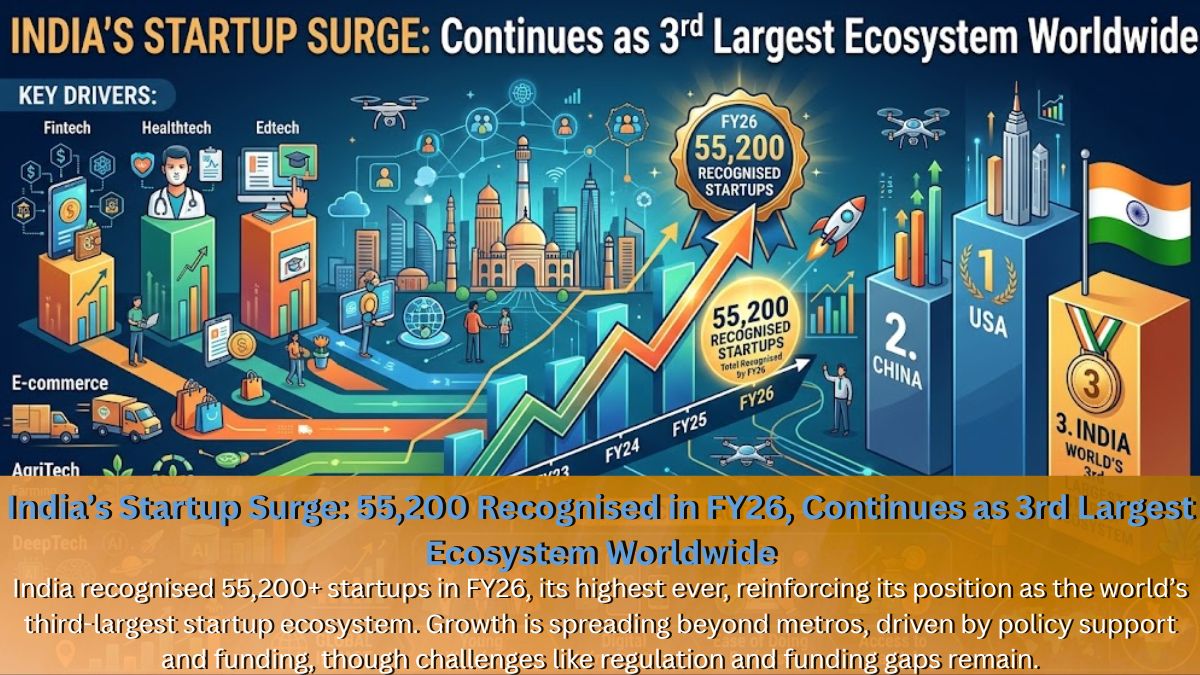
India’s Startup Surge has reached a historic milestone in FY26, with the government officially recognising over 55,200 startups under the Startup India initiative. This marks the highest annual addition of startups since the program began in 2016. As a result, India has further strengthened its position as the world’s third-largest startup ecosystem, behind only the United States and China.
The surge reflects a sharp rise in entrepreneurial activity across sectors such as fintech, artificial intelligence, clean energy, agritech, and deep tech. Notably, smaller cities and rural regions have contributed significantly to this growth, highlighting a shift beyond metro-centric startup development. Government-backed policies, improved access to venture capital, and a growing network of startup incubators and accelerators have played a crucial role.
In addition, India now hosts over 1.5 lakh DPIIT-recognised startups cumulatively, showcasing the scale and momentum of the country’s innovation ecosystem. The growth also aligns with increasing participation from angel investors, venture capital firms, and global funding networks. Meanwhile, sectors like fintech, SaaS, and AI startups continue to dominate funding rounds and innovation trends.
However, despite the surge, challenges remain. These include funding slowdowns, regulatory complexities, and scaling issues for early-stage ventures. Still, India’s startup ecosystem continues to evolve with stronger business models, improved mentorship, and global expansion strategies. Overall, India’s Startup Surge in FY26 reflects not just numbers but a deeper transformation in how businesses are built, funded, and scaled in the country. It signals a future where Indian startups will play a central role in global innovation, job creation, and economic growth.
1. Introduction to India’s Startup Surge
1.1 Understanding India’s Startup Surge in FY26
There’s something different about the way India’s startup story feels right now. It’s no longer just about a few standout companies making headlines. It’s about scale. Real, visible, undeniable scale. In FY26 alone, India added over 55,200 recognised startups under the Startup India initiative. That number isn’t just a statistic. It represents thousands of individuals taking risks, leaving stable jobs, convincing families, burning savings, and choosing to build something from scratch.
1.2 The narrative around Indian startups was concentrated around a few metro cities
For years, the narrative around Indian startups was concentrated around a few metro cities. But this surge tells a deeper story. It’s no longer just Bengaluru, Delhi, or Mumbai driving innovation. Founders are emerging from smaller cities, places where access to capital, mentorship, and networks used to be limited. And yet, they are building. You now see fintech platforms solving problems for rural users, AI startups building global SaaS products from small towns, and clean energy ventures tackling local challenges with scalable solutions. This diversity is what makes the current wave different from the earlier ones.
It’s not just growth. It’s expansion in every direction. What’s even more interesting is the mindset shift. Earlier, startups were often seen as risky experiments. Today, they are seen as legitimate career paths. Parents who once pushed for government jobs or corporate stability are slowly becoming more open to entrepreneurship. That cultural shift is hard to measure, but it’s one of the biggest reasons behind this surge.
At the same time, technology has lowered the entry barrier. You don’t need a massive office or a large team to start anymore. A laptop, internet connection, and a clear idea can get you started. That accessibility has unlocked a new generation of builders. So when we talk about India’s startup surge, we’re not just talking about numbers. We’re talking about a country that is gradually becoming comfortable with uncertainty, experimentation, and ambition.
1.2 Growth of the Indian Startup Ecosystem
The growth we’re seeing today didn’t happen overnight. It’s the result of a decade-long buildup. Ten years ago, starting up in India was significantly harder. Regulations were unclear, funding was limited, and there was very little structured support for early-stage founders. Today, the landscape looks completely different. India now has over 1.5 lakh recognised startups. That includes everything from early-stage experiments to unicorns valued at billions. But more importantly, it includes a wide range of industries.
You have fintech companies trying to bring financial services to underserved populations. Edtech platforms reshaping how students learn. Healthtech startups improving access to care. SaaS companies quietly building products for global markets. Each of these sectors reflects a specific need. And that’s what makes the ecosystem stronger. It’s not dependent on a single trend. Another major shift has been the rise of capital.
Earlier, founders struggled to raise even small seed rounds. Now, there’s a visible presence of angel investors, venture capital firms, and even global funds actively looking for opportunities in India. But funding alone doesn’t build an ecosystem. What truly accelerates growth is the combination of capital, mentorship, and community. Incubators, accelerators, and startup networks have played a huge role in this. They provide guidance, connections, and sometimes even the emotional support founders need during tough phases. Because building a startup is rarely a smooth journey. There are moments of excitement, but also long stretches of uncertainty. And having an ecosystem that supports you during both makes a difference.
2. Background and Journey of the Startup India Initiative
2.1 Launch and Vision
Back in 2016, when the government launched Startup India, the goal was clear but ambitious. Encourage people to build. At that time, entrepreneurship in India was still finding its footing. There were success stories, but they felt distant to most people. The idea of starting a company wasn’t yet mainstream. Startup India tried to change that. It focused on reducing friction. Simplifying registration processes. Offering tax benefits. Creating funding support mechanisms. Encouraging innovation across sectors.
But more than policies, it sent a signal. It told people that the government was willing to back risk-takers. That building something new wasn’t just acceptable, it was encouraged. For many first-time founders, especially those without strong financial backing, this mattered. It didn’t remove all challenges, but it made the path slightly less intimidating.
2.2 Evolution Over the Years
In the early years, progress was steady but not explosive. Startups were still figuring things out. Investors were cautious. Infrastructure was still developing. But slowly, things began to change. More success stories emerged. Early startups started scaling. Some failed, but even those failures contributed to learning. Angel networks began to expand. Venture capital firms started increasing their presence. International investors began paying closer attention to India.
At the same time, support systems improved. Incubators and accelerators became more accessible. Mentorship became easier to find. Knowledge started flowing more freely within the ecosystem. By the time FY26 arrived, the foundation was strong enough to support rapid growth. And that’s exactly what happened. The addition of over 55,200 startups in a single year is not just a spike. It’s a reflection of a system that has matured enough to sustain large-scale participation.
3. Sector-Wise Breakdown of the Startup Boom
3.1 Fintech and Digital Payments
Fintech has been one of the strongest pillars of India’s startup ecosystem. If you look closely, it’s solving problems that millions of people face every day. Access to banking, digital payments, credit availability, financial literacy. These are not niche issues. They are fundamental. Fintech startups have stepped in to bridge these gaps. From UPI-based payment solutions to lending platforms and digital wallets, they are making financial services more accessible. But what makes fintech powerful is its scalability.
Once the infrastructure is in place, it can serve millions of users with relatively low incremental cost. That’s why investors are particularly interested in this sector. Revenue models here are also well-defined. Transaction fees, subscriptions, partnerships with financial institutions, all create multiple income streams. And as digital adoption increases, fintech’s role will only become more central.
3.2 AI Startups and Tech Innovations
AI startups represent a different kind of growth. They are not just solving local problems. Many of them are building for global markets from day one. Automation, machine learning, data analytics, these are not buzzwords anymore. They are tools that businesses actively need. Indian AI startups are leveraging this demand. They’re building SaaS products, enterprise solutions, and specialized tools that companies across the world can use. What’s interesting is the shift in perception.
Earlier, deep tech startups were seen as high-risk and long-term. Today, they are seen as strategic bets. Their revenue models are often subscription-based, which creates predictable income. And their scalability makes them attractive for global expansion.
3.3 Clean Energy and Sustainability
Then there’s the rise of clean energy startups. This sector feels different. It’s not just about profit. It’s about urgency. Climate change, pollution, energy efficiency, these are challenges that require immediate attention. Startups in this space are working on solar solutions, electric vehicles, energy storage, and sustainable products.
Their business models vary. Some focus on product sales. Others provide energy services or work on long-term contracts with governments and organizations. What makes this sector compelling is the combination of impact and opportunity. As policies evolve and awareness increases, demand for sustainable solutions is only going to grow.
4. Startup Business Models and Revenue Strategies
4.1 Common Working Models
If you look across the Indian startup ecosystem, you’ll notice a pattern. Most successful startups are built on scalable models. Subscription-based businesses create predictable revenue. Customers pay regularly for continued access to a service. Freemium models attract large user bases by offering basic features for free while charging for premium offerings.
Marketplace platforms connect buyers and sellers, earning a commission on transactions. Each of these models has one thing in common. They are designed to grow without a proportional increase in costs. That’s what makes them powerful. But choosing the right model isn’t just a strategic decision. It’s also about understanding user behavior. What are customers willing to pay for? How often will they use the service? What value do they actually perceive? Answering these questions correctly often determines whether a startup survives or struggles.
4.2 Revenue Generation Approaches
Revenue is where theory meets reality. It’s easy to design a model on paper. It’s much harder to make it work in real life. Indian startups typically rely on multiple revenue streams to stay sustainable. Transaction fees are common in marketplaces. Advertising works well for platforms with large user bases. Premium services allow companies to monetize their most engaged users. But the real challenge is balance.
Charge too much, and users leave. Charge too little, and the business struggles to sustain itself. Finding that balance takes time. It involves experimentation, feedback, and constant adjustment. And this is where experience matters. Startups that succeed are not the ones that get everything right from the beginning. They are the ones that learn quickly and adapt.
5. Funding Landscape and Venture Capital Trends
5.1 Rise of Venture Capital and Angel Investment
If you talk to founders who started their journey ten or fifteen years ago, they’ll tell you one thing very clearly, raising money used to be one of the hardest parts of building a startup in India. Today, that reality has changed. Not completely, but enough to reshape the ecosystem. There’s been a visible rise in venture capital activity across the country. Funds are no longer limited to a handful of large firms sitting in metro cities. You now have a mix of domestic VCs, global investors, micro VCs, and an expanding network of angel investors who are actively backing early-stage ideas. And this matters more than it sounds.
Because the first cheque is often the hardest to get. It’s the point where someone believes in your idea before there’s real proof. Angel investors play a huge role here. They back founders at a stage where everything is still uncertain, product, market, even direction. That early belief can change everything for a startup.
What’s also interesting is how funding is no longer concentrated in just one or two sectors. Yes, fintech continues to attract strong capital because of its scale and clear monetization potential. But beyond that, AI startups, clean energy ventures, SaaS platforms, and even niche problem-solving startups are finding investors willing to take calculated risks. Funding rounds have increased not just in number, but in diversity. But here’s the part that doesn’t always get highlighted.
More funding also brings more pressure. Once capital comes in, expectations change. Growth targets become sharper. Timelines shrink. Founders are no longer just building, they are performing. And not every startup is ready for that shift. This is where experience and discipline start to matter. Raising money is one milestone. Using it effectively is a completely different challenge.
5.2 Global Funding and Investment Trends
India is no longer just a domestic opportunity. It has become a global investment story. International investors, from large venture firms to sovereign funds, are increasingly looking at India as a long-term market. And the reasons are clear. A massive population, increasing digital adoption, rising consumption, and a growing base of entrepreneurs who understand both local problems and global standards.
This combination is rare. Global capital is flowing into Indian startups not just because of potential, but because there is visible execution. Companies are being built, scaled, and in many cases, successfully monetized. There’s also a strategic angle. Many global investors see India as a gateway to other emerging markets. If a model works here, it can often be adapted for Southeast Asia, Africa, or Latin America. But with global funding comes global scrutiny.
Investors expect governance, transparency, and sustainable growth. They look beyond short-term traction and focus on long-term viability. For Indian startups, this means stepping up. Building not just fast, but responsibly. And for the ecosystem as a whole, it means maturing. Moving from a phase of rapid expansion to one of thoughtful, structured growth.
6. Problems Solved by Indian Startups
6.1 Financial Inclusion
One of the most meaningful contributions of Indian startups has been in financial inclusion. For years, a large portion of the population operated outside the formal banking system. Access to credit was limited. Financial services were complicated, often inaccessible, and sometimes intimidating. Fintech startups changed that equation.
They simplified payments. They made digital transactions normal. created platforms where opening an account or accessing basic financial services became easier. But more importantly, they reached people who were previously ignored. Small business owners, gig workers, rural users, people without traditional credit histories, these are not just “segments.” They are individuals whose daily lives have been impacted by better access to financial tools. And that impact is not abstract. It shows up in the ability to save, to invest, to handle emergencies, to grow a small business. Financial inclusion is often discussed in policy terms. But on the ground, it’s deeply personal.
6.2 Employment and Skill Development
Startups don’t just create companies. They create opportunities. But what’s unique about startup-driven employment is its nature. It’s not limited to traditional roles. It opens doors for new kinds of work. Developers, designers, marketers, product managers, data analysts, roles that were once niche are now widely available. At the same time, gig economy platforms have created flexible earning opportunities for millions. But beyond jobs, startups contribute to skill development.
Working in a startup environment is different. It’s fast-paced, often unstructured, and demands adaptability. People learn quickly because they have to. They take ownership earlier. They solve problems in real time. grow through experience, not just training. Of course, this environment can also be demanding. Long hours, uncertainty, and pressure are part of the journey. But for many, it accelerates growth in a way traditional roles don’t.
6.3 Driving Digital Transformation
If there’s one area where startups have quietly changed India, it’s digital adoption. From payments to healthcare to education, startups have pushed industries to go digital faster than they otherwise would have. Think about how quickly digital payments became normal. Or how online learning platforms scaled during critical moments. Or how businesses started relying on software tools for operations. Startups didn’t just participate in this transformation. They drove it.
They made technology accessible. Simplified interfaces. Focused on user experience in ways that traditional systems often overlooked. And once users experienced that convenience, there was no going back. Digital transformation is often discussed as a technical shift. But at its core, it’s behavioral. And startups have been at the center of that behavioral change.
7. Competitive Landscape
7.1 Direct Competition Within Sectors
Competition in the Indian startup ecosystem is intense, and in many ways, that’s a good thing. In sectors like fintech, multiple startups are trying to solve similar problems, payments, lending, wealth management. At first glance, it may seem crowded. But each player brings a slightly different approach. Different pricing, different user experience, different target audience.
This competition pushes companies to improve. It forces them to refine their products, listen to customers more closely, and innovate continuously. Because in a market with multiple options, users don’t stay loyal to brands. They stay loyal to experiences. And the moment a better experience appears, they switch. That’s the reality startups operate in.
7.2 Indirect Competition from Traditional Businesses
While startups often focus on competing with each other, a large part of the battle is actually against traditional systems. Banks, retail chains, service providers, these are deeply established players with strong customer bases and long-standing trust. They may not move as fast as startups, but they have scale, resources, and credibility. This creates an interesting dynamic.
Startups bring speed, innovation, and user-centric design. Traditional businesses bring stability, trust, and infrastructure. Increasingly, the line between them is blurring. Some traditional companies are adopting startup-like approaches. Some startups are partnering with established players to scale faster. In many cases, it’s not just competition anymore. It’s collaboration mixed with competition.
8. Industry Trends and Future Growth
8.1 Emerging Startup Trends
Looking ahead, certain trends are becoming impossible to ignore. AI is moving from experimentation to real-world application. Startups are building tools that automate processes, analyze data, and improve decision-making across industries. Blockchain, while still evolving, is being explored for use cases beyond cryptocurrency, supply chains, identity verification, and more. SaaS continues to grow quietly but powerfully. Indian startups are building products that serve global customers, often from relatively small teams.
What ties these trends together is scalability. They allow startups to build once and serve many. That’s where long-term value lies. But trends alone don’t guarantee success. Execution still matters. Understanding the market still matters. Timing still matters.
8.2 Challenges That Cannot Be Ignored
For all the growth and optimism, challenges remain very real. Funding, while more accessible than before, is not guaranteed. Market conditions change. Investor sentiment shifts. What was easy to raise last year may become difficult this year. Regulatory environments can also be complex. Compliance requirements, policy changes, and sector-specific regulations can slow down growth if not managed carefully. Then there’s the internal challenge.
Scaling too fast without strong fundamentals can create cracks. Hiring quickly without building culture can lead to instability. Chasing growth without focusing on profitability can become risky. These are not hypothetical problems. They are lessons the ecosystem has learned, sometimes the hard way. But challenges are not necessarily setbacks. They are filters. They push startups to become stronger, more disciplined, and more focused.
9. India’s Startup Surge and Its Global Position
9.1 Rising as the Third-Largest Startup Ecosystem
When people say India is now the third-largest startup ecosystem in the world, it sounds like a milestone. And it is. But the real meaning of that position goes much deeper than rankings. It represents years of quiet effort finally becoming visible. To reach this level, a country needs more than just a few successful companies. It needs a steady flow of new founders, access to capital, a growing customer base willing to try new products, and a system that can support both success and failure without collapsing. India has built that, layer by layer.
What makes this even more meaningful is the diversity within the ecosystem. This isn’t growth driven by one sector or one trend. It’s happening across fintech, SaaS, healthtech, logistics, AI, clean energy, and more. Each sector solving a different kind of problem, but all contributing to the same momentum. And the problems being solved are not small. They are deeply rooted issues, access to finance, gaps in healthcare, inefficiencies in supply chains, lack of digital infrastructure in certain areas. When startups start solving problems at that level, they don’t just grow. They become relevant.
That’s why global attention has shifted toward India. Investors are not just exploring anymore. They are committing capital. Global companies are not just observing. They are entering partnerships, making acquisitions, or building competing solutions. India’s position today signals something very clear. It is no longer catching up. It is actively shaping the global startup conversation.
9.2 Comparing Indian Startups with Global Players
There’s a subtle but important difference between Indian startups and many of their global counterparts. Indian startups are built in an environment where constraints are real. Limited early capital, price-sensitive customers, and complex markets force founders to think differently. They cannot afford to waste resources. They have to be efficient from day one. And over time, that constraint has turned into strength. Indian startups are known for doing more with less. Lean teams, optimized operations, careful spending, these are not strategies chosen for convenience. They are habits formed out of necessity. At the same time, they are building for scale.
India itself is a massive market, diverse, fragmented, and challenging. If a product works here, it has already passed a tough test. It means the product can handle complexity, adapt to different user behaviors, and operate under constraints. That makes Indian startups naturally suited for expansion into other emerging markets. Global startups may have advantages in terms of infrastructure or access to capital, but Indian startups bring resilience, adaptability, and a deep understanding of real-world problems. And increasingly, they are combining efficiency with innovation. They’re not just building cheaper solutions. They’re building smarter ones.
10. The Role of Government and Policy Support
10.1 Startup Regulations and Policy Impact
No ecosystem grows on its own. There’s always a framework supporting it in the background. In India’s case, initiatives like Startup India have played a meaningful role in reducing friction for founders. Starting a company used to feel complicated. Documentation, approvals, compliance, it often slowed people down before they even began. Over time, policies have tried to simplify this process. Registration has become more streamlined. Tax benefits have given startups some breathing space in their early stages. Funding schemes have helped bridge the gap between idea and execution.
But the real impact of these policies is not just operational. It’s psychological. When the government actively supports startups, it sends a message. It tells founders that they are not working in isolation. That their efforts are part of a larger economic vision. That risk-taking is not only accepted, but encouraged. That kind of signal builds confidence. Of course, challenges still exist. Regulations can still be complex in certain sectors. Compliance can still feel heavy, especially for small teams. But compared to a decade ago, the difference is clear. The path may not be easy, but it’s far more navigable.
10.2 Accelerators, Incubators, and the Human Layer of Support
If policies create the structure, incubators and accelerators bring the human element into the ecosystem. Because building a startup is not just about strategy or execution. It’s about navigating uncertainty. There are moments when founders feel stuck. When decisions carry weight but clarity is missing. When progress feels slow despite constant effort. This is where mentorship becomes invaluable.
Incubators and accelerators don’t just provide funding or office space. They provide guidance. They connect founders with people who have faced similar challenges. Help avoid mistakes that could otherwise cost months or even years. And perhaps most importantly, they create community. Founders often operate in isolation. Having a network of peers going through similar journeys makes a difference. It reduces doubt. It creates shared learning. Builds resilience. Over time, India has developed a stronger network of such support systems. And that has quietly strengthened the entire ecosystem. Because behind every successful startup, there’s usually a network of people who helped shape it.
11. Impact on Economy and Employment
11.1 Job Creation Beyond the Numbers
When startups create jobs, the impact is not just about employment figures. It’s about transformation. Startups introduce new roles that didn’t exist before. Product managers, growth specialists, data analysts, startup operators, these are now common career paths. At the same time, they create opportunities in less traditional formats. Gig work, freelance roles, platform-based earning, these models have expanded access to income. People who were earlier dependent on informal, unpredictable work now have structured opportunities, even if they are flexible. But the impact goes deeper.
Startups change how people work. They encourage ownership. They reward initiative. Push individuals to learn quickly and adapt constantly. Of course, this comes with pressure. Startup environments can be intense. Expectations are high. Stability is not always guaranteed. But for many, the growth they experience in such environments is unmatched.
11.2 Contribution to Economic Growth
Startups are becoming an important driver of India’s economic evolution. They attract investment, both domestic and international. They create products that improve efficiency across industries. Introduce competition, which forces traditional businesses to innovate. But more than anything, they bring a culture of problem-solving. When startups challenge existing systems, they don’t just compete. They push the entire market forward.
This leads to better services, more choices for consumers, and improved overall efficiency. Over time, these changes contribute to GDP growth. But beyond numbers, they contribute to something more meaningful, economic transformation. An economy that is not just growing, but evolving.
12. Learning for Startups and Entrepreneurs
12.1 Key Takeaways from the Surge
If there’s one clear lesson from India’s startup journey, it’s that ideas are only the starting point. Execution is everything. A strong idea without execution remains an idea. A simple idea executed well can become a powerful business. Startups that succeed are the ones that understand their users deeply. They don’t just build products. They solve problems in a way that people actually care about. Scalability also matters. Building something small is one thing. Building something that can grow without breaking is another. The best startups think about scale early, but they build it carefully.
12.2 The Real Role of Funding and Mentorship
Funding often gets the spotlight, but it’s only part of the story. Yes, capital helps startups grow faster. It allows them to hire, build, and expand. But without direction, funding can be misused. This is where mentorship becomes critical. Experienced mentors provide perspective. They help founders make better decisions. They challenge assumptions and bring clarity when things feel uncertain. The combination of funding and mentorship is powerful. One gives you the resources. The other helps you use them wisely.
12.3 Building Sustainable Startups
In the middle of all the growth and excitement, sustainability is often overlooked. But it’s what determines longevity. A startup that grows quickly but lacks a clear path to profitability eventually struggles. We’ve seen this happen multiple times. The more durable approach is grounded in fundamentals. Solve a real problem. Build something people value. Create a revenue model that works. Then scale. It sounds simple, but it requires discipline. Because the temptation to chase rapid growth is always there. But in the long run, the startups that last are the ones that balance ambition with stability.
About foundlanes.com
foundlanes.com is India’s leading startup idea discovery platform. It helps entrepreneurs find actionable startup opportunities, market insights, and industry-specific guidance to turn ideas into real businesses. With deep research and practical resources, foundlanes supports founders at every stage, from idea validation to launch and growth.