


Introduction
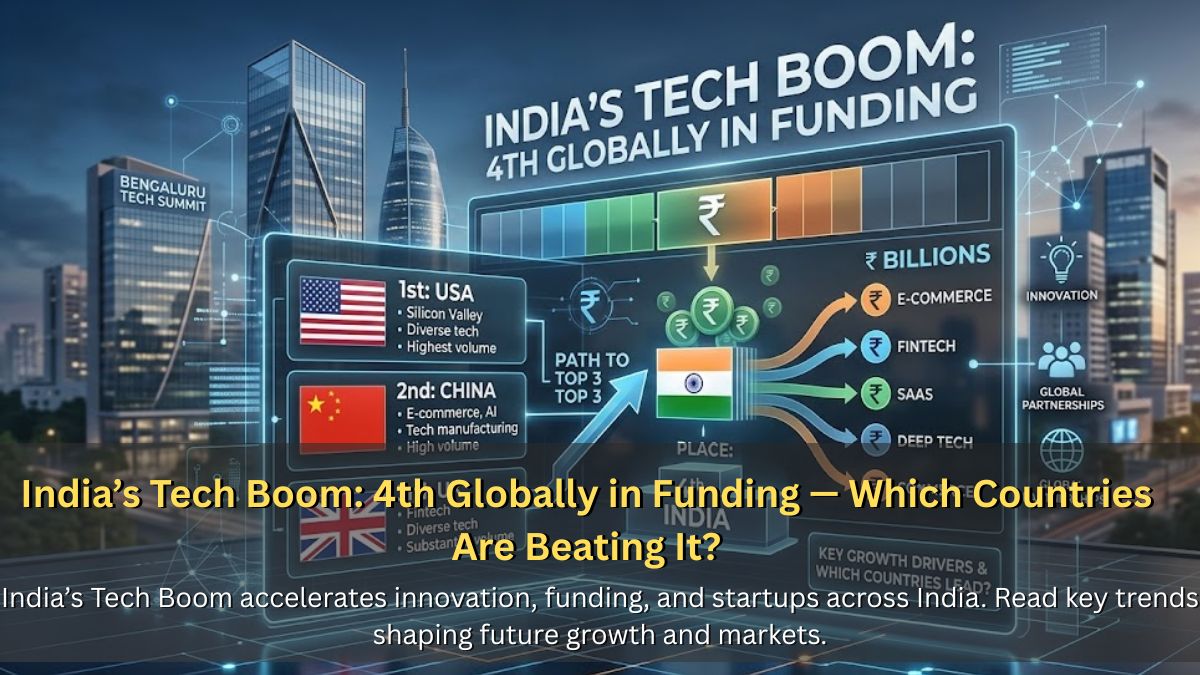
The rise of India’s Tech Boom has placed the country firmly on the global innovation map. According to recent industry reports cited across fintech and business research platforms, India has ranked 4th globally in tech funding, securing nearly $117 billion in total tech investments. This positions India behind a few major global economies that continue to dominate venture capital flows and large-scale technology investments. At the same time, India’s Tech Boom reflects more than just numbers. It signals a fast-growing startup ecosystem powered by unicorn companies, venture capital funding, AI startups, fintech growth, and rising global investor confidence. However, despite strong momentum, India still trails countries like the United States, China, and other advanced tech economies in overall funding scale.
Interestingly, early-stage investments in India have grown significantly, with reports showing nearly a 20% jump in early-stage funding activity. This indicates strong investor interest in emerging startups, startup founders, and disruptive tech innovations across sectors like fintech, blockchain news, clean energy, and SaaS platforms. Moreover, India’s Tech Boom is driven by rapid digital adoption, startup incubators, angel investors, and government-backed startup regulations that support entrepreneurship. Yet challenges remain in scaling late-stage funding and competing with global funding giants. So the key question remains: what makes India 4th, and who is ahead in this global race of tech innovation and venture capital dominance?
1. News Summary
1.1 India’s Tech Boom in Global Ranking Context
India’s position in global tech funding is no longer just a statistical update. It is a reflection of a massive shift happening inside the global innovation map. With nearly $117 billion in tech funding, India now stands 4th globally, placing it among the most influential startup ecosystems in the world. But this number does not tell the full story. Behind it is a long journey of risk-taking founders, evolving investors, and a country slowly building its identity as a serious global tech powerhouse.
What makes this ranking emotionally significant is the speed of transformation. A decade ago, India was still seen as an outsourcing hub. Today, it is home to thousands of startups building real products for real problems. Cities like Bengaluru, Hyderabad, Mumbai, and Delhi NCR have turned into living ecosystems where ideas constantly collide with capital. Yet, the gap with the United States and China remains visible, and almost intimidating. The US dominates through deep capital networks and IPO-driven exits, while China scales rapidly through massive domestic demand and policy-backed innovation. India stands in between ambition and maturity, growing fast but still building depth.
1.2 Early-Stage Growth Strengthens India’s Position
Early-stage funding is where India’s startup ecosystem feels most alive and emotionally powerful. A reported 20% rise in early-stage investments shows something deeper than money flow. It shows belief. Thousands of first-time founders are stepping into uncertainty every year, often leaving stable careers to build something from scratch. This early phase is where India’s real innovation story is being written, quietly and persistently.
Across coworking spaces, college dorms, and small offices, founders are experimenting with fintech tools, AI automation platforms, and SaaS products. Many of these ideas will fail, but a few will become the next wave of unicorn companies. Angel investors are no longer just financiers; they are mentors who guide founders through confusion, pivots, and product failures. Startup incubators are also becoming more structured, offering not just funding but emotional and strategic support. This ecosystem is creating a culture where failure is accepted, and iteration is respected.
1.3 Why India Still Trails Global Leaders
Despite strong momentum, India still faces a structural imbalance in its startup journey. Early-stage innovation is strong, but the challenge begins when startups try to scale globally. Many companies manage to build strong initial traction but struggle to raise late-stage funding. This is where global leaders like the US and China maintain a strong advantage, with deeper capital pools and more predictable exit pathways.
The United States benefits from a mature venture capital system where risk is normalized and rewarded. China, on the other hand, uses scale as its biggest weapon, allowing startups to grow rapidly within a massive domestic market. India’s challenge is more complex. It lies in fragmented demand, regulatory friction, and limited late-stage risk appetite. Yet despite these gaps, Indian founders continue building with persistence. There is a kind of quiet resilience in the ecosystem, where setbacks do not stop momentum, and that emotional endurance is one of India’s strongest hidden assets.
2. Understanding India’s Tech Boom and Startup Ecosystem Model
2.1 Working Model of India’s Tech Ecosystem
India’s startup ecosystem is not built on a single structure. It is a layered system that evolves through interaction between founders, investors, institutions, and government programs. It usually begins with early-stage incubation, where ideas are shaped in low-pressure environments. Here, founders test assumptions, build prototypes, and try to understand real market problems before scaling.
Once an idea shows potential, angel investors enter the picture. These early believers often take risks that traditional institutions avoid. As startups grow, venture capital funding becomes the driving force behind expansion. VC firms influence hiring, product development, and even market strategy. Alongside this, government-backed programs and innovation policies help reduce barriers for entry-level entrepreneurs. Over time, global collaborations also begin, connecting Indian startups with international markets. This layered system is what slowly converts small ideas into scalable companies that define India’s Tech Boom.
2.2 Revenue Model Across Indian Startups
Revenue models in India’s startup ecosystem are becoming increasingly diverse and sophisticated. Subscription-based SaaS companies focus on building predictable monthly income, which allows them to scale with stability. Fintech startups rely heavily on transaction-based revenue, where each digital payment, loan, or financial activity contributes directly to earnings. This model thrives in India due to the massive rise in digital transactions and UPI-based ecosystems.
At the same time, advertising-driven platforms are expanding rapidly, especially in consumer apps and content-based startups. Marketplace models are also growing, where platforms act as intermediaries connecting buyers and sellers while earning commissions. Increasingly, startups are adopting hybrid models that combine multiple revenue streams. This flexibility is important because India’s market is dynamic and price-sensitive. The ability to adjust revenue structures quickly gives Indian startups an edge in survival and long-term adaptation, strengthening the foundation of India’s Tech Boom.
2.3 Problems the Ecosystem Solves
The Indian startup ecosystem is not just a financial machine. It is deeply connected to everyday problems that affect millions of people. One of the biggest transformations has been financial inclusion. Fintech startups have brought banking, credit, and payments to people who were previously outside formal systems. This shift has changed how small businesses operate and how individuals manage money.
Another major impact is digital transformation. Traditional industries like retail, logistics, and education are rapidly moving online due to startup-driven solutions. Employment generation is also a critical outcome, as startup jobs are now a major source of opportunities for young professionals across cities. Beyond urban areas, startups are also solving rural challenges in healthcare, agriculture, and education. These changes are not abstract numbers; they are real improvements in daily life. This human impact is what gives India’s Tech Boom its true depth and meaning.
3. Global Competitors Leading Ahead of India
3.1 United States — The Funding Leader
The United States remains the most dominant force in global tech funding, and its leadership is deeply rooted in structure rather than just capital. Silicon Valley acts as a global magnet where founders, investors, and engineers constantly interact. Venture capital firms operate with a high-risk, high-reward mindset, which allows startups to scale aggressively without early pressure to become profitable.
Another major strength is the IPO ecosystem. Startups in the US have clear and well-established exit routes, which encourages continuous reinvestment into new ventures. This creates a self-sustaining cycle where success feeds new innovation. Sectors like AI, fintech, and deep tech receive massive funding rounds that are often unmatched globally. This ecosystem maturity is what keeps the US firmly ahead of India’s Tech Boom, even as India grows at a faster relative pace.
3.2 China — Strong Innovation and Scale
China’s startup ecosystem is defined by speed and scale. Once a product finds traction, it can expand rapidly due to the sheer size of the domestic market. This gives Chinese startups a unique advantage where growth is not limited by early global expansion needs.
Government involvement also plays a major role in shaping innovation. Strategic sectors like AI, clean energy, and advanced manufacturing receive strong policy support. This allows startups to integrate deeply with national economic goals. Additionally, digital ecosystems in China are highly interconnected, enabling seamless scaling of products and services. This combination of policy strength and market size allows China to remain a powerful competitor ahead of India’s Tech Boom, especially in deep tech and infrastructure-heavy sectors.
3.3 Other Key Global Markets
Beyond the US and China, several other global markets continue to stay ahead of India in total funding volume. These include advanced European economies and select innovation hubs that have built strong institutional funding systems. Their advantage lies in stability, structured capital markets, and well-defined startup exit pathways.
These regions also benefit from strong regulatory frameworks that reduce uncertainty for investors. Startup mergers, acquisitions, and IPO-driven ecosystems are more predictable, which attracts long-term capital. However, while they may be ahead in structure, they are not always ahead in speed. India’s growth curve is much steeper, and that aggressive expansion is what keeps India’s Tech Boom in global focus despite the gap.ily.
4. Industry Growth Trends Driving India’s Tech Boom
4.1 Rise of AI and Fintech Startups
AI and fintech are not just sectors in India anymore. They feel like the two engines quietly pushing the entire startup economy forward. If you look closely at what investors are chasing today, it is almost always one of these two. AI startups are building tools that automate decisions, reduce human effort, and completely reshape how businesses operate. Fintech startups, on the other hand, are solving a very real Indian problem: access to money, credit, and seamless digital transactions.
What makes this growth emotionally powerful is how real the impact feels on the ground. A small shopkeeper using a fintech app to manage daily payments. A student using an AI tool to learn faster or build a project. A startup founder in a small room building automation software that suddenly gets global attention. This is not abstract innovation. It is daily life being rewritten. That is why venture capital firms and angel investors are aggressively backing these sectors. They are not just funding ideas; they are funding behavior change. And that is exactly why AI and fintech sit at the center of India’s Tech Boom.
4.2 Expansion of Unicorn Companies
The rise of unicorn companies in India is not just a celebration of valuation. It is a reflection of how far founder ambition has come. Earlier, building a startup in India meant surviving. Today, it means scaling fast enough to compete globally. Unicorns are emerging because founders are thinking bigger from day one, often targeting international markets instead of limiting themselves to India alone.
Behind every unicorn, there is a long emotional journey that rarely gets discussed. Years of uncertainty, failed experiments, investor rejections, and product pivots that almost broke the company. Yet somehow, these startups push through. Innovation hubs and startup incubators play a quiet but powerful role in this journey. They give founders not just funding access, but emotional support, mentorship, and sometimes even a second chance when things fall apart. This ecosystem of belief is what transforms fragile early-stage startups into billion-dollar companies. And each new unicorn adds more confidence to the broader India’s Tech Boom narrative.
4.3 Strong Startup Hiring and Job Creation
One of the most visible impacts of India’s startup ecosystem is the explosion of startup jobs. Walk into any tech city like Bengaluru or Hyderabad, and you can feel the energy. Offices running late into the night, teams hiring aggressively, and recruiters constantly searching for talent. Hiring news has become a key indicator of ecosystem health because it reflects real expansion, not just financial speculation.
But behind this growth, there is also pressure. Startups often hire fast when funding arrives, and adjust just as quickly when markets shift. For employees, this creates both opportunity and uncertainty. Still, the demand for skilled professionals remains extremely strong, especially in engineering, product management, AI, and data roles. Investors watch hiring trends closely because they signal confidence in startup markets. If companies are hiring aggressively, it usually means they believe in future growth. This constant cycle of hiring and scaling is one of the most powerful forces shaping India’s Tech Boom today.
4.4 IPO and Acquisition Activity
IPO activity and startup acquisitions are becoming more frequent in India, and this marks an important maturity phase in the ecosystem. In the early years, startups were focused only on survival and growth. Now, they are thinking about exits, long-term value, and global positioning. IPOs represent not just financial success, but validation that a startup has reached a level of stability and trust.
Acquisitions are also shaping the ecosystem in a major way. Larger companies are absorbing smaller startups to gain technology, talent, or market share. For founders, this often represents both success and transition. Years of building a company can end in a strategic exit that opens new doors. For investors, these exits are critical because they recycle capital back into the ecosystem. This flow of capital is what keeps innovation alive. IPOs and mergers are therefore not just financial events. They are emotional milestones in the long journey of India’s Tech Boom.
5. Funding Structure Behind India’s Tech Boom
5.1 Venture Capital and Angel Investment Growth
Venture capital and angel investment form the emotional backbone of India’s startup ecosystem. Without them, most ideas would never move beyond a notebook or a pitch deck. What makes this system powerful is not just the money, but the belief that comes with it. Angel investors often step in at the riskiest stage, when there is no proof, no traction, and sometimes not even a clear product. They invest in people more than businesses.
As startups grow, venture capital firms take over and bring structure, scale, and discipline. They help founders think beyond survival and focus on expansion. This funding journey is often intense. It includes pressure, rapid decision-making, and constant expectations. But it is also what transforms small teams into global companies. Without this layered funding system, India’s Tech Boom would not have reached its current scale.
5.2 Global Funding Participation
Global investors are increasingly looking at India not as an emerging market, but as a core growth engine. This shift is important because it changes the level of seriousness in funding conversations. International startups, sovereign funds, and global venture capital firms are now actively participating in Indian deals.
What attracts them is simple: scale and opportunity. India has one of the youngest populations in the world, a rapidly growing digital economy, and a massive consumer base. For global investors, this combination is rare. It means products can be tested, scaled, and refined at speed. However, global participation also increases pressure on Indian startups to perform at international standards. This is pushing founders to think bigger, move faster, and build stronger fundamentals, further accelerating India’s Tech Boom.
5.3 Startup Incubators and Accelerators
Startup incubators and accelerators often operate quietly, but their impact is deeply visible. They are the places where raw ideas are shaped into structured businesses. Many founders enter these programs confused, uncertain, and overwhelmed. Over time, they receive mentorship, strategic guidance, and access to early funding networks.
What makes this system powerful is the human element. Mentors often share real failures, not just success stories. This helps founders understand that struggle is part of the journey. Accelerators also force discipline, pushing startups to validate ideas faster and avoid long-term mistakes. In many cases, this early structure becomes the reason startups survive long enough to attract venture capital. Without these support systems, the survival rate of startups would be much lower, and India’s Tech Boom would look very different.
6. Direct and Indirect Competitors in the Startup Ecosystem
6.1 Direct Competitors
India’s direct competitors in the global startup ecosystem are clearly defined. The United States leads with unmatched venture capital depth, Silicon Valley culture, and a strong IPO exit system. Chinese tech companies compete through massive scale, rapid execution, and strong government-linked innovation ecosystems. European innovation hubs bring stability, structured funding systems, and strong regulatory environments.
What makes competition intense is that each of these regions has a unique advantage. The US leads in capital and risk-taking. China leads in speed and scale. Europe leads in structure and stability. India, in comparison, is still building balance across all three dimensions. Yet, despite this, India continues to grow faster in percentage terms, which keeps India’s Tech Boom in global focus.
6.2 Indirect Competitors
Indirect competition comes from outside traditional startup ecosystems. Large multinational corporations are increasingly investing in internal innovation, building their own tech solutions instead of relying on startups. Traditional enterprises are also adopting digital transformation strategies, reducing dependency on new startups.
Global outsourcing companies add another layer of competition by offering cost-efficient tech solutions at scale. These players may not be startups, but they compete in the same space for clients, talent, and market share. This creates a complex ecosystem where startups are not only competing with each other, but also with established global systems. This pressure forces Indian startups to innovate faster and sharper, strengthening the long-term resilience of India’s Tech Boom.
7. Journey and Background of India’s Tech Boom
7.1 Early Digital Growth Phase
India’s startup story began with something simple but powerful: internet access and mobile penetration. When connectivity expanded, it created a new digital behavior across the country. People started exploring online services, digital payments, and mobile-first solutions.
This phase was not glamorous. It was messy, experimental, and uncertain. But it laid the foundation for everything that followed. Entrepreneurs began noticing gaps in education, finance, and communication. These gaps became opportunities. Slowly, the idea of building digital-first businesses started gaining traction. This early digital wave is the emotional starting point of India’s Tech Boom.
7.2 Startup Acceleration Phase
The acceleration phase began when government programs, private investors, and global interest started aligning. Startup incubators multiplied. Venture capital firms entered aggressively. Founders began receiving structured support instead of isolated struggles.
This phase saw the rise of fintech, SaaS, and AI-driven startups. It also created the first generation of unicorn companies. More importantly, it changed mindset. Entrepreneurship was no longer seen as risky failure, but as a legitimate career path. This psychological shift is one of the biggest drivers behind India’s Tech Boom.
7.3 Global Expansion Phase
Today, Indian startups are no longer thinking locally. They are building global products from day one. Venture capital and global funding networks have made this possible. Startups are now expanding into international markets, hiring global teams, and competing with established global companies.
This phase represents maturity in progress. India is still evolving, still learning, but now actively participating in global innovation rather than following it. That transition is what defines the current stage of India’s Tech Boom.
8. Startup Ecosystem Challenges and Business Transformation
8.1 Funding Inequality
Funding in India is strong at early stages but uneven at later stages. Many startups struggle after initial growth because scaling requires significantly larger capital. This creates a gap where promising companies sometimes lose momentum. This inequality is not just financial. It is emotional. Founders often feel the pressure of survival even after early success. Closing this gap is essential for the next phase of India’s Tech Boom.
8.2 Regulatory Complexity
Regulations in India are improving, but complexity still exists. Startups often face delays in compliance, taxation, and approvals. For early-stage founders, this can slow down execution. However, regulation is also evolving in response to ecosystem growth. Over time, simplification is expected to improve startup efficiency.
8.3 Talent Competition
Talent is one of the most competitive areas in India’s startup ecosystem. Skilled professionals are in high demand, especially in AI, engineering, and product roles. This creates intense hiring competition among startups. While this drives salaries and opportunities upward, it also creates instability for companies trying to scale quickly. Talent dynamics will continue shaping India’s Tech Boom in the coming years.
9. Learning for Startups and Entrepreneurs
India’s startup journey offers one clear lesson: growth is never linear. It is emotional, unpredictable, and deeply human. Successful founders are not just those with ideas, but those who survive uncertainty long enough to adapt.
Startups must focus on building strong foundations before chasing scale. Sustainability matters as much as speed. Global success requires patience, funding discipline, and the ability to learn from failure. Most importantly, founders must build with users at the center, not just investors. In the end, entrepreneurship in India is not just about building companies. It is about navigating chaos, adapting continuously, and staying committed even when outcomes are unclear. That is the real spirit behind India’s Tech Boom.
About foundlanes.com
foundlanes.com is India’s leading startup idea discovery platform. It helps entrepreneurs find actionable startup opportunities, market insights, and industry-specific guidance to turn ideas into real businesses. With deep research and practical resources, foundlanes supports founders at every stage, from idea validation to launch and growth.