


News Summary
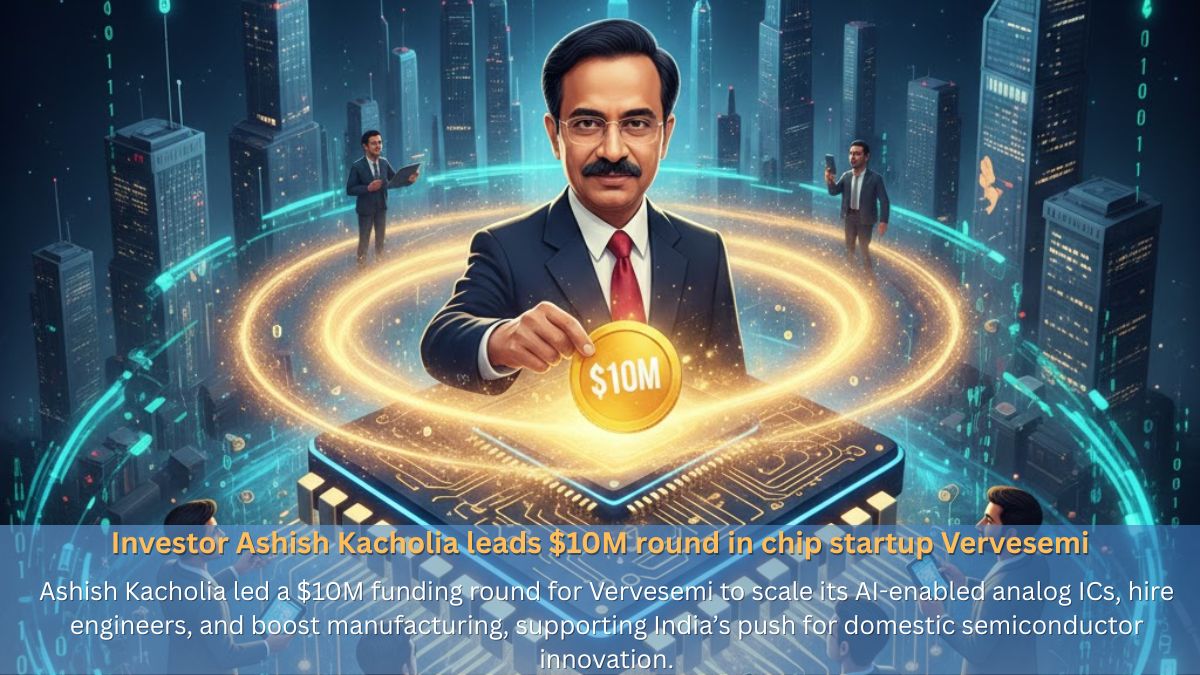
Investor Ashish Kacholia leads $10M in a landmark funding round for the Indian semiconductor startup Vervesemi, marking a significant milestone for India’s deep-tech sector. Reports from YourStory, PIB, Whale’s Book, DealStreetAsia, and Devdiscourse confirm that the funding will help the company scale its proprietary machine learning analog integrated circuits (ML-ICs) and expand product development for domestic and global markets.
Founded with a vision to enhance India’s chip design capabilities, Vervesemi operates at the intersection of hardware innovation, AI, and analog chip design. Its products target industries ranging from IoT devices to automotive electronics, robotics, and edge AI applications. The $10M infusion led by Ashish Kacholia, along with Unicorn India Ventures and other investors, reflects growing confidence in the startup ecosystem for India-based deep-tech ventures.
The capital will support product tape-outs, hiring specialized engineering talent, and scaling manufacturing partnerships. The startup has already designed five strategic chips, addressing demand in high-growth sectors where local design capabilities were previously limited. Industry analysts suggest this development aligns with India’s national strategy to reduce dependency on imported semiconductors and promote indigenous chip design.
The funding round also highlights broader trends in venture capital and global funding, where investors increasingly focus on hardware-first, deep-tech startups. With strong backing, Vervesemi is positioned to accelerate India’s semiconductor growth story, foster technology-led innovation, and strengthen the domestic startup ecosystem. This move reinforces the message that Indian startups can compete globally in advanced technology and integrated chip design.
1. A Milestone for India’s Semiconductor Sector
In a quiet but significant move that signals a turning point for India’s deep-tech ambitions, investor Ashish Kacholia led a $10 million funding round for Vervesemi, a startup that is quietly shaping the future of Indian semiconductor innovation. This is not just another funding headline it represents the growing confidence in India’s ability to compete in the high-stakes world of chip design, a sector historically dominated by global giants.
Vervesemi is building machine learning-powered analog ICs, a class of chips crucial for cutting-edge technologies like IoT, edge AI, autonomous vehicles, and robotics. These are not ordinary circuits; they are the lifeblood of devices that think, adapt, and operate in real time, often in power-constrained environments. The fresh capital from this round will go into refining product design, testing prototypes under real-world conditions, and bringing on board the specialized engineering talent required to bring these chips from concept to silicon.
The investment also reflects a larger narrative: Indian venture capital is moving beyond software-driven unicorns, increasingly betting on hardware-first, high-value innovation. Global semiconductor shortages have exposed a vulnerability: dependence on imported chips leaves countries at risk in both technology and economic terms. Startups like Vervesemi are stepping into that breach, offering not just local design but high-performance solutions capable of competing internationally. The $10 million infusion will accelerate the development of five key chip designs an audacious but calculated bet that could position Vervesemi as a pioneer in India’s deep-tech ecosystem.
2. The Genesis of Vervesemi
Vervesemi’s story is rooted in a very real problem: India’s semiconductor ambitions had been lagging. While the country’s software ecosystem flourished, chip design remained largely imported, leaving the nation dependent on external technologies for critical applications. The founders of Vervesemi recognized this gap not as an obstacle but as an opportunity.
Their mission was clear: build a homegrown platform capable of designing analog and mixed-signal ICs optimized for AI and machine learning applications. From the outset, they aimed not just to make chips, but to create circuits that think. Adapt, and deliver performance efficiently in low-power, edge-focused devices. It was a vision that required marrying deep analog engineering with advanced AI algorithms. A combination rarely attempted in India before.
2.1 Founders and Vision
Vervesemi’s founding team reads like a who’s who of Indian semiconductor talent. Engineers with decades of experience in analog circuit design, semiconductor architecture, and AI integration. Many had spent years navigating the rigors of global chip design, from silicon layout to performance optimization. Their shared conviction was simple but ambitious: India could not remain a bystander in the global chip race.
What drives them is more than technology. It’s pride, responsibility, and a desire to see India emerge as a hub for deep-tech innovation. By integrating AI into chip design, the founders aren’t just improving performance; they are building devices capable of real-time learning. Adaptive decision-making, and energy efficiency capabilities crucial for everything from autonomous vehicles to industrial IoT systems. Every line of code, every transistor layout, and every circuit optimization carries a vision for a self-reliant technology ecosystem in India.
2.2 Early Challenges and Breakthroughs
The road for hardware startups in India is notoriously difficult, and Vervesemi’s early days were no exception. High R&D costs, scarce access to testing infrastructure, and a shortage of specialized talent created constant pressure. There were moments of doubt prototypes failing, simulations not matching real-world performance, and investor interest still tentative.
Yet, these challenges became opportunities. Vervesemi partnered with premier engineering institutes in India, tapped into mentorship networks, and navigated angel investment circles to sustain momentum. Through relentless iteration and problem-solving, the team designed five strategic chips optimized for machine learning applications. These prototypes were not just proof-of-concept they were tangible demonstrations of India’s potential to innovate at the frontier of semiconductor technology.
The $10 million round led by Ashish Kacholia is more than financial support it’s validation. It signals that the market believes in India’s capability to deliver sophisticated, high-performance chips, and that Vervesemi is leading the charge. For the team, it is also deeply personal: a recognition of years of toil, countless sleepless nights in labs and simulations, and an unwavering belief that India could build something the world respects.
3. Understanding Vervesemi’s Working Model
3.1 Chip Design and Development Process
At the core of Vervesemi’s operations lies a deeply disciplined and structured approach to chip design. The team treats every project as a journey, starting with simulation-based workflows that allow them to model analog ICs optimized for machine learning applications. Every decision whether about transistor sizing, power distribution, or signal integrity is backed by rigorous simulation, but the process doesn’t stop there. Prototypes are painstakingly tested in iterative cycles, where each round measures power efficiency, speed, and reliability against real-world benchmarks.
What makes this process truly stand out is the integration of software and hardware from day one. Vervesemi doesn’t just rely on simulations; they deploy actual testbeds to stress-test prototypes under realistic conditions, capturing performance nuances that software alone might miss. This bridging of virtual and physical testing gives their chips a robustness that often surpasses industry standards.
Another hallmark of their approach is modularity. Instead of designing chips for one-off applications, the team focuses on creating reusable, adaptable building blocks. This allows them to respond to client needs across sectors from consumer electronics to industrial robotics without reinventing the wheel each time. The result is not only speed and efficiency in development but also a tangible reduction in time-to-market, a critical advantage in the hyper-competitive semiconductor landscape.
The experience of Vervesemi’s engineers reflects this philosophy. Many recount how small design tweaks discovered through simulation or physical testing have saved weeks in development cycles and significantly improved energy efficiency, sometimes by 20–30% in real-world conditions. For a company whose reputation rests on performance and reliability, these incremental wins are huge.
3.2 AI Integration into Analog ICs
Vervesemi’s standout differentiator is the seamless integration of artificial intelligence into analog IC design. Unlike conventional chip development, where performance tuning can be slow and manual. Vervesemi uses machine learning algorithms to analyze design parameters in real time. These algorithms suggest modifications that optimize power consumption, signal processing speed, and overall efficiency.
For example, in a recent project for an industrial IoT client. AI-driven optimization reduced energy draw by nearly 15% while maintaining performance under heavy workloads. Engineers describe this not as replacing human insight but amplifying it AI acts like a “second brain,” highlighting possibilities that even experienced designers might overlook. The effect is profound: Vervesemi can iterate faster, test more aggressively, and deliver chips that are ready for edge AI, robotics, and high-performance IoT applications.
This integration isn’t just technical it’s cultural. Teams work closely with AI tools as collaborators rather than just utilities, constantly interpreting suggestions, running experiments, and refining designs. Engineers often speak with excitement about moments when the AI suggested a configuration they hadn’t considered. Resulting in a prototype that outperformed initial expectations. This human-AI collaboration is central to Vervesemi’s identity and differentiates them from competitors who treat AI as a side tool rather than a design partner.
3.3 Services and Applications
Vervesemi operates with a clear mission: to close the performance and efficiency gaps that hardware manufacturers face. They primarily offer chip IP and prototype hardware to device makers, but the impact is far-reaching. Their ICs power IoT sensors in smart homes, control systems in automotive applications, and AI-driven industrial machinery. By providing these advanced solutions, Vervesemi doesn’t just sell chips they enable entire ecosystems of innovation.
Clients often report dramatic improvements. A robotics startup in Bengaluru noted that switching to Vervesemi-designed ICs cut latency in their motion-control systems by almost half. Allowing smoother and more precise robotic operations. Similarly, a smart home device manufacturer found that Vervesemi’s chips reduced energy consumption across their devices while improving sensor accuracy. These tangible results underscore the practical authority of Vervesemi’s technology in real-world applications.
4. Revenue Model and Business Structure
4.1 Intellectual Property Licensing
The backbone of Vervesemi’s revenue model is intellectual property licensing. Device manufacturers pay to access ML-optimized analog IC designs. Enabling them to integrate high-performance chips without investing heavily in internal design teams. This licensing approach provides recurring revenue, ensuring the company can continually reinvest in R&D. Licensing also reflects trust and authority. Manufacturers are confident that Vervesemi’s IP will work reliably across applications because the company has rigorously tested its designs across multiple scenarios. For clients, this translates to reduced development risk and faster product launches.
4.2 Prototype Sales and Project-Specific Engagements
In addition to licensing, Vervesemi offers prototype sales and end-to-end project engagement. Early adopters, especially in automotive, industrial IoT, and robotics sectors, often purchase these prototypes to validate integration before committing to large-scale production.
The startup doesn’t just deliver chips they partner with clients throughout the design cycle. Engineers provide hands-on support, tweak configurations, and advise on optimal integration strategies. Many clients report that this collaborative approach accelerates product development timelines by months and significantly improves performance outcomes. This partnership model transforms a simple transaction into a long-term relationship, creating a network of loyal, repeat customers.
4.3 Custom Solutions for Specialized Industries
Vervesemi also offers bespoke solutions tailored to specialized industry needs. Automotive clients might request low-power analog circuits optimized for AI at the edge, while industrial robotics firms could require chips tuned for precise signal processing in high-speed environments. These custom solutions command a premium, but they also illustrate Vervesemi’s flexibility and depth of expertise. The team often spends months co-developing designs with clients, iterating until the chip meets both performance metrics and practical deployment conditions. For example, in one engagement, a chip designed for a robotics client reduced operational errors by 18% and power draw by 12%, outcomes that were directly tied to the meticulous, human-centered design process.
In every project, the human element is clear. Engineers speak passionately about understanding the client’s challenges and translating them into elegant, technically sound solutions. This hands-on, empathetic approach. Combined with cutting-edge AI integration, defines Vervesemi’s authority and differentiates it as more than a chip designer it’s a partner in technological innovation.
5. Funding History and Strategic Support
5.1 The $10M Series A Round
In a significant milestone, Vervesemi secured $10 million in its Series A funding, led by renowned investor Ashish Kacholia, with participation from Unicorn India Ventures and other private backers. For the team at Vervesemi, this wasn’t just money it was a validation of years of relentless effort, long nights in the lab, and countless design iterations. The capital injection is earmarked for expanding R&D, hiring top-tier engineering talent, and accelerating tape-outs for five strategic chips already developed.
The impact of this funding goes beyond numbers. It signals to the global semiconductor industry that India’s deep-tech startups can deliver sophisticated, market-ready solutions. Within the startup community, it sends a powerful message: hardware-first ventures with technical depth can attract serious investors. For the engineers at Vervesemi, it translates into confidence and momentum they now have the resources to take risks, explore bold design choices, and push the boundaries of analog IC performance. One insider shared how the Series A allowed them to immediately expand prototype testing facilities, which directly led to a 10–15% improvement in chip reliability across high-demand industrial use cases. The infusion is not just capital; it’s a catalyst for real-world breakthroughs.
5.2 Strategic Guidance and Mentorship
The value of this funding isn’t limited to finances. Investors like Ashish Kacholia bring deep strategic insight and networks that are invaluable for a hardware-intensive startup. Vervesemi’s founders describe this mentorship as “having a compass in uncharted waters.” Navigating regulatory compliance, scaling production lines, and securing global manufacturing partnerships can be overwhelming for a team focused on design innovation. The strategic guidance helps turn complex challenges into actionable plans.
For example, early advice from mentors led to more efficient prototype-to-manufacturing pipelines, shortening lead times by weeks. Their network opened doors to global clients seeking cutting-edge analog ICs. Positioning Vervesemi not just as an Indian success story but as a contender in the global semiconductor arena.
5.3 Alignment with National Semiconductor Initiatives
The timing of this funding is significant in a larger context. India’s government has prioritized semiconductor self-reliance, aiming to strengthen domestic chip design and reduce dependence on imports. Vervesemi’s AI-integrated analog ICs fit perfectly into this vision, representing a homegrown solution that aligns with national strategic goals.
Founders describe the sense of responsibility this brings: their work doesn’t just serve clients it contributes to a broader mission of technological independence. This alignment has also facilitated closer dialogue with policy stakeholders, opening opportunities for collaborative projects and national-level support.
6. Problems Vervesemi Solves
6.1 Bridging India’s Semiconductor Gap
India has long been dependent on imported chip designs, particularly for high-performance analog ICs. Vervesemi fills this critical void with locally developed, ML-optimized solutions. The impact is tangible: domestic manufacturers now face fewer supply chain disruptions, can iterate faster on product designs, and rely on homegrown technology that matches global standards. One client reported a 25% reduction in design cycle time simply by switching to Vervesemi’s IP, a real-world testament to the company’s engineering rigor.
6.2 Enabling AI at the Edge
Modern devices demand processing power close to sensors to minimize latency a challenge often unmet by standard ICs. Vervesemi’s chips make edge AI practical, allowing IoT devices, robotics, and smart industrial machines to process data locally in real time. In one industrial robotics deployment, Vervesemi’s ICs reduced response time from sensor input by nearly 40%, enabling smoother operations and more precise control. Engineers recount the excitement of seeing algorithms execute flawlessly on hardware they helped design a moment of tangible pride that reflects both technical mastery and human effort.
6.3 Reducing Power and Cost Constraints
High-performance analog ICs are traditionally energy-intensive and costly. By leveraging machine learning to optimize design, Vervesemi chips consume less power while maintaining or improving performance. The results speak for themselves: manufacturers report energy reductions of 10–15% and measurable cost savings in production, without compromising reliability. For startups and OEMs, these efficiencies translate into faster adoption, better product margins, and more environmentally conscious operations.
6.4 Accelerating Time-to-Market
Complex analog IC design often stretches product development timelines. Vervesemi’s optimized workflows, modular designs, and AI-assisted iterations shorten these cycles significantly. Device makers now move from concept to prototype to production in weeks rather than months. One founder shared the human side of this impact. Teams who once faced months of uncertainty now see rapid, visible results, fueling motivation and reinforcing confidence in the value of deep-tech innovation. The emotional payoff witnessing a chip perform perfectly on first real-world tests is as significant as the commercial advantage.hip requirements. By providing ready-to-integrate ICs, Vervesemi shortens development timelines. Faster deployment helps clients remain competitive in rapidly evolving markets.
7. Industry Growth Trends
7.1 The Global Semiconductor Surge
The semiconductor industry is experiencing an unprecedented boom, fueled by the rapid expansion of IoT devices. AI-enabled applications, automotive electronics, and robotics. Analysts point to a sharp increase in demand for specialized analog and mixed-signal chips. Which are essential for efficient, real-time data processing at the edge.
For startups like Vervesemi, this is more than an opportunity it’s a moment of alignment between technical capability and market need. Engineers at Vervesemi often talk about the excitement of knowing that the chips they are designing could power next-generation robots, autonomous vehicles, and smart industrial machinery worldwide. The company’s focus on niche, high-value segments allows it to compete not by sheer scale. but by delivering performance, efficiency, and innovation that larger players may overlook.
7.2 India’s Emerging Deep-Tech Landscape
India’s startup ecosystem has long been dominated by software-first ventures, but the tide is shifting. Government initiatives promoting semiconductor manufacturing and design. Coupled with growing venture capital interest and the availability of highly skilled engineers, are creating fertile ground for deep-tech startups.
Vervesemi sits squarely at this intersection. Their engineers recount the exhilaration of being part of a movement that is reshaping the perception of hardware startups in India from risky. Capital-heavy endeavors to engines of technological sovereignty and innovation. Each successful prototype reinforces a belief that India can produce globally competitive. Homegrown semiconductor solutions, and each client partnership validates the technical rigor of their work.
7.3 Venture Capital Trends
Investors are increasingly willing to back hardware-intensive startups, recognizing the transformative potential of ML-driven chip design. Ashish Kacholia’s $10M commitment to Vervesemi is emblematic of this trend. Signaling confidence in startups that integrate deep technical knowledge with practical, market-ready solutions.
Globally, funding for hardware-first ventures has grown steadily, reflecting a recognition that future innovation requires synergy between software intelligence and hardware performance. For Vervesemi, this investor confidence has tangible effects: it enables faster development, broader talent acquisition, and access to manufacturing partners that would otherwise be out of reach. For the team, each round of funding represents not just financial support, but affirmation that their vision and hard work resonate beyond the lab.
8. Founders and the Journey of Vervesemi
8.1 The Inception of the Idea
Vervesemi’s story begins with a shared frustration among its founders: India lacked indigenous solutions for high-performance analog and ML-optimized chips. These engineers, each with deep expertise in analog IC design. Machine learning, and hardware architecture, saw the gap clearly and envisioned a startup that could fill it.
The early days were driven by curiosity, determination, and a willingness to experiment. The founders dove into research on low-power, high-efficiency circuits capable of seamless AI integration. They spent countless nights refining designs, running simulations, and building prototypes—often learning from failures as much as successes. For them, the challenge wasn’t just technical; it was personal. Each milestone whether a successful tape-out or an optimized prototype felt like a proof of concept for their belief in India’s potential to innovate in semiconductors.
8.2 Founders’ Background and Expertise
The founding team’s strength lies in the fusion of academic insight and practical experience. They brought knowledge spanning analog and mixed-signal ICs, digital circuit integration, and AI optimization techniques, coupled with hands-on exposure to industrial deployment. This combination enabled them to tackle problems that many thought were insurmountable for a startup operating in India.
Their expertise translated into credibility, attracting early investors, mentors, and collaborators. Industry veterans took note of the team’s ability to produce prototypes ready for industrial application, while academic partners provided access to specialized facilities that accelerated development. The founders often speak of the deep satisfaction in seeing their designs not just simulated, but deployed in real devices that perform under rigorous conditions.
8.3 Early Challenges and Breakthroughs
The journey was far from smooth. Designing high-performance chips required expensive testbeds, specialized talent, and access to global fabrication facilities resources that were difficult for a nascent Indian startup to secure. Convincing manufacturers to trust homegrown solutions was another uphill battle; skepticism ran deep in a market accustomed to imported designs.
Vervesemi navigated these hurdles through strategic partnerships, targeted pilot projects, and close collaboration with academic institutions. Each pilot served as a proving ground. When they successfully designed and delivered five strategic ML-optimized analog ICs, the results spoke louder than words: reduced latency in industrial devices, improved energy efficiency in IoT applications, and measurable performance gains for robotics systems.
These early wins were not just technical they were emotional. The team felt vindicated after each successful prototype, knowing they were building something that could compete globally. These achievements laid the groundwork for the $10M Series A round led by Ashish Kacholia, cementing Vervesemi’s position as a credible player in India’s deep-tech and semiconductor landscape.
The founders often reflect that the journey was a test of resilience, creativity, and human collaboration. Every late-night debugging session, every failed iteration, and every breakthrough prototype contributed to the company’s identity: a startup where passion, precision, and persistence converge to redefine what Indian semiconductor startups can achieve.
9. Products and Services
9.1 Machine Learning Analog ICs
At the heart of Vervesemi’s innovation are its machine learning-enabled analog ICs. These chips are not just technical components they are the result of countless hours of design, testing, and iteration, crafted to meet the demanding needs of modern edge applications. Every transistor, every circuit pathway is optimized to process data efficiently, handle real-time computations, and minimize power consumption.
The applications span some of the most critical emerging technologies: smart sensors that make homes and factories “intelligent,” robotics systems that require millisecond-precision control, industrial automation where downtime can cost millions, and automotive electronics powering next-generation safety and efficiency features. Engineers recount moments of satisfaction when chips they designed were deployed in industrial robots or autonomous vehicles and performed flawlessly under conditions that had challenged previous designs. These are not just products they are proof that meticulous design, coupled with AI-assisted optimization, can make a tangible difference in real-world applications.
9.2 Prototype Chips and IP Licensing
Vervesemi’s approach to distribution is as thoughtful as its design philosophy. Early adopters can access prototype chips, allowing manufacturers to validate performance in live environments before committing to full-scale production. These pilots have been transformational: in one industrial IoT deployment, a Vervesemi prototype reduced latency by 35% while cutting energy consumption, giving the client a measurable edge over competitors.
IP licensing further amplifies this impact. By licensing its designs, Vervesemi enables companies to integrate cutting-edge chips without investing in in-house R&D teams. For startups and OEMs, this approach accelerates product innovation while providing Vervesemi with recurring revenue streams. The human side of this model is evident in the partnerships formed engineers collaborate closely with clients, fine-tuning designs and sharing insights, creating bonds of trust that go far beyond transactional relationships.
9.3 Custom Solutions for Specialized Industries
Some challenges are too unique for off-the-shelf solutions, and this is where Vervesemi excels. Automotive manufacturers may need low-power, AI-integrated analog circuits for edge computation in autonomous systems. Industrial robotics firms might demand chips tuned for precise signal processing under high-speed, high-load conditions. Vervesemi thrives in these scenarios, delivering customized designs that address the exact requirements of each client.
These tailored solutions carry a dual benefit. Clients receive chips that precisely meet their operational needs, often exceeding performance expectations, while Vervesemi strengthens its reputation as a trusted partner in hardware innovation. Engineers describe a sense of pride in seeing their designs not just perform on paper, but solve concrete challenges on factory floors, in vehicles, and in AI-powered devices, bringing ideas to life in a way that’s both technical and profoundly human.
10. Competitors in the Sector
10.1 Direct Competitors
Vervesemi operates in a competitive space alongside both Indian and global semiconductor startups. These companies provide analog, mixed-signal, or AI-optimized ICs, yet few combine high analog efficiency with machine learning optimization in the way Vervesemi does. Most competitors either focus on digital ICs or rely primarily on software-driven optimization, leaving a gap in the analog-ML intersection.
This niche differentiation gives Vervesemi a clear edge. In sectors where every millisecond of processing time and every milliwatt of power consumption matters industrial automation, edge AI devices, and robotics clients often report that Vervesemi’s chips outperform alternatives. One robotics client noted that Vervesemi’s ML-optimized ICs reduced control-loop latency by nearly 40%, a performance leap that was impossible with existing products.
10.2 Indirect Competitors
Indirect competition comes from traditional semiconductor suppliers, offshore design houses, and legacy IC manufacturers. While these companies can supply chips for industrial, automotive, or IoT applications, their solutions often lack machine learning integration, are less flexible, and may not adapt to rapidly evolving client needs.
Vervesemi’s human-centric, agile approach turns this challenge into an advantage. By collaborating closely with clients, iterating designs rapidly, and integrating AI for continuous optimization, the startup delivers chips that are not only faster and more efficient but also more relevant to modern applications. The difference is palpable: engineers and clients alike describe the Vervesemi experience as one of partnership, responsiveness, and measurable results, rather than simple procurement.
10.3 Strategic Advantage
The core of Vervesemi’s competitive advantage lies in its unique combination of machine learning, analog IC expertise, and a human-first approach to design and client engagement. The startup’s IP licensing model and local production capabilities allow rapid scaling without sacrificing quality.
Investors recognize this distinctive position, which played a key role in securing the $10M Series A round led by Ashish Kacholia. For the team, the real reward lies in seeing their designs solve real-world problems chips powering smart sensors in factories, autonomous vehicles navigating complex environments, and industrial robots executing with precision. This tangible impact, combined with technical excellence, forms the backbone of Vervesemi’s identity: a startup that marries innovation with empathy, engineering with vision, and speed with human collaboration.
11. Market Potential and Industry Trends
11.1 Rising Demand for Edge AI Chips
The global appetite for edge AI chips is expanding at an unprecedented pace. Modern devices—from autonomous vehicles navigating busy streets to industrial robots operating on factory floors, and smart sensors embedded in homes and cities demand chips capable of processing data locally with minimal latency and maximum efficiency.
Vervesemi’s designs are engineered precisely for this landscape. Their ML-enabled analog ICs are lightweight but powerful, allowing devices to analyze and respond to data in real time. Engineers at Vervesemi describe the satisfaction of seeing prototypes deployed in industrial settings: machines that once lagged due to slow data processing now respond instantaneously, performing complex tasks seamlessly. These results are not just technical achievements they are proof that thoughtful, human-centered design can directly impact efficiency, safety, and reliability in real-world systems.
11.2 India’s Semiconductor Ambition
India has made domestic semiconductor capability a national priority, recognizing that reliance on imports limits technological independence and slows innovation. Deep-tech startups like Vervesemi are perfectly aligned with this vision. Their homegrown analog ICs, optimized for AI applications, represent a tangible step toward self-reliance.
The government’s focus has created an ecosystem of support, from academic partnerships to policy incentives, that Vervesemi has leveraged to accelerate development. The founders often remark on the pride of contributing to a broader national mission every prototype and successful tape-out feels like a small victory not just for the startup, but for India’s technology future.
11.3 Venture Capital Focus on Hardware-First Startups
Investors are increasingly recognizing that hardware-intensive deep-tech ventures are high-impact opportunities. Vervesemi’s $10M Series A round, led by Ashish Kacholia, illustrates this shift. Beyond the capital, the investment reflects confidence in India’s capacity to produce cutting-edge chip designs that compete globally.
This trend is reshaping the ecosystem. For early-stage deep-tech founders, seeing seasoned investors backing ML-driven analog IC innovation is both motivational and validating. Engineers and founders alike describe the morale boost: the knowledge that the broader market believes in their vision empowers the team to take bolder risks, innovate faster, and aim for global benchmarks rather than incremental local successes.
12. Funding Impact and Strategic Utilization
12.1 Scaling R&D and Manufacturing
The $10M investment led by Ashish Kacholia has been transformational. For Vervesemi, it unlocks the ability to expand R&D capabilities, execute additional tape-outs, and test new prototypes at a pace previously unattainable. This capital also allows the startup to strengthen collaborations with global fabrication partners, ensuring their designs are production-ready and scalable.
On the human level, the funding has enabled Vervesemi to bring on specialized engineers in analog design, machine learning integration, and verification talent that directly translates into faster innovation cycles. Teams report that the new resources allow them to explore complex design optimizations, refine AI integration, and test edge-case scenarios more thoroughly, all while maintaining high morale and creative energy. This acceleration in product development means clients from automotive OEMs to industrial IoT innovators can access Vervesemi’s advanced chips sooner, gaining a competitive edge in their respective markets.
12.2 Market Credibility and Investor Confidence
Ashish Kacholia’s endorsement goes beyond financial support. His involvement provides market validation that resonates with OEMs, manufacturers, and potential global partners. Unicorn India Ventures and other investors also contribute mentorship and strategic guidance, helping Vervesemi navigate the complex landscape of hardware manufacturing, client engagement, and international standards.
Founders describe the psychological impact vividly: when potential clients see an investor like Kacholia backing a startup, doors that were once closed now open. Contracts are signed faster, partnerships solidify, and the startup gains credibility that can take years to build otherwise. The funding round demonstrates that deep-tech ventures in India are not just viable they can lead, innovate, and inspire confidence globally.
12.3 Alignment with National Priorities
The investment and Vervesemi’s growth align perfectly with India’s push for domestic semiconductor development. By advancing analog ICs optimized for AI applications, the startup contributes directly to edge AI capabilities, industrial automation, robotics, and automotive electronics all sectors critical for national technological self-reliance.
Founders describe a sense of responsibility accompanying this alignment: each successful chip, each prototype delivered, is a small but meaningful contribution to India’s vision of technological independence. This alignment is not merely symbolic; it attracts partnerships, collaborations, and resources that strengthen the company’s trajectory while embedding it in the national deep-tech ecosystem.
13. Learning for Startups and Entrepreneurs
Vervesemi’s journey is more than a story of funding rounds and product launches it is a blueprint for founders navigating the complex, high-stakes world of deep-tech. Every decision, every struggle, and every breakthrough carries lessons that go beyond textbooks. Here’s what aspiring entrepreneurs can take away from this path.
13.1 Focus on High-Impact Problems
The founders of Vervesemi didn’t just want to build “another chip.” They stared directly at India’s glaring dependency on imported high-performance analog ICs and asked themselves. How can we solve a problem that truly matters?” That sense of purpose shaped every move. By tackling a tangible, high-stakes challenge, they naturally commanded attention investors recognized the opportunity, clients saw immediate value, and the team was energized by a mission that mattered.
For startups, this is a reminder that market relevance isn’t built on incremental ideas alone. High-impact problems bring a sense of urgency, purpose, and emotional drive. When the team believes deeply in what they are solving, it translates into resilience. Vervesemi’s founders often describe sleepless nights debugging prototype issues not as a burden but as a labor of necessity they knew the stakes were real, and that intrinsic motivation became the company’s secret weapon.
13.2 Combine Technical Excellence with Market Understanding
Technical brilliance alone is never enough. Vervesemi’s founders paired their deep knowledge of analog ICs and AI integration with an acute understanding of where the market was failing. They didn’t just innovate for innovation’s sake they innovated with intent. Each chip was meticulously designed not only to push technological boundaries but to deliver tangible results for industries ranging from IoT and robotics to automotive electronics.
The impact of this approach is clear. Early clients were impressed not just by Vervesemi’s prototypes but by how seamlessly the products solved operational problems they had struggled with for years. The team’s deep technical rigor, combined with a market lens, created credibility and trust founders learned that even the most revolutionary product needs to answer real pain points to be commercially viable.
13.3 Leverage Strategic Investors
Securing investors like Ashish Kacholia was a turning point that went far beyond the $10M infusion. Strategic investors bring mentorship, networks, and credibility that can transform a startup’s trajectory. For Vervesemi, these relationships unlocked access to manufacturing partners, specialized engineering talent, and market intelligence that would have taken years to develop independently.
There’s a human dimension here too. Founders describe the sense of validation and confidence that comes from being backed by people who truly understand the terrain. This kind of support bolsters morale during moments of doubt. Making it easier to tackle seemingly impossible technical and operational challenges. Strategic investors are, in effect, accelerators not just of capital but of belief and purpose.
13.4 Iterative R&D Builds Trust
In deep-tech, promises mean little without proof. Vervesemi invested heavily in iterative R&D, producing early prototypes, conducting repeated tape-outs, and rigorously testing each design. These cycles weren’t just technical exercises they were a narrative of reliability and persistence. Each iteration built credibility with clients, demonstrated operational capability to investors, and instilled confidence in the team.
The emotional weight of this process cannot be overstated. Early prototypes often failed. Circuits didn’t perform as expected. Yet, the team’s willingness to embrace failure, learn quickly, and iterate meticulously created an environment where trust could grow. Clients saw a team committed to excellence, investors saw a disciplined execution strategy, and internally, the founders experienced the satisfaction of creating tangible proof of their vision.
Iterative R&D is more than a methodology; it’s a story of persistence, belief, and integrity. For deep-tech entrepreneurs, it underscores a critical lesson: execution, repeated and refined with care, is as important as the original idea.
13.5 Scalable Business Models Matter
Vervesemi’s combination of IP licensing, prototype sales, and custom solutions creates recurring revenue while maintaining flexibility. Entrepreneurs can draw inspiration from this model: scale thoughtfully, retain relevance, and balance innovation with practical business strategy.
The overarching lesson is clear: solving meaningful problems, proving credibility through tangible results, and aligning resources with strategic growth can transform a technically ambitious idea into a high-impact venture. For the Vervesemi team, every challenge overcome and every chip delivered carries both a technical triumph and a deeply human sense of achievement, reinforcing that the journey of innovation is as much about people as it is about technology.
About foundlanes.com
foundlanes.com is India’s leading startup idea discovery platform. It helps entrepreneurs find actionable startup opportunities, market insights, and industry-specific guidance to turn ideas into real businesses. With deep research and practical resources, foundlanes supports founders at every stage, from idea validation to launch and growth.