


Summary
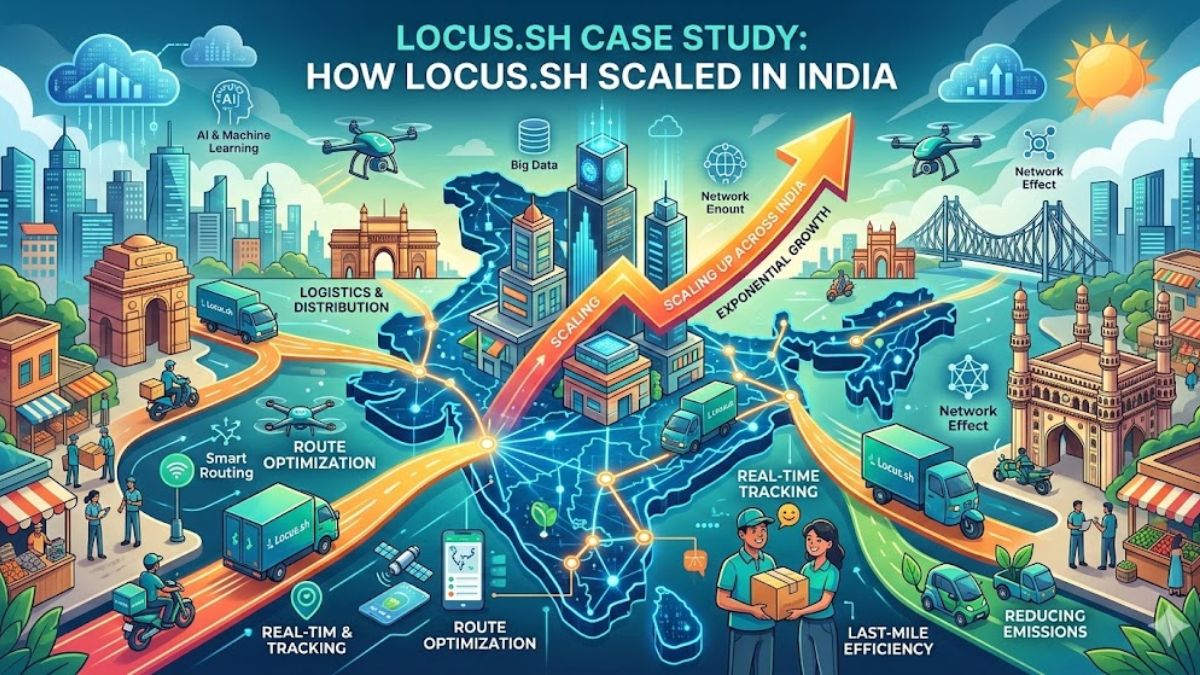
Locus.sh Case Study opens with a clear picture of one of India’s most significant logistics SaaS success stories. Locus.sh (commonly referred to simply as Locus) is an AI-powered logistics automation platform that helps enterprise customers plan, execute, and optimise fulfilment operations across the entire supply chain. The company’s technology is used to automate route planning, dispatch scheduling. Fleet allocation, delivery tracking, returns management, and other complex logistics decisions for enterprises with large distribution footprints.
What began as an effort to apply data and algorithms to real-world routing problems has grown into a global platform trusted by hundreds of brands. Locus was started to solve a core pain point many businesses suffer from. The inefficiency, inconsistency, and cost of logistics operations. Its founders saw that simply tracking trucks and couriers was not enough. Businesses needed a system that could intelligently optimise every decision that happens between order placement and delivery.
The startup was founded in 2015 by Nishith Rastogi and Geet Garg
The startup was founded in 2015 by Nishith Rastogi and Geet Garg. Both founders had roots in tech and machine learning, and they initially worked on location-based products and safety apps before pivoting fully into logistics optimisation. The company is headquartered in Bengaluru, India, and has expanded with a global presence spanning North America, Europe, Southeast Asia, and the Middle East.
Locus’s core platform uses advanced machine learning and proprietary optimisation algorithms that automate decision-making across complex logistics workflows. Rather than simply showing where a vehicle is. The system considers hundreds of variables to recommend optimal routes. Evaluate transporter options, predict delivery outcomes, and respond dynamically to real-time changes in demand or conditions.
Since its launch, Locus has raised significant funding from notable investors. Including GIC Singapore, Qualcomm Ventures, Tiger Global, and Falcon Edge. Notably, in 2021 the company closed a $50 million Series-C round that valued it at around $300 million. This Locus.sh Case Study will explore how the company identified a massive logistics opportunity. Built and scaled its product, and positioned itself as a leader in logistics SaaS and supply chain optimisation. It will look deeply at its origin story, founder journeys, product evolution. Go-to-market strategy, operational execution, competitive landscape, key milestones, and future trajectory.
2. Origins of Locus.sh and the Founder Journey
The story of Locus.sh begins against the backdrop of India’s rapidly evolving logistics sector. In the early 2010s, e-commerce, on-demand services, grocery delivery and retail distribution were all beginning to strain existing logistics systems. Supply chains were still largely manual, with routing decisions made using spreadsheets or simple tools that lacked sophisticated optimisation.
Nishith Rastogi and Geet Garg, the co-founders of Locus, were both deeply interested in the intersection of algorithms, data, and real-world problems. Early in their careers they worked on machine learning models for fraud prevention at Amazon. Exposing them to large-scale operations and the challenges of handling logistics and decision-driven processes. They later worked on consumer-facing apps. Including a social messaging prototype called PinChat and a safety-focused route deviation app for women called RideSafe. Their work on RideSafe revealed something significant. Location data was abundant, but tools that could turn that data into actionable optimisation decisions were rare.
By 2015, the founders observed that while GPS and tracking technology had proliferated in logistics operations, there was a lack of platforms that could automate the actual logistics decisions businesses had to make on a daily basis. Tracking a truck’s location was one thing; deciding where it should go next, how to allocate resources efficiently, and how to respond to disruptions in real time were entirely different challenges. This insight laid the groundwork for what would become Locus.sh. Their vision was simple but powerful: automate the human decisions in logistics that drive cost, efficiency, and reliability.
2.1 Early development was far from smooth
Early development was far from smooth. The founders bootstrapped their efforts initially, funded by a small seed reportedly around Rs 250,000 from angel backers including Amit Ranjan (co-founder of SlideShare) and Manish Singhal of pi Ventures which helped them build the first prototype of their product. Unlike many startups focused on the consumer market, Locus began by solving B2B logistics challenges for large enterprises that had the complexity and scale to benefit immediately from optimisation.
For Rastogi and Garg, prioritising quality over speed was a theme from the beginning. They often recount that building a platform capable of solving real logistics problems meant grappling with what most companies considered edge cases. Every decision variable, constraint, and operational nuance had to be accounted for, which required deep technical rigor and patience. Their product needed to reflect the real world’s messiness, not an idealised version of it. This ethos drove their engineering and product teams through the earliest versions of Locus’s optimisation engines.
2.2 Identifying the Opportunity in Logistics Automation
The logistics sector in India and globally was, and remains, a high-volume, low-margin industry. Traditional logistics technology focused on visibility knowing where packages are rather than optimisation deciding how to move them most efficiently. Many enterprises relied on manual route planning, ad-hoc dispatch decisions, and static tools that could not adapt to changing conditions on the ground.
Locus’s founders realised that logistics is essentially a decision problem. Each delivery order, fleet constraint, and customer promise was a decision point with implications for cost and performance. Instead of replacing people, Locus aimed to amplify human decision-making with algorithms that could handle hundreds of variables from fuel costs to driver shifts, traffic patterns to delivery time windows. This was the foundation of the Locus production strategy and differentiated Locus from legacy tools that merely tracked movement.
For enterprises with large distribution footprints high-volume e-commerce players, retail chains with omnichannel fulfilment, and manufacturers with complex transport networks the inefficiencies in decision processes translated into immense cost leakage. Locus’s route planning software success case narratives often cite reduced planning times, improved SLA adherence, and lower ground resource costs. These tangible operational improvements were compelling entry points for early customers.
3. Product Build and Evolution
From the outset, building an effective logistics automation platform was not simply about route optimisation. The founders knew they needed a suite of interconnected tools that could handle the entire decision lifecycle from order intake to delivery confirmation and returns.
The earliest products focused on core optimisation modules:
- Dispatcher, which automates route planning with real-time constraints;
- MotionTrack, real-time tracking and analytics;
- IntelliSort, automated shipment sorting; and
- FieldPro, a beat optimisation tool for field productivity.
Unlike point solutions that targeted one narrow logistics problem, Locus evolved into a modular, API-first platform capable of integrating with existing TMS, OMS, WMS and ERP systems. This allowed customers to adopt Locus’s optimisation engines without ripping out their entire operational stack.
A defining product decision was to embed AI and machine learning into the core of system logic rather than as an auxiliary add-on. Instead of static, rule-based planning, Locus developed algorithms that could assess hundreds of variables including distance, customer time windows, vehicle capacity, traffic patterns, driver availability, and more to generate near-optimal routing plans. The platform could also adapt plans on the fly when real-world disruptions occurred, giving operations teams greater flexibility and resilience.
The product roadmap continuously expanded to include dispatch planning solutions that optimise on-time delivery rates, hub operations modules that reduce manual handling time, and orchestration layers that automate carrier selection and network scaling. Each new module was designed to reduce the burden of manual decision-making and unlock efficiency gains across last-mile delivery models, hybrid fleets, and complex omnichannel fulfilment scenarios.
3. Early Traction and Validation
Locus’s early customers were some of the most demanding in the Indian business ecosystem. Brands like Urban Ladder, 1mg, Quikr, Lenskart and Licious adopted the platform to replace manual planning tools and spreadsheets with an automated logistics management system. Early results often showed dramatic improvements in planning time and delivery performance, validating that Locus’s technology could solve real problems enterprises faced.
These initial success stories became the backbone of Locus’s go-to-market strategy. Rather than broad top-of-funnel advertising, the company leaned into deep case studies with early customers, showcasing measurable outcomes like reduced planning effort, improved delivery rates, and cost savings. Over time, these word-of-mouth referrals helped Locus expand its customer base regionally and then globally, earning trust from retail, FMCG, delivery and logistics organisations.
4. Business Model and Revenue Approach
Locus operates primarily on a SaaS business model focused on enterprise customers. Revenues come from subscription fees for access to the platform, performance-based pricing tied to logistics volume or cost savings, and consulting support for implementation and integration. The modular nature of the platform allows clients to adopt only the components they need, making the pricing more flexible and aligned with value delivered.
Enterprise logistics tech case studies often highlight how SaaS pricing models in the logistics space must be deeply tied to business outcomes. Locus’s approach was to align its fees with the value customers derive from route optimisation, delivery performance improvements, and operational efficiency gains. This long-term value alignment helped Locus secure multi-year contracts with large brands and scale predictably.
4.1 Funding History and Investor Involvement
Locus’s funding history reflects increasing confidence from global investors in its vision and execution. After early angel backing, the company raised funding from venture firms including Exfinity Venture Partners, Blume Ventures and BeeNext in its initial rounds. These early rounds helped build the product team and prove the business model.
The most notable funding milestone came in 2021 when Locus closed a $50 million Series-C round led by Singapore’s GIC, with participation from Qualcomm Ventures, Tiger Global and Falcon Edge. This round valued Locus at roughly $300 million and underscored investor belief in its potential to transform logistics operations globally.
5. Go-to-Market Strategy and Distribution
Locus’s go-to-market strategy rested on deep engagement with enterprise customers. Unlike consumer-focused startups that rely on broad digital marketing, Locus leaned into consultative sales, proof-of-concept trials, and bespoke integrations with customer systems. Its teams worked directly with logistics, supply-chain and operations leaders to understand workflows and tailor the implementation. This approach helped build trust and ensured that prospective clients could see measurable performance improvements before committing long-term. Case study feedback from customers like Lenskart and BlueDart often emphasises not only improved metrics but responsive engineering support and customised features that addressed unique operational challenges.
Through partnerships and integrations with existing enterprise systems, Locus cultivated a distribution network that extended beyond India. Its global deployments span North America, Europe, Southeast Asia and the Middle East, enabling multinational brands to standardise logistics automation practices across geographies.
6. Brand Positioning and Messaging Evolution
From early days, Locus positioned itself as more than a tracking platform. Its messaging shifted enterprises’ focus from visibility to optimisation emphasising that knowing where a package is does not help if the decisions about routing and allocation are suboptimal. Over time, Locus’s brand narrative has centred on logistics automation platform analysis, AI logistics case study outcomes, and last-mile delivery optimisation success.
In markets where digital logistics transformation has been slower, Locus’s educational content on cost savings and decision automation helped bridge the gap between awareness and adoption. Its messaging evolved to highlight sustainability outcomes, such as reduced emissions through intelligent route planning, tying business performance with environmental impact.
7. Operational Challenges and Turning Points
Scaling logistics optimisation technology is inherently challenging. Early product versions struggled to handle real-time variability at scale, requiring significant engineering investment to improve performance and reliability. Implementing AI in mission-critical operations also demanded rigorous testing and trust-building with customers who could not tolerate system errors.
Another key challenge was entering global markets. Logistics workflows and regulatory environments vary widely across countries, necessitating localisation of operational rules and integration nuances. Locus’s engineering teams had to ensure that optimisation algorithms respected regional constraints and customer requirements without compromising performance.
Despite these challenges, Locus achieved significant turning points most notably securing global enterprise clients and closing major funding rounds that fuelled expansion. Each expansion into a new region reinforced the platform’s flexibility and adaptability to diverse logistics environments.
8. Competitive Landscape and Differentiation
The logistics SaaS space has grown crowded with companies offering components of supply chain and last-mile optimisation. Competitors range from traditional TMS providers to newer AI-driven startups focused on specific logistics layers. However, Locus’s deep-tech roots, advanced optimisation capabilities, and modular platform set it apart.
Where many competitors concentrate on visibility, tracking or basic workflow automation, Locus emphasises intelligent decision-making. Its optimisation engines consider hundreds of variables to suggest operational plans that often outperform manual or rule-based systems. This deep optimisation focus, combined with flexibility to integrate into existing enterprise systems, strengthens its differentiation. In global markets, Locus competes with legacy software and newer cloud-native platforms. Its advantage is often the depth of its optimisation algorithms and the ability to handle complex enterprise constraints at scale.
9. Growth Metrics, Milestones and Achievements
Locus has reported deploying its platform across 350+ customers in more than 30 countries, optimising over a billion deliveries and delivering hundreds of millions in logistics cost savings. Public metrics indicate that clients have seen improvements in on-time delivery rates, planning time reductions, and environmental impact through reduced emissions.
The company’s recognitions, such as being featured in industry awards and cited by analysts, reflect its position as a leading logistics automation platform. These milestones demonstrate sustained growth in reach, product capabilities, and customer outcomes without resorting to hype.
10. Team Building and Leadership Approach
Leadership at Locus has emphasised technical excellence and domain expertise. The founders, both technically grounded, built a culture that prioritises solving hard logistics problems over superficial features. Hiring strategies focused on engineers with real-world optimisation experience and operations professionals who understood the complexity of logistics workflows. This approach ensured that product teams were not only technically capable but also deeply familiar with customer business problems, enabling better product decisions and tighter alignment with enterprise needs.
11. Technology, Operations, and Supply Chain Insights
At its core, Locus’s technology reflects a synthesis of advanced optimisation, machine learning, and real-time analytics. Rather than static models, the platform’s algorithms constantly adjust to operational conditions, enabling dynamic dispatch planning, resource allocation, and cost optimisation. Operationally, integrating with existing enterprise systems allows Locus to leverage historical data, current orders, and real-time events in concert, yielding optimisation suggestions that are context-aware and practical. This technological sophistication is a common theme in AI logistics case studies that showcase measurable business impact.
12. Regulatory and Industry-Specific Hurdles
Expanding Locus across multiple countries has not been simply a question of technology or demand it has been a test of navigating complex, often unpredictable regulatory landscapes. Each new market brought its own maze of rules: stringent data privacy laws, transportation regulations, local labor norms, and varying standards for fleet management. One misstep could compromise operations or erode customer trust, so compliance had to be built into every layer of the platform from the start.
For Locus, this meant going beyond legal checklists. The team invested in understanding not just the letter of the law, but the practical realities of running logistics in each region. Data residency requirements forced careful architectural decisions to ensure sensitive information never left its jurisdiction, yet optimisation and real-time decision-making remained uncompromised. Similarly, fleet management had to adapt dynamically to local regulations around vehicle types, driver hours, and safety standards, all while maintaining the core promise of operational efficiency to enterprise clients.
These hurdles tested the founders’ problem-solving at every turn, forcing them to blend technology, strategy, and human judgement. It was not enough for the software to be smart. it had to be legally and operationally agile. Capable of delivering tangible results while remaining fully compliant.
13. Current Status of the Startup
Today, Locus operates as a privately held company with a rapidly expanding global footprint. It has earned a reputation as a trusted partner for enterprises aiming to automate complex, decision-driven logistics tasks and optimise multi-layer supply chains. Large clients across e-commerce, FMCG, and transportation rely on Locus not only for efficiency but also for predictability in operations, which has become a rare commodity in fast-moving markets.
Backed by leading institutional investors, the company continues to invest heavily in product innovation. Adding advanced AI-driven features that provide real-time insights, predictive analytics, and end-to-end route optimisation. The platform is increasingly seen not just as a tool, but as a strategic enabler helping businesses reduce costs, improve delivery speed, and enhance customer satisfaction.
Locus’s current trajectory reflects a careful balance between ambition and execution. The team is relentlessly focused on scaling responsibly, ensuring that each new market, client, and feature reinforces reliability and trust. In doing so, Locus is not just growing its revenue or customer base. it is shaping how logistics decisions are made globally, demonstrating that technology, when married to operational expertise, can transform an entire industry.
14. Future Outlook and Vision
Looking forward, the Locus.sh Case Study shows a clear trajectory toward deeper AI integration. Broader geographical reach, and expanded automation capabilities. The company’s roadmap likely includes enhancements to predictive logistics, carbon footprint analytics. And further integrations with autonomous and IoT-enabled devices in the supply chain. Sustainability is set to play a larger role in logistics technology decisions globally. Locus’s ability to quantify emissions savings and optimise routes with environmental considerations could amplify its value proposition. Continued investment in R&D could also strengthen its competitive position in the logistics automation space.
Locus’s founders have consistently emphasised product quality and long-term value over quick wins. This disciplined approach. Combined with strong customer outcomes, suggests that the company will continue scaling while helping enterprises manage the complexity of modern logistics operations.
About foundlanes.com
foundlanes.com is a platform that documents, analyses, and publishes in-depth startup case studies, founder journeys, and business insights focused on India’s startup ecosystem. It provides fact-driven, narrative-rich analyses designed for readers seeking a deeper understanding of how startups navigate real-world challenges and opportunities.