


Summary
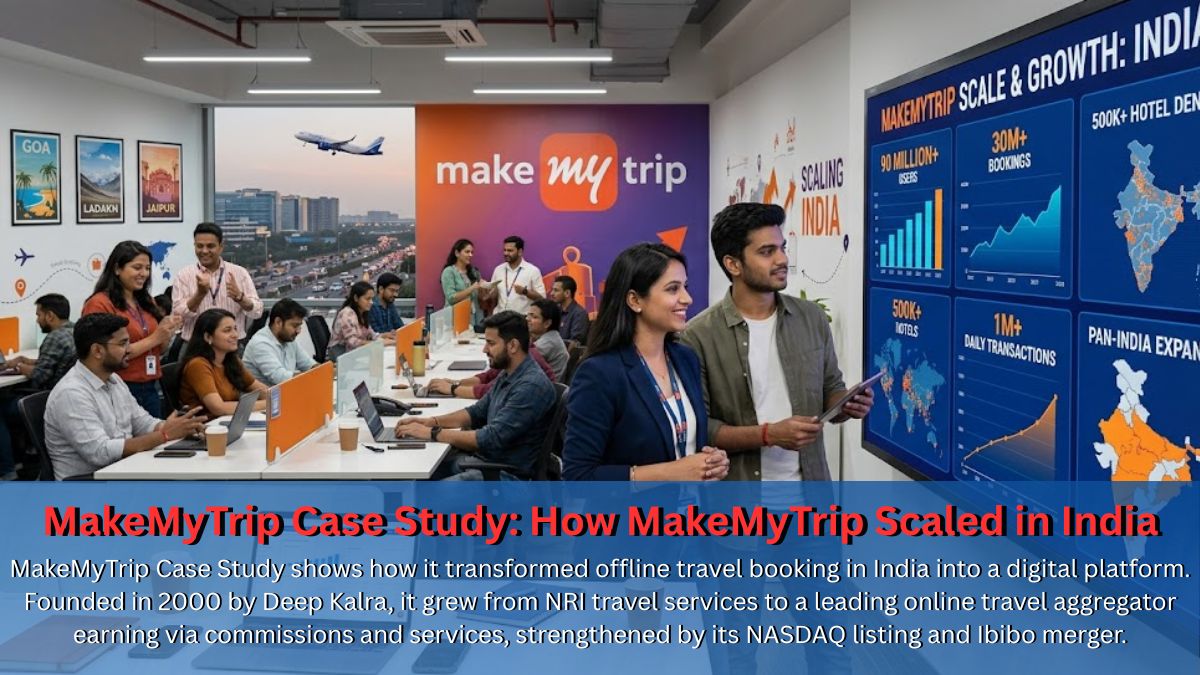
MakeMyTrip Case Study explores how one of India’s earliest online travel platforms transformed a fragmented offline travel booking industry into a structured digital marketplace. MakeMyTrip is an online travel booking platform that allows users to book flights, hotels, holiday packages, buses, and other travel services through a unified digital interface. It was started to solve a simple but significant problem in early 2000s India: booking travel was slow, offline, and highly dependent on travel agents with limited transparency.
The company was founded by Deep Kalra along with a team of co-founders including Keyur Joshi, Rajesh Magow, and others who helped shape its early operations. It is headquartered in Gurugram, India, with additional global presence, especially after its acquisition and international expansion strategy. MakeMyTrip was launched in 2000, during the early wave of internet adoption in India and the United States. Initially focused on NRI customers in the US-India travel corridor, it later expanded aggressively into the Indian domestic travel market as internet penetration and online payments improved.
The platform works as an online travel aggregator, connecting users with airlines, hotels, and transport providers. It earns revenue primarily through commissions, convenience fees, advertising, and value-added travel services. Over time, it has expanded its business model to include hotel aggregations, dynamic packaging, and mobile-first booking experiences. MakeMyTrip became one of India’s first major internet companies to list on NASDAQ in 2010, marking a milestone for Indian startup globalization. Later, its merger with Ibibo Group further strengthened its position in the Indian online travel ecosystem. Today, it remains one of the leading players in India’s online travel booking space alongside competitors like Yatra and emerging digital-first travel startups.
1. Origin Story of India’s First Major Online Travel Platform
The MakeMyTrip Case Study does not begin like a typical startup story with a sudden breakthrough or a dramatic funding moment. It begins quietly, almost like a workaround for a problem that most people at the time simply accepted as “how things are done.” In early 2000s India, booking a flight or planning a holiday was a slow, fragmented process. You called a travel agent, waited for availability, compared prices that were rarely transparent, and often relied on trust more than confirmation. Even a small change in plans meant more calls, more waiting, and more uncertainty. Travel existed, but convenience did not.
Deep Kalra saw this friction not as an inconvenience, but as a system failure waiting to be rebuilt. At the time, the internet in India was still fragile. Dial-up connections were common, cyber cafés were more visible than home broadband, and online payments were barely trusted for anything beyond small transactions. Most entrepreneurs would have seen this as a signal to wait. MakeMyTrip moved in the opposite direction, but not in India first.
The company actually began with a sharper, more focused bet on the Indian diaspora in the United States. That decision was not romantic or visionary in hindsight; it was practical. The US had stable internet adoption, credit cards were widely used, and most importantly, Indian expatriates had a recurring emotional and logistical need: travel between the US and India. That insight mattered more than it looked like on paper. The founders were not trying to “digitize travel for India” at first. They were trying to solve a narrow but high-frequency problem for a group already comfortable with digital behavior. This early constraint shaped everything that followed.
1.1 The problem was not simple
But even in that more advanced market, the problem was not simple. Flight bookings still required dealing with multiple airline systems. Prices changed frequently. Seat availability was not always accurate. And most importantly, trust was still fragile. People were not just buying tickets; they were buying reassurance that their money would not disappear into a broken system. Behind the scenes, MakeMyTrip had to stitch together fragmented airline data, manual confirmations, and early-stage digital payment flows. There was no clean API ecosystem like today. Much of the early platform behaved like a carefully managed hybrid system, part automation, part human verification, and a lot of operational firefighting.
The emotional reality of those early days is often overlooked. Every confirmed booking carried weight. If something failed, it was not just a technical bug; it was a customer stuck in another country with a real travel deadline. That pressure forced the team to treat reliability not as a feature, but as the core product itself. The turning point was not a sudden product launch. It was a slow realization that the model had to evolve from serving diaspora travelers in a controlled environment to addressing India’s massive, messy, and under-digitized domestic market.
1.2 That shift did not happen because the Indian market
That shift did not happen because the Indian market was “ready” in a neat, predictable way. It happened because the underlying infrastructure began to catch up. Internet penetration slowly improved after 2004–2005. Credit cards started reaching a slightly broader urban audience. Air travel in India itself was becoming more accessible due to industry liberalization and low-cost carriers entering the market. MakeMyTrip didn’t enter this phase with certainty. It entered with adaptation. The MakeMyTrip growth strategy India that we now analyze as structured and intentional was, in reality, a sequence of adjustments driven by what was working in real time. What worked in the US diaspora market could not simply be copied into India. User behavior was different. Trust barriers were higher. Price sensitivity was sharper. And offline agents were still deeply embedded in the ecosystem.
So the company recalibrated. Instead of asking how to replicate the US model in India, it started asking a more uncomfortable question: what does trust look like in a market that has never trusted the internet for high-value transactions? That question changed the product philosophy entirely.
2. Founder Journey and the Reality of Building Trust in a Distrustful Market
The MakeMyTrip Case Study becomes more meaningful when you strip away the clean narrative of “founder vision” and look at what Deep Kalra and the early team actually had to deal with on a day-to-day basis. This was not a world where users were waiting for an online travel platform to arrive. It was a world where even educated, urban consumers hesitated before entering card details online for something as expensive as an airline ticket. And that hesitation had consequences.
Every failed transaction, every delayed confirmation, every mismatch in fare information did not just hurt conversion metrics. It directly damaged trust, which was far harder to rebuild than any marketing campaign. In the early phase, MakeMyTrip’s biggest competitor was not another startup. It was habit. Travel agents had decades of relationships with customers. People trusted a familiar counter, a known face, and a printed ticket. Convincing someone to replace that with a website required more than discounts or UX improvements. It required emotional reassurance at scale.
This is where the operational side of the company quietly became as important as the technology side. The team had to ensure that when a user clicked “book,” the outcome was not uncertain. That meant constant backend coordination with airlines, manual reconciliation in edge cases, and building internal systems that could catch errors before they reached the customer. There were moments where the system worked perfectly in isolation, but broke under real-world pressure like sudden fare changes or airline inventory mismatches. Each of these failures was expensive, not just financially but reputationally.
2.1 What stands out in this phase of the MakeMyTrip business model
What stands out in this phase of the MakeMyTrip business model analysis is how heavily the company leaned on service recovery. In many cases, fixing a customer issue mattered more than acquiring a new customer. Refund handling, rebooking support, and responsive customer service became core parts of the experience, not afterthoughts. That approach created a slow but powerful shift in perception. Customers who initially tried the platform out of curiosity began returning because it worked consistently, not because it was the cheapest option.
The founder-led mindset during this phase was not growth at any cost. It was survival through reliability. That distinction matters because it shaped how the company scaled later. Instead of chasing aggressive expansion too early, the focus stayed on making the system stable enough to handle scale without collapsing under its own complexity. There is a subtle but important emotional layer here. Building trust in a high-value category like travel is not just a technical challenge. It is a psychological one. Every user interaction carries doubt in the background. Every confirmation email is, in a way, a reassurance that something important has not gone wrong.
The team had to operate with that awareness constantly. Over time, this discipline became an advantage. When the market finally opened up in India, MakeMyTrip was not just another website trying to sell tickets. It was already a system that had survived years of trust-building under pressure.
3. Early Market Problem and the Invisible Opportunity Most People Missed
The Indian OTA market case study is often described in terms of “untapped opportunity,” but that framing hides the deeper reality of what the problem actually looked like in practice. The issue was not simply that travel booking was offline. The issue was that information itself was fragmented and controlled by multiple disconnected players. Airlines controlled inventory. Agents controlled access. Hotels operated in entirely different networks. And customers sat at the far end of this chain, trying to make sense of incomplete information.
MakeMyTrip recognized something subtle but powerful. The real bottleneck was not booking. It was comparison. If users could not see options clearly, they could not make confident decisions. And if they could not make confident decisions, they stayed with intermediaries who reduced uncertainty, even at a cost. This insight led to the platform approach. Instead of trying to replace every part of the system, MakeMyTrip positioned itself as a layer on top of it. It aggregated information, standardized it, and presented it in a way that reduced decision friction.
3.1 The MakeMyTrip business model
The MakeMyTrip business model analysis shows that this aggregator role was critical because it allowed the company to scale without owning physical infrastructure. But more importantly, it allowed users to slowly transition from offline to online behavior without feeling like they were losing control. As internet adoption improved in urban India, something interesting happened. Users did not suddenly abandon travel agents. They started using both systems in parallel. They would compare online, then confirm offline, and eventually reverse that behavior as trust increased.
That transition period was slow, uneven, and highly emotional for users. It was not just about technology adoption. It was about letting go of a familiar system and trusting a new one that still felt uncertain. MakeMyTrip benefited from that gradual shift because it was already present when users began experimenting with online booking. The expansion from diaspora-focused bookings to domestic travel was not just geographic. It was behavioral. The company had to relearn its users.
Domestic Indian users were far more price-sensitive. They compared fares aggressively. They were less forgiving of delays or errors. And they were far more likely to abandon a transaction if anything felt unclear. This forced the platform to evolve quickly. Pricing systems had to become more dynamic. Search results had to become faster and more accurate. And the overall experience had to reduce uncertainty at every step. The real breakthrough was not market size. It was repeat behavior. Once users completed a successful booking and experienced zero friction, they began to trust the system in a way that could not be reversed easily. That is when MakeMyTrip stopped being an experiment and started becoming a habit.
4. Product Evolution and the Shift From Tool to Ecosystem
In the early phase, MakeMyTrip was essentially a utility. You went there to book a flight. That was it. But over time, something important changed. The platform stopped being a single-purpose tool and slowly became a travel planning environment. This shift was not driven by a single decision. It came from observing user behavior at scale. Once users completed flight bookings, they naturally asked for hotels. Then they asked for holiday packages. Then local transport options. Each new request was not a strategic expansion idea first; it was a user signal.
The MakeMyTrip growth strategy India evolved around this feedback loop. Instead of forcing users into predefined categories, the platform expanded based on what users were already trying to do informally. Mobile adoption accelerated this change dramatically. As smartphones became the primary internet device in India, travel planning itself became more continuous rather than episodic. Users were no longer sitting at desktops planning trips. They were browsing, comparing, and booking in short bursts throughout the day.
4.1 This changed product design philosophy
This changed product design philosophy. Search had to be faster. Recommendations had to be more contextual. Booking flows had to be shorter. And the entire system had to assume that users might drop off and return multiple times before completing a decision. The emotional reality of this shift is often missed. Travel is not a rational purchase. It is a mix of aspiration, budget anxiety, timing constraints, and personal planning stress. The platform had to adapt to that emotional complexity.
Over time, personalization became central. Not in the modern AI sense initially, but in basic behavioral learning. Returning users saw familiar routes. Frequent travelers saw quicker paths. Location and timing started influencing what users were shown. This gradual refinement is what transformed MakeMyTrip from a booking website into a decision-making assistant for travel. And that transition is where scale truly began to compound.
6. Business Model and Revenue Structure of MakeMyTrip
The MakeMyTrip Case Study becomes much clearer when you stop looking at it as a travel website and start seeing it as a trust-driven marketplace that monetizes uncertainty. At its core, MakeMyTrip does something very simple: it connects a traveler with a supplier. But what sits between those two points is where the entire business model lives. The primary revenue stream is commission. Every time a user books a flight, hotel, bus ticket, or holiday package, MakeMyTrip earns a percentage from the supplier. On paper, it looks straightforward. In reality, it is a constant negotiation between scale, pricing pressure, and supplier relationships that change depending on demand cycles.
Flights operate on extremely thin margins. Airlines already control pricing tightly, and OTAs like MakeMyTrip often operate in a high-volume, low-margin environment. The real story begins when you move into hotels and packages. That is where the economics start to change. Hotel bookings tend to carry significantly better margins because of fragmented supply and inconsistent pricing systems. Unlike airlines, hotels do not always have standardized distribution systems, especially in India’s mid-tier and regional markets. This gave MakeMyTrip room to build stronger margin pools through aggregation and negotiated deals. Over time, the platform did not just rely on visible commissions. It built an entire layered revenue structure that includes convenience fees, cancellation charges, service fees, and ancillary upsells like travel insurance, seat selection, and upgrades.
6.1 These may seem like small additions individually
These may seem like small additions individually, but at scale, they quietly stabilize revenue in an industry that is otherwise extremely volatile. There is also an important behavioral insight embedded in this model. Travelers do not just pay for tickets; they pay for certainty. Whether it is refund assurance, flexible cancellation, or faster resolution during disruptions, MakeMyTrip learned to monetize peace of mind. The MakeMyTrip business model analysis also reveals a gradual but intentional shift toward bundles and dynamic packages. Instead of selling isolated components like flight plus hotel separately, the platform increasingly encourages combined bookings.
This is not just a pricing strategy. It is a behavioral strategy. Bundles reduce decision fatigue for users and increase average order value for the company. For a user planning a trip, it feels simpler. For the platform, it increases revenue per transaction without increasing acquisition cost. At scale, this model becomes powerful because growth does not depend only on adding new users. It depends on increasing the value of each trip booked.
7. Funding History, IPO, and Strategic Acquisitions
The MakeMyTrip Case Study cannot be understood without looking at its funding journey, because capital did not just fuel growth; it shaped survival in a market that was still forming its digital habits. In its early years, MakeMyTrip raised funding from global venture capital firms that understood the potential of internet marketplaces before India fully caught up to that reality. This early capital was not used for aggressive expansion in the traditional sense. It was used to build systems that could handle uncertainty.
Uncertainty was everywhere. Demand patterns were unpredictable. Payment systems were still evolving. Supplier integration was inconsistent. Every new city expansion was not just a market entry; it was a risk experiment. Funding gave the company something more valuable than money. It gave time. That time became critical when India’s internet ecosystem began to mature. As broadband access improved and digital payments slowly became more reliable, MakeMyTrip was already operational, already tested, and already trusted by a growing user base.
7.1 The 2010 NASDAQ IPO was a defining moment
The 2010 NASDAQ IPO was a defining moment, not just financially but psychologically for the entire Indian startup ecosystem. It signaled that a company built around Indian consumers could access global capital markets and be evaluated as a serious technology business, not just a travel agency digitized on the surface. The listing also forced discipline. Public markets do not tolerate unclear unit economics or unproven scaling strategies. MakeMyTrip had to mature quickly into a more structured, metrics-driven organization.
But perhaps the most important strategic move came later with the merger of Ibibo Group in 2017. This was not just an acquisition. It was a consolidation of two parallel growth stories in the Indian travel ecosystem. Ibibo brought strength in segments like bus bookings and certain hotel categories, while MakeMyTrip brought brand strength, flight dominance, and broader market presence. The impact was immediate and structural. Instead of competing for the same customers with duplicated marketing spend, the merged entity could consolidate demand, optimize supply relationships, and improve operational efficiency.
In practical terms, it reduced internal competition that was burning capital across the ecosystem and created a more stable market leader. The MakeMyTrip funding and acquisitions strategy reflects a pattern that is often missed in surface-level analysis. It was not about aggressive expansion at all costs. It was about absorbing competition when the market matured enough to support consolidation.
8. Go-to-Market Strategy and Distribution Channels
The MakeMyTrip Case Study shows that distribution was never just a marketing exercise. It was about meeting users exactly where their trust already existed. In the earliest phase, acquisition was almost entirely digital and intent-driven. Users searching for flights or travel options online were naturally directed to the platform through search engines. This made early growth highly efficient because demand already existed.
But efficiency alone does not build a mass market in a country like India. As the domestic market expanded, MakeMyTrip had to move beyond high-intent users and start shaping demand itself. This is where the go-to-market strategy became more layered. Digital marketing expanded significantly. Search engine optimization, paid campaigns, and app-install strategies became central to user acquisition. But what mattered more was timing. Travel is seasonal, emotional, and often impulsive. Campaigns were structured around festivals, holidays, and long weekends, when intent naturally spikes.
At the same time, partnerships quietly became a powerful distribution channel. Banks and payment gateways played a crucial role. Co-branded offers, cashback partnerships, and card-linked discounts helped reduce friction for first-time users. These partnerships did something subtle but important. They borrowed trust from established financial institutions and transferred it to the travel platform. There was also a less visible but highly important shift: offline integration.
8.1 Instead of fully replacing travel agents
Instead of fully replacing travel agents, MakeMyTrip began working with them in smaller cities. This hybrid model allowed offline agents to use the platform for backend bookings while still maintaining customer relationships. In many ways, this was a transitional bridge between two systems rather than a replacement. The emotional reality of this transition is often overlooked. For many small-town users, booking travel online was still intimidating. Having a familiar agent assist in the process reduced that fear significantly. Over time, as confidence grew, users began bypassing intermediaries. But that transition was gradual, not abrupt. The MakeMyTrip growth strategy India in this phase was less about disruption and more about controlled adoption. The goal was not to shock the market into change, but to gently move behavior over time.
9. Competitive Landscape and Market Positioning
The Indian OTA market case study is often framed as a competition story, but in reality, it is more of a survival-of-scale narrative. MakeMyTrip operated in a market with several competitors, including Yatra, Cleartrip, and multiple smaller regional players. Each had its own niche strengths, whether in pricing, UX, or specific travel segments. But competition in online travel is not purely product-driven. It is structurally driven.
When users search for flights or hotels, they compare across platforms instantly. Switching costs are almost zero. This means that the real differentiator is not just interface or pricing. It is depth of inventory, speed of booking, and perceived reliability. MakeMyTrip’s early entry advantage gave it something competitors could not easily replicate: accumulated trust data. Every successful booking reinforced user confidence. Every resolved issue strengthened brand reliability.
The merger with Ibibo further tilted the balance. Instead of fragmented competition, the market started consolidating around fewer, larger players with stronger negotiation power over airlines and hotels. This had a cascading effect. Better supplier relationships improved pricing. pricing improved conversion. Better conversion improved scale. Scale further improved bargaining power. It is a reinforcing loop that is very hard for smaller players to break once it stabilizes. However, the market never became comfortable. Price sensitivity in India remains extremely high, and users are always willing to switch if another platform offers better value at the right moment. So positioning in this industry is never permanent. It is constantly defended.
10. Challenges, Failures, and Market Shifts That Reshaped the Company
The MakeMyTrip Case Study is not a smooth growth narrative. It is marked by repeated shocks that forced the company to adapt structurally. One of the most significant challenges has always been profitability pressure in a low-margin industry. Travel booking sounds like a high-volume business, but after supplier payouts, discounts, marketing costs, and operational expenses, margins remain thin. This creates a constant tension between growth and sustainability.
Market downturns have also played a major role in shaping strategy. During global economic slowdowns or travel disruptions, booking volumes collapse almost instantly. Unlike many digital products, travel demand is not sticky. It is highly sensitive to external conditions. The pandemic period, in particular, was a severe stress test. Demand dropped sharply, cash flows were disrupted, and the entire industry had to reimagine short-term survival. Recovery was slow and uneven, with domestic leisure travel returning before international travel stabilized.
Another recurring challenge has been rising customer acquisition costs. As competition intensified, acquiring a new user became more expensive, forcing the company to focus more on retention and repeat bookings. Despite these pressures, MakeMyTrip consistently adapted by tightening operations, optimizing marketing spend, and improving product efficiency. The focus gradually shifted from aggressive expansion to sustainable scaling.
There is also an emotional layer to these shifts. In high-volatility industries like travel, uncertainty is not occasional. It is structural. Every external event can change demand overnight. Operating in that environment requires a mindset that accepts instability as normal rather than exceptional.
11. Operational Scaling and Technology Infrastructure
Behind the visible platform, the MakeMyTrip Case Study is ultimately a story of building systems that can survive chaos. Travel booking is one of the most operationally complex digital categories. Every transaction depends on real-time data from airlines, hotels, and transport providers, all of which operate on different systems with different levels of digitization. MakeMyTrip invested heavily in integrating these fragmented systems into a unified backend infrastructure. APIs, inventory synchronization tools, and automated confirmation systems became the backbone of the platform. But technology alone was not enough.
The company also needed human fallback systems. When automation failed, support teams had to intervene quickly to resolve issues before they escalated. This hybrid model of automation plus human oversight became a defining feature of operations. Data analytics gradually became central to decision-making. Pricing optimization, search ranking, and user personalization all began to rely on behavioral data collected at scale. This allowed the platform to improve conversion rates without necessarily increasing traffic. Small improvements in search relevance or booking flow efficiency translated into large revenue impacts at scale.
Operational efficiency became the quiet foundation of profitability. In a low-margin business, even small inefficiencies can erode gains quickly. So every improvement in system speed, booking success rate, or support resolution time had a direct financial impact. What stands out most is that scaling was never just about adding users. It was about ensuring that every additional user did not increase system complexity disproportionately. That discipline is what allowed MakeMyTrip to grow into one of India’s dominant travel platforms without collapsing under operational strain.
12. Team Building, Leadership, and Organizational Culture
The MakeMyTrip Case Study becomes more revealing when you move away from products and markets and look at something less visible but far more decisive: how the company learned to scale people, not just software. In the early years, leadership at MakeMyTrip was deeply founder-driven. Deep Kalra was not just setting direction from a distance. He was involved in decisions that today would be considered too granular for a CEO of a scaled company. That level of involvement was not about control. It was about survival.
When a company is building trust in a completely new category like online travel in India, there is very little room for ambiguity. Every failure in execution directly impacts user confidence. In that environment, leadership cannot be abstract. It has to be present, responsive, and deeply aware of operational reality. The early culture reflected this urgency. The focus was not on slogans or structured HR frameworks. It was on one simple but demanding expectation: the customer experience must not break, even when everything else is still evolving.
12.1 That mindset shaped how teams were built
That mindset shaped how teams were built. Early hires were often people who could work across ambiguity. There was no clear playbook for how Indian users would respond to online travel booking. So the organization valued adaptability over specialization in many early roles. Teams had to constantly switch between product thinking, customer support, and operational problem-solving. As the company scaled, this informal structure could not hold. Growth introduced complexity that required more structured leadership layers. This is where professional management started to take over different verticals, bringing in systems, processes, and repeatable frameworks. But the interesting part is that culture did not fully shift away from its early DNA.
Even as corporate structures were introduced, the underlying emphasis remained consistent: reliability over hype, execution over noise, and customer trust over short-term gains. One of the most defining elements of the internal culture became data-driven decision-making. In a category where margins are thin and competition is intense, intuition alone is not enough. Decisions around pricing, marketing spend, and product changes increasingly relied on measurable behavior.
But even here, there was a balance. Data could tell what users were doing, but leadership still had to interpret why they were doing it. Travel, after all, is not purely transactional. It is emotional, seasonal, and often impulsive. Over time, this blend of structured management and original founder-led thinking created a culture that was neither purely startup-like nor fully corporate. It existed somewhere in between, shaped by constant adaptation.
13. Current Position in the Indian Travel Ecosystem
Today, the MakeMyTrip Case Study sits in a very different landscape than the one it started in. The company is no longer trying to introduce online travel booking to India. That battle has already been won. The new challenge is far more subtle: defending relevance in a market that is constantly evolving. MakeMyTrip now operates as one of the most established online travel platforms in India, with strong coverage across flights, hotels, holiday packages, buses, and increasingly integrated travel services. What once started as a niche solution for international travelers has become a mainstream habit for millions of Indian users. But maturity does not mean stability in this industry.
The current ecosystem is shaped by multiple pressures at once. Digital-first travel startups are pushing aggressively on user experience and niche segmentation. Global platforms are increasing their focus on India as outbound travel from the country grows. At the same time, price comparison behavior among users is stronger than ever, making loyalty extremely fragile. In this environment, MakeMyTrip’s position is less about dominance in a traditional sense and more about resilience.
13.1 The company continues to invest heavily in mobile-first experiences
The company continues to invest heavily in mobile-first experiences, recognizing that the majority of travel decisions in India now begin on smartphones. The app is no longer just a booking tool. It is a planning environment where users browse, compare, and decide over multiple sessions. International expansion also plays a growing role, especially as Indian outbound travel increases due to rising disposable incomes and more global mobility. This segment is strategically important because it often carries higher transaction value and stronger margins compared to domestic bookings.
Another important shift is the increasing focus on user experience refinement rather than just acquisition. In earlier phases, growth was heavily driven by getting new users onto the platform. Now, the focus is more on improving conversion, retention, and repeat usage within the existing user base. The competitive environment, however, remains intense. Pricing pressure never fully disappears in online travel. Even a small fare difference can cause users to switch platforms instantly. This makes differentiation extremely difficult unless it is anchored in trust, convenience, or ecosystem depth. What stands out in the current phase of the MakeMyTrip growth strategy India is that success is no longer defined by disruption. It is defined by consistency at scale.
14. Future Outlook: MakeMyTrip Case Study and the Road Ahead
The MakeMyTrip Case Study ultimately tells a larger story about how digital transformation in India rarely happens in a straight line. It unfolds slowly, unevenly, and often in response to shifts in infrastructure, behavior, and trust rather than technology alone. Looking ahead, the next phase of growth for MakeMyTrip will likely be shaped by how well it adapts to personalization at scale. Travel planning is becoming less about searching and more about being guided. Users increasingly expect platforms to understand intent before they explicitly express it.
This is where AI-driven recommendation systems, predictive travel planning, and contextual suggestions will play a larger role. Instead of users searching for options, platforms will increasingly anticipate needs based on past behavior, seasonal patterns, and emerging travel trends. The MakeMyTrip growth strategy India in the coming years is also expected to lean more heavily on mobile-first engagement. Mobile is no longer just a channel. It is the primary interface for travel decisions. This means every aspect of the product experience will need to be optimized for short attention spans, intermittent browsing, and quick decision cycles.
14.1 Subscription-based models and loyalty-driven ecosystems
Subscription-based models and loyalty-driven ecosystems are also likely to gain importance. In a market where acquisition costs are rising and switching behavior is high, retaining users through structured benefits becomes more valuable than repeatedly acquiring new users through paid channels. Another major direction is deeper integration with airlines and hospitality networks. Instead of just aggregating inventory, platforms like MakeMyTrip may increasingly move toward tighter partnerships that improve pricing efficiency, availability accuracy, and exclusive offerings.
At the same time, the broader Indian OTA market case study suggests that growth will continue to be supported by macroeconomic trends. Rising disposable incomes, increased domestic tourism, and a growing culture of experiential travel are all contributing to a structurally expanding market. Tier-2 and tier-3 cities will play an increasingly important role in this growth. As digital adoption deepens beyond metro cities, first-time travelers from these regions will become a significant user base. Their behavior patterns may differ from early urban users, which will require further adaptation in product design and communication.
But the most important long-term factor is not technology or expansion. It is trust. Travel is one of the few digital categories where emotion is always present. People are not just booking tickets. They are planning family trips, life events, business commitments, and personal milestones. Every booking carries expectation, uncertainty, and anticipation. MakeMyTrip’s long-term success will depend on how well it continues to respect that emotional weight while operating at massive scale.
In a market where loyalty is fragile and competition is constant, the platforms that survive are not necessarily the cheapest or the most feature-rich. They are the ones that consistently reduce uncertainty for users. That is the real foundation of the MakeMyTrip Case Study, and it is also the lens through which its future will be judged.
About foundlanes.com
foundlanes.com is India’s leading startup idea discovery platform. It helps entrepreneurs find actionable startup opportunities, market insights, and industry-specific guidance to turn ideas into real businesses. With deep research and practical resources, foundlanes supports founders at every stage, from idea validation to launch and growth.