


Introduction
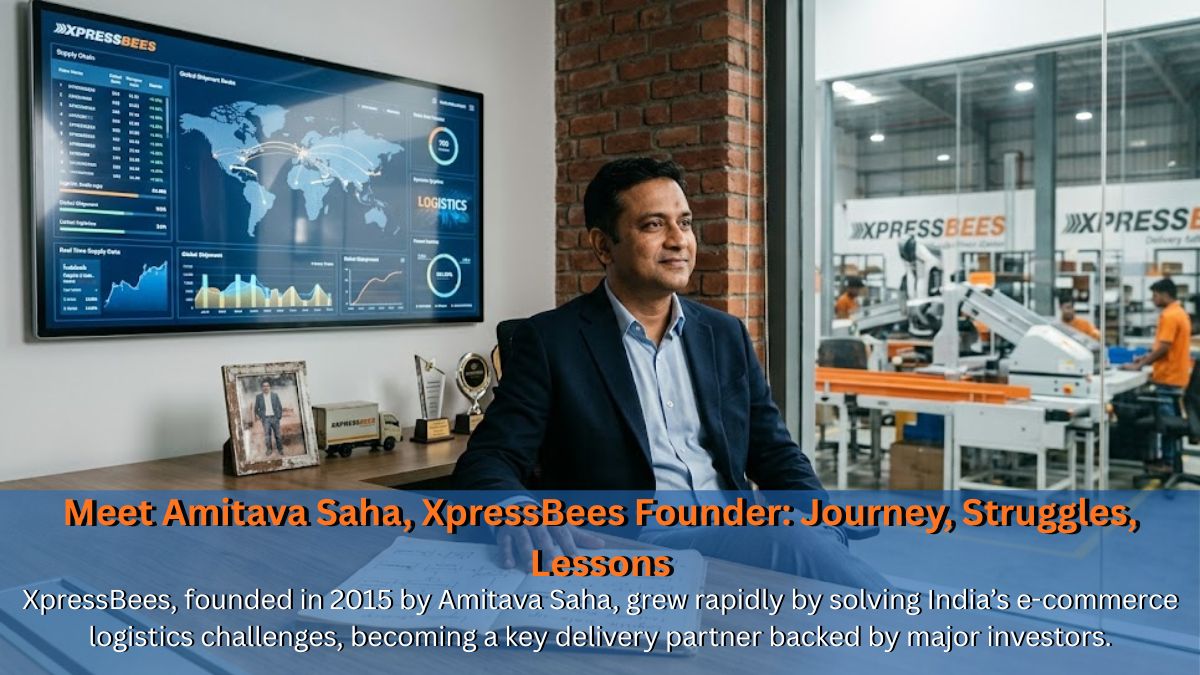
The rise of the XpressBees founder story is closely tied to the explosive growth of India’s e-commerce ecosystem. Amitava Saha is one of the key figures behind XpressBees, a logistics startup that has become a critical backbone for online commerce in India. Founded in 2015 and headquartered in Pune, XpressBees was built to solve one of the toughest challenges in Indian e-commerce: reliable, scalable, and efficient delivery.
The startup operates in the logistics and e-commerce delivery India space, offering services such as last-mile delivery, reverse logistics, and supply chain solutions. It works with major e-commerce companies, handling millions of shipments across the country. The idea behind XpressBees emerged when the founders identified a critical gap. While online shopping platforms were growing rapidly, logistics infrastructure was struggling to keep pace, especially in non-metro regions.
Amitava Saha, along with co-founders Supam Maheshwari and others, launched XpressBees as a spin-off from FirstCry, leveraging their experience in managing large-scale logistics operations. The company built its model around speed, reliability, and deep network penetration. Over the years, XpressBees has raised significant funding from investors including Alibaba Group, Blackstone, and others, helping it scale operations across India. The company has emerged as one of the fastest-growing logistics startups in the country. This case study explores the journey of the XpressBees founder, examining how Amitava Saha built a logistics powerhouse, navigated operational challenges, and contributed to shaping India’s e-commerce infrastructure.
1. Early Life and Background of XpressBees Founder
The journey of Amitava Saha is not the typical startup story filled with instant breakthroughs. It is rooted in years of hands-on experience, where he immersed himself in the realities of operations and supply chain management. Early in his career, Saha worked in environments where execution mattered more than ideas. He dealt with on-ground challenges like delayed shipments, inefficient routing, and unpredictable delivery cycles. These weren’t just operational issues, they were daily frustrations that shaped his thinking. Over time, he developed a sharp understanding of how logistics systems behave under pressure, especially in a country as diverse and complex as India.
His tenure at FirstCry proved to be a defining chapter. At FirstCry, he wasn’t just managing logistics, he was building it from the ground up for a fast-scaling e-commerce platform. The stakes were high, and the margin for error was almost zero. Every failed delivery impacted customer trust, and every inefficiency slowed growth. This intense exposure gave him a rare, inside-out view of logistics challenges in India. More importantly, it planted a deep realization that the existing logistics ecosystem was not built for the speed and scale that modern e-commerce demanded. That insight would later become the foundation of XpressBees.
2. The Spark Behind XpressBees Founder Journey
2.1 Identifying a Critical Gap
The idea behind XpressBees didn’t come from ambition alone, it came from repeated exposure to inefficiencies that refused to go away. Saha witnessed firsthand how India’s booming e-commerce sector was being held back by weak logistics infrastructure. Deliveries were inconsistent, service quality varied drastically across regions, and many areas lacked reliable coverage altogether. These weren’t isolated problems, they were systemic gaps that affected the entire ecosystem. For someone deeply involved in operations, these issues weren’t just frustrating, they were impossible to ignore.
What made this realization powerful was the clarity it brought. Saha understood that logistics wasn’t just a support function, it was the backbone of e-commerce growth. Without a strong, scalable logistics network, even the best e-commerce platforms would struggle to deliver on their promises. This insight turned a problem into an opportunity. It became clear that there was space for a new kind of logistics company, one that was designed specifically for the needs of digital commerce. That clarity of purpose became the starting point of the XpressBees journey.
2.2 Learning from FirstCry Operations
Working at FirstCry gave Saha something that most founders don’t get before starting up, a live laboratory of real-world challenges. Managing logistics for a growing e-commerce company meant dealing with constant unpredictability. Some cities performed well, others didn’t. Delivery partners varied in quality. Returns created operational chaos. Cash-on-delivery added financial complexity. Every day brought a new problem, and most of them required immediate solutions. This wasn’t theory, it was execution under pressure.
Over time, these experiences led to a deeper understanding that the problem wasn’t just with individual players, but with the structure of the logistics ecosystem itself. Saha and his team often had to build temporary fixes to keep operations running, but those fixes were never enough. The system needed a complete rethink. This realization slowly evolved into a bigger vision, to build a logistics network that was reliable, scalable, and tailored for e-commerce from day one. That vision became the seed from which XpressBees would eventually grow.
3 . Building XpressBees: From Idea to Execution
When XpressBees was launched in 2015, it wasn’t positioned as a large independent venture right away. Instead, it began as a logistics arm supporting FirstCry. This approach allowed Saha and his team to experiment, learn, and refine their systems in a controlled environment. They were not chasing rapid expansion in the beginning. Their focus was on solving real operational problems and building a system that actually worked. This grounded start helped them avoid many of the mistakes that early-stage startups often make.
As the system matured, the results became impossible to ignore. Deliveries became faster, reliability improved, and operational control strengthened. That’s when a critical shift happened. The team realized that what they had built was not just useful for one company, it had the potential to serve many. Transitioning into a third-party logistics provider was a bold move, but it opened the door to massive growth. It meant stepping into a competitive market and proving their value to new clients, but it also allowed XpressBees to scale rapidly and establish itself as a serious player in India’s logistics space.
4. Product and Service Evolution
In its early days, XpressBees focused on a single core service, deliveries. The goal was simple: move packages efficiently from one point to another. But as the company grew and client needs evolved, it became clear that logistics required a much broader approach. Customers were no longer looking for just delivery partners, they needed end-to-end solutions. This realization pushed XpressBees to expand its offerings beyond basic services and build a more comprehensive logistics ecosystem.
The company gradually introduced last-mile delivery, reverse logistics, and full-scale supply chain management services. Each addition was driven by real market demand and practical experience. Handling returns efficiently became just as important as making deliveries. Managing high shipment volumes during peak seasons required strong infrastructure. Cash-on-delivery transactions demanded accuracy and accountability. Over time, XpressBees transformed into a full-stack logistics provider, combining technology, operations, and strategy. This evolution wasn’t accidental, it was the result of continuous learning, adaptation, and a deep understanding of what the market truly needed.
5. Early Traction and Validation
The early days of XpressBees were not about chasing headlines or aggressive expansion. They were about proving one thing, that the system actually worked. The first real validation came from servicing FirstCry. This wasn’t just a client relationship, it was a pressure test. Every order fulfilled, every delivery completed on time, and every operational challenge solved became a small but meaningful win. There was no room to hide behind assumptions. If the system failed, it showed immediately. And if it worked, the results were visible just as quickly. This phase allowed the team to quietly build confidence, not just in the market, but within themselves.
As operations stabilized, something important started to happen. Consistency began turning into credibility. Other e-commerce companies started noticing. Slowly, new clients came in, bringing higher volumes and more complexity. This wasn’t easy growth. Each new client meant adapting to different requirements, managing larger networks, and maintaining the same level of reliability. But XpressBees didn’t rush it. They scaled carefully, making sure the foundation stayed strong. Over time, that discipline paid off. What started as an internal logistics solution began evolving into a trusted partner for multiple businesses. And that trust, earned through performance, became their biggest early asset.
6. Business Model and Revenue Approach
At its core, the XpressBees model is simple, but executing it at scale is anything but easy. The company earns through service-based fees, charging clients based on shipment volume, delivery distance, and the type of service required. On paper, this looks straightforward. But in reality, every shipment carries its own complexity. Different geographies, varying delivery timelines, and unpredictable conditions all impact execution. Pricing isn’t just about cost, it’s about balancing efficiency, reliability, and sustainability. This is where experience plays a critical role.
What makes the model powerful is its ability to scale with the market. As e-commerce grows, shipment volumes increase, and so does revenue potential. But XpressBees didn’t stop at just forward logistics. They expanded into reverse logistics, which is often more complicated than deliveries, and introduced value-added services that solved deeper supply chain problems. Each additional service wasn’t just a revenue stream, it was a way to strengthen relationships with clients. Over time, the business model evolved into something more resilient, where growth wasn’t dependent on a single offering but supported by a full ecosystem of services.
7. Funding and Investor Confidence
Building a logistics company in India requires more than vision. It requires capital, patience, and the ability to prove that execution can match ambition. XpressBees managed to do all three. As the company grew, it began attracting attention from serious global investors. Names like Alibaba Group and Blackstone didn’t just invest in an idea, they invested in a system that was already delivering results. That distinction matters. Investors weren’t betting on potential alone, they were backing performance.
This influx of capital changed the pace of growth. It allowed XpressBees to expand into new regions, strengthen its infrastructure, and invest in technology that could handle increasing complexity. But more importantly, it brought validation. For any founder, external belief from global players reinforces that the path being taken is the right one. The journey of Amitava Saha reflects this clearly. It shows that when execution is consistent and grounded in reality, funding becomes a natural outcome, not a desperate chase.
8. Go-to-Market Strategy and Distribution
XpressBees made a conscious decision early on to focus on a B2B model. Instead of trying to build a consumer-facing brand, they chose to serve the backbone of e-commerce, the businesses themselves. This decision shaped everything. By working directly with e-commerce platforms, they could operate at scale from the beginning. Each partnership brought not just revenue, but volume, learning, and operational depth. It was a strategy rooted in practicality, not hype.
At the same time, the company didn’t limit itself to metro cities. One of the most defining aspects of its growth was its expansion into tier 2 and tier 3 cities. These regions are often overlooked, yet they represent a massive opportunity. Reaching them isn’t easy. Infrastructure is inconsistent, and logistics challenges are far more complex. But XpressBees leaned into that challenge. They built networks where others hesitated. And in doing so, they didn’t just expand their reach, they unlocked new demand. This ability to go deeper, not just wider, became a critical advantage.
9. Brand Positioning and Messaging
In a crowded logistics market, standing out is not about loud marketing, it’s about silent reliability. XpressBees positioned itself as a partner that businesses could depend on, especially when things got difficult. Their messaging wasn’t built on exaggerated promises. It was built on consistency. Speed, accuracy, and reach weren’t just words used in branding, they were expectations the company had to meet every single day. And meeting those expectations required relentless focus behind the scenes.
Over time, this consistency became their identity. Clients didn’t just see XpressBees as a service provider, they saw it as an extension of their own operations. That level of trust is not easy to build, and it cannot be bought with marketing budgets. It comes from showing up, again and again, and delivering when it matters most. This is where the emotional side of the journey becomes visible. Because behind every successful delivery is a system that works, and behind that system are people who have spent years refining it. That human effort, often invisible, is what truly defines the XpressBees brand today.
10. Challenges Faced by XpressBees Founder
10.1 Scaling Operations
Scaling a logistics company is not like scaling a typical startup. It’s not just about adding more customers or increasing revenue numbers. It’s about managing chaos at a larger scale. For Amitava Saha, this was one of the toughest realities to deal with. Every additional shipment meant more moving parts, more dependencies, and more chances for things to go wrong. A delay in one hub could ripple across the entire network. A small inefficiency could multiply into a major operational failure.
What made it even more challenging was the expectation of consistency. Clients didn’t care how complex the backend was. They expected every delivery to be on time, every single day. Maintaining that level of reliability while expanding rapidly required relentless discipline. It meant building processes that could hold under pressure, hiring teams that could execute with precision, and constantly fixing what wasn’t working. Scaling wasn’t just growth, it was controlled growth. And achieving that balance demanded both patience and sharp decision-making.
10.2 Infrastructure Limitations
India is a market full of opportunity, but it comes with its own set of ground realities. Infrastructure is one of the biggest. For a logistics company like XpressBees, this wasn’t a theoretical challenge, it was something they faced every day. Roads in many regions are unpredictable. Connectivity in remote areas can be inconsistent. Weather conditions can disrupt entire routes without warning. These are not problems that can be solved overnight, yet they directly impact delivery timelines and customer experience.
Instead of seeing these limitations as barriers, the team had to learn how to work around them. They adapted routes, built local networks, and created systems that could handle unpredictability. But none of this was easy. It required constant monitoring, quick decision-making, and a willingness to get into the details. Delivering in a metro city is one thing. Delivering in a remote town with limited infrastructure is a completely different challenge. And yet, the expectation remains the same. This is where the real test of a logistics company lies, and XpressBees had to prove itself every single day.
10.3 Competition
The logistics space in India is intensely competitive, and for good reason. It’s a critical part of the economy, and everyone wants a piece of it. XpressBees found itself competing not just with established giants, but also with agile new startups trying to disrupt the market. Companies with years of experience, deep pockets, and strong networks were already in place. At the same time, new players were entering with fresh ideas and aggressive strategies.
For Saha, this meant one thing, standing still was not an option. The company had to keep evolving. Innovation wasn’t just about technology, it was about improving processes, enhancing reliability, and finding better ways to serve clients. Competition pushed the team to stay sharp. It forced them to question their own systems and continuously improve. In many ways, this pressure became a driving force behind their growth. Because in a market like this, survival itself is an achievement, and growth is a result of constant adaptation.
11. Operational Execution and Scaling Decisions
Behind every successful logistics company is a series of decisions that most people never see. For XpressBees, execution was everything. The company didn’t just rely on partnerships or external networks. It made a conscious decision to invest heavily in building its own infrastructure. Warehouses, sorting centers, and delivery hubs were set up across the country, creating a network that could support large-scale operations. This wasn’t a short-term move. It required significant capital, time, and long-term vision.
But infrastructure alone isn’t enough. The real power came from integrating technology into every layer of operations. Route optimization, real-time tracking, and data-driven decision-making became core to how the company functioned. These systems allowed XpressBees to handle increasing volumes without losing control. It made scaling more predictable, more efficient, and more reliable. What looks like smooth execution on the surface is actually the result of countless decisions, experiments, and refinements happening behind the scenes every single day.
12. Competitive Landscape and Differentiation
The logistics industry in India is crowded, with strong players like Delhivery and Ecom Express setting high benchmarks. Competing in such an environment requires more than just offering similar services. It requires a clear identity and a strong reason for clients to choose you. For XpressBees, that differentiation didn’t come from flashy branding or aggressive marketing. It came from execution.
What set the company apart was its ability to consistently deliver, even in challenging conditions. Its deep network reach, especially in underserved regions, became a significant advantage. While others focused on scale, XpressBees focused on control and reliability. This approach may not always grab headlines, but it builds something far more valuable, trust. And in logistics, trust is everything. The story of XpressBees is a reminder that in industries driven by execution, the smallest details often make the biggest difference.
13. Growth Milestones and Achievements
The growth of XpressBees didn’t happen overnight. It was the result of years of steady, disciplined effort. From handling its first set of shipments to scaling operations that now process millions annually, the journey reflects both ambition and resilience. Each milestone wasn’t just a number, it represented a system that had evolved, a team that had grown stronger, and a network that had expanded deeper into the country.
Today, the company’s presence across thousands of pin codes stands as proof of its reach and capability. But beyond the numbers, what truly matters is the reliability behind them. Every successful delivery, every satisfied client, and every operational milestone adds to the company’s credibility. These achievements are not just indicators of growth, they are reflections of consistency. And that consistency is what defines the journey of Amitava Saha and the company he built from the ground up.
14. Team Building and Leadership Style
Building a logistics company is not just about infrastructure or technology, it’s about people who can handle pressure when things don’t go as planned. For Amitava Saha, team building was never treated as a secondary task. It was central to everything. He understood early on that logistics is an execution-heavy business where even the smallest mistake can have a cascading impact. That meant hiring people who were not just skilled, but dependable. People who could think on their feet, make decisions in real time, and take ownership when things went wrong.
The leadership approach at XpressBees has always leaned toward accountability and performance. There is a clear expectation that results matter, but not at the cost of integrity or long-term thinking. Experienced professionals from logistics and technology backgrounds were brought in to strengthen different parts of the business. But beyond resumes and experience, what truly mattered was mindset. The company built a culture where people understood the weight of their role. Every package delivered successfully was a reflection of the team’s effort. And every failure was treated as a learning opportunity, not something to hide. That balance between pressure and trust is what shaped the company’s leadership style.
15. Technology and Innovation
In a business that deals with physical movement, it’s easy to underestimate the role of technology. But for XpressBees, technology became the backbone that made scale possible. From the beginning, the company invested in systems that could bring clarity to complexity. Data analytics started playing a crucial role, not just in tracking shipments, but in predicting demand, optimizing routes, and improving decision-making. These weren’t just technical upgrades, they fundamentally changed how the business operated.
Automation became another key pillar. Sorting centers that once relied heavily on manual effort began integrating automated systems to handle large volumes with speed and accuracy. This reduced errors, improved turnaround times, and allowed the company to manage peak loads more efficiently. But what stands out is that technology was never adopted just for the sake of it. Every innovation was tied to a real operational need. It was about solving problems, reducing friction, and making the system more reliable. Over time, this thoughtful integration of technology created a strong competitive advantage for the company.
16. Regulatory and Industry Challenges
Operating in the logistics sector in India means constantly navigating a web of regulations. It’s not just about moving goods, it’s about doing so within a framework that includes taxation rules, interstate movement regulations, and safety standards. For a growing company like XpressBees, this added another layer of complexity. Every new region brought its own set of compliance requirements. Every expansion required careful planning to ensure that operations remained smooth while staying within legal boundaries.
These challenges are often invisible from the outside, but they demand significant effort internally. Systems had to be built to manage documentation, ensure compliance, and avoid disruptions. Any oversight could lead to delays, penalties, or operational setbacks. Yet, the company had to keep moving forward without slowing down its growth. Balancing speed with compliance is not easy, but it is essential. And over time, XpressBees developed the capability to handle this balance effectively, turning what could have been a bottleneck into a manageable part of operations.
17. Current Status of XpressBees
Today, XpressBees stands as one of the prominent players in India’s logistics landscape. From its early days of handling limited volumes, the company now manages large-scale operations across the country. It serves multiple e-commerce platforms, each with its own demands and expectations. This scale is not just about numbers, it reflects the trust the company has built over time. Businesses rely on XpressBees to deliver consistently, and that reliability has become one of its strongest assets.
The company continues to expand its network, reaching deeper into regions that were once considered difficult to serve. Its growing infrastructure, combined with strong operational systems, allows it to handle increasing shipment volumes without compromising on quality. But what truly defines its current position is not just growth, it’s stability. In an industry where inconsistency is common, maintaining steady performance at scale is an achievement in itself. And that’s where XpressBees has managed to stand out.
18. Future Outlook
The future of XpressBees is closely tied to the growth of India’s e-commerce ecosystem. As more consumers move online and demand faster deliveries, the role of logistics companies will only become more critical. This creates a massive opportunity, but also raises expectations. Companies will need to deliver faster, reach farther, and operate more efficiently than ever before. For XpressBees, this means continuing to invest in the areas that have driven its success so far, infrastructure, technology, and people.
The journey of Amitava Saha is a clear example of how identifying a real problem and solving it with discipline can lead to something much bigger. But the journey is far from over. The company still has to evolve, adapt, and push its own boundaries. With the right focus and continued execution, XpressBees is well-positioned to play a significant role in shaping the future of logistics in India. And if its past is any indication, it will do so not through shortcuts, but through consistent, thoughtful progress built over time.
About foundlanes.com
foundlanes.com is India’s leading startup idea discovery platform. It helps entrepreneurs find actionable startup opportunities, market insights, and industry-specific guidance to turn ideas into real businesses. With deep research and practical resources, foundlanes supports founders at every stage, from idea validation to launch and growth.