


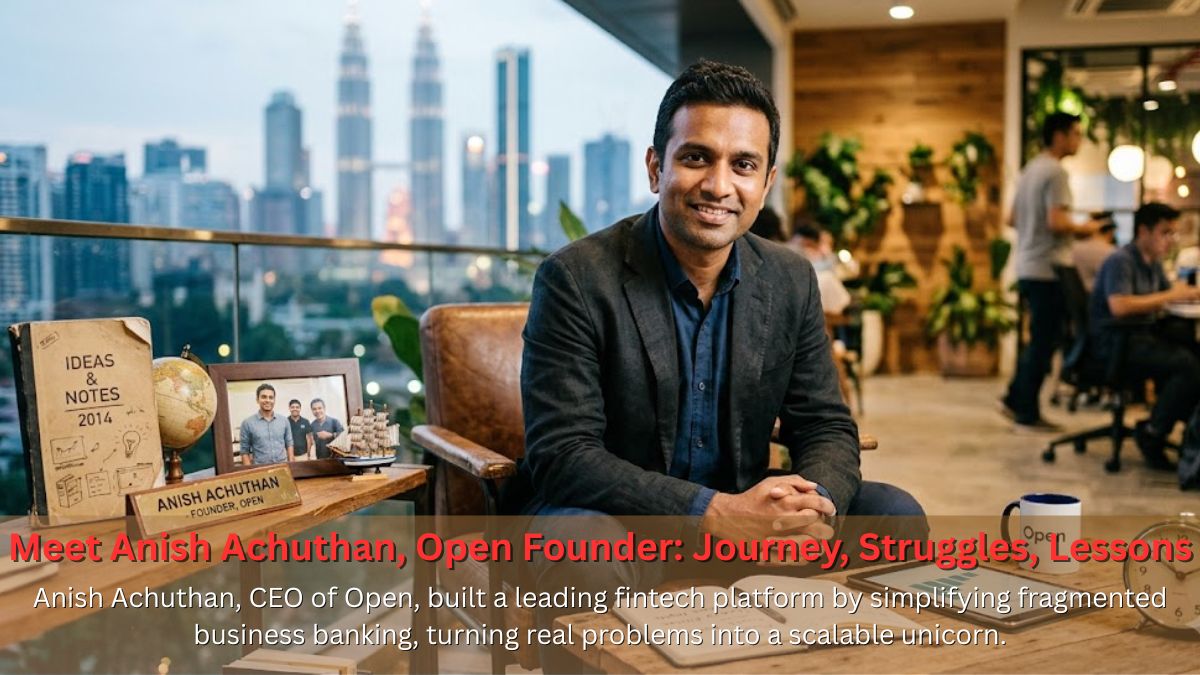
The story of Anish Achuthan Open founder is a reflection of how deep domain experience, persistence, and timing can come together to build a category-defining fintech company. Anish Achuthan is the co-founder and CEO of Open, one of India’s leading neobanking platforms designed specifically for small and medium businesses. Founded in 2017 and headquartered in Bengaluru, Open provides digital banking solutions that combine payments, accounting, and financial management into a single platform. The company works in partnership with traditional banks while building a modern layer of financial infrastructure for businesses. Before starting Open, Anish Achuthan had already spent years building and scaling startups in the fintech and mobility space, including TaxiForSure, which was acquired by Ola. This prior experience exposed him to the financial pain points faced by businesses, especially around managing cash flow, payments, and banking operations.
The idea behind Open came from a clear observation. While consumer fintech was evolving rapidly, business banking in India remained fragmented and inefficient. Entrepreneurs were forced to juggle multiple platforms for payments, accounting, and compliance. Open was built to simplify this. The company has since raised multiple rounds of funding from prominent investors and achieved unicorn status, with a significant Open valuation reflecting its growth. This Anish Achuthan success story is not just about building a company, but about understanding a problem deeply and solving it with precision. From early struggles to scaling a fintech platform used by millions, his journey offers practical lessons for founders navigating complex industries.
1. Background and Early Life
1.1 Early Life and Family Background
The story of Anish Achuthan doesn’t begin in a startup hub or a high-risk environment. It begins in Kerala, in a fairly typical middle-class household where stability mattered more than ambition, and discipline was valued more than experimentation. There’s something important about that kind of upbringing.
You’re not encouraged to “take big risks.” You’re taught to be practical, to think things through, to avoid unnecessary uncertainty. And yet, sometimes, that grounding creates a different kind of strength the ability to solve problems without getting carried away by noise. Anish grew up observing systems around him. How things worked. Where they broke. Why certain processes felt unnecessarily complicated. It wasn’t loud curiosity, but a quiet, persistent one. That mindset stayed with him. Later in life, when he entered the world of startups, he didn’t chase ideas that sounded exciting. He was drawn to problems that felt real the kind that people deal with every day but rarely talk about.
1.2 Education and Early Influences
Like many founders in India, Anish started with engineering. It gave him structure. It trained him to think logically, to break down problems into smaller parts. But here’s where things shifted. For some people, engineering becomes the destination. For him, it became a stepping stone. He realized early on that building a career inside a system didn’t excite him as much as building the system itself. His early exposure to startups and tech companies played a huge role here. He saw how small teams could create products that impacted thousands, sometimes millions of users. That kind of leverage changes how you think about work. You stop asking, “What job should I take?” And start asking, “What can I build?” That shift is subtle, but once it happens, it’s hard to go back.
2. Founder and Company Overview
When people talk about Anish Achuthan today, it’s almost always in the context of Open. And for good reason. Open isn’t just another fintech product. It’s an attempt to simplify something that most business owners struggle with but rarely articulate managing money across disconnected systems. At its core, Open is a neobanking platform designed for businesses. But that definition doesn’t fully capture its value.
It brings together:
- Business banking
- Payments
- Expense management
- Accounting integrations
Into one unified experience. If you’ve ever run a small business or even freelanced, you’ll understand the pain instantly. One app for banking. Another for payments. Something else for invoices. And then spreadsheets to somehow make sense of everything. It’s exhausting. Open tries to remove that friction. Its users startups, freelancers, SMEs, digital-first businesses don’t just need tools. They need clarity. They need to know where their money is, where it’s going, and how to manage it without wasting hours every week. Since its founding in 2017, Open has grown rapidly, becoming one of the most recognized players in India’s fintech space. But growth here isn’t just about numbers. It’s about relevance. The more complex business operations become, the more valuable simplicity becomes.
3. The Problem, Insight, and Trigger
3.1 The Problem: Fragmentation No One Talks About
Before Open, managing business finances in India felt like juggling. Not in an exciting way. In a frustrating, error-prone way. You had:
- Banks that handled accounts but not workflows
- Payment systems that didn’t integrate well
- Accounting tools that required manual effort
Everything worked… but nothing worked together. For large companies, this was manageable. They had teams, systems, and resources. But for small businesses? It was chaos. And the worst part is, people accepted it. They assumed this is just how things are.
3.2 The Insight: Lived Experience
What makes Anish’s approach credible is that this wasn’t a theoretical problem for him. He had lived it. In his previous ventures, he faced the same operational friction. The same inefficiencies. The same feeling that too much time was being spent managing tools instead of building the business. That kind of experience changes how you see opportunities. You’re not guessing what users want. You know what they need, because you’ve needed it yourself.
3.3 The Trigger: A Simple but Powerful Realization
The turning point wasn’t a sudden idea. It was a realization. If everything is becoming digital, why is business finance still so fragmented? Why can’t there be a single platform that brings it all together? That question led to Open.
Not as a “big vision” statement, but as a practical solution:
- One platform instead of many
- Integrated workflows instead of manual juggling
- Clarity instead of confusion
And that’s what makes this story feel real. It’s not about chasing disruption for the sake of it.
It’s about fixing something broken in a way that actually helps people. And when you do that consistently, growth follows.
4. Early Days and Initial Struggles
The early days of Open weren’t exciting in the way startup stories are often portrayed. There was no smooth takeoff, no instant validation. It was slow, uncertain, and at times, deeply frustrating. Building a fintech company in India is not just about writing code and launching a product. It’s about navigating a system that’s layered with regulation, trust barriers, and legacy thinking. One of the hardest parts? Convincing banks to even take you seriously.
Traditional banks are built to avoid risk. Startups represent the opposite. So when Anish Achuthan and his team approached them, the response wasn’t excitement. It was hesitation. Why should we trust you? How will this work at scale? What if something goes wrong? These weren’t unfair questions. But answering them required patience, persistence, and credibility that a young startup doesn’t naturally have. At the same time, the product itself was complex. Open wasn’t building a single feature. It was trying to bring together banking, payments, and financial workflows into one seamless system.
That sounds clean on paper. In reality, it meant dealing with:
- Multiple integrations
- Constant technical failures and fixes
- Edge cases that only show up when real users start using the product
There were days when things worked beautifully. And days when nothing seemed to hold together. This phase wasn’t about growth. It was about survival. About staying in the game long enough to make the system work.
5. Failures, Setbacks, and Self-Doubt
No startup journey moves in a straight line. And Open was no exception. There were product iterations that didn’t land the way the team expected. Features that seemed promising internally but failed to resonate with users. Growth that felt slower than it should have been. And then there’s something founders don’t talk about enough self-doubt.
When progress is slow and challenges keep piling up, it’s hard not to question yourself. Are we solving the right problem? Is the timing wrong? Are we missing something obvious? For Anish, these doubts weren’t new. He had been through ventures before Open, and not all of them had worked out. But that experience, as painful as it might have been at the time, became an advantage here.
Failure teaches you what textbooks and success stories don’t:
- What not to build
- What not to prioritize
- When to pivot and when to persist
Instead of breaking momentum, these setbacks sharpened the company’s focus. They forced harder questions. Better decisions. And slowly, things started to align.
6. Validation and Early Traction
Every startup waits for that moment when things stop feeling like a guess. For Open, that moment came from its earliest users small businesses. Not large enterprises. Not headline-grabbing clients. Just everyday businesses trying to manage their finances without losing hours every week. When they started using Open, something shifted. They didn’t just try the product. stuck with it.
They appreciated being able to:
- Manage payments without switching platforms
- Track expenses without spreadsheets
- Integrate their financial workflows in one place
And most importantly, they started giving feedback. Real feedback. Honest feedback.
Not “this is great,” but “this part is confusing,” “this could be faster,” “this actually saved me time.” That’s when you know you’re onto something. Adoption started growing. Slowly at first, then more steadily. Word of mouth kicked in. The product began to feel less like an experiment and more like a solution. This phase didn’t just validate the idea. It validated the direction.
7. Funding, Money, and Growth Constraints
As Open gained traction, capital followed. The company raised multiple funding rounds, with backing from global investors who saw the potential in what it was building. On the outside, funding looks like a milestone. And it is. But internally, it brings a different kind of pressure.
Now there are expectations.
- Scale faster
- Build more features
- Expand the team
- Capture market share
And in fintech, this pressure is even heavier.
Because growth isn’t just about users. It’s about:
- Compliance
- Security
- Infrastructure reliability
You can’t afford to cut corners. Every new feature has to be tested thoroughly. system has to be secure. Every partnership has to be stable. So while the funding helped Open grow, it also forced discipline.
The company had to constantly balance two things:
- Moving fast enough to stay competitive
- Staying stable enough to be trusted
That balance is difficult. But it’s what separates sustainable companies from short-lived ones.
8. Team Building and Leadership Evolution
In the early days, building the product is hard. But building the right team is even harder. Finding people who not only understand the problem but also believe in the solution takes time. For Anish Achuthan, this meant shifting his role gradually. In the beginning, founders do everything. Product decisions, hiring, partnerships, firefighting sometimes all in the same day.
But as the company grows, that approach stops working. You can’t scale a company if everything depends on you. That’s where leadership evolves. Learning to trust others. Letting go of control. Allowing teams to make decisions even if they’re not perfect. This transition is uncomfortable for most founders. But it’s necessary. Over time, Open built a team capable of handling complexity engineers, product leaders, compliance experts, growth teams all aligned toward the same goal. And that’s when a startup starts to feel like a company.
9. Growth, Scaling, and Operational Challenges
Scaling a neobanking platform isn’t just about adding more users. It’s about making sure the system doesn’t break when those users arrive.
For Open, this meant strengthening its foundation continuously.
- Technology infrastructure had to be robust and secure
- Systems had to handle increasing transaction volumes
- Integrations had to remain stable even under pressure
Then there were operational realities. Working with banks isn’t a one-time setup. It’s an ongoing relationship that requires coordination, compliance, and constant alignment. Regulations evolve. Requirements change. And the company has to adapt without slowing down. What stands out in Open’s journey is how it approached scaling. It didn’t rush blindly. It focused on building systems that could handle growth before pushing aggressively for it. That’s why, as demand increased, the platform didn’t just grow. It held up. And that’s the difference between growth that looks good on paper and growth that actually lasts.
10. Personal Sacrifices and Burnout
Behind every growing company, there’s a side of the story that rarely gets written about honestly. For Anish Achuthan, building Open wasn’t just a professional journey. It came with a very real personal cost. Long hours weren’t occasional. They were normal. Decisions weren’t spaced out. They were constant. When you’re building in fintech, the pressure is different. You’re not just responsible for a product. You’re responsible for people’s money, for trust, for systems that cannot afford to fail. That weight doesn’t switch off at the end of the day.
There’s always something running in the back of your mind:
- What if something breaks at scale?
- Are we compliant with the latest regulations?
- Are we growing fast enough, or too fast?
And over time, that pressure builds.
Burnout in entrepreneurship doesn’t always look dramatic. Sometimes it’s quiet. It’s the mental fatigue of making decisions every single day. It’s the constant switching between optimism and doubt. While the outside world sees funding announcements and growth numbers, the inside often feels like controlled chaos. Balancing work and personal life becomes less about perfect routines and more about survival. You try to make time. You try to disconnect. But when you’re building something from the ground up, it’s never fully off your mind. That’s the reality most founders live with.
11. Lessons, Beliefs, and Values
If you step back and look at the journey of Anish Achuthan, it’s not defined by a single breakthrough moment. It’s shaped by a set of beliefs that stayed consistent through the ups and downs. The first, and probably the most important: solve something real. Open didn’t start with a flashy idea. It started with a frustrating problem financial fragmentation for businesses. And everything was built around fixing that. The second is persistence. Building in a regulated, complex industry like fintech tests your patience constantly. Things move slower than you want. Approvals take time. Systems break. Plans change. You either learn to stay in the game, or you burn out trying to force speed. Then there’s transparency and customer focus.
When you’re dealing with financial products, trust is everything. Users need to feel confident not just in what you offer, but in how you operate. And finally, long-term thinking. It’s easy to chase short-term growth, especially when investors are watching and the market is competitive. But sustainable companies are built by thinking beyond the next quarter. These values don’t sound extraordinary. But consistently applying them is what makes the difference.
12. Present Challenges and Future Vision
Today, Open operates in a space that’s more competitive than ever. Fintech in India is booming. New players are entering. Existing players are evolving. And customer expectations are rising faster than most companies can keep up with.
The challenges are real:
- Regulation: Constantly evolving, non-negotiable, and often complex
- Security: One failure can break years of trust
- User expectations: People now expect speed, simplicity, and reliability all at once
And then there’s competition from startups, banks, and global fintech companies all trying to capture the same market. But challenges also bring clarity.
Open’s direction is becoming sharper:
- Expanding its product ecosystem
- Deepening integrations
- Becoming more than just a tool, but a complete financial operating system for businesses
The vision isn’t just growth. It’s relevance. To become the platform businesses rely on daily, not occasionally.
13. Future Outlook
The future of Anish Achuthan is closely tied to where fintech in India is heading. And that direction is clear. Businesses are becoming more digital. Operations are becoming more complex. And the need for integrated financial platforms is only increasing. This puts Open in a strong position. It already sits at the intersection of banking, payments, and business operations. If it continues to execute well, it can become an essential layer in how businesses manage money.
But the road ahead won’t be easy.
- Regulations will evolve
- Competition will intensify
- Technology will keep raising the bar
The companies that survive won’t just be the fastest. They’ll be the most consistent. For Anish, the mission doesn’t seem to have changed. It’s still about solving a problem that feels unnecessarily complicated for millions of businesses. And if that focus stays intact, the growth will follow just like it has so far.
About foundlanes.com
foundlanes.com is India’s leading startup idea discovery platform. It helps entrepreneurs find actionable startup opportunities, market insights, and industry-specific guidance to turn ideas into real businesses. With deep research and practical resources, foundlanes supports founders at every stage, from idea validation to launch and growth.