


Summary
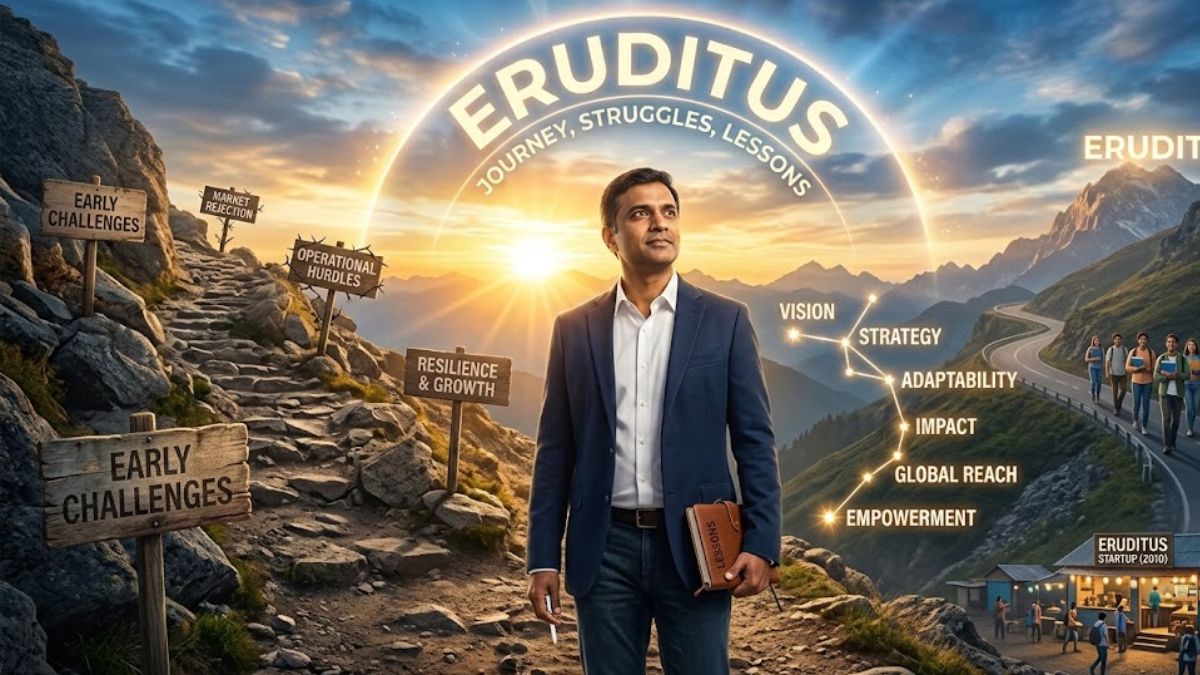
When people talk about global edtech leadership coming out of India, the story often turns toward Ashwin Damera Eruditus founder, the man behind one of the world’s largest executive education platforms. For more than a decade, he has helped reshape how working professionals access learning from top universities. His company, Eruditus, has grown into a rare Indian edtech venture that found scale not by chasing mass markets, but by building a premium global education product in partnership with elite institutions.
Damera’s journey didn’t begin in Silicon Valley or in a venture-funded accelerator. It began in Chennai, shaped by middle-class expectations, a strong emphasis on education and a desire to make something meaningful out of his early professional experiences. After an MBA abroad and a brief stint in consulting, he stumbled into entrepreneurship almost by accident. His first venture, Travelguru, was an online travel marketplace built in the early 2000s. It brought him both recognition and a difficult crash course in the realities of building a company in a market that wasn’t yet ready.
The turning point came years later
The turning point came years later. After exiting Travelguru and enrolling in an executive program himself, Damera saw a problem that bothered him deeply. Although the world’s best universities offered exceptional learning experiences, access was limited to a tiny group of people who could afford the time and travel required. He believed this gap could be bridged if universities were willing to rethink how they delivered education. That idea led to Eruditus.
Founded in 2010, the company set out to work directly with leading global universities and build programs that professionals anywhere could attend. It wasn’t a typical edtech idea. It wasn’t even a typical startup idea. Required patience, trust-building, and constant proof of value. Today, Eruditus is one of the world’s largest executive education platforms, serving learners across more than 80 countries. But the story behind that growth is filled with struggles, triggers, failures, near-shutdown moments, leadership transformation and an unwavering belief in education as a force for mobility. What follows is the full story of Ashwin Damera’s entrepreneurial journey, written for FoundLanes readers.
1. Background and Early Life
Ashwin Damera’s early life reflects the quiet aspirations of many middle-class Indian families in the 1980s and 1990s. He grew up in Chennai in an environment that placed high value on education and professional stability. His father worked in the banking sector, and his mother was a homemaker. Their expectations for him were clear: study hard, pursue a respectable profession, and build a secure future. Growing up in such a household created a certain discipline and a worldview where structure mattered. But Damera also had a curiosity that often ran beyond conventional boundaries. He was drawn to business stories, global affairs and the work of leaders transforming industries. That early exposure helped shape his desire to do something meaningful, though he didn’t yet know it would lead to entrepreneurship.
He graduated from Loyola College in Chennai before pursuing his MBA from the Indian Institute of Management Calcutta. Those years broadened his horizons, introduced him to the world of management thinking and gave him his first real taste of the global economy. The mix of academic rigor and peer learning at IIM prepared him for a career in consulting, which he initially saw as the ideal professional path. The real turning point came later when he enrolled at Harvard Business School for an MBA. That experience introduced him to entrepreneurship in a far more hands-on way. He was exposed to founders building category-defining companies and professors who encouraged students to chase problems worth solving. It left a lasting impression on him. What he didn’t know then was how deeply those ideas would influence his next two decades.
2. Founder and Company Overview
Eruditus was founded in 2010 with a simple but ambitious mission: make high-quality executive education accessible across the world by partnering directly with top universities. The idea was to take the rigor, depth and academic excellence of elite programs and make them available through formats that working professionals could realistically adopt. Damera and his cofounder saw a gap in the market. While there were several online learning platforms offering short courses, there was no scaled company dedicated to premium executive education created in collaboration with institutions known globally for academic excellence. They believed that professionals were willing to invest in programs that could truly advance their careers, provided the experience met the high standards of the universities behind them.
Unlike mass-market edtech companies, Eruditus built an audience that included mid-career professionals, executives and emerging leaders. The company’s learners came from fields such as finance, technology, healthcare, management and public policy. Its programs were designed for those who wanted to advance without taking a break from work. From its early days, the company focused heavily on partnerships. Over the years, Eruditus forged relationships with institutions such as MIT, Columbia, Wharton, INSEAD and Cambridge, among others. This strategy helped differentiate the company in a crowded edtech landscape and made it one of the most sought-after platforms for online executive learning.
3. The Problem, Insight, and Trigger
The core problem that inspired Eruditus emerged from Damera’s own experience. After completing an executive education program, he realized how transformative such learning could be. But he also saw that only a very small fraction of working professionals could access it. The cost, geography and time commitment made it out of reach for millions. He believed there was a way to unlock this value if universities were open to rethinking how their programs were delivered. The insight was that executive learning wasn’t limited by content but by accessibility. If delivered through blended or online formats, universities could reach a much wider global audience without compromising academic quality.
The trigger moment came when Damera learned how many professionals applied to executive courses but didn’t get in due to capacity limits. Thousands of candidates were rejected each year. That mismatch between demand and availability convinced him that the world needed a new model. But identifying the problem was only the beginning. The real challenge lay in convincing universities, many of which had little or no experience with online learning, to trust a startup from India to help them deliver programs globally.
4. Early Days and Initial Struggles
Eruditus’s early days were marked by intense uncertainty. When Damera began approaching universities, most were polite but skeptical. Online learning was still seen as inferior, and many institutions feared it would dilute their brand. Building trust required countless meetings, presentations and detailed discussions on how academic rigor would be maintained. Those conversations often stretched for months. Some universities initially agreed, only to delay decisions repeatedly. Others requested pilot programs that required time, resources and upfront costs Damera could barely afford.
There was also the question of learner adoption. The assumption was that professionals would see the value of remote executive learning, but the reality was far more nuanced. Many were still warming up to the idea of online education. The early adoption curve was slower than expected. Building the company’s first programs also took considerable effort. There were logistical hurdles, misaligned expectations and technical challenges. The team was small, stretched thin and learning through trial and error.
What surprised Damera most was how hard it was to get even the basics right. A new business model meant that everything had to be built from scratch. Pricing, program design, marketing, admissions, faculty coordination, delivery platforms all required careful planning and constant adjustments. Early assumptions frequently collapsed, forcing the team to improvise. These struggles shaped the company’s culture. They taught the team resilience, patience and the ability to handle ambiguity. But they also pushed the founders to the edge more than once.
5. Failures, Setbacks, and Self Doubt
Every founder faces a period where doubt becomes overwhelming. For Damera, that moment came repeatedly in the first few years of Eruditus. There were months when revenue barely trickled in. Universities would delay decisions without clear timelines. Cash was so tight that salaries were sometimes delayed. The company came close to shutting down more than once. One of the biggest setbacks was a partnership that fell apart after months of planning. The team had spent significant time and money preparing for the launch, only to have the university change its priorities. That incident shook the company and forced them to rethink their approach to dependency and risk.
There were also emotional lows. Damera has often admitted that he questioned whether he had chosen the right path. His previous venture had been acquired, but not with the outcome he had hoped for. Starting another company and seeing it struggle felt like reliving the same pain. He wondered whether he was repeating past mistakes.
Entrepreneurship can be deeply isolating. Damera’s journey was no exception. He carried the weight of responsibility for his team, his commitments to university partners and his own ambitions. There were days he considered returning to a corporate role. But something in him refused to give up. He believed too strongly in the mission and felt responsible for seeing it through. Those moments, though difficult, were foundational. They taught him that resilience isn’t a trait but a skill built through repeated trials.
6. Validation and Early Traction
The first real validation for Eruditus came when a leading global university agreed to collaborate on a pilot program. The partnership wasn’t guaranteed to be a success, but it offered credibility and a foothold in a sector notoriously hard to break into. Once the program launched, the response exceeded expectations. The course attracted professionals from multiple countries, demonstrating that the demand for high-quality executive education was real and global. The positive feedback from learners helped solidify the company’s belief in its model.
This moment changed everything. It boosted internal morale, helped attract talent and made conversations with other universities far easier. With one successful program in place, the company could point to actual outcomes rather than theoretical promises. The early revenue from these programs gave financial breathing room and proved that the model was scalable. It wasn’t explosive growth, but it was steady, dependable and built on substance. Most importantly, it provided a strong foundation for the next phase.
7. Funding, Money, and Growth Constraints
In its first few years, Eruditus operated with extreme financial caution. The company didn’t have the luxury of large venture funding, so every rupee was measured. The founders relied heavily on personal savings, small loans and careful cash-flow management. This bootstrapped period taught the team intense discipline. But it also limited the speed at which the company could grow. Program development was slow, hiring was restricted and marketing budgets were minimal. While competitors burned money to scale quickly, Eruditus focused on building a sustainable model grounded in partnerships and outcomes.
As the company started gaining traction, investors began to take notice. What appealed to them was the strong unit economics, global audience and a defensible partnership-driven approach. Funding arrived gradually over time, helping Eruditus expand its university partnerships, invest in technology and enter new markets.
Even as a funded company, growth constraints remained. Executive education is a high-touch business requiring meticulous coordination. Scaling programs globally meant handling time zones, faculty schedules, content adaptation and local market expectations. Growth was possible, but operationally complex. The capital the company raised helped solve some constraints, but it didn’t reduce the need for careful planning or operational rigor. Unlike K-12 or test-prep edtech models, executive education required credibility and trust, both of which took years to build.
8. Team Building and Leadership Evolution
Building a strong team was one of the most challenging and transformative phases of Damera’s journey. In the early days, he hired quickly to fill urgent gaps. Some of these decisions turned out to be mistakes. He learned that people who thrive in structured environments often struggle in startup chaos. The company needed individuals who could work with ambiguity, take ownership and adapt quickly.
Delegation was another major challenge. Coming from a consulting background, Damera was used to being deeply involved in the details. But as the company grew, that approach became unsustainable. He had to learn how to trust others, step back from micromanagement and let teams make decisions, even if it meant accepting occasional mistakes. Over time, his leadership philosophy evolved. He began focusing more on clarity of purpose, transparent communication and empowering people. He realized that his job was not to be the smartest person in the room but to build a team strong enough to run the company without constant involvement from him.
The company also invested in leadership development as it scaled. The team became more global, diverse and specialized, mirroring the markets Eruditus served. This shift helped strengthen the company’s institutional capabilities and allowed it to execute complex global programs more efficiently.
9. Growth, Scaling, and Operational Challenges
Scaling Eruditus required solving a series of complex challenges across branding, operations, technology and global coordination. The first was understanding the positioning of the company. Unlike other edtech brands that targeted students, Eruditus served professionals, executives and leaders. Its audience valued credibility and outcomes over flashy marketing. The company had to build a brand rooted in trust and academic excellence.
Operationally, the challenges multiplied as partnerships expanded. Every program required close collaboration with university faculty, administrators and student support teams. Time zone management became a major concern as the company served learners across continents. Technology also had to evolve, since early tools weren’t built for the scale the company eventually reached.
There were breakdowns along the way. Programs that didn’t attract enough learners. Technical glitches that disrupted classes. Faculty coordination challenges. Each issue demanded prompt fixes and stronger processes. Over time, Eruditus built a more robust operational backbone. It improved its technology infrastructure, standardized program delivery and invested in data-driven decision-making. These moves helped the company scale more efficiently without compromising academic quality.
10. Personal Sacrifices and Burnout
Entrepreneurship often demands personal sacrifices long before success appears. For Damera, this meant long hours, constant travel and the emotional weight of carrying a company through difficult phases. There were periods when work consumed almost every part of his life. Running a global business meant dealing with meetings late at night, coordinating across continents and solving problems that emerged at any hour. Sleep was often irregular, and personal time was limited.
Burnout wasn’t a single event but a recurring phase. Each time the company faced setbacks, the pressure intensified. There were moments when the emotional load became overwhelming. Maintaining balance became difficult, especially when the company was navigating financial challenges or uncertain partnerships. The impact on personal life was inevitable. Family time was reduced. Social interactions took a backseat. Entrepreneurship demanded presence, focus and energy, and there were days he felt stretched beyond his limits. But these sacrifices also shaped him. They taught him resilience, adaptability and the importance of building systems that allow founders to step back and recharge.
11. Lessons, Beliefs, and Values
Over the years, Damera has distilled several lessons from his entrepreneurial journey. One of the most important is that success is rarely linear. It requires patience, long-term thinking and the ability to navigate uncertainty. He also learned the value of trust. Building partnerships with some of the world’s top universities required deep credibility. Trust cannot be rushed, and for Eruditus, acquiring it was a slow but rewarding process.
Another key belief is the importance of solving real problems. Edtech has seen many trends come and go, but sustainable companies focus on long-term value rather than hype. Eruditus stood apart because it tackled executive education through a thoughtful, partnership-first approach rather than quick scaling tactics. Humility became a core value as well. Working with global institutions and diverse teams reminded him that leadership is about listening, learning and adapting rather than dictating from the top. Above all, he believes in education as a force for transformation. This belief continues to drive his decisions and shapes the company’s strategy.
Present Challenges and Future Vision
Even today, Eruditus faces challenges. The global education landscape is evolving rapidly. Universities are exploring new models, competition is increasing and learner expectations continue to shift. Damera’s current leadership approach emphasizes adaptability, innovation and building long-term institutional partnerships. He is focused on strengthening technology, deepening global reach and maintaining the academic excellence that defined Eruditus from the beginning.
His long-term vision is clear: make high-quality executive learning accessible to anyone, anywhere in the world. He remains obsessed with the problem of bridging the gap between demand and access for professional education. He believes the future of learning lies in flexible, accessible programs built in close collaboration with universities and powered by strong pedagogy and technology. For him, the next decade is not just about scaling further but about shaping the global executive education landscape.
About foundlanes.com
foundlanes.com is India’s leading startup idea discovery platform. It helps entrepreneurs find actionable startup opportunities, market insights, and industry-specific guidance to turn ideas into real businesses. With deep research and practical resources, foundlanes supports founders at every stage, from idea validation to launch and growth.