


Summary
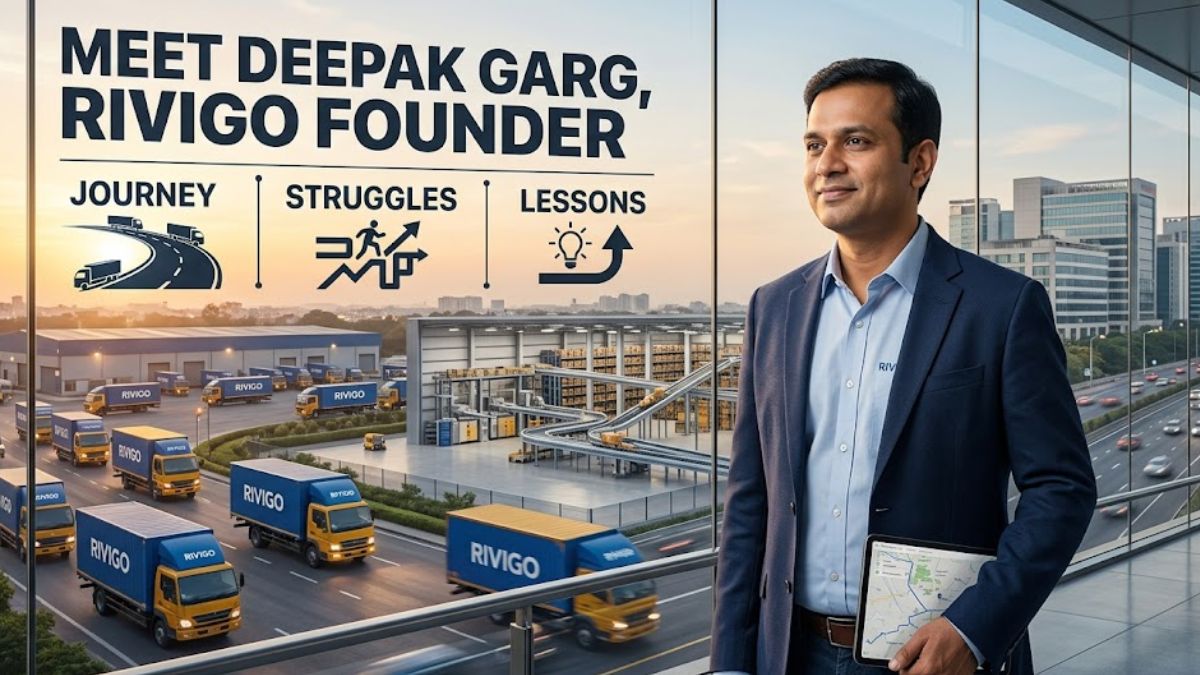
The story of the Rivigo founder Deepak Garg is closely tied to one of the most ambitious attempts to transform India’s logistics sector through technology and human-centric innovation. Deepak Garg co-founded Rivigo in 2014 with the vision of solving deep inefficiencies in the country’s long-haul trucking ecosystem. Headquartered in Gurugram, Rivigo set out to redefine how goods move across India by introducing a relay trucking model that focused on speed, reliability, and driver well-being. Before starting Rivigo, Deepak Garg worked at McKinsey & Company, where he was exposed to large-scale supply chain challenges across industries. During this time, he observed that India’s trucking sector suffered from long transit times, driver fatigue, low asset utilization, and fragmented operations. These inefficiencies were not just operational problems but systemic issues affecting the entire economy.
Rivigo’s approach was different. Instead of traditional long-haul trucking, it introduced a relay model where drivers would operate within fixed routes, handing over trucks at pit stops. This significantly reduced delivery time and improved driver quality of life. Over time, Rivigo also built a strong technology backbone with fleet management systems and real-time tracking.
The company raised funding from global investors including Warburg Pincus and SAIF Partners (now Elevation Capital), scaling rapidly across India. Rivigo became one of the most talked-about logistics startup India success stories, not just for its growth but for attempting to humanize an industry long ignored. This article explores the Rivigo founder journey, diving deep into Deepak Garg’s background, struggles, failures, leadership evolution, and the lessons he learned while building a company that aimed to change how India moves.
1. Background and Early Life
If you try to understand the journey of Deepak Garg, you have to go back to the kind of environment that shaped him long before Rivigo existed. His early years were not defined by shortcuts or sudden breakthroughs. They were defined by discipline, structure, and a constant push toward excellence. Getting into IIT Kanpur is not just about intelligence, it’s about persistence, consistency, and the ability to perform under pressure. That experience alone changes how you think. It forces you to break down problems, question assumptions, and look for solutions that actually work, not just sound good.
But what’s interesting is that he didn’t stop there. He went on to pursue an MBA from IIM Lucknow, and that combination quietly became one of his biggest strengths. Engineering gave him the ability to think logically and analytically. Management education added another layer, understanding people, markets, and decision-making under uncertainty. Together, they created a mindset that could handle both complexity and scale. These weren’t just degrees. They were experiences that trained him to operate in environments where stakes are high and answers are rarely straightforward.
Before stepping into entrepreneurship, Deepak Garg worked at McKinsey & Company, and this phase is often underestimated. Consulting is not just about presentations or strategy decks. It exposes you to real businesses, real inefficiencies, and real consequences of poor systems. You see how industries function from the inside, where they break, where they waste time, and where they lose money. For Garg, one of the most striking observations came from supply chains and logistics. These weren’t glamorous sectors, but they were critical. And more importantly, they were broken in ways that most people had simply accepted. That exposure planted a seed, one that would later turn into something much bigger.
2. Founder and Company Overview
2.1 Who is Deepak Garg
When people refer to Deepak Garg, they often focus on his role as a startup founder. But what really defines him is the kind of problem he chose to solve. At a time when many entrepreneurs were chasing consumer internet ideas, apps, marketplaces, and quick scalability, he went in a completely different direction. He chose logistics. A sector that is messy, operationally heavy, and anything but glamorous.
That choice says a lot about how he thinks. Logistics is not a space where you can rely on just ideas. It demands execution, patience, and a deep understanding of ground realities. It involves people, infrastructure, and systems that don’t change easily. By stepping into this space, Deepak Garg wasn’t just building a company. He was stepping into a problem that required long-term commitment and the willingness to deal with complexity every single day.
2.2 Company Overview and Offerings
Rivigo was built with a simple but powerful idea: make logistics more efficient by rethinking how it works from the ground up. Instead of treating it as a traditional trucking business, the company approached it as a technology-driven system. It focused on long-haul trucking, freight movement, and optimizing supply chains in a way that reduces delays and improves reliability.
The most defining innovation was the relay trucking model. On paper, it sounds straightforward. Instead of one driver covering an entire long-distance route, multiple drivers take shifts, handing over the truck at designated points. But the impact of this idea is profound. Trucks keep moving almost continuously, reducing idle time. Drivers don’t have to stay away from home for weeks, improving their quality of life. And clients receive goods faster and more predictably. This is what real innovation looks like. Not something flashy, but something that fundamentally improves how a system operates.
2.3 Year of Founding and Business Stage
Founded in 2014, Rivigo entered a market that was already massive but deeply inefficient. Scaling in such an environment is never easy. Unlike digital startups, where growth can sometimes be rapid and asset-light, logistics demands infrastructure, coordination, and capital. Yet, Rivigo managed to grow quickly in its early years, gaining recognition as one of the most innovative logistics startups in India.
What drove this growth was not just the idea, but the execution behind it. The company positioned itself not just as a service provider, but as a technology-first logistics player. This distinction mattered because it changed how clients perceived it. It wasn’t just moving goods. It was solving supply chain problems. And in industries like e-commerce, FMCG, and automotive, where delays can have cascading effects, that value became extremely important.
3. The Problem, Insight, and Trigger
India’s trucking industry is enormous, but if you look closely, it’s also deeply fragmented. Thousands of small operators, inconsistent systems, and a lack of standardization create inefficiencies at every level. Trucks often sit idle for long periods. Deliveries take longer than they should. And behind all of this are drivers who spend weeks, sometimes months, away from their families. The system works, but it doesn’t work well.
This is what Deepak Garg saw during his time at McKinsey & Company. He wasn’t just looking at numbers. He was seeing the human side of the problem. The fatigue of drivers, the inefficiency of routes, the wasted potential of assets that could be utilized better. And once you see a problem at that level of clarity, it’s hard to ignore it.
The real trigger came from a simple but powerful question: What if this system could be redesigned instead of just improved? Most people try to optimize existing systems. Garg wanted to rethink the system entirely. That’s where the relay trucking model was born. It wasn’t an incremental improvement. It was a structural change. And that’s what made it powerful.
4. Early Days and Initial Struggles
4.1 Entering a Complex Industry
Starting Rivigo was nothing like launching a typical startup. There was no easy entry point. The trucking industry in India is deeply rooted in traditional practices. People rely on what they know, and changing that requires more than just a good idea. It requires trust, patience, and relentless effort. Convincing stakeholders was one of the biggest challenges. Truck owners were used to operating in a certain way. Drivers had their own routines and expectations. Clients were cautious about trying something new. Every conversation required explanation, reassurance, and sometimes repeated effort. It wasn’t about selling a product. It was about changing mindsets. And that is always a slow, difficult process.
4.2 Execution Challenges
Even after gaining initial acceptance, the real challenge was execution. The relay model depended on infrastructure, pit stops, route planning, and precise coordination. It wasn’t enough to have the idea. It had to work consistently across different routes, different conditions, and different stakeholders. And in the early days, things rarely go as planned.
There were gaps, delays, and operational hurdles that had to be solved one by one. What looked elegant in theory became complex in practice. But this is where persistence matters. Deepak Garg and his team had to keep refining the system, learning from mistakes, and improving continuously. Over time, those small improvements added up. And slowly, the model started to prove itself, not just as an idea, but as a working system that could scale.
5. Failures, Setbacks, and Self-Doubt
Every startup story sounds clean in hindsight, but when you are inside it, nothing feels certain. The journey of Deepak Garg was no different. The relay trucking model looked powerful in theory, but scaling it across a country as vast and unpredictable as India was an entirely different challenge. Not every route behaved the same way. Some stretches worked beautifully, while others exposed gaps in planning, infrastructure, or coordination. What seemed like a repeatable system had to be constantly adjusted on the ground.
And then there was the financial pressure. Logistics is not forgiving. It demands capital at every stage, vehicles, infrastructure, people, technology. Money doesn’t just go into building the business once. It keeps going in, every single day. Managing this while trying to grow creates a constant tension. You want to expand, but every expansion comes with risk. You want to move fast, but the system forces you to be careful. In those moments, doubt is natural. You start questioning whether the model will truly work at scale, whether the effort will justify the cost, whether you are pushing in the right direction.
For Deepak Garg, these weren’t just operational problems. They were emotional battles. There are days when execution doesn’t match your expectations, when things break despite careful planning. And in those moments, conviction is tested. What keeps you going is not certainty, but belief, belief that the problem is worth solving, and that the solution, even if imperfect today, can be refined tomorrow.
6. Validation and Early Traction
In a journey filled with uncertainty, validation doesn’t come as a big announcement. It comes in small, quiet signals. For Rivigo, one of the earliest signs was something simple but powerful: deliveries started happening faster. Clients who had grown used to delays and unpredictability suddenly experienced consistency. Goods arrived on time, sometimes earlier than expected. And in logistics, that kind of reliability is not just appreciated, it’s valued deeply.
What made this validation stronger was repetition. Clients didn’t just try the service once. They came back. Repeat business is one of the most honest indicators that something is working. It means the value is real, not just perceived. At the same time, there was another layer of validation that mattered just as much, drivers. The relay model changed their lives in ways that are hard to quantify on a spreadsheet. Instead of being on the road for weeks, they could return home more frequently. That shift created a level of acceptance that no business strategy alone could achieve. When both sides of the system respond positively, customers and operators, you know you’re building something meaningful. For Deepak Garg, this dual validation was a turning point. It proved that the idea wasn’t just innovative on paper. It worked in the real world, where conditions are messy and unpredictable.
7. Funding, Money, and Growth Constraints
As Rivigo started to gain traction, funding became both an enabler and a responsibility. Backing from investors like Warburg Pincus and SAIF Partners brought in the capital needed to scale. It allowed the company to build infrastructure, expand operations, and invest in technology that could support its ambitious model.
But funding doesn’t remove pressure. In many ways, it increases it. Because now, there are expectations. Growth has to justify the capital. Every decision carries more weight. And in a business like logistics, where expenses are ongoing and significant, managing cash flow becomes a constant challenge. It’s not just about raising money. It’s about using it wisely, making sure that every investment contributes to long-term sustainability. There’s a delicate balance here. Grow too slowly, and you lose momentum. Grow too fast, and you risk burning through resources without building a stable foundation. For Deepak Garg, navigating this balance became a central part of the journey. It required discipline, patience, and the ability to say no to growth opportunities that didn’t align with long-term stability.
8. Team Building and Leadership Evolution
8.1 Hiring and Early Team
Building Rivigo was never a one-person effort. From the beginning, the challenge was to find people who could operate in a space that demanded both precision and adaptability. Logistics is not a clean, predictable environment. It requires people who can think on their feet, solve problems in real time, and stay calm when things go wrong.
At the same time, Rivigo was positioning itself as a technology-driven company. That meant hiring engineers, product thinkers, and data specialists who could build systems that scale. Finding individuals who could bridge these two worlds, operations and technology, was not easy. Early hiring decisions shaped not just the company’s capabilities, but its culture. The team had to believe in the mission, not just the job. Because in tough phases, it’s belief that keeps people going, not just incentives.
8.2 Leadership Learnings
As the company grew, Deepak Garg had to evolve as well. In the early days, founders are involved in everything. Every decision, every problem, every detail. But as the organization scales, that approach stops working. Delegation becomes necessary, not as a choice, but as a survival mechanism.
This shift is not easy. Letting go of control, trusting others to make decisions, and focusing on the bigger picture requires a different mindset. Leadership moves from execution to direction. From solving problems yourself to building systems where problems get solved without you. For Garg, this evolution was part of the journey. Learning when to step in and when to step back is one of the hardest lessons for any founder.
9. Growth, Scaling, and Operational Challenges
Scaling Rivigo was never just about increasing numbers. It was about making a complex system work consistently across different geographies, conditions, and stakeholders. Expanding the relay model meant building more pit stops, optimizing routes, and ensuring coordination at a level where even small errors could create large disruptions.
Every new route introduced new variables. Traffic patterns, road conditions, local regulations, driver availability, each factor had to be understood and managed. Infrastructure had to be built where none existed before. Systems had to be refined continuously. Scaling, in this context, was not a straight line. It was a series of adjustments, corrections, and improvements.
At the same time, the company had to define how it wanted to be seen. Rivigo was not just another trucking company. It positioned itself as a technology-first logistics player. This positioning mattered because it shaped how clients interacted with the brand. It signaled innovation, efficiency, and reliability.
The growth story of Rivigo is not just about expansion. It’s about the ability to scale without losing control. To grow while maintaining efficiency. And to keep improving a system that is inherently complex. That balance is what defines the difference between a company that grows and one that sustains that growth over time.
10. Personal Sacrifices and Burnout
Building something like Rivigo is not just a professional journey. It quietly becomes personal. In a sector like logistics, where operations run around the clock, there is no real “switch off.” Problems don’t wait for office hours. Trucks move at night, delays happen unexpectedly, and every disruption demands attention. For a founder like Deepak Garg, this means living in a constant state of awareness, always thinking about what could go wrong and how to fix it.
Over time, this takes a toll. Long hours turn into a routine. Weekends blur into weekdays. The mind rarely gets a break because even when you step away physically, the responsibility stays with you. Burnout in such environments doesn’t arrive suddenly. It builds quietly. It shows up as fatigue, as reduced clarity, as moments where even simple decisions feel heavier than they should. And yet, most founders push through it, not because it’s easy, but because they feel responsible for what they’ve started.
There’s also the personal side that often goes unnoticed. Time with family gets limited. Relationships require compromises. The balance between professional ambition and personal well-being becomes harder to maintain. While there may not be detailed public accounts of these struggles, it’s almost impossible to build something at this scale without making sacrifices. The reality is simple and difficult at the same time: behind every growing company, there is a founder carrying more than what is visible from the outside.
11. Lessons, Beliefs, and Values
If you look at the journey of Deepak Garg, the lessons don’t come from theory. They come from experience, from things that worked and things that didn’t. One of the strongest beliefs that stands out is the importance of solving real-world problems. Logistics was not a trending sector. It didn’t have the glamour of consumer apps or the excitement of viral growth. But it had depth. It had inefficiencies that affected the economy at a fundamental level. Choosing to work on such a problem requires a different kind of mindset.
Another key belief is in the power of technology, but with a very important nuance. Technology alone is not enough. You can build the most advanced systems, but if they don’t integrate well with real-world operations, they fail. Rivigo succeeded because it combined technology with execution. The relay model was not just a concept. It was implemented, tested, refined, and improved continuously. That’s where the real work happens.
Then there’s patience. In capital-intensive businesses, results don’t come quickly. You invest heavily before you see returns. You build infrastructure before you fully utilize it. You hire teams before everything is stable. This requires persistence. It requires the ability to stay committed even when progress feels slow. And finally, there’s a quiet but powerful value that runs through the journey: respect for the people who make the system work. Drivers, operators, teams on the ground. When their lives improve, the business improves. That understanding changes how you build.
12. Present Challenges and Future Vision
Today, Rivigo operates in an environment that is more competitive than ever. The logistics space is attracting new players, new technologies, and new expectations. Scaling remains a challenge, not just in terms of expansion, but in maintaining efficiency while growing. Costs have to be managed carefully. Operations have to remain consistent. And every new layer of growth adds complexity.
At the same time, the foundation built over the years gives the company a strong position. Its focus on supply chain technology, its understanding of ground realities, and its experience in execution create an advantage that is not easy to replicate. The vision going forward seems to be about becoming more than just a logistics provider. It’s about building a comprehensive platform that integrates technology, operations, and efficiency into a single system.
Looking ahead, the role of data and automation is only going to increase. Decisions will become more predictive. Systems will become more optimized. But at the heart of it, the core challenge remains the same: moving goods efficiently while maintaining reliability. If Rivigo can continue refining this balance, it has the potential to shape how logistics operates in India at a much larger scale.
About foundlanes.com
foundlanes.com is India’s leading startup idea discovery platform. It helps entrepreneurs find actionable startup opportunities, market insights, and industry-specific guidance to turn ideas into real businesses. With deep research and practical resources, foundlanes supports founders at every stage, from idea validation to launch and growth.