


Summary
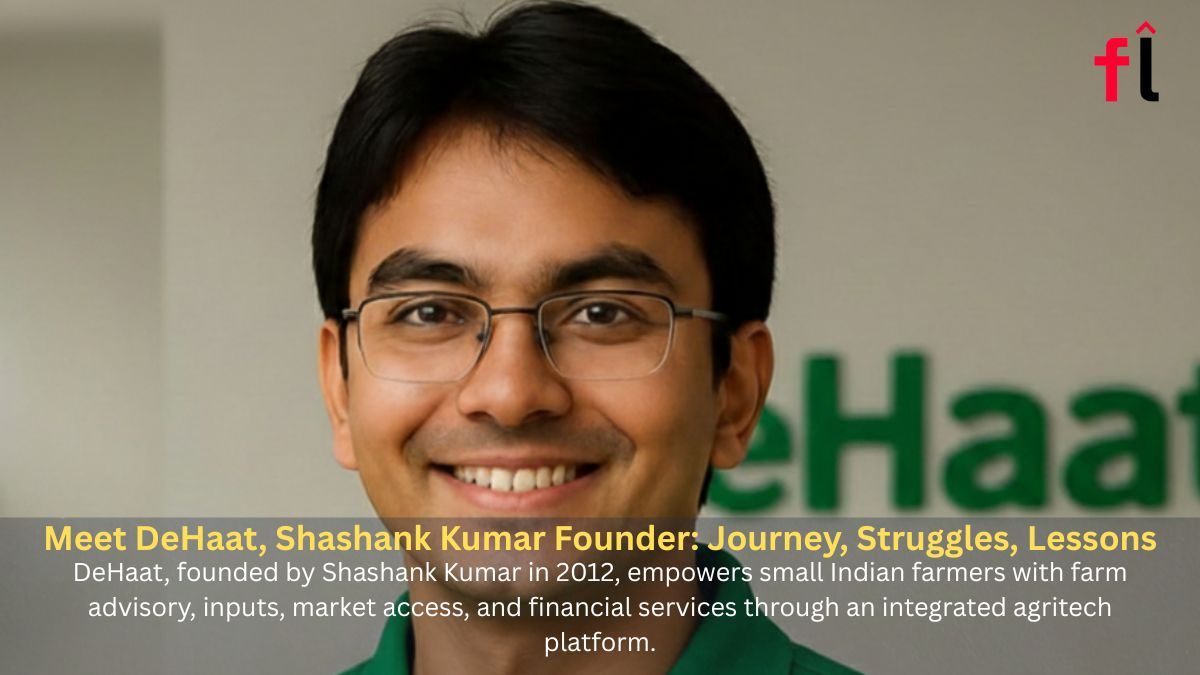
DeHaat is one of India’s most impactful agritech startups, co‑founded in 2012 to tackle the deep‑rooted inefficiencies in India’s agricultural value chain. At the heart of this transformation is DeHaat Shashank Kumar Founder, an entrepreneur from Chhapra, Bihar, who left a cushy management consulting career after graduating from the Indian Institute of Technology Delhi to build a platform that could empower smallholder farmers with modern agricultural services. DeHaat — meaning “the village” in Hindi — brought together farm advisory, quality input distribution, market access, financial services, and tailored supply‑chain support under one roof for farmers who had long been underserved.
Headquartered in Patna with corporate operations in Gurugram, DeHaat operates across more than a dozen states in India and has created a network of thousands of micro‑entrepreneurs and DeHaat Centers serving millions of farmers. Its model combines digital technology with local agent networks to deliver seeds, fertilizers, crop advisory, machinery, and market linkages directly to rural producers.
Over the past decade, the company has raised significant capital from marquee investors including Temasek, Prosus Ventures, Sofina, RTP Global, Sequoia India, and Lightrock, amounting to well over $220 million to date. DeHaat grew from a regional pilot in Bihar to a full‑stack agritech business with robust revenue momentum — its operating revenue exceeded ₹3,000 crore in FY25 and the company recorded net profits after years of reinvestment and scaling.
This story explores Shashank Kumar’s personal journey — from rural roots to IIT graduate to agritech founder — and the highs and lows of building a startup that seeks to reshape Indian agriculture. It delves into his early motivations, initial setbacks, strategic pivots, leadership lessons, and the ongoing challenges that DeHaat faces even as it charts an ambitious future.
1. Background and Early Life
Shashank Kumar grew up in a modest environment in Chhapra, a district in Bihar, surrounded by agricultural communities and firsthand exposure to the struggles of rural farming life. Unlike peers who pursued opportunities in urban centres, Kumar’s early life was shaped by the rhythms of rural India and the economic realities of farming families. This upbringing would later become more than just context — it became the emotional foundation of his entrepreneurial mission.
His early education was marked by dedication and academic excellence, a pathway that eventually led him to the Indian Institute of Technology Delhi, where he studied textile engineering and also pursued business‑oriented coursework. His time at IIT broadened his horizons and deepened his understanding of systems, data, and scalable problem‑solving — skills that would prove essential in building a tech‑enabled agritech platform years later.
After graduating in 2008, Kumar began his career in management consulting, working with supply‑chain and strategy projects across major companies. He saw firsthand how supply chains worked in urban and industrial contexts, yet he remained acutely aware of the complexities and inefficiencies plaguing India’s farm sector. This dual exposure — to structured corporate operations and rural hardship — shaped his world view and planted the seeds for his future venture. Though few details are publicly documented about his family life beyond this early narrative, it is clear that growing up near agricultural communities offered both empathy and insight into the problems DeHaat ultimately sought to solve. His roots in Bihar, a state with a high proportion of small‑scale farmers, informed his understanding of the economic, infrastructural, and informational barriers farmers faced — challenges that were both personal and systemic.
2. Founder and Company Overview
DeHaat was founded in 2012 by Shashank Kumar along with a group of co‑founders including Amrendra Singh, Shyam Sundar Singh, Adarsh Srivastav, and Abhishek Dokania. While Kumar served as the visionary force and CEO, the broader founding team brought together engineering and management alumni from prestigious institutions like IIT Delhi, IIT Kharagpur, IIM Ahmedabad, NIT Jamshedpur, and IIT Dhanbad.
The company began with a focus on structuring agricultural support services for India’s millions of smallholder farmers. At its core, DeHaat India offers a full‑stack agritech platform that integrates crop advisory, agri‑input distribution (seeds, fertilizers, pesticides), connections to financial services, digital farm advisory, and market linkages that allow farmers to sell produce directly to institutional buyers.
DeHaat’s target audience is primarily small and marginal farmers — those with less than two hectares of land — who historically lacked consistent access to quality inputs, technical advice, and transparent markets. The startup’s model bridges this gap by combining digital tools with a network of micro‑entrepreneurs and DeHaat Centers that operate physically close to farming communities, often within a few kilometres of rural households.
Since its launch, DeHaat has evolved from a pilot advisory service into a full‑stack agritech business, operating across multiple states, including Bihar, Uttar Pradesh, Odisha, Jharkhand, West Bengal, Maharashtra, Madhya Pradesh, Rajasthan and others. It serves millions of farmers through tens of thousands of micro‑entrepreneurs and digital channels, often integrating AI‑enhanced crop advisory and supply‑chain data to optimize outcomes. Over the past decade, DeHaat expanded beyond inputs and advisory into exports, branded products (like Honest Farms), and precision agritech services, pushing deeper into the rural ecosystem while maintaining an unwavering focus on farmer income and empowerment.
3. The Problem, Insight, and Trigger
Shashank Kumar’s insight into Indian agriculture stemmed from a personal understanding of rural challenges. Farmers across Bihar and other states faced inconsistent access to quality seeds, fertilizers, and crop protection products. Market linkages were opaque, leading to low margins, and advisory services were either nonexistent or unreliable. The inefficiencies in the supply chain often resulted in crop losses, lower yields, and financial instability for smallholder farmers. (economictimes.indiatimes.com)
Kumar observed that technology adoption in rural India was limited, despite the growing penetration of smartphones. While farmers could potentially benefit from digital platforms, solutions at the time were fragmented — some apps offered market price info, others sold inputs, and still others gave generic advice. No platform integrated inputs, advisory, finance, and market access in a cohesive ecosystem.
The trigger moment came during interactions with local farmers while traveling for consulting projects. Kumar realized that solving this problem at scale required combining digital tools with trusted human intermediaries. This approach would allow farmers to access timely guidance, quality inputs, and market information without the friction of existing rural supply chains. This insight became the foundation of DeHaat’s full-stack agritech model.
4. Early Days and Initial Struggles
DeHaat began as a small pilot in Bihar, with Kumar and his co-founders visiting villages to understand the pain points firsthand. Early assumptions about digital adoption were challenged immediately. Many farmers were skeptical of apps, distrusting digital advice or unfamiliar with smartphones. Kumar recalls that convincing farmers to try the platform required patience, repeated demonstrations, and tangible value in the form of free seeds or advisory sessions.
Operationally, the team faced logistical hurdles. Procuring high-quality inputs and delivering them to remote villages involved unreliable transport networks, local middlemen, and fragmented storage facilities. While the founders had planned to scale quickly, reality dictated slower, incremental growth. The team learned early that relationships with farmers and trust-building were more critical than rapid expansion.
Financial constraints compounded these challenges. Initial operations were bootstrapped, relying on personal savings and small seed capital. Every operational decision — hiring, inventory management, training — required careful resource allocation, and early revenue was insufficient to cover expanding costs. Despite these challenges, the team remained committed to the mission of empowering smallholder farmers. They iterated the model based on feedback, testing which inputs, advisory formats, and delivery schedules worked best. These early days were marked by long hours, on-field problem-solving, and hands-on experimentation, building both resilience and operational insight.
5. Failures, Setbacks, and Self-Doubt
The journey was far from linear. In the initial years, cash flow volatility was a persistent problem. Farmers sometimes delayed payments, seasonal demand fluctuated, and supply chain disruptions — such as delayed fertilizer shipments or poor-quality seeds — risked undermining credibility. Technical infrastructure also presented hurdles. Early attempts at integrating digital advisory with inventory management suffered from buggy apps, incomplete databases, and poor rural connectivity, causing delays and errors in service delivery. These setbacks often led to frustration within the founding team and moments of self-doubt, questioning whether a scalable solution was possible.
Shashank Kumar has spoken publicly about the emotional toll of these years. Traveling to remote villages, facing skeptical farmers, and juggling limited resources created a pressure cooker environment. Yet, these experiences also reinforced the importance of resilience, humility, and relentless iteration, shaping the founder’s philosophy for building a sustainable agritech business.
6. Validation and Early Traction
The first real validation came when farmers who initially resisted digital tools began reporting better yields and higher profits using DeHaat’s advisory and inputs. Word-of-mouth referrals grew organically as successful farmers shared their experiences with neighbors.
By 2014–2015, the platform began showing early revenue growth, enough to justify expanding to additional districts in Bihar. The team also noted that micro-entrepreneurs running DeHaat Centers were crucial to scaling trust and adoption. These agents acted as the face of the platform, providing in-person advisory, facilitating transactions, and serving as local problem-solvers.
The realization that combining digital efficiency with human trust created a scalable model was a turning point. Shashank Kumar and his team refined operational protocols, trained agents rigorously, and began rolling out structured programs for farmer engagement. Early successes in Bihar and subsequent expansion into Uttar Pradesh demonstrated proof-of-concept at scale, validating both the business model and the impact mission.
7. Funding, Money, and Growth Constraints
As DeHaat began showing traction in Bihar and Uttar Pradesh, the team faced the challenge of raising sufficient capital to scale operations while maintaining cash flow discipline. Early operations were bootstrapped, and every rupee had to be allocated carefully toward input procurement, agent incentives, and logistics. The capital-intensive nature of agri-tech — with inventory, distribution, and digital infrastructure — meant that growth was always constrained by available funds.
DeHaat’s first significant external funding came from angel investors who believed in the vision of transforming smallholder farming. Subsequent rounds included marquee investors like Sequoia India, RTP Global, Lightrock, Temasek, and Prosus Ventures, allowing the startup to scale beyond its initial districts. By 2020, cumulative funding crossed $220 million, enabling expansion into multiple states and the establishment of thousands of DeHaat Centers.
Despite investor support, the startup had to balance rapid geographic expansion with operational readiness. Overextending too quickly risked supply chain failures, poor service quality, and farmer attrition. Kumar often emphasizes that capital alone could not solve trust and operational bottlenecks, and that human-centric processes were critical to sustainable growth.
8. Team Building and Leadership Evolution
Building an effective team was one of the earliest and toughest challenges for Shashank Kumar. Initially, the founding team struggled with delegation and operational oversight. Recruiting capable managers who could navigate rural markets, understand agriculture, and implement technology solutions was difficult.
DeHaat’s first wave of employees often juggled multiple roles, from field operations to technology support, leading to burnout and mistakes. The company learned that hiring for both cultural fit and domain expertise was essential. Over time, structured training programs for agents and middle managers were developed, standardizing processes and aligning incentives across rural operations.
Leadership evolution involved Kumar moving from hands-on micro-management to strategic guidance, trusting regional managers and micro-entrepreneurs to execute while he focused on product strategy, investor relations, and long-term vision. His philosophy emphasizes mentorship, data-driven decision-making, and empathy for both employees and farmer partners.
9. Growth, Scaling, and Operational Challenges
DeHaat’s growth trajectory has been aggressive but deliberate. Scaling from a few pilot villages to tens of thousands of farmers required overcoming logistical, technological, and human resource challenges simultaneously.
One of the first hurdles was supply chain optimization. Ensuring timely delivery of seeds, fertilizers, and farm equipment to remote villages demanded partnerships with local transport providers, warehouse management, and real-time tracking. The team built a centralized digital platform to manage inventory, track orders, and predict demand, integrating analytics to reduce stockouts and waste.
Operational scaling also required training micro-entrepreneurs, who act as local touchpoints for the platform. These agents are trained in farm advisory, digital tools, and customer service. This model allows DeHaat to maintain high service quality across diverse geographies without overloading a central management team.
Brand positioning was equally critical. DeHaat needed to convince traditional farmers to trust a technology-driven platform. Marketing campaigns combined demonstrations, workshops, and success stories of improved yields, showing tangible results rather than abstract promises. This approach built credibility and fueled word-of-mouth adoption.
Kumar acknowledges that seasonal volatility and unpredictable weather patterns remain constant operational challenges. Operational decisions must factor in crop cycles, rainfall dependency, regional pest issues, and market price fluctuations, making planning complex. Yet, the blend of data analytics, field insights, and flexible operations has allowed DeHaat to navigate these uncertainties effectively.
10. Personal Sacrifices and Burnout
Building DeHaat demanded significant personal sacrifices from Shashank Kumar. The founder spent years traveling across villages, often in challenging conditions, balancing investor demands, employee oversight, and technological development. Long working hours and constant pressure to deliver tangible impact led to periods of burnout, a common experience among founders of mission-driven startups.
Kumar has spoken about the emotional intensity of witnessing farmers struggle despite interventions, which reinforced both urgency and stress. Maintaining personal relationships and work-life balance was difficult, and he often relied on the support of co-founders and a tight-knit core team to sustain focus.
Despite these pressures, Kumar’s commitment to his mission — improving farmer livelihoods and creating a scalable agritech model — served as a motivation anchor, guiding decisions through uncertainty and fatigue.
11. Lessons, Beliefs, and Values
Through the journey, Shashank Kumar distilled several core lessons that underpin DeHaat’s ethos:
- Trust and human relationships matter as much as technology. Farmers adopt tools when they trust the people behind them.
- Iterative problem-solving beats grand plans; learning from each village, season, and agent is critical.
- Sustainability requires balancing impact and profit; a platform that empowers farmers must remain financially viable.
- Local context is essential; Indian agriculture is diverse, and solutions must be customized for regions, crops, and cultural practices.
Kumar emphasizes non-negotiable values of integrity, transparency, and accountability, both internally with employees and externally with farmers. These principles shape hiring, partnerships, and operational decisions across DeHaat’s growing footprint.
12. Present Challenges and Current Leadership Philosophy
Even after scaling across multiple states and serving millions of farmers, DeHaat continues to navigate complex operational and market challenges. Rural India remains heterogeneous, with differences in language, crop cycles, soil quality, and local infrastructure. Ensuring consistent quality of service across regions requires constant training of micro-entrepreneurs, robust supply chain monitoring, and adaptive digital tools. Shashank Kumar’s leadership philosophy today reflects a balance between strategic oversight and empathy-driven management. He emphasizes data-informed decision-making while remaining deeply connected to the ground reality of farmers’ lives. By personally visiting DeHaat Centers and interacting with farmers, Kumar ensures that strategic plans are informed by real-world insights rather than purely desk-based analytics.
Another ongoing challenge is technology adoption. While smartphone penetration is increasing, many farmers still require simplified interfaces, local-language support, and offline capabilities. Integrating AI-driven advisory services with human support is central to overcoming these gaps, ensuring that digital tools enhance rather than replace human trust and relationships. Cash flow and working capital management remain operational priorities. The agritech model involves inventory-heavy operations, seasonal revenue cycles, and fluctuating market prices. Kumar and his executive team constantly optimize procurement, logistics, and pricing models to maintain both financial sustainability and service reliability.
13. Future Vision and Strategic Roadmap
Looking ahead, DeHaat aims to become the most trusted full-stack rural agritech platform in India, expanding both depth and breadth of services. The vision encompasses three primary dimensions:
- Geographic Expansion: DeHaat plans to deepen its presence in tier-2 and tier-3 states, bringing modern agri-services to farmers who remain underserved. Customized regional strategies, local-language interfaces, and crop-specific advisory modules will drive adoption.
- Technology and Data Integration: Investment in AI and analytics will enable predictive crop advisory, precision farming insights, and market demand forecasting. By using data to optimize planting schedules, input usage, and sales, DeHaat can increase farmer yields while reducing risk.
- Diversification of Services: Beyond seeds, fertilizers, and advisory, DeHaat intends to expand into crop insurance, finance, exports, and branded products. Initiatives like “Honest Farms” demonstrate the company’s ambition to integrate smallholder farmers into high-value markets while retaining profitability.
Kumar’s philosophy emphasizes mission-aligned growth over rapid but unsustainable scaling. While capital from investors provides resources, he prioritizes impact measurement, farmer income improvement, and trust-building as benchmarks of success.
14. Ongoing Founder Insights and Obsessed Problems
Even after a decade, Shashank Kumar remains personally obsessed with solving structural inefficiencies in Indian agriculture. His focus extends to optimizing the supply chain, increasing adoption of technology, and empowering micro-entrepreneurs who form the backbone of DeHaat’s distribution network. He frequently highlights that the real measure of success is whether smallholder farmers see tangible improvements in income, yields, and resilience. This farmer-centric view informs decisions from product development to market expansion.
Kumar also emphasizes leadership lessons learned through adversity: resilience in the face of failure, patience with slow adoption cycles, and the importance of keeping purpose at the center of operational and strategic decisions. These principles guide DeHaat’s ongoing evolution as both a business and a social impact platform.
15. Legacy and Sectoral Impact
DeHaat’s journey under Shashank Kumar exemplifies the intersection of entrepreneurship, technology, and social impact. The company has demonstrated that scalable agritech solutions are feasible when digital tools, human trust, and operational rigor are integrated. The startup has inspired a generation of Indian agritech entrepreneurs, showing that solving real-world challenges in agriculture can be both financially viable and socially transformative. Its success highlights the potential of technology-enabled rural platforms to address systemic gaps in input access, market linkages, and advisory services. By institutionalizing processes for training, data analytics, and supply-chain management, DeHaat has created a replicable model that can scale to other states, crops, and even countries with similar challenges.
16. Conclusion and Future Outlook
As DeHaat continues its mission, Shashank Kumar envisions a future where every smallholder farmer in India has access to reliable inputs, actionable advice, and fair market access. The focus remains on integrating technology, human networks, and operational excellence to create measurable impact.
The next decade may see DeHaat expanding into financial services, precision farming, and international markets, while remaining committed to the principle that profit and social impact must grow hand in hand. Kumar’s story — from rural Bihar to founding one of India’s leading agritech startups — illustrates the resilience, vision, and empathy required to transform complex, fragmented sectors.
DeHaat’s journey underscores that successful entrepreneurship in India is not just about innovation but also about deep understanding of societal needs, operational execution, and long-term trust-building. It is this combination that will determine how the startup continues to scale, serve, and inspire in the years to come.
About foundlanes.com
foundlanes.com is India’s leading startup idea discovery platform. It helps entrepreneurs find actionable startup opportunities, market insights, and industry-specific guidance to turn ideas into real businesses. With deep research and practical resources, foundlanes supports founders at every stage, from idea validation to launch and growth.