


Summary
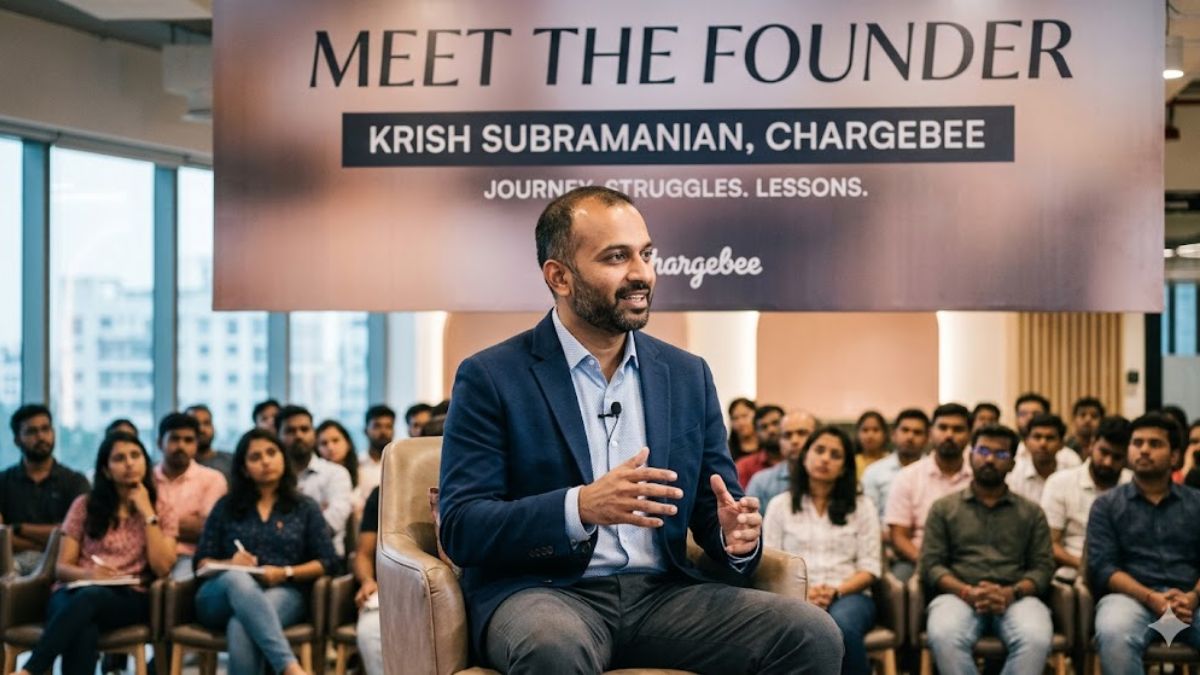
The story of Krish Subramanian Chargebee founder is one of persistence, experimentation, and building a global technology company from India at a time when the country’s SaaS ecosystem was still evolving. Krish Subramanian is the co-founder and CEO of Chargebee, a subscription billing and revenue management platform used by thousands of companies across the world. Founded in 2011 in Chennai, Chargebee has grown into one of India’s most successful SaaS companies, helping businesses manage recurring billing, subscriptions, payments, and revenue operations.
Krish Subramanian, along with co-founders Thiyagu Srinivasan and Raja Hammoud, started Chargebee with a clear objective. They wanted to solve a problem that many subscription-based companies faced but few were addressing effectively. At the time, the global shift toward subscription models was accelerating, especially among SaaS startups. However, managing recurring billing, taxes, invoicing, and payment integrations across multiple countries was complex.
Before launching Chargebee
Before launching Chargebee, Krish had already experienced the realities of startup life. He had co-founded a product startup called ChargeBee’s precursor, which initially struggled to find product-market fit. Those early struggles helped him understand the importance of solving a real customer problem and building a product that businesses genuinely needed. What makes the Krish Subramanian startup journey particularly interesting is how he helped build a global SaaS company from India long before the current SaaS boom. Chargebee eventually became one of the leading subscription management platforms worldwide and raised significant venture funding from global investors such as Insight Partners and Tiger Global.
Today, Chargebee serves thousands of businesses, including SaaS startups, e-commerce brands, and digital service providers across more than 50 countries. The company’s growth mirrors the rise of India’s SaaS ecosystem and highlights how Indian entrepreneurs are increasingly building global software products.b The Krish Subramanian founder story offers valuable lessons about persistence, learning from early failures, building strong teams, and focusing deeply on customer problems. It also shows how Indian SaaS entrepreneurs are shaping the global technology landscape.
1. Background and Early Life
Understanding the journey of the Krish Subramanian Chargebee founder requires looking at the environment and influences that shaped him early on. Like many successful entrepreneurs in the Indian technology ecosystem, his path toward entrepreneurship was not linear. Instead, it evolved through education, curiosity about technology, and exposure to early startup experiences.
1.1 Early Life and Family Background
Krish Subramanian grew up in India during a period when the country’s technology industry was just beginning to take shape. The late 1990s and early 2000s were a defining time for India’s IT services boom. Companies like Infosys and TCS were expanding globally, and technology careers were becoming increasingly attractive. While much of the global startup ecosystem was concentrated in Silicon Valley, India was slowly building its own technology talent pool. This environment influenced many young engineers, including Krish Subramanian. Although detailed public information about his family background remains limited, it is clear that education and technology played a significant role in shaping his early ambitions. Like many aspiring engineers of his generation, he gravitated toward computer science and software development.
1.2 Education and Early Influences
Krish Subramanian pursued engineering studies in India and developed a strong interest in software and product development. During this time, he became deeply interested in how technology products are built and scaled. His education exposed him to programming, systems design, and software architecture. But beyond technical knowledge, it also helped him understand the broader possibilities of technology entrepreneurship. The early 2000s saw the rise of global internet companies and the beginnings of the SaaS revolution. Software was gradually moving from traditional licensing models to cloud-based subscription services.
This shift fascinated many engineers and product thinkers. For Krish Subramanian, it planted the seeds for what would eventually become Chargebee. At the same time, India’s startup ecosystem was still small. Unlike today’s vibrant startup culture, there were relatively few role models or startup founders in the country. This made entrepreneurship seem risky and uncertain. Yet for individuals like Krish, that uncertainty also represented opportunity.
2. Founder and Company Overview
The Krish Subramanian founder story is closely tied to the evolution of Chargebee itself. The company’s growth reflects not only the vision of its founders but also the global shift toward subscription-based digital services.
2.1 Introduction to the Founder
Krish Subramanian is widely recognized today as one of the prominent Indian SaaS entrepreneurs who helped put India on the global SaaS map. As the CEO and co-founder of Chargebee, he has been instrumental in building the company’s strategy, product vision, and international expansion. Before founding Chargebee, Krish had already experimented with building products and startups. These early experiences helped him understand the realities of entrepreneurship, including the importance of product-market fit and customer feedback. The Krish Subramanian entrepreneur journey is often cited among technology startup success stories emerging from India’s SaaS ecosystem.
2.2 Company Overview and Offerings
Chargebee is a subscription management and recurring billing platform designed for modern businesses. The platform helps companies automate subscription billing, invoicing, revenue recognition, and payment workflows. The Chargebee SaaS platform provides tools that allow businesses to manage the complexities of subscription-based revenue models.
Chargebee’s core product offerings include:
- Subscription lifecycle management
- Automated billing and invoicing
- Payment gateway integrations
- Revenue recognition and accounting automation
- Analytics and subscription metrics
These capabilities make Chargebee particularly valuable for companies operating subscription-based business models. The Chargebee subscription billing software is widely used by SaaS startups, digital service companies, e-commerce brands, and media platforms.
2.3 Target Audience and Market Served
Chargebee primarily serves businesses that operate on recurring revenue models. These companies include:
- SaaS startups and software companies
- Digital product businesses
- Subscription-based e-commerce brands
- Media and streaming services
As the global subscription economy expanded, the demand for platforms like Chargebee increased significantly. Businesses needed reliable infrastructure to manage subscriptions, payments, taxation, and revenue operations across multiple countries. Chargebee positioned itself as a flexible platform capable of serving both startups and large enterprises.
2.4 Year of Founding and Business Stage
Chargebee was founded in 2011 in Chennai, India. At the time, India’s SaaS ecosystem was still in its early stages. Today, the company is widely recognized among global SaaS companies and has raised substantial venture capital funding. Chargebee also joined the league of SaaS unicorn startups, becoming one of the most notable Indian unicorn founders success stories in the technology sector. The growth of Chargebee reflects the broader rise of SaaS startups in India, many of which are now building global products from Indian cities.
3. The Problem, Insight, and the Moment It All Began
Great companies rarely start with a random idea. More often, they begin with a deep frustration that someone refuses to ignore. That was exactly the case with Krish Subramanian and the team behind Chargebee. The idea did not arrive as a sudden spark of inspiration. It slowly formed through years of observing how businesses struggled with one specific operational problem that most people outside the industry rarely noticed.
3.1 The Core Problem They Could Not Ignore
As subscription-based businesses began gaining popularity across the global software industry, one challenge kept appearing again and again: managing recurring billing was painfully complicated. At first glance, subscription billing sounds simple. Charge a customer every month or every year. But once companies started scaling, the reality became far messier.
Businesses had to manage:
- Automated billing cycles
- Payment failures and retries
- Global tax regulations
- Currency conversions
- Invoicing and financial reporting
- Plan upgrades, downgrades, and cancellations
Many companies tried to handle these issues with spreadsheets or multiple disconnected software tools. As the customer base grew, so did the chaos. Billing errors increased. Finance teams spent hours fixing manual mistakes. Revenue tracking became unreliable. The founders saw this inefficiency everywhere. It was clear that subscription businesses were growing faster than the infrastructure supporting them. That realization became the foundation for Chargebee’s product. The goal was simple but powerful: build a single platform that could handle the entire lifecycle of subscription billing without the operational headache.
3.2 The Personal Insight That Sparked the Idea
The founders were not outsiders observing a problem from a distance. They had already spent years building software products and interacting with businesses trying to scale globally. Through that experience, they repeatedly encountered the same pain point. Billing infrastructure was often treated as a technical afterthought. Yet it sat at the center of every company’s revenue engine. The more they looked into it, the more obvious the opportunity became. Subscription models were rapidly replacing traditional one-time software purchases. Companies were shifting toward recurring revenue, which promised stability and predictable growth.
But the tools supporting this shift were still limited and fragmented. Krish Subramanian and his co-founders began asking a simple question: What if subscription billing could be as easy as launching a product? That question slowly turned into a vision. Instead of companies struggling with dozens of operational tasks, a platform could automate the complexity behind the scenes. That vision eventually became Chargebee.
3.3 The Trigger That Pushed Them to Build
There is often a moment when an idea stops being a thought experiment and becomes a commitment. For the Chargebee founders, that moment arrived when they saw how quickly the subscription economy was expanding across the global SaaS industry. Software companies were abandoning traditional licensing models. Instead of paying once for software, customers were paying monthly or annually for continuous access and updates.
The shift was massive. Yet despite the growth of subscription businesses, the infrastructure supporting them remained underdeveloped. Companies were improvising solutions that were not designed to scale. The founders recognized a rare opportunity. If they could build a reliable subscription management platform early enough, it could become an essential layer of the global SaaS ecosystem. That realization was the turning point. It marked the real beginning of the entrepreneurial journey for Krish Subramanian and his team.
4. Early Days and the Struggles No One Talks About
Looking back today, Chargebee’s growth story appears impressive. But in the early days, nothing about the journey felt predictable or secure. Like most startups, the beginning was filled with uncertainty, experimentation, and countless moments where the founders had to rely on belief more than evidence.
4.1 Early Assumptions That Didn’t Hold Up
One of the biggest lessons the founders learned early on was that building a great product is not the same as building a successful company. Coming from strong technical backgrounds, the team believed that if they built a powerful billing platform, businesses would naturally start using it. Reality proved far more complicated.
Selling software to international companies required much more than product quality. It required:
- Trust
- Clear positioning
- Marketing strategy
- Customer education
- Sales processes
For a young SaaS startup operating from India, breaking into global markets was especially challenging. Many potential customers had never heard of the company. Convincing them to trust a critical financial system to a new platform required patience and persistence.
4.2 The Real Entrepreneurial Struggles
In the early days, resources were limited. Every decision mattered.
The founders had to balance several priorities at once:
- Continuing product development
- Supporting early customers
- Building brand credibility
- Managing cash flow
Meanwhile, competitors in international markets already had brand recognition and established customer bases. Chargebee had to compete not just on features, but also on reliability and trust. Every new customer was hard-earned. But each success helped the team gain confidence that they were moving in the right direction.
4.3 The Unexpected Challenge of Product-Market Fit
Perhaps the most humbling lesson during this phase was how difficult product-market fit can be. The founders knew the problem existed. They had seen companies struggle with billing infrastructure. But transforming that insight into a product that customers truly loved required constant iteration. Early users shared feedback that forced the team to rethink parts of the platform.
Features needed adjustments. Workflows had to be simplified. Integration capabilities had to expand. Instead of defending their original ideas, the founders listened carefully to customer feedback. Each iteration made the product stronger. Over time, the platform began to evolve into something businesses genuinely relied on. The journey taught them one of the most important truths about building SaaS products: success rarely comes from the first version of an idea. It emerges from continuous learning and improvement.
5. Failures, Setbacks, and the Emotional Weight of Entrepreneurship
From the outside, startup success stories often look like a straight line from idea to victory. In reality, the path is rarely smooth. The journey of Krish Subramanian and Chargebee was filled with difficult moments that tested both strategy and emotional resilience.
5.1 The Toughest Phase
One of the most challenging periods came when the company was still trying to secure its place in the global SaaS market. Billing systems are deeply embedded in a company’s financial operations. Once a business sets up a billing infrastructure, changing it becomes risky and complicated. That made customer acquisition slow.
Even when companies liked the platform, switching from existing systems required significant effort. For a young startup, waiting months to close deals could feel discouraging. During this phase, the founders had to rethink how they positioned the product and communicated its value.
5.2 Early Setbacks and Hard Lessons
The team also discovered that building billing software was far more complex than it initially seemed.
Every new feature introduced layers of technical complexity. The platform had to handle:
- Different tax structures across countries
- Multiple payment gateways
- Compliance requirements
- Secure financial reporting
Even small mistakes in billing systems could have serious consequences for customers. Solving these challenges required deep technical expertise and relentless attention to detail. Progress sometimes felt slower than expected, but every improvement strengthened the product.
5.3 Moments of Self-Doubt
Behind every startup milestone are moments that never appear in press releases. There were times when the founders questioned their decisions. The SaaS market was competitive, and many companies were building tools for subscription businesses. Entrepreneurship can also be lonely. Founders carry the responsibility of employees, customers, and investors. During difficult phases, the pressure can feel overwhelming.
Krish Subramanian has often spoken about how important resilience becomes during these periods. Confidence does not come from ignoring challenges. It comes from continuing to move forward despite uncertainty. In many ways, these struggles shaped the company more than its early wins. They forced the founders to sharpen their strategy, strengthen their product, and stay deeply focused on customer needs. And over time, that persistence began to pay off.
6. Validation and Early Traction
Every startup reaches a moment when uncertainty slowly begins to turn into belief. For Krish Subramanian and the team behind Chargebee, that moment came not through a single breakthrough but through a series of small yet meaningful signals from the market. In the beginning, the founders were working largely on conviction. They believed businesses needed better tools to manage subscription billing. But belief alone is never enough in entrepreneurship. What truly matters is whether customers see the same value.
6.1 The First Real Validation
The first real validation came when early SaaS companies began using Chargebee for their subscription billing operations. These were not large corporations with huge budgets. Most were startups themselves, navigating the same chaotic subscription management problems the founders had observed earlier. These early customers were crucial. They did not just use the product. challenged it.
They pointed out what worked, what was confusing, and what needed improvement. Sometimes their feedback was blunt, but it was exactly what the team needed. Every conversation revealed something new about how subscription businesses actually operated in the real world. For the founders, each successful billing cycle processed through the platform felt like a small victory. It meant the software was not just theoretical. It was being trusted to handle real revenue.
6.2 Early Revenue and the Power of Customer Conversations
Revenue in the early days was modest. There were no massive contracts or sudden spikes in income. Growth came slowly, one customer at a time. Yet those early payments meant everything. Each company that decided to pay for Chargebee was essentially confirming that the problem was serious enough for them to invest in a solution. For the founders, that validation mattered far more than vanity metrics like downloads or signups. Even more valuable was the feedback those customers provided. The founders began to understand that product development should not happen in isolation. The most important insights were coming directly from users trying to run their businesses.
So the team built a habit of listening carefully. Instead of guessing what features customers wanted, they asked questions, observed how businesses used the platform, and refined the product accordingly. This constant feedback loop became one of Chargebee’s greatest strengths. It allowed the platform to evolve quickly while staying closely aligned with real customer needs.
6.3 The Moment the Vision Became Bigger
As more international SaaS companies started adopting the platform, something shifted in the founders’ mindset. Until that point, Chargebee could still have been viewed as a niche billing tool. But when customers from different countries and industries began using the product, the team realized they were building something much more significant.
They were building infrastructure for the global subscription economy. This realization changed the level of ambition inside the company. The focus moved beyond solving individual billing problems toward building a platform capable of supporting thousands of subscription businesses worldwide. It was a powerful moment. The early uncertainty had not disappeared completely, but the direction was now clearer than ever.
7. Funding, Money, and the Reality of Growth
While early traction gave the team confidence, building a global SaaS company required more than belief and customer enthusiasm. Scaling a platform like Chargebee demanded serious investment in technology, people, and infrastructure. Managing money wisely became one of the most important parts of the journey.
7.1 The Discipline of Bootstrapping
In the beginning, Chargebee operated largely as a bootstrapped startup. The founders relied heavily on their own resources and the revenue generated from early customers. Bootstrapping forces founders to think differently. There is no room for wasteful spending or vanity projects. Every hiring decision must be justified. Every product feature must serve a real purpose. Growth happens carefully rather than recklessly.
While this approach sometimes slowed expansion, it also helped the company develop strong financial discipline. The team learned how to prioritize effectively and focus only on initiatives that truly mattered. Those early habits later proved extremely valuable when the company began scaling rapidly.
7.2 Investor Support and the Path to Unicorn Status
As Chargebee’s product matured and its customer base expanded globally, investors began paying attention. The rise of SaaS businesses around the world had created enormous demand for infrastructure platforms that could support subscription models. Chargebee was emerging as a strong contender in that space. Eventually, the company secured funding from major venture capital firms including Accel, Insight Partners, and Tiger Global Management.
These investments gave the company the resources to expand its engineering capabilities, improve its product, and strengthen its international presence. Over time, this growth helped Chargebee achieve unicorn status, placing it among the most successful SaaS companies to emerge from India. But funding did not eliminate challenges. If anything, it raised the expectations even higher.
7.3 Managing Growth Without Losing Control
SaaS businesses often require heavy upfront investment. Building reliable infrastructure, maintaining global payment integrations, and supporting customers across multiple time zones all require significant resources. At the same time, revenue in subscription businesses accumulates gradually. Unlike traditional sales models where companies receive large payments upfront, subscription income grows month by month.
This dynamic creates constant pressure to balance investment with sustainability. Krish Subramanian and his team had to ensure that expansion remained responsible. Growth had to be ambitious, but it also had to be financially sound. Striking that balance became one of the defining leadership challenges during Chargebee’s scaling phase.
8. Team Building and the Evolution of Leadership
No startup grows because of a single founder. Behind every successful company is a group of people who believe in the mission and work relentlessly to bring it to life. For Chargebee, building that team was one of the most important and sometimes difficult parts of the journey.
8.1 Early Hiring Lessons
Like many founders, Krish Subramanian initially focused heavily on technical skills while hiring. Engineers with strong coding abilities were essential for building a complex SaaS platform. But over time, the team realized something important. Technical talent alone was not enough. Startups operate in unpredictable environments. Plans change quickly, priorities shift, and challenges appear without warning. The people who succeed in such environments are those who are adaptable, curious, and willing to solve problems creatively. Cultural alignment began to matter just as much as technical expertise. The company started prioritizing individuals who believed in the long-term vision and were comfortable navigating uncertainty.
8.2 The Challenge of Letting Go
In the early days, founders naturally involve themselves in everything. Product design, customer calls, marketing decisions, hiring interviews, operational details. Everything runs through them. For Krish Subramanian, this hands-on involvement was necessary at first. But as Chargebee grew, it became clear that this approach would not scale. Learning to delegate responsibilities was not easy. Letting go of certain decisions required trust. But empowering capable leaders within the company allowed the organization to grow faster and operate more efficiently. Delegation did not weaken leadership. In many ways, it strengthened it.
8.3 Leadership That Evolves With the Company
As Chargebee matured, Krish Subramanian’s role evolved significantly. Instead of focusing primarily on product features, he began concentrating on broader strategic priorities such as company culture, global expansion, and long-term vision. Building a strong leadership team became essential. Different leaders took responsibility for engineering, operations, customer success, and international growth.
Today, Chargebee operates with a global workforce and a leadership structure designed to support international markets. The transformation reflects how leadership itself evolves as companies move from startup phase to global organization.
9. Growth, Scaling, and the Complex Reality of Expansion
Scaling a startup introduces a completely new set of challenges. What worked for a small team serving a few customers rarely works for a company managing thousands of businesses across the world. Chargebee had to continuously adapt as it grew.
9.1 Learning the Importance of Clear Positioning
One of the early lessons during Chargebee’s growth phase involved how the company communicated its value. Initially, the platform was often described simply as billing software. But as the founders listened to customers, they realized that businesses were using the platform for much more than billing. Companies were managing pricing models, tracking revenue metrics, analyzing subscription performance, and handling customer lifecycle events.
So the company refined its positioning. Instead of presenting itself as a billing tool, Chargebee began positioning itself as a subscription management and revenue operations platform. This broader identity helped attract a wider range of businesses and allowed the company to compete more effectively in the global SaaS ecosystem.
9.2 The Technical Demands of Scaling
Growth also brought technical complexity. As more businesses adopted the platform, the number of transactions processed through Chargebee increased dramatically. The system had to handle payments across multiple gateways, currencies, and regulatory environments. Reliability became critical.
If a billing platform fails even briefly, it can disrupt the revenue flow of hundreds or thousands of companies. The engineering team had to invest heavily in building robust infrastructure capable of handling global scale. This meant constant upgrades, improved security measures, and sophisticated monitoring systems.
9.3 Fixing Operational Gaps
Rapid growth often exposes weaknesses within an organization. Chargebee experienced this as well. As the customer base expanded, issues began to appear in areas like onboarding processes, customer support response times, and internal coordination. Instead of ignoring these problems, the leadership team addressed them directly.
New systems were introduced to streamline operations. Dedicated customer success teams were created to help businesses get the most out of the platform. Support infrastructure was expanded to ensure users received timely assistance. These improvements were not always glamorous, but they were essential. Operational discipline became one of the key reasons Chargebee was able to sustain long-term growth in a competitive SaaS market.
10. Personal Sacrifices and Burnout
Behind every startup success story lies a long period of personal sacrifice. The Krish Subramanian Chargebee founder journey was no different. Building a global SaaS company demanded intense focus, long working hours, and constant decision-making under pressure.
Entrepreneurship, especially in the early stages, often blurs the boundaries between personal life and professional responsibilities. For Krish Subramanian and his co-founders, Chargebee became the central focus of their lives for many years.
10.1 Personal Costs of Entrepreneurship
Running a startup involves significant emotional and personal investment. During Chargebee’s early years, the founders had to dedicate most of their time to product development, customer conversations, and operational decisions. This level of commitment inevitably affected personal routines and work-life balance. Late nights, constant travel, and ongoing problem-solving became a regular part of life. For many successful startup founders in India, this trade-off is an unavoidable part of building something meaningful. Entrepreneurs often prioritize long-term vision over short-term comfort. Krish Subramanian’s experience reflects this reality.
10.2 Burnout Phases and Emotional Pressure
Startup founders frequently encounter phases of mental exhaustion and emotional strain. For Krish Subramanian, the pressure of scaling a global SaaS company sometimes created moments of burnout. Leading a rapidly growing organization requires managing multiple responsibilities simultaneously. Product decisions, investor expectations, employee morale, and customer satisfaction all demand attention. During periods of intense growth, these pressures can accumulate quickly. The Krish Subramanian startup journey shows how founders must develop emotional resilience to navigate such challenges. Burnout is not uncommon among top Indian tech entrepreneurs, especially those building companies in competitive global markets.
10.3 Impact on Personal Life
As Chargebee expanded internationally, the demands on leadership increased. Travel to global markets, investor meetings, and strategic planning consumed large amounts of time. Like many founders building global SaaS companies, Krish Subramanian had to balance professional responsibilities with personal commitments. While entrepreneurship brings excitement and purpose, it can also create distance from personal routines and social life. Over time, many founders learn the importance of building support systems and maintaining mental well-being alongside professional success.
11. Lessons, Beliefs, and Values
The Krish Subramanian founder story offers several lessons for entrepreneurs, especially those building technology startups from India. His journey demonstrates how persistence, curiosity, and customer focus can shape long-term success. Over the years, Krish Subramanian has shared insights about entrepreneurship, leadership, and building global products from India.
11.1 Core Lessons Learned
One of the biggest lessons from the Krish Subramanian entrepreneur journey is the importance of solving real customer problems. Many startups fail because they focus on building technology without understanding actual user needs. Chargebee’s success came from deeply understanding the challenges faced by subscription-based businesses. By building tools that addressed these challenges directly, the company created lasting value for customers. Another important lesson involves patience. Building a SaaS company takes time. Unlike consumer apps that can grow quickly, enterprise software businesses often scale gradually as customers adopt and trust the product.
11.2 Beliefs That Changed Over Time
In the early days, Krish Subramanian believed that strong engineering and product development would automatically lead to success. However, the journey of building Chargebee revealed that distribution, marketing, and customer relationships are equally important. This realization changed how the company approached growth. The founders invested more effort in customer success, partnerships, and global market expansion. These strategies helped Chargebee evolve from a small startup into one of the most recognized SaaS company founders success stories from India.
11.3 Non-Negotiable Values
Throughout the growth of Chargebee, certain values remained central to the company’s culture. Customer trust became one of the most important priorities. Billing systems are critical infrastructure for businesses, so reliability and transparency are essential. Another core value was continuous learning. The Krish Subramanian success story shows how entrepreneurs must remain open to feedback and willing to adapt their strategies over time. Finally, long-term thinking played a major role in Chargebee’s growth. Rather than focusing only on short-term revenue, the company prioritized building a platform that could support the evolving subscription economy.
12. Present Challenges and Future Vision
Even after achieving significant success, the journey of the Krish Subramanian Chargebee founder is far from complete. Building and scaling a global SaaS company brings new challenges at every stage. Today, Chargebee operates in an increasingly competitive environment where many companies are developing tools for subscription management and revenue operations.
12.1 Ongoing Struggles Today
One of the biggest challenges facing Chargebee today is maintaining innovation while scaling operations globally. As the subscription economy grows, customer expectations continue to rise. Businesses now demand advanced analytics, seamless integrations, and automated revenue workflows. Meeting these expectations requires continuous product development and technical investment. For SaaS startups in India, competing on a global stage means maintaining world-class product quality and customer support. Chargebee’s leadership continues to focus on these priorities.
12.2 Current Leadership Philosophy
Krish Subramanian’s leadership philosophy has evolved significantly since the company’s early days. Today, he emphasizes building strong teams and empowering leaders across the organization. Instead of making every decision personally, he focuses on enabling teams to experiment, innovate, and take ownership of their work. This approach allows Chargebee to scale effectively while maintaining agility. The Krish Subramanian founder story reflects how leadership evolves alongside company growth.
12.3 Long-Term Vision
The long-term vision for Chargebee centers on becoming a comprehensive platform for subscription and revenue management. The global subscription economy continues to expand across industries such as software, e-commerce, media, and digital services. Businesses increasingly rely on recurring revenue models, making platforms like Chargebee essential infrastructure. Krish Subramanian remains deeply interested in solving the complexities of subscription billing, payments, and revenue operations.
This ongoing focus keeps the Krish Subramanian Chargebee founder journey aligned with the evolving needs of modern digital businesses. The company’s growth also represents a broader shift in India’s technology ecosystem. Today, Indian entrepreneurs are building global SaaS companies that compete successfully in international markets. The rise of Chargebee highlights the potential of Indian SaaS entrepreneurs to shape the future of the global technology industry.
About foundlanes.com
foundlanes.com is India’s leading startup idea discovery platform. It helps entrepreneurs find actionable startup opportunities, market insights, and industry-specific guidance to turn ideas into real businesses. With deep research and practical resources, foundlanes supports founders at every stage, from idea validation to launch and growth.