


Summary
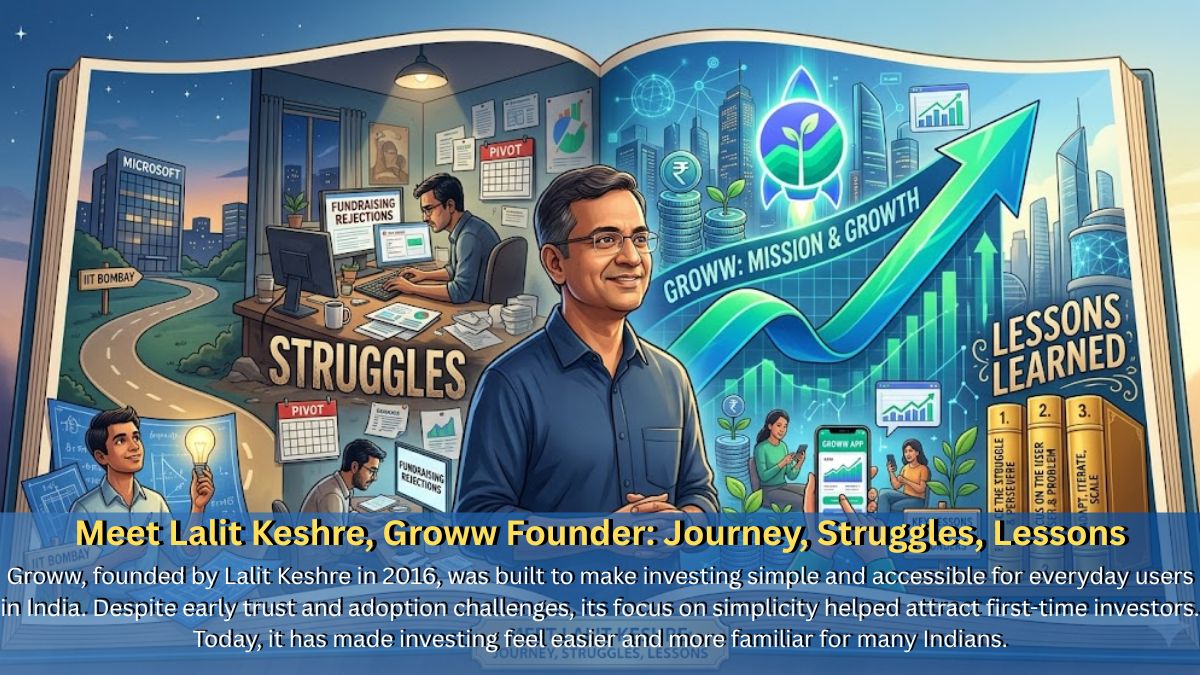
For a long time, investing in India felt like something you only did if you really “knew finance.” For most people, it came with hesitation. Too many forms, too much jargon, and honestly, not much clarity on where to even begin. That’s the kind of friction Lalit Keshre saw up close. He had already spent time building products at Flipkart, where the focus was on making everyday actions like shopping feel simple. But investing looked very different. It felt heavy, complicated, and a bit out of reach for first-time users. That gap stayed with him.
In 2016, he and a small team of ex-colleagues decided to start Groww in Bengaluru. The idea wasn’t flashy. It was actually quite simple: if people can buy clothes or book cabs with a few taps, why should investing feel so difficult? The early days were not smooth at all. There was a lot of trial and error. Some features didn’t land the way they expected. User growth came slowly. And more than anything, there was the bigger challenge of trust. Asking someone to put their money on a new platform is not easy. People don’t just download an app and start investing. They pause, they question, they double-check.
There were moments where things felt uncertain
There were moments where things felt uncertain. Decisions around what the product should even look like changed more than once. But instead of trying to do everything at once, the focus stayed on simplicity. Clean design, easy language, and helping users understand what they were doing instead of overwhelming them. That approach started to work. Slowly at first, then more clearly. First-time investors began joining. People who had never touched stocks before started trying small investments just to see how it works. Over time, that confidence built up.
What makes Groww stand out is not just growth numbers, but the shift it represents. Investing is no longer seen as something distant or complicated for many young Indians. It feels more accessible, even normal in everyday conversations. Today, Groww is part of a much larger change in how India thinks about money. It didn’t just build a platform. It helped remove a layer of fear around investing, and made it something people feel they can actually try, learn, and grow into over time.
1. Background and Early Life
1.1 Early Life and Family Background
Lalit Keshre grew up in that same kind of middle-class setting, where financial discipline was just part of everyday life. You don’t really see people around you talking about investing or wealth creation in detail. Most of the focus stays on saving and staying secure.
Because of that, investing often feels distant. Almost like something meant for “other people” who understand finance better. That early observation stayed in his mind for a long time. Not as a problem to solve immediately, but as a feeling he kept noticing again and again.
1.2 Education and Early Influences
Later, he joined IIT Bombay, where life is very different. You’re surrounded by people constantly building things, discussing ideas, and trying to solve real-world problems. It’s not just about classes or exams. It’s more about how you think. You start looking at problems differently, like something that can be simplified or improved. A lot of the people he met there would later become part of his professional journey too.
That time didn’t just give him technical skills. It quietly shaped how he looked at everyday problems and how small ideas could turn into something much bigger.
2. Founder and Company Overview
2.1 Introduction to the Founder
Before starting Groww, he worked at Flipkart. And that experience mattered a lot later on. At Flipkart, he saw how people interact with digital products in real life. Not in theory, but in actual usage. He noticed how even small changes in design or flow could make something easier or more confusing for millions of users. That idea stayed with him. That building a product is not just about adding features, but about removing confusion.
2.2 Company Overview and Offerings
When Groww started in 2016, it wasn’t trying to be everything at once. It began with mutual funds, something relatively simple and less intimidating for beginners.The idea was not to impress experienced investors, but to help someone who has never invested before just get started without feeling lost. Over time, it slowly expanded into stocks, ETFs, IPOs, and other investment options. But the approach stayed the same. Keep things clear, avoid unnecessary jargon, and make the experience feel less overwhelming.
2.3 Target Audience and Market Served
Most of Groww’s early users were people trying investing for the first time. Young professionals, students stepping into their first jobs, and people from smaller cities who were just starting to explore financial tools. For many of them, investing wasn’t something they grew up understanding. It was new, sometimes confusing, and a bit scary at first. Having a simple platform made that first step easier. It’s less about being an expert and more about just getting started without feeling pressured.
2.4 Year of Founding and Business Stage
Founded in 2016, Groww has grown steadily in India’s fintech space. It didn’t explode overnight. It built itself step by step, as more people slowly started trusting digital investing. Even today, the focus is still pretty simple. Help more people feel comfortable with investing, especially those who are doing it for the very first time.
3. The Problem, Insight, and Trigger
3.1 Core Problem Identified
If you looked at investing in India a few years ago, it honestly felt a bit overwhelming, especially for beginners. Platforms were packed with information, the language was heavy, and nothing really felt built for someone just starting out.
Groww founders noticed this gap clearly. A lot of people around them were curious about investing, but the moment they tried to begin, they got stuck. Not because they didn’t want to invest, but because everything felt too complicated to even take the first step. That disconnect was the real issue. Interest was there, but the path wasn’t simple.
3.2 Personal Insight Behind the Idea
Lalit Keshre and his co-founders started seeing something very basic but important. Investing wasn’t the problem. The experience around it was. People weren’t avoiding investing out of fear alone. They were avoiding it because it didn’t feel approachable. Too many terms, too many steps, too little clarity.
That understanding shaped how they thought about the product later. If something feels simple, people are more willing to try it. If it feels confusing, they step back. That became the early direction for Groww, keep things simple, and help people actually understand what they’re doing.
3.3 Trigger Moment to Start
The final push came from everyday conversations. Friends, colleagues, even well-educated professionals would talk about wanting to invest, but then admit they didn’t know where to begin. That pattern kept repeating. It wasn’t one dramatic moment. It was more like noticing the same struggle again and again in different people. At some point, the idea became hard to ignore. Instead of just observing the problem, they decided to build something around it. That’s when they chose to leave stable jobs and start working on a solution from scratch.
4. Early Days and Initial Struggles
4.1 Early Assumptions and Naivety
Like most first-time founders, there was a bit of optimism in the beginning. The belief was simple, if the product is good, people will come. But reality didn’t move that fast. In finance, people don’t just try a platform because it looks good. They need time. They need trust. And trust is something you can’t rush.
4.2 Entrepreneurial Initial Struggles
Getting users in the early days was tough. Convincing someone to invest money on a new platform is not a small ask. Most people hesitated, even if they were curious. On top of that, there was another challenge. Explaining finance in a way that felt simple but still accurate. If you oversimplify, you lose meaning. If you stay too detailed, people get confused. Finding that balance took a lot of trial and error.
4.3 What Turned Out to Be Harder Than Expected
The biggest surprise was trust. In e-commerce, people can buy a product, try it, and decide. But in investing, it’s different. There’s real money involved, and mistakes feel heavier. So the usual product playbook didn’t work the same way. Everything, from design to wording, had to be more careful and more reassuring. It wasn’t just about building an app. It was about making people feel safe enough to take that first step.
5. Failures, Setbacks, and Self Doubt
5.1 Toughest Phase of the Journey
The early days of Groww were not exciting or fast-moving like people often imagine startups to be. Growth was slow, sometimes painfully slow. There were weeks where not much seemed to change. Users weren’t coming in the way the team had hoped, and everything felt uncertain. In those moments, it’s natural to pause and ask a simple question: are we even solving the right problem? Lalit Keshre and the team went through those thoughts more than once. Not because they lacked effort, but because the outcome wasn’t clear yet.
5.2 Early Failures and Major Setbacks
The first versions of the product didn’t really land the way they expected. People tried it, but many didn’t stick around. That’s a hard signal to ignore. So the team went back again and again, changing small things, adjusting flows, rethinking how users moved through the app. It wasn’t one big fix. It was a slow process of trial, feedback, and rebuilding. Each setback pushed them to look at the product more honestly. What feels simple to the team doesn’t always feel simple to a new user.
5.3 Moments of Self Doubt and Emotional Lows
Like most early-stage founders, there were quieter moments too. The kind where progress feels invisible and motivation starts dipping a bit. When growth is slow, it’s easy to question decisions. Wondering if leaving stable jobs was the right move is a very normal thought in that phase. But what kept things going was belief in the original idea. Even when results were unclear, the problem they were solving still felt real. That belief helped them push through the slower periods.
6. Validation and Early Traction
6.1 First Real Validation
The first real shift came when users started investing on their own without needing help. That might sound simple, but for the team, it was a big moment. It meant the product wasn’t just working, it was clear enough for someone new to use without confusion. That’s a strong signal in a space like finance.
6.2 Early Revenue Growth and Feedback
As more people started using the platform, feedback also became more consistent. Users kept mentioning the same things, it felt simple, and it didn’t feel overwhelming. That kind of feedback mattered more than anything else at that stage. It wasn’t about scale yet. It was about knowing they were moving in the right direction.
6.3 Why This Moment Changed Belief
This period quietly changed how the team saw the product. It stopped feeling like just an idea and started feeling like something that could actually grow. The belief became clearer, if investing could feel this simple, more people would try it. And once that door opened, demand would naturally follow.
7. Funding, Money, and Growth Constraints
7.1 Funding Journey and What It Actually Felt Like
When Groww finally raised funding, it wasn’t just a business milestone. It honestly felt like a deep breath after holding tension for a long time. Up until that point, everything was being built with a mix of belief, pressure, and uncertainty about whether it would really work.
For Lalit Keshre and the early team, that moment brought a quiet kind of validation. It felt like someone outside the room was finally saying, “yes, this makes sense.” But that didn’t make things easy. If anything, it added a new kind of responsibility. Now it wasn’t just about proving the idea, it was about not wasting the trust that came with it.
Even after funding, life inside the startup didn’t suddenly become comfortable. It just became faster, more demanding, and a bit more structured. Every decision started carrying weight because now there were expectations attached to it.
7.2 Cash Flow Pressure Nobody Talks About
One thing that rarely shows on the outside is how often startups think about money, even after raising it. It’s not just “do we have funds,” it’s more like “how long will this last if things slow down,” or “are we spending in the right places.”
There were days when the team had to pause and really think before making decisions that looked simple from the outside. Should we hire now or wait? Should we spend on growth or strengthen the product first? These weren’t dramatic meetings, but they carried a lot of mental weight.
The hard part is that both caution and ambition are needed at the same time. Move too fast and you risk instability. Move too slow and you miss momentum. Living in that balance becomes part of daily life.
7.3 Growth That Had Natural Limits
From the outside, it might look like growth is just about adding more users. But in fintech, every step forward comes with invisible work behind it. More users means more responsibility, more checks, more systems that need to hold up without breaking.
Sometimes growth had to slow down, not because demand wasn’t there, but because the foundation needed time to catch up. And honestly, that can feel frustrating when you’re in it. You can see the opportunity clearly, but you also know you can’t rush trust or safety. Over time, the team started accepting something important. In this space, speed is exciting, but stability is what actually keeps people around. And stability takes time, even when everything else is moving fast.
8. Team Building and Leadership Evolution
8.1 Early Hiring Mistakes and Real Learning
Hiring in the beginning was honestly a bit of guesswork. You meet people, you like their skills, and you hope it fits. But startups quickly teach you that it’s not that simple at all. Some early hires looked perfect on paper but didn’t fit the way the team worked. Others surprised everyone by growing into roles much bigger than expected. It was messy at times, and there were definitely a few wrong calls along the way.
For Lalit Keshre and the team, it became clear over time that skills alone are not enough. The way someone thinks under pressure, how they communicate, and how they handle uncertainty matters just as much, sometimes even more. Culture started becoming something you feel, not something you define.
8.2 Learning to Step Back Without Feeling Lost
As Groww grew, the hardest shift wasn’t technical. It was personal. In the early days, everything goes through the founder. You know every detail, every decision, every small change. Letting go of that is not easy. At first, delegating felt uncomfortable. There’s always that thought that “I could do this faster myself” or “I just want to make sure it’s right.” But that mindset doesn’t scale. Slowly, responsibility had to be shared, even if it felt a bit unnatural in the beginning.
Over time, something changes. You start seeing that things don’t fall apart when you step back. In fact, they often improve because more people bring their own thinking into it. That realization takes time, but once it clicks, it changes how you work completely.
8.3 Leadership That Grew With Experience
Leadership, for Lalit Keshre, didn’t come from theory. It came from real situations, mistakes that stayed in memory, and decisions that didn’t always turn out as expected. There were moments of clarity and moments of doubt, sometimes even in the same week. But slowly, one thing became clear. Leadership is not about controlling everything. It’s about building people and systems that can move forward even when you’re not in every detail.
The focus shifted from doing everything right personally to creating an environment where others can do things well too. And that shift, even though it sounds simple, is actually one of the biggest turning points in any founder’s journey.sion.
9. Growth, Scaling, and Operational Challenges
9.1 Finding the Right Position in a Crowded Market
When Groww started growing, one thing became very clear early on, it couldn’t just be another investment app. There were already players in the market, and users had options. So the question became, what makes someone stay? The answer slowly formed around simplicity. The team leaned into being beginner-friendly, not trying to impress experienced investors, but focusing on people who were just starting out. That decision shaped almost everything, from design to communication.
Over time, education also became a quiet but powerful part of growth. Instead of assuming users already knew how investing worked, Groww started helping them understand it step by step. Simple explanations, easy language, small learning moments inside the app. It wasn’t loud marketing, but it worked in a steady way. For Lalit Keshre and the team, this shift wasn’t just a strategy. It was a reminder that clarity often matters more than complexity.
9.2 Scaling Without Breaking Things
As more people started joining the platform, things naturally got heavier behind the scenes. What worked smoothly for a few users suddenly needed to work for millions. And that changes everything. There’s a point in every growing product where you start feeling the pressure of scale. Pages need to load faster, systems need to handle more traffic, and even small delays start to matter. It’s not always visible to users, but inside the team, it becomes a constant focus.
For Groww, scaling wasn’t just about adding servers or improving speed. It was about making sure the experience stayed simple even as complexity increased behind the curtain. That balance is tricky, because growth pushes you forward, but stability keeps you grounded.
9.3 When Systems Start Feeling the Load
Every startup eventually reaches a point where things that once worked smoothly start showing cracks. Nothing dramatic, just small issues that appear more often as usage grows.
The team had to keep revisiting systems, fixing gaps, improving flows, and sometimes rebuilding parts that couldn’t keep up anymore. It wasn’t a one-time effort. It became part of the routine.
What makes this phase challenging is that progress and problems happen together. On one side, more users are joining. On the other, the system is constantly being tested in ways it wasn’t before. Learning to operate in that space becomes a skill on its own.
10. Personal Sacrifices and Burnout
10.1 What Entrepreneurship Really Takes From You
Behind the growth story of Groww, there’s also a very human side that doesn’t always get talked about. Startups don’t just demand time, they quietly take over most of your daily rhythm.
For Lalit Keshre, like many founders, long working hours became normal without even planning for it. Weekdays, weekends, it all started blending together. There’s always something that needs attention, something that can’t wait till tomorrow.
Over time, personal space starts shrinking. Not because you want it to, but because the work naturally fills it. And even when things are going well, there’s always that underlying pressure of “what next?”
10.2 Burnout and Quiet Emotional Pressure
There are phases in a startup journey where energy drops without warning. It’s not always obvious at first. You just feel more tired, less sharp, a bit disconnected. That’s usually burnout showing up quietly.
For the team, those periods often came during high-pressure moments when everything was moving fast at once. Deadlines, scaling issues, user growth, product decisions, all happening together. It can feel like there’s no pause button.
What helped in those moments wasn’t big solutions, but small resets. Taking a step back, talking things through, and reminding each other why the work mattered in the first place. Managing stress slowly became part of leadership itself, not something separate from it.
10.3 Balancing Work and Personal Life
Like most founders, Lalit Keshre had to learn how to balance two very different worlds. On one side, there’s the responsibility of building and growing a company. On the other, there’s personal life that also needs attention and presence.
The balance was never perfect. Some days work took over completely, other days there was a conscious effort to step away. Over time, it became less about achieving balance every day and more about managing it over longer periods. It’s a quiet challenge many founders face. Not often visible from the outside, but very real in how the journey actually feels day to day.bilities.
11. Lessons, Beliefs, and Values
11.1 Core Lessons Learned
After going through the journey of building Groww, a few things start to feel very clear in a real, practical way. The biggest one is probably this: if something feels too complicated, people eventually stop using it. No matter how powerful it is underneath. For Lalit Keshre and the team, simplicity wasn’t just a design choice, it became something they leaned on again and again. When things got confusing, they would come back to one question: can a first-time user understand this without help?
Another important lesson came from the nature of finance itself. In this space, trust is not optional. People are not just using an app, they are putting their money into it. And that changes everything about how you build.
11.2 How Beliefs Slowly Changed
In the early days, there’s usually a lot of excitement. You believe that if you build something good, growth will naturally follow. But over time, experience adds more layers to that thinking. For the founders, including Lalit Keshre, one belief that became stronger over time was patience. Growth doesn’t happen on demand. It takes time, consistency, and a lot of small improvements that don’t always feel big in the moment.
There were phases where progress felt slow, and phases where things picked up suddenly. Over time, that rhythm became normal. It stopped feeling like failure or success and started feeling like just part of the process.
11.3 Values That Never Changed
Even as Groww scaled, some things stayed constant. Transparency became one of those quiet but important values. If something is not clear to users, it eventually becomes a problem, no matter how good the product is. Along with that, user-first thinking stayed at the center. Not in a slogan way, but in very practical decisions. If something made the experience more complicated, it was questioned. If something made it simpler, it was preferred.
These values didn’t come from theory. They came from watching real users struggle, learn, and slowly build confidence.
12. Present Challenges and Future Vision
12.1 Challenges That Still Exist
Even today, the journey is not without pressure. The fintech space in India is crowded, and competition keeps increasing. Every company is trying to improve, move faster, and offer more features. On top of that, regulations in finance keep evolving. That means teams constantly need to adjust, stay compliant, and adapt to new rules. It’s not always visible from the outside, but it shapes a lot of decisions inside the company. For Groww, this means the work is never really “done.” It keeps shifting with the environment.
12.2 How Leadership Thinks Today
Over time, Lalit Keshre has leaned more towards long-term thinking. The focus is less on quick wins and more on building something that lasts. That shift often comes with experience. Early on, it’s natural to chase speed. But as a company grows, decisions start to carry longer consequences. So patience becomes part of strategy.
Short-term results still matter, but they don’t drive every decision anymore. Stability, trust, and consistency slowly take priority.
12.3 Where the Vision Is Headed
The long-term idea behind Groww has stayed fairly consistent from the beginning. Make investing something that feels reachable, not intimidating. Something an everyday person can understand without needing financial expertise. Over time, that vision has expanded a bit. It’s not just about investing anymore. It’s about building a broader financial platform where users can manage different parts of their financial life in one place.
But the core idea hasn’t changed much. Keep it simple. Keep it clear. It usable for someone doing this for the first time.
12.4 Looking Ahead
When you look at the journey of Lalit Keshre and Groww, it feels less like a straight line and more like a slow shift in how people think about money. India’s digital adoption is still growing, and with that, more people are getting comfortable with investing. Platforms like Groww are becoming part of that transition, not just as tools, but as entry points.
In the end, the bigger story isn’t only about building a company. It’s about slowly changing a mindset that existed for a long time, and making investing feel like something people can actually start, learn, and grow into over time.
About foundlanes.com
foundlanes.com is India’s leading startup idea discovery platform. It helps entrepreneurs find actionable startup opportunities, market insights, and industry-specific guidance to turn ideas into real businesses. With deep research and practical resources, foundlanes supports founders at every stage, from idea validation to launch and growth.